










Sanjha Morcha

What’s New

Click the heading to open detailed news

Current Events :

web counter

Print Media Reproduced Defence Related News

Surgical strike clips & Army’s honour by Pravin Sawhney

Surgical-strike operations are covert, never announced and always denied. The video clip of strikes, and comments of Lt-Gen DS Hooda raise disturbing questions on the Army’s professionalism which impinge upon national security.

Surgical strike clips & Army’s honour

Lt-Gen Hooda’s remarks a reflection on Army leadership. Tribune Photo: Mohammad Amin War

Pravin Sawhney

Strategic affairs expert

The recently released video clip of the surgical strikes, and the comments of the then northern army commander, Lt-Gen DS Hooda, have raised two disturbing questions on the Army’s professionalism which directly impinge upon India’s national security.

Mission objective

The first concerns the mission objective. The seniormost theatre commander, Lt-Gen Hooda, is of the view: “We did not even remotely think that it will end Pakistan-sponsored terrorism.” Instead, “We proved that we were capable of crossing the heavily guarded Line of Control and strike at multiple points.” Moreover, “We are capable of doing it again.” To recapitulate, strikes were done at seven temporary terror launch pads (not Pakistan Army posts) across the LoC by the Army’s 4 and 9 Special Forces on the night of 28-29 September 2016. According to the then Director-General Military Operations (DGMO), Lt-Gen Ranbir Singh (now the northern army commander), “Significant casualties were inflicted on terrorists.” The Pakistanis were informed about the strikes before they were announced to the Indian people. Significantly, they were told that India had no further plans for such strikes.The DGMO’s remarks run contrary to what is taught to professional armies the world over. Such operations are covert, never announced and always denied. Most importantly, the enemy is kept guessing about when and where the next wave of strikes would come from. The latter compels the enemy to review his war-preparedness before launching counter-attacks, which would almost certainly lead to tactical-level escalation. This is because the initiator of the strikes, while well-prepared for an escalation, resorts to surgical strikes to caution the enemy to mend ways or face the well-defined war-escalation ladder.The Indian Army did the opposite. By telling Pakistan that it need not fear any more strikes, the Indian Army and the political leadership admitted to the lack of war-preparedness and political will for tactical-level escalation, or any more such strikes. The Indian Army, therefore, failed in the textbook legitimate mission objective of such strikes, which should have been to check (temporarily halt), if not end cross-border terrorism.Given this, Lt-Gen Hooda’s comments, to say politely, are intriguing and speak volumes about the Army leadership. On the issue of “crossing the heavily guarded LoC”, the Indian Army had done it better, multiple times, without fanfare and without senior Army and political leadership’s direct involvement, in the decade of 1990s until November 2003, when the ceasefire came into being. Instead of terrorists, Army’s unit commandos (not even Special Forces) on numerous occasions had raided Pakistani posts, killed their soldiers, later denied the acts, and got gallantry awards too! These actions had kept Pakistani cross-border terrorism in-check, and below the escalation threshold.However, after the Indian Army’s conduct post September 2016 strikes, the Pakistani Army did what was best for them. It stoutly denied surgical strikes, and while heaving a sigh of relief at the state of Indian Army’s poor escalation capabilities, intensified the infiltration and fire assaults across the LoC, killing Indian soldiers and civilians. Not only have India’s losses of its soldiers shot up, thousands of civilians living close to the LoC have also been forced to relocate to makeshift shelters.In the larger war-fighting scenario with Pakistan, the 2016 surgical strikes did as much damage as the 2001-2002 Operation Parakram, the 10-month long military standoff. While Operation Parakram — as the failed military coercion attempt — had blunted India’s conventional warfighting capabilities, the surgical strikes had blunted India’s tactical-level capabilities on the LoC. Since a likely war is expected to begin at the LoC (limited to the mountains and high altitudes) for fear of crossing the nuclear weapons threshold on the international border, the so-called surgical strikes have convinced Pakistan that it could continue its proxy war unabashedly, killing more Indian soldiers and civilians. 

Politico-military relations

The second serious concern is about politico-military relations in conduct of war which has become complex. While mission-building is done together, the military leadership has the critical responsibility to both advise and emphasise upon the political leadership about what can and cannot be done, and the implications thereof. For example, General Sam Manekshaw advised and insisted to Prime Minister Indira Gandhi (India’s only leader who understood national security) the timings and preparedness for the 1971 war which India won decisively.This was not done in the 2016 strikes, where the political leadership converted the Army mission into a political mission: to create a perception of a first-of-its-kind spectacular operation! Since videos of the strikes were shot, it was a given that the Modi government would be disclosing it at a politically opportune time. With a big chunk of pliant media at its beck and call, the Modi government would showcase itself as the best custodian of national security. Given the national narrative, where anyone who questions the government or the Army leadership is dubbed as anti-national, it will not be difficult to silence the informed critics.All this has been done by undermining the Army leadership which was initially against the disclosure of the video clips. It knew that having done extraordinarily better in the past in tactical-level operations, the video clips showed the Army and its leadership in poor light to the discerning observers. The clips showed some terrorists being killed and a few bunkers and military constructions destroyed; the larger effect was given by the background roaring commentary. What came to mind after viewing the clips was the then foreign secretary, S Jaishankar’s remarks made to the Parliamentary Committee on Foreign Affairs. He said, “The strikes were target-specific, limited-calibre, counter-terrorist operations across the LoC which the Army had done in the past too, but this is the first time the government has gone public about it.” Since any military force is as good as its leadership, it is time to pause and ponder over the future of the Indian Army. Can the honour, valour and professionalism of this force of 13 lakh remain secure and respected when its leadership seems to have pledged its own to the government?

Grenade attack on Army patrol in Shopian

Srinagar, June 29

Militants on Friday hurled a grenade towards an Army patrol party in Shopian district of Jammu and Kashmir, police said.There are no reports of any loss of life.A grenade was lobbed towards the Army patrol party in Ahgam area of Shopian in south Kashmir, a police official said.The area had been cordoned off, the official said.Further details are awaited. PTI


Army chief Rawat junks UN report on ‘rights abuse’

I don’t think we should get too concerned. Some of these reports are motivated. I don’t need to speak about the human rights record of the Indian Army.
GEN BIPIN RAWAT, Army chief

From page 01 NEW DELHI: Army chief General Bipin Rawat on Wednesday trashed a recent United Nations report on alleged human rights abuses in Jammu and Kashmir as “motivated,” reiterating the government’s position that it was “fallacious, tendentious and motivated.”

“I don’t think we should get too concerned about the report. Some of these reports are motivated,” Rawat said on the sidelines of a cyber security conference.

He said the army’s human rights record was “absolutely above board.

Released on June 14, the report by the Office of the United Nations High Commissioner on Human Rights, titled ‘Report on the Situation of Human Rights in Kashmir: Developments in the Indian State of J-K from June 2016 to April 2018, and General Human Rights Concerns in Azad J-K and Gilgit-Baltistan,’ sought an international inquiry into the alleged abuses.

General Rawat added, “I don’t need to speak about the human rights record of the Indian Army. It is well known to the people of Kashmir and to the international community.”

The report also sought repealing of the Armed Forces Special Powers Act (AFSPA) “urgently” and also the immediate removal of “the requirement for prior central government permission to prosecute security forces personnel accused of human rights violations in civilian courts.”

Reacting to the report when it was released, a government spokesperson said, “It is overtly prejudiced and seeks to build a false narrative,” and violated “India’s sovereignty and territorial integrity.”


Congress accuses BJP of ‘politicising’ soldiers’ blood to garner votes

Congress accuses BJP of ‘politicising’ soldiers’ blood to garner votes

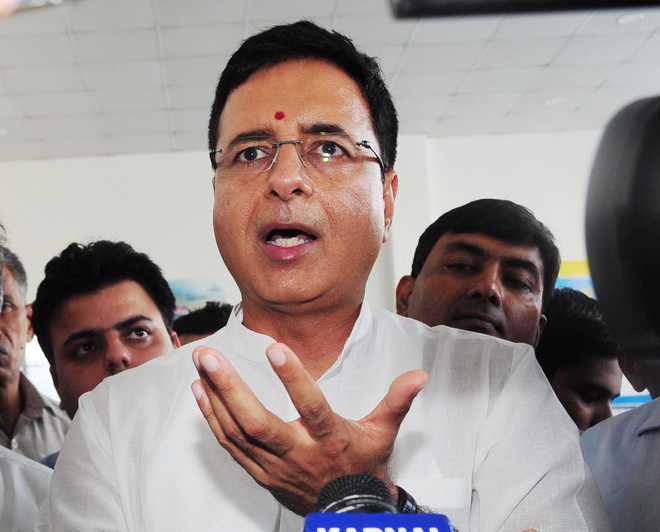
Randeep Surjewala. File photo

Aditi Tandon

Tribune News Service

New Delhi, June 28

Hours after a video showing an Indian Army surgical strike against Pakistan terrorists was released, the Congress on Thursday accused the BJP government of “politicising” the sacrifices of soldiers and using them for “garnering votes”.Recalling the September 28-29, 2016 surgical strike which the BJP leaders called as the first ever, Congress media head Randeep Surjewala said the BJP had “brazenly” used that strike-form politics ahead of the 2017 Uttar Pradesh elections.The Congress also asked the PM why he was cutting corners when it came to ensuring the benefits to the Armed Forces. Surjewala referred to ration and various other cuts effected by the government on the forces to make his point.The Congress said the valour of the forces was a “matter of pride and not politics” and cited the post 2000 surgical strikes conducted silently.Surjewala mentioned the following strikes—on January 21, 2000 (Nadala Enclave, across the Neelam River); September 18, 2003 (Baroh Sector, Poonch); June 19, 2008 (Bhattal Sector, Poonch); August 30 to September 1, 2011 (Sharda Sector, across Neelam River Valley in Kel); January 6, 2013 (Sawan Patra Checkpost); July 27, 28, 2013 (Nazapir Sector); August 6, 2013 (Neelam Valley); January 14, 2014 (Army Chief, General Bikram Singh’s statement qua surgical strike on Dec 23, 2013).The Congress said the ruling dispensation had used the September 2016 surgical strikes “shamelessly” to advance their electoral agenda and posters of the PM appeared taking credit for the Army’s job.“The BJP has trashed every tradition of restraint by belligerent chest-thumping to claim credit of surgical strike with an eye on political and electoral gain. BJP president Amit Shah dishonoured the 70-year-long history of bravery and sacrifice of our Armed Forces by making a disgraceful statement on October 7, 2016 in a press conference in New Delhi that the Indian Army had crossed the LoC for the first time in 68 years. This was also a lie,” Surjewala said.


Militancy in south Kashmir is Vohra’s biggest hurdle

IN THE DRIVING SEAT Will take over state affairs for the fourth time, touted to be the most difficult

1 SRINAGAR: Jammu and Kashmir governor Narendra Nath Vohra took charge of the state’s administration for the fourth time on Wednesday, but rising local militancy might make his assignment this time more difficult than in the past, political leaders and analysts said.

“In the past three-four years Kashmir has changed a lot. It will need special efforts to calm tempers. The space for mainstream parties has shrunk and local boys have joined militancy,” said a senior National Conference (NC) leader who knows Vohra closely.

“Now it remains to be seen how south Kashmir will behave. And if something happens like killing of civilians or any big incident happens, governor Vohra and the Centre will also [sic] be responsible,” said the politician on condition of anonymity.

The state was put under Governor’s Rule on Wednesday after the Bharatiya Janata Party (BJP) pulled out of the ruling coalition, forcing chief minister Mehbooba Mufti to resign.

“This is the fourth time Vohra is taking over affairs of the state. And this time it’s the most difficult assignment. Let us see how he uses his cards on the political and governance front,” said the editor of a Srinagar-based newspaper on condition of anonymity.

The 82-year-old Vohra’s second term as governor ends on June 27 but he is likely to get an extension in light of the Amarnath Yatra, which begins on June 28.

“It’s true Jammu and Kashmir will get a new governor but for the time being NN Vohra is the best choice and he will likely get an extension at least till Amargarh Yatra concludes,” said a senior BJP leader.

The central government’s priority is to ensure security for the yatra as militancy in south Kashmir has increased in recent months. Vohra, as head of the Shri Amarnath Shrine Board, has been successfully organising the Yatra. His knowledge about Kashmir and its security scenario has come in handy for the annual pilgrimage to the cave shrine.

“Jammu and Kashmir right now can’t afford to have a new governor who will need three to six months know the state,” said a bureaucrat. “Governor Vohra has experience and the Centre will try to use his expertise to get things in the state administration settled. So there is every possibility he will be asked to continue to run this state,” the bureaucrat added.

Leaders of mainstream political parties have faith in Vohra and almost every top leader of the People’s Democratic Party (PDP), Bharatiya Janata Party, National Conference and the Congress enjoys close ties with him.

Vohra, a veteran civil servant who has held different posts in the state and Centre, was appointed the state’s 12th governor in 2008. The United Progressive

Alliance government gave Vohra a five-year extension in 2013.

A Punjab cadre IAS officer, Vohra was appointed Punjab’s home secretary when the state was passing through a turbulent phase after Operation Bluestar in 1984. He played an important role in holding elections to the Punjab assembly in 1985 in the backdrop of Sikh militancy. After serial bomb blasts in Mumbai in 1993, Vohra was appointed Union home secretary (1993-94).

SALUTING THE BRAVEHEART

Defence Minister Nirmala Sitharaman (second from left) with slain rifleman Aurangzeb’s family, in Poonch on Wednesday. Aurangzeb was abducted from Pulwama by terrorists and his bulletridden body was recovered on June 14. Sitharaman was accompanied by senior army officers and visited Salani village to offer her condolences, saying the family stood out as an inspiration for the entire nation. She met Aurangzeb’s father too, a former army man who reiterated his resolve to sacrifice his all to safeguard the integrity and sovereignty of the country.


Anti-terror operations restart, J&K truce ends

Anti-terror operations restart, J&K truce ends

On May 17, the Centre had decided that the security forces will not conduct offensive ops during the month of Ramzan.

Mukesh Ranjan

Tribune News Service

New Delhi, June 17

In line with the security agencies’ assessment of the ground situation in Jammu and Kashmir and also in view of the Amarnath Yatra commencing on June 28, the Centre on Sunday announced its decision “not to extend” the suspension of anti-terror operations in the state any further, as it was in vogue for the holy month of Ramzan.In the evening, the Army, CRPF and state police jointly carried out the first cordon and search operation post the unilateral ceasefire in Baramulla district.   Earlier in the day, Union Home Minister Rajnath Singh said, “Security forces are being directed to take all necessary action at the earliest to prevent terrorists from launching attacks and indulging in violence.” At the same time, he made it clear that the government will continue with its endeavour to create an environment free of terror and violence.“It is important that all sections of peace-loving people come together to isolate the terrorists and motivate those who have been misguided to return to the path of peace,” the minister added.The Centre had announced suspension of operations at the beginning of the holy month on May 17 “in the interest of the peace-loving people of the state”.Commending the role played by the security forces in implementing the decision in “letter and spirit” despite grave provocation, the minister said it enabled the Muslim brothers and sisters to observe Ramzan in a peaceful manner.“But while the security forces displayed exemplary restraint, the terrorists have continued with their attacks,” he said. According to officials, there were 18 incidents of terror between April 17 and May 17  and the figure rose to above 50 during the suspension of operations. The period saw brutal killings, including that of journalist Shujaat Bukhari.


35 ultras in PoK aiming to attack Army installations 0 SHARES FacebookTwitterGoogle+EmailPrint

Ajay Banerjee

Tribune News Service

New Delhi, June 15

Security agencies have alerted the Centre about 35 terrorists wanting to infiltrate into Jammu and Kashmir from across the Line of Control on a specific mission to attack Army installations. Based in Pakistan-occupied Kashmir, the terrorists have been seeking to strike at two locations in the state. Sources said while one group wanted to target Army forward units in Poonch, situated to the south of Pir Panjal mountain range, another was on a mission to attack an installation towards the north of the mountain range.The southern part of Pir Panjal falls in Jammu region where terrorists hardly enjoy any local support. Definitive information with the security agencies is that 26 terrorists have been particularly waiting to infiltrate into the north of Pir Panjal. The possible target could be Army installations in Kupwara, said sources.  The group that is looking to enter Poonch area could carry out blasts or plant IEDs in Bimbher Galli and Saujiyaan, both close to the LoC.


Financial aspects of DPC overlooked by Bhartendu Kumar Singh

The new Defence Planning Committee is expected to facilitate India’s quest for military power. But its financial atmospherics need to be delineated since the DPC has a challenging objective of ensuring a cost-effective approach.

Financial aspects of DPC overlooked

Bhartendu Kumar Singh

Indian Defence Accounts Service

When the Defence Planning Committee (DPC) was announced recently, it was hailed as another milestone in India’s ongoing military reforms. Expectations are naturally up that the DPC would carve out grand narratives for facilitating India’s quest for military power. While many components of India’s rising military power profile have been discussed and debated in the follow-up period, the financial aspects remain overlooked. Unless the financial atmospherics are properly delineated, the true roadmap for various components of defence planning may not emerge. Mainstream literature on defence as well as recent write-ups on DPC treat defence planning as essentially a military issue. This is, perhaps, not true. Apart from matters of war and peace, defence planning is equally about economics since the entire fulcrum of military issues are shaped by economic factors. Kevin Narizny in his book ‘The Political Economy of Grand Strategy’ hypothesises that economic interests determine great power military strategies. The very first dimension of modern-day grand strategy is a state’s assertiveness or its willingness to pay the costs (military spending, diplomatic capital etc). His emphasis on politico-economical approach remains the best tool to understand the rise of economic powers (like the UK and US). Therefore, the utilitarian aspect of the DPC lies in enabling India’s military modernisation and reforms in a systematic way along with and benefiting from the country’s growing economic profile. The institutional arrangement for a revamped DPC is necessitated partly because past efforts for autonomous and independent defence planning did not yield the desired results. To ensure flexibility, the defence sector was kept out of the purview of the erstwhile Planning Commission and treated as a ‘non-Plan’ expenditure. However, that arrangement did not work, best evident in delayed approvals of defence five-year plans and associated funding problems. Indian defence planning was often a victim of segregated approach in the last 70 years, having no correlation with the other important aspects of the nation-building process. The low levels of economic growth often translated into scarcity of resources for the defence sector. Further, the macro-reforms of the early 90s did not touch the defence sector. From a futuristic perspective, India as a rising military power is still exploring a cost-effective  trajectory on many issues. The revamping of the Planning Commission into Niti Aayog offers an opportunity for a synchronised thinking on defence and development where both supplement each other, ie development as the best form of defence and defence contributing to the developmental aspects like growth of a robust military industrial complex.  The DPC has a challenging objective of ensuring a cost-effective approach to India’s rise in global politics. At the minimum, India needs a peaceful  environment that is conducive to its goals without being overtly distracted by conflictual relations with China and Pakistan. This is possible by a deft crafting of a national security strategy (NSS), one of the key mandates for the DPC. We need to take a cue from the US NSS, wherein equal emphasis has been given on economic aspects of security and a series of white papers on defence by China over the years that sought to create a ‘peaceful periphery policy’ for enabling focussed attention on development. There are many financial issues that need consideration of the DPC. First, despite the healthy growth in revenue expenditure and budgetary allotment for the same for defence, statements have poured in media lamenting the slow growth of revenue expenditure and its adverse impact on the modernisation plans of the armed forces. In fact, even after adjusting for inflation, there has been a net increase in the defence expenditure by 0.75 per cent in 2018-19 over the previous year. However, the DPC would be challenged in taming the galloping revenue expenditure by innovative ways to facilitate equal consideration for other priority sectors like health, education and infrastructure. Second, there is need to build up a defence posture on the basis of internal strength and save money wherever possible. For example, India has established a lead in missile defence largely through indigenous research and development. And yet, as Stephen Cohen, noted South Asia expert, laments, there has been no systematic analysis of trade-offs between aircraft and missiles. No country chooses one exclusively over the other, but according to him, understanding the trade-off is important to balance investment. It would be prudent to add that such trade-offs be exercised  on a larger scale in mapping out various components of defence planning.  Third, contemporary wars are waged by ‘other means’. Focus has shifted to preferred tools like ‘geo-economics’. The Trump administration is practising it vigorously with even allies falling prey to sanctions and duty regime. China is another good player in geo-economics, as is evident in its mega initiative of Belt and Road Initiative and trapping most South Asian countries into its fold. Economic power is as important as military power and increasing India’s visibility in the international economic order, therefore, deserves more salience in DPC’s thought process. These are just representative examples. The idea is to reiterate that while financial aspects are only a part of the larger defence planning problem, the bottomline apprehension is that if they remain neglected or overlooked, we may find it difficult to secure a cost-effective defence planning for India.

(Views are personal)


General Bipin Rawat: The Army chief who dares to pose questions to fraternity

General Bipin Rawat

Gen Rawat is questioning privilege that is deemed as a given within the Army like he did through an order removing . soldiers posted as ‘sahayaks’ with retired officers.
General Bipin Rawat is an unusual Army chief. And not due to his different approach in Kashmir or the doggedness to face up to the Chinese in Dokalam, but largely because of the question he dares to pose to his own fraternity.

The office of the Army chief has always been seen as the representative embodiment of the ‘fauj’. He is what his Army is, reflecting both its glory and custom. Yes, he can be an agent of change, but usually in matters of strategy and expansion. Rarely, have you found someone who has questioned privilege, perks or benefits from a perceived sense of exalted status. This is a very sacred territory within the Army, one which is assumed as being undisputed within society. But Gen Rawat questions that. He is worried, a fact he disclosed to ET, that in reality civilian population may actually be getting “irritated” with secluded green zones of the Army. He wants cantonments to open their gates to civilians before they barge into it out of anger and frustrations. He doesn’t agree with the notion that a civilian cannot access the road to Delhi airport through the Delhi Cantt if there’s a traffic snarl, which is routine during rush hour, on NH-8.

Yes, he’s bound to get some of the military brass upset but it’s a question that cannot be wished away. Just like the ‘sahayak’ issue, which is a very emotive officer-soldier relationship but one that he feels requires relook especially if these soldiers end up spending their entire time outside combat formations because of these duties.
Now, these are deeply sensitive issues for an Army chief to raise with his own lot. But he has done so. This includes questioning military club culture, whether there should be elaborate partying in officer messes and the general conduct with civilian residents in cantonments.
In short, Gen Rawat is questioning privilege that is deemed as a given within the Army like he did through an order removing soldiers posted as ‘sahayaks’ with retired officers.
In a changing social dynamic, parity equations in offwork situations change both within the military hierarchy and outside. So, he wants to reconfigure civil-military harmony. The Army can’t be so segregated that it ends up inviting the ire of the civilian population, yet it must retain its core identity.
Which is why the questions that General Rawat asks of his Army will define his time in office. Many within the Army may agree or disagree, or even agree to disagree, with him but they surely can’t ignore his red flag or brush aside the questions.


Nepalese Army Gen visits war memorial

Nepalese Army Gen visits war memorial

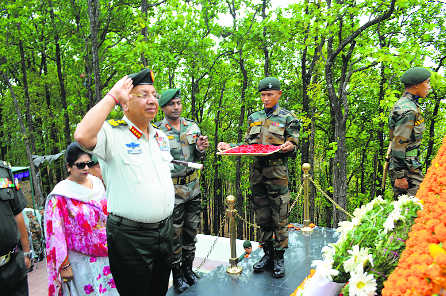
Nepalese General Rajendra Chhetri and his wife Rita Chhetri at the Khalanga War Memorial in Dehradun on Friday. Tribune photo

Jotirmay Thapliyal

Tribune News Service

Dehradun, June 8

Lesser known Khalanga War Memorial, the symbol of first battle of Anglo-Nepalese war, shot into prominence with Nepalese Army General visiting the memorial, which depicts the brave exploits and sacrifice of the Gorkhas.Nepalese General Rajendra Chhetri, who will be reviewing the passing out parade of Indian Military Academy on Saturday, led a Nepal Army delegation to the memorial in Dehradun on Friday. General officer accompanied by his wife Rita Chhetri and other Nepal Army senior officers took time to visit this memorial which symbolises the battle of Nalapani, which was the first battle of the Anglo- Nepalese War.General Chhetri, who laid the wreath at the memorial, lauded the efforts of Gorkha Samiti and the Archaeological Survey of India in maintaining the historical legacy of Gorkhas in the form of Khalanga memorial and said the Battle of Nalapani was one of the most important landmarks in the history of the Gorkhas.At the memorial, the delegation was briefed by Lt Gen Shakti Gurung, (retd), Madhu Gurung and Ram Singh Thapa, president of the Khalanga Vikas Samiti. The delegation also interacted with the members of the samiti. The visit was facilitated by the Indian Military Academy and 1/3 Gorkha Rifles.The Khalanga War Memorial in Dehradun has immense significance. It is probably the world’s first memorial erected by an Army for their opponent. It was the Britishers who constructed the Khalanga War Memorial in the memory of Major General Rollo Gillepie who led the attacking British troops as well as Captain Balbhadra Kunwar, as a mark of tribute to the courage of the Gorkhas.The Battle of Nalapani was the first battle of the Anglo-Nepalese War. In the battle, General Gillespie was killed on the first day of the siege while rallying his men. Despite considerable odds, both in terms of numbers and firepower Captain Balbhadra and his 600-strong garrison successfully held out against more than 5,000 British troops for over a month.