Sanjha Morcha

What’s New

Click the heading to open detailed news

Current Events :

web counter

Print Media Reproduced Defence Related News

75th anniversary of Azad Hind govt: PM to join flag-hoisting ceremony at Red Fort

75th anniversary of Azad Hind govt: PM to join flag-hoisting ceremony at Red Fort

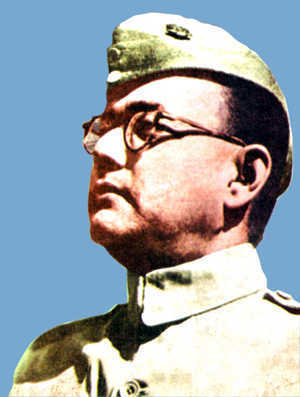
Subhas Chandra Bose

New Delhi, October 20

Prime Minister Narendra Modi will join a flag-hoisting ceremony at the Red Fort on Sunday to mark the 75thanniversary of the ‘Azad Hind government’ headed by Subhas Chandra Bose.

Interacting with BJP workers via video-conference on Wednesday, Modi had announced his plans to attend the ceremony.

Traditionally, the Prime Minister hoists the national Tricolour at the historic Red Fort on Independence Day on August 15.

Modi said that BJP respects everybody who served the country, irrespective of party affiliation. He said his government celebrates the contributions of many great personalities who were neglected by the Congress in its rule of several decades.

While the Congress neglected the likes of Bhim Rao Ambedkar, Bose and Sardar Vallabhbhai Patel, the BJP believed in remembering everybody who contributed to nation-building, he said, citing his government’s works, including constructing museums for noted tribal personalities and developing five places linked to Dalit icon Ambedkar.

“We respect everybody who served the country,” he had said.

The Prime Minister would also lay the foundation stone of a museum dedicated to the Azad Hind Fauj.

On October 21, 1943, Bose had announced the formation of the country’s first independent government. PTI


Standing in defence of our soldiers

Standing in defence of our soldiers

While India can claim credit for surgical strikes and other operations, the fact is that the defence services do what they are supposed to do without grumbling. Government must ensure their faith remains intact

Data and the tax department don’t lie, to paraphrase a saying. IndiaSpend is the torchbearer of new journalism. It specialises in data-crunching, rather than relying on vague, perception-based analysis. In a report about a new study, it backs up with data what we always knew but could not prove. The Azim Premji University and Lokniti (the Centre for the Study of Developing Societies or CSDS) in 2018, conducted a study covering eight States to map trust in institutions. The study covered 22 Assembly constituencies with more than 16,000 respondents. It revealed that nearly 77 per cent respondents showed the most trust in the military, followed by 54.8 per cent in the Supreme Court and 48 per cent in the High Courts.

On an average, elected offices and institutions, such as the President, Prime Minister, Chief Minister, Parliament, State Legislature, et al, enjoyed an “effective trust” of 40 per cent. Effective trust is the difference between percentage of respondents who opted for a “great deal of trust” at one end of the scale and “no trust at all” at the other. According to the study, political parties garnered low trust, at minus 1.75 per cent. Political parties polled the lowest in the list of 16. The average “effective trust” in Parliament was 36.6 per cent in the eight States surveyed. Government officials scored 4.8 per cent trust while the police managed only 0.9 percentage points more.

Why do you think this is? It could be because the military in India has proved time and again to be free of political influence, unlike the police, administration and other institutions. The study suggests the Indian people believe the effect of political parties is toxic (reflected in the low ranking to political parties) and, therefore, they trust the courts more than the Prime Minister and Parliament. The military does not hide or lie to cover up unpleasant realities — although sometimes, it might highlight certain parts of truth: Like what a wonderful aircraft the Rafale is (true) and that India could never have made such a wonderful aircraft (false).

The main thing is, the military does what it is supposed to do without grumbling or complaining (although its Chiefs do occasionally go to court about their personal problems — and are quickly absorbed by political parties). It is often weighed down by crippling shortages, but it gets the job done, no matter what the difficulties, even though it doesn’t get paid enough in relation to the other arms of the Government, tends to be bossed over by them, and is frequently denied state-of-the-art equipment.

It is true that no Army in the world has a full inventory — it is a mix of modern, mature and legacy/obsolete equipment. In 1995, Army Chief Gen Shankar Roy Choudhury was fed up writing letters to his superiors about critical deficiencies and was forced to go public. “The Army should not be held responsible for failing to meet its mandate.” In the same period, Chief of Naval Staff, Admiral VS Shekhawat, concerned about the shrinking size of the Indian Navy, warned over dangers at sea in the event of hostilities. His outburst resulted in the then Defence Minister Mulayam Singh Yadav calling him to a breakfast meeting and immediately placing orders on Naval Dockyards for ship construction. In France this year, the Chief of Defence Staff (CDS) resigned because of arbitrary reduction in the defence budget. By this yardstick, many of our service chiefs ought to have resigned. Last year, the defence budget was lowest since 1962.

One is periodically reminded that China has risen, while India is still rising and no one will come to India’s help in the event of conflict. India will have to fight its battles alone. But is it equipped to do so? A strategic reset is essential to meet the emerging security challenges. Of the 340 recommendations by the Kargil GoM, many are unimplemented, including the appointment of CDS. A headless Integrated Defence Staff (IDS) created more than a decade ago is an exercise in futility. Integration of the three services with the Ministry of Defence (MoD) has not even begun while jointness is only in name. Defence planning on the basis of 15, five and one year plans is compartmentalised and offers no strategic choices. The IDS simply collates the three services’ plans and lets the MoD determine priorities.

The service chiefs have consistently complained about inadequate say in decision-making. The military is seen to be subservient to the political class and civilian bureaucracy. Speaking at a public lecture some years ago, the then Comptroller and Auditor General of India (CAG) Vinod Rai urged the Government to repose trust in the Armed Forces by giving full financial powers to the service chiefs. He said the Defence Procurement Policy (DPP) (which has undergone seven upgrades and become very complex) involved the participation of 13 agencies.

The ghost of Bofors is a B, (you could add an R for Rafale) plus the three Cs — CAG, CVC and CBI — these are retarding the procurement process. Are we surprised that the Army has not added a single new gun to its inventory since 1986 when it is required to deter a two-front war? Transformation of the Army — like the Navy and the Indian Air Force (IAF) — is underway independent of a tri-service operational plan. There is no long-term Strategic Defence and Security Review (SDSR) to derive national security and defence strategies and then evolve doctrines. We have put the cart before the horse.

During the limited war in Kargil, Army Chief Gen Ved Malik despairingly announced: “We will fight with what we have.” But for Israel’s strategic intervention with 155 mm Bofors ammunition, UAVs and PGMs for the IAF, vacation of Pakistan’s aggression would have met cost, time and casualty overruns. Fast-tracked acquisitions arrived only after the war was over. One of the reasons for Operation Parakram not taking off was the discovery that the military was not combat ready, probably an alibi for lack of political will which got translated as strategic restraint. Not fighting a war since 1971 and acquisition of nuclear weapons have willy nilly undermined the conventional deterrence.

We can feel good about surgical strikes and claim credit for such piecemeal operations in elections. But remember: The faith of the people of India resides in the defence services, because like the people of India, the services make do with what they have; and do a damn good job in it. That faith, Governments must ensure never breaks.

(The writer is a retired Major General of the Indian Army and founder member of the Defence Planning Staff, currently the revamped Integrated Defence Staff)


How oil crisis began & multiplied into geopolitics by Lt-Gen Syed Ata Hasnain (Retd)

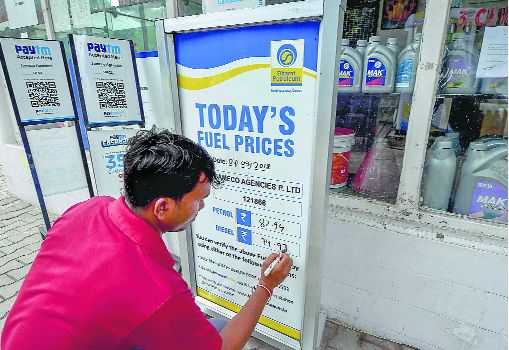
The saga of oil price rise goes back to October 6, 1973 when Egyptian President Anwar Sadat decided to restore the self-esteem of his armed forces and the nation by launching the Yom Kippur war. Today is the 45th anniversary of that event.

How oil crisis began & multiplied into geopolitics

Lt-Gen Syed Ata Hasnain (Retd)
Chancellor, Central University Kashmir

Forty five years ago, most of us never thought twice about filling the fuel tanks of our vehicles. A full tank of my Vespa scooter cost me Rs 6. My parents’ Ambassador car needed Rs 50 to be brimful.  Fuel was the last of our worries and we consumed it as if the good times would never end. They did, on October 6, 1973, the day of Yom Kippur, the holy day of atonement of sins by the Jews. President Anwar Sadat of Egypt launched one of the best ever conceived, planned and coordinated military offensives in history, into his own territory. That territory was then held by Israelis along the Suez Canal front with the entire Sinai under them, having captured it in the lightning offensive of the Six Day War of June 1967. That Sadat’s offensive floundered at the altar of execution, the bane of the planner, is a different story. Importantly, it upset the breeze of a life we lived in those times. Prices of fuel shot up and very soon my scooter’s full tank was costing me  Rs17; that’s an increase of three and a half times almost overnight. Imagine if petrol were to suddenly cost you Rs 275 a litre! A heart-stopping development for most of us.

What’s the connection between Sadat’s Yom Kippur war of October, 1973 and oil prices? That’s what I will endeavour to explain in brief.

The Yom Kippur war: The conflict itself is one of the most studied and analysed conflicts of the Cold War period. It stood out for three things in terms of military technology. One, the first serious use of anti-tank guided missiles (ATGMs) in the mechanised battlefield, the SS 11B1 and the shoulder fired Malutka of the Soviet family and the American TOW (developed in 1970) which worsted the Israeli, Egyptian and Syrian armoured assaults in the war. Two, was the use  of Surface to Air Guided missiles (SAM6 and shoulder fired SAM7, again of the Soviet family). The third was the first demonstrated employment of the T-72 tank and the BMP-1, both iconic combat vehicles of the Soviet era.

Anwar Sadat put together a beguiling plan to deceive the ever-prepared Israeli armed forces and achieved almost total surprise. A young Egyptian military engineer developed a method of hosing down the high banks of the Suez Canal to provide access to Egyptian bridging and mechanised war fighting material even as hordes of Egyptian infantrymen with ATGMs went rushing across the canal and fanned into the desert to take on the Israeli armoured counter-attacks. SAM launchers were also rushed over the bridges to their pre-designated sites and kept at bay the attacking Israeli air force, thus creating a 10-km air defence umbrella. Despite the early success, the Egyptians floundered as the plan desisted from further ingress, diluting into a defensive holding action with the canal behind the Egyptians. In the end, the Egyptians were roundly defeated due to the massive airlift of state-of-the-art military equipment by the US to support Israel; TOW missiles were deployed from the airfields directly into action.

The connection with the oil crisis: Arab oil producers seething at the western support to Israel imposed an embargo on any nation seen to be with Israel. The decision to boycott and punish the US and the West led to the price of crude to rise from $3 per barrel to $12. The price of petrol all over the world shot up drastically, making transport more expensive. The demonstrated power of energy and its crunching effect on international economics first came to be realised in the wake of this embargo.

It sent the international political stock of countries such as Saudi Arabia, Iraq and Iran much higher. The Organisation of Petroleum Exporting Countries (OPEC) was founded in 1960 by Saudi Arabia, Iran, Iraq, Kuwait, and Venezuela with the principal objective of raising the price of oil. Others soon joined them. For the first decade, OPEC had little impact on the price of oil, but by the early 70s, the demand for oil was increasing. Japanese and US car production was exponentially increasing and although the world was in the Cold War mode, a period of peace in the troubled 20th century was ensuring better quality of life for people. That meant an increasing dependency on travel as cities expanded along with motorised transportation and international travel. OPEC did not succeed in increasing the price of oil even till the early 70s. The Yom Kippur War came as a trigger and OPEC suddenly acquired a larger political clout. It threatened to also cut back production to create an oil crisis, sensing an opportune moment.

Spur to alternative energies:  Although US Secretary of State Henry Kissinger did manage to negotiate with the Arabs on the availability of oil for the US, this crisis effectively spurred the world towards greater development of alternative energies and localisation of energy resources. The UK, for instance, developed its North Sea facility to eventually become an oil exporter. The US research led to the discovery and development of shale gas, making it self-sufficient and no longer dependent on Middle Eastern oil. However, there can be no denying that the oil boom, which later tapered, led to the rise of the Gulf countries, some of them very appropriately as trading and business development hubs. The flocking of the 7.5 million Indian diaspora to these countries began just after these developments. The Persian Gulf received a strategic boost out of proportion to its geostrategic location, which multiplied further during the disastrous Iran-Iraq war of the 80s and the two Gulf Wars.

India’s struggle: China and India’s economic boost through the 90s and the early millennium was courtesy the dependence on Middle Eastern oil. That situation has hardly changed as both struggle with alternative energies; renewable resources such as solar and wind have not sufficiently made a dent, although steps are afoot. Electric surface transport resources are developing; electric air transportation seems yet afar.

Unless a comprehensive shift to alternate sources takes place, it is unlikely that the geopolitical and geostrategic importance of the Middle East can wane, the US independence in energy notwithstanding. Already, India is reeling under the weight of rising fuel prices with social, economic and political ramifications.

It all goes back to October 6, 1973 when Anwar Sadat decided to restore the self-esteem of the Egyptian armed forces and the nation. Today is the 45th anniversary of that event.


IAF drops ration in remote Himachal hamlet

Shimla, October 4

A remote Himachal Pradesh settlement in Kangra district, where there has been an acute shortage of ration owing to closure of trekking routes following heavy snowfall in September, received relief material on Thursday.

An Indian Air Force (IAF) chopper provided the food material at Bara Bhangal inside the Dhauladhar Wildlife Sanctuary — an area not accessible by road, a government spokesperson told IANS here.

Senior district officials along with a medical team on board reached the area located at an altitude of over 2,800 metres to provide the ration and help after it was cut off for almost 14 days following untimely and heavy snowfall between September 22 and 24.

The officials also conducted an aerial survey, including over the Thamsar Pass, Jalsu and Khalihani Pass, to search for people stranded, but no one was spotted.

“Fifty packets of dry ration were handed over to the government fair price shop in Bara Bhangal for distribution. There are 20-22 flocks of sheep in the areas and all shepherds are safe,” he said.

The official ruled out media reports of starvation, mainly among shepherds, with the closure of pathways after the snowfall in the region.

Ahead of winter’s onset, many of Bara Bhangal residents migrate to Bir in Baijnath subdivision, near Palampur town, some 250 km from here. This time the snowfall was well in advance and people were caught unaware.

“After trudging over 75 km, we managed to reach Bir in three days. Most of the area enroute is under a thick blanket of snow,” Bhrigu Devi said.

Sheep and cattle rearing is the main occupation of these people who are nomads.

Akshay Jasrotia, an activist who is taking up their cause with the administration, said the situation is quite grim.

He said since most trekking routes leading to Bara Bhangal are out of bounds due to snow, the helicopter is the only mode of transportation to reach there.

Bara Bhangal is also accessible through the Thamsar Pass, located at an attitude of 4,700 metres.

Kangra Deputy Commissioner Sandeep Kumar told IANS that a team of doctors accompanied the district officials who landed at Bara Bhangal for first-aid.

Additional Chief Secretary Manisha Nanda said the state on Tuesday requested the Defence Ministry to provide a helicopter for dropping the relief material as there was possibility that people might have run out of supplies.

The Dhauladhar Wildlife Sanctuary is spread over 944 sq km at an altitude above 3,000 metres.

IANS


Surgical strike is demonstration of power, says retd Maj Gen

Surgical strike is demonstration of power, says retd Maj Gen

Maj Gen Amarjit Singh (retd)

Tribune News Service

Chandigarh, September 29

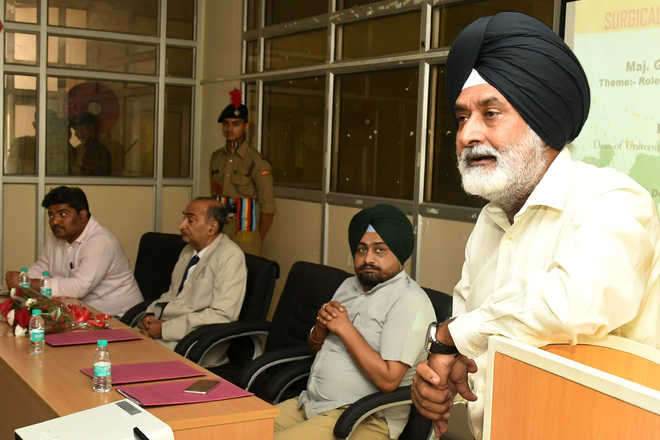
Surgical strike is a demonstration of power and showing capability of going across the border, said Major General Amarjit Singh (retd.), who was at Panjab University to deliver a lecture on Saturday.

The Department of Defence and National Security Studies celebrated the Surgical Strike Day in collaboration with the NCC Army Wing. A special lecture on the “Role of Armed Forces in Nation Building” was delivered.

Singh, while speaking to The Tribune, said: “It is very low of the political parties to start a debacle over the surgical strike. It is certainly because one party is at loggerheads with another party. They are biased to protect the political standpoint.”

He said: “We need to respect Army personnel for showing strength to the enemy. Pakistan will not change and India has already confronted in the UN. When you cross border, some of us lose a leg or an arm. The esteem of an Army officer is questioned when controversy over surgical strike sparks. We should hence celebrate this day proudly.”

Singh started his lecture by giving a historical perspective on how India as a nation has dealt with the aspect of nation building which entails managing security as well as pursuing economic progress.

He highlighted the requirement to keep both the Armed Forces and the Central Armed Police Forces separate as they have their own specific roles and responsibilities.

A chronological overview of various operations conducted by the Indian Armed Forces in the post-independence history of India as well as the tasks performed in an aid to civil authorities was given.

He explained the importance of surgical strike and how it was perceived worldwide by quoting the examples of Israel and Russia.

Seminar on surgical strike

Kharar: A seminar on Surgical Strike was conducted at Doaba Group of Colleges, Mohali. The main speakers were DGC Administrator Capt SS Kalmotia (retd.) and Principal of Doaba Polytechnic College, Col CS Dhillon (retd.).

Capt Kalmotia explained the essence of surgical strike and its relevance in the military operations. He also reviewed the history of India – Pakistan conflicts and highlighted the commendable successes of the Indian Armed Forces.

Col CS Dhillon emphasised the extent of planning and training required for surgical strike. He also shared his own experience in the Army, life as a soldier, various incidents, events, strategies etc.

He motivated the young students to join the Army and serve the country.

The seminar was attended by the directors and principals of constituent institutes of the DGC, faculty and students. — OC


US expects Pak to take action against ‘non-state actors’: official

US expects Pak to take action against ‘non-state actors’: official

Responding to a question on the India-Pakistan ties, Wells said there are issues between them that affected regional stability.

New York, September 29

President Donald Trump has made it clear to Pakistan that the US expects Islamabad to take steps to end the role of “non-state actors”, a senior State Department official said.

Principal Deputy Assistant Secretary for the Bureau of South and Central Asia Region Alice Wells, briefing reporters on Friday on US priorities in the South and Central Asia Region, cited Pakistan Army chief General Qamar Javed Bajwa’s statement that in his country non-state actors and extremist groups had no role.

Responding to a question on the India-Pakistan ties, Wells said there are issues between them that affected regional stability.“We acknowledge that, and we continue to support any dialogue efforts between the governments that can lead to greater stability and reducing of tensions, but at the same time, President Trump has made it clear that we do expect and we do have high aspirations for Pakistan to take steps to end the role of non-state actors,” she said.

When asked if the US would play a role in bringing New Delhi and Islamabad together for a dialogue to resolve their differences, Wells said it is for the countries to decide.“America is always willing to play a role that’s asked of us by the countries of the region. We have two strategies focused on the region, the South Asia strategy as well as the Indo-Pacific strategy. And both involve strong and close bilateral and regional partnerships,” she said.

When told that Pakistan had concerns about security threat to it due to the US-India strategic alliance, Wells said, “I don’t accept the premise of the question because I don’t see a strong US-India strategic partnership being at the expense of or as a threat to Pakistan.”

She said the US-India strategic partnership is a global one, “a great deal of the focus has been how to build out a relationship towards the East, again dealing with the necessity of ensuring that the Indo-Pacific region remains free and open”.

She underscored that US and Indian efforts to provide regional stability and to enhance economic growth are a “net-plus for everyone in the region, including Pakistan,” adding that Washington’s relationship with Islamabad stood on its own. PTI


Armed Forces Must Remain ‘Uncontaminated’ From Sectarian Appeal: Manmohan Singh

The Congress has been accusing the Modi government of politicising the armed forces for electoral gains.

Armed Forces Must Remain 'Uncontaminated' From Sectarian Appeal: Manmohan Singh

The topic of Dr Singh’s lecture was “Defence of secularism and Constitution”.

NEW DELHI: The armed forces are a splendid embodiment of the country’s “secular project” and it is vitally important that they remain “uncontaminated” from any sectarian appeal, former prime minister Manmohan Singh said on Tuesday.

The senior Congress leader also said the judiciary should not lose sight of its primary duty to protect the secular spirit of the Constitution as the task has become much more demanding with political disputes and electoral battles turning out to be increasingly over-laced with religious overtones and prejudices.

“The judiciary needs to arrive at its own enlightened view of its custodianship of the Constitution-irrespective of the irresponsible and selfish politicians who have no qualms in injecting communal virus in our body politic,” he said while delivering the second A B Bardhan memorial lecture in Delhi.

Talking about the importance of the Election Commission in India’s democratic framework, Dr Singh said it must ensure that religion, religious sentiments and prejudices do not get worked into election discourse.

“As the custodian of the integrity of the electoral process, it is incumbent upon the Election Commission to see to it that religion and religious sentiments and prejudices do not get worked into the election discourse,” he said.

“The Commission must be thinking of rolling back the easy acceptance of over-manipulation of religious imagery,” the senior Congress leader said.

Dr Singh praised the armed forces, saying that they were a splendid embodiment of India’s secular project and have a glorious record of keeping away from the “politicians’ manipulations and intrigues”.

“It is vitally important that the armed forces remain uncontaminated from any sectarian appeal,” he said.

Dr Singh’s remarks came amid the government’s plans to celebrate on September 29 the second anniversary of the surgical strikes on terror camps in Pakistan-occupied Kashmir (PoK).

The Congress has been accusing the Modi government of politicising the armed forces for electoral gains. The topic of Dr Singh’s lecture was “Defence of secularism and Constitution”.

Terming the demolition of the Babri Masjid as a “traumatic event” that brought India’s secular commitments into “disrepute”, Dr Singh noted that the entire political leadership came in for criticism for failing to protect a place of worship.

“In particular, concerned citizens were deeply disappointed at the judiciary’s stance in the events leading up to the demolition. December 6, 1992 was a sad day for our secular republic,” the former prime minister said. He also forcefully stated that any attempt to weaken the secular fabric of India would be an attempt to dismantle the larger egalitarian project — a secular, progressive and democratic polity.

He said the onus of preserving the country’s secular robustness of rests on all constitutional institutions. Dr Singh said the media is an equal partner in upholding secularism.

“Above all, it is the duty of the political parties to keep on educating, enlisting and mobilising our citizens in the cause of secular values and practices as the highest republic virtues, so centrally located in our Constitution,” he said.

In his address, Dr Singh also recalled the famous Bomai case in which a nine-judge bench of the Supreme Court found an opportunity to reaffirm that secularism was a basic feature of the Constitution. He said it came as a “consolation”, but satisfaction derived from the verdict was short-lived as soon after that came Justice JS Verma’s “famous and controversial” ‘Hindutva a way of life’ judgment. This verdict had a decisive impact on the debate among the political parties about the principles and practices of secularism in India, Dr Singh opined.

“The judgment ended up making our political discourse somewhat lopsided; and, many believe that ‘there can be no doubt that the decision requires to be revisited,” he said.

Dr Singh asserted that no constitutional arrangement can be protected and preserved only by the judiciary, no matter how vigilant or enlightened the judges may be. “Ultimately, it comes down to the political leadership, civil society, religious leaders, and intelligentsia to defend the Constitution and its secular commitments,” he said.

In his address, Dr Singh also listed various articles of the Constitution that uphold its secular spirit. “Every civilized society is known and defined by the terms it offers to its minorities, especially its religious minorities. And that was one of the principal issues facing our national leaders when they got down to writing a Constitution for the newly-Independent India,” Dr Singh said.

He also highlighted that there was a definite global and domestic context to the Constitution-writing exercise. The global context was that the world was reeling from the brutalities of the Second World War, a war whose origin can primarily be traced to the ideology of fascism and its ugly demands, he said.

“This ideology, of National Socialism in Germany, was a violent assertion of one race over another; in practice, it took pride in a naked use of aggression against minorities in Germany,” he said.

21 COMMENTS

Dr Singh also stressed on the role played by India’s first prime minister Jawaharlal Nehru and other leaders of the independence movement such as Mahatma Gandhi, Sardar Vallabhbhai Patel and Maulana Abul Kalam Azad, in upholding secular values.



Pak’s Oppn holds Imran Khan govt responsible for ‘diplomatic debacle’ with India

Pak's Oppn holds Imran Khan govt responsible for 'diplomatic debacle' with India

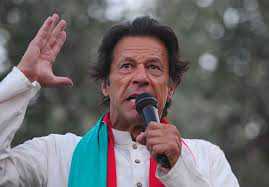
Imran Khan had written a letter to Prime Minister Narendra Modi, seeking to re-start bilateral talks on key issues ‘challenging the relationship’ including on terrorism and Kashmir. File photo

Islamabad, September 23

Pakistan’s two major opposition parties have questioned the “haste” shown by Prime Minister Imran Khan in making efforts to mend ties with India and held him responsible for the “diplomatic debacle”, saying he should have done his “homework” before approaching for a meeting.

Khan had written a letter to Prime Minister Narendra Modi, seeking to re-start bilateral talks on key issues “challenging the relationship” including on terrorism and Kashmir.

India initially agreed to a meeting between Foreign Minister Sushma Swaraj and her Pakistani counterpart Shah Mahmood Qureshi on the sidelines of the UN General Assembly in New York this month.

However, New Delhi on Friday called off the meeting citing the “brutal” killing of three policemen in Jammu and Kashmir as well as the release of the postal stamps “glorifying” Kashmiri militant Burhan Wani.

Dawn news reported that two major opposition parties—the Pakistan Muslim League-Nawaz (PML-N) and the Pakistan Peoples Party (PPP)—have held the Pakistan Tehreek-e-Insaf government responsible for the latest “diplomatic debacle” following New Delhi’s refusal to hold the meeting.

Former foreign minister and PML-N lawmaker Khawaja Mohammad Asif criticised Khan for stating in the letter that “Pakistan remains ready to discuss terrorism” and said it seemed the government was “not prepared” from the day one.

“Too much keenness being shown by the prime minister showed weakness on our part. Giving them (India) too much reflects haste on our part to mend fences with India,” Asif was quoted as saying by Dawn news.

Asif said he was not against normalisation of relations between India and Pakistan but “dignity must be maintained”.

He regretted that Khan wrote a letter in which he “talked about terrorism” without realising that the US and India had recently issued a joint statement after the visit of Secretary of State Mike Pompeo to New Delhi and Islamabad which was “dead against” Pakistan.

“They (the US and India) raised all kinds of allegations against Pakistan and you are talking about terrorism (in the letter). This is a sign of weakness (on our part),” Asif said.

He also criticised Prime Minister Modi, alleging that “he is playing to the gallery” as part of poll campaign.

PPP Vice-President and former envoy to the US Sherry Rehman said that the Imran Khan government should have done its homework before approaching India for a meeting, especially after the initial response.

“Right now, however the Indian Govt and Army chief response is both immature and irresponsible. What are they threatening Pakistan about?”

“They have crossed all diplomatic norms and protocols to emerge as a belligerent nuclear power that is only looking to externalise its own extremisms,” Rehman said on her official social media page on Twitter.

Ties between India and Pakistan nose-dived following a spate of terror attacks on Indian military bases by Pakistan based terror groups since January 2016. Following the strikes, India announced it would not engage in talks with Pakistan, saying terror and talks cannot go hand-in-hand.

Amid heightened tension with Pakistan over Uri terror attack in which 18 soldiers were killed, India had pulled out of the SAARC Summit to be held in Islamabad in November, 2016. The summit was called off after Bangladesh, Bhutan and Afghanistan also declined to participate in the meet. PTI 


Indian govt proposed Reliance Defence as Rafale partner: French media quoting Hollande

Indian govt proposed Reliance Defence as Rafale partner: French media quoting Hollande

PM Narendra Modi had announced the procurement of a batch of 36 Rafale jets after holding talks with then French President Hollande on April 10, 2015, in Paris. File photo

New Delhi, September 21

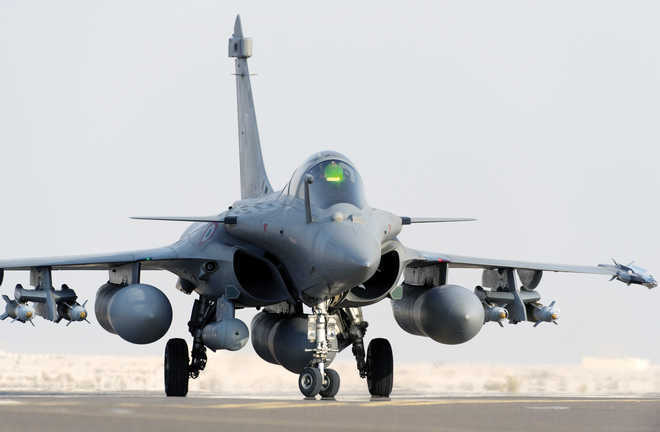
In a significant development, a French media report quoted former French President Francois Hollande as purportedly saying that the Indian government had proposed Reliance Defence as the partner for Dassault Aviation in the Rs 58,000 crore Rafale jet fighter deal and France did not have a choice.

Reacting to Hollande’s remark that is at variance with the stand taken by the Indian government, the Defence Ministry spokesman said on Friday, “The report referring to former French president Hollande’s statement that government of India insisted upon a particular firm as offset partner for the Dassault Aviation in Rafale is being verified.”

The spokesperson also said, “It is reiterated that neither the government nor the French government had any say in the commercial decision.”

Dassault Aviation, the makers of Rafale, had chosen Reliance Defence as its partner to fulfil offset obligations of the deal. The government has been maintaining it did not have any role in selection of the offset partner.

Hollande’s remark is set to escalate the political slugfest over the controversial multi-billion dollar deal.

The French media report quoted Hollande as saying “we did not have a say in this…the Indian government proposed this service group and Dassault negotiated with (Anil) Ambani group. We did not have a choice, we took the partner who was given to us.”

The Congress and other Opposition parties latched on to the report and stepped up their attack on the Modi government over the deal.

“President (Former) Francois Hollande should also enlighten us how the price went up from 590 crore in 2012 to 1690 crore in 2015 per Rafale fighter jet? Escalation of a mere 1100 crore. I am sure the Euro equivalent would not be a problem to calculate,” Congress spokesperson Manish Tewari tweeted.

Prime Minister Narendra Modi had announced the procurement of a batch of 36 Rafale jets after holding talks with then French President Hollande on April 10, 2015, in Paris.

The Opposition has been accusing the government of choosing Reliance Defence over state-run Hindustan Aeronautics Ltd to benefit the private firm, though it did not have any experience in the aerospace sector. PTI

clip


Joint India, US military exercise begins in Almora

Joint India, US military exercise begins in Almora

This is the 14th edition of the joint military exercise. PTI file

Dehradun, September 16

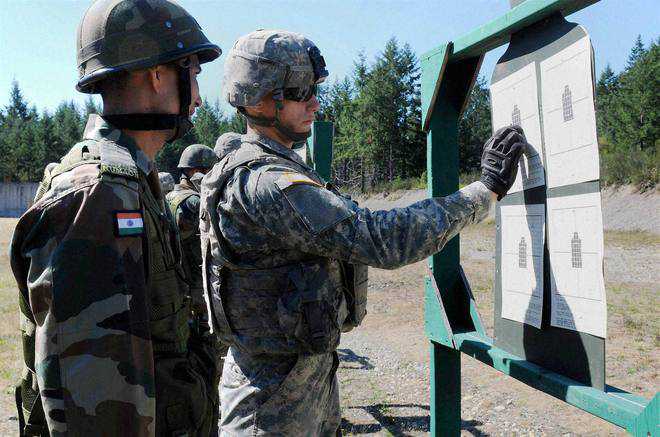
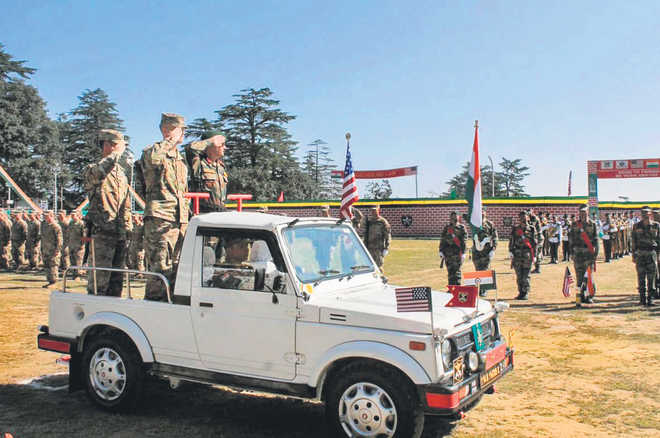
A joint India-US military exercise began on Sunday at Chaubattia in the foothills of the Himalayas in Uttarakhand’s Almora district.

‘Yudh Abhyas 2018’ is one of the longest running joint military training exercises and a major bilateral defence cooperation endeavour between India and the US.

This is the 14th edition of the joint military exercise, which is hosted alternately by the two countries.

Set to conclude on September 29, the combined exercise simulates scenarios where both nations are working together in counter insurgency and counter terrorism operations in mountainous terrain, a defence press release said.

The two-week exercise will see the participation of about 350 personnel of the US Army and similar strength from the Garud Division of the Indian Army.

The exercise curriculum is progressively planned where the participants will initially get familiar with each other’s organisational structure, weapons, equipment, confidence training and tactical drills.

Subsequently, the training will advance to joint tactical exercises and battle drills of both the armies.

The training will culminate with a final validation exercise in which troops of both countries will jointly carry out an operation against terrorists in a fictitious but realistic setting. PTI

Yudh Abhyas 2018 in Almora

Yudh Abhyas 2018 in Almora

The Indo-US training exercise that commenced at Chaubattia, Uttarakhand, on Sunday. PTI

Dehradun, September 16

A joint military training exercise between the Indian and US armies began on Sunday at Chaubattia in the foothills of the Himalayas in Uttarakhand’s Almora district.

Yudh Abhyas 2018 is one of the longest running joint military training exercises and a major bilateral defence cooperation endeavour between India and the US.

This is the 14th edition of the joint military exercise, which is hosted alternately by the two countries.

Set to conclude on September 29, the combined exercise simulates scenarios where both nations are working together in counter-insurgency and counter-terrorism operations in mountainous terrain, a defence press release said.

The two-week exercise will see the participation of about 350 personnel of the US Army and similar strength from the Garud Division of the Indian Army.

The exercise curriculum is progressively planned where the participants will initially get familiar with each other’s organisational structure, weapons, equipment, confidence training and tactical drills.

Subsequently, the training will advance to joint tactical exercises and battle drills of both the armies.

The training will culminate with a final validation exercise in which troops of both countries will jointly carry out an operation against terrorists in a fictitious but realistic setting. — PTI

Defence coop with US  

  • Yudh Abhyas 2018 is one of the longest running joint military training exercises and a major bilateral defence cooperation endeavour between India and the US.
  • This is the 14th edition of the joint military exercise, which is hosted alternately by the two countries.