Sanjha Morcha

What’s New

Click the heading to open detailed news

Current Events :

web counter

Print Media Reproduced Defence Related News

Awantipora Attack: Local Suicide Squads, the New Twist in J&K Saga by Lt Gen Syed Ata Husnain

Too busy to read the whole story? Listen to it instead:

On 13 July 1999, even as the Indian Army achieved its final success in Kargil, a new phenomenon unfolded in the Kashmir Valley. A small group of foreign terrorists (FTs) staked out a company of the Rashtriya Rifles in north Kashmir and executed an intrusion into its camp resulting in heavy casualties among the Security Forces (SF). Within a few days, other SF camps were struck with a couple of such actions for which they were unprepared.

Earlier Foreign Terrorists Used to Outnumber Local Terrorists

Those were the days when the ratio of FTs to local terrorists (LTs) was skewed almost completely in favour of the former. These sneak actions were termed by terrorists as Fedayeen. The latter is a phenomenon associated with Palestinian suicide squads. It literally means – ‘those who sacrifice themselves in the name of God’.

In the context of J&K, it meant a transformation of the sub-conventional conflict in the sense that till July 1999, FTs in groups of about 6-8 terrorists challenged the SF in villages, towns, jungles and mountain tops but scrupulously avoided coming near the camps.

The sudden change in terms of targeting the SF camps with suicide squads, that attempted to intrude through perimeter fences or by means of various ruses such as the disguise of Indian soldiers, was aimed at placing the SF on the defensive.

They hoped to tie them down to their camps and force an out-of-proportion effort by SF to lay emphasis on defensive measures instead of offensive counter terror operations. Some high profile actions by the Fedayeen did manage to place the SF on the defensive as the latter devised new tactical methods of countering them. Casualties mounted in such actions witnessed at various HQ and units including a daring attempt on the entrance to HQ 15 Corps where the Public Relations Officer (PRO) and others were killed on 3 November 1999.

Also Read: The Challenges of Securing Local Soldiers and Policemen in J&K

Comeback of the Fedayeen Trend

All these Fedayeen actions were executed by Pakistanis recruited from west Punjab with some on death row and others designated as terminal HIV cases. At least two cases of suicide bombing were carried out by local Kashmiris in this period, but by and large the local Kashmiri footprint in Fedayeen was absent.

Better preparedness by the Indian SF and inability to find volunteers as recruit led to the eventual tapering off.

However, after 8 July 2016 (Burhan Wani’s killing) once again Pakistan-sponsored proxy war received a fresh impetus and the Fedayeen trend returned. Pathankot preceded this (1 January 2016) but Uri (18 September 2016) and Nagrota (29 November 2016) followed.

The Jaish-e-Mohammad (JeM), that was looking for a new avatar after being in the dog house for a while, focused on Fedayeen and managed some successful sneak actions against SF camps.

Inducting Local Kashmiris in the Fedayeen Squad

On 31 December 2017, the JeM executed a sneak action against the CRPF Letapura camp near Avantipura. The difference in this was the composition of the Fedayeen squad. The three-man squad had at least two local terrorists.

The death of Fardeen Ahmad Khanday, 16-year-old son of a policeman and Manzoor Baba, both from south Kashmir, revealed a new ploy by the JeM under the guidance of Pakistani proxy controllers; that of inducting local Kashmiris into Fedayeen suicide squads.

Also Read: Pulwama Operation Ends, Body of Third Militant Recovered

How does the presence of locals in such squads change the nature of proxy conflict and thereby the threats? South Kashmir is an ideologically more energetic segment where after Burhan Wani’s killing, the terrorist movement involving local youth has taken shape. While the presence of FTs still persists it is mainly restricted to north and central Kashmir.

Inducting an FT Fedayeen squad is cumbersome and involves recruitment, training, motivation, infiltration and concentration at safe houses. The chances of discovery and attrition are far greater besides the time taken to execute an action. The JeM along with its handlers has belied the belief that Kashmiris do not believe in suicide acts and has probably more volunteers-in-waiting. If this recruitment drive gets further success there could be an army of such youth willing to be members of suicide squads. There would be no need for infiltration and safe houses because locals need none of that.

Fedayeen actions could be executed more frequently and with the help of locals working at SF establishments; all these personnel would immediately become suspect resulting in more alienation. Fardeen Khanday’s eight-minute video aired on social media, in Burhan Wani’s tradition, reveals how the young man had been radicalised in three months. His beliefs appear to relate him to the Islamic Caliphate type of ideology; the larger brotherhood of the Islamic Ummah.

Challenge for Indian Security Forces

With mosque power at its height, the youth in revolt mode and alienation of general public, a phenomenon which appears not to be waning, the signs for this winter and beyond appear ominous, not the least because of the threat of multiple Fedayeen squads which will force a far greater defensive mentality on the SF.

If this trend translates to the next level, which is suicide bombing with ‘strap on’ explosives and explosive laden cars in the Iraq, Pakistan and Afghanistan mode, the Indian SF would have a new challenge on their hands.

For enhanced security against local Fedayeen there would be a need for sharper intelligence for which funding should never be a constraint, constantly improving infrastructure of camps and establishments (the Letapura camp is reported to have had the usual glitches) and most importantly a rapid counter radicalisation exercise which needs an ‘all hands on deck’ approach. The meaning of outreach needs redefining but continued military domination is the key.

Also Read: Ruthless Strike Across LoC Signals India’s Eye-for-an-Eye Resolve

(Lt Gen (Retd) Syed Ata Hasnain is a former GOC of the army’s 15 Corps and now associated with Vivekanand International Foundation and Institute of Peace & Conflict Studies. He can be reached at @atahasnain53. This is an opinion piece and the views expressed above are the author’s own. The Quint neither endorses nor is responsible for the same.)


Jawan, girl killed in Pak shelling


25 villages targeted in Jammu and Samba districts; 6 locals injured, villagers shifted to makeshift camps in safer areas

From page 01 JAMMU: A Border Security Force (BSF) head constable and a 17-year-old girl died and six villagers were injured after Pakistan rained mortars and opened heavy weapons fire at Indian villages and posts along the International Border (IB) in Arnia and Ramgarh sub sectors of Jammu and Samba districts respectively through Wednesday night.

NITIN KANOTRA/HTOfficers and soldiers of BSF carry the coffin of Head Constable A Suresh during the wreath­laying ceremony at the BSF headquarters in Jammu on Thursday.The heavy exchanges between BSF and Pakistan Rangers that began on Wednesday midnight continued till 8.30 am on Thursday.

The deceased jawan and the girl have been identified as Head Constable A Suresh Kumar and Neelam Kumari aka Sweety.

BSF Jammu Frontier IG Ram Awtar said BSF retaliated strongly to the unprovoked firing and shelling.

The 1976-born Head Constable Suresh joined BSF in 1995. He hailed from Tamil Nadu. He is survived by a 13-year-old daughter and 6-year-old son.

Arnia SHO Sunil Kumar said that around 8.30 am on Thursday, a Pakistani mortar shell exploded in a field in Pindi Charakan village in Arnia where the girl had gone to relieve herself.

She died instantly, he added. Tehsildar of Arnia tehsil, Gurpreet Singh said, the girl identified as Neelam aka Sweety, daughter of Satpal, had come to her uncle’s house from Dayalachak to attend a family function.

ALERT ISSUED N JAMMU BORDER AREAS

Singh informed that on Wednesday night, Pakistan shelling also injured four villagers, who have been identified as Ramesh Chander, Chanchala Devi, Darshan Lal and Ramesh Lal, all residents of ward number 13 of Arnia Town.

He informed that over 25 villages were targeted by Pakistan.

A police officer from Samba said that overnight shelling in Ramgarh sector also left two villagers injured. They have been identified as Suresh Kumar and Puneet Choudhary of Kamore village.

WE’RE PEACE LOVING BUT HAVE THE RIGHT TO RETALIATE: BSF DG The BSF’s director general KK Sharma said on Thursday the situation along the Line of Control and International Border was “tense” but the paramilitary force was “more than prepared”.

“We don’t initiate first fire but if provoked, we strongly retaliate. The martyrdom of head constable A Suresh won’t go waste,” Sharma said. Commenting on increasing truce violations by Pakistan recently, Sharma said India is a peace loving nation and doesn’t want to create a war-like situation.

“We are more than prepared to foil infiltration attempts and respond to ceasefire violations,” he added.

The DG said that he has asked officers on the ground to retaliate with full force and teach Pakistan a lesson.


clip


Rs 5 lakh for martyr’s kin CM’s emissary promises govt job to Gurmail’s family

Rs 5 lakh for martyr’s kin
CM Capt Amarinder Singh’s chief adviser Tejinder Shergill (R) hands over a cheque to family members of Lance Naik Gurmail Singh at Alkare village in Amritsar on Monday. Tribune photo

Tribune News Service

Amritsar, January 1

Tributes were paid to Lance Naik Gurmail Singh during his bhog and antim ardas ceremony at his native village, Alkare, in the district today.Chief Minister Capt Amarinder Singh’s chief adviser Tejinder Singh Shergill gave Rs 5 lakh to the bereaved family as ex gratia grant and paid homage on behalf of the state government. He promised to provide a government job to Gurmail’s kin. He said he would urge the government to upgrade the village school and name it after the martyr.Gurmail was killed in the Keri sector along the Line of Control in Rajouri district after Pakistani troops violated ceasefire on December 23. Col Amarbir Singh Chahal, Deputy Director, Social Security and Welfare, said the Centre would pay around Rs 90 lakh to Gurmail’s family, while the state would give Rs 12 lakh and a government job. The Sainik Welfare Department contributed Rs 25,000. His Army division gave Rs 1 lakh to the martyr’s kin as immediate relief.The political leaders present included ex-minister Bikram Singh Majithia, Bhagwant Singh Sachhar, Sawinder Singh Kathunangal, Laxmi Kanta Chawla, Sukhjinder Raj Singh Lalli Majithia and Veer Singh Lopoke. Majithia demanded Rs 1 crore as compensation for Gurmail Singh’s family and a government job to a family member.Gurmail, who was the breadwinner of the family, is survived by wife Kuljit Kaur and daughter Vipindeep Kaur (8). He has also left behind father Tarsem Singh, mother Gurmeet Kaur, younger brother Harpeet Singh and sister Daljit Kaur.Gurmail had joined the armed forces around 14 years ago. Over a month ago, he had visited his village.


Promises in Punjab ‘delivered, more on way’

Promises in Punjab ‘delivered, more on way’

Captain Amarinder Singh

The year 2017 was momentous for Punjab, whose people voted for a much-needed political change. Today, as I look back at the year gone by, I recall that moment when, on March 11, I received the people’s mandate to lead the state into the future. There was, of course, a lot of anger in that mandate against the previous regime. More importantly, however, there was much hope and optimism, as the people of Punjab welcomed the Congress government with open arms to bring them out of the debris of ruin into which they had been plunged over the previous decade.To say that I felt humbled by this mandate would be an understatement. I, and I am sure every other member of our party, was truly overwhelmed as we took on the onerous responsibility which the people had handed over to us. (Follow The Tribune on Facebook; and Twitter @thetribunechd)It took us some time to come to terms with the harsh realities facing us, and as we started unravelling the depth of the havoc which the erstwhile government had wreaked on our beloved state, we realised that the task before us was daunting to the extreme. We had the option of sitting and crying, and spending the next one year blaming the Akali-BJP leadership for what they had done to the state, or getting down to fulfilling our poll promises one by one. We chose the latter.Nine months is hardly any time to judge the success or failure of a government elected for five years, especially considering the mess we have inherited on every front. Yet, we have managed to not only implement many of our key election promises but, in fact, have set the ball rolling for the others. It is not my intention here to list out all the work we have done in this short period of time. But it does give me pleasure to share some of the promised tasks we have successfully executed.  And let me clarify that I am doing so, not because I want to brag about our achievements but, more importantly, to put an end to the Opposition’s campaign to mislead the people of the state with their blatant deceits and falsehoods.Let me begin by talking about the crop loan waiver issue, which the Opposition has been trying to use as a missile to fire at my government at every opportunity. Frankly, we could have easily taken refuge in the stark reality of empty coffers to push back the implementation of this promise, which has a huge financial implication. We chose not to do that, as we realised the gravity of the problems faced by the farmers, as a result of the lopsided policies of the previous government. A few days from now, I will be formally launching the farm debt waiver scheme, which will eventually go on to benefit 10.25 lakh of the worst-hit farmers in the state. This will be in addition to all the other steps we have taken for the welfare of the farming community, including abolition of kurki, take-over of loans of farmers who committed suicide, and hike in kharaba compensation from Rs 8,000 to Rs 12,000 per acre.  And, of course, you are all aware of the unprecedented hassle-free procurement of wheat and rice, which has helped bring some semblance of security back into the lives of our beleaguered farmers.Moving now to another critical promise of my government, the new industrial policy, complete with power subsidy and an end to the free reign of the transport unions, is already a reality. And it has started showing tangible results by bringing in substantial investment and business to the state, which had been witnessing large-scale closure of industries over the past 10 years. From contributing to the state’s economic development, to generating the much-needed employment for our youth, I see this policy yielding excellent results in the new year, and ahead.Drugs is another issue on which, notwithstanding the Opposition’s attempts to project the contrary, our accomplishment on the ground is self-evident. For those who do not believe in numbers (though there are enough numbers to show that our efforts to destroy the drugs mafia have resulted in resounding success), I would like to point to the virtual non-availability of drugs in the open market to show that we have, well and truly, succeeded in breaking the backbone of the drugs mafia. Some of the big fish might have managed to evade arrest so far, but the day is not far when they would land in the police net, and meet the fate that is inevitable, considering the seriousness of their crime.An important aspect of our accomplishments so far, which definitely requires mention here, is the various social welfare initiatives that have paved the way for the upliftment of the underprivileged sections of the society. Hike in social security pension and financial assistance under the Ashirwad scheme, besides increase in reservation for OBCs in educational institutions and for SCs in all government schemes, are some of the measures we have implemented on this count. Women empowerment, rural and urban infrastructure development, in addition to improvement in education and health welfare, have also been high on our implementation agenda.From improved law and order, to decline in the cases of sacrilege, the overall enrichment in the lives of the people of Punjab is not something that even the most pessimist can easily deny. It was my promise to bring to book those responsible for victimisation of innocent people through false cases, and the process is well under way. As mentioned earlier, this is not a comprehensive list. But this should suffice to show the commitment with which we have embarked on our journey to bring Punjab’s development and growth back on track. The beginning has been made, and made well. And as they say, well begun is half done. The momentum has been set for the next four-plus years that we still have to go. And, if need be, I am quite prepared to take on the mantle of Punjab’s governance again after the end of this term to ensure that the state is not thrown back on the path of regression from which it has just started to recover. My promises are sacrosanct, and I will stand by them, whatever it takes for me and my government.Finally, Happy New Year, my Punjabi brethren. May it bring peace, happiness and prosperity in your lives.(The writer is the Chief Minister of Punjab)


Army denies bodies of Major and three jawans, killed in Pakistani ceasefire violation, were mutilated

Indian army

Representational image   | Photo Credit: PTI


New Delhi: The Indian Army on Sunday refuted media reports and categorically denied that the bodies of four Armymen, who were killed in a ceasefire violation along the Line of Control (LoC) on Saturday, were mutilated.

He promised to come home next year. That year would never come now: Mother of martyred Army Major

Amid rumours doing the rounds, the Army clarified in a statement: “There has been no mutilation of bodies, the injuries suffered are due to splinters and gunshot wounds sustained due to firing by the enemy on the patrol.”

The clarification came as the nation remembered the four Armymen who got martyred on Saturday in Jammu and Kashmir’s Rajouri district.

A Major and three soldiers were killed when Pakistani troops opened fire on an Indian Army patrol along the LoC in Keri sector of Rajouri district.

Pakistani troops targeted the Army patrol at Brat Galla in Keri sector at around 1215 hours on Saturday.

“We suffered three fatal casualties including one officer in the incident. Major Moharkar Prafulla Ambadas, Lance Naik Gurmail Singh and Sepoy Pargat Singh were grievously injured during the ceasefire violation and succumbed to their injuries. Two other personnel also sustained injuries and are undergoing treatment,” the spokesman said.

Senior Superintendent of Police (SSP) of Rajouri Yougal Manhar added that one of the two injured personnel died later.

The Army, in a statement, said that Indian troops retaliated “strongly and effectively” to the “unprovoked” firing.

For peace talks, Pak should stop supporting terrorists in J&K: Army Chief

Major Ambadas (32) belonged to Bhandara district in Maharashtra and is survived by wife Avoli Moharkar, while Lance Naik Gurmail Singh (34) belonged to Amritsar district in Punjab and is survived by wife Kuljit Kaur and a daughter.

Sepoy Pargat Singh (30) belonged to Karnal district in Haryana and is survived by wife Ramanpreet Kaur and a son, the Army said.

“Major Ambadas, Lance Naik Gurmail and Sepoy Pargat were brave and sincere soldiers. The nation will always remain indebted to them for their supreme sacrifice and devotion to duty,” the Army statement said.

(With PTI inputs)


Pakistan’s delicate dance by Lt Gen Bhopinder Singh

Pakistan’s delicate dance

In retrospect, 9/11 was the defining moment of the re-engagement and recalibration of the US-Pak dynamics that till then were nestled in favour of Pakistan as a ‘major non-NATO ally’. After the Cold War ended in the 1990s, Pakistan had fallen off the immediate radar as Washington was busy meddling with the affairs of the Middle East. In the process, it effectively overlooked Pakistan’s dangerous transgressions as in Kargil, its support to terrorism in Kashmir or even its surreptitious stockpiling and proliferation of its nuclear wherewithal.

The ‘Bush-Mush’ equation underwent a sudden reality-check as the simplistic ‘with us or against us’ spirit accompanying the looming ‘war on terror’ was evident when the Deputy Secretary of State, Richard Armitage threatened Pakistan’s Intelligence Director ~ “Be prepared to be bombed. Be prepared to go back to the Stone Age”, in case Pakistan failed to join the US-led initiative against Al Qaida and the like.

Since then, Pakistan has undertaken a delicate dance of pandering to contradictory pulls from both the external and internal constituencies, leading to the perfection of its famed and patented ‘double game’. The coercive tone of the US notwithstanding, the Pakistanis had managed to extract three important concessions from Washington ~ an assurance that India and Israel would not join the mopping up operations, an undertaking that the US will not act unilaterally inside Pakistani territory and above all, securing the invaluable ‘reimbursements’ in exchange for its operational costs and commitments towards the ‘war on terror’. And yet, a reluctant and visibly embarrassed Pervez Musharraf had to publicly retract from his erstwhile policies of open-patronisation of the terror groups like the Taliban, and join the chorus of ‘war on terror’, albeit, selectively.

As per the US Agency for International Development (USAID) data, the US had sanctioned up to $33.4 billion during the past 15 years, of which 44 per cent ($14.57 billion) was earmarked for logistics and aerial support in the Afghan war, whereas the remainder $18.8 billion was meant for civilian and internal security-related infrastructure. However, given Pakistan’s track record of misuse, persistent ‘double game’ and cozying-up to the Chinese, the levels of US support and aid for Pakistan are steadily declining and the relationship is on a functional lifeline. According to opinion polls, the societies in both Pakistan and the US have the most negative perceptions of each other. This trust deficit between the two ‘allies’ has led to bitter counter-accusations, with Pakistan claiming $123 billion as the financial cost and the loss of 60,000 Pakistani lives, on account of its commitments towards the ‘war on terror’. The US administration, on its part, is increasingly talking about getting ‘ripped off’, with routine threats of cutting all military aid to Pakistan.

China has strategically moved into the vacuum created by the US disinterest in Pakistan, and is trying to plug the financial-military-diplomatic gap. As per the official Board of Investment figures released by the Pakistani PMO, the foreign investment inflow into Pakistan by the US in 2008-09 was $ 869.9 million and that of the Chinese was a negative $ 101.4 million. The figures for the July-November 2017-18 period read as $42.6 million by the US and $837.4 by the Chinese. The latest Pentagon report to the US Congress has upped the ante by reiterating, “To move forward, we must see fundamental changes in the way Pakistan deals with terrorist safe havens in its territory”. Rather provocatively, it suggests the “use of a range of tools to expand our cooperation with Pakistan in areas where our interests converge, and to take unilateral steps in areas of divergence”. This is virtually forcing Pakistan to drop its deliberate ambiguity and duplicity of the ‘double game’, failing which it will be left with only one recourse ~ sovereign sustenance, via China.

Beyond ‘all-weather-friendship’, the Sino-Pakistan equation is bereft of any civilisational, cultural or ideological convergence; it is an outright case of hardnosed realpolitik and compulsions. This over-dependence on Beijing is fraught with risks for Islamabad, as the implications of the China Pakistan Economic Corridor (CPEC) are gradually unfolding. Already rumour mills in Pakistan are awash with the hard bargaining that the Chinese have done in the CPEC projects, with the Pakistan government giving up a lot more than it secured in the bargain. Demeaning suggestions like making the Chinese yuan the free-usage currency in the Gwadar Free Zone has growing portents of compromising on Pakistan’s ‘economic sovereignty’.

Economically, the US remains the biggest trade partner (four times that of China). Militarily, Pakistan needs the US drones to target specific areas in the restive Af-Pak frontier. The bulk of Pakistani military hardware still has US-markings (F-16 fighter planes, Lockheed C-130 transporters, Cobra Attack Helicopters, M113 APC’s, artillery guns, Aati-tank missiles and so on). Therefore, beyond the political theatrics and sabre-rattling, a sudden freeze of US support could be devastating for the Pakistanis, both economically and militarily. Equally for the US, avoiding the Pakistani land routes and ‘airlifting’ the wares for its men and material deployed in landlocked Afghanistan, would be impractical and prohibitive.

There is an obvious urgency to curb the menace of extremist ideologies and the terror industry that is consuming, bleeding and sapping the vital interests and energies of both Pakistan and the US. Towards that end, Pakistan has to overcome its traditional instincts and confidence in retaining leverage with select terror groups (e.g. the Haqqani network that faces Afghanistan and Lashkar-e-Taiba, that faces India). It will have to dispense with its flawed belief in China adequately stepping in to fill in the vacuum caused by US disinterest.

The principal institutions in Pakistan ~ the military, the political class and the clergy ~ must desist from misusing the ‘extremist’ elements for furthering their own institutional interests in the ongoing turf wars for control of power. The US-bashing may make political and emotional sense in the short-run. However, for Pakistan to retain the economic-military control over its own sovereignty and destiny will call for Islamabad to make peace with its hypothetical “ghosts”, ulterior motives in the neigbourhood, and a reality check of the efficacy of its fabled ‘all-weather-friendship’ with China.

The writer IS Lt Gen PVSM, AVSM (Retd), Former Lt Governor of Andaman & Nicobar Islands & Puducherry


With last-minute approval, India set to snap up world’s last available C-17 Globemaster

Boeing C-17 Globemaster III during its induction
Boeing C-17 Globemaster III during its induction into Indian Air Force in 2013 in Ghaziabad. Photo by Sakib Ali/Hindustan Times via Getty Images

Two years after special request made to hold aircraft, defence ministry committee clears signing of contract.

New Delhi: India is now set to snap up the world’s last available C-17 heavy transport aircraft after a last-minute approval by the defence ministry last week, two years after a special request was made to Washington to reserve the plane.

A meeting of the defence acquisition committee (DAC) headed by minister Nirmala Sitharaman cleared the procurement that will take the total number of the transport aircraft in the Indian Air Force to 11.

US manufacturer Boeing has shut down the production line after producing 279 aircraft and the last C-17 Globemaster had more than one global contender given its unique role as a large airlifter optimised for special operations, humanitarian assistance missions and carrying troops over large distances.

The lone aircraft is likely to cost India over Rs 2,700 crore and could arrive within a few months after the formal signing of the contract. The plane is being bought under the Foreign Military Sales (FMS) or direct government purchase route from Washington.

With the clearance, the defence ministry will now send a formal ‘letter of acceptance’ (LOA) to confirm the sale.

As reported by ThePrint, India had lobbied hard to get the last plane since 2015 but bureaucratic red tape had created the possibility of the aircraft being taken up by another buyer. Sources said that the aircraft – which has been produced and kept mothballed – will be prepped up and will go through a set of tests before being delivered.

In 2015, the Air Force had cleared a proposal to buy three of the heavy lifters at a cost of Rs 8,100 crore but as procurement process dragged on, its manufacturer Boeing ran out of aircraft to sell as the C-17 production line was shut down.

In 2011, India had bought 10 aircraft for $4.7 billion. The contract also had a follow-on option clause to procure six more aircraft. However, with limited resources available, the Air Force had asked for an additional three, impressed by its operational abilities.


India in US global strategy Limits to friendship with Uncle Sam

India in US global strategy

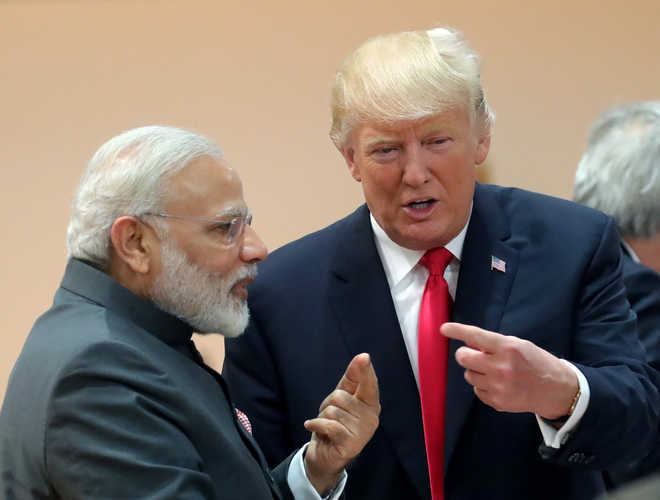
A NEW US national security strategy under Donald Trump was bound to induce great interest, especially about India’s place in how the global system should be ordered. The 68-page document is confined to a macro view of the world’s complex and interconnected problems. However, India clearly emerges as a useful cog in US attempts to prevent a shift in the balance of power in the Asian heartland. More than West Asia, the US has chalked out a more prominent role for India in the maritime domain in line with its strategy to prevent a free hand to hobble China’s bid to expand its regional influence. What are the payouts? Trump explicitly asks India to loosen its purse strings in Central and South Asia, perhaps as compensation for declining to put Indian boots on Afghan soil.  The price for partnering the US in the Indo-Pacific is both tangible — more orders for US military companies at a time when the US budget is facing constraints — and intangible — greater Indian visibility in the near neighbourhood. Just as the US is single-mindedly devoted to advancing American influence, India will have to cut its cloth according to its own national interests. It cannot view Russia and China from the American lens of unremitting hostility: its only two make-in-India defence projects are of Russian origin and there is already word that a Sino-India trade-off on NSG and One-Belt One-Road may be in the offing. India can ill afford to shrink the room for dialogue with both Russia and China.A reality check is also in order: the US mentions India as only one of the eight potential allies in the Asia Pacific. If India is described as a  “leading world power”, there is approbation for the others: Japan is a “critical ally”, Australia “a key partner”, and friendship with South Korea “forged by trials of history”. In West Asia too, India has a marginal role as the US has several irons in the fire. Whether it was Obama earlier or Trump now, proximity with the US has its limits as well as advantages.


Modi stoops to conquer by S Nihal Singh”””””” Tragedy of low campaign rhetoric””””

Modi stoops to conquer
Not on: The conspiracy theory against senior Opposition leaders is a new low.

S Nihal Singh

THE roles of a Prime Minister and the rabble-rouser in state assembly elections do not mix. Although Mr Narendra Modi had given us a foretaste of it by discarding convention and practice that the person holding the highest political office in the land does not do politicking at the state level, Mr Modi was single-minded in his devotion to collect votes with crowd-pleasing themes and scorn for the Opposition.Mr Modi’s extravagances were bound to descend to the depth of low politics, and an address of his at a Gujarat election rally was so shocking that it demeaned the office of Prime Minister and shook the country to its foundation.Mr Modi insinuated that his predecessor and a number of other notables, including the former Vice-President and Army Chief, had a private dinner with Pakistani officials in Delhi to help plot Pakistan’s efforts to defeat the BJP in the Gujarat election.The charge was so ridiculous that Mr Modi should have been red-faced and although Dr Manmohan Singh was sharp in his response, many Opposition  parties condemned this election rhetoric as a new low. Government spokesmen’s efforts to answer the near universal condemnation were feeble and unconvincing. Is there a method to stooping so low to conquer? It would seem so. Basically, the Sangh Parivar wants to outflank the middle class and concentrate on the masses, usually swayed by emotion and religiosity. The government’s ultimate aim is to build a Hindu rashtra to transform the country into a majoritarian state and it is imperative for the BJP to win votes, from Parliament and state assemblies to panchayats, to be able to alter the Constitution. The BJP’s eyes are fixed on the 2019 general election and all efforts are concentrated on how to undercut Opposition-ruled states either through subversion or by forming coalitions of convenience. Present efforts are concentrated on West Bengal, Karnataka and Kerala although Odisha is claiming some attention. What is the Opposition doing in the face of the BJP’s assault to alter the country’s moorings from secularism to majoritarian rule? Changes are already being made at the fringes to signify the primacy of Hinduism. After all, the Parivar’s attempt is to marry nationalism with Hinduism much like Israel runs the Jewish state by excluding non-Jews from citizen rights. As usual, the Opposition is divided. The Congress remains the only party with countrywide support, greatly diminished as it is. With Mr Rahul Gandhi taking over the party from his mother, his task is to form a priority-related programme with an energetic set of workers. Whatever the result of the Gujarat and Himachal Pradesh elections, Mr Gandhi has been learning on the job with quick repartees and giving selfies to members of the public. It would be too optimistic to believe that the Opposition parties will come together like a happy family. The splintering of parties in Indian politics is often determined by leaders seeking greater honours. Second, the tendency of opposition members to gravitate towards the ruling party for the loaves and fishes of office is common.For ideological parties of the Left, the end of the heyday of Communism has presented problems, like in the rest of the developing world. There was for a time the Russian and Chinese models to choose from, with Russia after the demise of the Soviet Union living through the chaotic era of nationalism, with Yeltsin passing the baton to Mr Vladimir Putin who retained the one-party Communist structure while marrying it to Orthodox Christianity.The Chinese have climbed on the bandwagon of economic capitalism while maintaining tight state control of key economic sectors. Their goal has been to take over advanced technological innovations by buying them or copying them or simply stealing them. They have been singularly successful in their endeavours and are now the largest exporters of solar equipment, to give one example. But the Chinese have married their Communism to ultra-nationalism.The short point is that Indian Communists, like their brethren in the rest of the developing world, have to fend for themselves. The CPM might still fly the flag of Marx and Engels but no one, including its followers, take these symbols seriously notwithstanding their rhetoric. The sooner the Left parties behaved like other organisations the better.It is up to Mr Gandhi to get all Opposition parties together to work out a basis of fighting the general election instead of waiting till the last minute for seat adjustment. Pulls and pressures for the number of seats is par for the course but the Congress leadership must persuade others of the benefits of a rational approach.The first-past-the-post system of parliamentary democracy would seem to favour the populist and rabble-rouser, but any system can be subverted, given determination and money. The BJP and the larger Parivar have both these assets in ample measure.Obviously, the country wanted a change when the BJP won the last general election under its own steam. In Mr Modi the RSS saw a leader with wile and determination to change the country’s direction and plumbed for him, instead of relying on senior leaders like Mr LK Advani who are past their prime. Thus far, Mr Modi has served the cause dear to them well to the extent of partially ruining the rural economy in Uttar Pradesh in particular. And the Prime Minister had to eat his words when reprimanded by the RSS on the number of cow vigilantes operating in the country.Mr Modi’s election rhetoric will make his task of wooing the middle class that much more difficult. Many of the extravagances of poll rhetoric are taken as fair game. But the charge that a man of the stature of Dr Manmohan Singh is plotting against his country in league with Pakistan is preposterous and must be addressed by the Prime Minister after the results are out.It is a sad moment for Indian democracy that we should be discussing such insulting language of abuse and charges just to win votes.