


Sanjha Morcha

What’s New

Click the heading to open detailed news

Current Events :

web counter

Print Media Reproduced Defence Related News

Baramulla camp attackers used human shields to escape: Police

GPS device, wire-cutters found during search; India, Pak NSAs discuss de-escalation

SRINAGAR/NEW DELHI: Militants who attacked a paramilitary camp in north Kashmir’s Baramulla used civilians to “shield” their escape, police said on Monday, even as the national security advisers of India and Pakistan spoke over phone to reduce hostilities along the defacto border.

NITIN KANOTRA / HT AND PTIBSF men stand guard near the International Border fence in Akhnoor sector on Monday; and (right) tributes being paid to a BSF trooper who was killed in the Baramulla attack, in Srinagar.

A Border Security Force (BSF) soldier was killed and another jawan wounded after at least six gunmen attacked the 46 Rashtriya Rifles camp in Janbazpora on the outskirts of Baramulla city around 10.30pm on Sunday, triggering retaliation from the forces. The attack continued till 1am.

A “GPS device and wire cutters” were found during a search after the attack, a BSF spokesperson said, indicating that the attackers may have crossed over from across the LoC.

Wire cutters, compass and GPS devices were also recovered after the Uri camp attack, which India blames on the Pakistan based Jaish-e-Mohammed. The Army, however, said the attack was not in “retaliation” to the “surgical strikes” by India across the LoC as the militants may have crossed over “a month or two” ago.

The Baramulla attack came three days after India claimed to have conducted “surgical strikes” to wipe out seven to eight militant launch pads in Pakistan-occupied Kashmir (PoK).

Army sources said attackers were unlikely to have crossed the LoC in the past few days when vigil along the LoC has been very tight.

Reports of two militants being killed during the attack were untrue, sources said.

Ties between India and Pakistan have nosedived since the September 18 attack on an Indian Army garrison in northern Kashmir’s Uri that killed 19 soldiers. While India has blamed Pakistan-based terrorists for the strike, Islamabad has denied the charges.

North Kashmir DIG Uttam Chand told HT that the militants involved in the Baramulla attack used the large population near the camp as “shield” to escape under the cover of darknes. He said forces could not retaliate heavily as it would have otherwise caused civilian casualties.

The BSF company deployed in Baramulla shares the 46 RR headquarters with the army. At the time of attack both BSF and army men were on guard.

“A massive combing operation is on to nab the attackers,” said Vikas Chandra, the BSF’s inspector general in Srinagar.


Reports said the BSF also foiled an infiltration attempt by a group of 8-10 militants near the Chakri border out post (BoP), 30 km from Gurdaspur in Punjab.

Meanwhile, Pakistan’s top diplomat Sartaj Aziz said the NSAs of both countries have spoken to reduce hostilities along the LoC.

A home ministry spokesperson in New Delhi confirmed the telephonic discussion.

Aziz, the adviser to prime minister on foreign affairs, told Geo. tv that Pakistan wants to “reduce tensions on LoC”, and added Pakistani NSA Nasser Janjua and his Indian counterpart Ajit Doval have stressed the need to establish contact.Aziz, however, alleged that India was escalating tensions with Pakistan “to deflect the attention of the world from Kashmir issue”.
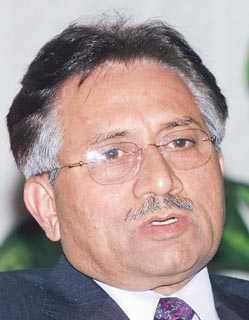
Pak’s ‘wrong policies’ responsible for global isolation: Musharraf

Pak’s ‘wrong policies’ responsible for global isolation: Musharraf
Pervez Musharraf

Lahore, October 2

Taking on the Nawaz Sharif-led government, former prime minsiter General Pervez Musharraf (retired) has claimed that Pakistan is facing international isolation thanks to its own wrong policies.

Musharraf’s statement comes in the wake of the postponing of the SAARC summit, which was scheduled for November in Islamabad, as Bangladesh, Afghanistan and Bhutan, joined by Sri Lanka on Friday, pulled out citing concerns over terrorism.

(Follow The Tribune on Facebook; and Twitter @thetribunechd)

According to Dawn, the Chairman of the All Pakistan Muslim League (APML) spoke by telephone to APML workers on the party’s sixth foundation day and lashed out at the government.

“It is astonishing that the government has taken and spent a loan of $35 billion, but not a single beneficial megaproject has been completed with that money. Instead, the people have been suffering because of the government’s corruption,” he said.

Training his guns on New Delhi, Musharraf stated that India is only good at hurling threats but if Pakistani military decides to act on them the response will assume a far more practical form.

“India should realise that Pakistan is not Bhutan. India has a habit of levelling allegations against Pakistan each time there’s an attack on its soil,” he said. — ANI


Modi staged surgical strike ‘drama’ amid pressure: Hafiz Saeed

Modi staged surgical strike ‘drama’ amid pressure: Hafiz Saeed
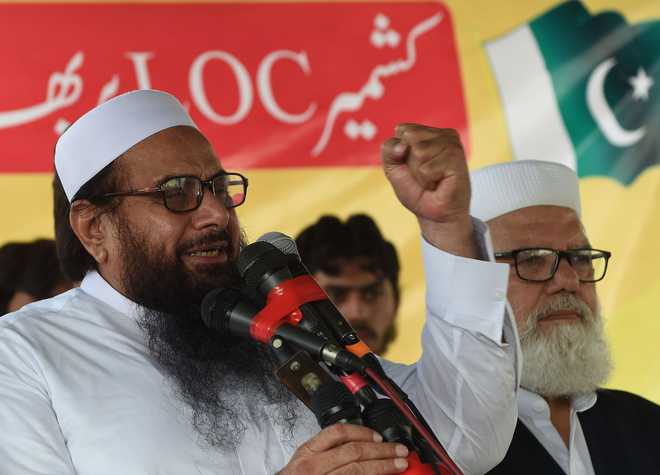
The Jamaat-ud-Dawah chief at it again. AFP

Lahore, October 1

Hafiz Saeed, chief of Jamaat-ud-Dawah (JuD), an Islamic charity linked to outlawed militant group Lashkar-e-Taiba (LeT), has said that New Delhi staged the “surgical strike” drama following domestic pressure on Prime Minister Narendra Modi to retaliate after 19 soldiers were killed in the Uri attack.“They (some people in India) started asking that ‘you had said that you would attack Pakistan, you would do a surgical strike’. Everyone who was in grip of this fever started asking Modi and the Indian government. For this Ajit Doval staged a drama. He made up a surgical strike drama while sitting indoors,” Saeed said.

(Follow The Tribune on Facebook; and Twitter @thetribunechd)

Saeed was of the opinion that no raid was actually carried out by the Indian troops.“The whole film was made in which this surgical drama was shown in which they said their 150 expert paratroopers, after crossing the control line and entering Pakistan, carried out a raid. Actually, no raid was carried out, neither in Bhimber nor in Lipa, Chamb and Dudhnial,” he added.The Indian Army has said it conducted surgical strikes on terror launch pads across the Line of Control (LoC) in response to the terrorist attack at Uri sector. Two Pakistani soldiers and over 30 terrorists were reportedly killed in the attack.Director General of Military Operations Lt General Ranbir Singh said the motive of the operation was to hit out at the terrorists who were planning to infiltrate into the Indian territory.Lt Gen Singh said significant casualty was caused to terrorists during the operation.The DGMO said it was a matter of serious concern that there had been many infiltration bids by terrorists at the LoC and it was reflected in the terror attacks in Poonch and Uri on 11th and 18th of this month.Meanwhile, anti- India protests were held in Lahore, Multan, Karachi and some cities of Balochistan in wake of the rising tensions between the arch-rivals. ANI


Grandmom dies after Pak captures jawan

MUMBAI/NEW DELHI: The lone Indian soldier, who strayed across the LoC after the surgical strikes on Wednesday, was identified as 22-year-old Chandu Chavan, who hails from Borvihir village in Dhule district of Maharashtra. Local Marathi television channel IBN Lokmat reported that his grandmother, Lilabai Patil, died after she heard of his capture by the Pakistan army. It is reported that the maternal grandmother had brought up Chavan since he was a child after his parents were killed. Minister Rajnath Singh said, “The government has taken note of media reports that say our soldier is in Pakistan’s captivity… India will take up the matter with Pakistan,” TV channels reported him as saying. Singh also spoke to the Chavan’s family and assured them of all support.


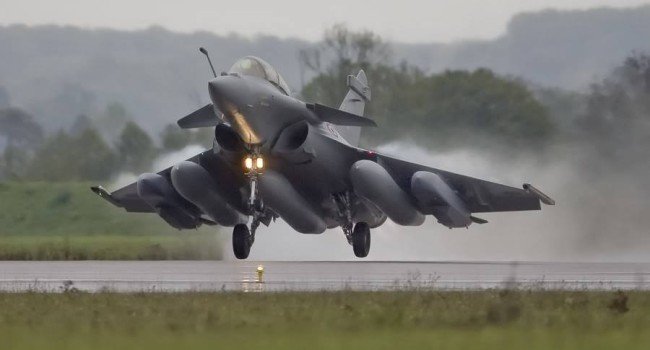
‘India may deploy N-capable Rafale jets on China, Pak borders’

‘India may deploy N-capable Rafale jets on China, Pak borders’
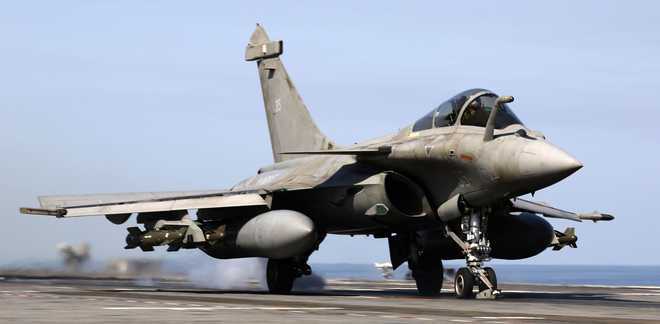
File photo of a Rafale fighter jet

Beijing, September 30

China apprehends that India will deploy the 36 nuclear-capable Rafale fighter jets to be acquired from France in the border regions of China and Pakistan to enhance its deterrence capability, a media report here said.

India will deploy the new French-made fighters in the disputed areas bordering Pakistan and China, state-run Global Times reported quoting Shenzhen Television.

A recent report by Stockholm International Peace Research Institute (SIPRI) said India is the largest arms importer in the world, the newspaper said.

(Follow The Tribune on Facebook; and Twitter @thetribunechd)

Increased arms imports into the Asian region are primarily due to the unstable security environment in the Middle East and concerns from China’s neighbours over its rise.

The Rafale fighters in flyaway condition carry tactical nuclear warheads, and this means India’s nuclear deterrence capability will be greatly improved, Shenzhen Television reported.

“India also wants to purchase the Rafale technology from Dassault but France refused, meaning France has no intention to help India promote its military industrial system,” Zhao Gancheng, director of South Asia Studies at the Shanghai Institutes for International Studies said.

While India is rapidly expanding its military capabilities spending an estimated $100 billion on new defence systems, many other countries with an advanced military industry are also competing for India’s market, such as Russia, the US and Israel, the daily quoted SIPRI report as saying.

Zhao said before this deal with France, India was also considering the US-made F-16s.

“India picked French-made jet fighters because they are cheaper and have a nuclear-deterrence capability,” he said.

SIPRI’s list of the top 10 arms importers for 2011-2015 has nine Asian or Asia-Pacific countries.

Many of China’s neighbours are also on the list of top 10 importers, such as Vietnam, South Korea and India, he said.

“Due to the South China Sea dispute and the increasing power of the Chinese navy, countries like Vietnam and the Philippines are very concerned, but the US is not helping China solve the problem peacefully,” said Song Zhongping, a Beijing-based military expert.

“The US government and media are hyping the ‘China Threat Theory,’ trying to convince countries in Asia that China is on the offensive,” he said. — PTI


India strikes across LoC, Nawaz warns Delhi

New Delhi, Sep 29 (IANS) India said on Thursday it carried out surgical strikes on terrorist launch pads across the LoC inflicting heavy casualties, triggering a sharp warning from Pakistan Prime Minister Nawaz Sharif.

Eleven days after terrorists killed 18 Indian soldiers in Jammu and Kashmir, Indian Special Forces targeted “some terrorist teams” positioned at launch pads on the Line of Control (LoC), the military announced.

“During these counter-terrorist operation, significant casualties have been caused to the terrorists and those who support them,” Lt Gen Ranbir Singh, the Director General Military Operations (DGMO), told the media here.

The announcement followed a meeting of the Cabinet Committee on Security chaired by Prime Minister Narendra Modi.

Pakistan denied any surgical strike by India but admitted to the death of two soldiers in cross-LoC firing by Indian troops.

Sharif warned that Pakistan’s “intent for peaceful neighbourhood should not be mistaken as our weakness”.

Gen Ranbir Singh said the targeted terrorists had planned “to carry out infiltration and terrorist strikes in Jammu and Kashmir and various other metros in our country.

“The operation was basically focussed to ensure that these terrorists do not succeed in their design of infiltration and carrying out destruction and endangering the lives of citizens of our country,” he said.

Gen Ranbir Singh said the operation had since ceased. “We do not have plans of further continuation of the operations. However, the Indian armed forces are fully prepared for any contingency that may arrived.”

The surgical strikes were based on “very specific and credible information”, he said.

The Pakistani military said there were no surgical strikes by India, “instead there had been cross-border fire initiated and conducted by India which is existential phenomenon.

“As per rules of engagement, the same was strongly and befittingly responded by Pakistani troops. The notion of surgical strikes linked to alleged terrorist bases is an illusion being deliberately generated by India.”

On Thursday, Pakistani military shelled Indian positions across the Line of Control — which divides Jammu and Kashmir between the two countries — at Danesh and Lakshmi posts in Naugam sector, the Jammu and Kashmir Police said. The Indian military retaliated.

Pakistan’s Inter-Services Public Relations said the exchange of fire began at 2.30 a.m. and continued till 8.00 a.m., leaving two Pakistani soldiers dead.

“Pakistani troops befittingly responded to Indian unprovoked firing on the LoC in Bhimber, Hotspring Kel and Lipa sectors,” it said.

Minutes after India announced the surgical strikes on Thursday, Prime Minister Sharif denounced what he called was an “unprovoked and naked aggression” by Indian forces.

“Our intent for peaceful neighbourhood should not be mistaken as our weakness as our valiant forces are fully capable of defending the territorial integrity of our country,” Sharif said.

He said Pakistan can “thwart any evil design made to undermine the sovereignty of Pakistan”.

The Indian DGMO said he spoke to his Pakistani counterpart and “explained our concerns and also shared with him the operation that we had conducted.

“It is India’s intention to maintain peace and tranquility in the region but we cannot — certainly not — allow the terrorists to operate across the LoC with impunity and attack the citizens of the country.

“We expect the Pakistan Army to cooperate with us to erase the menace of terrorism from our region,” he added.

“Indian troops are effectively retaliating Pakistani firing. Exchanges are still going on in the area,” the police added.

–IANS


The prophesies of Pakistan’s annihilation

Saba Naqvi
After Sharif’s latest speech at the UN and the Uri attack whatever goodwill there was may have gone for the immediate future.

The prophesies of Pakistan’s annihilation
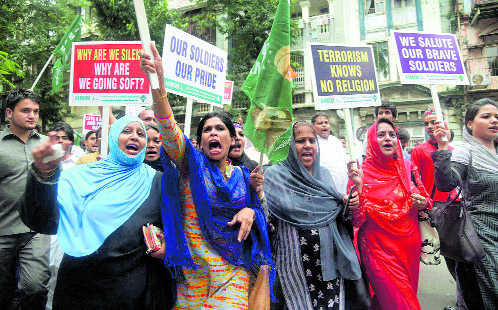
A demonstration in Mumbai. PTI

The highpoint of my TV entertainment this week was to hear an RSS/BJP functionary who is an old friend of mine declare on prime time that Sri Aurobindo had predicted that Pakistan would cease to exist by 2018. Wonderful, I thought, problem solved! Before that another agitated panelist had held forth about the vile nature of the Pakistani army: among the sins he listed a proclivity for keeping many “mistresses”. A third panelist suggested in all seriousness that one of the panelists be sent forthwith to serve the nation in the PMO. It was a complete scream. But jokes apart we must ask if after the Uri attack the government is contemplating military options against Pakistan. Not being a retired general or retired foreign secretary I don’t know. But I do know that both the prime ministers of India from the BJP have had dramatic engagements with Pakistan, fluctuating from war noises to peace gestures to mobilizing troops. Atal Bihari Vajpayee, whose PMO I covered for six years, genuinely wanted to leave a legacy of a peace in South Asia. That was his passion (economics frankly bored him). But as it turned out we had the Kargil war instead (provoked entirely by Pakistani excursions) and then Operation Parakram that began after the attack on Indian Parliament. It cost us a bomb literally and metaphorically and killed 798 Indian soldiers, mostly due to stepping on land mines and ammunition accidents. The Kargil war claimed less lives: 527 Indian soldiers. Narendra Modi is a very different personality but even he has made a couple of friendly gestures towards Pakistan, most dramatically dropping in suddenly to greet Nawaz Sharif on his birthday on December 25 last year. Now after Sharif’s latest speech at the UN and the Uri attack whatever goodwill there was may have gone for the immediate future. But are we seriously thinking of military options? I wish Jaswant Singh, a critical part of the Vajpayee establishment, had been able to give his views about mobilizing troops on the border. (Sadly, he has been in a coma for two years). The man who served as Finance, Defence and External Affairs minister under Vajpayee had elaborated to me about his opposition to Operation Parakram.Here are his exact words as I recorded them: “I was not there when certain important decisions were taken. When I came back, I said, what have you done? No, no, it will be advantageous, I was told. Then it was fait accompli. Troops had already been deployed. I said I did not stand for war. Soldiers know what war is. A soldier can never be a war-monger. I had differences with Atalji too at that time. When he said “aar-paar ki ladai ho jaaye (let there be a fight to the finish)”, I said to him, what are you saying? Atalji said, “Us waqt kah diya (I just said it at that time).” Atalji was a man given to emotion and rhetoric. But he would never take offence at honest criticism.” The last time I met Jaswant Singh was in September 2012 when I moderated the discussion at the launch of his book titled The Audacity of Opinion: Reflections, Journeys, Musings. He did have a lot of opinions that did not sit well in the BJP post the Vajpayee era. I imagine he would have thought that if revenge is to be a trigger for action, then it is a dish best served cold.Meanwhile, it may be worth our while to reflect on the fact that Vajpayee possibly earned a certain level of credibility in Kashmir valley as he was prime minister when one of the fairest elections in Jammu & Kashmir took place in 2002 in four phases. Electronic voting machines were used for the first time and the elections were seen as a victory of the ballot over the bullet.  Mufti Mohammad Sayeed became chief minister after for three years in a seat-sharing arrangement with the Congress. I remember covering that campaign and meeting two candidates who were later shot dead by terrorists who were opposing the elections. There was also a close shave when I got delayed returning from the beautiful Lolab valley that was then a hiding place for separatists and militants. It was dark and we had not made it to Srinagar when an army post shot at our vehicle and missed. We could only move on when our Indian identities were revealed. This time round Mufti made a pact with the BJP. He has passed away but his party has for a complicated set of reasons not under their control, now lost all credibility. The valley should have by now been under Governor’s rule but I suspect the only reason that the PDP-BJP regime stays in power is because the BJP has stakes in government. It is a good question to ask why the people of Jammu should be denied their mandate. But what of the people in the Valley now entering the third month of their torment? Perhaps we should ask friends in the RSS if there are any prophecies about Kashmir. Pakistan, rest assured, will cease to exist.


If There Is War, India Will Win Says::—— US Think Tank The Telegraph – London

India enjoys a strong numerical advantage over Pakistan in both conventional and nuclear weapons, giving it an edge in its current confrontation with its perennial foe, according to data released by a leading US think tank.

But a prominent US expert on South Asia also warned that the roughly two-to-one military advantage of the Indian armed forces makes it more likely that a cornered Islamabad could lash out with a nuclear strike.

“If you had a full war between India and Pakistan, not just skirmishes on the border, India would start winning,” said former US ambasador Dennis Kux, who has served in both India and Pakistan. “And at a certain point Pakistan, rather than going under, would push the button,” he said on CNN’s The Capital Gang show.

According to a report by the Washington-based , India has more than 12 lakh soldiers on active duty compared to Pakistan’s 6.2 lakh.

A similar advantage is observed in practically all major conventional weapons category, the survey showed. New Delhi’s arsenal includes 3,414 main battle tanks and 1,540 light tanks, while Islamabad’s heavy armor is limited to a total of 2,300 pieces.

India is also better positioned in the sky, if its current tensions with Pakistan were ever to boil over into a shooting war.

India’s air bases house a total of 738 combat aircraft while Pakistan’s house 353, according to CSIS. New Delhi also has nearly a five-fold advantage in transport aircraft and a six-fold advantage in combat helicopters, which, as events in Afghanistan have shown, can inflict devastating damage on ground troops.

In addition, India has 37 Naval aircraft compared to Pakistan’s five, the reported indicated.

Islamabad has an advantage only in self-propelled artillery, being able to field 240 pieces compared to India’s 180. But it loses out in towed artillery where New Delhi has a 4,175-to-1,467 advantage, the data showed.

Kux said geography also favored India because an armored blitz across arid Punjab province toward the Afghan border could cut off Islamabad, the capital, from Sindh, the country’s economic owerhouse and its main port of Karachi.

“India could just cut across the middle of Pakistan,” said the former diplomat. “In the desert, it should be fairly easy to do.”

US experts believe that even in an exchange of nuclear strikes, India, while suffering tremendous losses, could have an advantage. Although no reliable official data is available, it is estimated that New Delhi has 400 kg of weapons-usable plutonium, according to the CSIS report.

Since it takes about six kg of plutonium to manufacture a nuclear bomb, the amount would be sufficient to produce some 65 bombs if old technologies are used, or 90 bombs employing more advanced methods.

By contrast, Pakistan is believed to have more than 200 kg of weapons-grade uranium, which is enough to construct 15 to 25 nuclear weapons, the report said.Copyright © 2001 Mid-Day Multimedia Ltd all rights reserved

http://googleweblight.com/?lite_url=http://www.rense.com/&lc=en-IN&s=1&m=334&host=www.google.co.in&ts=1474687908&sig=AKOVD646cRKjev0ela0sWZkQjOXYaqXHXA


Russian troops arrive in Pak for first-ever joint military exercise

Russian troops arrive in Pak for first-ever joint military exercise
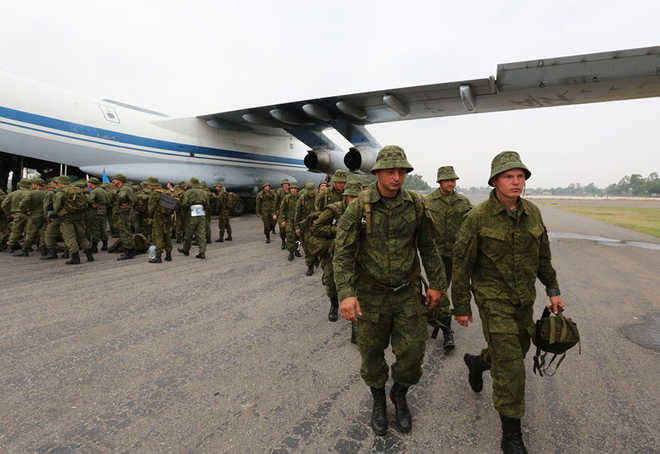
In this handout photograph released by Pakistans Inter Services Public Relations (ISPR) on September 23, 2016, Russian troops arrive at a Pakistan military base at an undisclosed location.- AFP

Islamabad, September 23

A mechanised infantry unit of the Russian military on Friday arrived in Pakistan to participate in the first-ever joint military drills dubbed ‘Friendship-2016’ starting from tomorrow, reflecting growing military ties between the two former Cold War rivals.

“A contingent of Russian ground forces arrived in Pakistan for the first-ever Pak-Russian joint exercise from September 24 to October 10,” Army spokesman Lt General Asim Bajwa tweeted along with some photographs of the Russian and Pakistan troops.

A statement by Russia’s Southern Military Command said the drills will involve over 70 servicemen of the Southern Military Command, including the Mountain Mobile Brigade’s personnel deployed to the Karachay-Cherkessia Republic (North Caucasus), and also officers from the headquarters’ staff.

(Follow The Tribune on Facebook; and Twitter @thetribunechd)

“The Southern Military Command’s mechanised infantry servicemen are fully equipped and have their mountain gear with them, as well as ammunition for their standard weapons,” Russia’s Itar-Tass news agency reported, citing the statement.

The two militaries will share their experience and employ teamwork in fighting in mountainous areas, particularly destroying illegal armed groups, it said.

“The joint military drills are aimed at bolstering and building up military cooperation between the two countries,” it said ahead of the opening ceremony tomorrow which is scheduled to take place at Pakistan Army’s High Altitude School in Rattu, Gilgit-Baltistan, Pakistan-occupied Kashmir.

About 200 troops from the two countries will take part in the two-week-long military drills called as ‘Friendship 2016’, which have been termed as a sign of growing military ties between the former rivals of Cold war era.

The joint drill is seen as another step in growing military-to-military cooperation, indicating a steady growth in bilateral relationship between the two countries, whose ties had been marred by Cold War rivalry for decades.

Pakistan decided to broaden its foreign policy options after its relations with the US deteriorated following a secret CIA raid in Abbottabad that killed al-Qaeda chief Osama bin Laden in May 2011.

Its relations with the US were soured recently when US lawmakers blocked funds for the sale of eight Lockheed Martin Corporation’s F-16 fighter jets to Pakistan.

Pakistan decided to look at alternative sources to purchase the aircraft, including from Jordan.

Over the last 15 months, the chiefs of Pakistan’s Army, Navy and Air Force travelled to Russia. The flurry of high-level bilateral exchanges resulted in the signing of a deal for the sale of four MI-35 attack helicopters to Islamabad.

The agreement, signed in Moscow in August 2015, was considered a major policy shift on part of Russia in the wake of growing strategic partnership between the US and India.

Islamabad is eager to improve its ties with Moscow to diversify its options in the event of any stalemate in ties with Washington.

After securing the helicopters deal, Pakistan is also exploring options to buy Su-35 fighter jets from Russia. For this purpose, Chief of Air Staff Air Chief Marshal Sohail Aman visited Moscow in July. — PTI


Mother lends shoulder to martyr’s body

Mother lends shoulder to martyr’s body
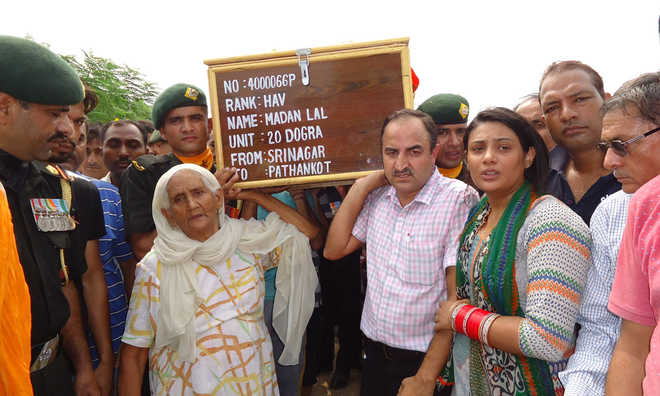
The mother of martyr Hawaldar Madan Lal Sharma lends a shoulder to his coffin. Tribune photo

Ravi Dhaliwal

Tribune News Service

Gharota (Pathankot), September 22Dharmo Devi (82), mother of martyr Havildar Madan Lal Sharma (40), who was killed in a gun battle with militants in the Kashmir valley on Tuesday, stunned everybody present by walking 3 km while lending her shoulder to the coffin in which the body of her son lay.The soldier’s mortal remains were brought to the family house in the village on Thursday morning by the jawans of the 2nd Dogra Regiment. Earlier, it was flown in to the Pathankot IAF base from Kashmir.The moment the body was placed in the house for people to pay their last respects, the soldier’s mother made it clear that out of the four persons who would carry the body to the cremation ground she would be one. She was dissuaded from doing so by senior army officers who told her that keeping in view her age and the long distance to be travelled it would not be feasible for her to lend a shoulder. However, she was adamant and told the officers if that was the case the body would not leave the house.On the entire course, she kept on saying that the country needed more soldiers like her son who could rise to the occasion to defend the nation.More than a thousand people had gathered to pay last respects to the soldier.