



Sanjha Morcha

What’s New

Click the heading to open detailed news

Current Events :

web counter

Print Media Reproduced Defence Related News

Suspended army officer moves SC, says getting death threats from insurgents

Suspended army officer moves SC, says getting death threats from insurgents

The officer claims to have been framed in false corruption case.

New Delhi, June 7

A suspended Army officer, who is facing a CBI probe for allegedly amassing disproportionate assets, on Thursday knocked the doors of the Supreme Court with a plea that he feared for life from insurgents in Manipur, where he claimed to have been framed in a false corruption case.Lieutenant Colonel Harpreet Singh, who was recently suspended, was posted at Manipur in the intelligence wing of Assam Rifles where he had carried out a series of operations against insurgents in which he claimed that over 100 ultras had surrendered and several of them were killed.A vacation bench of Justices Adarsh Kumar Goel and Ashok Bhushan was today told by Singh’s counsel that the officer had received death threats in April this year when he had gone to Imphal to attend court proceedings in a disproportionate assets (DA) case lodged against him by the CBI.The matter was mentioned in the court for urgent listing by senior advocate S P Singh and advocate Sudhakar Dwivedi and the bench said the plea seeking transfer of the DA case from Imphal to Chandigarh would be heard after re-opening of the top court following the ongoing summer vacations.In his plea, the petitioner has said he had suffered 60 per cent disability due to injuries in operations in Jammu and Kashmir in Kupwara sector and was awarded the Sena Medal in 2002.He said in October 2009, he was sent to Assam Rifles on deputation and he was posted as SO-2 (intelligence) where his duty entailed functioning to control insurgency.”The petitioner (Singh) was able to establish an effective intelligence and liasion network and was successful in getting more that 100 surrenders and apprehensions of the cadres belonging to the major insurgent groups active in the area of Manipur. During anti-insurgency operations, some cadres of the insurgent groups were also killed,” he claimed.As per the petition, Robin Luwang Cha, now the chief of militant outfit People’s Liberation Army, was a senior functionary of the insurgent group and Singh was collecting intelligence inputs against him during his posting at Imphal.The petitioner has claimed that Robin was closely related to an Army officer who was posted in vigilance wing of Assam Rifles.Singh has alleged that the Army officer “used to frequently change the local intelligence informers of Manipur with a view to hamper the anti-insurgency operations” and he “often leaked out the secret information about the conduct of operations resulting in failure of the sensitive operations”.He claimed that the Army officer had often threatened him over phone after which he duly brought to the notice of his superiors the apprehension about the motives and designs of the officer.”For the above reasons, the petitioner is on the radar of the major insurgent groups operating in and around Manipur and faces serious threat to his life,” he said claiming that he would “surely be killed by the insurgent groups” if he goes to attend court proceedings at Imphal.He said his plea seeking transfer of the case from Imphal was dismissed by the apex court in March this year after which he went there to attend court proceedings but he received threat on his phone.The plea said a CBI FIR was lodged under the provisions of the Prevention of Corruption Act in October 2013. – PTI


Pilot Killed After Air Force’s Jaguar Crashes In Gujarat

The Indian Air Force Jaguar aircraft, flown by Air Commodore Sanjay Chauhan, was on a routine training mission, a defence spokesperson said

An Indian Air Force (IAF) Jaguar aircraft crashed in Gujarat’s Kutch soon after take-off this morning, killing the pilot. Reports suggest the plane flew from the Jamnagar air base and crashed near a village.

The aircraft, flown by Air Commodore Sanjay Chauhan, was on a routine training mission, a defence spokesperson said. The plane’s debris was strewn on the fields near a village in Kutch, around 340 km from Ahmedabad.

The incident comes months after an IAF helicopter crashed in Assam’s Majuli island, killing two pilots — Wing Commander J James and Wing Commander D Vats.

58COMMENTS

“Today morning a Jaguar aircraft on a routine training mission from Jamnagar crashed around 10:30 am,” defence spokesperson Lieutenant Colonel Manish Ojha said.

jaguar

The parts of the IAF’s Jaguar bomber that crashed in Gujarat

A court of inquiry has been ordered by the air headquarters to investigate the cause of the crash.

The Jaguar is a twin-engine, ground attack aircraft which can penetrate deep behind enemy lines on bombing runs. It has a maximum speed of 1,350 kmph or 1.3 times the speed of sound. The aircraft is ageing since it was inducted into the Indian Air Force in 1979 — almost four decades ago.

https://www.ndtv.com/video/news/news/pilot-killed-after-air-force-s-jaguar-crashes-in-gujarat-486483


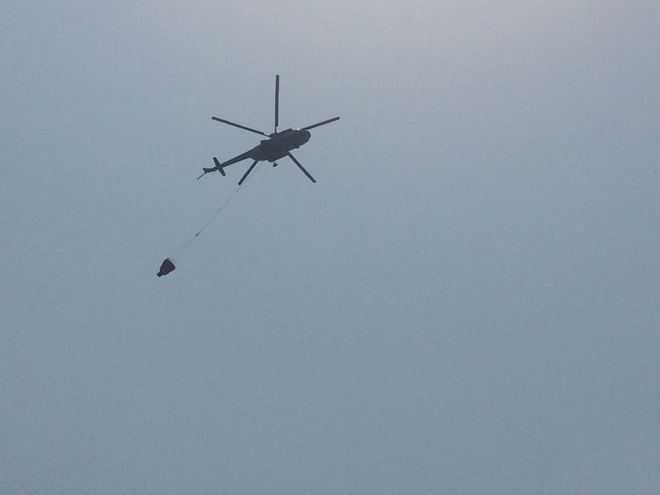
IAF choppers to douse forest fires

IAF choppers to douse forest fires

Tribune News Service

Shimla, May 31

With there being no signs of rain, the state has requisitioned three IAF choppers to douse the raging forest fires in the worst-affected districts of Chamba, Kangra, Hamirpur and Mandi.Forest Minister Govind Thakur on Thursday said the IAF had kept three of its choppers on stand-by and the exercise would be undertaken Friday onwards.“We will press IAF choppers into service which can spray 3,500 litre of water in one sortie at places where it is tough for fire tenders to reach in the absence of roads,” he said.Water to douse the fires will be brought from Pong Dam in Kangra, Govindsagar Dam, Chamera in Chamba and Kol Dam in Bilapur and Pandoh in Mandi. So far a total of 1,544 forest fires have been reported this summer, resulting in a loss of Rs 1.68 crore to forest wealth.The Forest Minister said a total of major 56 forest fires had been reported out of which 12-day-old fire in the Baddi area of Solan and the week-old fire in the Bhattiyat area of Chamba was the most worrisome as these could not be controlled.He said 95 per cent forest fires were caused by human callousness. He added that drone cameras would be used to find out the cause.He said patrolling would be intensified and police assistance would be sought to keep a check on anti-social elements, who were behind these fires.He said there was no dearth of funds for combating forest fires and the department would adopt the latest technology to prevent huge loss resulting from these forest fires, every summer.So far four persons, Deputy Ranger Ashok Kumar in Chamba and three persons, Manju Devi (Sunni), Satwinder (Jaswan) and Chambel Singh (Sarahan), have lost their lives in the forest fires. Six other persons have been injured while trying to control forest fires.CM mourns Dy Ranger’s death Chief Minister Jai Ram Thakur mourned the death of Deputy Ranger Ashok Kumar, who lost his life during a fire-fighting operation in Chamba district. The Chamba Deputy Commissioner provided Rs 25,000 as immediate relief to the family of the deceased. Principal Chief Conservator of Forests Dr GS Goraya said the Deputy Ranger died as he fell into a gorge during the fire-fighting operation. He was not charred to death as reported in a section of the media, he added.


India wants peace, but Pak must stop sending militants into J&K: Gen Rawat

India wants peace, but Pak must stop sending militants into J&K: Gen Rawat

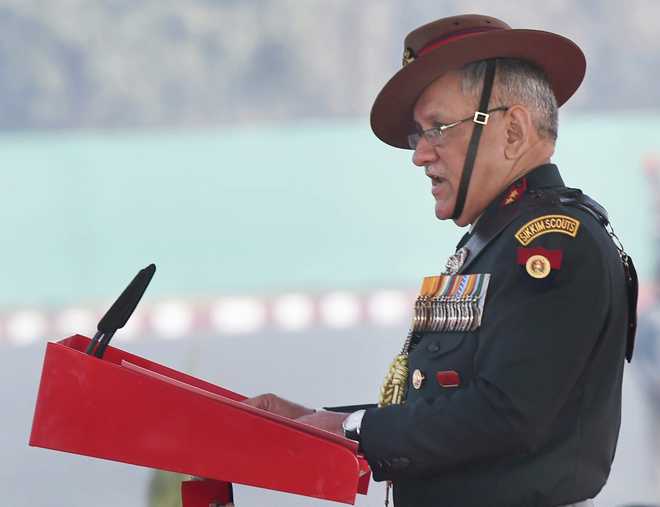
File photo of Army Chief General Bipin Rawat. PTI

Pahalgam, May 25

The suspension of combat operations in Jammu and Kashmir can be extended further if the atmosphere of peace continues in the state, but any action by terrorists would trigger a rethink immediately, Army Chief General Bipin Rawat said on Friday.

Rawat also said Pakistan should stop sending militants into the state if it was interested in peace.

“If Pakistan really wants peace, then we will want them to take the first step by stopping infiltration of terrorists into our side. The ceasefire violation mostly takes place to aid infiltration,” Gen Rawat told reporters at a function here, 95 km from Srinagar.

The army chief said India wants peace along the borders but Pakistan was continuously violating the ceasefire, which caused loss of life and property.

“When such an action takes place, we also have to respond. We cannot sit idle. If there is ceasefire violation, then there will be action from our side,” he said.

Gen Rawat said for peace, it was imperative that cross-border terrorism comes to an end.

“It is imperative to stop terrorism from across (the LoC), the camps which are there where training is given to them, from where the ammunition is infiltrated into J-K and India, that should stop. If that happens, then I can assure you that peace will prevail on the borders,” he added.

The Army chief said the suspension of anti-militancy operations in Jammu and Kashmir was an attempt to make people realise the benefits of peace.

“The suspension of operations or what we call NICO (Non initiation of combat operations) has been done to make the people believe and see how the atmosphere is when there is peace. The way an atmosphere of peace and calm is here right now, in my opinion, the people here are very happy with that,” he said.

The Union home ministry had announced on May 16 that security forces would not launch any operations in J&K during the holy month of Ramzan. However, the security forces reserve the right to retaliate if attacked or if essential to protect the lives of innocent people.

Gen Rawat said the Army will think about continuing the unilateral ceasefire if the peaceful situation continues in the valley.

“If this atmosphere of peace continues, then I assure you that we will think about continuing with NICO. But if there is some action by the terrorists, then we will have to rethink on this ceasefire or suspension of operations or NICO,” he said.

Gen Rawat was here to launch Digital Education in five Army Goodwill Schools which has been established with the help of Power Grid Corporation and Extra Marks Foundation.

“Children in AGPS should get right kind of education. Their education standards should keep improving. Knowledge and education today needs infusion of technology. With this aim, we have taken help from PGC and Extra Marks foundation to start Digital education here,” he said.

Gen Rawat said the Corporation has contributed nearly Rs 25 lakh and Extra Marks foundation is providing support.

“This will be started in five army good schools on pilot basis. We would like to extend this technology to other Army Goodwill Schools also. We want the children from here develop and progress in life,” he added. PTI


Cross-border friendship in Rome by Vijay Sabharwal

Cross-border friendship in Rome

Vijay Sabharwal

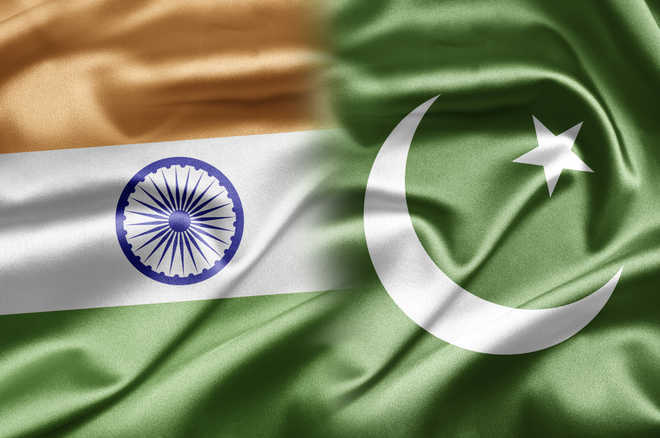
IT’S been seven decades since the Partition, but the relations between India and Pakistan are still complex, verging on hostility. Most people don’t know what goes on across the border, except what their media tells them. But there are many who refuse to harbour animosity against the other. And therefore, whenever they come across each other, they rarely see an enemy. In fact, owing to the similarity in food, culture and language, they tend to become friends with greater ease. I observed this during an exchange programme initiated during the tenure of the Vajpayee government. It is heartening to see those visitors maintaining ties with their counterparts to date. In my own experience, too, I have noticed during my foreign visits that whenever people from these two nations meet, especially in a third country, they go out of their way to help each other. My recent visit to Rome further strengthened my perception about the other side and the desire for amity.I went to enquire about the city tour bus for Vatican City and found that it would cost 22 euros for a ticket and 40 for two. On my way back to the hotel, I was approached by a man offering me two tickets of another bus company for just 36 euros. Apparently, my familiar appearance in a foreign country prompted him to ask if I was an Indian. His face gleamed with joy when I nodded. ‘I am from Pakistan.’ I told him that I was born in Eminabad (now in Pakistan), to which he zealously responded that he was from Lahore.   We began talking. I told him that though I didn’t know much about Pakistan, as I was a child when we moved to India, I had fond memories of my father’s friend, Sheikh Mohammad Ali, who had retired as Principal of Dayal Singh College, Lahore. ‘I used to call him Chachaji and he often visited our place even after the Partition.’ A look of astonishment crossed his face and he exultantly took my hand in his own, saying he was a graduate from Dayal Singh College, and coincidentally, his father had studied under Sheikh saheb in the same college! ‘See how close we are, but it is the politicians who have separated people of the two nations,’ he sighed.Introducing himself as Hanif, he further reduced the ticket price to 32 euros. Meanwhile, my wife joined us. He greeted her and started explaining the itinerary for the tour. When she told him that except for Vatican City we had already visited the rest of the places, he asked us not to waste money on the bus tour, and rather take the Metro. He took us to the nearby station and helped us buy return tickets for only 3 euros each. While we were lauding Hanif on our way back, we happened to meet another Pakistani who got us delicious biryani at reduced rate as a gesture of goodwill.While cherishing Rome’s memories, Hanif’s words often make me ponder whether it is the lack of political will or positive vision that is not allowing these two nations to embrace each other. Whatever it is, the people don’t desire perpetuation of this separation.


Stone-pelters today, gun-wielders tomorrow by Col Mahesh Chadha (retd)

Reconciliation, and not confrontation, is the key to peace. In this time of crisis in J&K, the nation needs to stand together with sincerity of purpose, without any hidden agenda of political parties, to give peace a chance.

Stone-pelters today, gun-wielders tomorrow

Col Mahesh Chadha (retd)

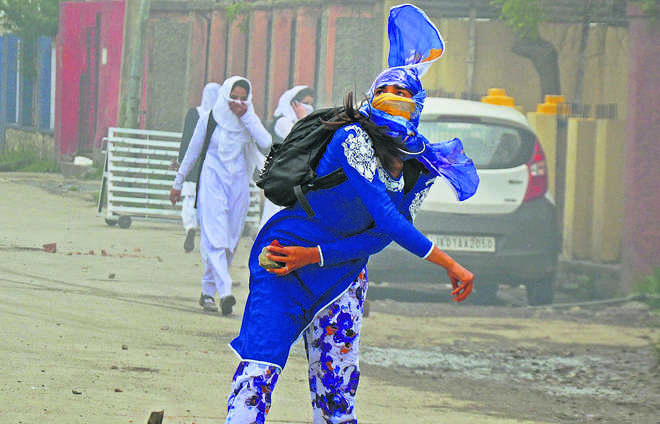
Catch them young is what presents a picture of the prospective diehard generation in the Kashmir valley today. It is now almost three decades that the boys and girls born in the interim have learnt to pursue the mission ingrained in them — to liberate Kashmir from the occupation forces of India. A very simple act of stone-pelting at the security forces (SF) is being practised that obstructs and diminishes the chances of launching any successful operation against the insurgents or the anti-national elements and places them in a win-win situation; one, making the terrorists escape under the shield provided by them and two, ensuring their own safety for any action taken against them would make the SF liable to prosecution. In the two recent cases where a boy was overrun by the J&K police vehicle and a tourist was done to death with stones brings to fore a question: what could a driver do when a boy pelting stones on the preceding vehicle came under it and died? To a common man, it would appear as an accident in the heat of the moment, when the terrorists are being chased, the driver sits on the right and the boy came from the left hand side. But to the separatists like the Hurriyat and their supporters, it would appear to be a cold-blooded murder. But the latter case for them is not so. For the SF, this is a very sensitive and critical situation to handle for which they would have to face courts for long. Can this go on forever? After all, it is an Indian blood that would have been preserved for a better cause.

The stone-pelting phenomenon

The question is why these young boys and girls have taken to stone-pelting. May be, some of them have lost their kith and kin in crossfire, or have been subjected to troublesome cordon and search operations carried out regularly by SF to hound out suspected terrorists. Or, above all, that they have been indoctrinated by their peers, leaders, parents, relatives and friends inimical to India and through vitiated propaganda that goes on in their schools and religious places. That such are the atrocities being inflicted upon them as to be confronted with stone-pelting is a mere expression of their ire at the SF — doing a David to a Goliath. Regarding the exodus of Kashmiri Pandits from the valley as a victory over the sympathisers or informers for the SF, it is such youth who in the near future is likely to take up arms and join like their elders the terrorist groups launching a rebellion against the state in the times to come — resulting in civil war-like situation. It must be remembered that the gun is more lethal than the stone. Therefore, wisdom lies in to bear the injuries caused by stones, let the terrorist escape for the time being; for he can only live another day and his turn would come sooner or later. What is the hurry in launching the ‘Operation All Out’, cause and suffer casualties on both sides as insurgency of such high intensity is not likely to die- but continue to simmer? So, it has to be doused in a manner that it does not look anti-Kashmiris as it does today. So, irrespective of the danger imposed upon the SF there is a need to be more tolerant as such retaliatory incidents negate all the good work done by the SF and the state to bring the youth in to main stream.

The solution

From time to time, we have tried many options; but not what we adopted as ‘give and take’ that paved the way for the Mizo National Front to take over the reins from an elected government to terminate the insurgency. The Naga accord is another successful experiment. The fear that such a move may enable the separatists to call for a referendum is ill founded as there are provisions in the Constitution that would require the assent of the President, participation in elections, PoK to be brought under Indian control and it’s participation and, above all, Jammu and Ladakh not toeing such a line to pass the referendum for an accession or joining Pakistan. Perhaps, such a government may be able to re-orientate the stone-pelters to better cause of joining the mainstream.The following are some points that would bring today’s stone-pelters — for they can still be remoulded to utilise their energy towards the cause of peace in Kashmir:

  • Start afresh, listen and not assert on issues that have brought Kashmir to such a pass.
  • A soothing counter propaganda by the authorities in the schools, colleges and other institutions to negate the propaganda by the separatists and the terrorists.
  • Follow the principles of good faith, minimum force and preventive action rather than punitive action.
  • Armed action only against foreign insurgents crossing over to Kashmir.
  • A unilateral cease fire against own trouble makers during religious festivals and when talks are under progress to create an atmosphere of understanding and peace.
  • Reinvent commandments to take forward the essence of Kashmiriat, Insaniyat and Jamhooriat.
  • Assuage the feelings of hurt and animosity against India by constant dialogue with social workers, eminent persons, writers and poets.
  • Dispense quick justice to the victims.

There is nothing worse than shedding more blood on Indian soil revered for ages for its unity in diversity, art and culture for which Kashmir stands out as heaven on earth. In this hour of crisis, the nation has to stand together with sincerity of purpose without any hidden agenda of political parties to give peace a chance.


India must evolve its own model of integrated military theatre and not copy-paste from global examples by LT GEN SYED ATA HASNAIN (RETD)

Indian military

India may need to adopt a model that keeps the individual components in a theatre under some form of dual control.

There is now a proposal to amend the single service acts to legally facilitate more operational integration between the three military services. The goal is that command and control issues, which are single-service based, do not come in the way of joint operations and the future joint theatre concept.

Some military legal experts have expressed their view that this has nothing to do with the desired operational integration. But any trigger to bring to light issues regarding integration, better command and control, jointness and resource sharing, is always welcome.

There needs to be greater debate in the public realm about these things because transparency in defence matters can be healthy.

There is a basic logic to the argument for ‘jointness’ and integration. The common aim of the three armed forces is to secure India against aggression and conduct such operations in the achievement of the national aim. To do this, they have different means, resources and work cultures. Without optimising joint capability, there is much wastage of resources. Also, the lack of a common work culture and procedures often places the achievement of the national aim at risk. It is the practice of integrating common technologies and available best practices with smart resource sharing that makes winners.

The Kargil Review Committee (KRC) in 2001 strongly recommended the adoption of greater integration, and the appointment of a Chief of Defence Staff (CDS) to be the single authority for the government to consult, rather than individual service chiefs.

There are many examples of integrated services around the world. However, the model to be finally adopted has to be an Indian one, based on the threat pattern, geographic factors, and distinct work culture. It is best never to copy-paste existent models, but examine each for its worth.

The most common model quoted for integration is that of the US, which actually forced its armed forces into integration through a legislation in 1986; the Goldwater Nichols Act. It was the result of the perceived collective failure of the disastrous rescue attempt to evacuate hostages from the US embassy in Tehran in 1980 and the botched Grenada operation of 1983. All resources of the four armed forces (the Marines being the fourth element) were placed under different regional and task-based theatre headquarters.The theatre commander reports directly to the President of the US through the defence secretary (equivalent to defence minister in our case). The Joint Chiefs of Staff acts as an advisory body, with a chairman as its head. The individual service chiefs of the components do not assume operational responsibility, but are responsible for personnel, logistics and equipment aspects.

Is such a model applicable to the Indian scenario?

The answer is both yes and no. India has 17 individual service command HQs. The issue is whether these can regionally be integrated into theatres to ensure that no single service can claim primacy for its operations.

Whatever model of integration is adopted, there has to be doctrinal guidance and placement of all resources in a single basket. The key question is the ability to accept one service as the lead for a theatre. The best example of this is witnessed in the Andaman & Nicobar Command (ANC) where naval primacy may be obvious and J&K where the Army may have to be in greater control. The issue of primacy, however, can pose obstacles in the path of integration.

The Shekatkar Committee has included in its recommendations the appointment of a CDS and an integrated ministry of defence, but that’s exactly what the KRC also did.

Here, the US model will make the service chiefs somewhat irrelevant. This is not a model which will be easily welcome in India. Our model may need to yet keep the individual components in a theatre under some form of dual control. Will this work optimally is something which needs intense debate. The responsibility for details of structures and resource sharing is surely that of the current military leadership, which can suitably seek greater advice from the strategic community.

The critical question is whether the incremental approach towards theaterisation and integration is the right way or a sudden, transformational approach as adopted by the US in 1986.

Baby steps such as amending service laws may not really lead to anything substantial. The government is on record to have taken a decision on the Defence Cyber and Space Agencies and a Special Operations Division, which the defence secretary has said will soon become a reality. However, a MoD shorn of expertise in the handling of these may surely not be the optimum way towards the future.

One can perhaps visualise a potential compromise formula as a first move: creating a CDS holding all task-based commands and agencies (including Strategic Forces Command and ANC). We can also reform the MoD, infusing it with some uniformed presence. These can be the baby steps that eventually move towards a full-blown theatre command concept.

Lt Gen. Syed Ata Hasnain (Retd), a former GOC of Srinagar-based 15 Corps, is associated with the Vivekanand International Foundation and the Institute of Peace and Conflict Studies


Kashmir Ramzan ceasefire is a wise move by Indian government by Lt Gen SYED ATA HASNAIN

Sub-conventional operations always demand an early end to hostilities, through the creation of conditions which limit – or end – the scope for any perceived success by those who adopt the path of violence. However, operations in Jammu and Kashmir (J&K) have witnessed dynamic cycles of violence, without an end in sight. No doubt proxy support to terror groups, both foreign and local, and the high stakes our adversaries perceive in the continuation of violence place attaining peace out on a limb.

Through 2017-18, the security forces (SF) successfully conducted robust operations to achieve military domination in J&K. However, the end game in such situations cannot revolve only around the elimination of the last terrorist to attain peace – it must include outreach for the acceptance of the state’s narrative by the people.

Through most of Operation All Out, there has been constant criticism of the robust approach without efforts to match counter-narratives thwarting proxy and inimical local narratives. In other words, a mix of “soft power” (psychological and information ops) with hard might has been conspicuously missing in Kashmir.

Instead, the powerful narrative spelt out for the people of Kashmir by the nexus of separatists, terrorists and proxy sponsors dwells on the attainment of Azadi (or, independence). In 1989-90, a similar narrative centered on the slogan “Kashmir Banega Pakistan” went viral with the people imagining the arrival of Pakistani rule the next morning. Then too, our counter-narratives were weak; or simply missing.

kashmir_inside_051718033233.jpgWheels of change: “Soft power” needs to run alongside military might

The counter-narrative that needs spelling out by the authorities must dwell upon the impossibility of the achievement of Azadi, and the need for mainstreaming the people with rest of India. Sensing the feasibility of such a counter-narrative, the nexus has ensured that despite the military domination achieved by the Indian security forces, turbulence persists in J&K, frequently through street power demonstrated as “people’s power” – that is the reason for stone throwing, activity via mosques, rabble rousing and the prevention of grassroots political activity. These deny the authorities the space required to project the national counter-narrative.

In the face of this, it is surprising that the Indian public has been unable to perceive how the national counter-narrative cannot be brought to bear alongside only a robust campaign aiming to eliminate the last terrorist.

In a movement, which has now become largely indigenous, the attempted elimination of the last individual who bears arms against the state is a flawed – and impossible – concept, which will only fuel the movement interminably.

In light of this, the Centre’s decision to accept the J&K state’s proposal for a temporary cessation of operations during the period of Ramzan, extending probably to the Amarnath Yatra which follows closely after Id ul Fitr, is not an incorrect one.

srinagar-airport_051718023022.jpgSecuring what’s ours: File photo of an Indian para-trooper after terrorists tried to storm the high security airport at Srinagar in 2001 (Reuters)

A unilateral restraint in operations is no indicator of weakness, as some may believe, and occupying the higher moral ground by the state will always place it at advantage. In fact, this is a display of the state’s confidence and will to seek peace. The execution must remain such that in the eventuality of failure, a return to operations must not witness greater terrorist capability.

The public in India remains apprehensive of the government’s decision due to incorrect perceptions about the cessation of operations; this is being viewed literally as a “ceasefire” akin to one at the LoC where the guns fall silent. But this is a mistake, for the operations of the SF continue as before – with the exception of offensive aspects, such as “cordon and search” and “search and destroy”, which are temporarily shelved. Counter infiltration, area domination, patrolling and even night ambushes remain as usual. As long as terror groups do not openly brandish arms, they can even move freely.

Going by experience, the chances of the successful extension of such a situation depends upon the response – in a similar cessation of operations in 2000, the LeT conducted one of its most daring operations, on the Srinagar airport. Even this time, the LeT has already rejected the offer, but its significance is comparatively reduced due to much lower strength of foreign terrorists.

The challenge now is to prevent any further local recruitment, bring a sense of calm to society, engage with the public (especially youth) in transformational ways, such as town hall meetings, and quietly convey the messages – J&K has much to gain being Indian; politically and geo-strategically, India cannot ever part with J&K; Azadi is an impossible and unattainable mission.

More themes for counter-narratives can be progressively built, but success now will depend on the coordinated political sensitivity needed to handle the next few weeks. Militarily, a political failure must not adversely affect the domination achieved. It’s a tall order – but India has the maturity to handle it.

Also read: Pakistan is working overtime to reignite the fires of jihad in Kashmir


Rana Gurjit must go Time to move away from moral squalidness

Rana Gurjit must go

EIGHT months after The Tribune exposed how people of meagre means but close to Punjab Power and Irrigation Minister Rana Gurjit Singh had managed to secure sand mines in auction, the powerful Cabinet member has submitted his resignation. As it turns out, Chief Minister Capt Amarinder Singh has held on to the resignation letter since January 4 without letting anyone get wind of it. A chance to make the best of a bad situation was lost in May itself, when the Chief Minister could have scored some brownie points by “promptly” removing from the Cabinet a person whose integrity had come under question.


By delaying acceptance of the resignation, he is compounding the mistake. There is nothing to consult in this with party president Rahul Gandhi. It is an open-and-shut case of moral shabbiness.Instances of less-than-perfect conduct by members of governments should not surprise anyone. But in this case, it is Capt Amarinder Singh’s personal standing that is at stake.

The reason for that is his well-known close ties with Rana Gurjit Singh, a man of resources. It is understandable that the Chief Minister may have found sacking Rana difficult precisely because he has a reputation that he stands by those who have stood by him. But a choice has become inevitable between obligations of personal friendship and preserving his own name; or worse, letting a tainted person have access to state’s resources. Besides accepting Rana’s resignation, the Chief Minister needs to institute a genuine inquiry — not the earlier eyewash — to see if any legal culpability is made out against the minister who seems to have dabbled in business with the government.Embarrassments over distribution of resources and licences hit the Congress government in Punjab rather early this time.

A lot of precious time and energy of the government, Assembly, and leaders of both the Opposition and the Congress have been taken up in levelling and countering allegations. It is time Capt Amarinder Singh stepped in to visibly put an end to the laissez-faire arrangement in government that every other person seems to be taking advantage of. The Rana distraction must end, and the task of governance be attended to.