Current Events :















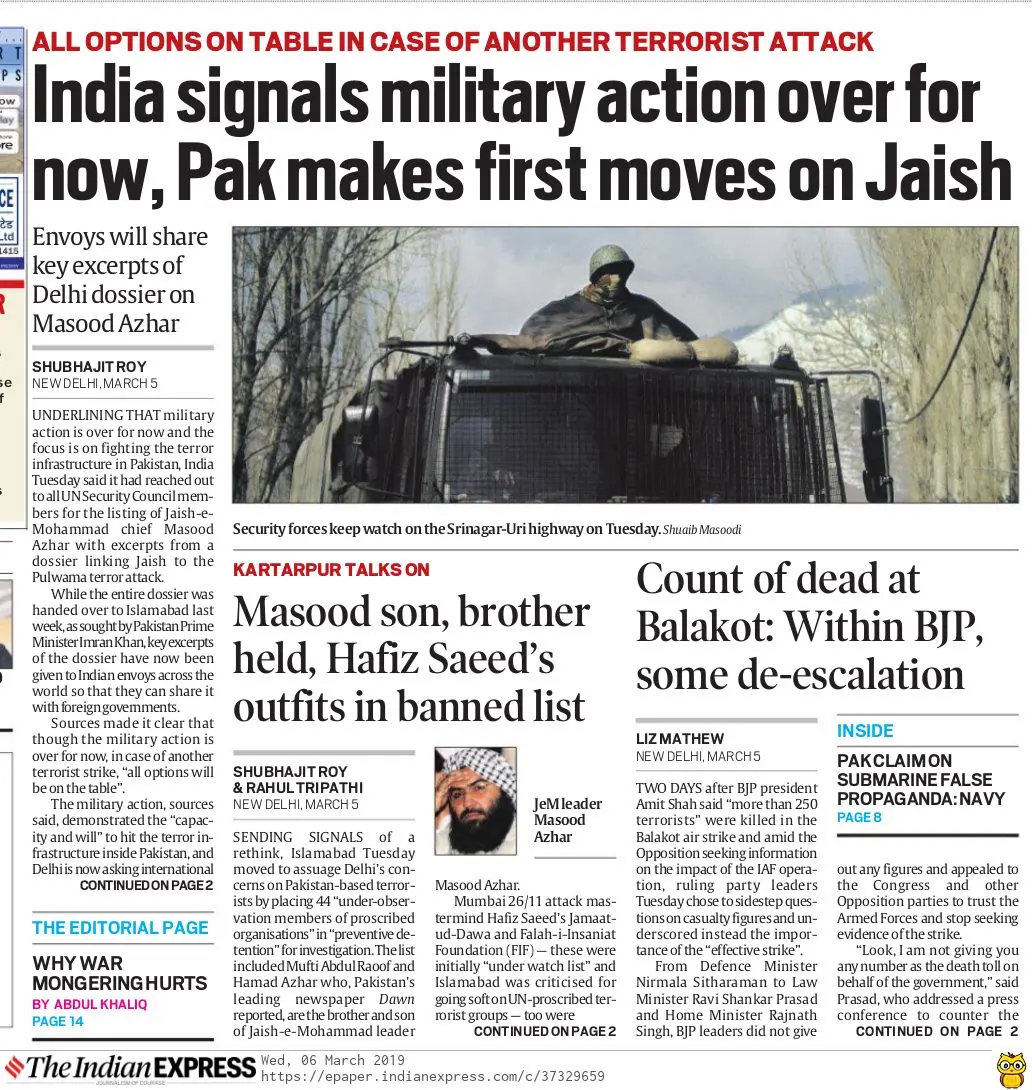
With India-Pakistan tensions running high since a Jaish-e-Mohammad suicide bomber killed 40 CRPF personnel in Pulwama, the whole village of Mohar Jamsher — the last on the India-Pak border in Fazilka, Punjab — has been on high alert.
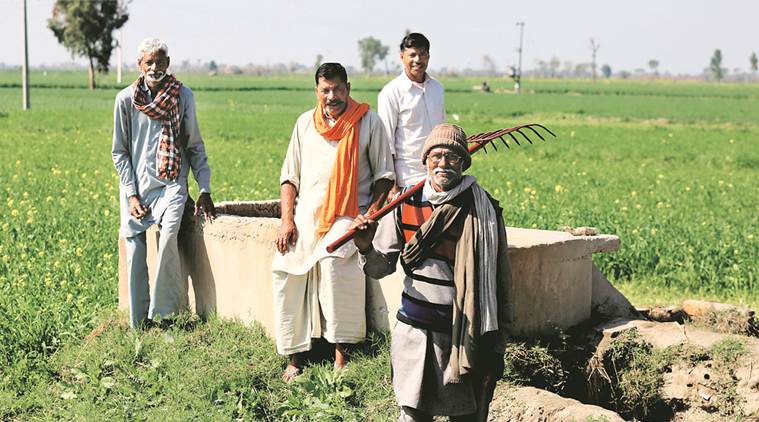
Since the Pulwama terror attack on February 14, Makhan Singh hasn’t had a full night’s sleep. His eyes and ears are fixed across the border and even his son’s wedding solemnised three days ago, didn’t weaken his vigil.
He is not the only one. With India-Pakistan tensions running high since a Jaish-e-Mohammad suicide bomber killed 40 CRPF personnel in Pulwama, the whole village of Mohar Jamsher — the last on the India-Pak border in Fazilka, Punjab — has been on high alert.
And with good reason. For, every time there is disquiet on the border, they pay a price. The last was in October 2016, after the surgical strikes, when they were asked to leave their homes and moved to a safe location.
Also Read | Across the aisle: Grief, anger but no wisdom

Surrounded by Pakistan on three sides and the Sutlej river on the fourth, Mohar Jamsher’s 1,500 residents have two choices to enter Punjab — row across the river or cross a high-security bridge. There is a BSF post at the entrance of the village, where every visitor is questioned before being allowed in.s sabre rattling between India and Pakistan intensifies, the destruction caused by the wars of 1965 and 1971 is still fresh in the minds of locals and over the last few days, the movement across the border has been of immense interest to all in Mohar Jamsher. On Saturday, women in the village were seen storing leftover dry rations while most men discussed Pakistan.
Sitting in his house, which is the closest to the barb wire fenced border, Makhan Singh is always tuned in to the loudspeaker on the other side. “That yellow building visible from our fields is their mosque and the green one is the Pakistan check post. These days, we are extra careful. We listen to the loudspeaker carefully to determine if it is azan or some other message after we heard of Pakistan Prime Minister Imran Khan’s threatening message.”
The brothers say even though there were two weddings in the village on February 20 and 21, people were busy discussing the possibility of war. And only a few houses are pucca, most are temporary. “We live on the border and have left our homes four times in the past. You never know when we will be asked to do the same yet again, so no one invests much money on houses,” said Hansa Singh.
Hansa was a teenager when the 1971 war broke out. “Our entire family shifted to relief camps except me and my father as we had to take care of cattle. I remember hearing a loud noise. I thought it was a cracker but soon the Army came and told us `Jung shuru ho gayi hai (war has begun).”
Next to Mohar Jamsher is Mohar Kheewa, from where the border and Pakistan check posts are seen even more clearly. Khushaal Singh (76) said, “Although all seems to be well, looking at TV debates and social media posts, it seems the whole country is ready for war. The Pulwama attack cannot be forgotten but we still have harsh memories of the 1965, 1971 and Kargil war with Pakistan when we had to flee and start life from scratch, each time after a gap of 18 to 24 months.”
According to Kushaal, in 1971, 28 villages of Fazilka were overrun by Pakistan including Mohar Kheewa. Then, they were given Rs 500 per acre per year as compensation for about two years. “When we got our villages back after about 18 months there were landmines in the fields. They were taken out by the Army but it was difficult to farm after such a gap. It was the same story in 1965 and 1999. War leads to destruction and nothing else,” he said.
Also Read | Inside Track: Pulwama and after
Gurdas Singh, in his late sixties of Mohar Jamsher village, has a word of caution. “Going by history, Pakistan attacked us first always. This is an age of nuclear weapons. So, damage to India will be more. Pakistan is far behind us. I wish there could be a solution without war.”
Advertising
All farming is done under strict BSF security between 10 am and 4 pm. He said: “We do see Pakistanis also farming on the other side. Our side is more green than theirs. At times some try to talk to us and wave saying `Sat Sri Akal’ but we never respond. In the 1960s people used to talk to each other freely. Times have changed. We don’t exchange a word now for we don’t want to be mistaken for a spy.”
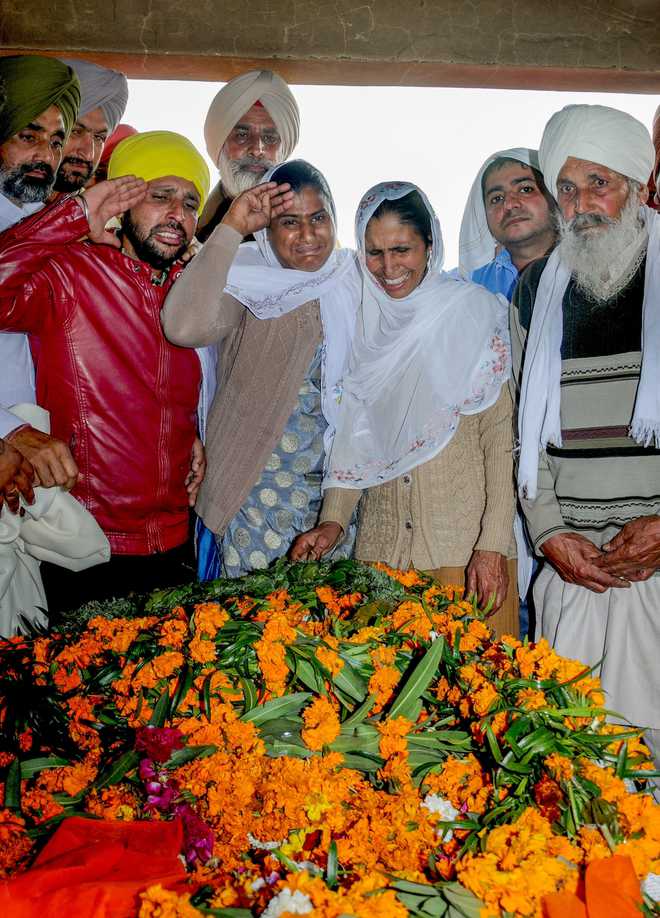
Tribune News Service
New Delhi, Febraury 16
Those who want to contribute voluntarily to the families of CRPF jawans martyred in Pulwama terror attack can do so on the official website of ‘Bharat Ke Veer’.
This fund is managed by a committee comprising Director Generals of Central Armed Paramilitary Forces (CAPFs) under the aegis of the Ministry of Home Affairs.
‘Bharat Ke Veer’ is a trust into which public can contribute voluntarily to support families of martyrs of CAPFs — BSF, CRPF, CISF, ITBP, NDRF, NSG, SSB and Assam Rifles, the MHA said.
Expressing gratitude for the support, MHA said, “During the last few days there has been a tremendous response from people wanting to contribute through the website : bharatkeveer.gov.in.”
However, due to heavy traffic, sometimes a slowdown is reported in accessing the website, it added.
“It is also reported that some unscrupulous elements are soliciting contributions from people through other accounts. It is advised that people desirous of supporting families of martyrs of CAPFs should only contribute through the website — bharatkeveer.gov.in,” the Ministry of Home Affairs said.
Shimla, February 14
A CRPF jawan, Tilak Raj, hailing from the Jawali area of Kangra, was among those killed in the militant attack in Srinagar. The 30-year-old, hailing from Dhewa village, is survived by his wife Savitri Devi.
Chief Minister Jai Ram Thakur has deputed Civil Supplies Minister Kishan Kapoor and Jawali MLA Arjun to be with the family in this hour of grief.
The Chief Minister said that those involved in this incident would not go unpunished. He also prayed to the Almighty to give peace to the departed souls and strength to the bereaved families to bear this irreparable loss. — T
NEW DELHI: Masood Azhar, the head of Jaish-e-Mohammad (JeM), responsible for the attack on the CRPF convoy, has had India in his sights for nearly three decades. He formed the terror organisation within a few months of his release at Kandahar on December 31, 1999. Azhar was flown to freedom in a special plane in exchange for the passengers on board an Indian passenger plane hijacked from Nepal.
REUTERS■ Soldiers examine the debris after a terrorist attacked a CRPF convoy in Pulwama on Thursday.
Azhar made his presence felt within a few months. On 20 April 2000, the JeM carried out the first suicide bombing in Kashmir, exploding a bomb in an Indian army barracks, killing five soldiers. Azhar, in fact, is the father of fidayeen attacks, and he has the dubious distinction of introducing them in the Valley where the gun first surfaced in 1989.
The second suicide attack was even bigger. On October 1, 2001, three Jaish militants carried out an attack on the Jammu and Kashmir state legislative assembly in Srinagar, using a Tata Sumo loaded with explosives. As many as 38 people were killed in an attack that shook the security establishment. Then too, the terror group claimed responsibility and named a Pakistani national Wajahat Hussain as the suicide bomber. In Thursday’s attack, Jaish named a local, home grown militant, who is believed to have rammed an explosive-laden vehicle into the CRPF convoy carrying as many as 2500 personnel.
The last big attack – the Jaish did not openly claim responsibility for this – was on the air force base in Pathankot in 2016. Phone calls made by the suicide bombers who infiltrated the high-security zone were tracked to the Jaish headquarter in Bahawalpur. The Narendra Modi government allowed a joint investigation team from Pakistan to visit Pathankot but according to the Dawn newspaper, the team concluded that India itself had staged the attack. The Pathankot attack led to cancellation of India-Pakistan talks and the two countries have had no formal engagement since.
Azhar first landed in India in 1994 on a fake Portuguese passport and few know that Srinagar was not the city he first went to. He chose Lucknow as his first stop after landing at Delhi’s international airport on January 29, 1994. Reaching Ayodhya was far more important because , according to his interrogation report, the demolition of the Babri Masjid was the spark that ignited his desire for jihad.
Protected by the deep state in Pakistan, Azhar is considered a big asset, who has escaped being proscribed by the United Nations Security Council because China has continually blocked moves to declare him a global terrorist. His terror group is also suspected to be behind the attack on an army camp in Uri that killed 19 army soldiers in 2016. The government retaliated through multiple surgical strikes across the line of control.
Suhail A Shah
Anantnag, February 14
Locals and eyewitnesses in the Lethpora area of Pulwama where the suicide car bomb left 39 CRPF personnel dead described the scenes at the place as those of “doomsday”.
“There are no other words than to describe it a doomsday. It was terrifying and gut-wrenching,” a local said.
The car bomb rocked the area, 27 km from Srinagar, at about 3.15 pm. The explosion was so powerful that even some people in Srinagar heard it.
The explosion took place in between the lines of the newly constructed saffron shops along the National Highway No. 44.
People in Lethpora said they felt that the sky was falling on their heads.
“Our house rocked as if a high-intensity earthquake had hit Kashmir valley. The noise was deafening,” Zafar Ahmad, a resident, said.
People only understood it was an attack when the explosion was followed by gunshots that reverberated in the area for about five minutes.
“Then came the CRPF men, who were part of the convoy, running towards our houses. Many of them took refuge in our houses and also kept firing shots as they heard guns roaring around them,” a resident said.
Shopkeepers in the area said it was mayhem. As the blast rocked the area, people ran for cover, wailing and crying.
But the nightmare was not over for them.
“As guns stopped roaring and we peeked outside, we could see scattered body parts lying around with the damaged parts of the vehicles that were hit by the explosion,” one of the shopkeepers, Abdul Karim, said
He described the scenes as horrible and gruesome.
“I don’t think anyone in Lethpora can sleep or eat tonight. It has shaken us badly,” another shopkeeper said.
The security forces immediately blocked traffic movement on the NH-44 and diverted vehicles to “safer” bypasses. Even scribes trying to reach the spot were not allowed to go the place.
Ajay Banerjee
Tribune News Service
New Delhi, February 11
Major Nishant Dogra of the Indian Army was killed in a sudden snow slide at Yongdi in North Sikkim.
Major Dogra was with his battalion at a high-altitude posting. He was inside his make-shift accommodation when the snow slide carried away the entire accommodation on February 9.
The Major, who is from an armoured unit, was found very seriously injured under mounds of snow late that night. Weather conditions prevented an immediate evacuation.
He died on Sunday. Army authorities in Delhi have confirmed the death. The Major’s family originally hails from Jammu, and is now in Delhi.
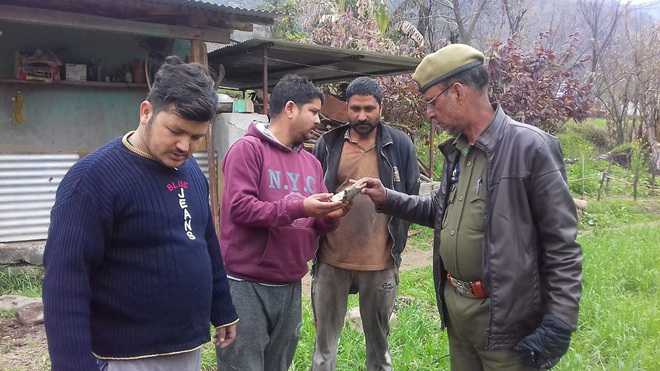
Tribune News Service
Jammu, February 5
The Pakistani army on Tuesday violated the ceasefire agreement in the Krishna Ghati sector along the Line of Control (LoC) in Poonch district.
Pakistani troops resorted to unprovoked truce violation around 10:30 am on Tuesday.
A defence spokesperson said: “About 10:30 am, Pakistan initiated unprovoked ceasefire violation along the LoC by firing two shells of rocket launchers in the Krishna Ghati sector.” Pakistan has been violating the truce agreement continuously.
Narrow escape for family
A family in a forward hamlet in Poonch district had a narrow escape on Tuesday when a mortar shell fired from across the LoC landed in front of their house in Bera hamlet in Jhalas general area around 11 am.
According to the family of one Krishan Lal Sharma, two mortar shells fired from across the LoC fell in their hamlet around 11 am.
“One shell fell near the livestock shed in the vicinity of our house. We had a narrow escape because due to harsh winter all family members and cattle were indoors,” said a member of Sharma’s family.
He said it was after a long time that the Pakistan army had targeted their area. Earlier, stray shells had hit their hamlet. The Indian Army has retaliated strongly and effectively while no injury or damage was reported.
ARTRAC NEEDS TO BE MOVED OUT OF SHIMLA TO A NEW LOCATION THAT HAS BETTER INFRASTRUCTURE
NEW DELHI: The Indian Army is exploring the possibility of moving the Army Training Command (Artrac) to Ambala as part of an overarching plan to restructure the force, two army officials said on condition of anonymity on Sunday.
Ambala is the base of Headquarters 2 Corps, a strike formation.
The names of other towns such as Meerut, Secunderabad, Bengaluru and Gaya have also been doing the rounds as the possible new location of Artrac, which is currently based in Shimla.
The army is yet to officially announce where Artrac will be moved. It needs to be moved out of Shimla to a new location that has better infrastructure, as the command’s role will increase after the restructuring.
The restructuring of the army headquarters will see the role of the Director General of Military Training being given to Artrac. This will require additional infrastructure that is not available in Shimla, said one of the officials cited above.
The headquarters of Punjab, Haryana and Himachal Pradesh Sub Area could be moved from Ambala to Shimla, he added.
The biggest exercise in independent India’s history to restructure the army is based on four comprehensive studies led by the army’s topmost generals, and it seeks to change the direction of the 1.2 million-strong force and transform it into a deadlier fighting machine prepared for future wars.
Raised at Mhow in Madhya Pradesh in October 1991, the command was shifted to Shimla in March 1993.
“When Artrac was moved to Shimla, it was initially felt it should be moved to a better location where communications are better as officers had to travel to training establishments around the country,” said former army vice chief Lieutenant General Vijay Oberoi (retd), who commanded Artrac during 1997-99.
“But now, Artrac is well established and I don’t think there’s a need to relocate it after nearly three decades in Shimla,” he added.
The command is responsible for drafting and disseminating concepts and doctrines related to strategy, operational art, tactics, logistics, training and human resource development.
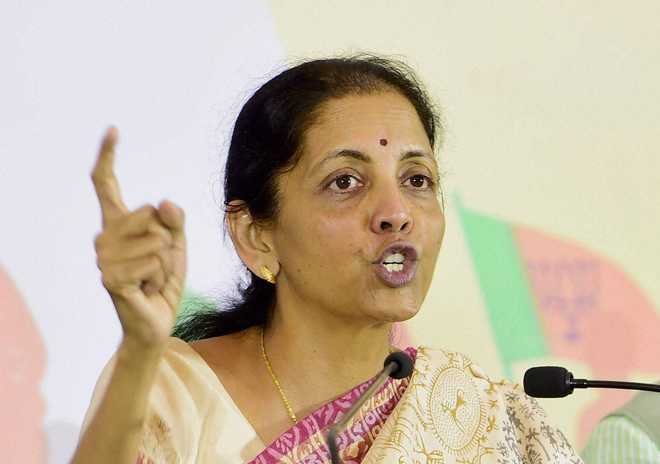
Defence Minister Nirmala Sitharaman approved their dismissal. File photo
New Delhi, January 24
In a punitive action, the Defence Ministry has sent five officers of the Military Engineering Services (MES) on compulsory retirement on the grounds of poor performance, official sources said Thursday.
They said the orders for their removal were issued on Tuesday following approval by Defence Minister Nirmala Sitharaman.The sources said performance of the officers was found “poor” in an internal performance audit.
The officers were serving in the rank of assistant engineers and they are being given three months’ salary and post retirement benefits as per laid down guidelines.
The officials had either crossed 55 years of age or completed 30 years of service. Performance of around 500 officers was analysed by an internal committee and the action was taken based on its report.
In August 2017, the ministry had sacked 13 officers of the Ordnance Factory Board for poor performance following a review of the employees’ performance.
The MES is a premier construction agency which provides engineering and infrastructure support to the Indian Army. It is one of largest construction and maintenance agencies in India with a total annual budget to the tune of approx Rs 13,000 crore.
The sources said government may continue to crack down on those showing “unsatisfactory performance”. PTI