









Sanjha Morcha

What’s New

Click the heading to open detailed news

Current Events :

web counter

Print Media Reproduced Defence Related News

1,248 cases of ceasefire violations so far this year: Rajnath Singh

The Army reported 1,248 cases of ceasefire violations (CFVs) and four casualties along the Line of Control this year, Defence Minister Rajnath Singh said on Monday.


he Army reported 1,248 cases of ceasefire violations (CFVs) and four casualties along the Line of Control this year, Defence Minister Rajnath Singh said on Monday.

In a written response to a question in Rajya Sabha, Singh said January saw 203 cases of CFVs, followed by 215 in February.

There were 267 cases of CFVs in March and the Army reported three casualties. April and May reported 234 and 221 cases of CFVs, respectively.

June recorded 108 cases of CFVs with one battle casualty.

Appropriate retaliation to the ceasefire violations, as required, has been carried out by the Indian Army, Singh said.

“Also all violations of ceasefire and infiltration are taken up with Pakistani authorities at the appropriate level through the established mechanism of hotlines, flag meeting, directorate generals of military operations talks as well as diplomatic channels between the two countries,” the defence minister said.

In response to a separate question, the Army said it sustained 34 fatal casualties in its counter-terrorism operations in Jammu and Kashmir from 2016 to June 2019.

Twelve casualties were reported by Assam Rifles/Army from 2016 to June 2019 during counter-insurgency operations in northeast India.

Replying to another question, Minister of State for Defence Shripad Naik said during the last two years (2017 and 2018), 36 members of Parliament had applied to purchase Army’s disposal vehicle.

The vehicles were made available to all the members who had applied.


General lessons :MILITARY MATTERS by Lt Gen Raj Kadyan (retd

Lt Gen Raj Kadyan (retd)

Lt Gen Raj Kadyan (retd)

In January 1965, I was evacuated from Ladakh after being found suffering from pulmonary oedema. After being discharged from hospital, I was placed in a low medical category for a year and posted to our Regimental Centre in Delhi Cantonment. A few weeks later, the Army Headquarters asked me whether I would be willing to be posted as ADC to the Governor of Andhra Pradesh, Kerala, Maharashtra or Rajasthan. Apprehending that most Governors, who are highly learned and eminent, may not treat an Army officer in a befitting manner, I conveyed my unwillingness.

In May 1965, a new General took over the command of the Delhi and Rajasthan area and wanted an ADC temporarily. Out of the panel of several officers, I was picked. I consoled myself that being an ADC to a General is different because having himself gone through the ranks, he would give a Captain his due. Also, it was only for two months or so.

As ADC, I was expected to manage the General’s professional and social calendar. In Delhi, many sought appointments. The General was too polite to refuse a meeting, but I could read his reluctance. Therefore, on my own, some 10 minutes into the meeting, I would walk in to announce that his conference was waiting. This made the “unwanted” visitor scurry off.

Since the ADC has also to interact with the family, I started with trepidation. The General’s family carried all the finesse and polish. In contrast, hailing from a rural village further increased my anxiety.

His elder son, Uday, was around my age and a graduate. Raghu, a year younger, was still in college. Since Uday was not doing anything, he spent long hours with me. He would even accompany me to spend weekends in my village where he enthusiastically learned the Haryana way of living.

The General was a remarkable person. He became my role model in honesty and integrity. In a dinner he hosted, the then Army Chief was an invitee. As he alighted from his car, the Chief handed a pay-book to the General, saying: “He is a soldier from your command. Shoot him.” The General passed on the pay-book to me. I did all the checking. It turned out that the “accused” was an Army lorry driver, who had overtaken the Chief’s staff car at a roundabout. Infuriated, the Chief got him out of the vehicle slapped him and took his pay-book. I reported my findings.  “What?” the General said, “The Chief slapped a soldier? Very unbecoming of him. Tell the man to go home and relax.” To my young mind, the Army Chief had a larger-than-life persona and his directions could not be ignored. I assumed that the General would change his mind by morning. But I was wrong. The next morning, he asked me to inform the soldier’s commanding officer that the man had already been overly punished and nothing more would be done to him.

In September 1965, our headquarters moved to Jodhpur to handle the war. We stayed in the MES Inspection Bungalow. The General occupied the first floor and I stayed in one of the two rooms below. The proximity living increased our interaction.

Later, Uday and his mother too joined us. Uday shared my room. The four of us ate our meals together. She was very caring and would point out if she thought I had not eaten enough. While Uday naturally addressed her as ‘Maa’, I followed the Army protocol and referred to her as Mrs Rajwade. Doing so regularly left me feeling awkward. I asked Uday to check with her if I could also address her as ‘Maa’. She was delighted. Over the years we became one family. It was a deeply emotional moment when at the General’s funeral I was one of the pallbearers.


HAL order book full with top IAF fighter Sukhoi Su-30MKI, LCA Tejas, helicopters

Defence Minister Rajnath Singh has said that the present capacity available with HAL is adequate to fulfil the existing orders/projects in hand.

HAL order book full with top IAF fighter Sukhoi Su-30MKI, LCA Tejas, helicopters

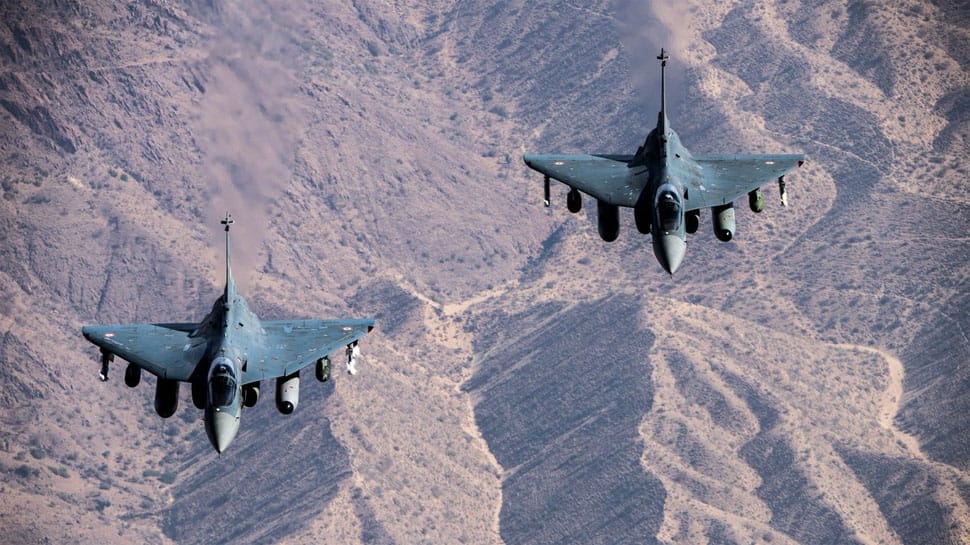
Indian Air Force’s top fighter Sukhoi Su-30MKI and indigenous Light Combat Aircraft Tejas are among the aeroplanes which Hindustan Aeronautics Limited is currently manufacturing. Apart from the Su-30 MKI and Tejas, the HAL has firm orders to manufacture Dornier DO-228 aircraft, Advanced Light Helicopter-Dhruv (ALH), Chetak and Cheetal choppers.

While giving the above information on Monday in a written reply to Dr T Subbarami Reddy in Rajya Sabha, Defence Minister Rajnath Singh added that the present capacity available with HAL is adequate to fulfil the existing orders/projects in hand.

HAL has also been paid Rs 8,140 crore from January 2019 to June 2019 from defence services and the PSU defence major also borrows from banks to meet its working capital requirements as and when required.

“Dues of vendors including HAL are paid depending on the availability of funds, prioritization of schemes and advances/payments that fall due to the vendors including HAL. The amount of arrears of payment to other contractors outstanding with HAL is Rs 868.14 crore,” said Rajnath Singh.

HAL has initiated various productivity improvement measures through:

1) Developing robust supply chain eco-system by partnering with the emerging Indian Defence Manufacturing Private Sector including Micro, Small & Medium Enterprises (MSMEs) to enable HAL to focus on its core activities.

2) Introduction of Digital Technology, Software Tools in the areas of Product Life-Cycle Management(PLM) and Product Data Management (PDM) to convert the Design Data to the Production Data, Design Simulator and Analysis to optimise development cost and time. Enhancing capability and improving the processes through introduction of new manufacturing technologies.

3) The company implemented an integrated software solution i.e., Enterprise Resource Planning (ERP) to encompass all areas of Production, Planning, Finance, Materials, Marketing and Human Resources Development (HRD). This facilitates implementation of uniform procedures and practices as well as providing on-line information for decision making for Management.

4) Strengthening the network connectivity to improve the communication and collaboration services across the Company.

5) With an objective to enhance the productivity, quality and customer satisfaction, through Skill upgradation, Skill Development Policy was notified in July 2016. Skill Mapping of the employees has been conducted for necessary training based on Skill Gap Analysis. The Company has also implemented globally acclaimed training methodology, “Training Within Industry (TWI)”, to improve efficiency and productivity.  It has resulted in upgrading the skills of the employees, reduction of rejection and rework, reduction of cycle time.

6) Promoting Quality Circles, Suggestion Scheme, implementation of Performance Based Incentives, etc.

7) The Company has regularly monitored the Performance of Production and related activities to identify areas for improvement, corrective actions as necessary for implementation as a continuous measure for companywide efficiency and productivity improvement.


Cops check vehicles at gunpoint in UP’s Badaun

Cops check vehicles at gunpoint in UP's Badaun

According to the residents, this has become a routine manner of checking by the police. Photo courtesy screenshot

Badaun (Uttar Pradesh), June 24

Policing in Badaun district in Uttar Pradesh has become “hazardous” and “humiliating” for the common man.

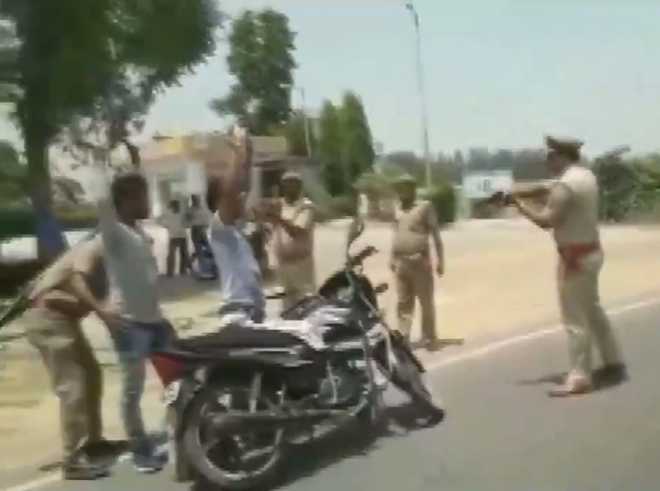
In a video that has gone viral on the social media, cops are seen making people hold up their hands at gunpoint while they check their vehicle.

The video was shot at the Bagren outpost in Wazirganj police station area and the outpost in-charge Rahul Kumar Sisodia is seen in the clip, intimidating people.

According to the residents, this has become a routine manner of checking by the police.

Dharmendra Yadav@MPDharmendraYdv

https://twitter.com/MPDharmendraYdv/status/1143070351938560000

‘हाथ ऊपर वरना गोली मार देंगे’ अपराध रोकना तो दूर, निर्दोषों के साथ अपराधियों जैसा सलूक।बदायूँ में वाहन चेकिंग के नाम पर आम जनता से अपराधियों जैसा व्यवहार नाक़ाबिले बर्दाश्त! वोट लेकर सत्ता पर क़ाबिज़ भाजपाइयों का ये रिटर्न गिफ़्ट हैं।


710 people are talking about this

“If you are driving and the cops want to stop you, they will do that with a gun in hand. The method is so intimidating and humiliating for the common man. The cops make no concession even if the driver is a woman,” said Raj Kumar Agarwal, a businessman.

A police official in Badaun, who spoke on condition of anonymity, said: “Badaun is a crime-prone area and we keep our guns out because you never know which vehicle is bringing criminals. We have to remain prepared.” When contacted, DGP’s office said that they would probe the incident and take action, if needed. — IANS


Una soldier cremated with full honours Martyr’s father says will also inspire five-month-old grandson to join Army

Una soldier cremated with full honours

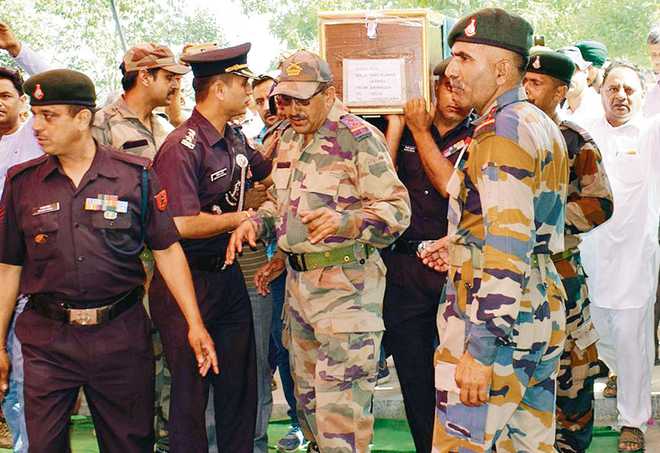
Army men carry the body of Rifleman Anil Kumar Jaswal to his home at Saroh village of Bangana in Una district. Tribune photo

r Correspondent

Una, June 19

The mortal remains of Rifleman Anil Kumar Jaswal, who died fighting militants in Anantnag district of Jammu and Kashmir, were consigned to flames at his native village Saroh in Bangana subdivision today.

The encounter took place on Monday. Jaswal succumbed to his injuries at the Army hospital on Tuesday morning.

The body was flown in to the Air Force base in Chandigarh from where it was taken in an Army vehicle to the soldier’s ancestral house. It was kept at the house for some time for family members and relatives to perform the rituals.

The soldier’s mother, wife and sister were inconsolable. His wife Shweta kept calling Anil Kumar to wake up, while sister Sapna demanded revenge, saying the Army should kill those who killed her brother.

Draped in the Tricolour, Army personnel later carried the martyr’s body to the cremation ground, where wreaths were placed by Rural Development Minister Virender Kanwar, Deputy Commissioner Sandeep Kumar and Army officials.

The atmosphere remained charged as youths chanted ‘Anil Kumar amar rahe’ and ‘Vande Mataram’, besides raising slogans against Pakistan.

The soldier was accorded full military and state honour as a posse of Army men fired in the air before the last bugle was blown in respect of the slain soldier.

His five-month-old son Varun’s hands were made to touch the bamboo stick which was later used to lit the pyre. Anil’s cousin Sandeep Jaswal performed the last rites.

The slain soldier’s father, Ashok Kumar, had also served in the Army. He said Anil was a third generation Army man in the family. Ashok Kumar said he would inspire his grandson too to join the Army like his father. “Our close combat weapons have failed to match the new challenges”, he said, adding that he was sure that PM Narendra Modi would do the needful to provide advanced weapons to jawans to save their precious lives.

Virender Kanwar assured all help and assistance from the state government to the family and presented a cheque for Rs 5 lakh. As per the norms, the family would be given an assistance of Rs 20 lakh, besides a government job to one member.

Vice-Chairman of the HP Industries Corporation Ram Kumar was also present.


Clean-up begins, thanks to Ferozepur SSP: Rana

Goel had blamed black sheep in Police Department for rampant drug menace in state

Rana Gurjeet Singh

Deepkamal Kaur
Tribune News Service
Jalandhar, June 19

Even as the recent speech of Ferozepur SSP Sandeep Goel on drug menace and involvement of cops caused embarrassment to the state, Congress Kapurthala MLA Rana Gurjeet Singh today endorsed the officer, saying, “it was a practical and straight talk by him”.

On the sidelines of a function held on the shifting of Kapurthala DC office to a new location yesterday, Rana Gurjeet Singh said, “The SSP has said only what he was confronting daily. Now, that he has attempted to make the society aware about the disease, he has also started making attempts to treat it. You have already seen that the process to identify and punish black sheep has already started in the Police Department.”

The ex-minister, however, added, “It is not for the first time that a problem has erupted in the system. We cannot blame the Capt Amarinder government for this.”

Later when asked about his statement, Rana Gurjeet Singh said, “I have not said anything wrong. I stand by the Ferozepur SSP as he has not only criticised the police, but only admitted to the shortcomings, which he wants to rectify. I commend such daring officials.”

Rana maintained, “The SSP’s statement has not caused any embarrassment to the government. It has only made the corrupt police officials worried. The credit for the same goes to this SSP because of whom the clean-up exercise has begun in a big way. No police officer ever did the kind of marking in staff which he has started. I think all other SSPs must emulate Goel.”


” He has attempted to make society aware about the disease (drugs). He has also started making attempts to treat it. The process to identify and punish black sheep has started in the Police Dept.” — Rana Gurje


The defence policy must be prioritised

The government has the political capital to bring in defence reforms. Band-aid fixes won’t work

Astriking feature of the 2019 Lok Sabha elections was the unusual prominence accorded to national security in the Bharatiya Janata Party (BJP)’s campaign. In 2014, the party’s election manifesto discussed security policy, but only towards the end. By contrast, the 2019 manifesto began with national security. Political scientists will debate the extent to which these issues shaped voters’ preferences, but the Narendra Modi government now has enormous political capital to bring about farreaching reforms in defence, reforms that cannot be put off. Indeed, the government faces daunting challenges from reforming the security architecture and structuring the armed forces to strengthening the defence industrial base and military readiness. Rhetorical fixes and institutional band-aids can no longer help.

Need for a Chief of Defence Staff (CDS): Let’s start with issues that are well-recognised before considering those that have yet to register in policy debates. It is almost 20 years since the Kargil Review Committee set out its recommendations for national security reforms — recommendations that were broadly endorsed by a subsequent Group of Ministers and revisited by another committee in 2011. The most important, yet thorny, of these was creating the post of a CDS as a single-point military adviser to the political leadership. The idea had met with resistance both from within the armed forces — the Air Force was not keen — and from political leaders who were averse to concentrating military authority in a single office.

During Prime Minister Narendra Modi’s first term in office, it appeared that these concerns had been smoothed over. In the summer of 2015, the then defence minister, the late Manohar Parrikar, publicly asserted that a “Chief Defence Staff is a must” and that he would come up with a proposal within three months. Three years on, Parrikar was still hoping to get this done. The problem, he observed, lay in ensuring that the CDS was linked with meaningful jointness among the three services.

In fact, the importance of creating integrated theatre commands had been emphasised all along. As a starting point, it was felt that supply and logistics functions could be integrated. But the government failed to make any headway in the remainder of its tenure, partly owing to resistance from within the armed forces. It bears emphasising, however, that defence reforms of this scale have been pushed through in other democracies in the teeth of greater or lesser opposition from the military. Even the choice of the first CDS or equivalent has often been unpalatable to the services and their leadership. Lord Mountbatten was chosen as Britain’s first CDS because he was equally detested by all the three services. It’s time the government moved decisively to create a fully empowered CDS with a road map for integration of commands.

Defence manufacturing: The strategic imperative of creating a solid defence industrial base is equally well-recognised. Here, too, the first Modi government sounded the right notes. Speaking at the Aero India show in February 2015, the prime minister said that defence manufacturing was “at the heart of the Make in India programme” and that the country should aim to manufacture 70% of military equipment domestically in the next five years. By the end of the term, the proposed defence manufacturing ecosystem had, along with Make in India, slipped out of sight. The only thing the BJP’s 2019 manifesto could talk about was manufacturing of AK-203 rifles in Amethi. But this is as good a time as any to push ahead the plans for a defence manufacturing base that includes private sector as well as public sector undertakings. If there is one area where industrial policy can work, it is defence. Emphasising this domain could fit well with the country’s larger requirements of economic renewal.

The fiscal challenge: The next priority for defence policy is to deal with the shrinking resources for military modernisation and the consequent need for structural change in the armed forces. Following the grant of onerank-one-pension and the implementation of the 7th Pay Commission, costs of salary and pension now account for over 70% of the defence budget. In the budget of 2018-19, the allocation for pensions grew at 27% over the previous year, while capital expenditure rose by only 9%. Given the constraints on increasing the overall allocation for defence, capital expenditure for military modernisation is unlikely to increase in line with the requirements.

This fiscal challenge, however, is also an opportunity to rethink the fundamental structure of our armed forces, especially the balance between long-service and short-service components as well as manpower and technology. The services are reportedly considering how to prune manpower, but this should be part of a broader exercise that ideally should be led by a CDS.

Military education must: This brings us to the last challenge — military readiness. Much of the discussion around this tends to focus on critical shortages of equipment and spares. But the long-term problem lies in professional military education, especially for officers.

Our training establishments impart narrow professional skills. They focus on preparing officers to command companies, battalions and brigades, or perform staff duties at various levels. There is practically no attempt to give the officers a sense of the larger contexts — strategic, political and international — in which the armed forces function. It is only at the highest training establishment, the National Defence College, that senior one-star officers get exposed to some of these issues. This is too little and too late.

This outmoded approach to training affects the quality of human capital at all levels in the services. Yet, no government has paid serious attention to this. The fate of the long-heralded Indian National Defence University is symptomatic of the political leadership’s neglect of this crucial area.

The BJP’s mandate gives the government an opportunity to place defence policy in the top tier of its priorities. It should seize this rare opportunity. The time for tarrying has passed.


Siachen, where hammers break eggs; soldiers’ video goes viral

http://

Tribune Web Desk
Chandigarh, June 8

Cutting open a carton of juice to reveal a block of orange ice, and breaking open eggs with a hammer! Soldiers on the Siachen Glacier have given a demonstration of life on the frozen military outpost in a video that is going viral.

Three soldiers can be seen explaining how they need to boil any food item, cooked or raw, before it can be cut or consumed in any manner.

So you see a juice pack being opened with a knife, eggs and tomatoes resisting blows from a hammer, onion and potato being broken apart when chopped with a khukhri, the versatile weapon and tool that is part of a Gorkha soldier’s gear.

Even as they attempt to convey the cold conditions on the remote glacier, clad in heavy jackets, their spirit and ‘josh’ seem high as they giggle away at their antics and seem to be having fun.

The warmth and high spirit in the video comes out especially at the end when they close it with the greeting“Tagra raho!”, a greeting of the Assam Regiment.


New Navy chief: No quasi religious functions, no red-carpet welcome on ships

New Navy chief: No quasi religious functions, no red-carpet welcome on ships

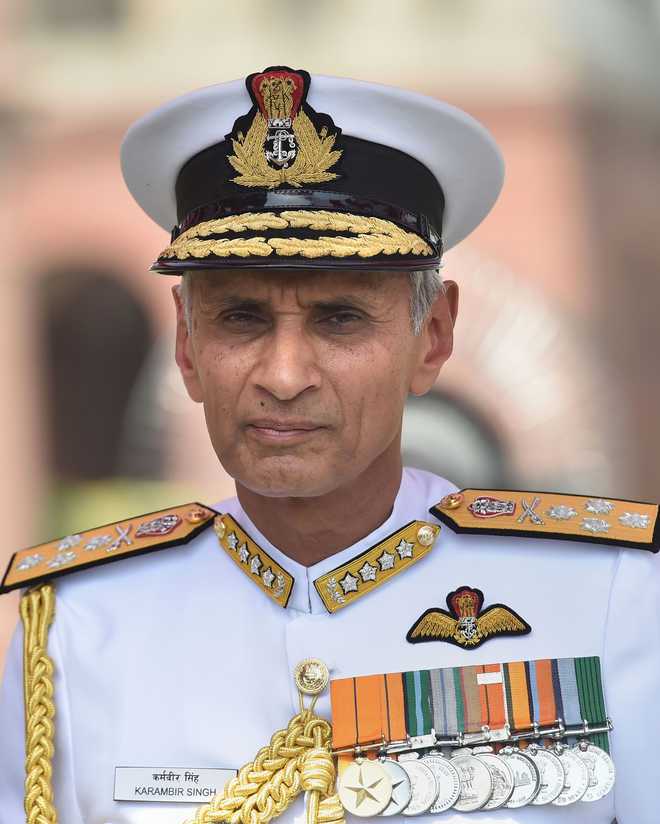
Navy chief Admiral Karambir Singh. PTI

Ajay Banerjee
Tribune News Service
New Delhi, June 5

Making a change from the past, newly-appointed Navy Chief Admiral Karambir Singh Nijjer has issued a set of instructions that ban ‘quasi religious’ functions in the Navy, puts a lid of ostentatious events and bans red-carpet welcomes.

Besides, the order puts an end to opening of car doors for VVIPs. Most importantly, officers and sailors at all functions will be served same drinks and food by using same cutlery and crockery.

Within the forces, personnel attending official functions often are served different food and use separate varieties of cutlery – all depending upon their ranks.

The Admiral took over on Friday, May 31, and his first full working day was Monday, June 3. The instructions shall override all other existing instructions. These shall come into force immediately.

In the list of 26 instructions issued on Tuesday evening, the Navy Chief says, “Lighting of lamp/functions of quasi religious nature/fawning gestures, garlanding and showering flower petals, on guests, invitees, dignitaries to be avoided.” The order also called for doing away with the practice of lining up women and children to welcome and see off dignitaries at naval events.

As of now, wives of younger officers are often called upon to welcome the wife of a visiting senior officer, very often they line up for a welcome which is essentially not their job. Some of the wives of younger officers are full-time working professionals and don’t find time from their schedules.

Also, no flower bouquets will be presented to officers and their spouse on a visit. The Navy Chief also called for ending the practice of having flower pots and red carpets on-board ships, when dignitaries come visiting.

The Chief says in his order, “As a modern fighting force, it is important that the Navy imbibes contemporary social and ceremonial procedures towards optimal utilisation of manpower and resources.”

The Admiral starts with himself and has instructed that there be no ‘standby’ cars for the Chief and only sailors – and no officers—be detailed for ‘liaison duties’ on visits.

Seeking more openness, the new Chief has asked senior officials to ensure that their juniors are respectful but not subservient. Sources said this is probably aimed at ending the ‘yes sir’ culture bred by sycophancy.

Full titles of the officers need not be mentioned in speeches. Only the rank and the name is needed. “No ostentatious snacks and drinks at functions”, say the instructions and add that all ranks—officers and sailors – have to eat same food and from same crockery


Capacity-building tour flagged off

Capacity-building tour flagged off

Army flags off a capacity-building tour for youth of Gool, Samote and Bagga to Dehradun, Delhi and Chandigarh. Tribune photo

Tribune News Service
Jammu, June 4

To create opportunities in personality development and education for people of far-flung areas, the Army on Tuesday flagged off a capacity-building tour for 20 youths to Dehradun, Delhi and Chandigarh till June 15. The youths belong to Gool, Samote and Bagga areas.

The aim is to provide an insight into the cultural heritage and diversity of the country. The youths are scheduled to witness a passing-out parade of gentleman cadets at the Indian Military Academy (IMA) on June 6. They will visit the Dehradun Military Station and interact with senior military officials.

They will also interact with Chief of the Army Staff in Delhi, followed by a visit to the National War Memorial, National Rail Museum and Nehru Planetarium, which will exhort them to join the Indian armed forces.

In Chandigarh, the participants will visit the Government Museum and Art Gallery and Rock Garden.