


Sanjha Morcha

What’s New

Click the heading to open detailed news

Current Events :

web counter

Print Media Reproduced Defence Related News

US sanctions on Iran threaten vital India-Afghanistan Chabahar project

US sanctions on Iran threaten vital India-Afghanistan Chabahar project

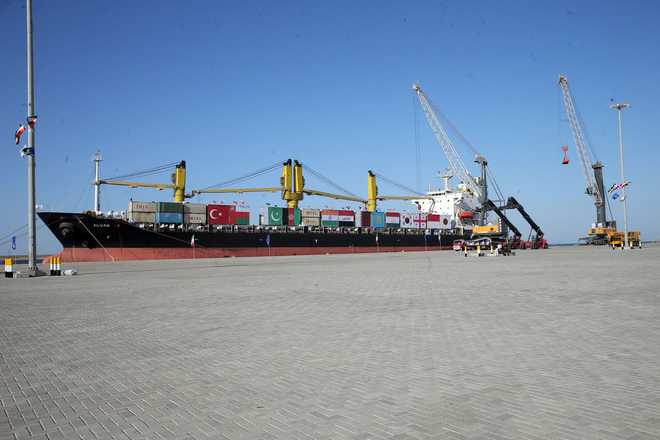
The Indian-backed Chabahar port complex in Iran is being developed as part of a new transportation corridor for land-locked Afghanistan. AFP file

Washington/Kabul, May 20

US President Donald Trump’s decision to pull out of the Iran nuclear accord and re-impose sanctions on Tehran threatens to derail a project to help build Afghanistan’s economy, endangering a key goal of the US strategy to end America’s longest war.

The Indian-backed Chabahar port complex in Iran is being developed as part of a new transportation corridor for land-locked Afghanistan that could potentially open the way for millions of dollars in trade and cut its dependence on Pakistan, its sometimes-hostile neighbor.

Building Afghanistan’s economy would also slash Kabul’s dependence on foreign aid and put a major dent in the illicit opium trade, the Taliban’s main revenue source.

But Trump’s decision to re-impose sanctions on Iran and penalize financial institutions for doing business with Tehran is clouding Chabahar’s viability as banks, nervous they could be hit with crippling penalties, pull back from financing.

“President Trump’s decision has brought us back to the drawing board and we will have to renegotiate terms and conditions on using Chabahar,” a senior Indian diplomat said.

“It is a route that can change the way India-Iran-Afghanistan do business, but for now everything is in a state of uncertainty.” The White House did not respond to requests for comment.

Launched in 2016, the joint Iran-India-Afghanistan Chabahar project already was facing holdups. It has yet to see significant traffic apart from some containers of donated wheat from India, and the first shipments of Afghan dried fruit to India are not expected before July.

At least three contracts to build infrastructure at the port now have been delayed, with two Chinese companies and a Finnish group left hanging while bankers seek clarity from Washington before approving guarantees, a person close to the project said.

In addition, Afghan traders, who were hoping for an alternative to Pakistan’s port of Karachi, now find themselves cut off from funding and forced to rely on the traditional hawala money transfer system, which is insufficient on its own to transform an economy. Hawala is a trust-based system commonly used in Afghanistan that involves the movement of funds between agents in different countries.

“We know our correspondent banks would not let us pay for imports coming through that port,” said a senior executive at one major Afghan lender.

Chabahar is among a number of projects of transport and energy networks projects designed to boost Afghanistan’s trade and lay the foundations for a mining industry capable of exploiting its billions of dollars in untapped mineral reserves.

Bypassing the border with Pakistan, which last year was closed for some 50 days over various disputes, Chabahar is seen as a way for Afghanistan to consolidate its relationships with India and other regional powers.

“The only way to get India more involved” in Afghanistan’s economic development “is through Chabahar,” said Barnett Rubin, an expert with New York University’s Center for International Cooperation and a former adviser to the State Department and the United Nations. “Our Iran policy is headed for a train wreck with our Afghanistan policy.”

Foreign aid

Some 17 years after the US-led invasion to oust the Taliban from power, Afghanistan remains one of the world’s poorest countries, highly dependent on foreign aid.

Apart from illegal opium exports estimated at some $2 billion by the International Monetary Fund, its main products are dried and fresh fruits, and carpets, none of which amount to more than a fraction of the value of the drugs trade.

Initially Afghanistan would export agricultural produce – such as pomegranates and grapes – through Chabahar, utilizing a section of a road India paid for and then an extension to the Iranian border that New Delhi built, experts said.

Eventually, those exports could expand to mineral resources, something Trump has expressed an interest in gaining for US firms. For India, this would mean using a planned railroad to Chabahar to export iron ore from two tracts at the Hajigak iron mine in central Afghanistan that it won the rights to exploit, the experts said.

“The economic piece is really important to get a glimmer of hope for Afghanistan to move beyond a land-locked, poppy-based economy. We are now shooting that in the head,” said Thomas Lynch, a National Defense University expert and a former US Army officer who advised the chairman of the Joint Chiefs of Staff on South Asia policy.

“There is no other legitimate and reliable way to do that.

You can’t do it by air, you can’t do it through Pakistan because they just extort for everything they do,” said Lynch. “The lifeline runs through Chabahar.”

In addition, by hindering the development of Chabahar, the United States will leave Afghanistan dependent on Pakistan, historically its main trade partner and outlet to the world.

That would undermine another Trump goal of pressuring Islamabad to shutter Afghan insurgent sanctuaries on its side of the border and force the militants into peace talks.

Afghan officials have lobbied hard for exemptions to the sanctions for Afghan companies operating though Chabahar without success and are waiting for clarity from Washington.

“Now the uncertainty is that we don’t know what’s going to happen with Chabahar,” said Atiqullah Nusrat, Chief Executive of the Afghanistan Chamber of Commerce and Industry. “We haven’t heard anything so we have to wait and see what happens.” Reuters
A war without end by Hasan Suroor

A war without end

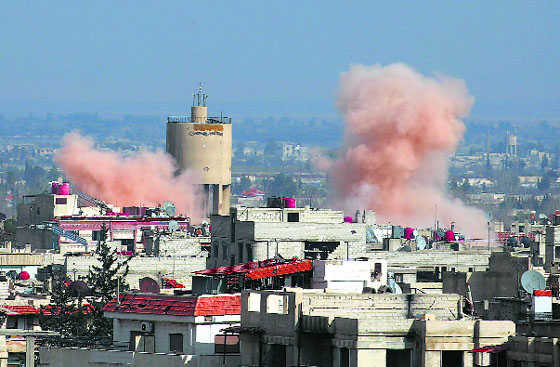
WAR WITHOUT END: The search for a political solution is being held hostage to rivalries and divergent interests.

Hasan Suroor

The Syrian civil war is in its seventh year with half a million people dead, an estimated 11 million (roughly half the pre-war population) displaced, and more than 75 per cent of the country’s economy destroyed. Syria is no longer even one country; and, given the myriad foreign interests involved, nor is it just “Syria’s war” any more. President Bashar al-Assad is still standing but is a much diminished figure, and locked in a grim battle for survival. It’s a catastrophe at every level – political, diplomatic, and humanitarian.And as for the future, even knowledgeable pundits admit they have no idea. For all the apparent flurry of “peace” initiatives, there’s no real movement towards a political settlement.”There’s no peace process going on, and I don’t see any endpoint. We’re in for a state of permanent uncertainty,” says Scott Lucas, Professor of International Politics at the University of Birmingham.

So, what’s going on?

To be sure, two high-profile parallel peace processes are underway – a UN-led process in Geneva, which has now been going on for six years with little to show for it, and another sponsored by Russia in tandem with Iran and Turkey. Dubbed the “Sochi initiative” after the Russian city where it was agreed, it, too, has UN backing, but like the Geneva process it has made little headway. The deadlock both at Geneva and Sochi has less to do with real issues at stake and more with divisions among Syrian opposition groups, mostly proxies for various international powers with competing agendas. Their relationship with each other is constantly fluctuating depending on the line from their international patrons; which then has a knock-on effect on the peace process. The search for a political solution is being held hostage to their rivalries and divergent interests.The other big factor for the stalemate is that the regime and the Opposition have contradictory expectations from any negotiations. And this is compounded by mutual suspicion and distrust. So, a process acceptable to one side becomes automatically unacceptable to the other. While Assad is suspicious of the Geneva process because it visualises a short transition period after which he may have to go, opposition groups are opposed to Sochi because it sidesteps the issue of Assad’s future.The opposition faction that’s proving to be particularly difficult is the UN-recognised Syrian Negotiation Committee (SNC). It’s refusing even to sit down for talks unless the removal of Assad is on the agenda. Its hardline stance on a “political transition minus Assad” as a precondition for participation is causing frustration as much among Assad’s allies as it is in western capitals, and especially at the UN. Its special envoy Staffan de Mistura, who is involved with both the Geneva and Sochi processes, has expressed concern that the SNC’s inflexibility is hindering an inclusive political settlement and has publicly chided it for boycotting the Sochi conference calling it a pro-Assad show intended to “supplant” the Geneva talks.Moves are afoot to go ahead with the decision taken in Sochi to set up a cross-party commission to draft a new constitution for a “democratic” Syria despite opposition from the SNC and its allies. De Mistura is trying to woo them with the assurance that that the 50-member commission would represent all shades of opinion, and not be confined only to those who attended Sochi. The SNC too would be invited to nominate its representatives, but nobody would have a veto on its composition. In other words, everyone will get fair representation but no faction, however big and irrespective of whose proxies they might be, would be allowed to derail the process. De Mistura has sought to allay opposition fears that it’s intended to “subvert” Geneva talks by holding out the promise of eventually merging the two processes. But so far he has failed to achieve a breakthrough.Five months since the Sochi conference, the deadlock continues while the situation on the ground is steadily worsening with Israel jumping into the fray ostensibly to counter Iran. Prof Scott likened De Mistura to a man “wandering in a desert” and hoping that something will turn up. The fact, he says, is that the UN itself is deeply divided and being pulled in different directions with few takers for De Mistura’s enthusiasm in New York. And that reflects the wider divisions within the international community over dealing with the Syrian crisis.Meanwhile, strange as it might sound, the fact is that if today anyone can claim some sort of a victory it is Assad, given the dire predictions of his imminent political demise at the start of the war. There was a moment when the conventional wisdom held that it was all over for him and it was only a matter of time before he was toppled. But he has defied all odds and managed to survive thanks largely to Russia’s game-changing military intervention and help from Iran and its regional proxies.Not only is his regime intact, he has been able to wrest back a lot of the territory he had lost to rebel groups and the Islamic State. Set against this, however, is the stark reality that he’s left clinging to a heavily truncated country, effectively partitioned into three geographical entities, only one of which is controlled by him. So, there’s a lot of work to do, for which continuing Russian backing remains critical. But Moscow is under growing pressure not only from the West but also from its regional Sunni friends who it cannot afford to alienate without risking its long-term strategic stakes in the Arab world. At home, too, Vladimir Putin is facing protests over the high financial and human cost of its military involvement in Syria at a time of deepening economic crisis as western sanctions start to bite. There’s also wariness about a long-drawn-out commitment that could see it bogged down as happened in Afghanistan.Last December, Putin announced a partial withdrawal of his forces saying declaring the mission had been mostly accomplished but he also made clear that Russia would continue to retain enough firepower as long as it was needed. Privately, however, he’s said to have conveyed to Assad that he should not expect him to hold his hand forever. The flip side of an abrupt withdrawal is that in the absence of a credible peace process it risks creating a vacuum which is likely to be exploited by extremists.Whatever the outcome eventually, Syria will go down as one of the biggest failures of international diplomacy in arguably the world’s most volatile region.The writer is a London-based commentator.


AFMS trophy awarded to Western Command Hospital

Chandigarh, April 20

The Raksha Mantri’s Trophy and Citation for the best service hospital in the Armed Forces Medical Services (AFMS) for the year 2017 has been awarded to the Command Hospital (Western Command), Chandimandir.The trophy was received by the Hospital Commandant, Major General Rashmi Datta, from the defence minister, Nirmala Sitharaman at New Delhi on Friday. The hospital has won this trophy several times in the past.The trophy was instituted in 1989 to create a healthy competition among the Command Hospitals of the Army and its equivalent hospitals in the Navy and Air Force. The best and second Best hospitals are adjudged on the basis of a number of objective criteria by a committee headed by Director General (Organisation and Personnel) with the Joint Secretary (Navy) in the Ministry of Defence being a member of the committee. — TNS


CIVIL-MILITARY CONFERENCE Army: Curb satellite phone use in areas bordering China

Issues raised with Kinnaur admn, police

Army: Curb satellite phone use in areas bordering China

Pratibha Chauhan

Tribune News Service

Shimla, April 13

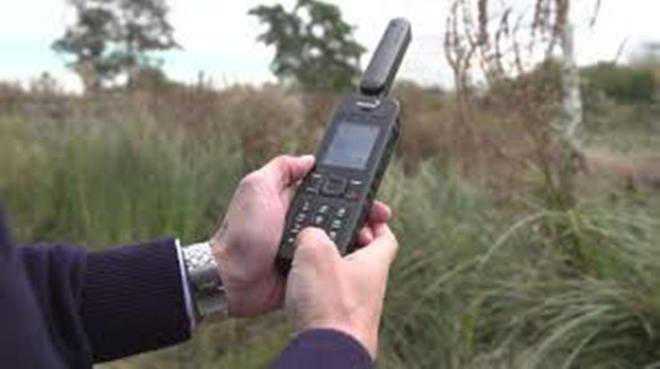
The Army has sought complete check on use of banned ‘thuraya’ satellite phones by tourists in areas close to the Chinese border in Kinnaur district and starting of helli taxi services for the convenience of both civilians and Army men in the tribal district which shares a 140-km border with China.The military authorities have asked the police authorities to check use of ‘thuraya’ satellite phones at the Chaura and Apka check posts. The use of these phones is banned, especially in the border areas in Kinnaur district which shares a 140-km boundary with China. The other tribal district of Lahaul-Spiti also shares 80-km boundary with China.The stepped up activity by China along the border on its territory has put India on the alert and efforts are on to strengthen the infrastructure and communication on our side of the border. The military authorities are keen that the state government starts helli-taxi services between Kinnaur and Chandigarh as it prove to be beneficial to both civilians and Army personnel.The Army has raised several military issues with the Kinnaur district administration and the police authorities at a civil-military conference held recently. The Army has also requested for setting up an Army check post at Dubling in Kinnuar. Besides the local police and the Army, the ITBP mans porous border between the two countries in Kinnaur and Lahaul-Spiti.“Though no tourist has been found to be in possession of the ‘thuraya’ phones during checking by the police at the two posts of Cahura and Apka in the inner line areas close to Chinese border, the Army authorities have detected their presence through interception and use of the phone in the border areas,” said Gopal Chand, Deputy Commissioner, Kinnaur. He added that directions had been issued to the police to undertake proper checking so that there was no use of satellite phones in the border areas.As a precautionary safety measure against helicopter accidents, the Army has also requested the Kinnaur administration to properly get the high tension wires and apple trolleys used locally marked properly so that no problem is faced by them during flights.The issue of setting up of the Army ammunition depot at Powari in Kinnaur remains undecided owing to resistance by the Lippa Gram Panchayat. The issue has been hanging fire for several years now. Though the issue is pending before the court the district administration too has been trying at its own level to convince the villagers to agree to let the depot come up in national interest.However, several other hitches like the provisions of the Forest Rights Act and Forest Conservation Act are also proving to be major impediments. The case sent to the Union Ministry of Environment and Forest for diversion of forest land for defence use has still not been accorded approval.Key demands

  • Complete check on the use of satellite phones in areas close to the Chinese border
  • Setting up of an Army check post at Dubling in Kinnaur
  • Proper marking of high-tension wires and apple trolleys to avoid helicopter accidents
  • Issue of starting of helli taxis also raised

CRPF men promoted for foiling attacks

Majid Jahangir

Tribune News Service

Srinagar, April 3

The Central Reserve Police Force (CRPF) has given out-of-turn promotion to four of its men for averting two fidayeen attacks in Kashmir.While three CRPF men have been promoted for foiling a fidayeen attack in June last year on their battalion headquarter at Sumbal, Bandipora in north Kashmir, by killing four attackers, a CRPF Constable, who averted a fidayeen attack in February this year in Srinagar city, has also been rewarded.“On the request of the CRPF, the Ministry of Home Affairs has waived the eligibility criteria of promotion in respect of these four men in recognition of their gallantry and praiseworthy performance in the operational area in the militancy-hit Jammu and Kashmir,” CRPF spokesman Rajesh Yadav said.He said Head Constable AS Krishana has been promoted to the rank of assistant sub-inspector, Constables K Dinesh Raja and Prafulla Kumar have been made head constables.“These three bravehearts of the 45 Battalion thwarted a deadly terrorist attack on the CRPF camp in Sumbal on June 5 last year,” he said.Constable Ghait Raghunath Ulhas, 27, who was instrumental in thwarting a fidayeen attack on the 23 Battalion headquarter in Karan Nagar in Srinagar on February 11, was rewarded with a promotion to the rank of head constable.Ghait was deployed on a sentry duty on a picket at the congested Karan Nagar locality and at around 4.30 am he noticed two armed men with rucksack bags coming from a house and approaching towards the camp. He instantly fired 30-35 rounds and the two militants retreated.“The subsequent action by the security forces, saw the neutralisation of both the Pakistani militants,” the spokesman said.The Karan Nagar attack was foiled two days after militants carried out a suicide attack on the Sunjawan Army base in Jammu.


Private Vendor May Have Fled With Data of 50 Lakh Ex-Servicemen, Reveals RTI

Private Vendor May Have Fled With Data of 50 Lakh Ex-Servicemen, Reveals RTI

New Delhi: In a shocking lapse, the Ministry of Defence has admitted that it was unsure whether or not a private vendor has fled with the personal data of about 50 lakh ex-servicemen and noted that it “cannot comment whether a copy of the same has been retained by the company or not”.

After maintaining a stony silence for over three months, the ministry finally responded to the issue raised by the Right to Information activist Commodore (retd) Lokesh K. Batra on March 22 and admitted that the data pertained to the Ex-Servicemen Contributory Health Scheme (ECHS).

Biometric data was contained in smart card

Responding to the questions raised by Batra about the maintenance of data on ex-servicemen at ECHS, its joint director (information technology) said that in the “system of Smart Card which was in vogue till May 2015, the biometric data (left & right thumb impression only) of the individual was stored in the Smart Card”.

The ECHS further stated that “the Smart Card was in the custody of the individual” and that “no biometric data was stored in the system”.

ECHS does not know if company retained copy of data

It was the remaining part of the reply, however, which ought to send alarm bells ringing as the data pertained to ex-servicemen of all ranks. The ECHS official admitted: “The other personal data as per the contract stipulation was handed over to the ECHS on termination of contract. ECHS cannot comment whether a copy of the same has been retained by the company or not.”

So, as Batra said, no one knows if a copy of the data has been made or was being misused. The matter, incidentally, moved at a sharp pace within the ministry only in the past week after the under secretary in the Department of Ex-Servicemen Welfare urged the commanding officer (CO), ECHS on March 16 to take “necessary action” within three days on the issues raised by Commodore Batra.

In the letter, the official, Jitender Kumar, had noted in the subject line that the matter pertained to “ECHS Smart Card/CSD Canteen Card made through ‘private vendor’ and issues related to personal information and data safety with ‘private vendor’.”

Further pursuing the matter, another under secretary in the Ministry of Defence, A.K. Karn, wrote a letter to the managing director of ECHS on March 21, after the three-day period had lapsed, pointing out that the CO of ECHS was earlier requested to take necessary action in the matter within three days on the issues raised by Batra and to apprise the ministry accordingly.

He further requested that the report or status on the matter related to biometric and personal information of ECHS Smart Card held with the private vendor be furnished to the ministry by the same evening and that the matter “be accorded top priority”.

Incidentally, even after this order of the defence ministry, Batra, who had been waiting for a response on his query for the last three months, was not too hopeful of an early reply. He had commented on social media that “cover-up will start now”.

‘Private vendors should be properly monitored’

The noted RTI activist said that the defence ministry should at least follow the same procedure as the Unique Identity Authority of India of taking affidavits from the private vendors. “If the vendor were to say that data has been destroyed …. how and who will ensure the truth?”

Stating that “50 lakh ESMs data is not a small number”, Batra had questioned if the private vendor had run away with the personal data of the nearly five million ex-servicemen


Exserviceman Rally and Medical Camp at Lebong Race Course on 25 March 2018

Exserviceman Rally and Medical Camp being conducted at Lebong Race Course under the aegis of Striking Lion Division on 25 Mar 2018. Max Veterans & Veer Naris requested to attend. @DefenceMinIn


Rs 50,000 reward for IMA, NDA entrants from Uttarakhand

Tribune News Service

Dehradun, March 16

Union Defence Minister Nirmala Sitharaman will be in Uttarakhand on March 25. She will be distributing cash awards to students of the state, who have been recently selected by the Indian Military Academy and the National Defence Academy. The award ceremony nomenclatured Shaurya Diwas was aimed to encourage young generation in the state to take up career in defence forces. Uttarakhand State Minister for Higher Education Dhan Singh Rawat presided over a high-level meeting to make the award ceremony a success.A cash award of Rs 50,000 will be given to the student, who has been selected in the IMA or the NDA recently. In case of absence of a student during the ceremony, his parents will be accepting the award. The award scheme is an initiative of the Uttarakhand Education Department.


Hostel opens for wards of defence personnel More facilities in U’khand, HP soon: Gen Rawat

Hostel opens for wards of defence personnel
Chief of the Army Staff Gen Bipin Rawat, Chief Minister Trivendra Singh Rawat and Pauri Garhwal MP Maj Gen BC Khanduri (retd) after inaugurating the Garhwal Rifles Regiment War Memorial Boys and Girls Hostel in Dehradun on Sunday. Tribune photo

Tribune News Service

Dehradun, March 18

Army Chief General Bipin Rawat today said they would soon open hostels for the wards of martyrs and serving and retired defence personnel in Himachal Pradesh, Arunachal Pradesh, Manipur, Nagaland and other difficult geographical terrains. He was addressing a gathering after inaugurating the Garhwal Rifles Regiment War Memorial Boys and Girls Hostel at Danda Lakhond here. He expressed gratitude to the Uttarakhand Government, regimental officers, jawans and others, who, he said,  had contributed generously towards the construction of the facility.Chief Minister Trivendra Rawat said children residing in far-flung areas could now avail the hostel facility and complete their higher education. He said another such hostel would come up in Haldwani. General Rawat said the state government had increased the grant provided to Sainik School, Gorakhal, from Rs 3 crore to Rs 5 crore. The Vice-Chief of the Army Staff, Lt Gen Sarath Chand, who is also Colonel of the Regiment Garhwal Rifles & Scouts, recalled how he conceptualised the hostel plan in Dehradun seven years ago.He said although he would be retiring shortly, he would continue to be connected to Uttarakhand through this hostel. He said an assistance of Rs 10 lakh was provided by the Garhwal Rifles Regimental Centre, Lansdowne, while each battalion of the Garhwal Rifles contributed Rs 3 lakh each. Maj Gen BC Khanduri  (retd), BJP MP from Pauri Garhwal, was also present during the inauguration ceremony. BJP MLA from Mussoorie Ganesh Joshi and a large number of ex-servicemen were present.


No lessons learnt: Vehicles on highways not checked

No lessons learnt: Vehicles on highways not checked
Security men patrol the Jammu-Srinagar highway. file photo

Tribune News Service

Jammu, March 8

The Jammu and Kashmir Police and other security agencies seem to have learnt no lesson even after several terror attacks in and outside Jammu district. There is no random checking of vehicles on the highways connecting the district.The police have established checkposts on the Jammu-Pathankot, Jammu-Srinagar and the Jammu-Poonch national highways, but policemen do not check any vehicle.There is no enhanced security on the Jammu-Pathankot national highway, where terrorists have carried out several attacks leading to killings of soldiers and civilians. The highway is sensitive as it is close to the International Border. On several occasions, militants, after infiltrating from Pakistan, have launched attacks on security installations along the highway.Similarly, the Jammu-Srinagar national highway has been used by militants from time to time to move and launch attacks. Intelligence agencies were of the opinion that three militants involved in the February 10 Sunjuwan terror attack had reached Jammu via this highway.The Jammu-Poonch national highway also assumes importance as it is the only road link through which supplies are carried to the Army and other security forces guarding the Line of Control. Major Army installations along the Poonch highway have time and again been the target of militants.Jammu IGP SDS Jamwal refused to comment, saying that he is busy and will talk about the issue later.NH used by ultras to launch attacks earlier   

  • The police have established checkposts on the Jammu-Pathankot, Jammu-Srinagar and the Jammu-Poonch national highways, but policemen do not check any vehicle
  • There is no enhanced security on the Jammu-Pathankot national highway, where terrorists have carried out several attacks leading to killings of soldiers and civilians
  • The Jammu-Srinagar national highway has been used by militants from time to time to move and launch attacks.