Sanjha Morcha

What’s New

Click the heading to open detailed news

Current Events :

web counter

Print Media Reproduced Defence Related News

Merge military training DG with ARTRAC: GOC-in-C

Merge military training DG with ARTRAC: GOC-in-C

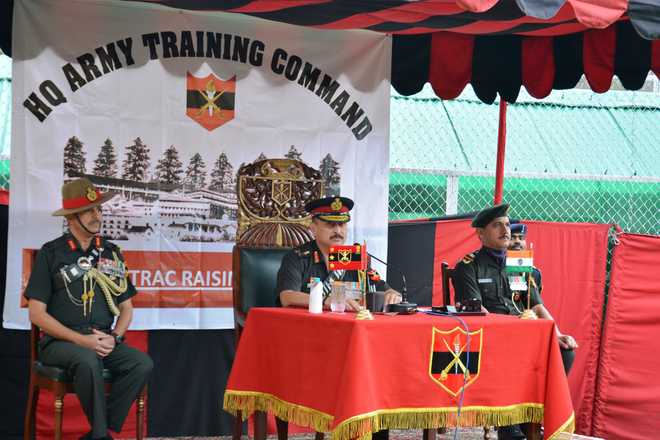
Lt Gen PC Thimmaya, GOC-in-C, ARTRAC, during the celebrations of its 29th Raising Day in Shimla on Tuesday. Tribune photo

Tribune News Service

Shimla, October 1

There is a need to merge the Directorate General of Military Training with Army Training Command so that a single point advice is available to the Chief of Army Staff (COAS) on all training matters, said Lt Gen PC Thimmaya, General Officer Commanding-in-Chief, Army Training Command, while speaking on the 29th Raising Day of Headquarters Army Training Command (HQ Artrac) here today.

A special Sainik Sammelan was organised in which Lt Gen PC Thimmaya, General Officer Commanding-in-Chief, Army Training Command, commended all ranks and the civilian staff for their dedication and urged them to maintain the highest professional standards.

He exhorted all ranks to put in sustained efforts towards propelling this great organisation further towards reaching the pinnacle of glory and advised them to be prepared to face the challenges ahead. A ‘Barakhana’ was organized for the troops on the same day.

Lt Gen PC Thimmaya highlighted the need to impart training on war gaming, simulation, artificial intelligence, cyber and space and stressed on the need for leadership training to be imparted to all ranks to keep pace with the changing battlefield milieu. He also presented outstanding individuals, including police officials, with commendation cards in appreciation for their outstanding contribution and devotion to duty.

The Army Training Command through its 32 training establishments spread all over the country imparts institutionalized training to Army personnel.


Naval Variant Of LCA Tejas Achieves Major Milestone As It Completes Full Launch, Arrested Landing In One Sortie

Naval Variant Of LCA Tejas Achieves Major Milestone As It Completes Full Launch, Arrested Landing In One Sortie

HAL Tejas NP-1 takes-off from the Shore Based Test Facility at INS Hansa, Goa (Indian Navy/Wikipedia)

The Naval variant of India’s light combat aircraft (LCA) Tejas has achieved a major milestone in its flight operations after completing a full sequence of launch and arrested recovery in a single sortie, Livefist Defence has reported.

As per a statement by the Defence Ministry, the LCA Tejas launched off its ski jump at 4.21 PM on 29 September and was trapped 10 minutes later at the arrested landing site.

The test which took place at Indian Navy’s offshore facility at INS Hansa in Goa, simulated conditions which are similar to seaborne aircraft carriers.

Indian Navy had earlier achieved arrested landing and ski jump takeoff individually but it was the first time the aircraft performed both these acts during a single sortie.

The ski jump was first performed by the aircraft in 2014 and the arrested landing was first successfully performed just two weeks ago.

The latest success is expected to bolster the LCA Naval program in its quest to become combat ready


Railways announces 14 special trains to Sultanpur Lodhi during 550th Prakash Purb celebrations

Railways announces 14 special trains to Sultanpur Lodhi during 550th Prakash Purb celebrations

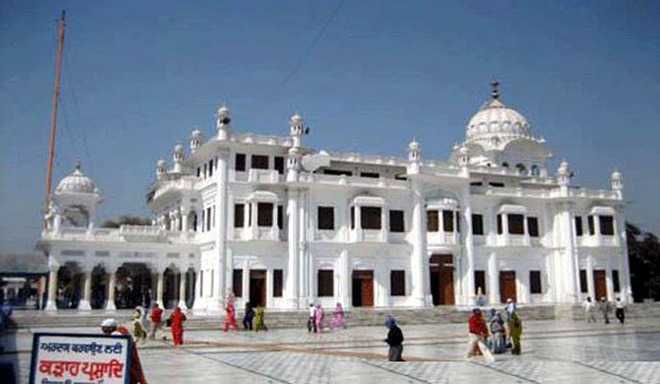
Ber Sahib Gurdwara in Sultanpur Lodhi

Chandigarh, September 30

Accepting Chief Minister Captain Amarinder Singh’s request for special trains for Sultanpur Lodhi to meet the rush of pilgrims expected there during the 550th Prakash Purb celebrations of Sri Guru Nanak Dev Ji, the Ministry of Railways has decided to run 14 special intra-state and long distance inter-state trains connecting the historic town from November 1, 2019.

These special passenger and express trains will facilitate devotees from Punjab and other regions, significantly Nanded and Patna Sahib, according to an official spokesperson. Earlier this month, the Centre had accepted the state government’s proposal to announce a special express train connecting New Delhi with Sultanpur Lodhi.

The ongoing works to upgrade the Sultanpur Lodhi Railway Station would be completed by the Railways before the historic celebrations scheduled to be held in November, the spokesperson said.

As per the communiqué issued by the Northern Railway, the Amritsar-Dera Baba Nanak diesel multiple unit (DEMU) would ply 60 times, between 1st and 16th November, 2019, starting from Amritsar at 9:10 PM to reach Dera Baba Nanak at 2:30 AM.

Anticipating a heavy inflow of pilgrims, the Railways would also be running another train connecting the historic towns of Dera Baba Nanak daily and Sultanpur Lodhi, which would leave Dera Baba Nanak at 7:15 PM to reach its destination at 1:30 AM. The frequency of the train would be doubled from 4th November.

The Ferozpur-Patna Junction express would run thrice between 1st to 16th November, 2019, departing from Patna Sahib at 10:45 PM on November 6, 10 and 16. For return journey it would start from Ferozpur at 12:40 AM on November 5, 9 and 14, to reach Nanded at 6:05 PM.

The weekly Ferozpur-Nanded express would start from Nanded on Saturday at 9:00 AM and reach Ferozpur via Bhopal, Agra, and Bhatinda at 10:50 PM. It would depart for its return journey from Ferozpur on Thursday at 1:30 AM and reach Nanded at 1:00 PM.  The Hissar – Sultanpur Lodhi would run 28 trips every day, as would the Sultanpur Lodhi to Ganganagar, Sultanpur to Nawanshar Doaba, and Fazilka–Sultanpur Lodhi trains. Old Delhi-Lohian Khas would run 40 trips on alternate days, leaving Delhi at 11:50 PM on Mondays.


Two months on: Kashmir schools continue to be shut

Two months on: Kashmir schools continue to be shut

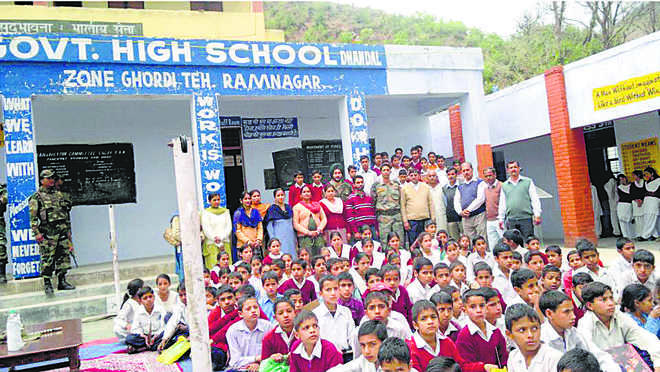
Students at a Government High School in Jammu and Kashmir.

Rifat Mohidin

Tribune News Service

Srinagar, September 27

At her home in Peerbagh locality of Srinagar, Rutba Mustafa, 18, a class XII is teaching few kids, her relatives and neighbors who study in lower classes. Voluntarily she is helping them to complete the syllabus at home as the schools continue to be shut for the last 53 days in Kashmir after Article-370 was abrogated.

“They show little interest to study as they have been disconnected from books as they have not been to schools for a long time,” says Rutba who is herself a student of Class XII.

“The atmosphere in Kashmir is very disturbing for all young people”.

The schools and colleges in Kashmir continue to be shut for last 53 days with no signs of them opening any soon as the annual exam season nears in the region’s schools sparking fears among the students of delay in the academic year and an uncertainty over their future prospects in their careers.

Some students were studying for competitive exams. Some were supposed to apply for national exams like Graduate Aptitude Test Exam (GATE). But overall, the students are in dilemma in Kashmir due to the closure of educational institutions and blockade of internet.

“The government has not any clear idea how much education is suffering and we also do not know whom to approach for any kind of help. The students are a forgotten lot. We are now taking our own initiatives to help ourselves. They will talk about education only when it is a matter of politics,” said  Muntaha Khursheed, a student of Government College for Women in Srinagar.

Earlier ,the government in August had announced to open schools in the areas where restrictions were eased but now there is no talk about schools even from the government making the students furious. Some private schools provided the students with assignments to be undertaken at home till the schools are opened. But there is a little relief for the student of government schools as no such measure has been taken.

“We have not been given any study material from our schools,” said a 17-year-old student of Government Higher Secondary School, Amira Kadal.

Students in the region are in a fix as the exam session is nearing in school but the students have neither completed the syllabus not there are any signs yet that the schools will be opened any soon.

“We do not know when the schools will open and we fear that the day it opens we should not be forced to appear in the exams when we have not completed syllabus yet,” said Misbah Rashid, a student of New Era School in Srinagar. “There is no clarity on any side”.

Another students Zainab from Linton Hall School in city said that they are studying at home but that does not suffice for the board exams.

“The main issue is that at home we remain under stress because there is only discussion about the current turmoil, there is no such atmosphere where we can study. We fear that it will affect our whole year,” she said. “There is also a rumor that situation will further worsen which makes us more anxious”.


General Rawat takes over as Chairman of CoSC

General Rawat takes over as Chairman of CoSC

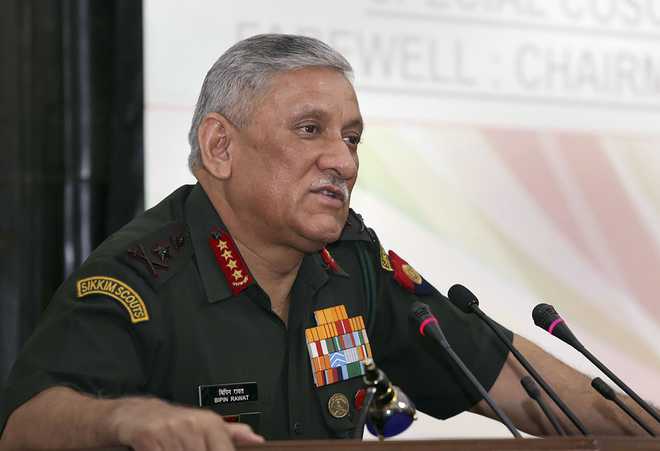
Army Chief General Bipin Rawat addressing after taking over as the new Chairman of Chiefs of Staff Committee (COSC) in New Delhi. PTI

New Delhi, September 27  

Army chief General Bipin Rawat formally took over the baton of Chairman of the Chiefs of Staff Committee (CoSC) in New Delhi on Friday.

Outgoing CoSC Chairman, Air Chief Marshal Birender Singh Dhanoa, handed over the baton to General Rawat in a ceremonial function in South Block.

Rawat, who was commissioned into the Indian Army in December 1978, has taken over as the chief of CoSC by virtue of being the senior-most officer from among the heads of the three armed services of the country.

General Rawat will continue holding the post till December this year when he retires.

Rawat, an alumnus of the National Defence Academy (NDA), had been commissioned into the 11 Gorkha Rifles of the Army. He has vast experience in operations across a wide spectrum of conflict and terrain profiles.

The post of Chairman of CoSC assumes the position of Primus Inter Pares, or first among equals, amongst all the three service chiefs. The Chairman of CoSC is assisted by the Integrated Defence Staff, which is an agency that coordinates amongst various branches of the Indian armed forces.

Prime Minister Narendra Modi had announced in his Independence Day speech from the ramparts of Red Fort on August 15 this year that there will be a Chief of Defence Staff (CDS) for the country.

The Defence Ministry is at present working out various modalities and protocols that will be instituted into the office of the CDS.

As per sources, if the office of the CDS takes shape before the end of this year, Gen Rawat might be the last person to have been appointed as the Chairman of CoSC.

The post of CoSC Chairman will be abolished after the formation of the office of the CDS which will be responsible for coordinating amongst all the three armed forces. — IANS


Dogra Art Museum temporarily shifted to facilitate restoration work

Dogra Art Museum temporarily shifted to facilitate restoration work

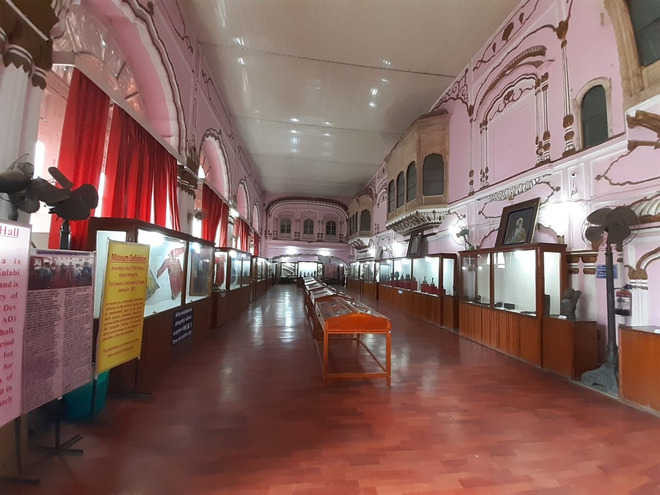
he Dogra Art Museum at the Mubarak Mandi Complex is being temporarily shifted to the Army headquarters building. Tribune Photo

Ranjit Thakur

Jammu, September 24

The Dogra Art Museum at the Mubarak Mandi Heritage Complex is being temporarily shifted to the Army headquarters building after the government sanctioned funds to facilitate renovation work.

The government has sanctioned Rs 65.38 crore under the Jammu & Kashmir Infrastructure Development Finance Corporation for six projects for renovation. The work on two projects has been started while tendering and technical evaluation process is on for three projects and tendering is under process for one project.

For the conservation of the Durbar Hall, Rs 6.74 crore has been approved, whereas Rs 3.37 crore for Dogra Museum, Rs 13.23 crore for Raja Ram Singh Palace, Rs 14.81 crore for the conservation of Mahal of Raja Ram Queens, Rs 14.73 crore for Raja Amar Singh Palace and for the redevelopment of central court yard, Rs 13.71 crore has been approved.

Assistant Director, Archives, Archaeology and Museums, Dr Sangeeta Sharma said, “Though we gave anti-termite treatment every year for preserving the historical items of Dogra rulers such as textiles, arms, world famous Basoli paintings and portraits of rulers, the building needed an immediate repair and preservation.”

“We have already started the process of shifting to the Army headquarters. The entire museum will be shifted to the Army headquarters in the next few weeks,” she added.

“We have also urged the departments concerned to provide security as we have been facing a shortage of staff,” she added.

The renovation work at the historic Mubarak Mandi Complex, the royal residence of erstwhile Dogra rulers in Jammu and Kashmir, continues at snail’s pace as only 5 per cent amount out of the estimated cost of Rs 298.86 crore has been spent on the project during the past 11 years.


Justice Deepak Gupta: Law of Sedition Needs to be Toned Down if Not Abolished

Justice Deepak Gupta: Law of Sedition Needs to be Toned Down if Not Abolished

On September 7, Justice Deepak Gupta of the Supreme Court delivered the valedictory address at a workshop organised by the Praleen Public Charitable Trust and Lecture Committee in Ahmedabad. The following are edited excerpts of his lecture.Today’s topic, ‘The Law of Sedition in India and Freedom of Expression’, is very important and relevant.  I would like to divide this topic in two portions. Since freedom of speech and expression is a fundamental right guaranteed under the Constitution of India, this must be given its due importance and weightage while interpreting any legal provisions including the law of sedition. Therefore, I will first deal with the constitutional right of freedom of speech and expression, then with the laws of sedition, and finally the interplay between the two.

Right of freedom of speech and expression

In the preamble to the constitution, ‘We the people of India’ have promised to secure for all citizens liberty of thought, expression, belief, faith and worship. This is an inherent human right and a part of the basic structure of the constitution. There cannot be any democratic polity where citizens do not have the right to think as they like, express their thoughts, have their own beliefs and faith, and worship in a manner which they feel like.

What is a general promise in the preamble later becomes an enshrined fundamental right.

Article 19(1)(a) guarantees the right of freedom of speech and expression.  This right is a well-recognised right which includes within its ambit the right of freedom of press, the right to know, right to privacy, etc.

Article 21 prescribes that no person shall be deprived of his life or personal liberty except according to the procedure prescribed by law. The word ‘life’ has been given an expansive meaning and has been now recognised to mean to live a life of decency and not a mere animal existence. I am not dilating on the various aspects of the right to life but even if there was no Article 19 (1) (a) we could include the right to freedom of belief, thought, expression, faith and worship in the right to life enshrined in Article 21.

Article 25 makes it clear that every person is entitled to freedom of conscience and the right to freely practice, profess and propagate his or her religion.

No doubt, the state has the power to impose reasonable restriction on the exercise of such rights in the interest of sovereignty and integrity of the country, the security of the State, friendly relations with foreign States, public order, decency or morality, etc.

Also read | Book Review: Chronicling the (Mis)use of Sedition Law in India

The right of freedom of opinion and the right of freedom of conscience by themselves include the extremely important   right to disagree. Every society has its own rules and over a period of time when people only stick to the age-old rules  and conventions, society degenerates. New thinkers are born when they disagree with well accepted norms of society.  If everybody follows the well-trodden path, no new paths will be created, no new explorations will be done and no new   vistas will be found. We are not dealing with vistas and explorations in the material field, but with higher issues. If a person does not ask questions and does not raise issues questioning age old systems, no new systems would develop and the horizons of the mind   will   not expand.

Whether it be Buddha, Mahavira, Jesus Christ, Prophet Mohammad, Guru Nanak Dev, Martin Luther, Kabir, Raja Ram Mohan Roy, Swami Dayanand Saraswati, Karl Marx or Mahatma Gandhi, new thoughts and religious practices would not have been established, if they had quietly submitted to the views of their forefathers and had not questioned the existing religious practices, beliefs and rituals.

It is said that when Guru Nanak Dev went to Mecca, he was very tired and lay down to take rest. His feet were facing the Kaaba which, for the followers of Islam, is the house of God.  The maulvi became angry on seeing Guru Nanak sleeping with his feet towards the house of God and shouted “You fool, don’t you know this is the house of God? Why are you lying with your feet towards the Kaaba?” Then Guru Nanak woke up and said, “O sir, I am sorry I didn’t know it. I was tired so I just lay down and fell asleep. Could you turn my legs to the side in which there is no God?” The maulvi had no real answer and Guru Nanak observed God does not live in one place. He lives everywhere.

Closer home, when Guru Nanak visited Haridwar and entered the holy Ganges to take a dip early in the morning, he saw that most of the pilgrims were taking water from the Ganges, raising it towards the sun and dropping it as an offering to their ancestors. Since he did not believe in such rituals and was a rationalist, Guru Nanak turned his back towards the sun, faced the West and started pouring water. This outraged some of the priests, who asked him what he was doing. He answered, my crops in the fields are dying because of lack of water. I am watering them. Everybody started laughing and making fun of him and asked him how this water would reach his fields hundreds of miles away. He answered that if the water that you pour can reach your ancestors in another world why can’t the water which I pour reach my fields.  Today, if somebody was to behave like Guru Nanak, most probably he would have to spend a couple of days in jail.

In   a   secular   country, every   belief   does   not   have   to   be religious. Even   atheists   enjoy   equal   rights   under   our   Constitution. Whether   one   is   a   believer, an   agnostic   or   an   atheist, one   enjoys complete   freedom   of   belief   and   conscience   under   our   constitution. There   can   be   no   impediments   on   the   aforesaid   rights   except   those permitted by the constitution.


Army brings uniformity in uniform for officers above Colonel rank

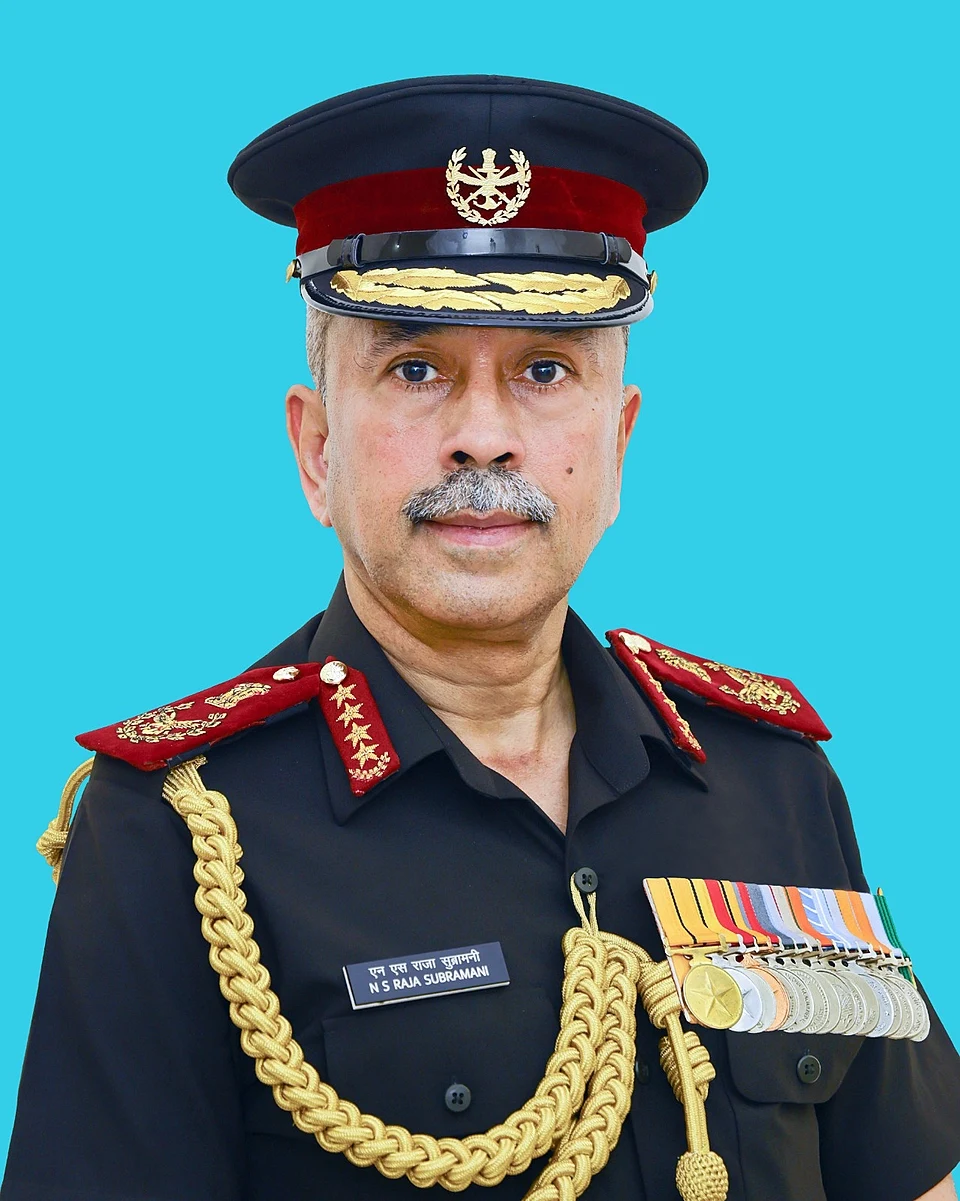
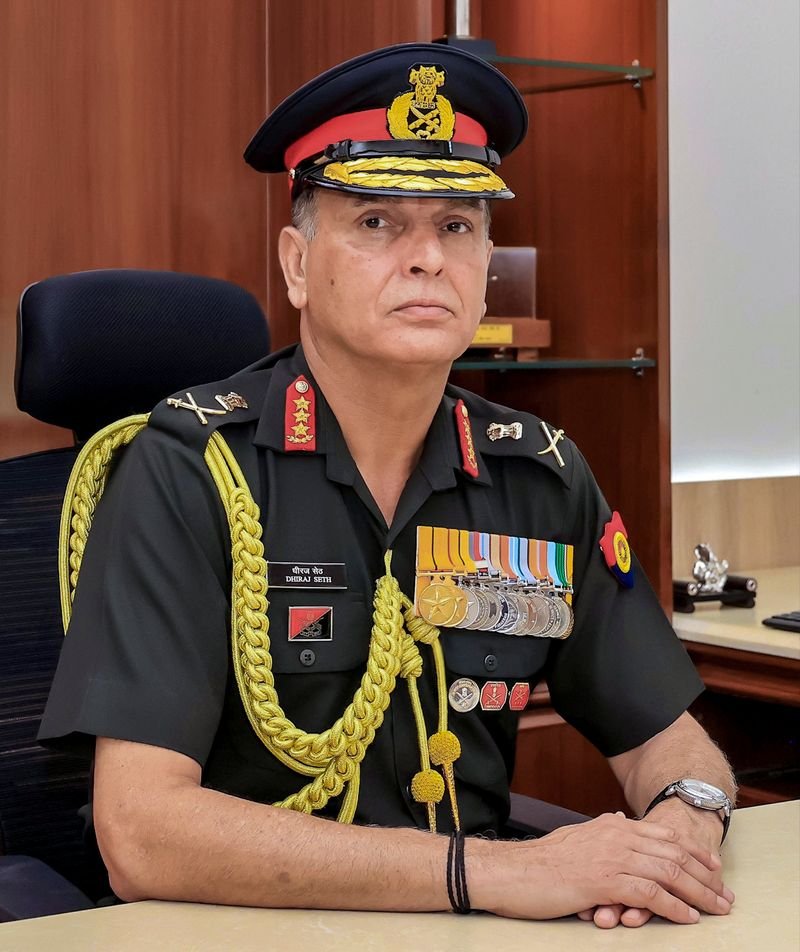
NEW DELHI: Calling it a move to bring in uniformity in uniforms, the Army has decided to do away with differences in the attires of officers above the rank of Colonel.

This means that all Brigadier-rank officers and above will sport the same beret, cap, shoulder badge, lanyard and belt.

Currently, depending on the regiment or arm that an officer belongs to, the colour of the beret, lanyard, badge, etc., differ. And the badge on the belt is also different.

“We have taken the decision to do away with differences in the uniform of officers from the rank of a Brigadier. The uniforms show your links with the regiment, arm or service that you belong to,” a senior Army officer said.

“But all of them are Indian Army officers, so there should be no difference. There should be no affiliation to the lanyard or the regiment,” the officer added.

To begin with, the dress that officers don in the evening while visiting the officer’s mess will be changed. The Army has already received three types of samples and a final decision on it will be taken soon.

The uniform is a matter of pride for every soldier. As soon as an officer gets commissioned, he is assigned a particular service that has distinct badges.


Currently, all rifle regiments such as the Rajputana Rifles and Gorkha Rifles have black-coloured badges on their shoulders and buttons.

The colour is silver for the Assam Regiment and brass for the J&K Light Infantry.

The colour of the beret also varies. It is navy blue for the engineers regiment, green for the Gorkha Rilfes and maroon for the parachute regiment. Similarly all regiments/corps have different lanyards.

The uniforms also change with the season, and are different in winter and summer.

The Army has a total of 42,913 officers, starting from the rank of a Lieutenant to the Chief of Army Staff with the rank of General.


My unit is not a ‘thana’, Colonel takes on IPS officer after being addressed as ‘in-charge’ in letters

Colonel Monash Bakshi, Commanding Officer of 4 Himachal Pradesh (Independent) Company NCC, has written to the SP, Arijit Sen Thakur, pointing out that correct protocol of letter writing was not being followed while addressing letters to him.

Colonel takes on IPS officer, chandigarh IPS officer, hamirpur NCC unit colonel, chandigarh city news, Colonel Monash Bakshi, SP Arijit Sen Thakur,

The letter then goes on to inform the SP about the rank structure of the Army and NCC units.

A Colonel, who is commanding an NCC unit in Hamirpur in Himachal Pradesh, has written a stinging letter to the Superintendent of Police (SP) of the district stating that his unit was not a ‘thana’ (police station), after taking exception to being incorrectly addressed in official communications, and adding that in future such correspondence will land in the dustbin in his office.

Colonel Monash Bakshi, Commanding Officer of 4 Himachal Pradesh (Independent) Company NCC, has written to the SP, Arijit Sen Thakur, an IPS officer, on August 9, pointing out that correct protocol as part of customary etiquette of letter writing was not being followed while addressing letters to him.

“The letters originating from your office to this unit addressing Commanding Officer, who is of the rank of a senior Colonel, looking after entire Hamirpur district and districts of Mandi, Bilaspur and Kangra, as ‘in-charge, NCC Company Commander’. Since it is not a ‘thana’ there is no-incharge here. I take it that it is perhaps due to lack of knowledge or ignorance about the rank structure of Indian Army on part of your clerical staff,” the letter states.

The letter then goes on to inform the SP about the rank structure of the Army and the NCC units. “The NCC units are not like other regular Army units where appointments like Company Commander are held. The NCC units have a nucleus comprising senior Army officer of the rank of Colonel/Lt Colonel and permanent instructor staff to enroll and train cadets from various education institutions/colleges. There are no Company Commanders in NCC units. The connotation of Commanding Officer/Officer Commanding all over Indian Army is same, only difference is the size of the unit,” it states.

The Colonel then goes to tell the SP that he should educate and instruct his ‘munshi’ (clerk) to follow correct customary protocol/order of precedence while communicating “failing which such letters will only find place in the dustbin of my office”.

“Am sure while undergoing training at LBSNAA, Mussoorie you had done attachment with the Army unit and are made aware of the rank structure of officers of the Indian Army. Looking forward for improved response,” Colonel Bakshi states in the end.

When contacted, SP Hamirpur, Arijit Sen Thakur, said that he had seen the letter which he had received on WhatsApp. “I haven’t received this letter official as yet…I cannot confirm its authenticity as yet,’ he said.

However, speaking to The Indian Express over the phone from Hamirpur, Colonel Monash Bakshi confirmed that he had written the letter. When told that the SP had said that he had not received it as yet, he said, “That you ask from the SP”. He also said that the office of the SP had not been using the correct nomenclature while addressing letters for the past some time. Colonel Bakshi refused to discuss the matter further saying that he did not know whom he was speaking to on the phone.