Sanjha Morcha

What’s New

Click the heading to open detailed news

Current Events :

web counter

Print Media Reproduced Defence Related News

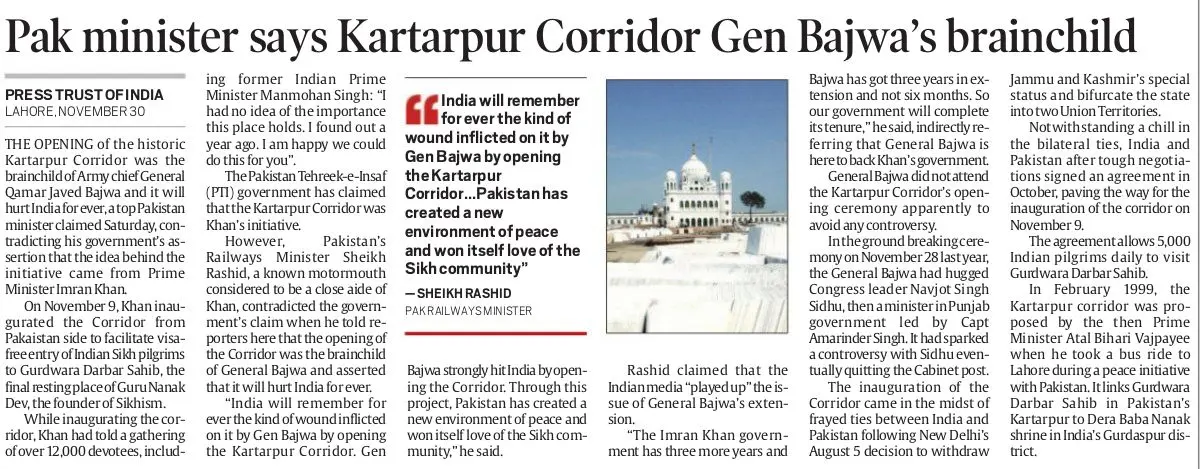
550 saal Guru Nanak de naal Celebration, reaffirmation

550 saal Guru Nanak de naal

As Guru Nanak’s teachings stand out for their relevance in the present times of divisive turmoil even 550 years after his birth, one’s head bows with humility to the Guru’s deep insight into the right way of living. And, astonishingly, the right path turns out to be quite simple. It is we who have made our lives complicated. With superstitions, rituals, idolatry, barriers of caste and creed, all dressed up with the cloak of religiosity to garner acceptance. In his endeavour to open the minds of fellow humans to the society’s blots and blemishes, the Guru freely dug into the preachings of his times — from those of the Hindus, the Muslims, babas, pirs, fakirs — to evolve his philosophy, that eventually became the Sikh way of life.

Also, equally astonishingly, it turns out that treading on that simple way of life is not quite so easy. One is easily led by ego, anger, lust, greed towards diversions, blind to the potholes that mark such digressions. After all, why is it so tough to consider all fellow beings as equal; that there is one nameless God, who constitutes the eternal truth and he resides in his creations? Why is truthfulness so hard to come by? Yet, that is the only way for a peaceful and fulfilling life. Be good, work hard, share fortunes. Vand khao, khand khao. Each one of us needs to learn and abide by this credo. The planet would then be a paradise.

It is in this context that the year-round global festivities around the 550th anniversary of Gurpurb assume importance. Whether it is the announcement of the Kartarpur corridor from Dera Baba Nanak in Gurdaspur to the International Border for further connection with Gurdwara Darbar Sahib at Kartarpur, Pakistan, or the development of Sultanpur Lodhi as a spiritual centre, the activities hold value only if they underscore the Guru’s message of overcoming divisiveness. He denounced the dogmas of the caste system, and taught that everyone is equal. Through the spiritual pursuits of love, equality, fraternity and virtue, one can be purged of falsehood.


Victims of mass genocide can’t be left in lurch: Judge

A Delhi court pronounces death sentence on one and life term on another for killing two people during mob violence in the aftermath of the assassination of ex­PM Indira Gandhi

NEWDELHI: Victims of ‘mass genocide could not be left in the lurch and that their allegations should also be given a fair hearing, a Delhi court observed on Tuesday while sentencing two convicts in a 1984 anti-Sikh riots case.

Additional Sessions Judge Ajay Pandey noted that for 33 years the two men had escaped the process of law and said that it is time for the court to rise upon the cry of the victims and the demand of the society. The court awarded death penalty to convict Yashpal Singh for killing two men during the riots — the first capital punishment in the case. Co-convict Naresh Sehrawat was given life term.

Judge Pandey said from the testimony of the eyewitnesses, it is clear that Yashpal had come to the spot in the bus on November 1, 1984 and that he was actively involved in the burning of shops of the deceased and the eye witnesses. The court also pointed that there was sufficient material and allegations in the affidavit given by one of the eyewitnesses, Santokh Singh, who is also the complainant.

The judge said there is no material before it to consider that convict Yashpal had reformed himself. “He appears to be playing gimmick with the court and victims to date. He appears to be purposely hiding his income and properties,” the court said.

“The court is of the opinion that if he did not repent for 34 years and his mentality did not reform when he was at large in society for such a long period. He attempted to mislead the court in order to escape his liability, his chances for reformation now are almost negligible,” the judge said.

While convicting the duo, the court has said that ‘fair trial should not be fair to only the accused persons. It also said that the accused had never been even arrested till the pronouncement of their conviction on November 14. “The court recalls the feelings of the victims when the eyewitnesses appeared before the court on November 5 and expressed their grief that the convicts were roaming at large,” the judge said.

Stressing on the need for justice in such cases, the judge said such incidents break the trust between communities which, once broken, cannot be restored, even after decades. “Incidents of this kind breaks entire fabric of trust and harmony against communities, severely affecting the knitting and assimilation of different religious and social groups,” the court said.

The verdict was pronounced in Tihar Jail after the local police moved a petition in the high court citing security reasons and possibility of attack on the convicts on the premises of the Delhi court, said a senior police officer.

Timeline of the Mahipalpur case

November 1, 1984: Two men were killed, three others injured after a mob armed with sticks and other weapons attacked them and threw them down from the first floor of a building in Delhi’s Mahipalpur. FIR (406/84) was registered at the Mehrauli police station the same day.

February 23, 1985: Chargesheet filed against Jai Pal Singh.

September 9, 1985: Santokh Singh, brother of three victims, filed an affidavit before Justice Rangnath Justice Ranganath Misra Commission that was formed to probe the killings for filing a separate case.

December 20, 1986: Sessions court acquitted Jai Pal Singh of all the charges. The other two accused Naresh Sehrawat and Yashpal Singh did not face trial.

1993: Fresh FIR was filed on Santokh’s affidavit on the recommendation of Justice JD Jain and DK Aggarwal committee

February 9, 1994: Metropolitan Magistrate TS Kashyap accepted the untraced (closure) report filed in the case by the Delhi Police, saying the police could not gather evidence to prosecute Sehrawat and Singh

February 12, 2015: Central government constituted Special Investigation Team (SIT) to reopen and further investigate anti-Sikh riots cases, which were either cancelled or closed for want of evidence.

July 8, 2016: The SIT intimated the Patiala House Court about re-opening and further investigation of the case

January 31, 2017: The SIT filed the chargesheet against Sehrawat and Singh.

November 14, 2018: The court convicted the two men.

November 15, 2018: Sehrawat was assaulted by Delhi’s Shiromani Akali Dal (SAD) legislator Manjinder Singh Sirsa outside the courtroom moments after the court reserved its order on the quantum of punishment.

November 20, 2018: The court pronounced death sentence for Singh and life term for Sehrawat.


Grenade Made In Pakistan, ISI Plotted Amritsar Attack, Says Amarinder Singh

Three persons were killed and 20 injured when two men on a motorcycle threw a grenade at a religious congregation in Adliwal village in Rajasansi area, about 15 km from Amritsar on Sunday.

CHANDIGARH:
HIGHLIGHTS

http://
Says one person arrested for attack at prayer hall on Sunday
Says this is a pure case of terrorism, no communal angle to incident
3 people were killed, 20 injured as men on bike threw a grenade

The grenade used for Sunday’s attack at a prayer hall in Amritsar, which killed three people, was made in Pakistan, Punjab Chief Minister Amarinder Singh said today. “There is no communal case in this. This is a pure case of terrorism. ISI (Pakistan intelligence agency) is resorting to all these sort of things,” Mr Singh told reporters today.
A man has been arrested for the attack, a hunt is on for the other, the Chief Minister said. The arrested man has been identifies as Bikramjit Singh. “A search for another accused, Avtar Singh, is on,” Mr Singh said.

tsoo30b4

Three people were killed and 20 injured in the attack at the Nirankari Bhawan at Amritsar’s Rajasansi village.

5v3q1jvk

Around 20 people were also injured as two men on a bike, their faces covered, threw a grenade at the Nirankari Bhawan at Amritsar’s Rajasansi village on Sunday morning. Like every Sunday, a religious ceremony was on at the time. Eyewitnesses said the men had threatened the devotees with a gun before flinging the explosive into the prayer hall.

The police had initially said they were also investigating the possible involvement of terrorists supporting the demand for Khalistan. Several people from Sikh separatist organisations were detained for questioning.

tsoo30b4
All victims were sect followers from nearby villages who had gathered for the weekly religious meeting.

But the Chief Minister said today that Pakistani intelligence agency ISI was behind the attack. “The mastermind of the attack is Pakistan’s ISI. Pakistan’s agenda is to disturb peace here,” the chief minister said.

COMMENT
Pakistan, the Chief Minister said, has been habitually trying to stir up trouble in Punjab, the state next to the border. The people, he said, “were easy targets and they were targeted”.


China recruits high school students to develop weapons systems Zoom

BEIJING:The Chinese government has for the first time recruited 31 high school students to join an experimental artificial intelligence (AI)-driven programme to develop intelligent weapons systems at the elite Beijing Institute of Technology (BIT).

REUTERS FILE■ Chinese solders at an honour guard in Beijing

The students, including four girls, will be the first batch to take the four-year course titled “experimental programme for intelligent weapons systems”.

The recruits will begin training as the world’s youngest AI scientists at BIT, which is among China’s leading weapons research institutes, South China Morning Post reported. More than 5,000 students had applied for the 31 seats. The programme was launched at the headquarters of Norinco, one of China’s biggest defence contractors, on October 28. News about the new batch was published on BIT’s website but subsequently deleted. An online snapshot of the BIT post provided details about the programme and what it aims to achieve. Quoting a statement from the 19th National Congress of the Communist Party of China, BIT said the new batch was an effort to implement the idea of establishing science and technology as the core combat capability and “providing important support for building a first-class national defence science and technology industrial system”.


Pak ‘diplomatic sabotage’ busted: India to go ahead with Ratle hydroelectric project, govt to send team to J&K

India has decided to go ahead with the 850 MW hydroelectric power project despite objections by Pakistan. The Ratle dam is currently under construction on the Chenab River. While Pakistan says that the dam violates the Indus Water Treaty, signed between the two countries in 1960, India has always maintained the Ratle project is a run-of-the-river hydroelectricity project and not in violation of the treaty.

According to the treaty, India can build hydropower projects on the Jhelum and the Chenab but Pakistan has deliberately protested and tried to stop any construction.

The decision to send the power ministry and state government officials to Ratle was taken at a meeting chaired by top officials of the prime minister’s office on October 30. This meeting was related to the Indus basin projects and apart from Ratle two other projects were also discussed.

The Punjab and Jammu and Kashmir government have revived the Shahpur Kandi dam project and have entered into an agreement to restart the work that has been stalled for the past four years.

While the Punjab government will begin the work, the water resources ministry will prepare a revised cost estimate and ensure cabinet approval.

The water resources ministry and the Jammu and Kashmir government are also planning to visit the Ujh multipurpose project to prepare the action plant. According to media inputs, the government is looking to lay the foundation stone of the project by the end of the year.

Basically, the treaty allows the waters from the Indus, Jhelum, and Chenab to Pakistan and the Ravi, Sutlej, and Beas to India.

World Bank has allowed India to construct Kishanganga and Ratle hydroelectric project on tributaries of the Jhelum and Chenab rivers with certain restrictions.


UK plans new fund for Indian soldiers who fought in World Wars

UK plans new fund for Indian soldiers who fought in World Wars

A group of soldiers at a signal station of the Dehra Dun Brigade Photos courtesy: The British Library

London, November 1

The UK government has unveiled plans to offer support to Indian soldiers who fought for Britain during the two World Wars but lost out on pensions and other benefits accrued to British armed forces personnel at the time.

UK International Development Secretary Penny Mordaunt said the government is keen to rectify the injustice faced by Indian and other Commonwealth war veterans, many of whose families are now living in harsh conditions in their countries of origin.

“These veterans were cast off, not taken care of and not given pensions and looked after. There are about 8,500 of these individuals and their widows around the world who are living on one meal a day and have no access to healthcare,” Mordaunt said, during her address at the Punjabi Society of the British Isles annual gala on Wednesday.

“I will announce a new programme that will take care of these servicemen and veterans and their widows for the rest of their lives. And, I think that is a great example of the values and the shared humanity among the members of the Commonwealth that the Punjabi Society exhibits,” she said.

The new programme will be a partnership between the Royal British Legion, the UK’s armed forces charity, and the Department for International Development’s UK Aid initiative.

It is set to be formally announced in the lead up to Remembrance Sunday, held on November 11 every year as a day to commemorate the contribution of British and Commonwealth military and civilian servicemen and women in the two World Wars and later conflicts.

It marks Armistice Day of November 11, 1918, when World War I finally came to an end.

A charity auction at the Punjabi Society event, which included lots such as a series of cricket paraphernalia signed by the Indian cricket team and captain Virat Kohli, helped raise over 20,000 pounds for another armed forces charity, Combat Stress.

The UK-based organisation offers support to armed forces’ men and women suffering from post-traumatic stress disorders and mental health conditions.

“The Punjabi Society is known for its efforts to support good causes over the years and we are very proud to help raise funds for the armed forces charity Combat Stress this year,” said Rami Ranger, British Indian businessman and patron of the society.

The event also marked the Pride of Punjab awards presentation, with Britain’s Pakistani-origin home secretary Sajid Javid being honoured for his political achievements on the basis of his roots in the wider region of Punjab in the Indian subcontinent.

“I am a proud Punjabi and this event celebrates the contribution British Punjabis make to every walk of British life,” Javid said.

Among the other winners included Indian-origin hotelier Jasminder Singh and Metropolitan Police Superintendent Davinder Singh Kandola for their services to the community.

“These awards reflect the real and significant contribution made by the Punjabi community to life in the UK,” said Atul Pathak, president of the Punjabi Society. — PTI


Pak poses ‘thrice the terror risk’ than Syria

London, October 27

Pakistan remains a breeding ground and supporter of global terrorism and is responsible for three times the terror risk to humanity that Syria poses, says a study. The report titled “Humanity at Risk — Global Terror Threat Indicant (GTTI)” was published by Oxford University and Strategic Foresight Group (SFG).

According to the GTTI, while the Afghan Taliban and the Lashkar-e-Taibba  pose the maximum threat to international security, Pakistan is placed on top of the list of countries with the highest number of terrorist bases and safe havens.

“If we look at the most dangerous terrorist groups, based on hard facts and statistics, we find that Pakistan hosts or aids majority of them. Also, there are a significant number of groups based in Afghanistan, which operate with the support of Pakistan,” the report says.

The report, which has been prepared to discuss the challenges for the next decade, presents an analytical framework and tool to enable policy makers to look into the future. “The rise of competitive extremism of all shades, misuse of weapons of mass destruction and economic disruptions can undermine human progress or even survival in the period from now until 2030. They are all interlinked with terrorism,” it said.

The SFG, which analysed 200 groups  involved in terror acts, said the factor influencing the future of terror groups would be the support they get from states, intelligence agencies and criminal networks. — Agencies


Army major, 8 jawans injured in IED explosion in Pulwama district

Army major, 8 jawans injured in IED explosion in Pulwama district

f the seven soldiers, three with serious injuries were airlifted to an Army hospital in Srinagar.

Our Correspondent
Anantnag, October 19

An army major and eight jawans were injured in an Improvised Explosive Device (IED) blast in south Kashmir’s Pulwama district late on Thursday, officials said.

An army Casper vehicle was targeted with an IED blast and was followed by firing by the militants at Trichal village at around 9.15 pm.

“The blast left nine soldiers injured,” a police officer said.

Soon after the attack, the area was cordoned off and searches were conducted by security forces to trace the militants.

The Casper vehicle which came under attack belonged to 55 RR of the Army and was targeted on the Lassipora-Pulwama road.


1st biofuel­blended IAF plane to take flight soon

If we do this well, we may never need to import crude oil for our armed forces.
DR ANJANY RAY, D irector of the CSIR-Indian Institute of Petroleum

NEWDELHI: On November 19, a Russian made AN-32 of the Indian Air Force’s transport fleet will take to the skies from a base in the Western Sector using a mix of Aviation Turbine Fuel and Bio-Fuel.

■ On an average, IAF flies over 100 transporter and over 500 helicopter sorties in a day.This is the first ever IAF aircraft to use the fuel blend.

After transporters, the helicopter fleet will fly using the Bio-Aviation combination. “It will be a gradual move, and ultimately fighters like the Su-30MKi, Mig-29 will also use it,” a senior IAF officer who didn’t want to named said.

On an average, IAF flies over 100 transporter and over 500 helicopter sorties in a day. “Using Bio-jet blended fuel is a commitment towards lowering the oil import bill and lower the carbon footprint and strengthen the farmbased economy,” Wing Commander Anupam Banerjee, the IAF spokesperson said.

Two years ago, the IAF sent Wing Commander Asheesh Srivastava to study the use of Bio Aviation Fuel at the Centre for Air Power Studies. Subsequently, the Indian Institute Petroleum and the Centre for Military Airworthiness & Certification and the Directorate General of Aeronautical Quality Assurance were roped in.

“If we do this well we may never need to import crude oil for our armed forces. This biojet product looks smells and performs exactly like Aviation Turbine Fuel. If we are able to work this out as we anticipate, our aircraft, vehicles and warship can all bank on domestic reserves of indigenously developed and produced renewable fuel,” Dr Anjany Ray Director of the CSIR -Indian Institute of Petroleum said.

Every year, the IAF spends about ~40,000 crore on ATF. With Bio-Aviation Fuel, it expects its fuel bill to drop by about 10 per cent. “Initially, the plan is to use a 90-10 mix (90 litres of AFT mixed with 10 litres of Bio-fuel), gradually, as the supply and production of Bio-Fuel increases the plan is to move to a 75 -25 mixture,” a senior official involved with the process who didn’t want to be named said.

To ensure that production of Bio-Fuel doesn’t affect the land available of food-grains, Bio-Fuel will be produced only from non-edible oils that grow well in arid lands. Gujarat, for instance, offered 10,000 acres arid land to produce non-edible oilseeds. Other states that are keen to produce non-edible oil seeds and put up plants to produce Bio- Fuel include Punjab, Haryana, Chattisgarh, Uttarakhand and Telangana.

If the test flight that starts from November mid-week goes as planned, IAF will showcase its capability during the Republic Day fly past on January 26, 2019, a senior IAF official said.


‘Indian Army does not like being committed to civilian operations, they’re our own people’

On this week’s Walk The Talk, Shekhar Gupta catches up with soldier, diplomat and academician Zameer Uddin Shah.

Shekhar Gupta (SG): Hello, and welcome to Walk The Talk. I am Shekhar Gupta and my guest today is General Zameer Uddin Shah, one of the most illustrious officers of the Indian Army. Better dressed than most people, better dressed than me, which is easy, but better dressed than most people.

Somebody who, in his memoirs, has called himself the ‘sarkari musalman’.

General Shah: Well, I am not a sarkari musalman. But I have named my memoirs The Sarkari Musalman because it is a sobriquet or a title given by the Muslim community to people who are generally government servants, when they don’t care about illegitimate demands of the community.

SG: Or stereotypes.

General Shah: Or stereotypes. That is one type. My father was called one (sarkari musalman) when he tried to implement reforms at the dargah in Ajmer. I had the fortune of meeting some young boys when I was a second lieutenant. And I tried to convince them to opt for the armed forces as a career.

SG: Muslim boys?

General Shah: Muslim boys from the Aligarh Muslim University riding club. They had come to the IMA (Indian Military Academy) to participate. And I told them the honour and glory of wearing the uniform. I also told them that we need horsemen.

Then, at the end of the talk, I asked them, how many of you want to opt for the Army. Not a single person opted. They said, “Janaab, aap to sarkari musalman hain.”

It meant that I was a government stooge trying to push the government’s agenda. So that stuck to me, and I said if I ever write a book, I’ll call it The Sarkari Musalman. But I am not one.

SG: But have times changed since then? Have young Muslims given up their suspicion of working for the government, or working for an institution like the Army, or does a lot of it still continue?

General Shah: No, I think there has been a quantum improvement. When I joined the NDA (National Defence Academy), I was the lone Muslim in my corps of 200 cadets. I am told that in one of the batches, there were 10 Muslim cadets which is a very positive sign.

Muslims, this is our country, and they too owe a responsibility for the defence of the country. So, I think it’s a healthy sign.

SG: Lt General Ata Hasnain has written for us, in fact, starting this debate that more and more Muslims should look at the Army as a career, specially officers.

General Shah: I agree.

SG: Did you feel a sense of discrimination, or did you feel like a trophy since you were the only Muslin in your batch?

General Shah: Nobody knew that I was a Muslim. At the National Defence Academy, you are given nicknames. Mine was carried by my schoolmates: Zoom Shah.

SG: Sounds like a very trendy one today.

‘No discrimination’

General Shah: You know, the nick name was not linked to any religion, caste, creed or anything like that. It was on some peculiar characteristic. For people who had protruding teeth, they are called ‘dentist’. You know, things like that. So, it was a name given to me.

And let me tell you that I faced no discrimination and I am not being a hypocrite.

SG: Which year was this, sir?

General Shah: I joined the National Defence Academy in 1964. I was 15 and a half years old. I tried to sprout a moustache to look older. And not only did I not face any discrimination, I faced affirmative action. One day, one of my coursemates, in jest, called me katua.

SG: Katua is a pejorative for Muslims.

General Shah: So, the rest of my coursemates got after him and said don’t ever say that again. So, that’s the sort of attitude that encouraged me and I was very enthused with this response.

SG: And you got it from top officers also?

General Shah: Absolutely.

SG: Was there ever any suspicion, “ki isko mat batao (Don’t tell him)”.

General Shah: Never. I was the operational officer in a division at Hussainiwala opposite Pakistan post 71. I was privy to everything. I was in the military secretary’s branch. I was the deputy chief. I mean I was privy to every national secret. There was never a time that I was told, General Shah, you go and play golf. While we are discussing, you go and… never anything like that.

SG: During the time of Operation Parakram, you were commanding a strike division that was poised to strike deep if need be. A key division.

General Shah: That’s right. And the very fact that my division was, since we were not committed on the ground, a strike division, I was tasked to lead the formation.

I was told later by General Padmanabhan, who was the chief (in my book, I have not given his name), that there were misgivings. I never felt anything. The Army, when asked, said, “We have not sent a Muslim General; we have sent the commander of the force that is committed”. And I thought that was a very good way of looking at it.

SG: So, you mean misgivings in the sense that people raised questions about the Army sending a Muslim General.

General Shah: Absolutely.

SG: But the fact is you just happened to be commanding a division that could be deployed there.

General Shah: Absolutely. The Army makes no distinction of religion, race, colour or creed. It is the commanding officer that is commanding the formation who commands.

SG: And you were in the reserve, whereas the division based in Ahmedabad was not available.

General Shah: I was in the reserve. They (division in Ahmedabad) were holding formation; they were deployed holding the border.

SG: So, what happened when you came to Ahmedabad?

General Shah: I was given the warning order by the chief personally on the evening of 28 February 2002. He just spoke to me for two minutes. He said, Zoom, get your formation in Gujarat and curb the riots. I told him, “Sir, it will take us two days”.

SG: Your formation was used to cavalry and mechanised forces.

General Shah: Well, it was a strike formation.

SG: If I do remember correctly, during General Sundarji’s time, it was earmarked to be an air assault formation. Helicopters never came.

General Shah: That’s correct. At various times, it was an amphibious division and other things. But it is a very potent division. I am very proud to have commanded it.

SG: And what happened once you were there?

General Shah: So I told him (the chief). He said, “Don’t worry. Get to Jodhpur air field. The Air Force will lay it on.” They did. Sixty flights. The complete resources of the Air Force were mobilised to move. I left immediately.

SG: So, 60 transport planes?

General Shah: Well, 60 flights. Maybe fewer planes. Sixty sorties. They were ferrying us the whole night. They were ferrying us from Jodhpur to Ahmedabad. When we flew in, I saw the whole city aflame. There were fires burning everywhere. The air field was deserted. It was dark. We landed and the deputy of the holding formation met me. He had been sent down to receive me. And I had been told that you will get all the resources you need. The resources we required was transport because we couldn’t carry them. Maps, magistrates.

SG: Because this was not AFSPA. You were in aid to civil power. So, you needed magistrates even to open fire.

General Shah: Yes, we needed that. Although a military officer, if he feels the situation (demands it), even if the magistrate is not there, he can fire. But then he needs to explain that. So, I asked Brigadier Mehra, where are the resources? He said the state government is providing it.

So, I asked for the chief secretary. He said he is abroad. So, I said, who is officiating? He gave me a number. I tried to call it, but there was no response. I decided that the only way to get things done was to go to the chief minister. I asked for a guide and I reached the chief minister’s office at 2 in the morning on 1 March 2002.

There, to my great relief, was defence minister George Fernandes. He was having a late dinner with the chief minister.

SG: Mr Narendra Modi.

General Shah: Yes. So, I had carried a tourist map because we didn’t have maps of Ahmedabad.

SG: And there were no Google maps, no Siri.

General Shah: On a tourist map of Gujarat, we plotted the trouble spots.

The assignment the Army hates

SG: I think the maps you had memorised were somewhere near the Multan sector.

General Shah: Quite right. That was working in our mind. You know, all these things I had completely forgotten. And let me tell you it’s a task that is abhorred by the Army. We don’t like to be committed to civil situations. Because they are our own nationals, they are our own citizens. And then one is to take action against them.

So, I was assured that they (the resources) would come. So I went back, received all the troops. They were large numbers, six battalions were flown in.

SG: That means, if I can take this question forward, maybe I am taking it too far. Did you get a sense that the central government had shown its keenness moving a strike division in that crucial time when Op Parakram was on, in giving you 60 sorties of the Air Force to move you there? But then you hit a wall with the state government?

General Shah: See, that would be a political statement. I think it was an administrate failure basically because of the chief secretary…

SG: I didn’t suggest, I am not going so far as to say it was deliberate.

General Shah: It was an administrative failure. The chief secretary should have been there, the officiating chief secretary should have ensured that the wherewithal for us to move into the city and all over Gujarat should have been positioned. But it wasn’t. On the morning of 2nd, Mr George Fernandes visited us at the air field.

SG: So, what happened when you reached the chief minister’s home at 2 am?

General Shah: Well, he welcomed me. He was very warm. Both showed great relief. So, I said,Saab, troops aane vaale hainmain first flight mein aaya hun (Sir, the troops are about to come. I took the first flight here).

Luckily, I had taken my vehicle and communications. So, we shared something to eat. I moved back with the assurance that things will be provided. They were ultimately provided on 2nd morning. Mr George Fernandes came to us at about at about 10 o’clock on 2nd morning.

SG: So, all of 1 March, you were just sitting.

General Shah: We were just sitting.

SG: And George Fernandes was in Ahmedabad?

General Shah: Did I say 2nd. No, he visited on the morning of 1 March.

SG: What did he say then?

General Shah: He said, you must ensure fair play; you must make sure that the message goes home that the Army has been deployed. And whatever is your requirement, we will make it up. He left after that. The transport started rolling in on the second. And we deployed.

SG: If you had been deployed on the first itself, would it have saved some lives?

General Shah: Of course, it would have saved one day of rioting.

‘A profound mistake’

SG: And did you ask people, did you reflect on it as to what happened, why did it happen? Was it deliberate, was it not deliberate?

General Shah: I did speak to a lot of people. There was a rift even in police. I was getting different versions of what actually happened. I didn’t take it. But I do know that, firstly, what made everybody angry was bringing the bodies of the karsevaks from Godhra to Ahmedabad. That inflamed passions. I think, again, it was an administrative failure, a decision that shouldn’t have been taken.

If that had not been done, probably the people wouldn’t have been so inflamed. I mean anybody would get inflamed.

SG: Was it a mistake, was it deliberate?

General Shah: I’ll not say that. I’ll not comment. I would say it’s a mistake. But you can draw your own inference from it.

SG: Would you presume it’s a mistake or would you say that the evidence of what you saw or heard suggests to you it was a mistake.

General Shah: I’ll not comment on that.

SG: You’d rather believe that it was a mistake.

General Shah: I would like to think that the leader of a state or the administrative machinery of a state did not do it deliberately. They did it as a mistake, a profound mistake.

SG: Did you find the state administration paralysed?

General Shah: Well, police was parochial, partial…

SG: Communal?

General Shah: Communal. Totally communal. The home guards, I won’t say anything. The bulk of the communards were members of Right-wing organisations.

SG: Home guards battalions?

General Shah: Home guards. They were actual participants in the rioting. I wrote that in my report. Police was non-committal. In fact, it was in the news that minority policemen who had homes in the police lines, they were burnt. So, you can imagine how much the communal violence had infected the police also.

SG: That’s what Mr KPS Gill (brought in as security adviser to the CM after the riots) also said later because he was called in and he said the problem was police.

General Shah: What really disturbed me is that, when we were deployed, I visited some areas that had sent an SOS to me. They were surrounded by mobs. The buildings had been made into fortresses. And police, instead of firing at the mobs, were firing into the windows of the buildings.

I said, what are you doing? They said, we are keeping the mobs apart. I said, then fire the other way. Why are you firing into the windows? That really shamed them. But let me tell you that whenever…

SG: They were firing into the windows of Muslim homes?

General Shah: Minority homes. And that was the excuse that we are keeping.

SG: Keeping the mobs happy.

General Shah: Well, I don’t know what they were doing.

SG: To calm them.

General Shah: Whatever it was.

SG: It’s jiu jitsu of riot control.

General Shah: Well, I won’t say that. I think it was parochial.

SG: Parochial, yes. I am also being sarcastic. These days you have to be careful.

General Shah: I am very proud that the Army, we had given strict orders that the firing has to be below the belt.

SG: And as soon as you came out, it calmed down.

General Shah: Yes, we shot down a couple of arsonists.

SG: Just two

General Shah: Two killed, 18 wounded below the belt. Large numbers were carried away and we don’t know the exact number of casualties. I think they were much larger.

SG: Casualties in terms of injured, not dead. Dead were two.

General Shah: Yes. That sent the message that the Army means business.

SG: That’s my experience covering other riots, including the anti-Sikh, you can’t call them riots, but anti-Sikh killings in Delhi. And you found that the Army came in, everybody just went home.

General Shah: That’s right.


Also Read: When Gita Gopinath batted for a GST with few slabs & talked of hope in an ‘unliberal’ world.


Uniform concerns

SG: I don’t think the Army fired at anybody or the Army arrested anybody. Once people know there is a uniformed force that means business, people are cowards, mobs are cowards.

General Shah: Yes, but I have a point here. Earlier, the olive green uniform used to be feared and respected. Now, everybody is wearing combat dress.

SG: Every security guard.

General Shah: Everyone. Even the bank guards. This is something that the Army headquarters needs to seriously take up. There is no need for camouflaged uniform for police. They need to revert to their khaki uniform. And camouflaged dress should only be the preserve of the armed forces so that it has a shock effect.

SG: Has it become a problem now?

General Shah: It has become a problem. The Army has to carry placards (that read) ‘Army’.

SG: In a flag march?

General Shah: In a flag march. We are Army. It’s disgraceful. I think action needs to be taken.

SG: I also find that every state police with ministers, they have these policemen all wearing the badge, ‘commando’. I think commando is the most diminished description in the country.

General Shah: I agree. We have stopped using it. We are using (the term) special forces in the Army.

SG: For this work in Gujarat. at that point, when did you start reflecting on writing this book?

General Shah: Well, I have been making my notes for a very long time, because I have not only been a soldier, I have been a diplomat for three years in Saudi Arabia. I have been a judge in the armed forces tribunal. And I have been an academician for five years at Aligarh Muslim University.

SG: A difficult university?

General Shah: Very difficult. I had a lot of anecdotes to write. But I never got the time. Now, people are accusing me of timing it (the book) with the elections. I mean I got hate mail saying you have political ambitions. I replied back, saying I have got none. Then, why did you write it now (the person asked). Well I said this is one year I got free, so I wrote it.

Siding with the British

SG: So, you have seen the Army change from camels to fully mechanised.

General Shah: Yes, I have seen it from the Lawrence of Arabia times to modernisation.

SG: Two eras. And your family. Your great grandparents joined the British army from Afghanistan.

General Shah: No, we migrated from Afghanistan in 1843. Basically, because of the succour given by my grandfather to 200 British women and children who were escaping. He gave them sanctuary.

SG: After the great massacre?

General Shah: After the 1843 war. Because of that, he was sentenced to death by the king, who was a nephew, incidentally, by marriage.

SG: Whose nephew? His nephew?

General Shah: His nephew. My great great grandfather by marriage. So he was sentenced to death and my great great grandfather escaped with his complete kabila and he came to India. And the Brits never forgot that. He was given a huge jagir. So, when 1857 took place, he sided with the British just like the Sikhs, all the martial races.

SG: All the races which were then called martial races by the British.

General Shah: The British-called martial races sided with the British. My children were very perturbed when I wrote this and they read it. I explained to them that, in 1857, there were no national loyalties. There was no nation.

It was tribal loyalty. My great great grandfather felt that the interests of the family would be best served by the winning side or the side that had always sheltered us. So he went to the British and we established the bridgehead over the Hindon.

SG: Oh, I see, next door?

General Shah: The Hindon, to enable the British columns to cross.

‘Army wives make incredible sacrifice’

SG: You talked about your children. You have an illustrious family.

I have you on my phone, your son Major Ali Shah on my phone. Most people will not identify him unless I say so. He plays the Army officer in the film Haider; Army officer in real life and Army officer in reel life. And he is the one who raids the house (in the film) and says the “life of my jawans, my troops is much more important than that of anybody else”.

And then you also have a brother and a sister-in-law whose numbers I have on my phone.

General Shah: I’ll tell you. Since we are following the family tradition, so my son joined the army. My son-in-law is a commodore in the Navy. He is a pilot and another son-in-law is a doctor. And, of course, the youngest, a little spoilt by my wife, he is …

SG: Always blame the wife. Let more women officers come…

General Shah: If you read (my book), the first page is devoted to my wife because I think I owe (her) a sense of gratitude. Army wives have to bear a lot. I mean they spend half their lives separate. And, in those days, there were no mobiles, you got the benefit of two letters a week. They do a tremendous job in running the household. They make a great sacrifice and it’s incredible.

SG: And your brother, more badnaam than you?

General Shah: OK, I have lived under his shadow for a very long time.

SG: Naseeruddin Shah

General Shah: I think he is the best actor of the country.

SG: So is Ratna (Pathak Shah).

General Shah: Yes, both are great actors and a wonderful team. And he has been self-effacing.

SG: You turned out to be a completely different character from your brother.

General Shah: Yes, my father gave us freedom of choice. And my elder brother cracked the IIT without any coaching. I went to the NDA. And Nasser ran away. But he still made it good. What I am trying to stress is that this talk of discrimination exists but you can surmount it by a good education.

SG: I think, on that note, that’s a very good note to conclude, but let me ask you one trick question. This feeling that you mentioned now, has it become better or worse over time?

General Shah: Feeling of?

SG: Discrimination

General Shah: Well, there was never any feeling of discrimination. But seeing what is happening in the country, I mean gau rakshaks are running amok.

SG: I believe you wrote to the Prime Minister about it.

A salad bowl country

General Shah: I did. I wrote an open letter where I was very perturbed. And I pointed out to him that it takes three generations for people to forget. If a gau rakshak murders somebody, it will take three generations for the family to forget. If a house is burnt in a riot, it will take three generations. These things are hurting the country, the unity. We are a salad bowl country, we are not a melting pot.

SG: Don’t make everybody one. Don’t give everybody the same belief system. Don’t even try to do it in the Army?

General Shah: No, we don’t try that. I mean we have got military mosques where the commanding officer comes and reads the namaz. Not that he is praying but he is…

SG: Even if he is not Muslim.

General Shah: The majority are. I mean I, being a Muslim, commanded Rajput troops. They never had any problems when I officiated in what we call the mandir parade.

SG: Similarly, you have masjid parade.

General Shah: Masjid parade, it’s a parade. So, we don’t classify on religion or anything like that. We respect the religious sentiments of our men. And when we are with the men, the Army is our religion, plain and simple.

SG: So, you would want the country to go back to that period of easy co-existence insured of becoming self-conscious about identity.

General Shah: No, we must leave it all behind. We are one nation and we should be one unified people.

SG: Spoken like a true soldier and a truly patriotic Indian. Thank you.