



Sanjha Morcha

What’s New

Click the heading to open detailed news

Current Events :

web counter

Print Media Reproduced Defence Related News

MILITARY LITERATURE FESTIVAL India no longer shy of using hard power

India no longer shy of using hard power

on the lookout: India must develop infrastructure along the border, re-balance and modernise its forces and increase strike abilities. Reuters

Maj Gen Jagatbir Singh (retd )

Geostrategy is an important aspect of relations between countries and has greater relevance when it comes to neighbours. India and Pakistan have fought four wars since Independence. Each of these had been initiated by our adversary in a different manner and area. Pakistan has been handed a crushing defeat in all the contests, even though some analysts feel that the 1965 war had ended in a stalemate. The last war between the two nations was fought on the icy heights of Kargil 20 years ago, soon after both the nations had demonstrated to the world that they were nuclear powers. We have also been involved in an ongoing proxy war with Pakistan as it continues to support terrorist activities on our soil.

We have been building our relationships both in our neighbourhood and across the world based on the issues of convergence and shouldering greater global responsibilities. However, our stand on taking the next step forward in our relations with Pakistan has correctly been linked to its cessation of support to terrorism

After Kargil, Pakistan has had four army chiefs — Gen Pervez Musharraf, Gen Ashfaq Parvez Kayani, Gen Raheel Sharif and the current chief, Qamar Javed Bajwa, with all except one serving extended tenures. India, on the other hand, has had nine Army chiefs in the same period, including the current chief, Gen Bipin Rawat. It shows the influence of army in Pakistan. It was reiterated when Pakistan’s Law Minister recently resigned for a day to represent Gen Bajwa in the Supreme Court for his extension.

India may have had the upper hand in all the conflicts, but have failed as a nation to use this advantage while bargaining for a better deal. This is evident in India agreeing to take the Kashmir dispute to the UN in 1949 and hold an internationally-supervised plebiscite, which is yet to take place. In 1965, we gave up most of the tactical advantages secured after the sacrifice of our valiant soldiers. Also, in the Simla Agreement, we merely agreed to changing the name of the Ceasefire Line to the Line of Control, and leaving ambiguity regarding the area North of Pt 9842, resulting in Operation Meghdoot in Siachen in 1984 and our physical occupation of the Saltoro Ridge. Our troops continue to fight in the highest battlefield of the world.

This is the region where India, Pakistan and China share boundaries, links Pakistan to China and Afghanistan, and overlooks the Silk Route and is the source of immense reserves of water. Three rivers, namely the Indus, the Jhelum and the Chenab, flow through this region. It also connects the resource-rich region of the Middle East with the manufacturing region of China, and gives China the access to the Arabian Sea and the Indian Ocean.

Epicentre of tension

The location and geostrategic significance of Kashmir is directly linked to the interest taken in it by our neighbours. The Line of Control remains the epicentre of tensions between India and Pakistan. We need to do a quick security scan of this region. The US is in the process of pulling out of Afghanistan. This will create a vacuum for the ISI-backed Taliban reasserting itself. They will, however, have to guard against the rise of Al Qaeda and the ISIS as Pakistan will not want to see the US troops returning. The other danger lies in the rise of militias as was seen during Najibullah’s time after the Soviet pullout due to fiscal reasons. The economic sustenance of Afghanistan is important, otherwise the region will again witness instability and the direct fallout will be the increase in foreign terrorists in the Valley.

As far as Pakistan is concerned, it believes nuclear weapons give it the shield to carry out sub-conventional warfare as a tool of its policy. It feels it can carry out its policy of inflicting thousand cuts without evoking a reaction from India owing to its nuclear umbrella. It is continuing with Operation Topac, the brainchild of Gen Zia in 1988, but the fencing post Operation Vijay has helped in reducing infiltration. It feels its strategy of patronising terrorism can result in the breakup of India. Its government continues to be a puppet in the hands of the army and the ISI remains the instrument for all its activities.

Strong Pak-China ties

The Pakistan-China ties continue to remain as strong as ever and the creation of the CPEC (China-Pakistan Economic Corridor) and the development of Gwadar has only deepened the relationship. The CPEC, which runs through this area, not only gives China access to markets and a route for the transportation of resources but can also give it access to the agricultural lands of Pakistan in case there is a grave water crisis.

The other important aspect is water. Tibet is the water reservoir of the area — six of Asia’s largest rivers originate here, namely the Indus, the Brahmaputra, the Yangste, the Mekong and the Yellow river. Water is the most important resource, and unpolluted waters from the Indus, the Jhelum and the Chenab flow across the LoC into Pakistan. The 1960 Indus Water Treaty weighs heavily in favour of Pakistan — India can access only 19.48 per cent of this water. Pakistan has the world’s largest contiguous canal network, fed by the rivers that flow across Kashmir. Here, the hydropower generation potential is immense. Pakistan’s agriculture and economy is dependent on these rivers, and hence they are of vital importance to our neighbour. However, population growth, urbanisation and climate change are placing increased pressure on water.

China on the move

This is the only area in the world which is a triangular junction of three nuclear powers. China has developed infrastructure in the region and has the ability to move its troops swiftly. There have been three distinct phases in India-China relationship — bhai-bhai, bye-bye and now buy-buy. Under President Xi Jinping, China is striving to be the most powerful nation and is hardening its engagement terms. It has long-term strategic interests that are clearly defined and pursued. Pakistan continues to remain of great relevance to its strategy.

Today, China is India’s biggest trade partner, with the balance of trade tilted heavily in its favour. Our trade has grown from $200 million in 1992 to $94 billion. While we have areas of convergence such as trade, investments and climate change, the major area of disagreement remains the issues of unresolved borders as our perceptions vary. Deep-seated beliefs take time to change. We need to come to an understanding that will elevate our relationship to a different plane and that will overcome the Pakistan-China threat on our northern borders. The recent summits in Wuhan and Chennai are a pointer in this direction. Our borders need to be tranquil and the legacy issues need to be resolved. Both sides must understand each other’s concerns and be accommodating. The benefits of two countries, with the largest populations and among the largest economies, narrowing down their differences are immense. It will have global implications.

How should we overcome these challenges? We need to develop our infrastructure in the region, re-balance and modernise our forces based on the emerging threats, increase our strike capability and deal with internal issues. There needs to be greater prosperity for our people living in these areas.

Since the nuclear explosion of 1998, we have defeated Pakistan in 1999, generated enough economic growth to be of global relevance and have worked with multiple countries on different issues. India has grown closer to the US and signed the US-India nuclear deal in 2005. At the same time, we have dealt with the rise of Islamic fundamentalism. India’s threats in this region are both internal and external. The removal of Article 370 has helped in integrating this area with the rest of the country; Article 370 gave the feeling to certain elements that the Instrument of Accession gave them a window for independence. While we have been building our relationships both in our neighbourhood and across the world based on the issues of convergence and shouldering greater global responsibilities, our stand on taking the next step forward in our relations with Pakistan has correctly been linked to its cessation of support to terrorism.

Three recent events demonstrate a new resolve with regard to our intentions. The first was our ability to stand up to China in Doklam till the issue was de-escalated, second was the surgical strikes post Uri, and the latest being the air strike at Balakot on February 26. The use of air power has the ability to quickly escalate and de-escalate the situation. We showed we were willing to climb the escalatory ladder and had the capability to do so. We can no longer be seen as a nation reluctant to use hard power.

We need to understand and deal with the new realities of the 21st century. The future lies in our growing strength as a nation, the resolve of our leadership and the public mood. We must continue to focus on greater prosperity, inclusive socio-economic growth and enhancing the strength and capability of our armed forces in securing our borders. The pursuit of national interests in the changing global dynamics needs to be done. This will no doubt increase our influence not only in the immediate neighbourhood but also in the world.


Army sepoy arrested from Hoshiarpur for stealing rifles from MP

Army sepoy arrested from Hoshiarpur for stealing rifles from MP
Photo for representation.

Chandigarh, December 10

A 25-year-old sepoy serving in the Indian Army was arrested in Punjab for allegedly stealing two INSAS rifles and ammunition from army’s training institute in Pachmarhi in Madhya Pradesh, police said on Tuesday.

The stolen arms and ammunition have been recovered, according to Hoshiarpur Senior Superintendent of Police, Gaurav Garg.

Harpreet Singh, who was declared a “military deserter” in October by the army, was arrested from Chotala village near Tanda in Punjab’s Hoshiarpur district on Monday, said Garg.

He was booked under relevant sections of 380 (theft), 399 (making preparation to commit dacoity) and 411 (dishonestly receiving stolen property) of the IPC and the Arms Act, the SSP said.

His three accomplices, including one Jagtar Singh alias Jagga—son of Harbhajan Singh, who is an accused in the drones arms drop case in Punjab’s Tarn Taran in September, were also arrested, Garg said. 

Posing as army officers, the accused had stolen the rifles and ammunition in the early hours of December 6, sending the police into a tizzy and forcing them to sound a high alert.

Police claimed that Harpreet Singh, who belongs to Hoshiarpur’s Miani village, along with his accomplices had allegedly planned to loot some jewellery and garments shops and also steal cars to make a quick buck as he wanted to pay-off a debt of about Rs 60 lakh owed by his family.

“He wanted to make quick money through illegal activities,” the SSP told PTI over phone.

However, the police said that foreign hand behind the theft cannot be ruled out yet and the case is being investigated from all angles. —


India aims to become self-reliant in defence sector: Punjab Governor

India aims to become self-reliant in defence sector: Punjab Governor


http://

Chandigarh, December 13

Punjab Governor V P Singh Badnore on Friday said the country is striving to become self-reliant in manufacturing defence equipment with cutting-edge technology.

Badnore made the remark while addressing a gathering after inaugurating the third edition of annual Military Literature Festival (MLF) here.

Punjab governor and UT administrator VP Singh Badnore inaugurating the 3rd edition of the annual Military Literature Festival at Lake Club in Chandigarh on Friday. The event will conclude on Sunday.

The nation has come a long way since Independence in 1947 and it is no longer dependent upon food or aid from abroad, said Badnore, adding the country, in fact, now provides aid to other weaker nations.

“We have had to rely upon war material from other countries but slowly, we aim to become self-reliant in making our own weapon systems with cutting-edge technology,” said the governor.

“For defence systems, ‘Make in India’ is no longer a mere slogan but a reality. Very soon we shall be securing our nation with a totally indigenously designed and manufactured weapons and equipment inventory,” said Badnore who is also the Chandigarh UT administrator.

Badnore also appreciated that one of the panel discussions during this festival is focussing upon the aforesaid issue and urged defence manufacturers to utilise the platform provided by this event to make people aware of this reality.

Perhaps a defence and security exposition showcasing domestic and international weapons systems and equipment should become a part of this festival next year, he further said.

On the occasion, the governor also paid tributes to the martyrs of Parliament attack, who made the supreme sacrifice while defending the ‘temple of democracy’ on this day in 2001.             The Punjab government organises MLF, an annual event, in collaboration with the Chandigarh administration.

Referring to the 150th birth birth anniversary of Mahatma Gandhi and the 550th of Sikhism founder Guru Nanak Dev, the governor said these occasions remind that the way of nations must be that of non-violence and a universal brotherhood where war is never an option.

But at the same time, he said India, as a strong nation, was capable enough to deal with any kind of insurgency threatening peace, unity and integrity of the country from within or across borders.

“Our armed forces have demonstrated this with a surgical strike in the mountains across the Line of Control and an air strike deep in Pakistan’s Khyber-Pakhtunkhwa Province,” he said.

“Our country has exhibited that it was competent in reaching targets in space, are evolving own global positioning system and have the ability to watch its frontiers and beyond with our satellite systems,” he said.

Talking about the MLF, the governor recalled that he mooted the idea to Chief Minister Amarinder Singh to start a literary festival, like Jaipur and other areas, in Chandigarh with sole focus on defence and war, which was accepted by him.

The festival is an excellent way of educating citizens and youths of the country about the country’s armed forces, their discipline and culture, their sacrifices and unique unity in diversity for the good of the nation, he said.

The governor said the event would surely provide a healthy platform for children to acquaint themselves with war stories, besides an opportunity to interact with the veterans and serving officers.

He said despite several odds, the people of Punjab “came out of their misfortunes” and turned the state into “the bread basket of India”.

Prominent amongst those present on the occasion included former Chief of Army Staff General VP Malik, ex-Air Chief Marshal B S Dhanoa, Former Chief of Naval Staff Admiral Sunil Lanba, British Deputy High Commissioner in Chandigarh, Andrew Ayre, and Canadian Consulate General Mia Yen. — PTI


TRIBUNE NEWS MISLEADING ::: DECORATED OFFICER LEFT OUT ,FAMILY UPSET

434d62f3-f1fe-4658-ac6f-0c05f2ea4bf7 (1)
The above mentioned news has been published in the Tribune Newspaper on 11 Dec2019 regarding that the name of Lt Karamjit Singh Judge Victoria Cross  of Burma war ( 1944)  has been left out form Military Literature Fest  -2019.
The above coverage regarding “DECORATED OFFICER LEFT OUT, FAMILY UPSET” is very misguiding, disheartening and generated a controversy and had demoralizing effect on the descendants of VC  recipient and was painful to read . Our Sanjha Morcha team checked up the detailed and found that there are only 6 venues which have been named after recipients of Victoria Cross till 1944.  There are many more recipient of VC and all could not be accommodated this year.
This year Military Literature Fest (MLF-2019) is honoring VCs of inter war years (Ishar Singh VC, 1921) and those corresponding up to 75th year of WWII, that is 1944.  
2/Lt K S Judge VC, is of March 1945 (Posthumously), that with others including Gian Singh, will be accommodated during celebration of 2020 MLF corresponding to 75th year of WWII, that is 1945.
Such a news created lot of misgivings, smelled partiality, heart burning among all defence fraternity especially against the MLF organization teams which also consist of HQ Western Command too but found to be incorrect and false 
Lt Karamjit Singh Judge VC name was left out to be accommodated in 2020 and we the ESM organization is totally convinced by the decision taken by MLF-2019 team  that was in order and hope this convinces all defence forces personnel ( Serving & Retired)too 
Col Charanjt Singh Khera
Gen Secy
Sanjha Morcha .
+91 9988266450 (whats app)

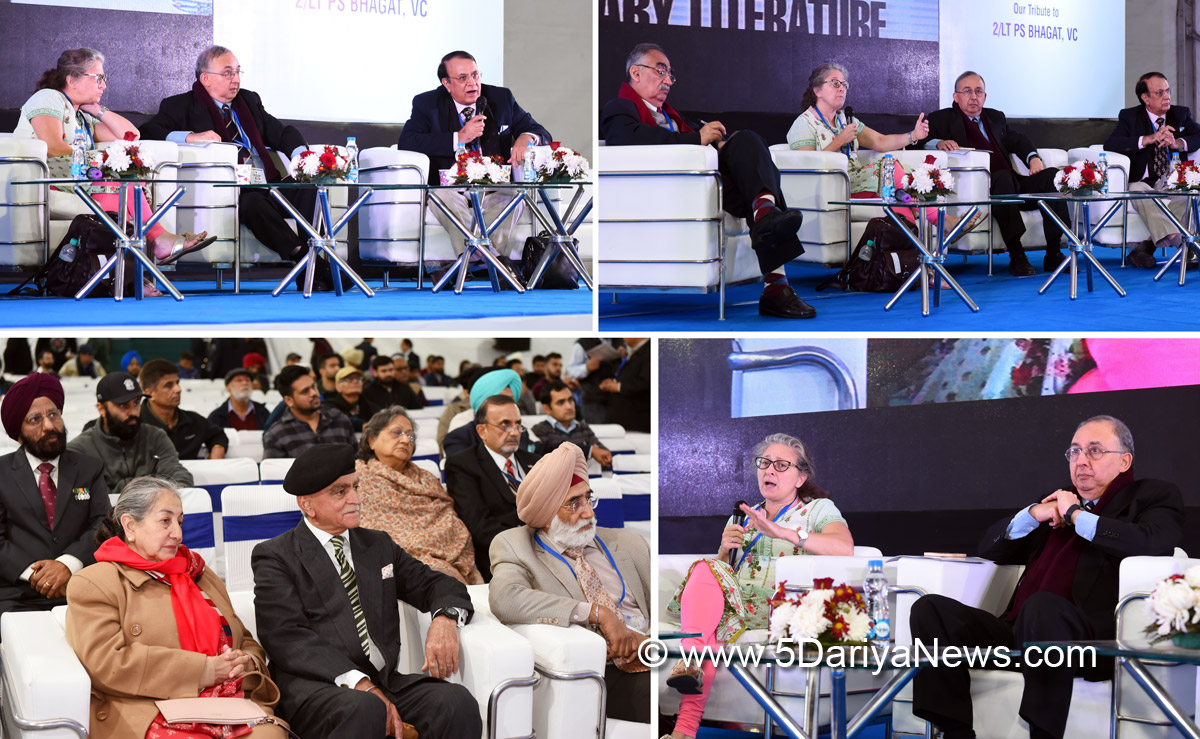
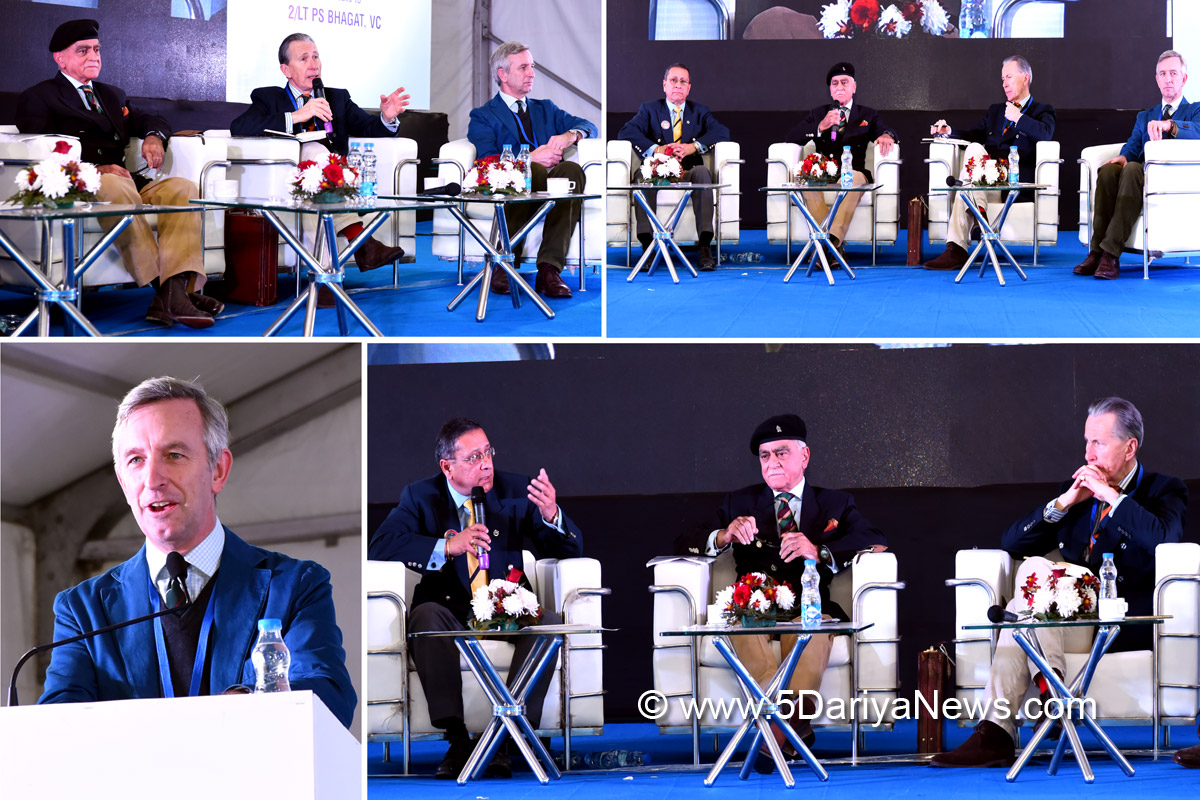
Punjab governor VP Singh Badnore inaugurated the third edition of the Military Literature Festival (MLF) at the Lake Club, Sector 1, here on Friday morning.

https://www.facebook.com/MilitaryLitFest/videos/1209868732535341/

Image result for military literature fest 2019"

Punjab governor VP Singh Badnore inaugurated the third edition of the Military Literature Festival (MLF) at the Lake Club, Sector 1, here on Friday morning.

Stating that dialogue is the only way forward to resolve issues concerning the nation, Badnore said that India is strong enough to deal with any insurgency and threat.

He said that strikes by Indian armed forces across the Line of Control shows that the country has the capability and competence to secure its borders, including naval routes.

The three-day festival, which will conclude on December 15, has no entry fee and is open to all.

Image result for military literature fest 2019"

The event is an international forum to exchange knowledge about the armed forces, besides acquainting youngsters with the country’s military heritage.

At least 22 panel discussions on issues of military and national significance are being organised during the event.

A special event to commemorate India’s participation in the Burma campaign during World War II is also planned.

Among the panel discussions slated for Friday are: Make in India and the nation’s security; Taliban and ISIK in Kashmir; and Implications of China’s Belt and Road Initiative.

The other two days will see sessions on medieval military architecture, Jallianwala Bagh massacre, Kargil War, hyper nationalism and Article 370.

Media experts, intellectuals and defence strategists, such as Mark Tully, Ravish Kumar, former army chief General VP Malik (retd), air chief marshal BS Dhanoa (retd) and Nandini Sundar, besides Oliver Everett, Kishwar Desai, Vivek Katju and Irfan Habib will speak at the festival.

Ten books by noted defence and literary authors will also be released on the occasion.


Image result for military literature fest 2019"

Image result for military literature fest 2019"

Image result for military literature fest 2019"

Former army chief General VP Malik with wife Ranjana, former navy chief admiral Sunil Lanba and former air chief BS Dhanoa at the inauguration of the three-day Military Literature Festival being organised along the Sukhna Lake in Chandigarh on Friday.

Former army chief General VP Malik with wife Ranjana, former navy chief admiral Sunil Lanba and former air chief BS Dhanoa at the inauguration of the three-day Military Literature Festival being organised along the Sukhna Lake in Chandigarh on Friday. (Twitter)

Image result for military literature fest 2019"


Rs10 lakh relief upheld for widow of soldier

Tribune News Service

Chandigarh, December 9

The Supreme Court has upheld a landmark decision of the Armed Forces Tribunal (AFT) that had granted a compensation of Rs 10 lakh to the widow of a soldier who had died in 1998 while in service due to alleged negligence on part of the Army authorities in handling his medical case.

The tribunal’s Chandigarh Bench, then comprising Justice Ghanshyam Prashad and Lt Gen HS Panag, had in 2011 ruled that callousness towards human life would not be tolerated and had granted the widow, Navindra Devi, Special Family Pension along with monetary compensation.

The petitioner’s husband had been posted near Bikaner when he developed psychiatric problems for which he was given electric shocks at a civil hospital. Thereafter, he was sent on leave to recuperate. A few days after returning from leave, the psychiatrically ill solider wandered out of the unit and went missing.

He was found near the Delhi Railway Station by the Government Railway Police, who requested the Army authorities to take him back. However, rather than sending a team to bring him back, his unit and military authorities in Delhi kept exchanging letters and shifting the onus on each other.

While the correspondence continued, the railway police let go of him when no one came to take him. His body was recovered the next day from a well.

The AFT had observed that there was negligence in handling the issue since no care was taken to keep the soldier under medical supervision and then to bring him back from the police. The AFT also observed that a court of inquiry was not held which was mandatory under rules and it was held 11 years after the death on judicial intervention. The Army had challenged the AFT’s order, but the apex court has dismissed the appeal and directed the government to release the amount to the aggrieved widow within eight weeks.

The case

  • The petitioner’s husband, posted near Bikaner, developed psychiatric problems and was sent on leave. After returning, he wandered out of the unit
  • He was found near the Delhi Railway Station by the police, who requested the Army authorities to take him back
  • However, his unit and military authorities in Delhi kept on shifting the onus on each other. The police let him go. The soldier was found dead in a well a day later

Veterans relive good old days

Veterans relive good old days

Srishti Jaswal

srishti.jaswal@htlive.com

Chandigarh : A nostalgic Colonel SC Tyagi, 65 and retired, saidthe ongoing Military Literature Festival at the Lake Club inSector 1 was no less than a reunion for him.

The first day of the third edition of the festival on Friday saw many officers from the Indian defence forces participating. Col Tyagi said, “It is always great to visit such festivals where you can meet old friends. I had a reunion of sorts today.”

Col Tyagi was the founder commandant of the Corps Battle School in the Kashmir Valley.

He said, “I met many men from my battalion today. I met General Ved Prakash Malik and Lieutenant General Syed Ata Hasnain and I felt so nostalgic. I look forward to such reunions every year.”

Gen Ved Prakash Malik served as the 19th Chief of Army Staff of the Indian Army from 1997 to 2000. He was the army chief during the Kargil War. Lt Gen Hasnain’s last assignment was as the military secretary.

Commodore SB Kesnur with the Indian Navy said he got a chance to meet Admiral Lanba here. “I am happy with the navy presence in the festival. Five serving officers are participating from various regiments.”

Admiral Sunil Lanba is a retired Indian naval officer who served as the 23rd Chief of the Naval Staff.

One Colonel Surjan Singh said he met many officers with whom he had served in the same unit. Col Surjan Singh is now retired and is a published author.


Israeli war hero to share experiences at military lit fest

Chandigarh, December 12

A war decorated Israeli General, who had cut short his honeymoon in Nepal, to answer a call to arms would be participating in the Military Literature Festival and talking about his battle experiences.

Then a Lieutenant Colonel during the Yom Kippur War in October 1973, Maj Gen Yosi Ben-Hannan was awarded the Medal of Courage, Israel’s second highest award for gallantry in the face of the enemy. This is for the first time that an Israeli military officer would be speaking at the festival.

In 1973, while on his honeymoon in Nepal, Ben Hannan heard of the outbreak of the war and returned to Israel and proceeded to the Golan Heights where he participated in fierce fighting with the Syrians. He was wounded but refused to be evacuated and continued fighting. According to available excerpts of the battle, on October 9, Ben-Hannan took command of a scratch force of Israeli tanks that had been put together from the remnants of the decimated 188th Armored Brigade. — TNS


MILITARY LITERATURE FESTIVAL How Indians rose up to be Officers

For long, they were given petty roles in the British army. Indianisation was achieved in 1949 with Lt Gen KM Cariappa becoming C-in-C

How Indians rose up to be Officers

A first: Field Marshall KM Cariappa went to the Royal Military College in Sandhurst; (left) President Giani Zail Singh hands over Field Marshal baton to General Cariappa

Brig MP Singh (retd)

The Army Day is celebrated on January 15. The day marks the completion of Indianisation of the army by appointment of a native Indian officer, Lt Gen KM Cariappa, as C-in-C of the Indian Army on January 15, 1949. Cariappa replaced the last British C-in-C, General Francis Robert Butcher.

The struggle for Indianisation was long and arduous. Pandit Nehru recorded in his autobiography, Discovery of India: “All key positions were kept in the hands of Englishmen and no Indian could hold the King’s Commission. A raw English subaltern was senior to the oldest and the most experienced Indian Non-Commissioned Officer or those holding the Viceroy’s Commissions. No Indian could be employed at army headquarters except as a petty clerk in the accounts department.”

Throughout World War I, Indian leaders supported the war effort in the hope that for the acquisition of freedom and democracy, it was necessary to back the British in their struggle. But the British were unscrupulous towards Indians. Consequently, the tempo of hatred of the British rule rose.

The highest rank obtainable by an Indian in the army was that of Subedar, and that too was given at a ripe age of 65 to 70 years. In the third session in December 1887, the Congress demanded that the military service in the commissioned grades should be opened to the natives of the country and that the government should establish military colleges in the country where natives could be trained for a military career as officers of the Indian Army. General Frederick Roberts, C-in-C, rejected the proposal on the ground, saying: “No rank that we could bestow upon them could cause him to be considered equal by the British Officer, or looked up to by the British soldier in the same way that he looks up to the last joined British subaltern.” Paradoxically, Roberts was full of admiration for Rajputs, Sikhs, Dogras, Jats, Gorkhas and select Mohamedans. Brigaded with British troops, he said, “I would be proud to lead them against any European enemy.”

Under constant pressure from freedom fighters, a proposal was put up according to which Indians of higher classes were to receive commissions in only two regiments, one of cavalry and the other of the infantry. The scheme was rejected by the Secretary of State, the Earl of Kimberlay, who recommended that two local regiments might be raised and located on the Baluch frontier for the protection of Dera Ghazi Khan and Pashin. The Indian officers appointed to these units were required to be placed under the supervision of British officers, which was not accepted. Another scheme in which Indians holding commissions were to be given all privileges, except the command, was considered. The Secretary of State accepted the scheme because of its modesty, for, bestowal of a mere honorary rank of high grade was in reality to be lower than Second Lieutenant which emphasised its inferiority. Honorary commissions were granted for ‘honoris cause’ to a few VCOs of exceptional ability, but, they were not counted among the effective strength of the King’s Commissioned Officers.

Yet another proposal of Indianisation of the army was put up in 1900 by Lord Curzon, the Governor General. He proposed the formation of an Imperial Cadet Corps of about 20 to 30 men, drawn from princely and noble families of India. As a result, in 1905, a special form of King’s Commission in His Majesty’s Native Land Forces was instituted for Indians who had qualified through the Imperial Cadet Corps. The commission only carried the power of command over Indian troops, and those who held it were not to rise above the rank of Major. The arrangement was frustrating as only men from princely classes could obtain it. The number of officers holding these commissions was only seven in 1917, and was increased to nine by the end of World War I.

The struggle continued

Throughout WWI, Indian leaders, notably Gandhiji and Lokmanya Tilak, supported the war effort in the hope that for the acquisition of freedom and democracy, it was necessary to back the British in their struggle. They pledged unstinted support to the war. But the British were unscrupulous towards Indians. Punjabis settled in the US asked Indians abroad to return to India and free their homeland from colonial government. Termed Ghadarites, seven of them were hanged to death on November 16, 1916. Such incidents raised the tempo of hatred of the British rule. To calm the Indians, on August 20, 1917, Secretary of State for India, Edwin Montagu, announced in the House of Commons: “The policy of His Majesty’s Government is that of increasing association of Indians in every branch of administration and the gradual development of self-governing institutions with a view to progressive realisation of responsible government in India as an integral part of the British empire.”

The Montagu-Chelmsford report tabled in November that year was full of praise for the gallant and faithful services of the Indians during the war, which rendered Indians eligible to hold King’s Commission in the army. As a result, 10 vacancies at the Royal Military College, Sandhurst, were reserved annually for Indians with good family background, which was undoubtedly an important step in so far as it served as a breakthrough for their appointment as Commissioned Officers. The measure, nevertheless, fell much below the Indian aspirations. They considered that against a loss of 53,485 dead, 64,350 wounded and 3,762 missing Indians during the war, the reward of 10 vacancies yearly at Sandhurst was too modest.

WWI ended on November 11, 1918 and the sacrifices by Indians were rewarded by Jallianwala Bagh Massacre on April 13, 1919, which changed the attitude of the freedom fighters from supportive to aggressive. When the Legislative Assembly met in February and March 1921, the Indian members pressed their demand for greater association of Indians in defence forces and Indianisation of the officer cadre. Consequently, a committee headed by Sir Tej Bahadur Sapru was appointed and its report was submitted on March 21, 1921. The three resolutions that concerned Indianisation were: 1) Not less than 25 per cent of the King’s Commissions granted every year should be given to His Majesty’s Indian subjects to start with; 2) Adequate facilitates should be provided in India for the preliminary training of Indians to fit them to enter the Royal Military College, Sandhurst; 3) The desirability of establishing in India a military college such as Sandhurst should be kept in view.

Speaking in the Legislative Assembly, Sir Tej Bahadur Sapru said: “To my mind the Indianisation of the commissioned ranks of the army is even more important than any question of immediate constitutional advance. Without an efficient Indian Army, officered by our own nationals, self-government for Indians must be a very unreal and shadowy thing…”

The pressure led to the establishment of the Prince of the Wales Royal Military College at Dehradun. This institution was intended to impart preliminary training to Indians preparing for entry into Sandhurst. The institute opened on March 13, 1922. Arrangements were made to enable 70 boys to be trained for six years.

Another step forward was the setting up of the Military Requirements Committee under the chairmanship of the C-in-C, Lord Rawlinson, who agreed with the recommendations of the Sapru Committee. In January 1923, the Viceroy conveyed to the Secretary of State a scheme of Indianisation which outlined the procedure for complete Indianisation in three stages of 14 years each and opening of an Indian Military College. The Secretary of State was very annoyed on reading the proposed scheme and telegraphically said: “Reports of a widely held belief, not only among Indians but among Englishmen, are being constantly received in England that our mission in India is regarded by us as drawing to a close and that preparations are being made by us for retreat. Such an idea if it exists is a complete fallacy, and its continuous existence can only lead to intensified challenges to our authority and a decline in morale among services…. We regret we cannot sanction your recommendation for Indianisation.”

Simon Commission

After prolonged correspondence, General Rawlinson in a speech to the Legislative Assembly announced the intention of the government to Indianise eight units. The Indian member of the Viceroy’s Executive Council called the 8-unit scheme ‘unsatisfactory and insulting’. In June 1925, a new committee called Indian Sandhurst Committee or Skeen Committee was appointed. This committee recommended that the number of vacancies at Sandhurst be increased from 10 to 20, Indians be made eligible as Kings’ Commissioned Officers in Artillery, Signals and Engineers too and that a military college be opened in India. The government did not accept the recommendations of the Skeen Committee in full but agreed to increase the vacancies reserved for Indians at Sandhurst from 10 to 20 per year.

Reacting to the new scheme, Pandit Motilal Nehru pointed out that “the whole thing is that there is no intention of putting India on her feet at an early date. He went on to address the Legislative Assembly: “I may say at once that the word Indianisation is a word I hate from the bottom of my heart. I cannot understand that word. What do you mean by Indianising India… The army is ours, we have to officer our own army, there is no question of Indianising there. What we want is to get rid of Europeanisation of the Army…”

Simon Commission arrived in India in 1928. Relying on the British argument that independence or dominion status could not be granted to India till it had its own national army officered and manned by Indians, a committee under the chairmanship of Pandit Motilal Nehru demanded ‘stepping up of the Indianisation of the army, specially by providing opportunities for military training in the country’. The Committee considered it obligatory on the government to establish military training schools and colleges in India. A cadet college was established at Indore where KM Cariappa was trained to be an officer.

The military college

The political situation of the country was such that the demand of the Indians for Indianising the army at a rapid pace could not be withheld for long. As President of the Indian National Congress, Pandit Jawahar Lal Nehru hoisted the national flag of India on January 26, 1930 and passed the memorable resolution on the establishment of a sovereign independent republic of India. Finding the Indians adamant about a National Army of their own, the British were obliged to appoint on May 23, 1931 a committee under the chairmanship of the C-in-C General (later Field Marshal) Sir Philip Chetwode in order to work out the detail of the establishment of a military college in India to train candidates for commission.

The Chetwode Committee recommended the establishment of an Indian military college with a training course of three years, the age of entry being 18 to 20 years. The college, named the Indian Military Academy, was opened at the Railway Staff College building in Dehradun on October 1, 1932.

The first batch of 40 cadets, which included Sam Manekshaw, arrived at the IMA on September 30, 1934. They called themselves ‘Pioneer’ and they passed out in December 1934. An officer senior to the Pioneers was Cariappa, who after schooling in Coorg and graduating from Presidency College, Madras, joined the Cadet College at Indore where he did extremely well. He was sent to Royal Military College, Sandhurst, and commissioned in 1919 as 2/Lt. After active service in Iraq, Syria, Iran and Burma during World War II in 1946, he was promoted to Brigadier. During the Kashmir War of 1947-48, he assumed charge of operations and got two quick promotions. On January 15, 1949 he was appointed C-in-C Indian Army, which completed the process of Indianisation. Since then, January 15 is celebrated as Army Day.


Govt approves admission of girl students in Sainik schools

Govt approves admission of girl students in Sainik schools
Photo for representational purpose only. Thinkstock

New Delhi, December 9

The government has approved admission of girl students in five Sainik schools for the academic session 2020-21 after a pilot project and now decided to admit girls in all 31 Sainik schools in the country for which a time-bound action plan will be implemented, the Rajya Sabha was told on Monday.

Minister of State for Defence Shripad Yesso Naik said during Question Hour that the government has approved admission of girls in five Sainik Schools—Kalikiri (Andhra Pradesh), Kodagu (Karnataka), Ghorakhal (Uttarakhand), Chandrapur (Maharashtra) and Bijapur (Karnataka) for the academic session 2020-21.

“The pilot project for admission of girl children in Sainik School, Chhingchhip (Mizoram) was started in the academic session 2018-19. After its success, the Government has decided to implement admission of girl children in other Sainik Schools,” Naik said.

In reply to a supplementary, the minister said girls will be admitted in “all 31 Sainik Schools” and for this a “time-bound action will be taken.”

In reply to another supplementary, Naik said the government has made a provision of 10 per cent reservation for girls in such schools.

In reply to another query, the minister said that if any state felt the need for Sainik schools they can send the proposal to the Centre. PTI