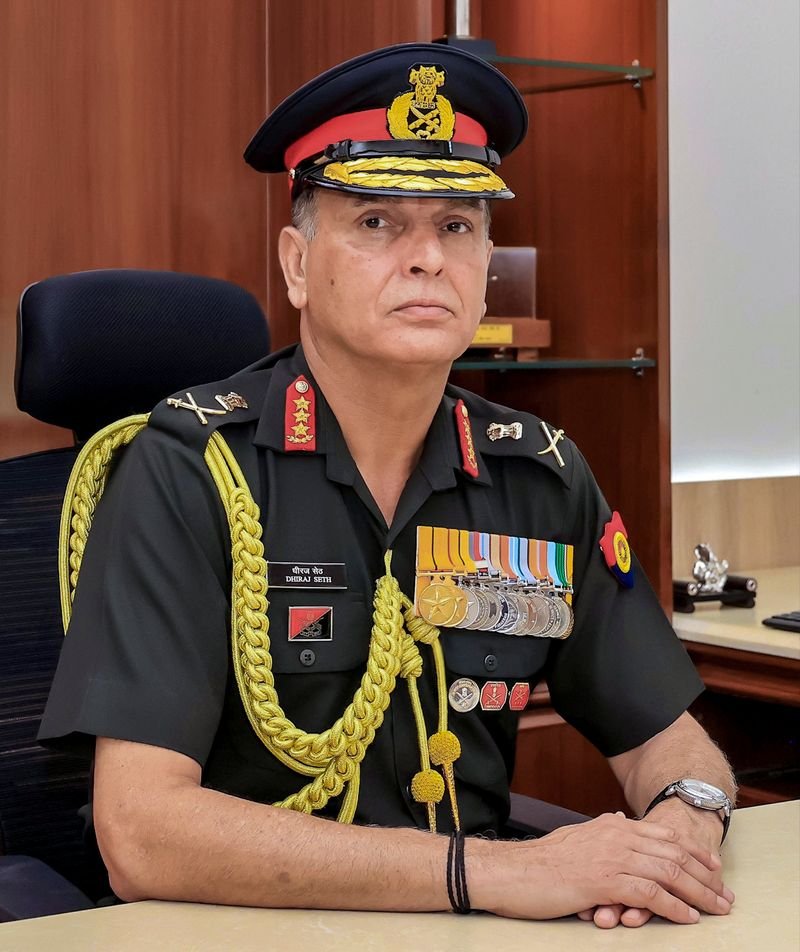
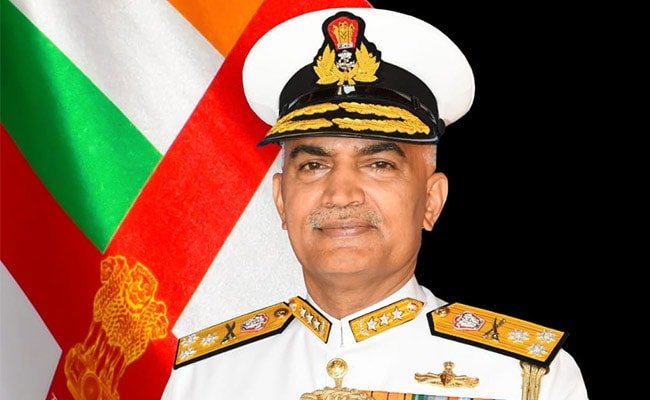




Lt Gen Ram Chander Tiwari, UYSM, AVSM, SM GOC-in-C Eastern Command & Col of the Kumaon & Naga Regts and Kumaon Scouts
GOC-in-C SW Command
LT GEN AMARDEEP SINGH BHINDER, AVSM, VSM,
GOC-in-C Southern Command
Lt Gen Ajai Kumar Singh, AVSM, YSM, SM, VSM
Print Media Reproduced Defence Related News
Delhi inferno: Muslim trader’s mattresses, quilts become lifesavers: he says everyone is same, whether Hindu or Muslim. We all are Hindustani. It was my duty to help our brothers, whether he is Hindu or Muslim.”
‘We are all Hindustani’: Man’s selfless act aids rescue amid Malviya Nagar tragedy, says helping victims was his duty
When thick smoke and flames engulfed a hotel and shrieks for help filled the air, a mattress trader opposite the fire-wrecked hotel in Malviya Nagar on Wednesday made a split-second decision: He sacrificed goods worth nearly Rs 2 lakh, laying out a makeshift safety net that helped save lives.
After rushing to the scene with his staff, Riyazuddin Mansuri spread dozens of quilts and mattresses on the ground outside the burning building, creating a cushion that allowed trapped residents to jump to safety.
Riyazuddin said they were the first to put out the mattresses and by the time the fire brigade arrived, they had already saved 8 lives, adding that he and his son sustained injuries during the rescue.
A fire that broke out at the Flourish Stay bed-and-breakfast hotel in the congested Hauz Rani area of Malviya Nagar killed at least 21 people, including 11 foreigners. The hotel largely catered to patients visiting the nearby Max Hospital. Nineteen of the 35 injured remained in critical condition across hospitals in Delhi, according to officials.
As the fire spread rapidly, several occupants were seen breaking window panes and calling for help.
Trader Riyazuddin’s son Arman said, “I reached the spot after a neighbour informed me about the blaze at 8.30 am. The ground floor was on fire. Nobody could go inside, and come out. People on the upper floors were shouting and asking if they should jump. I immediately brought out around 20 to 25 quilts and mattresses from the shop and spread them outside the building.” Arman’s family, who run the mattress shop opposite the hotel for around four decades, said several quilts and mattresses were stacked on top of one another so that people who jumped on them don’t get hurt.
“Around eight people jumped onto them and were safe. Only a few suffered minor injuries,” he said.
Eyewitnesses said scenes of panic unfolded as smoke filled the building. They said a woman jumped from the third floor with her child in her arms while other occupants desperately searched for ways to escape, and at that time the mattresses came in handy for some.
Riyazuddin said, “I suffered about Rs 2 lakh loss. We also gave bedsheets that were used to bring out the dead bodies and the injured. We also gave quilt covers. We gave away all our goods, whatever we could get our hands on. On the grounds of humanity, everyone is the same, whether Hindu or Muslim. We all are Hindustani. It was my duty to help our brothers, whether he is Hindu or Muslim.”
Arman said that had the fire not been brought under control in time, it could have affected my shop as well. “Emergency services reached the spot quickly and assisted in the rescue operation. Everyone arrived on time and helped us a lot,” he said.
MODERN military and strategic discourse is increasingly burdened by a creeping affliction: the substitution of clear thought with fashionable jargon. What masquerades as innovation is often little more than repackaging of long-understood principles in language designed to impress rather than illuminate. The result is not intellectual progress, but intellectual fog.
Take the term “layered defence.” It is now presented as if it were a novel doctrinal breakthrough. But when, in the history of warfare, has defence ever not been layered? From the Roman legions with their successive lines of infantry, to medieval fortifications with moats, walls and inner keeps, to the elastic defence-in-depth of the Second World War — layering has always been intrinsic to survival.
It is not innovation; it is amnesia. Similarly, “multi-domain operations” is offered as a revolutionary concept integrating land, sea, air, cyber and space. Yet war has always been fought across multiple domains. The Blitzkrieg combined armour, artillery, infantry and airpower in tightly coordinated operations. Naval warfare has long depended on intelligence, logistics and air cover.
Then there is “cyber warfare,” often described as an entirely new frontier. While the tools are undoubtedly modern, the underlying concept — penetrating, disrupting and manipulating the enemy’s information systems — is not.
During the Second World War, the Allied Ultra programme broke German codes, providing decisive intelligence that shaped operations across theatres. A favourite seems to be the new term, “cognitive warfare”. Have we forgotten the massive success of the BBC in retaining Britain’s soft power for decades after its economic decline, or the long-drawn success of the Russian and East European VOA (Voice of America) radio broadcasts that kept the idea of freedom alive and contributed to the fall of the Berlin Wall?
A favourite is “hybrid warfare”, the ultimate example of military jargon which is a catchword for using everything including the kitchen sink. This term replaced what has always been diplomatic and foreign intelligence meddling and used to describe any protest or fake news on X (Twitter) . But the more sophisticated would shun “hybrid warfare” and use “grey zone warfare” that would perplex the audience even more. The term “dropping bombs” is considered crass and has been replaced with “kinetic warfare”, a term which would dazzle most civilian audiences when it actually means “breaking things”.

Bureaucracies reward what looks like new thinking, or at least the appearance of it. New terminology creates the impression of fresh thinking, justifying financial outlays, reorganisations and doctrinal publications. It also signals apparent agreement with global trends, particularly those emanating from the US, where defence establishments are prolific producers of jargon.
Complex terminology creates an aura of expertise that discourages scrutiny. A good example is the sly answer to questions of the treatment of the prisoners in Guantanamo, to which the answer was — “enhanced interrogation”. Got it? Jargon distances strategic discourse from both historical understanding and common sense.
If policymakers believe they are confronting entirely new forms of warfare, they may neglect the enduring principles that govern conflict: logistics, morale, leadership and adaptability. Worse, they may overestimate the transformative impact of technology
while underestimating the resilience of adversaries. Another one that comes to mind is the alleged invention of a new strategy by China called “A2AD” against the maritime dominance of the US in the West Pacific; it turns out to be a rewording of “sea denial”, an old, well-established concept.
India, in particular, should be wary of using jargon as a substitute for rigorous thinking uncritically. Its strategic environment demands clarity, not fashion. The country has repeatedly suffered from strategic surprise — not because it lacked jargon, but because it misread emerging world scenarios. Clear thinking must also be rooted in history.
This is not an argument against innovation. New technologies — especially in cyber and space — require adaptation. But adaptation must be grounded in continuity. The past does not become irrelevant simply because the vocabulary changes. There must be a clear articulation of what is new; otherwise, it only causes confusion upwards and downwards. Quite possibly, other fields such as economics and diplomacy may be indulging in the same thing.
One term comes to mind to describe the tumult going on in the world where the established order has been upended, ideas of what constitutes power are fuzzy and long-established alliances are breaking. There is a suggestion that all this somehow becomes crystal clear if one says that the world has become “multipolar”. So, that is solved.
Words should clarify, not conceal. In the end, the test of any concept is not how impressive it sounds, but whether it sharpens judgment. Jargon that merely rebrands the obvious does the opposite. It dulls the mind, obscures the past and leaves us less prepared for the future. The political and business world is not immune to this disease either. Here, the most misused word is “strategic”, used indiscriminately before any political visit, deal, agreement or talks, as with any new commercial investment, whether it is in nuclear reactors or cosmetics.
Why, then, does this jargon proliferate? Part of the answer lies in institutional incentives. Bureaucracies reward novelty, or at least the appearance of it. New terminology creates the impression of fresh thinking, justifying budgets, reorganisation and doctrinal publications. It also signals alignment with global trends, particularly those emanating from the US.
Gender inequality: Can’t exclude married daughters from definition of ‘family’, rules SC
Married daughters can’t be excluded from compassionate appointment and their omission from the definition of “family” is manifestly arbitrary, unjustified and constitutionally untenable, the Supreme Court has ruled.
“It is incompatible with the constitutional guarantee of equality and perpetuates historical notions of gender inequality which the Constitution seeks to eradicate,” a Bench of Justice PS Narasimha and Justice Alok Aradhe said in an order on Tuesday.
Setting aside a March 2025 order of the Allahabad High Court that held the definition of “family” doesn’t include a married daughter for the purpose of compassionate appointment, it said marital status was irrelevant to dependency and exclusion of married daughters perpetuated gender stereotypes in violation of Article 14 (right to equality) and Article 15 (right to non-discrimination).
The order came on an appeal filed by one Kulsum Nisha — a married daughter of a deceased woman fair price shop dealer — challenging the high court’s order that had rejected her claim for appointment as a fair price shop dealer on compassionate grounds.
Writing the judgment for the Bench, Justice Aradhe ruled that dependency was not a matter of gender but was a question of fact and therefore can’t be conclusively determined by marital status alone.
“The impugned provision proceeds on the assumption that upon marriage a daughter ceases to be a member of, or dependent upon, her parental family. Such an assumption is constitutionally impermissible. Marriage neither extinguishes the bond between a daughter and her parental family nor furnishes a valid basis to presume absence of dependency. Contemporary social realities demonstrate that many married daughters continue to reside with, support, or remain dependent upon their parents.”
The Bench directed the Uttar Pradesh authorities to allot a fair price shop in four weeks in favour of petitioner Kulsum Nisha who continued to reside with her mother and four sisters even after her marriage and supported the family.
Nisha had applied for running the fair price shop after her mother’s death in March 2024. But citing an August 2019 rule issued under the Uttar Pradesh Essential Commodities (Regulation of Sale and Distribution Control) Order, 2016 that excluded married daughters from the definition of ‘family’, the authorities turned down her application.
In March 2025, the Allahabad High Court upheld the definition of family that excluded married daughters for the purpose of compassionate appointment.
However, the Supreme Court reversed the high court’s decision.
Noting that the rule did not exclude all daughters and “unmarried, legally separated or widowed daughter” were entitled to continue running the fair price shop, it directed the UP authorities to henceforth include married daughters under the definition of ‘family’.
“A son continues to remain within the fold of the family irrespective of his marital status, whereas a daughter is excluded solely because she is married. The distinction is founded upon a gender-based stereotype that a daughter, upon marriage, becomes a member of another family and loses all ties with her natal family,” the top court said.
“We are, therefore, of the considered view that the exclusion of married daughters from the definition of “family” fails the test of reasonable classification and is manifestly arbitrary. The distinction created by Paragraph IV(10) of the G.O. lacks any intelligible differentia having a rational nexus with the object of the scheme. The exclusion is founded solely upon marital status and gender stereotypes and consequently, violates Articles 14 and 15(1) of the Constitution of India,” the top court said.
Fourth S-400 squadron arrives in India; fifth expected by year-end
In a major boost to India’s air defence capabilities, the fourth squadron of the S-400 air defence missile system arrived at an Indian port on Monday.
The system, which includes multiple missiles, launchers, sensors, and radars, is being transported from Russia to India in phases. Sources confirmed to The Tribune that the first consignment arrived today, with the rest expected in the next few days.
Once assembled, the S-400 will be deployed by the Indian Air Force in a designated operational area.
The squadron is part of a USD 5.4 billion contract signed in 2018 under which India was to acquire five S-400 squadrons from Russia. Three were delivered two years ago, while the remaining two were delayed due to the ongoing Russia-Ukraine war.
The S-400 system was credited with intercepting Pakistani drones and cruise missiles during Operation Sindoor in May 2025. In February, the Indian Air Force released a video showing the S-400 in action, highlighting what the IAF called the “longest-ever air kill” in military history — a high-value aircraft struck at a range exceeding 300 km.
The fifth and final squadron of the S-400 missile system is expected to reach India by the end of this year.
Drawing on lessons from Operation Sindoor, the Ministry of Defence (MoD) approved the procurement of five additional Russian-origin air defence systems in March. The Defence Acquisition Council, the apex decision-making body at MoD, cleared the proposal at its March meeting. Sources said the five additional S-400 systems are expected to cost USD 6.1 billion.
The S-400 is designed to engage aerial targets, including those with stealth capabilities, at ranges of up to 400 km. It can also intercept ballistic missiles and hypersonic targets. Compared to its predecessor, the S-300, the S-400 has a firing rate that is 2.5 times faster.
MoD said in March that the S-400 system will counter enemy long-range air threats targeting vital areas, while UCAVs will enable offensive counter-air and coordinated operations, along with stealth intelligence and surveillance.
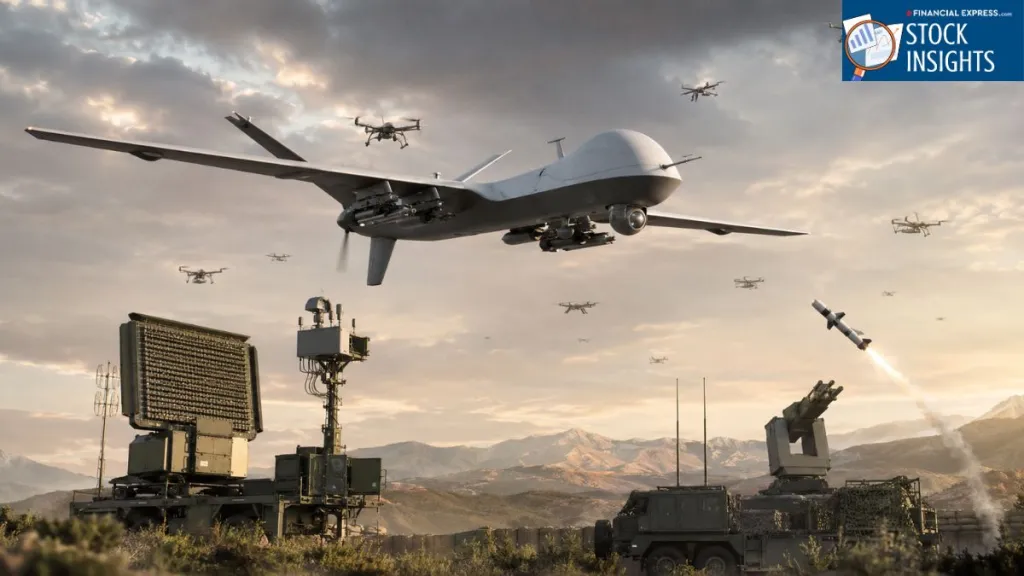
This expansion is part of a broader strategy announced by Prime Minister Narendra Modi on Independence Day 2025 to create a near-seamless kinetic and electronic shield across India’s most vulnerable borders. For this, India is also working on an indigenous programme, codenamed Project Kusha, to develop its own air defence systems capable of engaging enemy drones at ranges similar to the Russian system.
Indian killed as Iran targets Kuwait after fresh strikes by US
An Iranian strike on Kuwait International Airport early on Wednesday resulted in the death of the Indian national and injuries to several others. The strike was part of the latest back-and-forth attacks by Iran and the US.
Reacting to the incident, the Ministry of External Affairs (MEA) said: “We condemn the attack on Kuwait International Airport today in which an Indian national has died and several of our nationals are injured.”
“Since the onset of the conflict in West Asia, we have strongly urged that the civilian population and civilian infrastructure must not be targeted. We again call upon the parties to cease such attacks,” the MEA said.
The Indian Embassy in Kuwait is extending all possible assistance to those injured. “Indian missions and posts across the region are on alert and continue to proactively support our community,” the MEA
US trade body announces new 12.5% tariff on India, Govt says proposed tax not final
The US on Wednesday has proposed to impose 12.5 per cent tax on India, including China, the UK, and Japan after a USTR trade investigation under Section 301 of the Trade Act of 1974 found that these nations had failed to enforce legal restrictions on importation goods that were produced exclusively or in part with forced labour.
The action comes after 60 countries were the subject of investigations by United States Trade Representative (USTR) for allegedly failing to enact and successfully enforce bans on imports created using forced labour.
“The failure of our most important trading partners to address the importation of goods made with forced labour is unacceptable. This creates a dynamic where American workers are forced to compete globally on an unlevelled playing field,” USTR Ambassador Jamieson Greer said in a statement.
“We will no longer tolerate this disparity,” he added.
However, USTR suggested a lower rate of 10 percent for six nations — Pakistan, Canada, Ecuador, the European Union (EU), Indonesia, and Mexico.
It has claimed that these nations have shown a commitment to addressing forced labor imports and have pledged to impose and enforce a prohibition on forced labor imports through a formal Agreement on Reciprocal Trade (ART) with the US.
Meanwhile, India’s Commerce Ministry said India remains engaged with the US on the matter as a part of Section 301 proceedings. Also, India is also parallelly engaged with the US for finalisation of a framework agreement which was announced on February 2, and in accordance with the joint statement released on February 7.
“The proposed tariffs are not yet final and stakeholders can submit requests to participate in public hearings by June 22. Written comments can be submitted until July 6. Public hearings will be held on July 7. USTR will consider the comments and testimony received before taking a final decision on the proposed measures,” according to the statement issued by the Commerce Ministry.
Products covered under section 232 tariffs and certain other products are excluded from these tariff proposals. A special mechanism has also been proposed for textile and apparel products that could allow a certain volume of imports from selected economies to enter the US at lower tariff rates, it added.
Section 301 of the Trade Act of 1974
Section 301 of the Trade Act of 1974, as amended (Trade Act), is designed to address unfair foreign acts, policies, or practices affecting US commerce. It may be used to respond to unjustifiable, unreasonable, or discriminatory foreign government acts, policies, or practices that burden or restrict US commerce.
Under Section 302(b) of the Trade Act, the Trade Representative may self-initiate an investigation under Section 301.
On March 12, 2026, USTR initiated 60 investigations related to the failure of various economies to impose and effectively enforce a prohibition on the importation of goods produced with forced labour.
Pursuant to Section 304(b)(1)(A) of the Trade Act, USTR provided the public and interested persons with opportunities to present their views through a public comment process and through a public hearing.
USTR received testimony of nearly 60 witnesses and 500 comments and rebuttal comments.
Meet Colonel Archit Goswami: 4 Para SF Officer Whose Transfer Left Mizoram in Tears
In early May 2026, a video quietly broke the internet not because of explosions or action sequences, but because of something far more powerful: tears. Special needs students at Serchhip’s Shalom Special School (Vohbik School) in Mizoram, many of whom struggle to articulate words, were seen weeping uncontrollably, clinging to a man in uniform as he prepared to leave. Teachers wept. Parents wept. The man in fatigues — visibly moved — embraced each of them.
That man was Colonel Archit Goswami, SM, Commanding Officer of the 14th Battalion, Assam Rifles. A decorated Special Forces veteran. A counter-terrorism operative who had stared down hardcore terrorists in Kashmir. And, as Mizoram discovered, a deeply humane officer who had quietly transformed the lives of some of its most vulnerable children.
This is his story.
From the Elite Ranks of 4 Para SF, Before the Northeast, before Assam Rifles, Colonel Archit Goswami was forged in one of the most demanding crucibles in Indian military service.
He belongs to the 4th Battalion, The Parachute Regiment (Special Forces) 4 Para SF, the unit whose operators are trained for surgical strikes, hostage rescues, and deep penetration missions that most soldiers never encounter. His service number, IC-69038P, marks a career that progressed steadily through Captain, Major, and Lieutenant Colonel before his elevation to Colonel.
Early in his career as a Major, he was handpicked as part of India’s Special Forces contingent for Exercise Vajra Prahar (2011) a prestigious bilateral Joint Combined Exchange Training (JCET) conducted alongside US Army Special Operations Forces at Joint Base Lewis-McChord (JBLM), Washington. Serving as an Assault Team Leader, he trained in Close Quarters Battle, Advanced Military Operations in Urban Terrain, explosive breaching, and Full Mission Profiles. It was an early signal that Goswami was among the finest the Indian Army had to offer.
The Operation That Earned Him a Sena Medal Fast forward to 20 August 2019. Jammu & Kashmir. An active counter-terrorism operation in progress. A group of heavily armed terrorists had barricaded themselves inside a target house. A local police personnel was trapped inside pinned, with no clear extraction route. Under intense enemy fire, the then-Major Archit Goswami did what Para SF officers are trained to do under the most extreme pressure: he moved forward.
He personally eliminated a hardcore terrorist and successfully extracted the trapped police personnel from the target house an act the citation described as reflecting “unflinching bravery and leadership of the highest order.”
The President of India formally approved the Sena Medal (Gallantry) for Major Archit Goswami, announced via PIB on 14 August 2020 Independence Day. It was a fitting occasion to honour a man who had placed his life between a terrorist’s weapon and a fellow security force member’s survival.
The Sena Medal (Gallantry) is not handed out lightly. It is awarded to officers who display individual acts of exceptional bravery in the face of the enemy. Colonel Goswami earned his in the most direct way possible.
The Northeast Chapter: Soldier, Guardian, Builder. When Colonel Goswami took command of the 14th Battalion, Assam Rifles, his theatre of operations changed completely but his sense of mission did not.
The 14 Assam Rifles operates across the sensitive border districts of Nagaland and Mizoram, including stretches of the 510-kilometre Indo-Myanmar international border one of the most porous and narcotics-trafficked frontiers in South Asia.
Taking on the Drug Menace Under his command, the battalion launched systematic crackdowns on drug syndicates smuggling high-volume methamphetamine and heroin through Champhai, Mizoram a key transit corridor for narcotics flowing in from Myanmar’s Golden Triangle. These weren’t token seizures. The operations dismantled smuggling networks and disrupted supply chains that had been poisoning border communities for years.
Beyond enforcement, Colonel Goswami understood that stopping supply alone was insufficient. He partnered with local organisations, including the Miraculum Society, to launch multi-district drug awareness campaigns targeting youth in border villages building community resistance at the grassroots level, where the real battle against addiction is fought.
Winning Hearts in Noklak In Noklak, Nagaland, local communities including the Khiamniungan people organised a public farewell at the grounds, praising the battalion’s support and cooperation. They called the unit’s personnel “good Samaritans” and “real Friends of the Hill People.” Small gestures like arranging Sunday bus services for villagers travelling to church had accumulated into genuine, lasting goodwill.
The Farewell That Moved a Nation But it was in Serchhip, Mizoram, that Colonel Goswami’s impact reached its most visible and most emotional expression.
During his tenure, he directed sustained support toward the Shalom Special School (Vohbik School), an institution serving specially-abled children. His support went beyond token gestures covering infrastructure development, structural improvements, and sustained engagement with the school’s students, teachers, and parents.
For children who often struggle to find champions in their corner, Colonel Goswami became exactly that.
When his transfer orders came through in May 2026, the school organised a farewell. What followed was not scripted. Students many with limited verbal ability wept openly. Teachers who had watched the Colonel quietly, consistently show up for their school broke down. Parents embraced him. The footage circulated across Indian social media platforms within hours, drawing messages of admiration from citizens and commentators across the country.
The Indian Army’s unofficial motto in the Northeast — “Friends of the Hill People” — is often used ceremonially. Colonel Goswami lived it.
CAN ARMED FORCES BUILD TRUST FOR NEET EXAMS THAN CIVIL ADMINISTRATION
he military is being used as a trust substitute to somehow restore the faith of the public. And the Prime Minister having to “personally monitor” undergraduate admissions to medical colleges can hardly be a sign of good governance
In the wake of the Neet-UG question paper leak, the State’s response has been astounding. The Union education minister has said that the help of the Indian Air Force will be sought for the secure transportation of examination question papers ahead of the re-exam on June 21. And the Supreme Court has been told that Prime Minister Narendra Modi himself is monitoring the Neet situation. The IAF, in addition to securing Indian airspace, will now also protect Indian examination space. The decision to induct the IAF not only shows the loss of faith in the civil administration by the public, but by the government itself. The military is being used as a trust substitute to somehow restore the faith of the public. And the Prime Minister having to “personally monitor” undergraduate admissions to medical colleges can hardly be a sign of good governance. It is in fact the opposite. For a government that swears by good governance, the institutional architecture should be healthy and the chain of responsibility self-executing. The Prime Minister should not even be bothered with these processes. This is what a competent education minister and professional bureaucracy should be handling. That the Prime Minister has to step in suggests that the system has failed so completely that only the highest office in the country can be trusted to manage it. Also Read – Anita Anand | The Romance And The Tragedy Of The Monsoon In India
his is not all. Nisarga Adhikary, a 19-year-old Class 12 student from West Bengal and hobbyist cybersecurity dabbler, breached the Central Board of Secondary Education’s On-Screen Marking (OSM) portal — used by examiners to assess scanned answer sheets on a computer — in less than an hour. He proved that the digital security is so poor that anyone can impersonate an examiner and change a student’s grades.
Five alumni of Mohali’s Maharaja Ranjit Singh Armed Forces Preparatory Institute (MRSAFPI) graduated from the National Defence Academy (NDA), Khadakwasla, on May 30.
The passing-out parade was reviewed by Chief of Army Staff General Upendra Dwivedi.
The cadets, Jaskirtan Singh of Sangrur, Manjot Singh Walia and Dhruv Bhandari of Jalandhar, Harshdeep Singh of Patiala and Parth Kavi of Mohali, completed the gruelling three-year training at the NDA following two years of foundational grooming at the Mohali institute.
Much of their preparatory training at the institute took place during the challenging COVID-19 pandemic period.
They will now join their respective service training academies, where they are slated to be commissioned within the next year.
n a landmark moment for Punjab, five former cadets of the Maharaja Ranjit Singh Armed Forces Preparatory Institute (MRSAFPI), SAS Nagar, graduated from the prestigious National Defence Academy (NDA), Khadakwasla, Pune today. The passing out parade of the historic 150th NDA Course was reviewed by Chief of Army Staff General Upendra Dwivedi, PVSM, AVSM.
The five cadets including Jaskirtan Singh of Sangrur, Manjot Singh Walia & Dhruv Bhandari of Jalandhar, Harshdeep Singh of Patiala and Parth Kavi of Mohali, have completed a gruelling three-year training at the NDA following two years of foundational grooming at MRSAFPI. Notably, much of their preparatory training at the institute took place during the challenging COVID-19 pandemic period, a testament to their resilience. They will now join their respective service training academies, where they are slated to be commissioned as officers in the Indian Armed Forces within the next year.
Extending heartiest congratulations to the cadets, Punjab Employment Generation, Skill Development and Training Minister Mr. Aman Arora said that these young men have brought glory to Punjab. Their success is a powerful validation of Chief Minister S Bhagwant Singh Mann led Punjab government’s initiative to prepare our youth for the nation’s defence services. He exhorted them to continue serving with unwavering commitment and make the state proud.
Major General Ajay H. Chauhan, VSM, Director of MRSAFPI, said that the momentum will continue as another 25 cadets are scheduled for their SSB interviews. The achievements of AFPIANs are a matter of pride for this institution and for all of Punjab.
State Stalwarts
DEFENCE MINISTER
Minister Rajnath Singh
ALL HUMANS ARE ONE CREATED BY GOD
HINDUS,MUSLIMS,SIKHS.ISAI SAB HAI BHAI BHAI
CHIEF PATRON ALL INDIA SANJHA MORCHA
LT GEN JASBIR SINGH DHALIWAL, DOGRA
SENIOR PATRON ALL INDIA SANJHA MORCHA
MAJOR GEN HARVIJAY SINGH, SENA MEDAL ,corps of signals
.
.
PATRON ALL INDIA SANJHA MORCHA
MAJ GEN RAMINDER GURAYA ,MADRAS REGIMENT
sanjhamorcha303@gmail.com
PRESIDENT SOUTH ALL INDIA SANJHA MORCHA
COL SS RAJAN BOMBAY SAPPERS,
PRESIDENT UTTARAKHAND ALL INDIA SANJHA MORCHA
COL B M THAPA ,BENGAL SAPPERSS
PRESIDENT HARAYANA STATE CUM COORDINATOR ESM
BRIG DALJIT THUKRAL ,BENGAL SAPPERS
PRESIDENT TRICITY
COL B S BRAR (BHUPI BRAR)
PRESIDENT CHANDIGARH ZONE
COL SHANJIT SINGH BHULLAR
.
.
PRESIDENT PANCHKULA ZONE AND ZIRAKPUR
COL SWARAN SINGH
INDIAN DEFENCE FORCES
DEFENCE FORCES INTEGRATED LOGO
INDIAN AIR FORCE
Air Officer C-in-C WESTERN AIR COMMAND
AIR MSHL S PRABHAKARAN AVSM VM
AOC-IN-C, EASTERN AIR COMMAND
Air Marshal Inderpal Singh Walia
AOC-in-C SOUTH WESTERN AIR COMMAND
Air Marshal Vikram Singh
AOC-IN-C, SOUTHERN AIR COMMAND
Air Marshal J.Chalapati
AOC-IN-C TRAINING COMMAND
AIR MARSHAL SK GHOTIA VSM
AOC-IN-C MAINTENANCE COMMAND
Air Marshal Jagdish Chandra
Flag Officer Commanding in Chief, Western Naval Command
ice Admiral R Hari Kumar, PVSM, AVSM, VSM
Flag Officer Commanding in Chief, Eastern Naval Command
Vice Admiral Sanjay Bhalla, AVSM, NM
Flag Officer Commanding in Chief, Southern Naval Command