

Current Events :


















HT Correspondent
letterschd@hindustantimes.com
DERA BABA NANAK : Before dedicating the corridor to the nation, Prime Minister Narendra Modi partook of langar (community meal) with Punjab governor VP Singh Badnore, chief minister Capt Amarinder Singh and Punjab Congress president Sunil Jakhar here.
The langar was organised at a pandal in tent city set up by the state government. Donning a saffron-coloured turban, Modi chatted with Amarinder and Jakhar who said the Prime Minister was looking quite relaxed and spent around 20 minutes in the tented city. Union ministers Harsimrat Kaur Badal and Hardeep Singh Puri were among the other dignitaries.
 A forensic team collecting samples from the crime spot in Kharar on Wednesday. ht photo
 A bullet hole in the Toyota Fortuner’s front door. ht photo
HT Correspondent
chandigarh@hindustantimes.com
Mohali : Three gunshots were fired as three men tried to take away an ex-serviceman’s SUV forcibly on the busy Kharar-Chandigarh highway in Kharar on Tuesday night.
The victim, Vir Inder Pal Singh Walia, 42, of Sector 78, Mohali, was also stabbed in the right thigh, but he managed to foil the robbery bid.
Though injured, Walia, himself drove to a private hospital in Phase 6, Mohali, after the attack.
In his complaint to police, Walia mentioned that he had retired from the intelligence wing of Indian Air Force in 2014, after which he started a study visa consultancy in Kuraliin 2015.
On Tuesday, he was on his way back home when he stopped near Bhagat Ghat, about half a kilometre from the Kharar bus stand, to urinate around 10:30pm.
“I was about to get back in the car when two men — one holding a pistol and the other a knife — approached me and instructed me to hand over the keys of my vehicle (a Toyota Fortuner),” Walia told police.
Walia said the accused aimed the pistol at him and threatened to kill him. “One of the accused tried to drive away in the vehicle, when the third accomplice walked up and entered into an argument with him. I tried to pull the accused out of the SUV and snatch his pistol, when three gunshots were fired, of which one hit the front door and the rear windscreen,” he said in his complaint.
“As I took on the accused, one of the other robbers stabbed me in the right thigh and fled after pushing me,” said Walia, adding that the trio drove away towards Kharar in a white car. As it was dark, he could not identifythe make of the car or note its number.
Walia then made calls to his friends, informing them about the attack, and despite being injured, he drove to a hospital in Phase 6, Mohali, where he is undergoing treatment.
Walia told police that the accused were speaking in Hindi. A case has been registered under Section 394 (voluntarily causing hurt in committing robbery) of the Indian Penal Code (IPC) and the Arms Act.
“We are scanning CCTV footage of the area to get clues,” said Kharar (City) station house officer Baghwant Singh. Police have recovered two bullet shells from the spot. They are also investigating whether the attack took place due business rivalry.
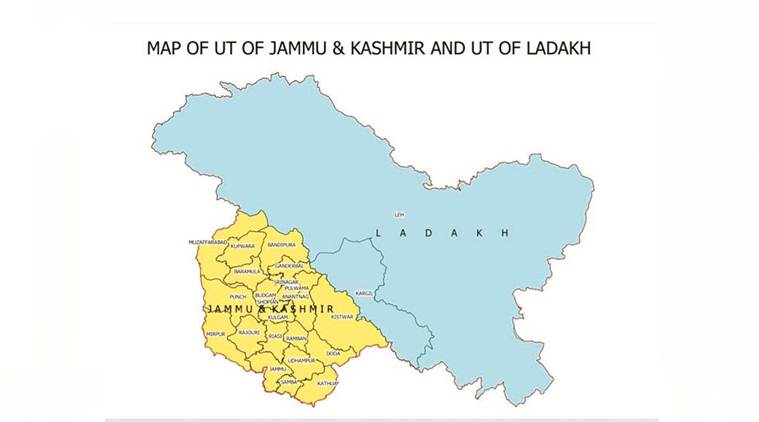 (Source: MHA)
Following the official bifurcation of the erstwhile state of Jammu and Kashmir into the two Union Territories (UT) of Jammu and Kashmir and Ladakh, the Survey of India has come out with new maps of India and the Jammu and Kashmir region.
The new maps show the two UTs clearly demarcated, and while Pakistan-Occupied Kashmir’s Muzaffarabad and Mirpur areas have been kept as part of the UT of Jammu and Kashmir, Kargil and Gilgit and Baltistan have been shown as part of Ladakh UT.
The President, too, issued an order on Saturday identifying Leh, Kargil, Gilgit, Gilgit Wazarat, Chilhas and Tribal Territory of 1947 as part of the Ladakh UT.
“The Leh district of the new Union Territory of Ladakh has been defined in the Jammu and Kashmir Reorganization (Removal of Difficulties) Second Order, 2019, issued by the President of India, to include the areas of the districts of Gilgit, Gilgit Wazarat, Chilhas and Tribal Territory of 1947, in addition to the remaining areas of Leh and Ladakh districts of 1947, after carving out the Kargil District,” a statement from the Ministry of Home Affairs said.
Washington, October 22
The US on Tuesday said it supported a direct dialogue between India and Pakistan as outlined in the Simla Agreement, asserting that the “chief obstacle” to talks remained Islamabad’s continued support to extremist groups that engaged in cross-border terrorism.
“We believe that direct dialogue between India and Pakistan, as outlined in the 1972 Simla Agreement, holds the most potential for reducing tensions,” Acting Assistant Secretary of State for South and Central Asia Alice G Wells told the Subcommittee on Asia, the Pacific, and Nonproliferation of the House Foreign Affairs Committee.
She said that during the 2006-2007 backchannel negotiations, India and Pakistan reportedly made significant progress on a number of issues, including Kashmir.
“History shows us what is possible,” Wells said in a prepared statement submitted to the Congressional subcommittee on the eve of the hearing ‘Human Rights in South Asia: Views from the State Department and the Region’.
“Restarting a productive bilateral dialogue requires building trust, and the chief obstacle remains Pakistan’s continued support for extremist groups that engage in cross-border terrorism,” she said.
The United States, Wells said, welcomed Prime Minister Imran Khan’s recent unambiguous statement that terrorists from Pakistan who carried out violence in Kashmir are enemies of both Kashmiris and Pakistan.
“Pakistan’s harbouring of terrorist groups like Lashkar-e-Taiba and Jaish-e-Muhammed, which seek to foment violence across the Line of Control, is destabilising, and Pakistani authorities remain accountable for their actions,” she said in a warning to Pakistan.
“We believe the foundation of any successful dialogue between India and Pakistan is based on Pakistan taking sustained and irreversible steps against militants and terrorists in its territory,” Wells said.
Both President Donald Trump and Secretary of State Mike Pompeo had met and spoken with their Indian and Pakistani counterparts multiple times, including at the recent United Nations General Assembly, to encourage dialogue, she told the lawmakers in the prepared statement.
Observing that the security situation in Kashmir remained tense, Wells said clashes between youth and security forces are a regular occurrence, and Indian forces killed suspected terrorists in multiple firefights last week.
“We are concerned about reports of local and foreign militants attempting to intimidate local residents and business owners in order to stymie normal economic activity. The United States supports the rights of Kashmiris to peacefully protest, but condemns the actions of terrorists who seek to use violence and fear to undermine dialogue,” she said. PTI

 CM Capt Amarinder Singh, his cabinet colleagues Sukhjinder Singh Randhawa (R), Charanjit Singh Channi (6R), state Congress chief Sunil Jakhar (L), Sewa Singh Sekhwan (5L) of SAD Taksali and leader of opposition Harpal Singh Cheema (4L) at an all-party meeting in Chandigarh on Friday. Ht photo

HT Correspondent
letterschd@hindustantimes.com
CHANDIGARH : An all-party meeting chaired by chief minister Captain Amarinder Singh in Chandigarh on Friday resolved to jointly celebrate the 550th birth anniversary of Guru Nanak on November 12 at Sultanpur Lodhi.
The state government has planned a mega event at Sultanpur Lodhi, where the first Sikh guru spent over 18 years of his life. It was observed at the meeting that even on earlier occasions, all such celebrations were organised by the state government and leaders of all political parties had jointly participated.
The state government will set up its own stage on the occasion despite an appeal from the Akal Takht jathedar to join the Shiromani Gurdwara Parbandhak Committee (SGPC) in celebrating the historic event.
The meeting regretted that some political parties have decided to hold parallel celebrations on this pious occasion for their vested interest, sending a wrong message to the Sikh community across the world, according to an official spokesman.
The meeting resolved that the state government will invite leaders of all political parties, both state and national, for the November 12 function.
In keeping with the religious sentiment of the event, all speeches will be restricted to propagating the Guru’s philosophy and his life, the spokesperson said. Besides the CM, his cabinet colleagues Sukhjinder Singh Randhawa, Charanjit Singh Channi, and state Congress chief Sunil Jakhar were present at the meeting.
Others who attended the meeting included Harbans Singh Kandhola (SAD 1920), Bhupinder Sambhar and Hardev Arshi (CPI), Gurparamjit Kaur Taggar (CP-M), Sewa Singh Sekhwan (SAD Taksali), Baba Sarbjot Singh Bedi (Sant Samaj), Jasbir Singh Garhi (BSP), Manjit Singh Bilaspur (AAP) and Harpal Singh Cheema (leader of opposition).
The CM said the state government had been keen for all parties and their representatives to join its main event, irrespective of different political ideologies. The historic occasion should have been kept above petty politics, he said, adding that he had also requested the Prime Minister for a single function, to which he had agreed but things eventually did not work out.
Lashing out at the Akalis for politicising the issue, the CM said he was in favour of joint celebrations from the outset and, in keeping with this sentiment, will be addressing the gathering from the stage at the event being organised by the Union government at Dera Baba Nanak on November 9.
Sekhwan recalled that when he was a public relations minister in the Akali government, all events were organised by the state government, but now they were crying foul, thus exposing their double standards.
Baba Sarabjot Singh Bedi said though the SGPC and Akal Takht have the right to celebrate religious functions, they were both unfortunately no longer independent bodies and were completely in the grip of one family.

Ashiq Hussain
letters@hindustantimes.com
Srinagar : The firing along the de facto India-Pakistan border in Jammu and Kashmir — the Line of Control (LoC) — in Tangdhar sector of Kupwara district on Saturday triggered panic as residents left their homes to take shelter in underground bunkers, residents and police said on Sunday.
A civilian, Mohammad Sidiq, 50, and two army soldiers were killed in the firing that prompted the Indian Army to launch an artillery attack in retaliation on Sunday. Army chief General Bipin Rawat said that India mounted the attack on at least four terror camps and Pakistani military positions across the LoC. He added that the firing from the Pakistani side was meant to assist infiltrators and at least six Pakistani soldiers were killed while heavy terrorist casualties were also inflicted in the artillery attack.
Sidiq was a resident of Gundishot in Tanghdar. Ishfaq Ahmad, a local resident, said that shells from across the LoC fell in Gundishot as well as hit an army post in Tanghdar. “One shell fell near the house of Sidiq and led to his death,’’ said Ahmad as he described the panic in the village.
He added that some residents took shelter in underground bunkers while others huddled on the ground floors of their homes. “There was chaos. Men, women, and children were crying. The shrieks could be heard throughout the night. People thought that they would not survive,” he said.
A police officer, who was not authorised to speak to the media, said that three more civilians were injured in the cross-LoC firing. “Two of them are stable. One of the injured civilians is still in the hospital as he has got some serious injuries,” said the officer.
Another police officer said that Pakistani troops fired shells at five to seven places and caused heavy damage to many residential houses. “Seven to eight houses, including a storehouse of grains, have been damaged,” he said on the condition of anonymity. The shells also hit cattle sheds and left some six cows and 10 goats dead.
Another local resident, who did want to be named, said that the shelling was the worst since 2003 when India and Pakistan agreed on a ceasefire along the 744-km long LoC and the 198-km long international border in Jammu and Kashmir.“When there was a massive earthquake in 2005, many underground bunkers were destroyed and people did not feel the need to reconstruct them as there were not many ceasefire violations in this area. There were minor skirmishes earlier. We demand the reconstruction of underground bunkers in the area.”
Tensions along the LoC have escalated since August 5 when the Centre moved to effectively revoke Constitution’s Article 370 that gave Jammu and Kashmir a special status. The state was also split into two Union territories in August.
New Delhi, October 17
Intelligence agencies have alerted the government that at least five ISI-backed Pakistan terrorists, highly trained, are placed in Nepal to infiltrate into India either through Uttar Pradesh or Bihar border ahead of Diwali, sources said.
Sources in the agencies said telephonic intercepts of conversations between the terrorists in Nepal and their handlers in Pakistan suggest they have a plan to strike in India in a big way with the help of a few of the home-grown Kashmiri militants, who will meet them in Delhi.
Their last location was found to be near Gorakhpur on Nepal border, but for a few days they stayed at Beerganj, near Raxaul border in Bihar. Officials in the MHA said following the input, a high alert has been issued across the country.
On Wednesday, several defence bases in Jammu and Kashmir and Punjab were put on orange alert after intelligence inputs suggested a group of terrorists is planning to target these, they said, adding a general alert had already been issued on August 5, when the government took the decision to do away with special status to J&K under Article 370.
In the last week of September, the multi-agency centre that collates data and inputs from human intelligence, radio intercepts and other sources had indicated that 60 terrorists had infiltrated into India since the government’s decision on Article 370, but most of them could manage through LoC. — TNS
Impending threat
Srinagar, October 31
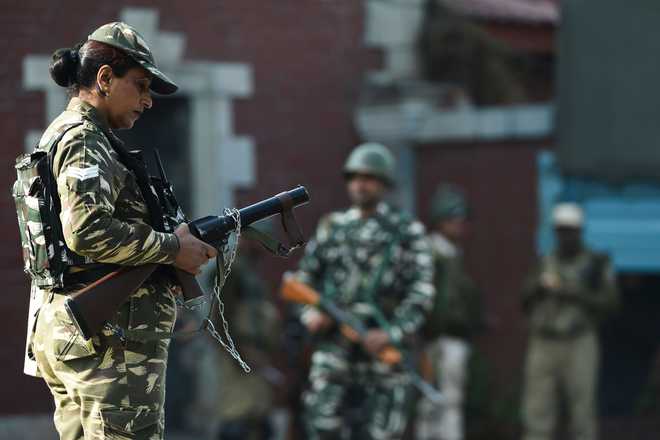
As the clock struck 12 and a new day beckoned, Jammu and Kashmir on Thursday transitioned from a state into two union territories with a wary Valley shutting down as it has for 88 days and Prime Minister Narendra Modi saying the “new system” is aimed at “building a strong link of trust”.
President Ram Nath Kovind revoked President’s rule imposed in the restive state, long the centre of global attention, and took over control of the administration of the two new union territories, Jammu and Kashmir, and Ladakh.
This is the first time that a state is being downsized into union territories, the two new entities taking the total number of UTs to nine and bringing down the number of states in India to 28.
This was in accordance with the government’s August 5 announcement withdrawing the state’s special status under Article 370 and bifurcating it into union territories.
Girish Chandra Murmu in Jammu and Kashmir and Radha Krishna Mathur in Ladakh stepped into history as the first lieutenant governors of the new union territories. Jammu and Kashmir High Court Chief Justice Gita Mittal administered the oath of office to the new appointees, first in Leh and then later in the day in Srinagar.
As the changes came into effect, the Prime Minister was at the Statue of Unity in Kevadiya in Gujarat where he paid glowing tributes to Sardar Vallabhbhai Patel on his 144th birth anniversary and led the “national unity pledge”.
Defending the abrogation of Article 370, he said the special status provisions only generated terrorism in Jammu and Kashmir.
“The new system in Jammu and Kashmir and Ladakh is not meant to draw a line on the land (to draw a boundary) but to build a strong link of trust,” the Prime Minister said.
In a swipe at Pakistan, he said those “who cannot win wars” against India are trying to destroy its unity.
“The country took the decision of abrogation of Article 370, which had given only separatism and terrorism to that state,” Modi said.
“Patel had once said that had he handled the Kashmir issue, it would not have taken so long to resolve it,” Modi said, in a veiled swipe at Jawaharlal Nehru, the country’s first prime minister whom the ruling BJP often blames for the Kashmir issue.
Addressing a gathering in the national capital, Union Home Minister Amit Shah said Articles 370 and 35A were the gateway of terrorism into Jammu and Kashmir. Modi closed the gateway by repealing them, he said.
With this move, the Constitution of Jammu and Kashmir and the Ranbir Penal Code have ceased to exist.
In the Kashmir Valley, however, it was another day of shutdowns and tension with markets shut, deserted roads and children staying away from school.
“This is a decision against our interests. They have robbed us of our special status and our identity,” Muzammil Mohamad, a resident of Srinagar’s Civil Lines area, said.
Another local, Umer Zargar, said, “Kashmir was a disputed territory and India’s decision was illegal, immoral and unconstitutional.”
“India cannot abrogate Article 370. This issue is in the United Nations. There are resolutions on it. This decision is illegal, immoral and unconstitutional,” he said.
For the third consecutive day, no vendors set up stalls on the TRC Chowk-Lal Chowk road, the officials said.
The roadside vendors, who had regularly set up their stalls over the past two months, have not been turning up for business since Tuesday when a delegation of EU parliamentarians landed for a two-day visit to assess the situation.
Landline and post-paid mobile phone services have been restored across the Valley, but all internet services continued to remain suspended since the night of August 4.
Most top-level and second-rung separatist politicians have been taken into preventive custody while mainstream leaders, including two former chief ministers–Omar Abdullah and Mehbooba Mufti–have been either detained or placed under house arrest.
Lok Sabha MP from Srinagar Farooq Abdullah has been arrested under the controversial Public Safety Act, a law enacted by his father and National Conference founder Sheikh Mohammad Abdullah in 1978 when he was the chief minister.
In a late-night notification on Wednesday, the Home Ministry replaced the state of Jammu and Kashmir with the “union territory of Jammu and Kashmir” and announced omission of “permanent residents or hereditary state subjects”.
The ministry’s Jammu and Kashmir division announced a slew of measures, including application of central laws to the state. PTI







































































