Sanjha Morcha

What’s New

Click the heading to open detailed news

Current Events :

web counter

Print Media Reproduced Defence Related News

US fighters fly over South China Sea

WASHINGTON: Two US bombers have flown over the disputed South China Sea, the US Air Force said on Friday, asserting the right to treat the region as international territory despite China’s claim to virtually all of the waterway.
The flight by the B-1B Lancer bombers from Guam on Thursday came as U.S. President Donald Trump and Chinese President Xi Jinping prepare for a meeting on the sidelines of a G20 summit in Germany. The two leaders were expected to discuss what China can do to rein in North Korea’s missile and nuclear weapon programmes.
North Korea fired an intercontinental ballistic missile on Tuesday that some experts believe has the range to reach Alaska and Hawaii and perhaps the U.S. Pacific Northwest.
While Trump has been seeking China’s help to press North Korea, the U.S. military has, nevertheless, been asserting its “freedom of navigation” rights in the South China Sea, at the risk of angering China.
Asked about the flight by the two U.S. bombers, Chinese Foreign Ministry spokesman Geng Shuang said there was no problem with freedom of navigation or overflight for the East and South China Seas.
“But China resolutely opposes individual countries using the banner of freedom of navigation and overflight to flaunt military force and harm China’s sovereignty and security,” he said.
The United States has criticised China’s build-up of military facilities on South China Sea reefs and tiny islands it has constructed, concerned that they could be used to extend its strategic reach.
Brunei, Malaysia, the Philippines, Vietnam and Taiwan also have claims in the sea.

CHINA’S CARRIER DOCKS IN HONG KONG

Top) The Liaoning, China’s first aircraft carrier, sailed into Hong Kong for a port call on Friday to celebrate the 20th anniversary of the People’s Liberation Army garrison’s presence in the city; (left) Residents photograph the ship; (right) A fighter jet on the Liaoning.


CAPTAIN WITH THE GENERAL

Punjab chief minister Capt Amarinder Singh called on army chief Gen Bipin Rawat on Thursday. Amarinder presented a set of six military history books authored by him to the General.


Homage to Indian WW1 heroes 44 soldiers sacrificed their lives protecting Israel’s Haifa city from Ottoman TurksHomage to Indian WW1 heroes 44 soldiers sacrificed their lives protecting Israel’s Haifa city from Ottoman Turks

Prime Minister Narendra Modi greets the Indian contingent of the United Nations Interim Force in Lebanon during a visit to the Indian Army Cemetery of the World War-I in the Israeli coastal city of Haifa. AFP

Simran Sodhi

Tribune News Service

New Delhi, July 6

Prime Minister Narendra Modi today paid homage to the Indian soldiers whose bravery was instrumental in securing the liberation of Haifa as he wrapped up his historic three-day Israel visit. The PM, accompanied by his Israeli counterpart Benjamin Netanyahu, visited the Indian cemetery in Haifa and laid a wreath to honour the Indian soldiers. “This is the final resting place for 44 of the Indian soldiers who sacrificed their lives during World War I to liberate the city,” Modi said before visiting the site.(Follow The Tribune on Facebook; and Twitter @thetribunechd)Forty-four Indian soldiers were killed protecting Haifa from the Ottoman Turks in World War I. Major Dalpat Singh (MC) is known as the ‘Hero of Haifa’ for his critical role in the liberation of the city. He was awarded a military cross for his bravery.The Haifa war was fought on September 22-23 in 1918. The Indian Army celebrates September 23 as Haifa Day every year. Later in the day, PM Modi and Netanyahu attended the first meeting of India-Israel CEOs forum in Tel Aviv. As many as 12 strategic pacts envisaging investments worth $4.3 billion were signed between Indian and Israeli companies at the first meeting of CEO forum in Tel Aviv today, according to information released by the Federation of Indian Chambers of Commerce and Industry (FICCI). “The forum identified and stressed on the need to realise opportunities in focus sectors identified during the first meeting of CEOs forum. There was a consensus that the current trade volume amounting to just over $ 4 billion has the potential to reach $20 billion in the next five years. To realise this goal, the forum underlined key recommendations to two heads of states,” FICCI said in its statement. After wrapping his rather successful visit, the PM left for the German city of Hamburg where world leaders have gathered to attend the G20 Summit.  Previous ImageNext Image Prime Minister Narendra Modi lays a wreath at the Indian cemetery in Haifa, Israel, on Thursday. Forty-four Indian soldiers laid down their lives during the liberation of Haifa in 1918. The PM also unveiled a plaque commemorating Major Dalpat Singh, known as the “Hero of Haifa”, for his critical role in defeating the Ottoman Empire forces. PTI Simran Sodhi Tribune News Service New Delhi, July 6 Prime Minister Narendra Modi today paid homage to the Indian soldiers whose bravery was instrumental in securing the liberation of Haifa as he wrapped up his historic three-day Israel visit.  The PM, accompanied by his Israeli counterpart Benjamin Netanyahu, visited the Indian cemetery in Haifa and laid a wreath to honour the Indian soldiers.  “This is the final resting place for 44 of the Indian soldiers who sacrificed their lives during World War I to liberate the city,” Modi said before visiting the site. (Follow The Tribune on Facebook; and Twitter @thetribunechd) Forty-four Indian soldiers were killed protecting Haifa from the Ottoman Turks in World War I. Major Dalpat Singh (MC) is known as the ‘Hero of Haifa’ for his critical role in the liberation of the city. He was awarded a military cross for his bravery. The Haifa war was fought on September 22-23 in 1918. The Indian Army celebrates September 23 as Haifa Day every year.  Later in the day, PM Modi and Netanyahu attended the first meeting of India-Israel CEOs forum in Tel Aviv. As many as 12 strategic pacts envisaging investments worth $4.3 billion were signed between Indian and Israeli companies at the first meeting of CEO forum in Tel Aviv today, according to information released by the Federation of Indian Chambers of Commerce and Industry (FICCI).  “The forum identified and stressed on the need to realise opportunities in focus sectors identified during the first meeting of CEOs forum. There was a consensus that the current trade volume amounting to just over $ 4 billion has the potential to reach $20 billion in the next five years. To realise this goal, the forum underlined key recommendations to two heads of states,” FICCI said in its statement.  After wrapping his rather successful visit, the PM left for the German city of Hamburg where world leaders have gathered to attend the G20 Summit.

PM pays tribute to Indian

VISIT ENDS On his last day in Israel, Modi visits cemetery of 44 soldiers who laid down their lives to liberate Haifa city

From page 01 TEL AVIV: Prime Minister Narendra Modi on Thursday visited the Indian cemetery in the Israeli city of Haifa and paid homage to Indian soldiers who laid down their lives during the World War 1 while protecting the city from the powerful forces of the Ottoman Empire.

AP PHOTOPM Narendra Modi lays a wreath during a memorial ceremony at the World War I Indian Army cemetery in Haifa on Thursday.Modi visited the cemetery on the last day of his visit to Israel.

“This is the final resting place for 44 of the Indian soldiers who sacrificed their lives during World War I to liberate the city,” Modi had said before visiting the site.

The Indian Army commemorates September 23 every year as Haifa Day to pay its respects to the two brave Indian Cavalry Regiments that helped liberate the city following a dashing cavalry action by the 15th Imperial Service Cavalry Brigade.

“I am deeply honoured to stand here today to salute the valiant soldiers, who laid down their lives for the liberation of Haifa during the First World War,” the Prime Minister wrote in the visitors’ book.

He also wrote that next year, the centenary of the Battle of Haifa would present another opportunity to mark the enduring bond between India and Israel. In the autumn of 1918, the Indian Brigade was a part of the Allied Forces sweeping northwards through Palestine in what is seen as the last great cavalry campaign in history.

Captain Aman Singh Bahadur and Dafadar Jor Singh were awarded the Indian Order of Merit (IOM) and Captain Anop Singh and 2nd Lt Sagat Singh were awarded the Military Cross (MC) as recognition for their bravery in this battle.

Major Dalpat Singh (MC) is known in the annals of history as the ‘Hero of Haifa’ for his critical role in the Liberation of the city. He was awarded a military cross for his bravery.

In 2012, the municipality of Haifa decided to immortalise the sacrifices made by Indian soldiers, many of whom are buried in the cemetery here, by including the stories of their valiant efforts in school curricula.

The municipality also decided to organise a ceremony every year to commemorate the role of the Indian Army in liberating the city from Turks after almost 402 years.

LEADERS LAUNCH INNOVATION BRIDGE

Modi, along with his Israeli counterpart Benjamin Netanyahu, on Thursday launched an India-Israel Innovation Bridge designed to link start-up companies and innovators of the two countries. The bridge is aimed at benefitting Israeli companies and India in areas like agricultural technology, water technology and digital healthcare.

While India has 157.35 million hectares of agricultural land, there are over 500 Israeli agricultural technology companies.

Similarly, while India is the largest user of ground water, Israel is the largest investor in water technology.

There will be over 600 million people seeking affordable healthcare by 2018. Israel, with over 385 companies in the digital health sector, can provide a solution.

MODI MEETS INDIAN STUDENTS IN ISRAEL

PM Modi on Thursday also met a group of Indian students pursuing higher education in Israel.

“It was great to meet Indian students studying in Israel,” Modi said in a tweet.

The meeting, which took place at Dan Hotel, was the last programme scheduled during the PM’s historic three-day visit to the Jewish nation.

Addressing the Indian diaspora here at an event also attended by Netanyahu, Modi on Wednesday said almost 600 students from India are studying in different subjects in Israel and some of them are present here. “My young colleagues, you are like the bridge of technology and innovation between India and Israel. My friend Netanyahu and I believe …. that science, innovation and technology will be the main base for the future relations between India and Israel. That is why whatever you are learning here, will help strengthen India,” he had said.


DG, Defence Estates, meets Governor

Srinagar, July 5

Jojneswar Sharma, Director General, Defence Estates (DGDE), called on Governor NN Vohra at Raj Bhawan.Sharma briefed the Governor about certain issues relating to acquisition of land, resettlement and rehabilitation of displaced persons and hiring and requisitioning of lands and buildings by the DGDE.The Governor stressed the vital importance of establishing a system for efficient management of defence land which ensures its optimum utilisation and a dynamic approach for unwanted pockets of such land being returned to the state.The Governor referred to several long-pending cases and recalled negative consequences being suffered on account of defence land in Jammu not having been returned to the University of Jammu for more than a decade. — TNS


Pay

The Union Cabinet chaired by the Prime Minister Shri Narendra Modi approved the recommendations of the 7thCPC on allowances with some modifications. The revised rates of the allowances shall come into effect from 1st July, 2017and shall affect more than 48 lakh central government employees.

While approving the recommendations of the 7thCPC on 29th June, 2016, the Cabinet had decided to set up the Committee on Allowances (CoA) in view of substantial changes in the existing provisions and a number of representations received. The modifications are based on suggestions made by the CoA in its Report submitted to Finance Minister on 27thApril, 2017 and the Empowered Committee of Secretaries set up to screen the recommendations of 7thCPC.

7th CPC recommendations on Allowances

The 7th CPC had adopted a three-pronged approach in examining a total of 197 allowances which involved an assessment of the need for continuation of each allowance, appropriateness of the set of people covered by the allowance and rationalisation which involved clubbing of allowances with similar objectives. Based on the examination on these lines, the 7th CPC recommended that 53 allowances be abolished and 37 be subsumed in an existing or a newly proposed allowance.

For most of the allowances that were retained, the 7th CPC recommended a raise commensurate with inflation as reflected in the rates of Dearness Allowance (DA). Accordingly, fully DA-indexed allowances such as Transport Allowance were not given any raise. Allowances not indexed to DA were raised by a factor of 2.25 and the partially indexed ones by a factor of 1.5. The quantum of allowances paid as a percentage of pay was rationalised by a factor of 0.8.

A new paradigm has been evolved to administer the allowances linked to risk and hardship. The myriad allowances, their categories and sub–categories pertaining to  civilians employees, CAPF and defence personnel have been fitted into a table called the Risk and Hardship Matrix (R&H Matrix). The Matrix has nine cells denoting varying degrees of risk and hardship with one extra cell at the top named as RH – Max to include Siachen Allowance. Multiple rates applicable to individual allowances will be replaced by two slab rates for every cell of the R&H Matrix.

Modifications approved by the Cabinet

The modifications approved today were finalised by the E-CoS based on the recommendations of the CoA. The CoA had undertaken extensive stakeholder consultations before finalising its recommendations. It had interacted with Joint Consultative Machinery (Staff side) and representatives from various staff associations. Most of the modifications are on account of continuing requirement of some of the existing arrangements, administrative exigencies and to further the rationalization of the allowances structure.

Financial Implications

The modifications approved by the Government in the recommendations of the 7th CPC on allowances will lead to a modest increase of ₹1448.23 crore per annum over the projections made by the 7th CPC. The 7th CPC, in its Report, had projected the additional financial implication on allowances at ₹29,300 crore per annum. The combined additional financial implication on account of the 7th CPC recommendations along with the modifications approved by the Cabinet is estimated at ₹30748.23 crore per annum.

Highlights of Cabinet approval on Allowances

1.        Number of allowances recommended to be abolished and subsumed:

Government has decided not to abolish 12 of the 53 allowances which were recommended to be abolished by the 7th CPC. The decision to retain these allowances has been taken keeping in view the specific functional requirements of Railways, Posts and Scientific Departments such as Space and Atomic Energy. It has also been decided that 3 of the 37 allowances recommended to be subsumed by the 7th CPC will continue as separate identities. This has been done on account of the unique nature of these allowances. The rates of these allowances have also been enhanced as per the formula adopted by the 7th CPC. This will benefit over one lakh employees belonging to specific categories in Railways, Posts, Defence and Scientific Departments.

2.        House Rent Allowance

HRA is currently paid @ 30% for X (population of 50 lakh & above), 20% for Y (5 to 50 lakh) and 10% for Z (below 5 lakh) category of cities. 7th CPC has recommended reduction in the existing rates to 24% for X, 16% for Y and 8% for Z category of cities. As the HRA at the reduced rates may not be sufficient for employees falling in lower pay bracket, it has been decided that HRA shall not be less than ₹5400, ₹3600 and ₹1800 for X, Y and Z category of cities respectively. This floor rate has been calculated @ 30%, 20% and 10% of the minimum pay of ₹18000.This will benefit more than 7.5 lakh employees belonging to Levels 1 to 3.

7th CPC had also recommended that HRA rates will be revised upwards in two phases to 27%, 18% and 9% when DA crosses 50% and to 30%, 20% and 10% when DA crosses 100%. Keeping in view the current inflation trends, the Government has decided that these rates will be revised upwards when DA crosses 25% and 50% respectively. This will benefit all employees who do not reside in government accommodation and get HRA.

3.        Siachen Allowance

7th CPC had placed Siachen Allowance in the RH-Max cell of the R&H Matrix with two slabs of ₹21,000 and ₹31,500. Recognizing the extreme nature of risk and hardship faced by officers / PBORs on continuous basis in Siachen, the Government has decided to further enhance the rates of Siachen Allowance which will now go up from the existing rate from ₹14,000 to ₹30,000 per month for Jawans & JCOs (Level 8 and below) and from ₹21,000 to ₹42,500 per month for Officers (Level 9 and above). With this enhancement, Siachen Allowance will become more than twice the existing rates. It will benefit all the soldiers and officers of Indian Army who are posted in Siachen.

4.        Dress Allowance

At present, various types of allowances are paid for provisioning and maintenance of uniforms/outfits such as Washing Allowance, Uniform Allowance, Kit Maintenance Allowance, Outfit Allowance etc. These have been rationalised and subsumed in newly proposed Dress Allowance to be paid annually in four slabs @ ₹5000, ₹10,000, ₹15,000 and ₹20,000 per annum for various category of employees. This allowance will continue to be paid to Nurses on a monthly basis in view of high maintenance and hygiene requirements. Government has decided to pay higher rate of Dress Allowance to SPG personnel keeping in view the existing rates of Uniform Allowance paid to them (which is higher than the rates recommended by the 7th CPC) as also their specific requirements. The rates for specific clothing for different categories of employees will be governed separately.

5.        Tough Location Allowance

Some allowances based on geographical location such as Special Compensatory (Remote Locality) Allowance (SCRLA), Sunderban Allowance & Tribal Area Allowance have been subsumed in Tough Location Allowance. The areas under TLA have been classified into three categories and the rates will be governed as per different cells of R&H Matrix and will be in the range of ₹1000 – ₹5300 per month. The 7th CPC had recommended that TLA will not be admissible with Special Duty Allowance (SDA) payable in North-East, Ladakh and the Islands. Government has decided that employees will be given the option to avail of the benefit of SCRLA at pre-revised rates along with SDA at revised rates.

6.                     Recommendations in respect of some important allowances paid to all employees:

(i)                  Rate of Children Education Allowance (CEA) has been increased from ₹1500 per month / child (max. 2) to ₹2250 per month / child (max.2). Hostel Subsidy will also go up from ₹4500 per month to ₹6750 per month.

(ii)                Existing rates of Special Allowance for Child Care for Women with Disabilities has been doubled from ₹1500 per month to ₹3000 per month.

(iii)          Higher Qualification Incentive for Civilians has been increased from ₹2000 – ₹10000 (Grant) to ₹10000 – ₹30000 (Grant).

7.        Recommendations in respect of some important allowances paid to         Uniformed Services: Defence, CAPFs, Police, Indian Coast Guard and    Security Agencies

                    i.                        The 7th CPC has recommended abolition of Ration Money Allowance (RMA) and free ration to Defence officers posted in peace areas. It has been decided that Ration Money Allowance will continue to be paid to them and directly credited to their account. It will benefit 43000 Defence officers.

                  ii.                        Technical Allowance (Tier – I & II) are paid to Defence officers belonging to technical branches @₹3000 per month and ₹4500 per month. 7th CPC has recommended that Technical Allowance (Tier – II) be merged with Higher Qualification Incentive for Defence personnel. In view of the specific requirements of Defence Forces for the Defence personnel to keep pace with changing Defence requirements and technologies, the  Government has decided not to discontinue Technical Allowance. The list of courses for these allowances will be reviewed to remain in sync with the latest technical advancements in Defence.

                iii.                        The facility of one additional free railway warrant (Leave Travel Concession) presently granted to personnel of Defence Forces serving in  field/high altitude/CI Ops shall also be extended to all personnels of CAPFs and the Indian Coast Guard.

                iv.                        Rates of High Altitude Allowance granted to Defence Forces and CAPF personnel will be governed by the R&H Matrix. The rates will go up from  ₹810 – ₹16800 per month to ₹2700 – ₹25000 per month.

                  v.                        Field Area Allowances are granted to Indian Army, Air Force & CAPF personnel. The rates of Field Area Allowances (Modified Field, Field & Highly Active)  will be governed by the R&H Matrix. The rates will go up from ₹1200 – ₹12600 per month to ₹6000 – ₹16900 per month. Classification of field areas for this allowance will be done by Ministry of Defence for Defence personnel and by Ministry of Home Affairs for CAPFs.

                vi.                        The rates of Counter Insurgency Ops (CI Ops) Allowance, granted to Defence and CAPFs while deployed in counter – insurgency operations will be governed by the R&H Matrix. The rates will go up from  ₹3000 – ₹11700 per month to ₹6000 – ₹16900 per month.

              vii.                        Rates of MARCOS and Chariot Allowance granted to marine commandos of Indian Navy will be governed by the R&H Matrix. The rates will go up from ₹10500 – ₹15750 per month to ₹17300 – ₹25000 per month.

            viii.                        Rates of Sea Going Allowancegranted to personnel of Indian Navy will be governed by the R&H Matrix. The twelve hour conditionality for determining the eligibility of Sea Going Allowance has been reduced to four hours. The rates will go up from ₹3000 – ₹7800 per month to ₹6000 – ₹10500 per month.

                ix.                        Rates of Commando Battalion for Resolute Action (COBRA) Allowancegranted to CRPF personnel deployed in Naxal hit areas will be governed by the R&H Matrix. The rates will go up from ₹8400 – ₹16800 per month to ₹17300 – ₹25000 per month.

                  x.                        Rates of Flying Allowance granted to flying branch and technical officers of Defence Forces will be governed by the R&H Matrix. The rates will go up from ₹10500 – ₹15750 per month to ₹17300 – ₹25000 per month. It has been extended mutatis mutandis to BSF Air Wing also.

                xi.                        Rates of Higher Qualification Incentive for Defence Personnel have been increased from ₹9000 – ₹30000 (Grant) to ₹10000 – ₹30000 (Grant).

              xii.                       Aeronautical Allowance, presently paid to personnel of Indian Navy, has been extended to Indian Coast Guard. The rate of this allowance has been increased from₹300 per month to ₹450 per month.

            xiii.                        Rates of Test Pilot and Flight Test Engineer Allowancewill be governed by the R&H Matrix. The rates will go up from  ₹1500 / ₹3000 per month to ₹4100 / ₹5300 per month.

            xiv.                        Rates of Territorial Army Allowance have been increased from ₹175 – ₹450 per month to₹1000 – ₹2000 per month.

              xv.                        Ceilings of Deputation (Duty) Allowance for Defence Personnel have been increased from ₹2000 – ₹4500 per month to ₹4500 – ₹9000 per month.

            xvi.                        Rates of Detachment Allowance have been increased ₹165 – ₹780 per day to ₹405 – ₹1170 per day.

          xvii.                        Rates of Para Jump Instructor Allowance have been increased from ₹2700/3600 per monthto ₹6000 / 10500 per month.

        xviii.                        Special Incident / Investigation / Security Allowancehas  been rationalized. Rates for Special Protection Group (SPG) have been revised to 55% and 27.5% of Basic Pay for operational and non – operational duties respectively.

8.         Recommendations in respect of some important allowances paid to Indian Railways

              i.                              Rates of Additional Allowance have been increased from ₹500 / 1000 per month to ₹1125 / 2250 per month. This has also been extended to Loco Pilot Goods and Senior Passenger Guards also @₹750 per month.

                  ii.                        In view of strenuous nature of the job, new Allowance namely Special Train Controller’s Allowance @5000 per month for Train Controllers of Railways has been introduced.

9.        Recommendations in respect of some important allowances paid to Nurses & Ministerial Staffs of Hospital

                 i.                        Existing rate of Nursing Allowance has been increased from ₹4800per month to ₹7200per month.

               ii.                        Rate of Operation Theatre Allowance has been increased from ₹360per month to ₹540 per month.

                iii.                        Rates of Hospital Patient Care Allowance / Patient Care Allowance have been increased from ₹2070 – ₹2100 per month to ₹4100 – ₹5300 per month. 7th CPC recommendations modified to the extent that it will be granted to Ministerial staff also.

10.       Recommendations in respect of some important allowances paid to        Pensioners


Rate of Fixed Medical Allowance (FMA) for Pensioners has been increased from ₹500 per month to ₹1000 per month. This will benefit more than 5 lakh central government pensioners not availing CGHS facilities.

                    i.                        The rate of Constant Attendance Allowance granted on 100% disablement has been increased from ₹4500 per month to ₹6750 per month.

11.       Allowances to Scientific Departments

              i.                              The recommendations of 7th CPC to abolish Launch Campaign Allowance and Space Technology Allowance has not been accepted. In order to incentivize the supporting employees in Space and Atomic Energy sector, the rate of Launch Campaign and Space Technology Allowance has been increased from ₹7500 per annum to ₹11250 per annum.Professional Update Allowance for non-gazetted employees of Department of Atomic Energy will also continue to be paid at the enhanced rate of ₹11250 per annum.

                  ii.                     The 7th CPC had placed Antarctica Allowance, paid to the Scientists and other members undertaking the expedition to Antarctica under the Indian Antarctic programme, in the RH-Max Cell of the R&H Matrix. The rates of the RH-Max Cell recommended by the 7th CPC were less than the existing rates of Antarctica Allowance which is currently paid on per day basis. Considering the specific nature of these expeditions and to provide appropriate increase in rates, Government has decided to keep Antarctica Allowance out of the R&H Matrix and the allowance will continue to be paid on per day basis as per existing practice. The Rates of Antarctica Allowance will go up from ₹1125 per day (Summers) and ₹1688 per day (Winters) to ₹1500 per day (Summers) and ₹2000 per day (Winters).

12.                  Allowances paid to D/o Posts

                    i.                        The recommendations of 7th CPC to abolish Cycle Allowance, granted     mainly to Postmen and trackmen in Railways, has not been accepted. Keeping in view the specific requirement of this allowance for postmen in Department of Posts and trackmen in Railways, the cycle allowance is retained and the rates have been doubled from ₹90 per month to ₹180 per month. This will benefit more than 22,200 employees.


LeT men behind CRPF convoy attack killed

SRINAGAR: Two Lashkar-eTaiba terrorists holed-up in Delhi Public School in the outskirts of the city were killed after a 17-hour firefight with security forces that ended on Sunday, police said.The terrorists were escaping after an attack on a convoy of 29th Battalion of the Central Reserve Police Force at Pantha Chowk-a high security zone less than one km from the headquarters of Army‘s Chinar Corps. A sub-inspector was killed and two CRPF personnel and a civilian were injured in the attack.Reinforcements were called once the police was informed about the terrorists sneaking in, and a combing operation took place inside the school which was nearly empty at the time -the students had left, but nearly 20 staff member had to be evacuated Saturday evening.
The holed-up terrorists fired at the combing security forces which triggered the encounter resulting in the killing of both the terrorists, the police said. Three Army personnel including a captain were injured in the encounter. Their condition was said to be stable.

Lashkar claimed responsibility for the attack. DGP S P Vaid said bodies of two militants were lying inside the DPS building. Vaid said the operation took long as the security forces wanted to ensure minimum collateral damage. “We wanted to ensure that the (school) building remained safe, because the enemy has a nefarious design that school buildings are destroyed and children forced to abandon their studies.We will ensure that no such thing happens,” Vaid said.


3 Lashkar militants gunned down, Army officer injured in Pulwama Protester killed in clashes following the encounter in south Kashmir

3 Lashkar militants gunned down, Army officer injured in Pulwama
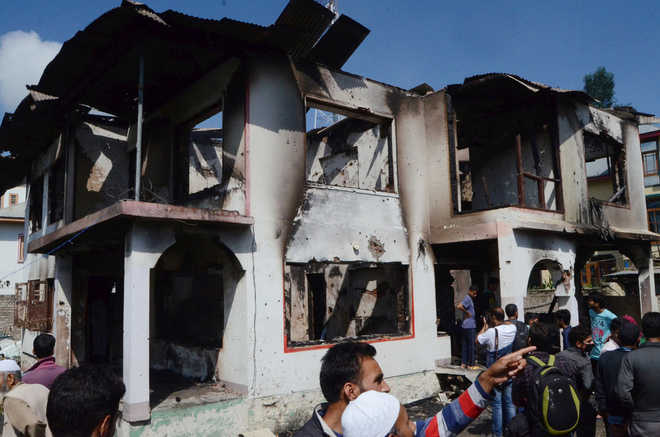
Villagers look at the house damaged during a gunfight in Pulwama district on Thursday. Tribune Photo: Amin War

Majid Jahangir

Tribune News Service

Srinagar, June 22

Security forces achieved a major success when they killed three local Lashkar-e-Toiba militants in an overnight gunfight in south Kashmir’s volatile Pulwama district. An Army officer was also injured in the gunfight.The killing of three militants sparked tension in Pulwama and adjoining areas and during the clashes that followed a protester was killed and nearly two dozen others were injured in the daylong clashes.The gunfight erupted late Wednesday at Kakpora, nearly 25 km from Srinagar, when joint teams of the police, Army and the CRPF launched a cordon and search operation following inputs of the presence of militants.“As the searches were launched around the suspected houses, militants opened fire, which was retaliated, triggering a gunfight. In the exchange that continued for five hours, three local Lashkar militants were killed and a Major was injured,” a police officer said. “Despite getting injured, the Army officer remained part of the anti-militancy operation till the end.”The recoveries made from the site of the encounter included two rifles and a pistol. The house where the militants were hiding was razed to the ground during the gunfight.The slain militants were identified as Majid Mir and Shakir Ahmed, both residents of Kakapora, and Irshad Ahmed of Awantipora. Mir was doing diploma in engineering at a private Srinagar college before he joined militancy last year.“Mir was involved in at least two bank robberies in Pulwama. Mir and Shakir were involved in the killings, including that of PDP district president of Pulwama, advocate Abdul Gani Dar and a civilian, Aijaz Ahmad, of Urbugh. Mir was also involved in the killings of sarpanch Fayaz Ahmad of Kandizal and sarpanch Fayaz Ahmad of Kakapora,” said Senior Superintendent of Police, Pulwama, Mohammad Aslam.During the anti-militancy operation last night, clashes broke out in the neighbouring villages and protesters tried to take out a march towards the encounter site. However, forces maintained a tight cordon around the village and did not allow militants to escape. After the encounter broke out, the authorities suspended the Internet services in Pulwama district late last evening.As the news about the killing of three militants spread, massive clashes and protests broke out in the area this morning. In the daylong clashes, 22-year-old Tauseef Ahmed Wani, a resident of Tengpuna in Pulwama, was killed and many others were injured. Wani had been booked in 2010 and 2016 in stone-throwing cases under the Public Safety Act.The police said Tauseef, alias Chota Geelani, was injured when a violent mob attacked Kakapora police post after the burial of militants. “In order to save lives and government property, the security forces used riot-control measures in which Tauseef was injured, who later succumbed,” a police spokesman said.Pulwama district observed a shutdown after the killing of militants.At least five militants have been killed since Wednesday morning. Two Hizbul Mujahideen militants, including a district commander, were killed in an encounter with the police and security forces in the Pazalpora area of north Kashmir’s Sopore sub-district on Wednesday.Ultra killed as infiltration foiled in KupwaraSrinagar: The Army on Thursday said it had foiled an attempt by militants to sneak into the Valley by killing an unidentified militant in a firefight near the Line of Control in north Kashmir’s frontier Kupwara district. Srinagar-based defence spokesman Col Rajesh Kalia said the bid was foiled in the Keran sector. “The operation is in progress. One terrorist has been killed so far and one weapon recovered,” the spokesman said. Defence sources said the Army noticed suspicious movement close to the LoC in the Keran sector during the intervening night of Wednesday and Thursday and the firefight broke out when the militants were challenged. “The militants opened fire, triggering a gunfight which continued for some hours. During the searches, the body of an unidentified militant was recovered,” the sources said, adding that searches in the dense forest area were continuing as they suspected that more militants might be hiding in the area. TNS

Separatists call for protests

Srinagar: The separatists have called for protests after the Friday prayers against the killing of a civilian and injuries to over two dozen others during clashes between the protesters and security forces in south Kashmir, where three militants were killed on Thursday in an encounter. In a joint statement, Syed Ali Geelani, Mirwaiz Umar Farooq and Mohammad Yasin Malik denounced the civilian killing by the forces, saying that the killing graph in restive Kashmir had “escalated”. TNS


Lockheed Martin signs pact with Tata to make F-16 planes in India

Lockheed Martin signs pact with Tata to make F-16 planes in India

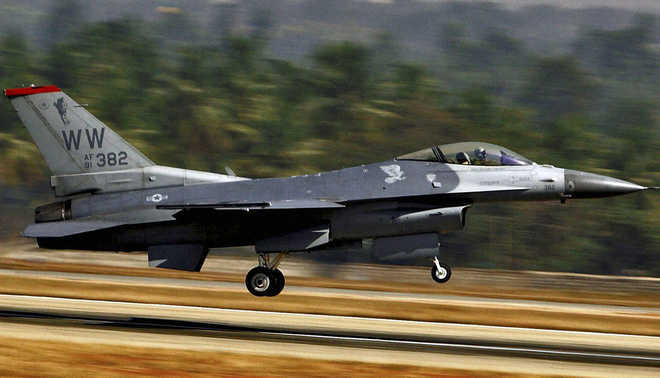
File photo of F-16 fighter plane. PTI

Paris, June 19

Lockheed Martin signed an agreement with India’s Tata Advanced Systems on Monday to produce F-16 fighter planes in India, pressing ahead with a plan to shift its Fort Worth, Texas plant to win billions of dollars worth of order from the Indian military.

(Follow The Tribune on Facebook; and Twitter @thetribunechd)

The Indian Air Force needs hundreds of aircraft to replace its Soviet-era fleet, but the Narendra Modi-led government has said foreign suppliers would have to make the planes in India with a local partner to help build a domestic industrial base and cut outright imports.

But Modi’s ‘Make-in-India’ drive runs the risk of conflicting with US President Donald Trump’s ‘America First’ campaign, under which he has been pressing for companies to invest in the US and create jobs instead of setting up factories abroad.

In announcing their agreement at the Paris Airshow, Lockheed and Tata said moving the production base to India would still retain jobs in the US.

“F-16 production in India supports thousands of Lockheed Martin and F-16 supplier jobs in the US, creates new manufacturing jobs in India, and positions the Indian industry at the centre of the most extensive fighter aircraft supply ecosystem in the world,” a joint statement by the firms said.

Sweden’s Saab is the other contender to supply the Indian Air Force, offering to make its Gripen fighter in India. It has not yet announced a local partner for the plane which it has pitched as a modern alternative to the F-16s.

The announcement comes days before Modi travels to Washington for a first meeting with Trump, scheduled for June 26.

India and the US have built a close defence relationship in recent years with Washington emerging as among the top three arms suppliers to India, along with Russia and Israel.

India will also have the chance to export the F-16 that is flown by air forces around the world, the joint statement said.

Some 3,200 of these planes are being flown by 26 countries and the model that is being offered to India will be Block 70, the most modern of all the F-16s.

“This unprecedented F-16 production partnership between the world’s largest defense contractor and India’s premier industrial house provides India the opportunity to produce, operate and export F-16 Block 70 aircraft, the newest and most advanced version of the world’s most successful, combat-proven multi-role fighter,” the statement said.

Tata is already building airframe components for the C-130 military transport aircraft.

India has not opened formal bidding for the jet order, which is expected to be anything from 100 planes to 250. Reuters


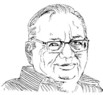
Walking with the martyrs Harish Khare

Early this week, I was in Kasauli. On Monday, I did a rather long hike from Gandhi Gram to Dagshai. A part of the walk was through an enchanting forest. Dagshai is a typical cantonment town, neat and clean, with an aura of serious business at work. All along the road from Anech to Dagshai, the cantonment board has very thoughtfully put up photographs of the brave men who have been awarded the Param Vir Chakra, the highest honour the nation bestows on its soldiers. It was like walking with the martyrs. And what an effect these heroes produce in a trekker! A major here, a lance naik there, a naib subedar, a grenadier, a captain over here, — all intrepid men who exhibited supreme valour and bravery to defend our unity and integrity. These were heroes from the 1962, 1965, 1971, Kargil wars and other battles our armed forces were called up to fight. A sense of humility and admiration overwhelms. There is a realisation that our national identity is unconsciously shaped and sharpened by tales of supreme sacrifice and bravery by each of these names — be it a Shaitan Singh, or an Abdul Hamid or a Yogendra Singh Yadav. The following day, I participated in a ‘Strategic Studies Seminar’ at the Kasauli Club. It is an annual dialogue organised by a very intellectually driven ex-fauji, Lt-General Kamal Davar (retd). I had three distinguished officers as fellow-panelists, as well as there were very many knowledgeable people among the select audience. It was a great honour to meet so many distinguished men and women.The fauji biradari remains engaged with matters of national security; the nation — and the government, hopefully— gain from their vast experience and knowledge. Some of them had even handed me brief notes on the security scenario. Such earnestness, such concern.Much of what my fellow-panelists had to say must remain unwritten, as the dialogue was conducted under what is called the Chatham House Rule (no publicity, frank discussion).I was the only non-military person in the gathering, and there is nothing secret about what I had to say. My basic contention was that national security was too serious a matter to be decided upon by the passions and noises generated in the television studios. I remain unconvinced of the need and the desirability of so many generals, admirals and air marshals allowing themselves to be enlisted as studio warriors. Somewhat bluntly, I argued that these retired generals neither add to the army’s image, nor bring any honour to the armed forces nor educate the nation. The electronic medium does not allow a panelist — however distinguished a soldier he may have been — to remain dignified; he is invited to serve the purpose of the medium.If these retired generals were not creating enough noise on their own, we now have a Chief of the Army Staff who is prone to be garrulous, inviting unbecoming comments from second-rung politicians.A very, very unhappy and unhealthy impression is gaining ground that the fauji biradari is needlessly allowing itself to get sucked into the politicians’ quarrels. And, now even serving officers feel encouraged — or, are probably being encouraged — to join the public argument. All these years, the working proposition was that it was the job of the politicians to defend the officers, whether in uniform or civvies. This very useful and very desirable tradition is being gradually dispensed with. Someone needs to put a stop to this new trend.                                                              ********************EVERONE — from former cabinet ministers to my local chemist — wants to know who would be our next President. They feel disappointed when told that only one and a half people in this country know as to who would be the ruling party’s candidate. My own preference would be Amitabh Bachchan. He is of the right age; still has the bearing and his baritone voice. He has what the writers describe as ‘presence,’ — someone who will stand out in a room full of personalities. He has a familiarity with the camera, a large following on Twitter/Facebook; he has a very photogenic and beautiful daughter-in-law. His parents were distinguished achievers. He has a good command over English and Hindi. A good dancer, a good comedian, knows the power of the pause and has diction. And, Bachchan has a natural gift for selling things. He has probably sold every single consumer product to come into market these last two decades. Besides, he helped sell Gujarat and, in the process, has helped respectify Narendra Modi. The ruling establishment, in fact, owes him a favour.                                                            ******************** HIS name is Bond. Ruskin Bond. And single-handedly, he has entertained and enchanted generation after generation of children with ‘Indian’ stories. His stories were a healthy supplement to all those ‘western’ writers —Roald Dahl, Enid Blyton, AA Milne, etc — that middle-class educated Indians gave their children to read. Now, Mr Bond has written his autobiography. It is suggestively entitled, Lone Fox Dancing. The title conveys a loneliness of his early life. All the skills of an adroit and gifted storyteller are on display. He offers a glimpse of the difficulties of life in the Uttarakhand hills — as also of the difficulties and travails of a writer trying to make a living; and, how he coped with bouts of despondency and desperation of loneliness. Bond is able to convey the mysterious equation the hills demand of those who choose to come close. In his case, the hills sparked creativity. He writes that “the changing seasons of Mussoorie determined the rhythm of my life and writing.” Winters in the hills are always bitter, but then he would look out “for the white-capped redstart that would perch on the bare branches of the pear tree in the garden and whistle cheerfully at me, giving the opening lines of a poem.” This is a tale of a very personal journey. But there is a remarkable paragraph that reveals the pull and attraction India had for those who choose to make it their home: “‘Home’— that was the magnet. Not the ‘home’ of my mother and stepfather, but the larger home that was India, where I could even feel free to be a failure. The Land of Regrets, someone had called India; but for me it was a land of acceptance. For hadn’t I, a mixed-up colonial castaway, an accident of history, found acceptance on the streets and in the tea-shops and the wayside haunts of Dehra?” And, in this almost entirely personalised account of one writer’s life, there is a stunningly profound political insight:“We called the dachshund Hitler. In Europe, the real Hitler was still ranting, waving his arms about, threatening to take over the world as demagogues are wont to do; but he had shot his bolt and retribution was fast catching up with him. Strange, how the human race can elevate the vilest of men to positions of all-powerful tyranny and then take an equal pleasure in dragging them down into the dust. Even good men can be destroyed if they excite the envy of their fellows.” What a masterly summation of a bloody century!                                                            ********************AT the Kasauli conclave, a senior serving Army officer made a most astounding — and, a most pleasing — revelation: he does not own a mobile phone. Nor was he entangled with the social media instruments. No Facebook. No Twitter. No Instagram. And, the officer contended that because of this decision to shun the smartphone slavery, he had a very positive disposition on life and his work. He suggested that because of this distance, his decisions and responses were sound. He is a wonderfully sane man, defying the mobile industry-driven values and attitudes.One of these days, we will need to share a cup of coffee.



kaffeeklatsch@tribuneindia.com


Vir Chakra awardee Jaiswal’s assailant arrested


Tribune News Service

Sangrur, June 17

Personnel from the Anti- Goonda Staff along with Handiaya police have arrested a criminal and accomplices for fracturing the legs of Vir Chakra awardee Brigadier Joginder Singh Jaiswal (retd) in Jalandhar last month.Accused Harinder Singh alias Honey faces other cases in Barnala too.SSP Baljot Singh Rathore said that their teams were tracking Honey since March 19 when he fled without paying money from a petrol pump on Mansa-Handiaya road.After the attack on Jaiswal on May 30, they had got information about the involvement of Honey in the crime and since then special police teams had been regularly raiding the area to arrest him.“On a tip off late last evening, our team arrested Honey from Handiaya chowk when he was waiting for his accomplices. He has confessed that he and his aideshad broken the legs of Jaiswal over a property dispute, he said.The Brigadier was attacked with iron rods and sharp- edged weapons on May 30 in Punjab Avenue colony, Jalandhar, when he was going home.