



Sanjha Morcha

What’s New

Click the heading to open detailed news

Current Events :

web counter

Print Media Reproduced Defence Related News

More govt offices burnt in Darjeeling


Ensure normalcy, WB Govt told 

  • The Calcutta High Court on Friday directed the West Bengal Government to take steps to restore peace and normalcy in unrest-hit Darjeeling hills
  • A Division Bench passed the directions while reiterating earlier orders of the Supreme Court and of the HC that bandh or general strikes are illegal
  • Acting on a petition filed by a lawyer, the Bench directed the state government to submit a report on the situation in the hills after two weeks, when the matter will come up for hearing again
  • The Bench also directed the state to make an estimate of the loss of government and private property due to the agitation
  • It asked petitioner Ramaprasad Sarkar to serve a notice to GJM chief Bimal Gurung and party general secretary Roshan Giri, who are respondents in the petition
  • Violence erupted in Darjeeling during an agitation by the GJM on June 9 while a Cabinet meeting was being held at the Raj Bhawan there
  • The hills have been restive since then and incidents of violence and arson have been reported from Darjeeling town and some other places in the hills
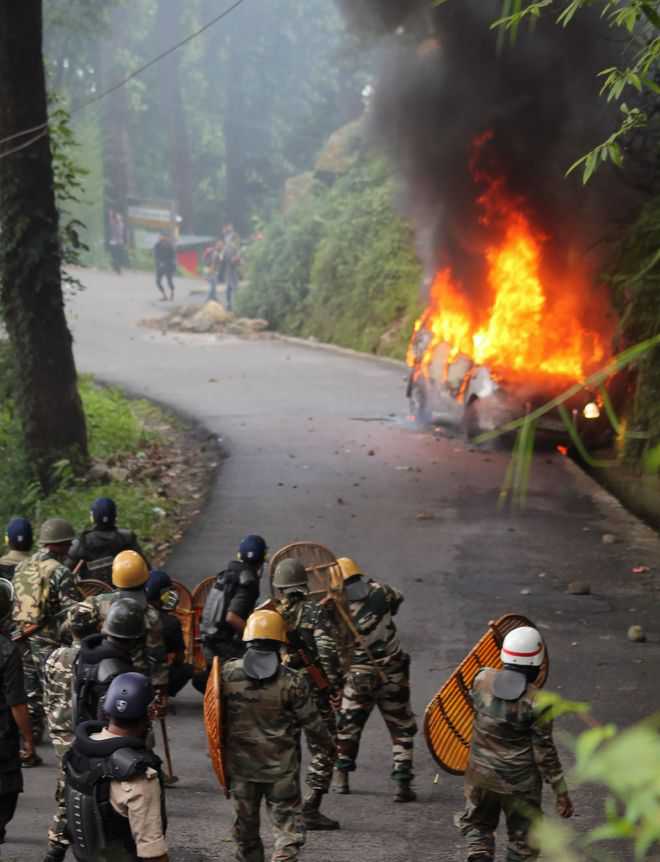


GJM activists turn violent as cops raid party chief’s house Several policemen injured | Vehicles, police outpost set on fire

GJM activists turn violent as cops raid party chief’s house
Cops stand near a burning car during clashes with GJM supporters in Darjeeling on Thursday. AFP

Darjeeling, June 15

The West Bengal hills saw widespread violence on Thursday as irate Gorkha Janmukti Morcha (GJM) supporters torched a police outpost and stoned security forces in angry reaction to a police raid on party chief Bimal Gurung’s house in Darjeeling.GJM activists, with their Nari Morcha in the vanguard, virtually surrounded the police force as they were returning after the raid on Gurung’s house in Patlebas, and started hurling stones at the police from elevated areas in the hills.Several policemen were injured in the stoning. In response, the security forces lobbed tear gas shells at the protesters after a baton charge failed to control the situation. Large police reinforcements arrived in the area. Some vehicles, including one belonging to a media house, were set on fire.In neighbouring Kalimpong district, alleged GJM supporters torched the Pedong police outpost. Accusing the state government of “high handedness and oppression”, GJM general secretary Roshan Giri appealed to the Central and state governments to intervene and sort out the “political problem”.“The GJM has not started the violence in the hills. The state government did. They are trying to suppress us using the police. To protest against the police high handedness, we are calling for an indefinite general strike in the hills,” Giri said.Terming the GJM’s call for complete shutdown illegal and a crusade against people, state Tourism Minister Gautam Deb vowed to stop the strike at any cost. — IANSCPI blames Mamata

  • The Communist Party of India on Thursday blamed West Bengal CM Mamata Banerjee for the ‘violent’ agitation for a separate Gorkhaland state, saying her ‘unnecessary promise’ earlier was the cause for the fresh round of protests
  • “Unnecessarily, Mamata Banerjee had given them some sort of hope on statehood earlier. That’s the reason it (the agitation) has again come up. Otherwise, during the Left Front government, this (agitation for separate Gorkhaland) was not violent, except for one time”, CPI general secretary S Sudhakar Reddy said


Pak army targets Nowshera, Bhimber Gali sectors

Pak army targets Nowshera, Bhimber Gali sectors
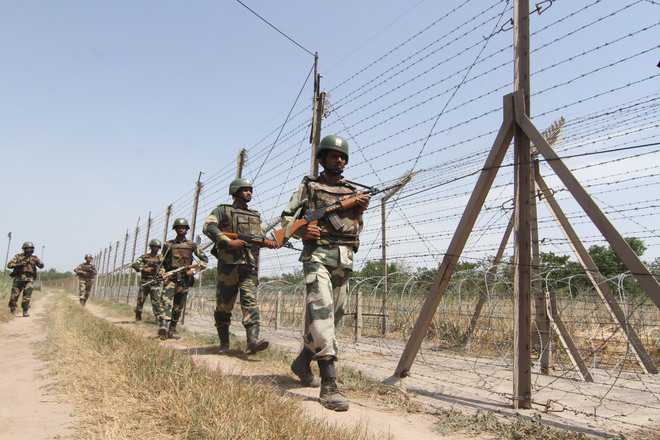
BSF personnel patrol the International Border on Wednesday.

Tribune News Service

Jammu, June 14

The Pakistani army again violated ceasefire along the Line of Control (LoC) in the Bhimber Gali and Nowshera sectors today. The Indian Army responded strongly and effectively.The defence PRO said at 5 am, the Pakistani army initiated indiscriminate firing from small arms, automatics and 82-mm mortars in the Bhimber Gali sector. The firing stopped at 5.45 am, he said.“Around 9.30 am, the Pakistani army violated the truce agreement in the Nowshera sector by firing with small arms, heavy automatics and recoilless rifles. The Indian Army also responded,” he said.The firing in the Nowshera sector stopped at 12.30 pm.


Hizb module busted, 4 arrested

Hizb module busted, 4 arrested
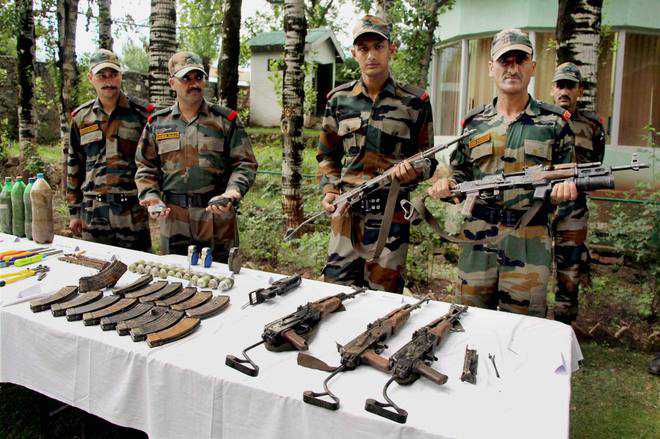
The Army displays arms recovered from the infiltrators killed in Uri Sector on Monday. PTI

Srinagar, June 12

The J&K Police on Monday claimed to have busted a Hizbul Mujahideen module by arresting two militants and two overground workers of the group.A police spokesman said two militants Mehrajudin and Obaid Shafi Malla, both residents of south Kashmir’s Awantipora sub-district, were arrested in Handwara in a joint operation.“On a specific information regarding movement of militants, a joint naka by the Handwara police and 21 Rashtriya Rifles was laid at Chogal, Handwara. Mehrajudin and Obaid Malla were caught while moving in suspicious circumstances. The duo was asked to stop but they started running away. The naka party immediately swung into action and caught them. On checking, a huge cache of arms and ammunition was recovered from them. During the investigation, they revealed that they had come to Handwara for receiving ammunition and other war-like stores for their militant outfit in south Kashmir,” the spokesman said.“They were misusing web chats to hatch and execute terrorist conspiracies,” he said. The preliminary investigation, the police said, revealed that these militants not only recruited youth by radicalising them over social media but also coordinated their training and arranged arms and ammunition.On their disclosure, two more members of the module working as overground workers were arrested from Awantipora.“They were identified as Shahid Ahmad Thoker and Irfan Ahmad both from Awantipora,” he said. — TNS

2 CRPF men injured

  • Srinagar: Two CRPF men were injured in a grenade attack in south Kashmir’s Tral sub-district. The grenade was lobbed by militants at 180 CRPF headquarters in Tral late this evening, a spokesman for the CRPF said. TNS

Search ops continue in Uri

  • The massive combing and search operation along the Line of Control in the Uri sector continued on Monday for the fourth consecutive day. The Army suspects two more militants are hiding in the dense forest area. TNS

Bussed out Systemic changes to transport policy should follow challans

Bussed out
Tribune file photo

A LARGE number of private buses that ply in Punjab do not have the requisite permission to do so. The first major drive by the Punjab Government to catch such offenders suggests a new and welcome seriousness in bringing back into the ambit of governance a sector that has hitherto operated largely outside of it. That many buses are run illegally on various lucrative routes has always been an open secret. It was confirmed when 27 per cent failed to produce proper documents during the drive. The ownership of most of the offending vehicles rests in political hands, either directly or indirectly.  Functionaries of the two main parties in the state hold most permits.  Political patronage has long been regarded a necessary condition for obtaining bus routes, and even after the change of guard, it would seem that SAD leaders continue to control a significant share. Decisions that favour private operators, too, are still in force. State transport bodies have been neglected and their buses are generally shunted to unremunerative routes. They are often portrayed as loss-making and precious little has been done to improve their fiscal health or modernise them. It is obvious that there is an urgent need to change such policies and come out with measures that allow genuine businessmen to compete in a level-playing field. The political hold over permits contributes significantly to the culture of corruption. To end this, the sector must be thrown open to ensure competition, and in turn provide both quality service and safety to passengers.  Special provisions may be made for ex-servicemen and unemployed youth to own and operate buses. The viability of app-based services and other unconventional mass transportation businesses should be examined. The Chief Minister has moved to fulfil a poll promise, but catching the obvious culprits in such a drive is just the beginning. Much more needs to be done, and for that, it is necessary to end the policy of patronage and usher in transparency in the sector that has for long been a cash cow for political operators.


Pakistan Tactical Nuclear Weapons: The Inevitability of Instability

Varun Sahni
Professor and Chairperson, CIPOD, SIS, JNU & Member, IPCS Executive Committee
Hatf IX (Nasr) is a Pakistani ballistic missile which can deliver a sub-kiloton nuclear warhead over a range of 60 km, or 37.3 miles. It is supposed to have entered service in 2013 and is believed to be fully integrated into Pakistan’s C3I (command, control, communications and intelligence). Its purported role is as a low-yield battlefield deterrent against mechanised columns. Should India – and the world – take Nasr seriously?
The development and deployment of Nasr by Pakistan was inevitable and  the impact of this tactical nuclear weapon (tac nuke) on the emerging India-Pakistan deterrence relationship is inherently destabilising.
Defining Tactical Nuclear Weapons: The Pakistani Context
There are four different yardsticks by which tac nukes could be defined and classified. The first is the range of the missile: it must be short range, that is less than 80-100 km. The second is yield of warhead, conventionally benchmarked at less than 5 kilotons (kT) with reference to a 1994 US Congressional definition prohibiting R&D in US nuclear weapons laboratories below this yield. The third is function – Pakistan would use its tactical nuclear weapons in an anti-armour role; bunker busting is the primary role envisaged by US proponents of research into low yield nuclear weapons. The fourth yardstick is impact, which in the case of tac nukes is limited to the immediate battlefield, or in other words, the sub-theatre.
Tactical Nuclear Weapons: Problem than a Solution?
Why are tac nukes usually seen as a problem rather than as a solution? In the first place, they lower the nuclear threshold by blurring the distinction between conventional and nuclear war. Secondly, tac nukes accentuate the ‘always-never dilemma’ inherent in all nuclear weapons: they must always work when you want them to, yet never be used when you do not want them to be used. The possibility of unauthorised or accidental use increases significantly with tac nukes: unlike ballistic missile submarines (SSBNs), whose commanders have delegative control, in the case of tac nukes delegative control may go down to subaltern/NCO levels under battlefield conditions. Thirdly, battlefield deployment of tac nukes, especially in situations of rapid armour movement, creates an enormous pressure to ‘use them or lose them’. Finally, there is a much greater possibility for tac nukes to fall into ‘wrong hands’ due to theft, pilferage or sabotage.
Given these problems, all of them well known for decades, why has Pakistan gone down the tac nuke route? In order to understand why, it is important to underline that Pakistan has, from even before South Asia’s overt nuclearisation, signalled a nuclear doctrine of not only first use but also early use. This doctrine has created problems for Pakistan, whose nuclear planners have had to grapple with the issue of nuclear thresholds, that is the point beyond which Pakistan would have no option but to use its nuclear weapons. As far back as 2002, the Landau Network–Centro Volta team (Cotta-Ramusino and Martellini) had identified four Pakistani thresholds: geographic (space threshold), military, political (domestic destabilisation) and even economic. Tac nukes are Pakistan’s solution to the military threshold.
Pakistan’s Tactical Nuclear Weapons: Here to Stay
There are three essential features of Pakistan that suggest that its tac nukes are here to stay. Firstly, as the weaker power in the India-Pakistan dyad, Pakistan faces significant conventional asymmetries. Only nuclear weapons provide Pakistan with a sense of strategic parity with India. Faced with the possibility of an Indian armoured thrust in the plains or desert sectors, Pakistan is signalling that it will use its tactical nuclear weapons despite their escalatory potential.
Secondly, Pakistan is a quintessential ‘homeland state’ with deep existential anxieties. Its entire national identity has been constructed as a homeland for an endangered people facing a historically implacable foe. No matter how many internal security challenges it faces, Pakistan will not drop its guard vis-à-vis India and will always give the external threat primacy. In such an identity construction, nuclear weapons give Pakistan and its people the assurance of national survival and civilizational certitude that they are second to none. Furthermore, they encapsulate the sense of ‘we will all go together when we go’ – akin to the Samson Option of that other nuclearised homeland state, Israel.
Finally, Pakistan is a revisionist power that has systematically pursued asymmetric strategies to overturn the territorial status quo. In this context, the nature of the ‘Kashmir issue’ comes into sharp focus. As a wise person once said of the Kashmir issue, ‘Kashmir is with India, the issue is with Pakistan.’ While admittedly a neat play on words, this observation identifies two core elements in the ‘shadow of the future’: (1) The Kashmir issue will be resolved only when Pakistan considers it resolved; (2) any change in the territorial status quo would be inimical to India. Pakistan’s dilemma is the nuclear weapons give it strategic parity but also buttress the territorial status quo. This explains why Pakistan has no compunction in deliberately shortening its nuclear fuse vis-à-vis India by deploying tac nukes.
An arms control agreement between India and Pakistan over tac nukes is unlikely: there is no incentive for Pakistan to remove a redline that begins at the international border (IB) itself. The strategic challenges that Pakistan’s tac nukes pose for India will be explored in a future column.

DCs empowered to provide relief to kin of martyrs

Tribune News Service

Chandigarh, June 6

The state government has decided to delegate the power to grant ex-gratia to Deputy Commissioners, Zila Sainik and Ardh Sainik Welfare Officers. The move aims at ensuring faster dispensation of financial relief to the bereaved families of martyrs.An official spokesperson said today that the power to sanction ex-gratia of Rs 50 lakh had been delegated to Deputy Commissioners so that there was no delay in the transit of documents from the district office to the Headquarters and vice-versa. He said it had been observed that often the defence and paramilitary authorities took time to issue necessary documentation in cases of death due to enemy action, terrorist encounters and IED blasts. The government has, therefore, decided to release the ex-gratia financial grant in cases of martyrdom which are widely reported in the media and where the facts are self-evident. In such cases, the government has decided not to wait for the issuance of documents from the military and paramilitary authorities and release the ex-gratia grant immediately.He said since November 2014, the state government had offered more than 120 jobs to the next of kin of martyrs in 2016-17 in the Group C and Group D categories.The government provides ex-gratia financial compensation of Rs 50 lakh to the bereaved families. This is the highest amount of ex-gratia for the families of martyrs in the country. The state offers the highest amount of financial assistance in the country to the families of the martyrs.He said: “Soldiers bravely defend our country from external aggression and ensure internal security so that we can live, work and sleep in peace.”Haryana is known for its contribution of personnel to the national defence and paramilitary forces. The number of ex-servicemen in the state is more than 2.83 lakh and their dependents’ number is about 8.75 lakh. Besides, there are 1,216 war widows, 85,121 widows and their 2,48,099 dependents. There are also 5,500 World War II ESM and widows. A large number of soldiers lay down their lives in the service of the nation at the borders, internal security duties, terrorist action and riots.


Chinese copters over Chamoli, IAF probing

Chinese copters over Chamoli, IAF probing
Photo for representational purpose only. iStock

New Delhi/Dehradun, June 4

Two Chinese helicopters were today seen hovering over the Indian airspace in Barahoti area of Chamoli in Garhwal, Uttarakhand, triggering concern in India’s security establishment. There have been three such incursions into the Indian airspace since March this year. Uttarakhand, during an internal security meeting in Delhi, had reported more than 30 incursions in the area between 2007-2012.Shepherds claimed to have spotted the helicopters at 9 am. The matter was brought to the notice of the revenue police, which hastened to inform ITBP officials. (Follow The Tribune on Facebook; and Twitter @thetribunechd)Official sources said the choppers, which returned to the Chinese side after about five minutes, could have carried out aerial photography of  ground troops during what was possibly a reconnaissance mission. The Indian Air Force is probing the incident.The choppers were identified as the Zhiba series of attack helicopters. On previous occasions, Chinese helicopters have entered 4.5 km into the Indian territory, an area China claims is its own and recognises as Wu-Je. Uttarakhand and Army officials have been reviewing security along the 350-km border with Tibet after China’s incursions into these areas, referred to as the middle sector.Barahoti is one of three border posts in this sector, comprising UP and HP besides Uttarakhand. Here, ITBP jawans are not allowed to carry weapons and are in civilian clothes.In 1958, India and China listed Barahoti, an 80-sq-km sloping pasture, as a disputed area where neither side would send troops. In the 1962 India-China war, the PLA did not enter the 545-km middle sector, focusing on the western (Ladakh) and eastern (Arunachal Pradesh) sectors.However, after the 1962 war, ITBP jawans began patrolling the area with weapons in a non-combative manner — barrel of the gun faced downward. In 2000, it was decided that ITBP troops would not carry arms to the three posts. — TNS & PT


Army school celebrates Founder’s Day

Tribune News Service

Chandigarh, June 2

Army Public School, Dagshai, celebrated its 31st Founder’s Day with a colourful cultural programme and exhibitions showcasing the talent and skills of students marking the occasion.Felicitating the students, their parents and school staff for all round improvement in performance, Brig RS Rawat, Commandant, 14 Gorkha Training Centre and the school’s chairman, said that training for National Defence Academy would be started in the school for boys so that more students can join the armed forces.Principal Dr SK Mishra highlighted the achievements of the school in academic, sports and extra-curricular activities. The school had been adjudged as the best Army school in the Western Command, the 3rd best school in Himachal Pradesh and the 3rd in value for money and sports education in India.


Manali-Leh road to open on June 8

Manali-Leh road to open on June 8
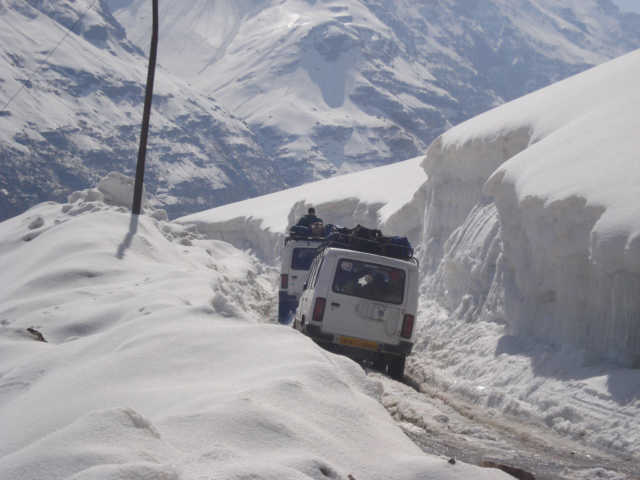
The Manali-Leh highway

MC Thakur

MANALI, JUNE 2

The 475-km-long strategically important Manali-Leh highway will be thrown open for traffic on June 8, BRO officials said here today.The officials said they had cleared snow from the 222-km Manali-Sarchu section and now they are engaged in widening and maintenance of the road. They had cleared snow from the entire stretch on May last, but as the surface condition at many stretches was not good it took time before it could be declared open.The officials said the road would be thrown open for all vehicular traffic on June 8. Snow-clearing from 13,050 ft high Rohtang Pass and (4,883 m) high Baralacha La posed the toughest challenge. “Avalanches and landslides posed threat to those engaged in snow-clearing work and machinery. Still, we succeeded in clearing snow without any harm to our men and machines”, official said.The Manali-Leh highway winds its way through the 13,050-ft-high Rohtang Pass, Baralacha pass (4,883 m), Lachlungla (5,065 m) and Tanglangla (5,359 m). Project Himank of the BRO has already cleared snow between Leh and Sarchu. This year the passes and most stretch of Manali-Leh highway had received more snow as compared to the previous three-four years.The Manali-Leh highway has extreme strategic importance. It is the lone lifeline of the local residents of Leh- Ladakh. With challenging curves, high-mountain passes and scenic view the road is very popular among tourists.Rohtang Pass, 51 km from here, was officially thrown open for vehicles on April 28.