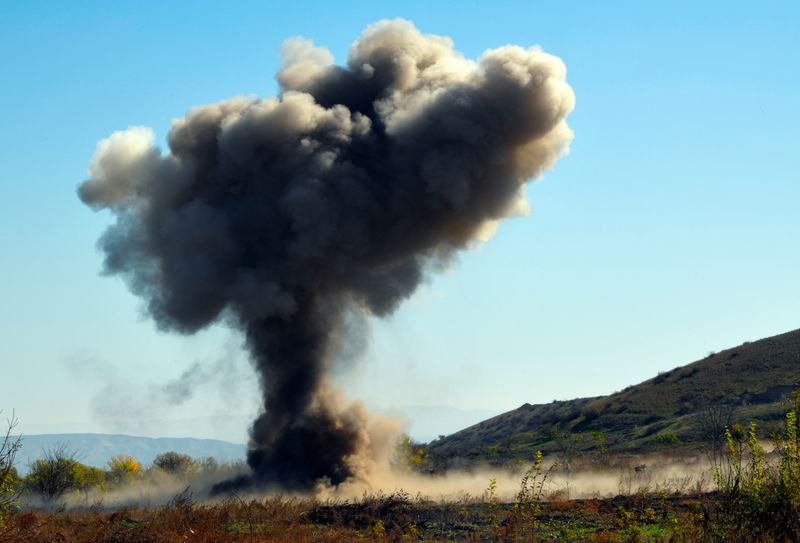
Kabul says it targeted Pakistani military posts, killing 58 soldiers in retaliation for what it called violations of Afghan airspace
People carry a Pakistani flag-draped coffin of soldier Aslam Jadran, who died following the overnight border clashes between Pakistan and Afghanistan, during a funeral in Kurram, a tribal district of Khyber Pakhtunkhwa province in Pakistan. Reuters Phot
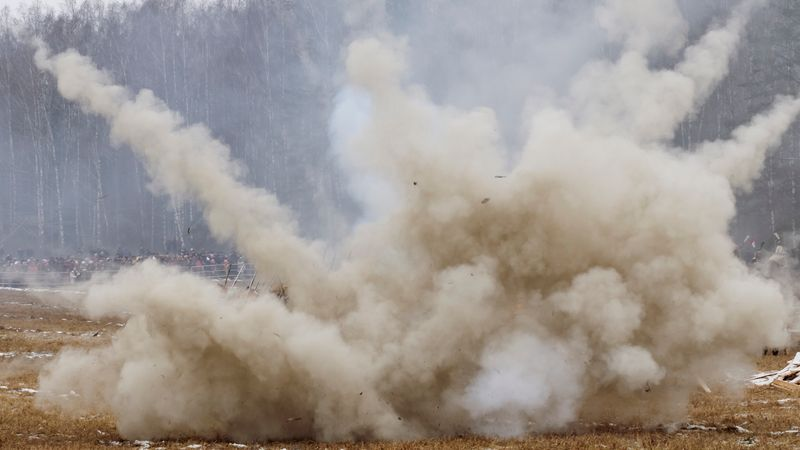
Clashes erupted on Tuesday between Pakistani and Afghan forces in a remote northwestern border region, with state-run media in Pakistan accusing Afghan troops of opening “unprovoked fire” that was repulsed.
Pakistani forces responded, damaging Afghan tanks and military posts, according to Pakistan TV and two security officials, who spoke on the condition of anonymity because they were not authorised to speak to the media.
Tahir Ahrar, a deputy police spokesperson in Afghanistan’s Khost province, confirmed the clashes but provided no further details.
This is the second time this week that the two sides have traded fire along their long border.
According to Pakistan’s state-run media, Afghan forces and the Pakistani Taliban jointly opened fire at a Pakistani post “without provocation”, prompting what the media described as a “strong response” from Pakistani troops in Kurram, a district in Khyber Pakhtunkhwa province.
Security officials said Pakistan’s military also destroyed a sprawling training facility of the Pakistani Taliban.
There was no immediate comment from Pakistan’s military, which has been on high alert since Saturday, when both sides traded fire across multiple border regions, resulting in dozens of casualties on each side.
Although the clashes halted on Sunday after appeals from Saudi Arabia and Qatar, all border crossings between Pakistan and Afghanistan have remained closed.
Over the weekend, Kabul said that it targeted several Pakistani military posts and killed 58 Pakistani soldiers in retaliation for what it called repeated violations of Afghan territory and airspace. Pakistan’s military reported lower figures, saying it lost 23 soldiers and killed more than 200 “Taliban and affiliated terrorists” in retaliatory fire along the frontier.
Tensions have remained high since last week, when the Taliban government accused Pakistan of carrying out airstrikes in Kabul and in an eastern market. Pakistan has not acknowledged those allegations.
But Pakistan has previously launched strikes inside Afghanistan, saying it targets hideouts of Tehreek-e-Taliban Pakistan, or TTP, which is separate from but allied to the Afghan Taliban.
Pakistan accuses Kabul of harbouring the group, which has carried out numerous deadly attacks inside Pakistan. Kabul denies the charge, saying it does not allow its territory to be used against other countries.
US-India expert Ashley Tellis arrested for retaining secret documents, links to China
The Justice Department said Tellis faces up to 10 years in prison and a fine of up to $250,000 if convicted
A leading expert on US-India relations who has advised successive US administrations has been arrested and charged with unlawful retention of national defence information, including over a thousand pages of top secret and secret documents at his home, court documents showed.
Ashley Tellis, 64, who served on the National Security Council of former Republican President George W Bush and is listed in an FBI court affidavit as an unpaid adviser to the State Department and a Pentagon contractor, was arrested on the weekend and charged on Monday, the documents seen on Tuesday showed.
Tellis is also a senior fellow at the Carnegie Endowment for International Peace, a Washington think tank.
A State Department official confirmed that Tellis was arrested on Saturday, but declined to comment further. A Pentagon official said it does not comment on ongoing litigation.
Carnegie did not immediately respond and Tellis could not immediately be reached. His lawyer was not listed in the court documents and was not immediately known.
Trump administration officials, including Director of National Intelligence Tulsi Gabbard, have vowed to prosecute individuals who mishandle classified information.
The FBI affidavit accompanying the charge document said that in September and October this year Tellis entered Defence and State Department buildings and was observed accessing and printing classified documents, including about military aircraft capabilities, and leaving by car with a leather briefcase or bag.
The affidavit said a search of Tellis’ residence in Vienna, Virginia, on Saturday uncovered over a thousand pages of classified documents with top secret and secret markings.
The affidavit also said Tellis had met Chinese government officials on multiple occasions over the past several years. The meetings included a September 15 dinner at a restaurant in Fairfax, Virginia, at which it said Tellis arrived with a manila envelope, which he did not appear to have when he left.
The affidavit said that due to his employment with the State Department and Pentagon, Tellis possessed a top secret security clearance with access to Sensitive Compartmented Information.
A Justice Department statement said that if convicted, Tellis faces up to 10 years in prison and a fine of up to $250,000.
“We are fully focused on protecting the American people from all threats, foreign and domestic,” said Lindsey Halligan, US attorney for the Eastern District of Virginia. “The charges as alleged in this case represent a grave risk to the safety and security of our citizens.”
Why Group Captain Nachiketa has ‘immense respect’ for a Pakistani Captain
Lieutenant General Manoj Kumar Katiyar Reviews Operational Preparedness of Rising Star Corps Western Command Chief Commends Professionalism and Innovation, Urges Troops to Stay Future-Ready
15 Pak Soldiers Killed As Taliban Hits Back Hard After Kabul Airstrikes
Soldiers killed, posts captured: Why Afghanistan, Pakistan are clashing at the border
Heightened vigil at LoC ahead of winter to curb infiltration of terrorists
Nation never had ‘clear-cut policy’ to deal with J&K challenges: Dulat
SC upholds Armed Forces Tribunal’s decision to substitute General Court Martial’s finding
Northern Command GoC reviews operational preparedness in Rajouri
Rajbeer Kaur becomes first turbaned woman to join Canadian police
Army officers messed up Operation Bluestar due to poor planning: Mani Shankar Aiyar
Trump warns Russia he may send Ukraine long-range Tomahawks if Moscow doesn’t settle war soon
‘Gaza war over’: Trump declares as Israel, Hamas set for hostage, prisoner exchanges
Latest contribution List as on 11 Sep 2025
‘Op Bluestar was a mistake, Indira Gandhi paid with her life’: Chidambaram
BSF air wing gets first woman flight engineer in over 50 years
Dramatic video: Helicopter spirals out of control, crashes into palm trees at California beach; 5 injured
Why Group Captain Nachiketa has ‘immense respect’ for a Pakistani Captain
In ‘Wings of Valour’, Swapnil Pandey brings to life the extraordinary journeys of fighter pilots, veterans, and Kargil heroes.
After the briefing, everyone hurried to prepare for the mission. Nachiketa, dressed in a green G-suit over his blue overalls, meticulously adjusted his gear in the squadron’s dressing room. His green jacket shielded him from the chill, and his standard-issue pistol was checked and securely holstered. The pouches on his G-suit held essential manuals, navigation maps and communication frequencies.
The mission briefing was thorough. Each pilot knew their role, the direction of attack, altitude and initial point. Communication was to be restricted to avoid enemy interception. The sequence was precise: Boxer-1 flown by Flight Lieutenant Anupam Banerjee and Boxer-2 by Flight Lieutenant Bhupendra Khatana would first deploy bombs, followed by Hyena-1 by Squadron Leader Ashwini Madokhot and Hyena-2 by Flight Lieutenant K. Nachiketa dropping rockets—the rockets were for targeted strikes, while the bombs would inflict widespread damage.
The aircraft were parked in blast pens for protection. Nachiketa climbed the ladder into his MiG-27, focused and eager. He fastened his seat harness and connected the pneumatic hose of his G-suit to the cockpit port. A technician removed the ladder, and Nachiketa closed the cockpit canopy. After a quick system check, he lowered his helmet visor and signalled that he was ready.
The engines roared to life as the pilots taxied out from the blast pen to the runway. The formation took off as a tight unit, with Nachiketa the last to leave, marking the start of Day 2 of Operation Safed Sagar.
The sky was clear as they flew in formation, weaving through hills to avoid enemy radar. Cruising at 26,000 feet and at around 1,000 kilometres per hour, the fighters approached the initial point, the landscape shifting from mountains to the target area.
Boxer-1 initiated his dive and released his bombs, followed by Boxer-2. The explosions created a dense plume of smoke, obscuring Hyena-1’s view. Unable to see the target clearly, Hyena-1 refrained from dropping his rockets.
As Nachiketa—Hyena-2—approached, the smoke began to clear. He completed his dive and released his rockets with precision. It was followed by gun attack but as he pulled out, disaster struck—the engine sputtered and then fell silent. Temperature and RPM13 dropped rapidly, and airspeed decreased. Nachiketa knew he had to act swiftly. He jettisoned the drop tank to reduce drag, hoping to buy a few precious moments.
He quickly radioed Hyena-1:
‘Mando, Nachi engine flame out! Relighting!’ He began the restart procedure.
The engine sputtered back to partial life, but with the hills approaching rapidly and only thirty to forty seconds to spare, Nachiketa knew he had no choice but to eject.
He informed his wingman, ‘Mando, Nachi ejecting,’ and pulled the ejection handle.
The ejection system activated swiftly: The cockpit canopy blew off and the seat was propelled out of the cockpit by a high-speed cartridge. A small drogue parachute deployed first to stabilize the seat, followed by the main parachute. Everything happened in a matter of seconds.
The ejection subjected him to extreme G-forces,14 causing him to experience a grey-out, where vision blurs and consciousness fades. Though the G-suit helped, it was less effective outside the craft. The descent was swift, landing him on a snow-covered, icy landscape.
As he touched down, he saw his aircraft’s wreckage nearby.
Despite the intense pain in his spine from the impact of landing, his survival instincts kicked in. He buried classified documents in the snow to prevent enemy access and dashed across the terrain, seeking cover among nearby boulders.
Suddenly, five figures emerged from the direction of a nearby river. Armed with AK-47s, they advanced, firing at Nachiketa. He fired back with his pistol, but it felt futile.
Group Captain Nachiketa (veteran) chuckled as he reflected:
You know, up in the air, fighter pilots feel invincible. Flying a 20,000 kg aircraft at lightning speed, you can cross from one corner of the earth to another in seconds. We’re the warriors of the sky, untouchable and powerful. But then, imagine the sudden shift when you come out of that comfort zone and feel utterly vulnerable. Up there, I was the king of the skies, but on the ground, I was just a mortal. Everything seemed immense and overwhelming. The severe back pain from the rough landing was a sharp reminder of my vulnerability. The sound of gunfire jolted me into action. I scrambled to find cover, drawing my small pistol and loading it as I took refuge behind a nearby boulder, firing back in desperation.
As his first magazine emptied, he reached for a second, but before he could reload, the enemy closed in and began to beat him mercilessly. As Nachiketa lay on the snow-covered ground, the tension peaked when one of the soldiers pressed the cold barrel of an AK-47 into his mouth, the finger poised on the trigger.
Just as it seemed his fate was sealed, A Pakistani Officer arrived and intervened.
The soldiers were angry. One shouted, ‘We’re not letting him go. He was dropping bombs from above and firing at us from below.’ With authoritative calm, the officer replied, ‘It’s all right. He was doing his duty. Now he is our captive.’
Nachiketa recalled:
That day, death came close to me twice. First, when my aircraft crashed and I had to eject. Second, when the soldiers were about to shoot me, and that officer arrived just in time. Had he been even a moment late or given the order to kill, I would have been dead. I have immense respect for that officer, Captain Qamar of the 5th Northern Light Infantry.
Severely injured and blindfolded, Nachiketa was herded downhill by the Pakistani men—the officer and five soldiers. As they descended, one soldier asked if there were any other pilots with him, possibly mistaking the drogue parachute as belonging to a second person. Nachiketa seized the opportunity to mislead them, replying, ‘Yes, there was another pilot.’
Unfamiliar with aircraft systems and focused on finding the supposed second pilot, the soldiers did not question him further.
Lieutenant General Manoj Kumar Katiyar Reviews Operational Preparedness of Rising Star Corps Western Command Chief Commends Professionalism and Innovation, Urges Troops to Stay Future-Ready.
SBCrack Last updated: October 11, 2025 Share Lieutenant General Manoj Kumar Katiyar, PVSM, UYSM, AVSM, General Officer Commanding-in-Chief, Western Command, reviewed the operational preparedness and technological advancements of the Rising Star Corps during his visit. The review focused on assessing combat readiness, modernization efforts, and integration of advanced technologies within operational frameworks. The Army Commander was briefed on various innovative initiatives undertaken by the formations to enhance operational efficiency, surveillance, and situational awareness. He lauded the professionalism, dedication, and forward-thinking approach demonstrated by all ranks of the Rising Star Corps, emphasizing the importance of continuous innovation to stay ahead in modern warfare. During his address, Lt Gen Katiyar highlighted the critical role of Western Command in safeguarding the nation’s borders and maintaining high levels of readiness in dynamic security scenarios. He urged troops to remain agile, focused, and technologically adept to meet emerging challenges.
More Read India-Australia Joint Military Exercise ‘AUSTRAHIND 2025’ Begins in Perth DAC Approves ₹5,150 Crore ‘Dharashakti’ Electronic Warfare System to Boost Army’s Signal Superiority Viral Photo of Army Veteran’s Car Blends Humor and Pride, Wins Hearts Online The visit underscored the Indian Army’s ongoing emphasis on leveraging technology-driven warfare capabilities, fostering innovation at the grassroots level, and ensuring seamless operational coordination across commands to maintain a decisive edge in future conflicts.
Afghanistan has accused Pakistan of carrying out airstrikes in its territory
Summary is AI-generated, newsroom-reviewed
New Delhi:
Fifteen Pakistani soldiers have been killed in Afghanistan’s Helmand province after the Taliban forces retaliated to Pakistani airstrikes in Afghan territory, including the capital Kabul.
Mawlawi Mohammad Qasim Riaz, spokesperson for the Helmand provincial government, told the media that 15 Pakistani soldiers were killed during last night’s retaliatory operations by Afghan forces near the Durand Line in Bahrampur district. He said Afghan forces also captured three Pakistani military outposts during this operation and seized weapons and ammunition.
Hitting back after Pakistan’s recent airstrikes in Kabul and Paktika provinces, Afghan forces have started targeting Pakistani posts in the provinces of Helmand, Kandahar, Zabul, Paktika, Paktia, Khost, Nangarhar, and Kunar. All these provinces are located along the Pakistan-Afghanistan border.
Airstrikes, Then Reprisal
Three explosions were reported in Afghanistan on Thursday — two in Kabul and one in the southeastern Paktika. The Taliban-run defence ministry blamed Islamabad and accused it of violating its sovereignty.https://d-1579846705777063156.ampproject.net/2509031727000/frame.html
“In retaliation for air strikes carried out by the Pakistani army on Kabul, Taliban forces are engaged in heavy clashes against Pakistani security forces in various areas” along the border, the Afghan military said in a statement.
Later, defence ministry spokesman Enayat Khowarazm told news agency AFP that the “successful” operations had ended at midnight. “If the opposing side violates Afghanistan’s territory again, our armed forces are ready to defend their territory and will respond firmly.”
Islamabad did not confirm it was behind Thursday’s attacks, but it called on Kabul “to stop harbouring the Pakistani Taliban on its soil.”
Tehrik-i-Taliban Pakistan
Also known as the Pakistani Taliban, the Tehrik-i-Taliban Pakistan is an ideological ally of the Afghan Taliban and assisted it during the 2001-2021 conflict.
Islamabad has accused the Tehrik-i-Taliban Pakistan of having killed hundreds of its soldiers since 2021. “This evening, Taliban forces began using weapons. We fired first light and then heavy artillery at four points along the border,” a senior official in Pakistan’s Khyber-Pakhtunkhwa province, bordering Afghanistan, told AFP.
“Pakistani forces responded with heavy fire and shot down three Afghan quadcopters suspected of carrying explosives. Intense fighting continues, but so far, no casualties have been reported,” he continued.
According to an AFP report, TTP militants have intensified their campaign of violence against Pakistani security forces in the mountainous areas bordering Afghanistan in recent months.
Islamabad alleged that Afghanistan has failed to expel militants using its territory to launch attacks on Pakistan, a charge denied by Kabul.
Pakistan’s Warning
Earlier this year, a UN report said the TTP “receive substantial logistical and operational support from the de facto authorities”, an apparent reference to the Taliban government in Kabul.
Pakistan’s Defence Minister Khawaja Muhammad Asif told its National Assembly last week that efforts to convince the Afghan Taliban to stop backing the TTP had failed. “We will no longer tolerate this. United, we must respond to those facilitating them, whether the hideouts are on our soil or Afghan soil,” he said. On Saturday, the TTP claimed responsibility for deadly attacks in northwest Pakistan that left 20 security officials and three civilians dead, news agency AFP reported.

What Taliban Minister Told NDTV When Asked About Pak-Afghan Clashes
Mawlawi Mohammad Qasim Riaz, spokesperson for the Helmand provincial government, told the media that 15 Pakistani soldiers were killed during last night’s retaliatory operations by Afghan forces
Soldiers killed, posts captured: Why Afghanistan, Pakistan are clashing at the border
Tensions between Pakistan and Afghanistan escalated into deadly clashes along their border over the weekend. Taliban claimed that its forces killed 58 Pakistani soldiers in overnight operations, following what it described as repeated violations of its territory and airspace by Islamabad.
Pakistan-Afghanistan border clash: Kabul forces report 58 casualties on Islamabad side, 25 post seized(File Photo/AFP)
Speaking at a press conference, Afghan government spokesperson Zabihullah Mujahid said Afghan forces had captured 25 Pakistani army posts, with “58 soldiers killed” and 30 others wounded, reported the Associated Press.
The exchange of fire dealt a big blow to both sides, significantly more to Pakistan, as per the Taliban. Mujahid said nine Afghan soldiers were killed during the clashes on Saturday, adding that the military action sparked by a blast on Afghan soil was halted at midnight after diplomatic intervention from Qatar and Saudi Arabia.
The attack that started it all
Afghan authorities say the latest flare-up came after two strikes earlier in the week, which they attribute to Pakistan. The first blast hit before 10 PM on Thursday in Kabul’s Abdul Haq Square, close to several ministries and the national intelligence agency, while the second occurred in the eastern province of Paktika.
The Afghan statement described the pair of strikes as “unprecedented, violent and heinous,” and warned that the Pakistani army would face consequences if the situation worsened.
However, the Afghan ministry did not supply details about the alleged targets, on what the source of the bombing was or how the strikes were carried out so deep in the territory without being intercepted.
Notably, Pakistan has a history of carrying out cross‑border strikes into Afghanistan to target alleged militant hideouts; Islamabad claims Afghanistan-based militants conduct attacks inside Pakistan and that it must act to protect its people, a charge Afghan officials deny.
The alleged strikes come as the Taliban make their first diplomatic visit to India since returning to power in 2021. Experts say closer ties between India and Afghanistan could be viewed with suspicion in Islamabad, which is concerned about potential destabilising effects on Pakistan’s western borders.
Pakistan’s ‘no compromise’ response to strikes
Pakistan’s government condemned what it called “provocations by Afghanistan” along the border and said it would respond to any threat to its defence.
A senior Pakistani security official (speaking on condition of anonymity) told AP that Afghan forces opened fire in multiple northwestern border districts in Pakistan’s Khyber Pakhtunkhwa province – including Chitral, Bajaur, Mohmand, Angoor Adda and Kurram.
He further added that Pakistani troops returned fire with heavy weaponry near Tirah and across the frontier in Afghanistan’s Nangarhar province.
At a news conference, Pakistani army spokesman Ahmad Sharif was asked whether the military had carried out strikes inside Afghanistan to target leaders of the banned Pakistani Taliban group but he did not present a direct answer rather said that “nevessary measures” to safegaurd Pakistani people “will be taken.”
Pak-Afghanistan border crossings closed
Fierce clashes prompted closures at major border crossings. Torkham, one of two principal trade routes between the countries, did not open at its usual time of 8 AM on Sunday, and officials said both Torkham and Chaman crossings were shut after overnight fighting, reported news agency AFP.
The closures disrupt trade and movement for communities on both sides of the border.
Pakistan and Afghanistan share a 2,611-kilometre (1,622‑mile) frontier, commonly referred to as the Durand Line; Afghanistan has never formally recognised it.
Relations have been tense since the Taliban returned to power in Kabul in 2021. Islamabad accuses Kabul of sheltering militants who carry out attacks in Pakistan, an assertion Afghan authorities reject.
Heightened vigil at LoC ahead of winter to curb infiltration of terrorists
Intelligence inputs suggest that terrorists are waiting at various launch pads across the border to infiltrate into the Valley
The BSF has heightened its vigil along the Line of Control (LoC) in Kashmir ahead of the winter as there is a possibility of increased infiltration attempts from across the border, a senior officer said on Sunday.
Intelligence inputs suggest that terrorists are waiting at various launch pads across the border to infiltrate into the valley, the Border Security Force (BSF) officer said.

“Generally, it has been seen that there are increased attempts of infiltration before the winters. Keeping that in mind, we have put our jawans and officers on alert and have heightened our vigilance on the border,” Additional Director General of BSF, Satish S Khandare told reporters on the sidelines of Wular 2.0 Marathon in north Kashmir’s Bandipora district.
“It is difficult to give an exact number, but the reports we have is that our neighbouring country is making some launchpads across the border,” he added.
The BSF officer said the danger of terrorists infiltrating into our country from across always remains, but the BSF and the Army is alert and prepared on the border to deal with the situation and thwart such attempts. “We are fulfilling our responsibilities very well,” he said.

Scores of participants, including youth and women, took part in the three race categories—5 km, 10 km, and 21 km of the marathon.
“This is the second edition of the marathon. The BSF conducted the marathon last year as well. This is a part of our efforts to have good relations with the people living near the LoC and border,” the BSF ADG said.

Nation never had ‘clear-cut policy’ to deal with J&K challenges: Dulat
Must engage with Pak for lasting peace, says ex-RAW chief
Jammu and Kashmir was the focus of discussion on the second day of the Khushwant Singh Litfest here today during various sessions delving into diverse cultural issues. Former RAW chief AS Dulat’s latest book, “The Spy Chronicles”, was deliberated upon at a session. Jyoti Malhotra, Editor-in-Chief, The Tribune, and Dulat categorically stated that the nation never had a clear-cut policy or vision to address the challenges that Jammu and Kashmir presented in the past few decades.
Dulat said reposing faith in the Abdullah family after showing the door to Maharaja Hari Singh was always fraught with challenges. “There have been so many turning points down the line but Delhi could never take Jammu and Kashmir into its fold. Peace in Jammu and Kashmir will not be permanent unless we engage with Pakistan,” he added.


At another session, a discussion on journalist Harinder Baweja’s book, “Inking a memoir”, was held. There was an emphatic narrative that Jammu and Kashmir’s “Dil Ki Doori” must not become “Dilli Se Doori”. In conversation with former Union Home Minister P Chidambaram, Baweja minced no words while saying that the seemingly high number of tourists in Jammu and Kashmir would always be a superficial expression of peace. She added that initiatives like Operation Sindoor would not resolve the problem.
Baweja emphasisied that there was no need to demonise Kashmiris because a big section of the population knows that it was being used by the Pakistan forces to put Jammu and Kashmir on the boil. She termed the Tiranga Yatra across Jammu and Kashmir in recent times as a telling statement that spoke volumes about the national mindset of people.
A session on “Harvesting hope through science and service” delved into MS Swaminathan’s life as viewed by author Priyamvadha Jayakumar, who has penned book, “The Man Who Fed India”. Swaminathan, acclaimed as the father of the green revolution, abandoned his medical career midway to become an agriculture scientist after seeing the devastating Bengal famine that killed millions. “This was like a clarion call to him, prompting him to leave his two-year medical career and take up agriculture. The agriculture warrior acclaimed globally transformed the destiny of India by playing a pivotal role in ending food insecurity,” said the young writer, who laid bare rare insights into his life.
“Though there are several books on Swaminathan, none looks at him from the point of view of an agriculture scientist,” she said while dwelling on what prompted her to pen this book. Asked about the failure of the successive governments to confer Bharat Ratna upon Swaminathan, she said that conferring the highest award was a political decision and the Narendra Modi government did it before the 2024 elections. On being denied the honour for so long, she said, “It didn’t make a difference to Swaminathan, as for whom genuine love of farmers was all that mattered.”
The failure to constitute a national commission for farmers, as professed by Swaminathan, also found expression in her book. Priyamvadha admitted that some ideas remain on paper and it was due to lack of political will that the panel could not take shape.
Noted writer and columnist Shobha reflected on how no one wanted to talk about the intimate side of relationships while recalling her association with Khushwant Singh, whom she had worked with in her career as a journalist. That scenario, however, has changed though she termed today’s young generation as self-absorbed and too much into themselves. She also vouched for the re-release of Rekha’s “Umrao Jan” while averring that the latest flick “Saiyaara” has bought the younger generation back to the power of romantic love and passion. She also termed another flick “Man Marziya” as incredible.
SC upholds Armed Forces Tribunal’s decision to substitute General Court Martial’s finding
The top court rejects Commandant SK Jain’s appeal against AFT’s order, holding that Tribunal’s decision to substitute the GCM’s view was proportionate and did not warrant any interference
The Armed Forces Tribunal (AFT) is empowered under the Armed Forces Tribunal Act, 2007, to substitute the findings of a General Court Martial (GCM) if the findings are excessive, illegal or unjust, the Supreme Court has ruled.
“Thus, under Section 15(6) (a) & (b) of the 2007 Act, the Tribunal (AFT) is empowered to substitute the finding of (General) Court Martial which includes the disciplinary proceedings under the Act and also to interfere with the sentence if the same is found to be excessive, illegal or unjust and to mitigate the punishment awarded,” A Bench of Justice JB Pardiwala and Justice Alok Aradhe said.
The Bench upheld the AFT’s decision to set aside a GCM’s order to dismiss SK Jain—a Commandant of the Northern Command Vehicle Depot, Udhampur—for corruption, illegal possession of ammunition, and unexplained cash holdings and substitute it with compulsory retirement with pensionary benefits.
A GCM held the appellant Commandant guilty on these charges and sentenced him to dismissal from service in 2009.
The AFT acquitted him of corruption in 2012 on the ground that the evidence of bribery was insufficient. It also set aside his conviction under the Arms Act.
However, invoking its statutory powers, the AFT convicted him under Section 63 of the Army Act, saying his conduct amounted to “an act prejudicial to good order and military discipline’ and reduced his punishment from dismissal to compulsory retirement with pensionary benefits.
The top court rejected Jain’s appeal against the AFT’s order, holding that the AFT’s decision to substitute the GCM’s view was proportionate and did not warrant any interference.
Writing the judgment for the Bench, Justice Aradhe said, “The Tribunal has exercised its discretion under Section 15(6) of the 2007 Act in a manner which is both just and proportionate, balancing the disciplinary needs of service with fairness to the individual. The Tribunal has acted strictly within the statutory framework. The aforesaid exercise of discretion, therefore, does not call for any interference in this appeal. The Tribunal did not commit any error in rejecting the petition for review filed by the appellant.”
Noting that Section 15(6) of the 2007 Act empowered the AFT to substitute the finding of GCM and awarding a sentence afresh, the top court said, “In the instant case, the Tribunal in exercise of its power under Section 15(6) of 2007 Act, on the established fact of recovery of ammunition from the possession of the appellant, has taken a lenient view in favour of the appellant and has modified the punishment from dismissal to compulsory retirement with all pensionary and retiral benefits.”
State Stalwarts
DEFENCE MINISTER
Minister Rajnath Singh
ALL HUMANS ARE ONE CREATED BY GOD
HINDUS,MUSLIMS,SIKHS.ISAI SAB HAI BHAI BHAI
CHIEF PATRON ALL INDIA SANJHA MORCHA
LT GEN JASBIR SINGH DHALIWAL, DOGRA
SENIOR PATRON ALL INDIA SANJHA MORCHA
MAJOR GEN HARVIJAY SINGH, SENA MEDAL ,corps of signals
.
.
PATRON ALL INDIA SANJHA MORCHA
MAJ GEN RAMINDER GURAYA ,MADRAS REGIMENT
sanjhamorcha303@gmail.com
PRESIDENT SOUTH ALL INDIA SANJHA MORCHA
COL SS RAJAN BOMBAY SAPPERS,
PRESIDENT UTTARAKHAND ALL INDIA SANJHA MORCHA
COL B M THAPA ,BENGAL SAPPERSS
PRESIDENT HARAYANA STATE CUM COORDINATOR ESM
BRIG DALJIT THUKRAL ,BENGAL SAPPERS
PRESIDENT TRICITY
COL B S BRAR (BHUPI BRAR)
PRESIDENT CHANDIGARH ZONE
COL SHANJIT SINGH BHULLAR
.
.
PRESIDENT PANCHKULA ZONE AND ZIRAKPUR
COL SWARAN SINGH
INDIAN DEFENCE FORCES
DEFENCE FORCES INTEGRATED LOGO
INDIAN AIR FORCE
Air Officer C-in-C WESTERN AIR COMMAND
AIR MSHL S PRABHAKARAN AVSM VM
AOC-IN-C, EASTERN AIR COMMAND
Air Marshal Inderpal Singh Walia
AOC-in-C SOUTH WESTERN AIR COMMAND
Air Marshal Vikram Singh
AOC-IN-C, SOUTHERN AIR COMMAND
Air Marshal J.Chalapati
AOC-IN-C TRAINING COMMAND
AIR MARSHAL SK GHOTIA VSM
AOC-IN-C MAINTENANCE COMMAND
Air Marshal Jagdish Chandra
Flag Officer Commanding in Chief, Western Naval Command
ice Admiral R Hari Kumar, PVSM, AVSM, VSM
Flag Officer Commanding in Chief, Eastern Naval Command
Vice Admiral Sanjay Bhalla, AVSM, NM
Flag Officer Commanding in Chief, Southern Naval Command