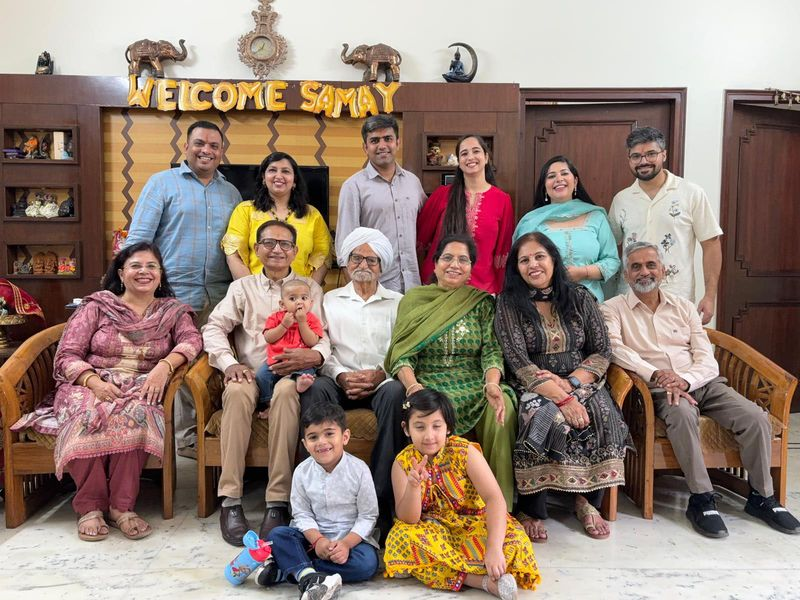
Kundan Singh Madaan was born on July 1, 1926, in Kasur tehsil of Lahore district, now in Pakistan, and was among the millions displaced during Partition in 1947
As the country celebrates its 80th Independence Day today, 100-year-old Kundan Singh Madaan still remembers the home and two grocery shops he left behind in Lahore at the age of 19, believing he would return within a week after the violence subsided. That week, however, stretched into eight decades, and Madaan, now living in Jalandhar, never returned to the home he left behind during Partition.
Madaan was born on July 1, 1926, in Kasur tehsil of Lahore district, now in Pakistan, and was among the millions displaced during Partition in 1947. Recalling the horrors of Partition, Madaan said his family owned a house and two grocery shops in a Muslim locality in Kasur tehsil, where he grew up with his eight siblings. Although there were only a few Hindu households in the Muslim-dominated area, he said the families shared cordial relations and lived in harmony.
That changed about a week before Independence, when riots broke out and his family decided to move to a relative’s house in India. A Muslim neighbour advised them to leave quickly as violence gripped the region. “Our family, along with cattle and a few belongings, decided to move to a relative’s house in a nearby village on August 14, 1947. We expected to return within a week. However, the next day, after the announcement of Independence, we realised that the area was now part of Pakistan,” Madaan recalled.
Leaving everything behind, the family of around 15 members migrated barefoot to Rajiyan village in Barnala. They stayed at a relative’s house, where they were provided clothes, food and shelter. After eight days, however, they could not stay there any longer and moved to a nearby village abandoned by Muslims who had migrated to Pakistan. There, the family lived in an abandoned kutcha house.
To support his family, Madaan rented a cart and began selling soaps and soda. For three months, the family took up odd jobs to survive. It was only in November that his maternal relatives contacted them, following which they decided to move to Ferozepur, where the relatives lived.
“During those days, the government had arranged additional compartments in trains for refugees travelling to Ferozepur, Ludhiana, Jalandhar and other parts of eastern Punjab,” Madaan recalled. After reaching Ferozepur, Madaan said he secured a job with the Railways with the help of relatives. Two years later, he was transferred to Jalandhar, which eventually became his home. He served in the department for nearly 37 years before retiring on June 30, 1984. Looking back, he says the Railways helped improve his family’s financial condition and provided stability after the upheaval of Partition.
“One cannot forget one’s birthplace. For years, I wanted to visit my house, but due to family and financial constraints, I could not go there,” he said. In 2011, Madaan managed to secure a Pakistani visa valid for 10 years. He hoped to finally return to the home he had left behind decades earlier. But his wife’s health deteriorated, and the journey never happened.
Nearly eight decades later, the house in Lahore remains a place Madaan remembers vividly but has never been able to return to.
Am I the child of another nation less Indian than you are?
At the stroke of the midnight hour, when the world sleeps, India will awaken to life and freedom,” thus spoke the designated Prime Minister of India, Jawaharlal Nehru, on August 14, 1947. But on that day, Mohandas Karamchand Gandhi, the supposed victor of that freedom movement, was in Calcutta. And the national capital and its surroundings were convulsed in communal mayhem, Indian against Indian.
So, Rajmohan Gandhi, grandson of the Mahatma, writes in a biography of C Rajagopalachari, his maternal grandfather, Rajaji, A Life: ‘The Mahatma was feeling the pain of fratricide, not the thrill of freedom.” When the so-called liberated India’s first new year dawned in 1948, a Thai visitor complimented Gandhi on India’s independence. But in dolorous response, Gandhi said to him, “Today, Indian fears brother Indian. Is this independence?”
Centuries ago, a Chinese Buddhist monk traversing this land wrote of it in the early seventh century CE, “People of distant places, with diverse customs, generally designate the land they most admire as India.” India has, indeed, been politically united only for a brief fraction of its timeless history. But is it political unity alone that constitutes what we today identify as a nation? For all its political convolutions India has, in fact, remained as Xuanzang, the Chinese monk I mention, saw it. While describing his holy land as the Five Indias, he perceived “India as a single cultural, sacral and geographical unit”. I contend that my India has in fact so remained throughout its history since at least the time of the Solasa mahajanapadas, the 16 great states of the 6th century BC, a millennium before the venerable monk’s pilgrimage and what he saw India to be. And I would differ from William Dalrymple, from whose book The Golden Road I have quoted Xuanzang; in that this nation survived in continuum because of the infusion of Islam into the brew. This was until it was finally brutally sundered at the stroke of that midnight hour.
Winston Churchill, the last bastion of the lost citadel of what had been an empire on which the sun never set, moaned that India was simply a geographical expression. It should be clear that these were the utterances of a charlatan. India’s nationhood had been demonstrated by India’s 1857 war of independence wherein both India’s principal communities, whether in the Company’s army or in India’s Hindu heartland of Awadh, my home, united in support of a decrepit Muslim emperor.
Then again it asserted its hold in the 1920s in the first exclusively Indian anti-colonial mass mobilisation, unmatched until then anywhere in its vast empire, against the British with the Khilafat Movement. Of the Ali brothers who led the movement, the younger, Mohammed Ali had, in 1916 while in jail, been elected President of the Muslim League and then in 1923 President of the Congress. The November 1919 meeting of the Central Khilafat Committee was presided over by none other than the Mahatma. On this Committee was Maulana Azad, and the movement helped draw Muslims en masse into the Congress for the first time — rallying against colonial rule across Asia
Tragically the education imbibed from the Raj — the more Anglicised the education, the deeper the failure to understand ourselves — construed otherwise. This is what has been described as the “colonization of the mind” by Pakistani historian Ayesha Jalal, although I doubt if she’d concede that the very theory of two nations constituting India was in itself a consequence of that colonial mindset Jawaharlal Nehru’s Discovery of India will bear me out. In this a young Englishman, which was what Nehru had become from his Harrovian upbringing, revels in the glories of India, which, he argues manfully, carries a bright future if its components can be molded into a nation.
Through this prism the geographical entity, India, was made up of many nations that had been constantly in conflict. Put simply, such a conclusion completely ignores the huge symbolic message of Tulsidas’ Ramcharitmanas. The Avadhi language of this composition caries the genesis of the Urdu language, which came in the mid-20th century to be divisively identified as the language of Muslims.
More fraught with symbolism is the Taj Mahal. Conceived by an orthodox Sunni Muslim emperor, genetically more Rajput than Turk, for a Shia Muslim Empress, with its architectural flourish, construction material and adornment of gems drawn from the far corners of South Asia by artisans of every ethnic hue, the Taj is a dramatic display of the multidimensional character of India. This was more recently manifested in the modern restoration of the Taj precursor, the Humayun’s tomb in Delhi, executed by another product of such fusion, the Agha Khan Foundation. And so, although to the disinterested eye India’s history screamed otherwise, that although India was indeed a divided society, cloven along lines of caste and profession, these divided communities were all dependent on each other, together creating what was intrinsically a nation, which today we call India.
This accounted for the wealth of India that nurtured Dalrymple’s Golden Road, but also secured the stability of India’s social fabric despite its gross inequalities all well recorded. For example, Dalrymple waxes eloquent on India’s ancient silk industry. Today weavers across north India are Muslim while traders in their vibrant products, were until recently exclusively Hindu —- trade being the business of the Hindu Bania community, whilst the artisan across India largely accepted Islam.
Notwithstanding, the bulk of UP Muslims never supported the idea of a separate homeland. The electoral success of the Muslim League in 1937 cannot be cited as support for such a homeland because the electorate were largely the landowning class of Muslim society terrified of the prospect of Congress’ socialism with its avowed land reform.
My own politically active family, part of the old feudal leadership of Avadh, was scattered in 1947 between India, Pakistan and the UK. My grandmother Inam Fatima, a leader of the Muslim League, had headed the party’s women’s wing which she had founded in the party’s Patna session in 1938.
In my childhood conversations with her she rarely spoke of her admitted mentor Jinnah, but often and proudly of the Ali brothers. She described them as the true architects of India’s freedom movement.
In the family arguments on Partition, often acrimonious, what was at issue was the opportunities created by the birth of Pakistan, never that Partition was necessary to separate two warring nations. My grandmother’s own principal reason for supporting the League was to work for the emancipation of Muslim women, on which she had Jinnah’s strong support.
She herself was the first among the Avadhi Talukdar women, the majority of whom were Rajput and Kayasth, to shed the purdah. And when the time arrived leaving home was not even a choice. Nor did the bulk of the Muslim community of the UP, the largest of any state in India, migrate under the compulsions of Partition.
And what of India’s Muslim leadership? The undisputed leaders of Muslim thinking in the early years of the 20th century, even as Lord Curzon actively promoted the idea of a distinct Indian Muslim nation actively endorsed by intellectuals as different as Veer Savarkar and Sir Syed Ahmad Khan, were the brothers, Shaukat Ali and Mohammad Ali, leaders both of the Congress and the then Muslim League.
Maulana Mohammad Ali whose representation of India’s Muslims in London’s Round Table Conference, from which he never returned to India is now legend, had this to say, “I belong to two circles of equal size, but which are not concentric. One is India and the other is the Muslim world….We as Indian Muslims came in both circles. We belong to these two circles, each of 300 million and we can leave neither.” As an Indian and a Muslim myself, I would broadly agree. But the Indian circle is woven through the “concentric” of professional distinctions, which today is sought to be promoted as pasmanda (destitute) and ashraf (privileged).
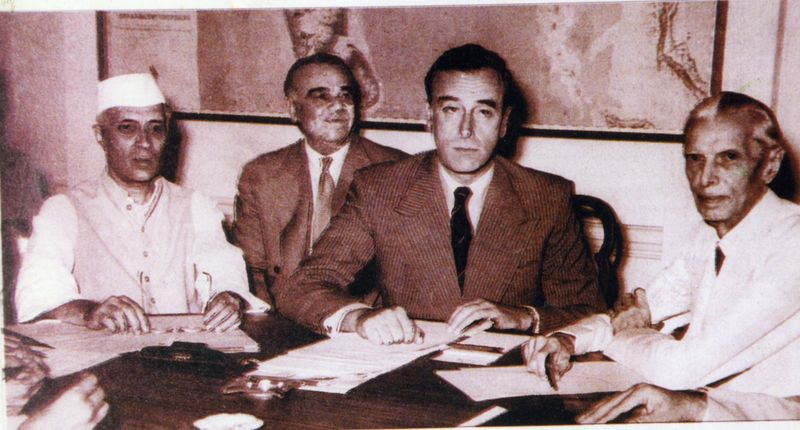
And finally, the colonial mindset had its day, which led to the final distortion of India’s identity. The key Indian intellectuals in the drama of Partition were Jawaharlal Nehru, a visionary statesman who dreamt of unifying India’s peoples in the unity of the proletariat, and Muhammad Ali Jinnah, India’s greatest lawyer, who looked upon India as two nations, one Hindu and the other Muslim, juxtaposed by geography and little else.
Both declared their commitment to secularism. But both stood firmly grounded on one falsity — that India, a conglomerate, required to be sculpted into nationhood. And so, their consequent response to Mountbatten’s offer, really an ultimatum — Partition or continued British rule —- from a government worsted in a war that had been won in Europe by the Soviet Union and in Asia by the US.
The ultimatum was, in fact, a cut-and-run operation from a spent power, bankrupt economically, militarily and politically. The last British Viceroy, the pretentious Mountbatten and his headstrong wife Edwina were chosen instruments. And so, Gandhi’s plea to his party’s working committee that while we might agree to Partition, but its details be worked out between ourselves was firmly rejected. This monstrous and acutely sensitive enterprise, including, riot, exodus of millions and evacuation was left to an administration appointed by the defeated colonial arbitrator, resulting inevitably in turning Indians against each other.
That the Partition of India was a human tragedy is recognised. The tragedy of the Holocaust is also universally acknowledged as a crime for which all Europe should have been held accountable, but has not. But then, Partition, in many ways was an even greater crime committed by India upon itself even though the catalyst might have been a dying Empire. India — and what is today Pakistan and Bangladesh — must accept that. Only then can we move to heal a wound suppurating now for close on a century.
Let me end with a question to my readers. Can I as a Muslim Indian, proud of my Indian heritage and having done my bit in the service of India as have my parents before me and their forbears, am I the child of another nation less Indian than you are? And could this be simply because I’m a committed Muslim?
Wajahat Habibullah is a J& K cadre bureaucrat and former Chairman, National Commission for Minorities
‘Dimagi Naxal’ latest addition to political vocabulary: RJD MP ‘thanks’ PM Modi
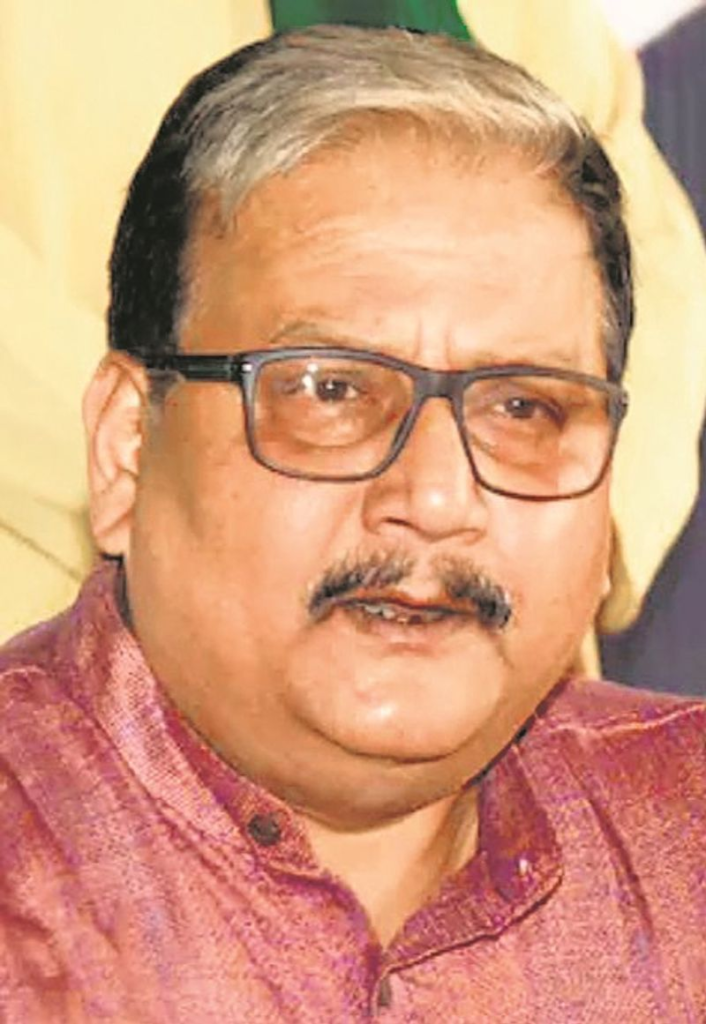
RJD MP Manoj Jha on Saturday took a jibe at Prime Minister Narendra Modi for the ‘dimagi Naxal’ phrase in his Independence Day speech, saying he had contributed to the nation’s political vocabulary with terms such as ‘andolanjeevi’ and ‘urban Naxals’.
Janashakti Janata Dal founder Tej Pratap Yadav advised the PM to travel across the country and identify dimagi Naxals.
Another Bihar leader, Union Minister for Food Processing Industries Chirag Paswan, however, supported the PM, saying that those who intend to spread anarchy and seek to disrupt India’s progress need to be identified.
In his Independence Day speech earlier in the day, Modi warned the country about the intellectual Naxals (dimagi Naxals) who have allegedly entrenched themselves in the system and continue to pose a threat to society by manipulating policies, urging the citizens to “identify and isolate” them.
“I thank Prime Minister Narendra Modi for adding a new term each year to the vocabulary. Once, he coined ‘andolanjeevi’ and then ‘urban Naxal’,” the RJD MP told PTI Videos.
“I once asked in Parliament what urban Naxal means. I was told there was no definition of urban Naxal. Now this phrase (‘dimagi Naxal’) has emerged,” Jha said.
Janashakti Janata Dal founder Tej Pratap Yadav said that the PM is better positioned to clarify “who a dimagi Naxal is and who is not.”
“The PM should travel across the country and identify dimagi Naxals. Who knows, he might find the largest number of dimagi Naxals within the BJP itself,” said Yadav, the elder son of RJD president Lalu Prasad.
Responding to Modi’s reference to ‘dimagi Naxals,’ Union Food Processing Industries Minister Chirag Paswan said that there is a need to identify people who are moving forward with the intent to “spread anarchy and disrupt India’s progress path.”
Time for young law graduates, lawyers to carry the Bar’s responsibility forward: CJI Surya Kant
Addressing young lawyers on the occasion of the 80th Independence Day, he said the responsibility carried by the Bar since the days of the freedom struggle would soon rest on their shoulders
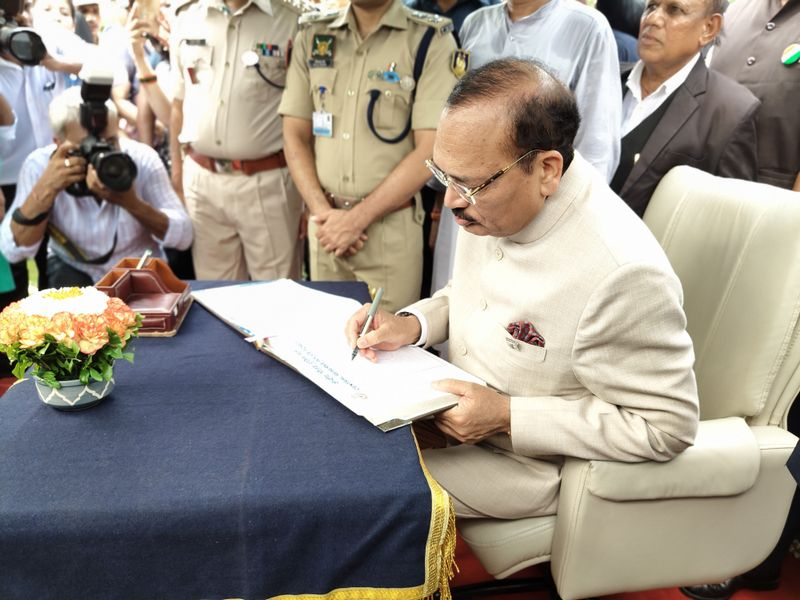
Chief Justice of India (CJI) Surya Kant on Saturday said the nation has overcome several formidable challenges in the last eight decades but much remains to be done, urging young law graduates and lawyers to be ready to shoulder the responsibilities of the future.
Speaking at the national flag hoisting ceremony organised by the Supreme Court Bar Association on the occasion of 80th Independence Day at the apex court premises, CJI Kant said the journey of the nation does not end with what it has accomplished.
“The journey of a nation does not end with what it has accomplished. Every achievement also brings with it a renewed sense of responsibility and duty. There is much that remains to be done, and many more miles to travel in our journey ahead,” he said.
The programme was attended by several senior judges, lawyers and court staff.
Addressing young lawyers, Kant said the responsibility carried by the Bar since the days of the freedom struggle would soon rest on their shoulders.
“To our young law graduates and young lawyers, I want to say this: the responsibility that this Bar has carried since the days of the freedom struggle will, before long, rest on your shoulders. The institutions of justice that generations before you have built and strengthened are now yours to protect and to carry forward,” he said.
“Please know that the Bar and the Bench remain committed to your growth: by extending mentorship, by creating meaningful opportunity, and by placing our confidence in you. The miles that remain are yours to walk, and we walk with you,” he added.
CJI Kant said the freedom struggle had a deep and enduring connection with the law and it was through the vision and work of some of the finest legal minds of that generation that we began to discover that the true purpose of law is not just to command or regulate, but to serve justice, protect liberty and uphold human dignity.
He said Mahatma Gandhi and BR Ambedkar, whom he described as two of the greatest architects of modern India, as well as Sardar Vallabhbhai Patel, Motilal Nehru, Bal Gangadhar Tilak, Lala Lajpat Rai were all lawyers which shows that the legal profession was not a bystander to India’s freedom struggle, but an integral part of it.
He said that the nation has overcome formidable challenges and achieved much in the last eight decades, while its legal and judicial institutions have also grown and matured remarkably alongside the Republic and played an important role in shaping the conscience of the country.
Kant added that with many more miles to travel in the nation’s journey, his thoughts turn naturally to the young lawyers of today.
“They stand where many of us once stood – filled with hope, ambition, and perhaps a little unsure of what lies ahead. I personally remember the anxieties of those early years at the Bar, and I say this not to discourage our young colleagues, but because I want them to know that we see them, and we understand their challenges,” CJI Kant said.
Speaking about the challenges faced by the young lawyers, he said the profession is more competitive today, the learning curve has become steeper, and the pressures of building a practice weighs heavily in these early years.
“And yet, I have also seen in our young colleagues a remarkable resilience, a sharp intellect, and a genuine commitment to justice that gives me great confidence in the future of this profession,” he said, adding that this generation brings with it qualities that give us every reason to be confident.
The CJI said that they have grown up in a world where technology has transformed the way we communicate and access knowledge, and they are bringing that adaptability into the courtroom.
“At the same time, they bring a greater awareness of the social realities around them. Many young lawyers approach the law with a deep sensitivity to questions of equality, inclusion and access to justice, and with an understanding that the law must remain connected to the lives and aspirations of the people it serves,” he added.
Highlighting that India’s struggle for independence was different from the freedom struggles that had preceded it in other colonies, CJI Kant said, “Ours was not primarily an armed insurrection; it was instead a sustained challenge to the legitimacy of colonial rule through political movements, petitions, public debates, and, most importantly, through the language of law.”
He said that the country’s freedom movement often confronted the British with a question that was simple but difficult to answer: if you claim to govern through the law, can that law deny liberty, equality and dignity to the very people whom it governs?
“This is a lesson that is still holding its weight in practice today, as courts continue to be the place where people from very different backgrounds come to assert their Constitutional rights, challenge arbitrary action, and seek the same idea of equal treatment under law. Courts have continued to serve as a unifying space for the litigants and members of the Bar alike,” he said.
Supreme Court Bar Association President Vikas Singh and other members of the bar body also spoke on the occasion