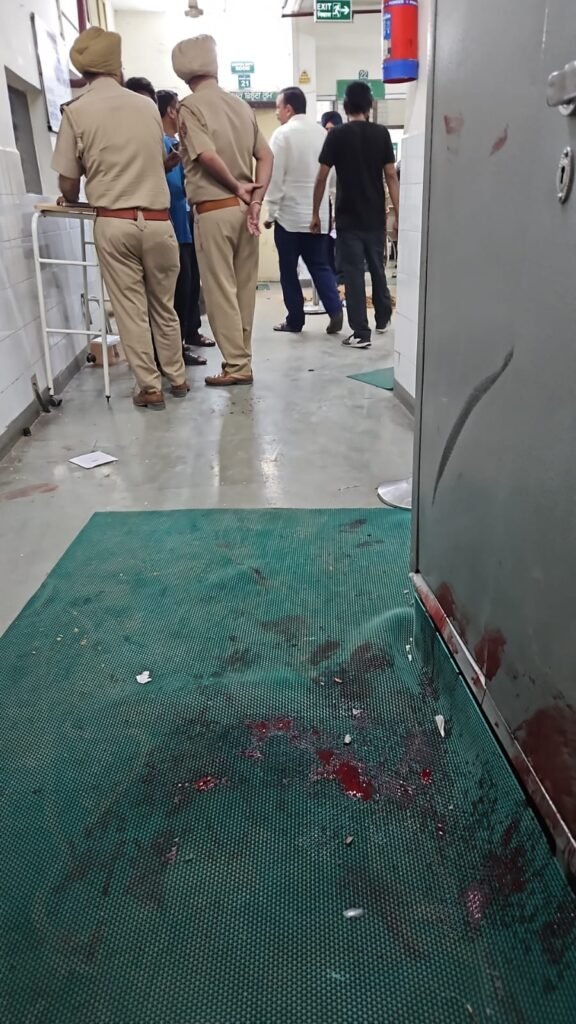
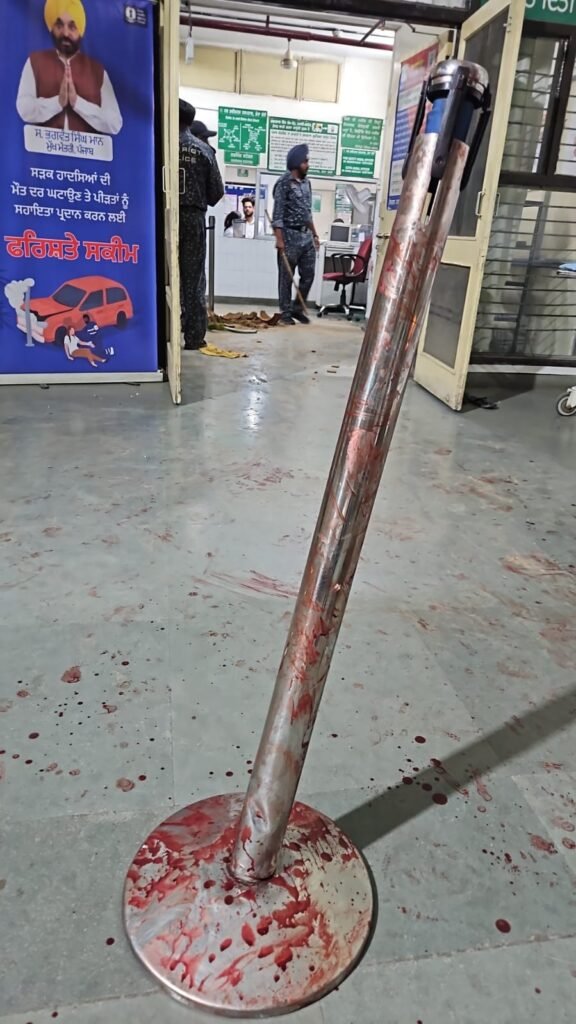
Fatehgarh Sahib Senior Superintendent of Police Subham Agarwal has suspended two police personnel for allegedly mercilessly thrashing a son of an ex-serviceman and his driver after detaining them for allegedly possessing opium.
A special investigation team (SIT) has also been formed to investigate the incident. The SIT will be led by SP (Investigation) Rakesh Yadav.The victims, identified as Surinder Pal and his driver Vicky, were admitted to the Civil Hospital for treatment after release from police custody.
Colonel Bath’s wife protests at SSP office
The FIR was registered and the cops suespended after a high drama was witnessed at the SSP office, where Jaswinder Kaur, the wife of Colonel Pushpinder Singh Bath, who was allegedly assaulted by Patiala Police personnel, reached to protest the police action against the two persons.
She alleged high-handedness by the police and demanded a meeting with the SSP. As the SSP reached his office, she narrated the incident to him and handed over a written complaint from Surinder Pal’s brother Mandeep Singh.According to the complaint, Surinder Pal and his driver Vicky were returning home after harvesting wheat crop last night when they were stopped at a check-post and “asked to hand over the opium in their possession”. When they rejected the charge, they were taken to the Khera police chowki, where they were thrashed mercilessly throughout the night.
Fatehgarh Sahib Senior Superintendent of Police Subham Agarwal has suspended two police personnel for allegedly mercilessly thrashing a son of an ex-serviceman and his driver after detaining them for allegedly possessing opium.
A special investigation team (SIT) has also been formed to investigate the incident. The SIT will be led by SP (Investigation) Rakesh Yadav.
The victims, identified as Surinder Pal and his driver Vicky, were admitted to the Civil Hospital for treatment after release from police custody.
Colonel Bath’s wife protests at SSP office
Jaswinder Kaur, wife of Colonel Pushpinder Singh Bath, protested at the SSP office.
The FIR was registered and the cops suespended after a high drama was witnessed at the SSP office, where Jaswinder Kaur, the wife of Colonel Pushpinder Singh Bath, who was allegedly assaulted by Patiala Police personnel, reached to protest the police action against the two persons.
She alleged high-handedness by the police and demanded a meeting with the SSP. As the SSP reached his office, she narrated the incident to him and handed over a written complaint from Surinder Pal’s brother Mandeep Singh.
According to the complaint, Surinder Pal and his driver Vicky were returning home after harvesting wheat crop last night when they were stopped at a check-post and “asked to hand over the opium in their possession”. When they rejected the charge, they were taken to the Khera police chowki, where they were thrashed mercilessly throughout the night.
Photos sent by Mrs Jaswinder Bath to Sanjha Morcha
A total of 255 cadets of Maharaja Ranjit Singh Armed Forces Preparatory Institute have joined various service training academies since the first cadets passed out of the institute in 2013
As many as 26 cadets of the Maharaja Ranjit Singh Armed Forces Preparatory Institute (AFPI), Mohali, have made it to the all-India merit list for entry into the National Defence Academy (NDA), Kharakvasla.
The AFPI Director, Major General Ajay H. Chauhan (retd), said this is the highest number of cadets from the institute to get selected for joining the NDA in the same batch. To date, a total of 255 cadets of this institute have joined various service training academies since the first cadets passed out of the institute in 2013, and 170 alumni of the institute have so far been commissioned as officers in the defence services.
They will be joining NDA’s 154th Course that is scheduled to begin in June 2025, for which call letters are in the process of being issued. Cadet Aryan Sofeth from Patiala has secured the 9th rank in the merit list, while 10 other cadets have secured positions among the top 100.
Out of the 34 AFPI cadets that appeared for interview before the Services Selection Board for the 154th Course after passing in the written entrance exam, 26 were declared successful. All the cadets are from 12th Course of the AFPI.
Congratulating the cadets, Punjab Employment Generation, Skill Development and Training Minister, Aman Arora said these cadets are the pride of Punjab. He also felicitated AFPI alumni Gunjot Singh and Aryan Dutt on their selection for the Officer Training Academy (OTA), Chennai, for the Short Service Commission’s 64th (Technical) Course.
Gunjot hails from Patiala district and his father works at Thapar University, while Cadet Aryan belongs to Mohali district and his father retired as a Commander in the Indian Navy.
The AFPI, which began functioning in 2011, was set up by the Punjab Government to stem the declining trend of youth from the state joining the armed forces as officers. It offers a two-year residential programme for matriculate boys under which they complete their 10+2 and alongside prepare to join the NDA through a structured training process.
Later, a similar institute, called the Mai Bhago Armed Forces Preparatory Institute, was also set up in Mohali to prepare girls aspiring to become defence officers. This institute initially offered a three-year programme along with graduation aimed at the Short-Service Commission, but with the NDA opening its doors to girls, a two-year programme for women, similar to that of the AFPI, was also introduced recently.
Army Chief reviews operational preparedness along western borders
Gen Upendra Dwivedi also visits Headquarters Panther Division in Amritsar, where he was briefed by senior officers on the operational aspects and prevailing security situation in the region
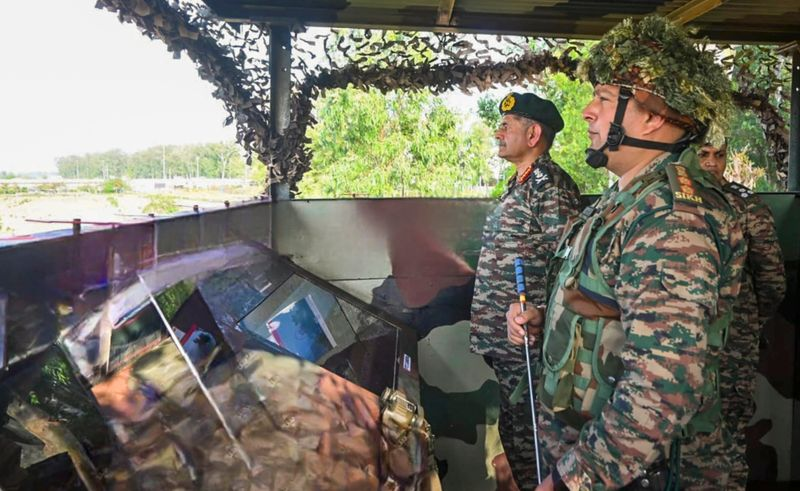
Chief of the Army Staff, Gen Upendra Dwivedi, visited forward areas along the western borders and reviewed the operational readiness of frontline troops deployed along the border with Pakistan.
He also visited Headquarters Panther Division in Amritsar, where he was briefed by senior officers on the operational aspects and the prevailing security situation in the region. A few days ago, Gen Dwivedi had also visited Headquarters Western Command in Chandimandir.
This visit to the Western Sector come in the wake of the Army Chief visiting operational areas on the northern sector. There have been reports of infiltration bids and ceasefire violations by Pakistan along the Line of Control this week, which has also resulted in casualties.
Interacting with the troops, he lauded their professionalism and unwavering commitment, urging the adoption of cutting-edge technologies in line with the Army’s transformation roadmap.
During his visit, he also honoured six veterans, Brig Satinder Singh, Lt Col Amarjit Singh Bhullar, Sub Gulzar Singh, Hony Capt Daljit Singh, Nb Sub Balraj Singh and Lance Havildar Lakhwinder Singh with the ‘Veteran Achievers Award’ at a ceremony held in Jallandhar.
Brigadier Satinder Singh served as the Director, Defence Services Welfare, Punjab, where he enhanced support for war widows by getting the ex-gratia payment from the state government enhanced from Rs 10 lakh to Rs 1 crore, improving educational opportunities, and reserving jobs for children of martyrs.
Lieutenant Colonel Amarjit Singh Bhullar, served as Deputy Director of Sainik Welfare in Punjab, helped in enhancing army recruitment. He works with the Red Cross Drug De-addiction Centre in Gurdaspur, mentoring young addicts while guiding them to join the armed forces.
Subedar Gulzar Singh, as the Sarpanch of Nijjar village, initiated several development projects, secured funding for schools and improved infrastructure, including roads and medical facilities, while Naib Subedar Balraj Singh actively supports his community by promoting environmental conservation among farmers, providing career guidance for aspiring soldiers, campaigning against drug abuse and assisting the elderly in accessing government welfare schemes.
Army chief General Dwivedi felicitates four ex-servicemen with ‘Veteran Achievers Award’
This recognition honoured their contributions to society, youth empowerment and nation-building
Chief of Army Staff General Upendra Dwivedi visited Vajra Corps headquarters in Jalandhar and interacted with veterans, felicitating four distinguished ex-servicemen with ‘Veteran Achievers Award’. This recognition honoured their contributions to society, youth empowerment and nation-building.
Among them was Col Jagdeep Singh (retd), a wheelchair-bound battle casualty who has secured Rs 76 crore in dues for more than 1,300 veer naris and veterans. He has also enabled jobs for 23 families of bravehearts.
Commander Gurcharan Singh (retd), a 1971 war veteran, was honoured for supporting the community by resolving decade-old financial cases and securing lifelong Red Cross aid for the families of bravehearts.
Honorary Capt Gurmail Singh (retd) has empowered over 700 youth for defence services, resolved over 100 pension cases and facilitated 60 job placements. He also conducts environmental awareness, girls’ education and anti-drug campaigns in Punjab.
The fourth awardee was Havildar Simranjeet Singh (retd) who runs a sports academy in Raikot and is training rural youth for sports, armed forces and paramilitary forces. So far, over 50 of his trainees have been selected.
Security forces on Saturday killed three Naxalites, one of them carrying a reward of Rs 5 lakh, in an encounter in Chhattisgarh’s Bijapur district, police sources said. It was the first encounter in the state after Union Home Minister Amit…
Security forces on Saturday killed three Naxalites, one of them carrying a reward of Rs 5 lakh, in an encounter in Chhattisgarh’s Bijapur district, police sources said.
It was the first encounter in the state after Union Home Minister Amit Shah appealed to the Naxalites to lay down arms and join the mainstream last week.
A gunfight broke out on a forested hill in the Indravati National Park area around 9 am on Saturday, when a joint team of security personnel was out on an anti-Naxalite operation, Sundarraj P, IG, Bastar Range, said.
One of the three slain Maoists was Anil Punem, an area committee member who carried a reward of Rs 5 lakh on his head. Punem was allegedly the mastermind of the blast carried out by the Maoists near Ambeli village in Bijapur in January, Sundarraj said.
While “The Cantonment Conspiracy” is fiction, Naravane said its plot draws heavily from his field experience and years of interaction with people from all walks of life, including villagers and soldiers
Former Army Chief Gen Manoj Naravane (Retd) has ventured into fiction writing with his novel, “The Cantonment Conspiracy”, a military thriller set in the near future. Speaking at a discussion at the India International Centre on Saturday, Naravane described the shift from soldiering to storytelling as a natural evolution.
“Just as an artist doesn’t confine themselves to one form, I wanted to try something different,” he said, adding, “Becoming a storyteller is just an extension of the many good stories I’ve shared through my life.”
The novel follows close on the heels of his memoir “Four Stars of Destiny”. While “The Cantonment Conspiracy” is fiction, Naravane said its plot draws heavily from his field experience and years of interaction with people from all walks of life, including villagers and soldiers.
He revealed that while the story’s premise had long been in his mind, the identity of the actual culprit evolved as the writing progressed. The narrative, set in 2026, touches upon future developments in the armed forces — including the commissioning of the first batch of women officers from the National Defence Academy after training at IMA Dehradun.
Strong female characters feature prominently in the story, a reflection of the push for gender inclusivity in the forces during his tenure. “The induction of women into permanent commission has found its way into the plot,” he said.
The novel spans a wide socio-economic canvas, portraying characters from diverse backgrounds. “Disparities have fuelled unrest in regions like Manipur, and such realities shape the backdrop of the story,” he noted.
More than just a thriller, the book humanises defence personnel, presenting them as individuals grappling with emotions and moral dilemmas. “Soldiers, too, face emotional upheavals,” Naravane said, hinting at the novel’s many twists and turns.
JCO killed thwarting infiltration bid at LoC; LG Sinha, Army Chief pay tributes
Just two days after a flag meeting between India and Pakistan over increased ceasefire violations along the Line of Control (LoC), a Junior Commissioned Officer (JCO) of the Indian Army was killed while thwarting an infiltration bid by terrorists in…
Just two days after a flag meeting between India and Pakistan over increased ceasefire violations along the Line of Control (LoC), a Junior Commissioned Officer (JCO) of the Indian Army was killed while thwarting an infiltration bid by terrorists in the Keri-Battal sector of Akhnoor in Jammu.
The incident occurred late Friday night when Army troops, using thermal imaging devices, detected movement close to the LoC in the sector. The alert troops immediately engaged the group of heavily armed Pakistani terrorists. During the exchange, Subedar Kuldeep Chand of 9 Punjab was severely injured and later succumbed to his injuries.
Jammu-based 16 Corps of the Indian Army stated, “GOC of White Knight Corps and all ranks salute the supreme sacrifice of braveheart Sub Kuldeep Chand of 9 Punjab. He laid down his life while gallantly leading a counter-infiltration operation along the Line of Control in the Keri-Battal area of Sunderbani on the night of April 11, 2025. His team’s valour and Sub Kuldeep’s ultimate sacrifice foiled an infiltration attempt by terrorists. We stand in solidarity with the bereaved family in this hour of grief.”
This incident follows a deadly blast in February this year in the same area, where two soldiers were killed in an IED explosion. The IED, planted by terrorists on a patrol route near the LoC, was detonated as soon as the soldiers approached it.
On Thursday, a brigade commander-level flag meeting was held at the Chakan-Da-Bagh crossing point in Poonch district. During the meeting, the Indian Army issued a stern message to its Pakistani counterparts, urging them to uphold the ceasefire agreement that was renewed by both countries on February 25, 2021.
Despite the meeting, tensions persisted on Saturday along the LoC. The Indian side heightened vigilance and launched a search operation to ensure no terrorist managed to infiltrate during the bid.
Meanwhile, Jammu and Kashmir Lt Governor Manoj Sinha and Army Chief General Upendra Dwivedi have paid their tributes to Subedar Kuldeep Chand. A solemn wreath-laying ceremony was held at military garrison Tanda in Akhnoor in the afternoon and later his mortal remains were despatched to his family in Himachal Pradesh for last rites, officials said.
Anniversaries serve as occasions for revisiting and re-examining major historical events. It’s an opportunity to consider their significance for the present generation and looking at history afresh. As the country observes the 106th anniversary of the Jallianwala Bagh massacre of April 13, 1919, it is perhaps pertinent to ask — how does this event speak to us today, particularly to young Indians? How do we recontextualise this event for the current generation of Indians?
For Tript, a young professional who has grown up in Punjab but works in Bhubaneswar, “Jallianwala Bagh has not only been a part of my history textbooks, but also cultural memory.” She says in addition to the school textbooks, she learnt about the tragedy from her parents and also through popular culture and films like ‘The Legend of Bhagat Singh’. “I recently visited the renovated memorial complex in Amritsar and saw the light and sound show. In its new avatar, though, the site seems to have lost its sanctity,” she adds.
According to Prannv Dhawan, a young lawyer, “Jallianwala Bagh evokes a fair degree of anti-colonial zeal because you tend to perceive the colonial state as a violent and uncivilised force. This turns the notion of the Empire as a civilising force on its head.” Another young advocate, Abhijeet Rawaley, corroborates this sentiment: “The Jallianwala Bagh massacre exemplified the absolute tyranny of colonialism.”
A stark example of the brutality of the British Empire, the Jallianwala Bagh massacre has been the subject of heated and vigorous historiographic debates, literary portrayals and representations, and a controversy over how it should be commemorated. But beyond the politics of commemoration, histories of colonial violence and anti-colonial resistance are narratives which resist any neat teleologies. The story of Jallianwala Bagh and its aftermath, through the testimonies and experiences of students of the time, is one such narrative which gets lost in the meta-narratives of colonial and nationalist histories. How did it impact students of the time? What were their perceptions of the event? How were their lives transformed in the aftermath of the Jallianwala Bagh massacre?
The writings and debates on the massacre have spanned microhistories of the event, works which have juxtaposed local history and memory against nationalist appropriation of the event. Commentary has focused on critiques of the renovated memorial complex among other aspects.
Zooming out a little, there is also a need to study the immediate contexts that preceded and followed the event. These include the context of what in colonial records has been referred to as the ‘Punjab disturbances’ and also the oppressive and draconian martial law regime which followed the massacre.
The flame of liberty at the Jallianwala Bagh memorial in Amritsar. PTI
That students constituted one of the major classes which participated in the Rowlatt Satyagraha and ‘Punjab disturbances’ of 1919 is corroborated by the official report of the Political and Secret Department on Punjab Disturbances. The report goes on to say, “The evidence at present available appears to indicate that among the classes most deeply implicated are — Pleaders and their Munshis, College Students and Schoolboys (emphasis added), Traders, Members of Arya Samaj…”
The involvement of students in the Rowlatt Satyagraha and the ‘Punjab disturbances’ apart, there is evidence of testimonies of students of Khalsa College, Amritsar, on what transpired on the fateful day of April 13, 1919.
“On the 13th, I did not hear of any proclamation prohibiting public meetings. I went to attend the meeting at about 4 pm. When I arrived there, a Sikh gentleman was addressing the meeting. Then he sat down, and another gentleman whose name I do not know spoke for a short time… Shortly after, I heard the sound of firing, and people began to run on all sides. I did not see any soldiers, as there was a large number of people all around me. I kept sitting where I was. As soon as the first firing ceased, I took the opportunity to run away towards the mud wall to the east. When I was jumping over the wall, the firing began again, and I got a bullet on my right forearm.”
This testimony of Ratan Chand, son of Lala Gokal Chand, 17 years of age, a student of Khalsa College, is one among a handful of testimonies given by students that can be found in the report of the Congress Punjab Inquiry Committee (Volume II).
The historian VN Datta identified another student of Khalsa College, Deva Singh Cheema, who was wounded during the massacre. In a letter to the historian, Deva Singh admitted that he had visited the site of the massacre despite Principal Wathen’s warning to the contrary. Deva Singh also stated that their Principal had some inkling of the meeting at the Bagh turning disruptive, even violent.
The aftermath of the Jallianwala Bagh massacre saw martial law being declared in both Amritsar and Lahore. If one goes through the martial law orders and notices issued in 1919, the names of the students, along with their institutions and the quantum of punishment given to each, is indicated very clearly in these notices.
In all, 64 martial law notices were issued at Lahore, between April 15, 1919, and June 6, 1919. Out of these, seven notices i.e. notice numbers 7, 13, 16, 30, 36, 44 and 46, dealt exclusively with various kinds of punitive action recommended against the students of different colleges. Apart from general punishment announced for the students who were found guilty of “seditious activities”, specific punishments were announced by name for the students of King Edward Medical College, Dyal Singh College, Sanatan Dharam College, Forman Christian College and other educational institutions in Lahore.
These notices adversely affected the careers of around 254 students, as most of them had to pay heavy penalties, which ranged from imposition of fine to suspension for a year, but some even had to face expulsion or permanent ban on seeking re-admission. Of the total number of 254 students listed in these notices, 78 have not been named at all. Some of the students whose names figure in these notices were: Nanak Chand Kapur, Pran Nath, Shamsher Singh, Fahur-ud-din, Bhagwan Das, Dina Nath, Sher Singh, Manzur Hasan Khan, Durga Dutt, Din Dayal, Des Raj.
The martial law regime was thus particularly hostile to students, with thousands of them from Lahore colleges even being forced to attend roll call before military officers four times a day for three weeks before their examinations.
The history of the Jallianwala Bagh massacre and its fallout from the vantage point of students deserves closer attention. The tragedy left a deep mark on the students who were witness to it, and the lives of countless students was altered by the events that followed it. It is a history of wounded bodies and jeopardised careers.
It is also a history of how brutally the colonial state snuffed out any dissent. As Professor Amandeep Bal, who is the Jallianwala Bagh Chair at Guru Nanak Dev University, Amritsar, says, “The history of Jallianwala Bagh is a reminder for the current generation to be vigilant about its rights.”
This narrative is but a small slice of a complicated and contested history. However, it is a narrative which could possibly resonate with the young and serve as a point of reflection and inspiration for them. Recovering a history of student voices and experiences with respect to the Jallianwala Bagh massacre thus is perhaps one way in which that history can become more meaningful for the current generation of young Indians.
— The writer, a freelance contributor, did his Masters in history from SOAS
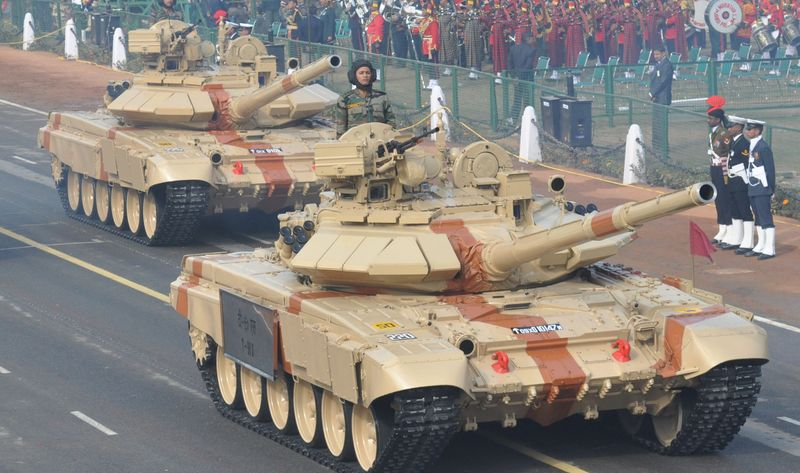
Keeping in mind the damage drones cause to tanks in the ongoing Ukraine-Russia conflict, the Indian Army is planning to procure full-scale ‘mock tanks’ to mimic the T-90 tanks in its fleet.
These ‘mock tanks’ will deceive drones into believing that real tanks are deployed. It is expected that surveillance by enemy drones would show ‘tanks’ being stationed. This has a two-pronged effect. First, the adversary can choose to attack these ‘mock tanks’ using the ammunition on the drones, and second, change the position of its own troops.
The use of ‘mock-ups’ is an old military tactic. Ukraine used it recently. India, too, has employed similar tactics in the past. However, advancements in technology now allow mock-ups to look very real.
The Ministry of Defence (MoD) has issued a Request for Information (RFI), the first step in the tendering process, seeking an unspecified number of ‘mock-ups’ of the T-90 tanks.
The RFI is open to both Indian private sector firms and public sector undertaking, with a clear mandate that the products must be ‘made in India’.
According to the technical parameters by the MoD, the ‘mock-up’ should generate noise and have thermal signature (heat exhaust) like a real tank. Sensors and drones of the adversary will pick up heat and noise signatures.
Additionally, the mock tanks must have same dimensional characteristics—height, width, ground clearance, slope of armour—as well as other external fittings such as radio antennas, wind sensors, and external fuel tanks.The MoD in its RFI said these ‘mock-ups’ will help preserve real tanks from drone attacks. They will be used in the terrain and environmental conditions as existing in the Indian subcontinent.
In a parallel development, the Army is also looking at procurement of light artillery guns. These guns are expected to be 105 mm, 37 calibre, and mounted on vehicles. The Army wants these gun systems can be deployed by dropping them with parachutes to a desired location.
The MoD has already given ‘Acceptance of Necessity’ for this requirement and is expected to issue a Request for Proposal to prospective vendors by June 1.
Explainer: 41 years after Siachen capture, the China threat
Forty-one years after the Indian Army captured Siachen Glacier, it is China, and not Pakistan, that poses a greater threat to Indian interests on the 76-km-long strategically located perma-frost in Ladakh. Siachen is situated like a ‘strategic wedge’ between Pakistan-occupied…
Forty-one years after the Indian Army captured Siachen Glacier, it is China, and not Pakistan, that poses a greater threat to Indian interests on the 76-km-long strategically located perma-frost in Ladakh.
Siachen is situated like a ‘strategic wedge’ between Pakistan-occupied Kashmir (PoK) to its west and Shaksgam valley, illegally ceded by Pakistan to China in 1963, to its north. India lays claim to both areas. The eastern flank of the glacier abuts Depsang plains in Ladakh that form the Line of Actual Control (LAC) with China.
On Baisakhi day, April 13, 1983, Prime Minister Indira Gandhi okayed a military plan called ‘Operation Meghdoot’ to capture Siachen. A platoon of the 4th Battalion of the Kumaon Regiment was flown onboard helicopters to Bilafond La (a 17,880 feet high pass in the Karakoram mountains). The Indian flag was raised. Pakistan’s attempts to re-capture were repulsed.
The dispute
After the India-Pakistan war of 1947-48, the Karachi Agreement of 1949 approved a ceasefire line (CFL) between India and Pakistan. The 1965 and 1971 Indo-Pak wars ended in agreements at Tashkent and Shimla, respectively. However, on ground, the Line of Control (LoC) beyond Point NJ 9842 — a reference point on the map — is undefined.
The 1949 agreement said, “From Point NJ 9842, the ceasefire line (CFL) will run northwards to the glaciers.”
India and Pakistan differ on what is ‘northwards to the glaciers’. Islamabad claims the LoC should go north-east and end at Karakoram Pass dividing Ladakh in India and Xinjiang under Chinese control. Post April 1984, Indian troops are stationed along the watershed of the Saltoro Ridge in the Karakoram mountains that runs ‘northwards’ of Point NJ 9842.
PLA FACTOR
The Indian Army has, in the past, war-gamed a scenario that the People’s Liberation Army (PLA) of China can attempt to make a westward thrust through Depsang plains along the LAC in eastern Ladakh.
The PLA’s possible military objective could be to cut off the vital 255-km Darbuk-Shayok-Daulat Baig Oldie (DSDBO) road to restrict Indian access to the Karakoram Pass. Militaries of India and China were involved in a deadly clash alongside the Galwan river in June 2020, just 8-10 km east of the DSDBO road.
Also, the PLA could possibly attempt to seize the 20,000 feet high Saser La, which is west of Depsang and it opens a route to Sasoma and further westwards to the Siachen base camp.
Indian defensive positions have been accordingly ‘militarily tailored’ to hold back the PLA with tanks, artillery guns, latest systems, besides additional troops. The Indian assessment is that PLA can be thwarted if it tries this westward thrust.
On the western flank of Siachen, in PoK, the Chinese, under the guise of road and dam builders, have made an entry. China’s Karakoram Highway, part of the China-Pakistan Economic Corridor, runs close by.
Glacier’s importance
Saltoro Ridge is dominated by the Indian Army and overlooks the Gilgit-Baltistan area of PoK. On the eastern flank, the Indian military guards the routes that provide access to Siachen via the Depsang plains in Ladakh. The northern part of the glacier, ringed by very high peaks, dominates the Shaksgam valley.
De-militarisation
Pakistan had suggested de-militarisation. It was discussed at Track-II diplomatic channels, but without any agreement. From the Pakistan side, the approach to the Saltoro Ridge and the Siachen Glacier is vulnerable as the Indian Army occupies the heights. From an Indian perspective, vacating anything is not possible.
Pak designs
Ambiguity on the alignment of the LoC allowed Pakistan to play its own game. Between 1972 and 1983, it permitted foreign expeditions on the Siachen Glacier and the surrounding peaks, with Pakistani army officers accompanying them.
In India, things happened by coincidence — in 1977, two German mountaineers requested to trek up the 24,600 feet high Mamostong Kangri on the south-east edge of Siachen. India did not give permission, Pakistan did. The location of the Mamostong glacier spurred India into action as it is closer to Depsang in India than to Pakistan.
Col Narinder (Bull) Kumar led the first mountaineering expedition in 1978; the Indian Army did two similar expeditions in 1980 and 1981 before Operation Meghdoot was launched.
State Stalwarts
DEFENCE MINISTER
Minister Rajnath Singh
ALL HUMANS ARE ONE CREATED BY GOD
HINDUS,MUSLIMS,SIKHS.ISAI SAB HAI BHAI BHAI
CHIEF PATRON ALL INDIA SANJHA MORCHA
LT GEN JASBIR SINGH DHALIWAL, DOGRA
SENIOR PATRON ALL INDIA SANJHA MORCHA
MAJOR GEN HARVIJAY SINGH, SENA MEDAL ,corps of signals
.
.
PATRON ALL INDIA SANJHA MORCHA
MAJ GEN RAMINDER GURAYA ,MADRAS REGIMENT
sanjhamorcha303@gmail.com
PRESIDENT SOUTH ALL INDIA SANJHA MORCHA
COL SS RAJAN BOMBAY SAPPERS,
PRESIDENT UTTARAKHAND ALL INDIA SANJHA MORCHA
COL B M THAPA ,BENGAL SAPPERSS
PRESIDENT HARAYANA STATE CUM COORDINATOR ESM
BRIG DALJIT THUKRAL ,BENGAL SAPPERS
PRESIDENT TRICITY
COL B S BRAR (BHUPI BRAR)
PRESIDENT CHANDIGARH ZONE
COL SHANJIT SINGH BHULLAR
.
.
PRESIDENT PANCHKULA ZONE AND ZIRAKPUR
COL SWARAN SINGH
INDIAN DEFENCE FORCES
DEFENCE FORCES INTEGRATED LOGO
INDIAN AIR FORCE
Air Officer C-in-C WESTERN AIR COMMAND
AIR MSHL S PRABHAKARAN AVSM VM
AOC-IN-C, EASTERN AIR COMMAND
Air Marshal Inderpal Singh Walia
AOC-in-C SOUTH WESTERN AIR COMMAND
Air Marshal Vikram Singh
AOC-IN-C, SOUTHERN AIR COMMAND
Air Marshal J.Chalapati
AOC-IN-C TRAINING COMMAND
AIR MARSHAL SK GHOTIA VSM
AOC-IN-C MAINTENANCE COMMAND
Air Marshal Jagdish Chandra
Flag Officer Commanding in Chief, Western Naval Command
ice Admiral R Hari Kumar, PVSM, AVSM, VSM
Flag Officer Commanding in Chief, Eastern Naval Command
Vice Admiral Sanjay Bhalla, AVSM, NM
Flag Officer Commanding in Chief, Southern Naval Command