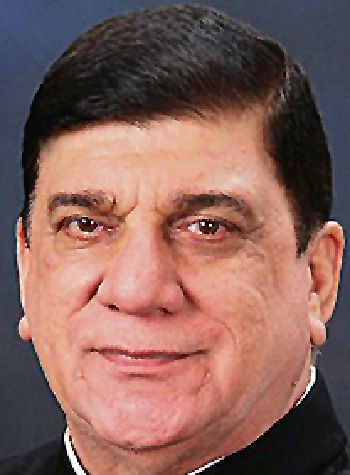
The court of Additional Sessions Judge Surinder Pal Kaur rejected the anticipatory bail application of a cop, who is one of the accused in the Colonel Pushpinder Singh Bath assault case. Inspector Ronnie Singh, the applicant, claimed that he had…
The court of Additional Sessions Judge Surinder Pal Kaur rejected the anticipatory bail application of a cop, who is one of the accused in the Colonel Pushpinder Singh Bath assault case.
Inspector Ronnie Singh, the applicant, claimed that he had been falsely implicated in the case. Following the court’s directions, the investigating officer of the Chandigarh Police today appeared before the judge and submitted the detail of the probe conducted so far.
After due deliberation, the court rejected the anticipatory bail application of the accused inspector, said advocate Harinderpal Singh Verma, counsel for Colonel Bath.
Earlier, Ronnie Singh had applied for a reprieve from the Punjab and Haryana High Court. He had claimed that he, along with a police team, had conducted a raid near Rajindra Hospital in Patiala following an intelligence input regarding a wanted drug trafficker.
“During this operation, he encountered individuals consuming alcohol in public and obstructing access to the hospital. Upon being politely asked to clear passage, these individuals, including Col Pushpinder Bath and his son, reacted aggressively, assaulted the petitioner and created public nuisance,” the petitioner had alleged, adding that the incident was captured on CCTV and had been corroborated by eyewitnesses.
The attack on Colonel Pushpinder Singh Bath and his son took place near Government Rajindra Hospital on the night intervening March 13 and 14.
The incident reportedly stemmed from a parking dispute at a roadside eatery. Colonel Bath and his son sustained injuries.
Top 10 CSD Benefits & Updates Every Veteran Must Know
Nearly two centuries after Dogra General Zorawar Singh led his audacious campaign into Tibet in 1841, the Indian Army today hosted a symposium to commemorate the numerous military campaigns carried out in high-altitude. Unconnected to events of 1840’s, the Indian…
Army Chief General Upendra Dwivedi (fourth from left) at event to honour Dogra general Zorawar Singh. The portrait in the background is of General Zorawar.
Nearly two centuries after Dogra General Zorawar Singh led his audacious campaign into Tibet in 1841, the Indian Army today hosted a symposium to commemorate the numerous military campaigns carried out in high-altitude.
Unconnected to events of 1840’s, the Indian Army and China today hold strategic positions in the icy heights along both sides of the Line of Actual Control (LAC).
Titled “General Zorawar Singh: Up, Close and Personal,” the symposium was held at the Manekshaw Centre in Delhi Cantonment. It was jointly hosted by the Jammu and Kashmir Rifles and the Centre for Land Warfare Studies (CLAWS). Speakers at the event emphasised how Zorawar’s high-altitude campaigns across the Himalayas laid the foundation for principles later adopted in ‘mountain warfare’ by Indian forces.
A few years prior to the Tibet campaign, General Zorawar, in 1834, had extended the limits of the Dogra kingdom by capturing Ladakh, then part of the Sikh Empire headquartered in Lahore.
In 1839, Zorawar Singh turned his attention to Baltistan, the Lahore Durbar and Dogra King Gulab Singh were okay with it.
By February 1840, Dogra forces under Zorawar Singh had moved into Baltistan, then ruled by Ahmed Shah.After fierce combat, the Dogras captured Skardu and surrounding valleys by June 1840.
In April 1841, Zorawar Singh launched his expedition into Tibet, reaching the northwestern edge of Nepal by September.
The British were getting edgy over this progress.
In October 1841, the British Government wrote a letter to Lahore Darbar asking that forces led by Zorawar Singh need to withdraw from Tibet , resulting in a scheduled withdrawal from Tibet on December 10, 1841—ultimately halting what could have been a march toward Lhasa. The British, did capture Lhasa in 1904 only to give it up three years later
These high-altitude battles laid the groundwork for future administrative and strategic cohesion in the region with India.
Today, at the event General Zorawar Singh’s pivotal role in shaping the boundaries of the modern-day state of Jammu and Kashmir and Ladakh was highlighted.
At today’s event, Indian Army Chief General Upendra Dwivedi was the the Chief Guest. He released two military history books during the ceremony, “The Warrior Gurkha” by Madhulika Thapa, daughter of Param Vir Chakra awardee Lt Col Dhan Singh Thapa (1962 Sino-Indian War) and “A Kashmir Knight and the Last 50 Years of the Princely State of J&K” authoured by Lt Gen Ghanshyam Singh Katoch (Retd).
Forces Law Review unveiled at Commonwealth Law Conference; Advocate Navdeep Singh attends
Three Indian lawyers and a former High Court judge are among those tasked with the editorial oversight of the international military law journal.
The Forces Law Review (FLR), the first international military law journal, was unveiled on April 9 at the Commonwealth Law Conference in Malta, which saw the attendance of Punjab and Haryana High Court advocate Major Navdeep Singh among others.
Sharing the news of the unveiling of the opening volume of the Forces Law Review- the first ever international military law journal, a unique global academic collaboration between the National Institute of Military Justice, Washington DC and Centre for Constitution & Public Policy, University institute of Legal Studies, Panjab University, Chandigarh.
Long-range glide bomb ‘Gaurav’ successfully tested, launched from Sukhoi
The Defence Research and Development Organisation (DRDO) has successfully conducted a ‘release trial’ of 1,000 kg ‘long-range glide bomb (LRGB), Gaurav.
The tests were carried out over three days, from April 8-10, from an Indian Air Force fighter jet, the Sukhoi 30-MKI.“The weapon was integrated to multiple stations in different warhead configurations, with the land target on an island. The trials successfully demonstrated a range close to 100 km with pin-point accuracy,” the Ministry of Defence said.
The trials have paved the way for induction of the weapon into the IAF, the ministry said.
Defence Minister Rajnath Singh in a post on X complimented the DRDO, IAF and industry for the successful development trials of Gaurav. He said “the development of Gaurav will further enhance the capabilities of the armed forces to a great extent”.
The system has been realised with the support of development-cum-production partners – Adani Defence Systems and Technologies, Bharat Forge and various MSMEs.
Gaurav was first tested in August last year.
Once the bomb is launched from air, the glide bomb steers towards the target using highly accurate hybrid navigation scheme with a combination of GPS data.
Gaurav has been designed and developed indigenously by the Research Centre Imarat, Hyderabad.
Supreme Court sets aside Punjab and Haryana High Court order, says CBI probe shouldn’t be directed in routine manner
The bench says the high courts should order CBI probe only in cases where the material prima facie warranted an investigation by the agency
The Supreme Court has set aside an order of the Punjab and Haryana High Court which transferred the probe in a case to the CBI, and said such directions should not be routinely passed.
A bench of Justices Sudhanshu Dhulia and K Vinod Chandran said the high courts should order Central Bureau of Investigation (CBI) probe only in cases where the material prima facie warranted an investigation by the agency.
“The high courts should direct for CBI investigation only in cases where material prima facie discloses something calling for an investigation by the CBI and it should not be done in a routine manner or on the basis of some vague allegations,” it added.
The top court went on, “The ‘ifs’ and ‘buts’ without any definite conclusion are not sufficient to put an agency like the CBI into motion.” The apex court’s verdict came on an appeal challenging the high court’s May 2024 order.
The bench said an FIR was lodged in Panchkula in October 2022 alleging the accused impersonated an inspector general (IG) of the Intelligence Bureau and threatened the complainant to transfer Rs 1.49 crore into his account.
The FIR alleged that the complainant, who had a pharmaceutical business, was coerced by the accused to work with his associates and faced extortion for money.
The complainant moved the high court seeking the transfer of probe from the state police to the CBI.
The high court allowed the plea following which the accused moved the apex court.
In its April 2 verdict, the apex court said “vague and bald” allegations were made in the petition filed before the high court.
The main ground, it said, the complainant alleged in the high court was the police officials were acquainted with the appellant and they could also be involved in the case.
The bench said these claims of the complainant were not substantiated at all.
It referred to a top court judgement to say CBI investigation should not be directed in a routine manner or only because allegations were against the local police.
The bench said the high court was perhaps moved by the assertions made by the complainant that local police officers, who would conduct the probe, were of lesser ranks and that the matter allegedly involved some high-ranking officials.These allegations were vague and moreover, the commissioner, Panchkula, had constituted a three-member special investigation team under the chairmanship of an assistant commissioner of police for investigation, the court noted.
While allowing the appeal, the bench set aside the high court order.
An unmanned aerial vehicle (UAV), deployed for surveillance, crashed at the airfield in Jammu, leaving a soldier injured, officials said. The incident occurred when the UAV was landing at the airfield after carrying out a routine sortie, they said, adding…
An unmanned aerial vehicle (UAV), deployed for surveillance, crashed at the airfield in Jammu, leaving a soldier injured, officials said.
The incident occurred when the UAV was landing at the airfield after carrying out a routine sortie, they said, adding that the injured soldier has been hospitalised. The UAV hit a tower inside the area and crashed to the ground on Thursday night, they said.
The technical airport is part of the Jammu airport, designated for operations of the IAF’s chopper unit.
Partisan governors: The shrinking space for dissent by Lt Gen Bhopinder Singh Retd
Conduct of constitutional offices and institutions warrants apolitical bearing and expressions. While legality is imperative, upholding the spirit of constitutional morality and unconstrained ‘voice’ is the key. Is India witnessing the erosion and diminishment of such offices and institutions or are they displaying the spine to question the powers-that-be? The answer lies in the capacity to recollect the last time when a dissenting note was struck against the ruling dispensation at the Centre by the Rashtrapati Bhawan, Raj Bhawan/Raj Niwas, investigative agencies, et al? The displeasures are seemingly reserved exclusively for opposition parties or states run by the same.
To be fair, this is not a new phenomenon as there have always been taints of partisanship in earlier times too. From the infamous surrender on the night of June 25, 1975 (imposition of Emergency) to the then Uttar Pradesh Governor Romesh Bhandari’s ill-advised recommendation to dismiss Kalyan Singh’s government, history is instructive of misuse of constitutional offices.
However, there have been many instances of presidents and governors who refused to kowtow and upheld the dignity and majesty of democratic and constitutional traditions. Examples like KR Narayanan, APJ Abdul Kalam to even Zail Singh, standing up to attempts to reduce their offices to “rubber stamps” are legendary.
But all that was in the distant past. Today, successive occupants to the highest office of the land on the Raisina Hill have quietly endorsed all Bills and debates (some contentious and polarising) with no call to caution, let alone “reconsider”. The highest offices in the states and union territories, too, have shown similar acquiescence, with no space to disagree, save for disagreements with opposition parties or against the opposition party-led governments. The timeless adage of a thriving democracy that “disagreement is the highest form of patriotism” has long been buried.
Foundational fathers of the “constitutional idea of India”, including Dr BR Ambedkar, had insisted that a governor ought not to use his/her discretion as a “representative of a party” but as the “representative of the people as a whole.” It implied a fierce independence that owed no obligation to the partisan persuasion that had elevated them to the high office in the first place.
While competitive politics by all national or regional parties are rumbustious, unsubstantiated, and even unhinged, it was hoped that the constitutional appointees would act like the proverbial “adults in a room” to ensure that constitutional propriety reigned supreme once the dust and din of accusations had settled.
Sadly, recent times have seen a flurry of gubernatorial outreaches that have blurred the essential lines between constitutional posts and politicians. To make matters worse, such partisan derelictions by erring appointees are not shunned. Rather, they are encouraged with telling silences and promotions.
It is not as if it is only the career politicians in gubernatorial roles who are found unhealthily enthusiastic on partisan matters. Even those from professional backgrounds in supposedly apolitical institutions are seen participating in matters which militate against the mandated restraint and sobriety.
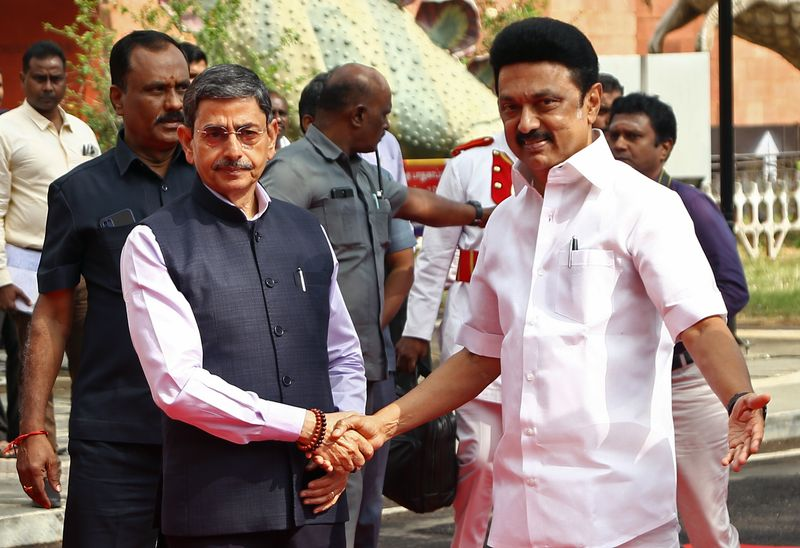
One running case of the governor-versus-chief minister saga (obviously in an opposition party-ruled state) is from Tamil Nadu. While the state politicians (irrespective of party) are never a modicum of constitutional morality, given the excesses, “manufactured emotions”, and leniencies that they practice, it is incumbent on the “conscience-keeper of the Constitution”, ie, the governor, to not retaliate act by act.
Tamil Nadu has had its own complicated history of dissonance, with contentious issues like language, culture, etc, but over time, most sore points had healed and an overarching theme of acceptance and natural inclusivity prevailed.
Today, a sense of reactionary and regional revisionism with perceived impositions by “Delhi” has returned. The agendas of the past are making a comeback. While the regional and national political parties cannot escape blame for the regressive slide, it is conjoining of the gubernatorial offices in the partisan battles that is increasingly discomforting.
Recently, it took the Supreme Court to call out that actions of the sitting Governor of Tamil Nadu as “arbitrary” and “illegal”, when ruling that the Governor cannot reserve Bills for the President after withholding assent. The top court presciently reminded, “All actions of the Governor must align with the principle of parliamentary democracy”, suggesting a diminishment of the vital federal spirit, as envisaged in the Constitution. On cue, it corrected the action by noting, “All actions taken by the Governor thereto for the 10 bills are set aside. These Bills shall be deemed to be cleared from the date it was re-presented to the Governor.”
Incidentally, the said Governor has had a distinguished career in the Indian Police Service in amongst the most politicised states (in terms of Center-state relations), ie, Kerala. Hence, he would be expected to be well versed with the dangers of partisanship. Later, he was to assume very responsible positions in other professional and ostensibly apolitical institutions like the Central Bureau of Intelligence (CBI) and the Intelligence Bureau (IB) and even a stint as Deputy National Security Adviser, which would have grounded him in the need to maintain the lofty spirit of independence and constitutional morality.
But his gubernatorial stint has been marked by inelegant run-ins with the state government. For example, when he refused convention to deliver a prepared speech and pursuant to the same, omitted words such as secularism, compassion, women empowerment, self-respect and portions on Dravidian leaders and BR Ambedkar. It would be naïve to assume that the selected omissions were not conforming to any partisan preference.
In times that be, valourising the dominant partisan thought is all-pervasive and the crucial power to dissent is seemingly exercised at only the opposition side. If the ruling dispensation truly seeks to be the “party with a difference” (as claimed), it needn’t invoke the playbook of the past. Indians and Indian politics deserve better.
Tahawwur Rana wanted Pakistan’s highest honour for 26/11 attack terrorists, said ‘Indians deserved it’
The US Department of Justice revealed that intelligence agencies had once intercepted conversation between Rana and David Headley after the Mumbai attacks, in which Rana had commended the 9 Lashkar-e-Taiba terrorists who had been killed committing the attacks, saying that ‘they should be given Nishan-e-Haider’ — Pakistan’s ‘highest award for gallantry in battle’
Extradited terrorist Tahawwur Rana wanted Pakistan to give its highest honour ‘Nishan-e-Haider’ to 9 Lashkar terrorists who were neutralised during the 2008 Mumbai terror attack and was even heard saying “India deserved it” in an intercepted conversation with David Headley.
“After the attacks were complete, Rana allegedly told Headley that the Indians deserved it,” the US Department of Justice revealed through a statement.
Tahawwur Rana, a Canadian national of Pakistani origin, arrived in Delhi on Thursday after a lengthy legal battle in the US, during which he fought extradition on health and legal grounds. He is currently in NIA’s custody for next 18 days.
The US Department of Justice revealed that intelligence agencies had once intercepted conversation between Rana and Headley after the 26/11 Mumbai attacks, in which the 64-year-old Rana had commended the 9 Lashkar-e-Taiba terrorists who had been killed committing the attacks, saying that “they should be given Nishan-e-Haider”—Pakistan’s “highest award for gallantry in battle”, which is reserved for fallen soldiers.
The US, meanwhile, termed Rana’s extradition as a critical step toward seeking justice for the victims of the Mumbai terror attack which also included six Americans.
“These attacks resulted in the tragic loss of 166 lives, including six Americans, and shocked the entire world. The US has long supported India’s efforts to ensure those responsible for these attacks are brought to justice. As President Trump has said, the US and India will continue to work together to combat the global scourge of terrorism,” the US State Department said.
Notably, India’s pending proceedings against Rana are not the first proceedings in which he has been accused of conspiring to commit violent acts of terrorism.
In 2013, Rana was sentenced to 14 years in prison following his trial conviction in Northern US District of Illinois for conspiring to provide material support to LeT and to a foiled LeT-sponsored terrorist plot in Copenhagen, Denmark.
Army deploys robotic mules, nano drones in earthquake-hit Myanmar
Teams are conducting technical evaluation and search-and-rescue operations using modern equipment
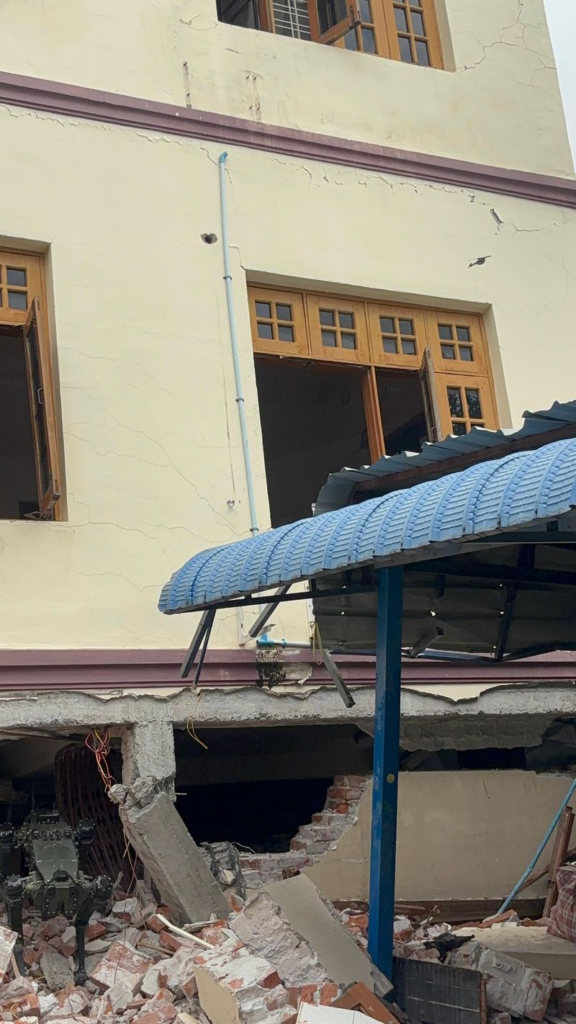
The Indian Army has deployed robotic mules and nano drones in Myanmar to assist in damage assessment and search-and-rescue operations following the earthquake that struck the country on March 28.
The teams are conducting technical evaluation and search-and-rescue operations using modern equipment. The earthquake, measuring 7.7, claimed over 3,600 lives.
Under Operation Brahma, India has sent over 650 metric tonnes of relief materials via seven Indian Air Force aircraft and five naval ships. Additionally, a field hospital set up by India has provided medical aid to more than 1,300 patients.
These rescue tools, like robotic mules and nano drones, have been instrumental in navigating debris and locating survivors in Myanmar’s hardest-hit regions. The robotic mules, known as SAR Robo Mules (Multi-Utility Legged Equipment), are designed to traverse unstable terrain, enabling precise assessments of damaged structures. Meanwhile, nano drones are equipped with thermal imaging cameras, allowing rescuers to locate survivors trapped under rubble.
Videos shared by the Army showcase these machines in action, demonstrating their effectiveness in technical evaluations and rescue operations.
India has also provided food packets, medicines, water purifiers, solar lamps, and tents to affected regions.
An 80-member team from the National Disaster Response Force (NDRF) also conducted search-and-rescue operations before returning home earlier this week.
State Stalwarts
DEFENCE MINISTER
Minister Rajnath Singh
ALL HUMANS ARE ONE CREATED BY GOD
HINDUS,MUSLIMS,SIKHS.ISAI SAB HAI BHAI BHAI
CHIEF PATRON ALL INDIA SANJHA MORCHA
LT GEN JASBIR SINGH DHALIWAL, DOGRA
SENIOR PATRON ALL INDIA SANJHA MORCHA
MAJOR GEN HARVIJAY SINGH, SENA MEDAL ,corps of signals
.
.
PATRON ALL INDIA SANJHA MORCHA
MAJ GEN RAMINDER GURAYA ,MADRAS REGIMENT
sanjhamorcha303@gmail.com
PRESIDENT SOUTH ALL INDIA SANJHA MORCHA
COL SS RAJAN BOMBAY SAPPERS,
PRESIDENT UTTARAKHAND ALL INDIA SANJHA MORCHA
COL B M THAPA ,BENGAL SAPPERSS
PRESIDENT HARAYANA STATE CUM COORDINATOR ESM
BRIG DALJIT THUKRAL ,BENGAL SAPPERS
PRESIDENT TRICITY
COL B S BRAR (BHUPI BRAR)
PRESIDENT CHANDIGARH ZONE
COL SHANJIT SINGH BHULLAR
.
.
PRESIDENT PANCHKULA ZONE AND ZIRAKPUR
COL SWARAN SINGH
INDIAN DEFENCE FORCES
DEFENCE FORCES INTEGRATED LOGO
INDIAN AIR FORCE
Air Officer C-in-C WESTERN AIR COMMAND
AIR MSHL S PRABHAKARAN AVSM VM
AOC-IN-C, EASTERN AIR COMMAND
Air Marshal Inderpal Singh Walia
AOC-in-C SOUTH WESTERN AIR COMMAND
Air Marshal Vikram Singh
AOC-IN-C, SOUTHERN AIR COMMAND
Air Marshal J.Chalapati
AOC-IN-C TRAINING COMMAND
AIR MARSHAL SK GHOTIA VSM
AOC-IN-C MAINTENANCE COMMAND
Air Marshal Jagdish Chandra
Flag Officer Commanding in Chief, Western Naval Command
ice Admiral R Hari Kumar, PVSM, AVSM, VSM
Flag Officer Commanding in Chief, Eastern Naval Command
Vice Admiral Sanjay Bhalla, AVSM, NM
Flag Officer Commanding in Chief, Southern Naval Command