RAdm. Sanjay Mahendru,NM FOMA presided over the function.
Sena Medal for Siachen ‘miracle man’

Lance Naik Hanamanthappa

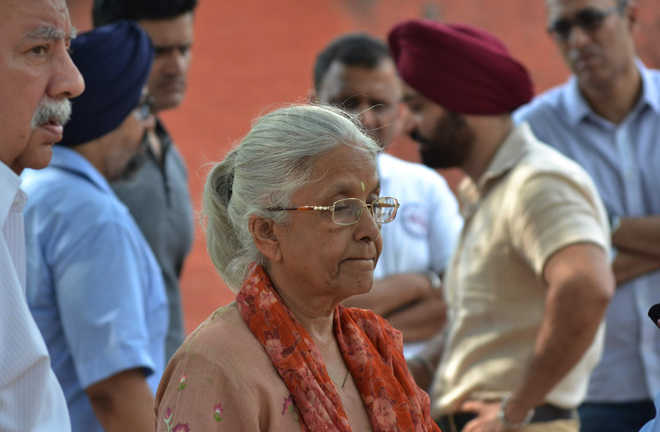
Army Chief Gen Bipin Rawat honours Lance Naik Hanamanthappa’s widow on Sunday. Manas Ranjan Bhui
Tribune News Service
New Delhi, January 15
Army Chief Gen Bipin Rawat today warned jawans against using social media platforms to air complaints saying such personnel shall be liable for punishment.Addressing troops on Army Day, Gen Rawat said the Army had well-established norms to address complaints and using social media to express grievances was lowering the morale of security personnel.The Army’s social media policy allows jawans and officers to use social media platforms like Facebook strictly for their family and private lives. Revealing one’s regiment, location, rank or military identity is barred. Hence, no pictures or videos of self in uniform are allowed and no opinion on military issues can be presented on social media.Referring to the use of social media, Gen Rawat said: “Aapne jo karwai ki hai aap iske liye apradhjanak hain, aur saza ke haqdaar ho sakte hain (You are violating rules by your act and you could be punished for that).“If any jawan has any grievance, he has been provided with a proper forum to resolve his issue and maintain a balance. If you are not satisfied with the action, you can contact me directly,” he said.Gen Rawat also said that despite Pakistan’s continuous engagement in proxy war against India, “we want to restore peace on the Line of Control”. “But we will not hesitate from giving a fitting reply in case of any ceasefire violation,” he asserted.The Army Chief awarded gallantry medals to soldiers who showed extraordinary courage while performing duty.On the terror menace, he said that in the last few months of 2016, the security situation in Jammu and Kashmir turned very volatile.”Be it LAC (Line of Actual Control) or LoC (Line of Control), we will take the appropriate action and our soldiers are doing a commendable job on all fronts,” he said.Later in the evening at the ‘at home’ function at the Army Chief’s residence, Defence Minister Manohar Parrikar said a new mechanism was being put in place to ensure the system of having a Sahayak was streamlined. The Army has proposed that the regular Army Sahayak should not be given in a peace station.Every year, Indian Army celebrates 15th January as Army Day to commemorate the day when General (later Field Marshal) KM Carriappa took over the command of Army from General Sir FRR Bucher, the last British Commander-in-Chief in 1949 and became the first Commander-in-Chief of Indian Army post-Independence.

350-ft-high border Tricolour at Rs 4.5 cr
Amritsar Improvement Trust to foot bill for ‘tallest flag’ near Wagah

Jupinderjit Singh
Tribune News Service
Chandigarh, January 15
Away from the din of ensuing Punjab Assembly election and rhetoric on nationalism over surgical strikes, work is on war-footing near the Wagah Border to hoist the tallest national flag in the country.At more than 350 feet high, the flag would be around 100 feet taller than the Qutub Minar. The work is expected to be over by January 26. Local Bodies Minister Anil Joshi said the flag would be an additional attraction to the large number of tourists visiting the border. “The cost of the project is Rs4.5 crore. The Improvement Trust, Amritsar, is funding it,” he said.The work to lay the foundation, around 20 feet underground, for the giant pillar to hoist the flag is underway. The site is 200 metre short of the India-Pakistan border. “Twenty-four extra flags will be given to the BSF so that there is no delay in replacing it if damaged,” Joshi said.Earlier, a site closer to the border was shortlisted for the purpose but due to some restrictions on erecting high installations near the International Border, it was decided to install the flag at a distance.The project was first delayed as the initially chosen land belonged to the Defence for which the permission of the Ministry of Home Affairs was required. “To save time, a piece of land of the State Tourism Department was selected and approved,” Joshi said.He said earlier his ministry had funded erection of the 170-foot high national flag on the Wagah border. “We thought it was the tallest but it was not. So, we decided to install a flag taller than the Qutub Minar,” he added.

Within five days of his assumption of the high chair of army chief Gen Bipin Rawat set out for Jammu & Kashmir; a trip almost every predecessor of his undertook within a few days of their elevation too. Interestingly across the border, newly appointed Pakistan army chief Gen Qamar Bajwa undertook the same pilgrimage to PoK just a month earlier.
The guns fell silent after Bajwa’s trip although reading much into that could be premature. ‘General Winter’ has far reaching effects on security matters. Despite the Akhnoor terror attack on a civilian labour camp of the Border Roads Organisation on January 9, Gen Rawat may still have a good three or four months to refocus on his erstwhile hunting ground, without too many distractions.
In a media interaction the army chief referred to the Centre of Gravity (CoG) of the asymmetric proxy war in J&K and repeated the commonly understood notion, that the people are the CoG in this situation. But unlike his predecessors he went a step beyond and stated that it’s not people alone but ideas, emotions and propaganda that drive them which is the actual CoG.
In military terms, CoG is “the source of power that provides moral or physical strength, freedom of action, or will to act”. It is the core centre of the adversary’s strength the targeting of which is essential and around which a strategy is developed.
In the First Gulf War the CoG on which US concentrated was the Iraqi Republican Guard; once neutralised, the rest was a cakewalk. In the Second Gulf War the US and its allies focussed on regime change which made Saddam Hussein the CoG. It’s a little more abstract than that in asymmetric warfare, where a campaign targeting a CoG may stretch many years.
In 2011 a middle level, well-educated officer who knew the Valley extremely well argued through a paper that for long India correctly identified the ‘people of J&K’ as the CoG and yet made a mistake. The strategy was to work towards keeping people on India’s side through sops, development work and good governance, to meet basic aspirations of physical comfort and quality of life. However, Pakistan and the separatists were working on the minds of the people, continuously impressing on them the ideas of azadi and Islamic affinity.
Thus, the terrorist first targeted the locals who were not in line with terrorist thinking. Second, terrorist acts against the security forces were aimed at demoralising and weakening them. The third aspect was the most important: propaganda targeting the populace to keep them wedded to the idea of sacrifice for azadi, the need for being a part of the larger Islamic movement of resistance to non-Islamic forces, to remain steadfastly anti-India.
The Indian strategy has only revolved around countering the first two aspects, both related to terrorists. The idea of a strategy to keep the people on India’s side has only been supported by the Army’s Op Sadbhavna, a good hearts and minds measure but only at the tactical level. Even Sadbhavna fails to target the belief, ideology and thought processes which form the basis of the struggle for azadi. It also does not assist in restoring self-esteem and sense of loyalty to the nation, both of which have progressively dwindled over time.
That explains where the Indian strategy has gone wrong. The ability to defeat ideas on an intellectual plane has escaped our planners and strategists. Our inability to research on intellectual soft power and study hybrid conflict in its entirety, has brought us to the current impasse through a period during which the Valley was radicalised under our noses.
Gen Rawat’s coming as the army chief and his full knowledge and experience of the way it needs to be handled can be a great force multiplier, provided the authorities give him a patient hearing and not only allow him to follow his head and heart but back him to the hilt. Once that realisation dawns this conflict will mainly be fought in a different dimension, the information domain

Tribune News Service
Dehradun, January 12
The Sainik Samaj Party in Uttarakhand today announced candidates for the seven Assembly seats. It said more candidates would be declared shortly.Announcing the candidates, Sainik Samaj Party president Lt Col Balbir Singh Parmar (retd) said dedicated party men had been given tickets and he was very hopeful that they would emerge victorious in the poll battle.He said Om Prakash Panwar would be the party candidate from the Luxor Assembly seat. He said Shiv Kumar would be contesting from the Yamunotri Assembly seat and Sita Ram Rankoti would be the party candidate from the Deoprayag Assembly seat.Further, Usha Negi will be contesting from the Narendranagar Assembly segment and Surya Prakash Lodhi will contest from the Doiwala Assembly seat.Pallavi Kukreti has been given the party ticket from the Khanpur Assembly seat and Narayan Thapa will be contesting from the Sahaspur Assembly seat.Lt Col Parmar said the time had come for ex-servicemen to take head on the BJP and the Congress in the state. He said the people of Uttarakhand were fed up with both the BJP and the Congress as both these parties were neck deep in corruption and clean governance was the need of the hour. He said the Sainik Samaj Party was of the firm opinion that the issue of permanent capital for Uttarakhand should be addressed for one and all. He said the Panchayati Raj arrangements must be strengthened in order to empower rural areas of the state.
Simran Sodhi
Tribune News Service
New Delhi, January 12After China, it is now the turn of Pakistan to fret and fume over India’s testing of the Agni-IV missiles. Pakistan has now raised its “concerns” about India’s testing of intercontinental ballistic missiles (ICBM) which it claims can pose a danger to regional peace and stability.According to a report in the Pakistani media, these “concerns” were raised by Pakistan during a meeting with members of the Missile Technology Control Regime (MTCR) delegation which is currently in Pakistan.The MTCR is a 35-member grouping that places voluntary restrictions on its members’ exports of missile and missile-related technology. Using that platform, Pakistan raised its concerns that “highlighted the risks posed to regional peace and stability due to the introduction of destabilising systems such as missile defence programmes and ICBMs”.Pakistan also lost no opportunity to press upon the members of the MTCR of its commitment to sticking to the guidelines. A statement issued by the Pakistan foreign office today said the agenda for talks included latest political and technical developments in the MTCR.Additional Secretary Tasnim Aslam from Pakistan briefed the MTCR delegation on Pakistan’s contribution to international efforts aimed at preventing the proliferation of weapons of mass destruction and their means of delivery.“Pakistan’s export control regime is on a par with the best international standards and its national control lists encompass the items and technologies controlled by the MTCR,” a Pakistan foreign ministry official informed the delegation.
CHANDIGARH : Punjab Congress chief Captain Amarinder Singh on Tuesday met Bihar chief minister Nitish Kumar over lunch and invited him to campaign for the party in the state.
PTIBihar chief minister Nitish Kumar presenting a memento to Punjab Congress president Capt Amarinder Singh in Patna on Tuesday.
Amarinder, who was in Patna to take part in the 350th birth anniversary celebrations of the 10th Sikh Guru, Gobind Singh, offered prayers at Takht Harmandir Sahib and praised Nitish for taking personal interest in making elaborate arrangements for the Parkash Parv.

Tribune News Service
Ambala, January 2
Air Commodore LK Chawla has become the new Air Officer Commanding (AOC) of the Air Force Station here. He took over the command from Air Commodore Tejinder Singh during a ceremonial parade held at the Air Force Station today.An alumnus of the National Defence Academy and the Defence Services Staff College, Air Cdre Chawla was commissioned on December 17,1988, in the fighter stream of the Indian Air Force (IAF). He is an experienced fighter pilot with more than 4,300 hours of accident-free flying on various fighter and trainer aircraft of the IAF.Meanwhile, Swapna Chawla has taken over as the president of the Air Force Wives Welfare Association (Ambala) from Nancy Singh.
Vijay Mohan
Tribune News Service
Chandigarh, December 23
The Principal Bench of the Armed Forces Tribunal (AFT) today allowed a bunch of petitions seeking grant of non-functional upgradation (NFU) to all armed forces officers on similar lines as it was implemented for civil services in connection with the Sixth Pay Commission.(Follow The Tribune on Facebook; and Twitter @thetribunechd)The AFT’s order marks a turning point in a long battle for parity that saw a lot of legal and bureaucratic wrangling. The NFU was among several issues involving benefits and status that the armed forces wanted to be addressed. Several issues are still to be resolved. Justice BP Katakey and Lt Gen Sanjiv Langer said the NFU for all officers of the three services would be applicable with effect from January 1, 2006, although the arrears would be restricted to three years from the date of the petition.Disposing of the petitions filed by Col Mukul Dev from the Judge Advocate General’s Department and about 160 other officers, the Bench also directed that in case the government decided to include NFU for civilians under the Seventh Pay Commission, the same would also be extended to armed forces officers. The Bench also rejected the Union of India’s prayer for leave to appeal to challenge the order in the Supreme Court.The NFU scheme, implemented by the UPA government in 2008, entitled IAS officers and other Group-A officers to get pay scale of the highest promoted officer of their batch even if they were not promoted. The affected non-promoted officers are given the higher grade two years after their batchmates are elevated.Unlike civil services that have a cylindrical hierarchy, the armed forces have a pyramid structure and many officers do not make it to the next selection-based rank, making the issue of stagnation much more severe in the forces. On implementation, the NFU was not extended to the armed forces and a few other organisations. The central armed police forces also got NFU after intervention by the Delhi High Court.“The judgment implies that officers of the armed forces, whose status had been downgraded as their civilian counterpart started drawing higher salary and grade pay, will now be restored,” Col Rajiv Manglik, the petitioner’s counsel said. “Besides averring that the denial of NFU was unconstitutional and a violation of the principle of equality, we had contended that the armed forces fulfilled all six parameters laid out by the government to categorise Group-A services.” There are several civilian cadres that do not meet all parameters but have still been classified as Group-A services.
The Centre should have given better reasons to justify General Rawat’s elevation than just his experience in J&K,
writes H
ARWANT SINGH
Selecting an Indian Army chief is the prerogative of the government. As a practice, five to six names are put up to the Appointments Committee of the Cabinet and it is left to the panel to decide on who on that list is most suitable for the post.
KUNAL PATIL/HTLt Gen Bipin Rawat pays tributes to war martyrs during a function to commemorate the 1971 war victory, Mumbai, December 16, 2015
All the commanders considered for this post are competent and meet the parameters needed to hold the coveted post. So, the government needs to have some very compelling reasons to bypass seniority.
There have been just two cases in the past when seniority was overlooked. Once, it was done in the case of Lt-Gen SK Sinha and the second for Lt-Gen Prem Bhagat, VC (Victoria Cross). In both these cases, the officers overlooked were competent officers but were perceived as forthright and strong personalities. Perhaps the then government did not feel comfortable dealing with them.
For Lt-Gen Bipin Rawat’s elevation the justification offered by the ministry of defence is his experience in counter-insurgency operations and his long tenure along the Line of Control (LoC) in Jammu and Kashmir. Many defence experts too are giving the same argument as the ministry: That terrorism in Jammu and Kashmir and counter-insurgency or what is also known as “asymmetrical war” is of greater relevance to the country than a full-scale conflict with an adversary.
We seem to forget that the main task for the Indian Army, with its large troops and the essential arsenal, is to secure the country’s borders and fight a full blooded war against an enemy, when pushed into such a situation. Counter insurgency in the Northeast and terrorism in Jammu and Kashmir, at the scale faced by the country should be handled by state and central police forces. Unfortunately, as of now, these do not measure up to the task, both in training and junior leadership. Therefore, the army has to chip in.
Going by precedence, it can be recalled that on Gen Bipin Joshi’s sudden demise while in office, the one promoted to the post of army chief was then the senior-most, although he had not been general officer commanding-in-chief (GoC-in-C) and was merely looking after training aspects. The next in the line had distinguished himself in the 1962 and 1965 wars. However seniority prevailed.
So the argument that the one now promoted has more experience in an area, which decidedly is of relatively less importance, compared to the larger tasks set out for the Indian Army, cuts little ice. It is the overall national security scene, the deteriorating relations with Pakistan, its close links with China and more recently Russia, which should beep on the Indian security radar. The geostrategic scenario, the ever-tightening “string of pearls” around country’s neck, should be an area of greater concern than insurgency. Only the short-sighted can fail to see the emerging threats to national security at the strategic level.
In a possible future scenario, India should prepare to face a two-front conflict. The threat from the use of tactical nuclear weapons is another area demanding very careful responses, where experience in fighting terrorists and lowlevel counter-insurgency operations have no relevance. In any case these operations and on the LoC have little connect at the level of an Indian army chief and are effectively handled at much lower levels.
An army chief who cannot render firm advice to the political leadership in operational matters, is likely to bring about a national disaster. Had General Pran Nath Thapar firmly advised the government against the “forward policy” and offensive action at Thagla Ridge, when the Indian Army was in no state to go to war with China, the ignominy of 1962 could have been prevented.
Had Gen Sam Manekshaw not firmly held his own against the political leadership’s demand to commence an early war against East Pakistan, India would have suffered a defeat as severe as the one we received against China. General Manekshaw was willing to resign than go against his own professional assessment of the situation. It was the political leadership, which eventually profited from the general’s decision.
Since all those considered for elevation to the post of army chief are equally competent, the political leadership, if it wants to bypass seniority, must take into reckoning the quality of forthrightness. The one selected should have the gumption to tell the government not what it wants to hear but what it must hear. Such military commanders act in national interest and in the long run, the interest of the political leadership.
In the present case, the government has simply failed to come up with any compelling reasons to break the chain of seniority and has in fact, politicised the appointment of the army chief.
Lt Gen T S SHERGILL ,PVSM WRITES
An extremely sensitive and important appointment ineptly handled.All Corps and Army Commanders are competent to be appointed COAS as they have 36 years and more of experience.At this rank they are well above the need for sector profiling for placement; the COAS does not command troops, Army Commanders do.Wise Army Commanders do not fight division or brigade battles that are the the responsibility of Corps Commanders. Counter insurgency is fought and won at most at battalion level. The Chief of the Army ‘Staff’ is far removed from this. So the government is wrong on two principles,first, Sector profiling is no pressing reason to appoint a COAS;second, an six to eight weeks early time is necessary to enable a COAS designate to plan his team and achieve a smooth transition…India is not at war unless the poor hit by demonetisation call that and in which a new COAS has little role to play.A forthright government would have made the announcement accordingly and explained why competent generals have been superceded unless there were something to hide. Were there other reasons? We may never know however the government will be unable to remove the shadow of politicisation of the Army by an act that lacks moral courage.The ‘team’ implies senior Principal Staff Officers in Army Headquarters not personal staff like A’DC. As mentioned in my post there is nothing wrong in ‘deep selection,’ all Corps and Army Commanders could be considered.However, it is better to let the environment know it is being considered and afterwards give substantial reasons for doing so, for instance creating a ‘young’ higher command profile that would justify even a Corps Commander being appointed.Merely Sector Profile does not wash; the persons to be convinced is the Services leadership otherwise such decisions lead to avoidable controversies as this one or like previous cases.The Chief Justice of Supreme Court and Chairman of UPSC are appointed by seniority of Justices or Members respectively precisely to avoid controversy however strange it may seem that an appointee might perform for only a few months in that appointment.Promotion by seniority is probably not the best way but to have another process for selection should involve a known well thought out policy.
THE NEW ARMY CHIEF BY LT COL NOEL ELLIS (RETD)
Congratulations Gen Rawat for being nominated to take over the world’s best Army. My congratulations to the new Air Chief designate Air Marshal Dhanoa too. Both of you have herculean tasks ahead. May God grant you the wisdom, strength and acumen to carry them out in a professional manner and may you also do something to stop this constant bickering amongst certain people especially the disgruntled lot. They only find faults with anything and everything, including your appointments. Well, in today’s world everyone has a birthright to crib and squabble. Everyone has his own favourites, likes, dislikes and everyone has his point of view. Now that the government has taken a decision, accept it and be done with it, the sooner the better. If someone can change this decision, then do it and if you can’t then let these people do their jobs.Yes I feel bad for Gen Bakshi, he was my instructor in ACC&S long time ago, but maybe there are better things in store for him. I personally feel very bad for Gen Hariz, as I personally know him, and we wore the same RECCE & SP (TR) badge. Naturally guys, if given a choice to me I shall chose him first being from the Mech fraternity, in fact my second choice would have been Gen Bakshi as I have a soft corner for him, being from the Mech forces again and having been my “ustad” many moons back. Gen Rawat would have been my third choice, as I don’t know him at all. I believe he is a very highly decorated officer, and I am sure the merit system must have been put in place before the final decision to appoint him was taken. I have no doubts. So why is there so much fretting and fuming amongst the armed forces fraternity. Now some politicians who don’t know the D of Defence have also jumped in and trying to gain political mileage for no reason.Ok let us for the time being just assume that a person X has been appointed the army chief. So what are the expectations from him today is one part of the question. The second part is that what he should do for the army to make it the fittest fighting machine against all adversaries. Now, the expectations would differ with who needs what, so let’s take the ex-servicemen for instance. They want the OROP to be implemented as they are already tired of protesting and look at you as a messiah. The serving want the 7th pay commission recommendations implemented tomorrow, with all anomalies removed. Thirdly, I will like to pay no income tax, for which I would like to push Gen X to fight with the government tooth and nail from tomorrow. I would like MS branch disbanded, as they never give any choice posting ever. In fact when you say you don’t want Delhi they send you to Delhi. I remember telling them to leave me in the unit as it was my last chance to appear in Staff College, they posted me to an Assam rifles unit, that too under a sector HQ RR in the Kashmir valley. Thank God I passed the exam from there.Here after come the real wishes that every commander should have a Mercedes Benz as a staff car, every CO to have a Range rover, then only every Lt Col and below may get a gypsy. I would like to have free rations to be picked up from big basket and home delivered even if I am in field. If they can’t deliver there then Gen sir the same should be delivered to where my family stays, extra bread, eggs and butter included. I would like to have all the in lieu items of ration once in a while. I may be excused from paying electricity and rent of any kind to the government for any kind of house or furniture which is provided to me. I would like the MES also to be disbanded and people like L&T or HCC to build for the army. I would like to have any other pen in place of “Pen Wilson” from my ACG funds. My quota of liquor needs to be increase to 24 bottles irrespective whether I drink them or not. These are just a few demands Chief, in case you are capable of getting me all this, then my vote is for you, otherwise, I shall curse the system till cows come home. One more thing, the railways and the airlines have to give me and my family confirmed seats free of cost, then I will consider you as the man who matters.Now comes the other items on the agenda which might be required for national interest. We want the best of guns; best of equipment, best of clothing, best of transport, and best of you name it. In case the government cannot provide all these within 4 months of you taking over, I want you to put in your resignation the next day.Then I would say that you have the guts to shake the government. You have to get all pay and allowances cleared or else put up your resignation, then I shall consider you to be the Chief with certain principals. All tanks, all ammunition has to be made up and all Capex utilised in the first year of your taking over, otherwise you will send your resignation to the PM along with your yearly report on the fitness of the Army.Then will I consider you to be worth your salt. You have to sort out Pakistan, without a single casualty, and Pakistan should be on its knees, before the next Army commander’s conference you chair. Then probably you would meet our standards to be the army chief. Well the list is never ending.Well ladies and gentlemen, enough of fiction, enough of day dreaming, and enough of bak-bak. Given a choice, I would love to sit in the bar of Le Meridian, and fight a war on social media and destroy all my enemies while having a glass of beer. Can a Chief do what we expect out of him, or is he made the chief to do what the Nation and the supreme commander wants him to do within the means that the country can afford. I am sure there is ample space of improvement and ample budget available for everything. But can procedures and systems be bypassed. Is the Chief going to fight those tactical battles at ground level or is he going there for strategic thinking and implementation? Is the chief going to forecast the Army in 2050, or is he going to be the fire fighter in chief; that he keeps dousing one fire after the other. Are we as field commanders doing our bit to make life easy for him to fight the political bigwigs? Are we doing our bit to ensure that the chief doesn’t keep rushing from post to post? Friends he has seen enough of posts, now it is our turn to defend the country and defend it to the best of our abilities. No more heads severed and taken away, no more failed infiltrations bids. Let us sort these buggers out for our senior commanders to do what they are meant to do.Well, had I become the chief I would have done it all, however, I would have been thrown out on day one for my dislike of politics and the politicians. I feel bad when people bring in the communal angle of a “Bhulla” and a “Kancha” in between. Not warranted and not done. My best wishes to the ones who missed out on this and God Bless and God speed to you Gen Rawat. I am waiting for the day when my course mate becomes a chief of either of the services. Maybe then I may come to know what goes into making a chief, and then I may also ask him how uneasy lies the head that wears the crown. I am really waiting for that day, but will they tell me the inside story? I wonder!!!!!!!!!!!
Lt Gen Vijay Oberoi WRITES
CHANDIGARH: For the uninitiated, ‘Langar Gups’ are rumours in the army that emanate from Messes, where uniformed persons gather and discuss issues pertaining to the military in general and the army in particular. Although ‘Langar’ refers to Jawans’ Messes, the term generally refers to discussions where officers, JCO’s and Jawans congregate and ‘shoot the breeze’!For over a month and more, when the appointment of a new Chief of the Army was not announced, speculation started and evolved into Langar Gups, with all kinds of permutations and combinations emerging. Many claimed inside knowledge about who will be the next Chief and the rank and file, besides being perturbed as to why the announcement was not forthcoming, rightly smelt that the powers that be were up to some hanky-panky! The startling news about the appointment of the next Chief of Army that was announced on December 17 confirmed it.Generally, appointments of new incumbents at the higher levels of the armed forces are announced two to three months in advance. This is because unlike hierarchies of police, bureaucracy and others, the armed forces being the custodians of the nation’s security are much more important appointments and need to be announced much before time and thereafter filled on the stipulated dates. If this is not done, not only the contenders remain on tenterhooks but also wrong signals are sent across the board that ‘all is not well’ and possibly some kind of nefarious activities are in the offing.In the last few months unfortunately, even Headquarters Command remained headless over months and hence it was clear to the discerning that the politico-bureaucratic combine was up to some tricks! The announcements of the new Army and Air Chiefs at such a late stage have confirmed such misgivings.In countries like Pakistan, where the elected representatives are mortally scared of the powerful army that can manouvre a military take-over in a jiffy, it is standard for the elected elite to weigh all consequences till nearly the last date, but in democracies such things do not and must not happen. Therefore, the only conclusion is that the leaders and their advisers are up to no good.Announcing that Gen Vipin Rawat will be the next Chief of the Army, superceding two General officers senior to him smacks of both arrogance and stupidity on the part of the present government.Let me clarify that giving lame excuses of operational experience or lack of it does not cut ice with veterans like me who are experienced and are ‘au fait’ with the tricks of governments.For the uninitiated, please note that officers are posted to appointments in accordance with well laid out systems based on their profiles, and no one opts for so-called operational appointments or otherwise. It is all the luck of the draw and when officers become army commanders, they all are professionally the best, otherwise they would not have reached such exalted heights.In my considered view, it is more important to have a full tenure as an army commander and not a truncated one of a few months to command the third largest army in the world. Commanding at various levels up the chain adds to one’s experience as a professional, but it will only be naïve persons who will place experience of commanding an army lower than commanding units and formations at subordinate levels, whether in counter-insurgency operations; on the borders; or elsewhere.It is no doubt the prerogative of the government of the day to appoint whoever they consider meets their criteria, but governments usually think many times before grossly interfering with what has generally been happening in the past. Trotting out excuses justifying their actions and scotching perceptions with lame excuses tend to reinforce that there was some skullduggery indeed. Yes, even in the past there have been a few instances where the seniority principle was sacrificed, but they were quite unconvincing.Before I give my views on this episode, let me go back in time and recapitulate instances of the past where practically more harm than good ensued on account of unwarranted interference, mostly on specious (read political) grounds.The easing out of General Thorat by the then combine of Prime Minster and Defence Minister and appointing General Thapar instead, was a case of sacrificing merit and professionalism at the altar of sycophancy that resulted in the biggest debacle for our country in 1962. The excuses now trotted out were uttered earlier too, when the highly professional and greatly admired late General SK Sinha was passed over, ostensibly for lack of operational experience, when the actual reason was that he was opposed to military action against the Punjab militants; what followed is well known. In keeping with the credo of an officer and a gentleman, he quietly resigned and went home.Later, the same General (with less operational experience, as the government had averred!) was appointed Governor in two insurgency-infested states, which he managed adroitly and with aplomb!Even earlier, the highly professional, highly decorated and a soldier’s General – PS Bhagat was denied his rightful appointment, based on whims and ulterior motives by another Prime Minister. In each of these cases, the political leadership succumbed to the manipulators, mostly bureaucrats, sycophants and parochial advisers.At this stage, I need to narrate a discussion held on the sidelines of a seminar at the College of Defence Management Secunderabad, many years back. During a discussion I had with two cerebral military intellectuals – Gen Raghavan and Air Vice Marshal Kak, the three of us discussed the pros and cons of selecting a service chief on the basis of seniority as was the norm vis-à-vis an open-ended selection from the C’s-in-C.After weighing the issue with great deliberation, we came to the conclusion that there were more negatives in the latter, as chances of selection based on political, sycophantic and non-professional reasons may become predominant in due course, with professional and character qualities being sacrificed on account of extraneous issues. With such precedence’s, even appointments of Army and Corps Commanders may meet such a fate later, throwing professionalism to the winds.I have no quarrel with the Chief-Designate, as I hardly know him, but it is the principle that is of utmost importance. Personalities are passé, but institutions like the army are far too important to be fiddled with because of political, parochial or other considerations. We are fortunate that the nation has a highly apolitical and professionally competent army, which will continue to conduct itself with élan and pride irrespective of who leads it. We have had a gamut of average leaders, along with a few highly superior ones, but the Indian Army has weathered all storms and stood stoically to defend the nation. Two more points before I sign off. If the present Prime Minister continues with his dictatorial ways, like the first Prime Minister of Independent India did, without consulting advisers who would give him unbiased advice, then the nation is in big trouble. Rhetoric’s with modulated utterances may go down well with ignorant masses, but they are no substitute for good governance. Secondly, it is only Modi Bhagats, including the few still in the armed forces with their personal agendas, are quoted by the Sarkari propaganda machine and the paid media, while the bulk of the citizenry is not at all convinced.The moot point remains that the nation and the army needs an Army Chief that delivers and not one who sways with the wind because he is grateful for small mercies! Let me end with the optimistic note that the new incumbent will take the army to greater heights of professionalism and pride and not succumb to blandishments and sweet words.(The writer is a former Vice Chief of Army Staff)