All posts by webadmin

Army bids adieu to slain soldier

Army bids adieu to slain soldier
Army personnel and local villagers carry the coffin of slain soldier Lance Naik Mohammed Naseer to his village in Ajout, Poonch district, 260 km from Jammu, on Sunday. PTI

Tribune News Service

Jammu, July 16

The Army today paid bid adieu to Lance Naik Muhammad Naseer, who was martyred on the Line of Control (LoC) in the Rajouri sector yesterday while responding valiantly to unprovoked firing by Pakistan at the Line of Control (LoC).Wreath-laying ceremonies were organised at Rajouri and Poonch where wreaths were laid on behalf of the GOC-in-C, Northern Command, GOC, 16 Corps, GOC, 25 Division and the Commander, 93 Brigade.The mortal remains of the soldier were then sent to his native village for performing the last rites. Lance Naik Naseer, a native of Poonch district, is survived by his wife and three children.


India developing nuclear arsenal with an eye on China: US experts

Washington, July 13

India continues to modernise its atomic arsenal with an eye on China and the country’s nuclear strategy which traditionally focused on Pakistan now appears to place increased emphasis on the Communist giant, two top American nuclear experts have said.An article published in the July-August issue of the digital journal- After Midnight has also claimed that India is now developing a missile which can target all of China from its bases in South India.India is estimated to have produced enough plutonium for 150–200 nuclear warheads but has likely produced only 120–130, wrote Hans M Kristensen and Robert S Norris in the article — “Indian nuclear forces 2017”.India’s nuclear strategy, which has traditionally focused on Pakistan, now appears to place increased emphasis on China, the two experts claimed. — PTI


GORKHA STIR Violence, arson back in Darjeeling GTA office, rly station set on fire; several government vehicles damaged

Violence, arson back in Darjeeling
Gorkha Janmukti Morcha activists block a road at Panighata in Siliguri on Thursday. PTI

Darjeeling, July 13

A GTA office was set on fire and several vehicles were damaged in Darjeeling today as the indefinite shutdown in the hills entered the 29th day.The Gorkhaland Territorial Administration (GTA) office for travel and tourism in Chowrastha of Mall Road in Darjeeling was set ablaze by pro-Gorkhaland supporters early morning. Several government vehicles were also damaged near the Darjeeling station by unidentified men last night.A railway station in Gayabari area of Kurseong was set on fire by pro-Gorkhaland supporters this morning. A forest bungalow near Teesta river was also set on fire today.The convoy of state tourism minister Gautam Deb was also attacked on the way to Darjeeling’s Panighatta where the minister was going to attend a programme on the occasion of poet Bhanubhakta Acharya’s birth anniversary.Meanwhile, responding to the call of the Gorkhaland Movement Coordination Committee (GMCC), a writer and a singer returned the awards given to them by the state government.The GJM and pro-Gorkhaland supporters today celebrated the birth anniversary of noted Nepali poet Bhanubhakta Acharaya. Hundreds of Pro-Gorkhaland supporters today took out colourful rallies reciting poems written by Bhanubhakta Acharya and carrying placards in favour of separate state of Gorkhaland. Internet services remained suspended for the 26th day.Except medicine shops, all the shops, restaurants, schools, colleges, hotels and private offices remained closed. The police and the security forces maintained a tight vigil at all entry and exit points.

‘Hold tripartite meet’

CPM general secretary Sitraram Yechury on Thursday said Union Home Minister Rajnath Sigh must convene a tripartite meeting of representatives of the Centre, state government and GJM leaders to restore peace in the region. — TNS & PTI

Gorkhas return awards

  • Expressing support for a separate Gorkhaland state, Gorkha public figures gave up their awards on the birth anniversary of Nepali poet Bhanubhakta Acharya
  • Those who gave up their awards are Nepali writer and translator Krishna Singh Moktan, musician Karma Younzon and Principal of Kurseong College Prakash Pradhan
  • “More than any award, it is Gorkhaland which is important for us. Once it is formed,I will receive many awards from it,” said Younzon,who received the ‘Sangeet Samman’ last year

Grievance redressal camp for ex-servicemen, widows

Grievance redressal camp for ex-servicemen, widows
Director Defence Services, Brig Jatinder Singh Arora, distributes cheques among ex-servicemen during a camp at Raikot on Thursday. A Tribune Photograph

Our Correspondent

Raikot, May 11

A panel of office-bearers of the District Defence Services Office, Ludhiana, redressed problems of over 400 ex-servicemen and widows of defence personnel from various localities of the subdivision during a camp organised here today.Director, Defence Services, Brig Jatinder Singh Arora, presided over the function and district welfare officer, Lieut-Col (retd) Jasbir Singh Boparai, was the convener of the camp. The organisers distributed cheques to beneficiaries of various schemes being launched by the Union and the state governments for families of ex-servicemen from time to time.Illustrating modalities for availing welfare schemes for the defence personnel, the speakers including Brigadier Arora, Lieutenant Colonel Boparai, Wing Commander Gurpreet Singh Mangat, Major Bahadur Singh and Major Gurdeep Singh, said members of families of defence personnel and ex-servicemen should consult officials at the district defence welfare office in Ludhiana according to their convenience.The speakers highlighted salient features of various schemes and facilities being provided to families of ex-servicemen and defence personnel from time to time.Concessional supply of durable and consumable items, education for wards of ex-servicemen and reservation in various departments of the Union and state governments, were cited among special facilities.


Dilemma of a two-front war by Maj Gen Ashok K Mehta (retd)

Obsessed with Pakistan, India has grossly neglected the real adversary. In point-to-point skirmishes and standoffs, battle- hardened Indian soldiers will deter, if not defeat, the PLA. However, across a broad front spectrum in an unlikely all-out war, it is advantage China.

Dilemma of a two-front war
CHINA THREAT: This file photo taken on July 10, 2008, shows a Chinese soldier (L) next to an Indian soldier at the Nathu La border crossing between India and China in Sikkim. AFP

At a time when China is threatening to teach India another lesson and warning not to engage in a two-front conflict over the standoff in Doklam, our Service Chiefs, it seems, are not on the same page about fighting a two-front war especially as Beijing might try to emulate the New Delhi-Thimpu alliance in “disputed territory” with one with Islamabad in PoK. While General Bipin Rawat has more than once asserted the Army’s preparedness for a two-front war, Air Chief Marshal BS Dhanoa has highlighted the critical shortfall in the number of fighter squadrons — 32 against the required 42 squadrons — to dominate a two-front conflict, saying: “It is akin to a cricket team playing with seven players instead of 11”. The deficiency in air assets has existed for decades but this is the first time an Air Chief has related it to a two-front war. The Chief of Naval Staff, Sunil Lanba, when asked about the disparity in preparedness of the services, said: “The way national security is being handled is not commensurate with the security environment which is extremely serious at the moment”. Recently, Gen Rawat told a military audience that the military was not getting enough funds for modernisation — repeated ad nauseum by every Chief — due to the perception that expenditure on defence is a burden on the economy. This set the cat among the pigeons as Finance Minister Arun Jaitley, a regular fill-in for Defence Minister, is believed to have told Gen Rawat: “Don’t worry about funds. When you run out, call me”. In the mid-1990s, when the Naval Shipyard order books had gone dry, CNS, admiral Vijay Shekhawat went public about the Navy’s operational deficiencies, prompting Defence Minister Mulayam Singh Yadav to invite him to discuss dwindling fleet numbers. Ad hocism has become the hallmark of modernisation of the military.

Power differential

The Chinese are constantly reminding India about the power differential — military, economic and infrastructural — between them. Being obsessed with Pakistan, India has grossly neglected the real adversary. The reason for this is the institutionalised absence of strategic thinking and higher political direction of war and conflict in the face of growing threats and challenges to internal and external security. Prime Minister Modi’s boast about big  defence reforms is hollow: had he been serious about defence, he would have named a full-time Defence Minister. The appointment of a Chief of Defence Staff has not overcome the hesitation of history — read bureaucracy. The country has never produced a “Defence White Paper” or done a “Strategic Defence and Security” review. Something called the “Raksha Mantri’s Directive” masquerades as higher political direction on deterrence and war. This bit of literature drafted by the military has its origin in 1983, with periodic face-lifts to make it contemporary. The Parrikar doctrine covering surgical strikes was included in the Joint Military Doctrine, scripted by the Integrated Defence Staff, which attracted extraordinary flak from the defence community for being substandard. In its present organisation, each service essentially fights single-service combat. In the last border skirmish at Kargil, the Army’s operation was called Vijay while the IAF campaign in support was named Safed Saagar. So much for jointness.  So the Raksha Mantri’s Directive passes off as political guidance by the highest echelons of government. When I once asked a former Air Chief how he evolved his service’s span of responsibility, he replied: “Most of the time, from speeches made by the Prime Minister during the Combined Commanders’ Conferences.” Are we surprised that while President Xi Jinping who heads the Central Military Commission, has personally ordered and supervised the reorganisation of the combat formations facing India, reducing them from three commands to one command — a single Western Theatre Command headed by the powerful Gen Xhao Zongqi — the China front in India is managed by four Army and three Air commands deployed at seven locations. 

Integrated command

A forward-looking proposal made by a defence committee recommending three integrated operational commands — North, West and South instead of 17 single service commands — was shot out of hand by (no guesses) the Air Force. The CDS and accompanying Joint Staff ordered by the UK in 1984 was a fait accompli. It was introduced by a political class which understood defence and strategic security. In India, countless defence reforms are languishing for want of decision making. It is instructive to recall how the two-front strategy was formally enunciated in December 2009 by the Army Chief Gen Deepak Kapoor. It followed the 2008 Mumbai terrorist attack, after Prime Minister Manmohan Singh ordered the Service Chiefs to prepare for war. Defence Minister AK Antony then had “preparation for a two-front war” added in his Directive but did little to implement it. Both in 1965 and 1971 wars with Pakistan despite the collusive threat from China, there was no cross-border intervention by China though sizeable formations of the Eastern Command remained deployed against it and forces could not be switched to the west or east for fighting in East Pakistan in 1971. In a real two-front war, swing forces in east and west will not be able to reinforce either front and only dedicated formations will fight the war. Given the paucity in current force levels, inadequate sophistry of combat support and terrain and infrastructure handicaps, it will be an uphill task to match the PLA’s strength and versatility across a 3,488-km front of undefined borders. In point-to-point skirmishes and standoffs, battle-hardened Indian soldiers will deter if not defeat the PLA. Across a broad front spectrum in an unlikely all-out war, it is advantage China unless India is prepared to rethink its “no first use” nuclear doctrine. As an offset in the western front, Gen Rawat has suggested creating a two-front situation for Pakistan: either in Afghanistan or Iran. Doklam may go the 1986 Sumdorong Chu way; the 10-month-long standoff challenging the Chinese intrusion at Thandrong, west of Tawang over the interpretation of watershed, without a shot being fired. India need not invoke its doubtful capacity to fight a two-front war; instead, speedily augment its deterrence against China. This may not win votes for Modi but it will prevent Chinese pinpricks that he famously called “toothache”.The writer is the founder-member of the Defence Planning Staff.


Attari post gets modern surveillance equipment

AMRITSAR: After the central government’s failure to install fullbody truck scanners at the Attari Integrated Check Post (ICP) even five years after the proposal was mooted, the customs authorities have acquired modern hand-held detectors for identification of narcotics and explosives traces.

COURTESY: LASER­DETECT.COMThe I­scan equipment, which has the ability to detect traces of explosives and narcotics.

Imported from Israel, one of the equipment called I-scan will be utilised to check the baggage of Samjhauta Express passengers as well as goods trains from Pakistan. “I-scan, which is capable of detecting traces of explosives and narcotics, will come in handy for checking both trucks and scanning baggage of the passengers,” says a customs official, on the condition of anonymity.

The official further added that the testing of I-scans is currently going on and the gadget will be put to use within a week’s time.

Along with three I-scans, which cost around ₹30 lakh, the customs authorities have also bought another device called video boroscope, which will help in checking cavities in the trucks.

The department says it has acquired four video boroscopes.

TRUCK SCANNERS STILL MISSING

The authorities have failed to set up the much hyped full-body truck scanners at the Integrated Check Post (ICP), which was inaugurated to facilitate trade between India and Pakistan in 2012.


More troops for Darjeeling

More troops for Darjeeling
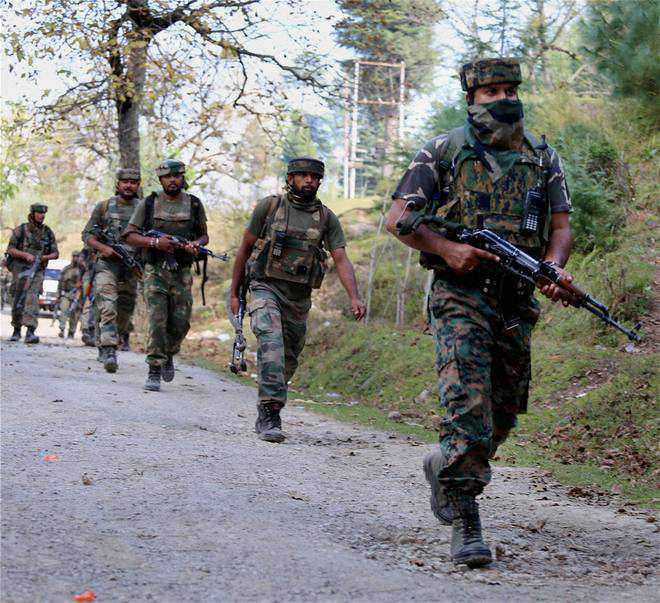
Army men patrol Darjeeling town. An additional column of the Army has been deployed at Kalimpong. PTI

Kolkata, July 10

An additional column of the Army was today deployed in the troubled Darjeeling Hills of West Bengal, taking the number of Army columns in the hills to three.While one Army column each was deployed on Saturday at Darjeeling and Sonada, troops were today deployed at Kalimpong to prevent arson by agitators.Protesters want Gorkhaland, a separate state to be carved out of West Bengal consisting of areas falling in the erstwhile Darjeeling district (split into Darjeeling and Kalimpong districts in February this year). Responding to a call by the Gorkha Janmukti Morcha (GJM), which is spearheading the movement, indefinite bandh is being observed in the hills since June 12 to press for the demand.The GJM-led coordination committee of hill-based political parties was supposed to meet on July 18 to take a fresh call on the continuance of the agitation. However, for reasons best known to the GJM leadership, the meeting of the coordination committee will  be held tomorrow.This has triggered speculation that the GJM may withdraw the indefinite strike and hold talks. At least five civilians have lost their lives till now in the agitation, the government property worth several crore has been destroyed by protesters who have been setting fire to government establishments. — TNS


Hizb killed Kashmiri lieutenant

INSAS shell casings found at spot indicate use of weapon snatched from police

SRINAGAR: Militants of the homegrown outfit Hizbul Mujahideen abducted and killed off-duty army officer Ummer Fayaz in Kashmir’s Shopian, possibly with arms snatched from security forces, a top police officer said on Thursday.

Two news agencies quoting defence sources, however, said six militants of the Hizbul Mujahideen and the Pakistan-based Lashkar-e-Taiba (LeT) were involved in the killing of Ummer, a 22-year-old lieutenant who was on leave for the marriage of his cousin sister.

The army has termed the killing of the young officer, which has sparked outrage across the country, a “watershed moment” that will turn the people of Kashmir against militancy.

“A local Hizbul Mujahideen module was involve(in the killing). Though we have identified the militants, their names cannot be revealed immediately,” inspector general of police Javeed Gillani said.

Investigators recovered two empty cartridges of INSAS rifle from the spot where the officer’s body was found on Wednesday. The officer was shot twice.

A probe was on to check if these were the same cartridges snatched from policemen a few days ago, he added. The made-in-India INSAS rifles are used by police as well as the army deployed in the valley for counter-insurgency operations.

“Although police are yet receive the post-mortem report, preliminary examinations revealed there were no torture marks on his body,” Gillani added, refuting reports that militants assaulted the officer before shooting him dead. The Hizbul Mujahideen is the only homegrown militant outfit in Kashmir battling security forces. The killing of one of its leaders, Burhan Wani, by security forces last year had sparked violent street protests that left nearly hundred people dead, including security personnel.

Hundreds of others, including children, were blinded by pellet guns fired by security forces, stoking public anger. Police said around 200 militants are operating in the valley, out of which around 88 are local youth hailing from South Kashmir.


On Burhan death anniv, Army holds match in his home dist

On Burhan death anniv, Army holds match in his home dist
Pinglana Warriors with the trophy in Pulwama on Saturday. Tribune photo

Tribune News Service

Srinagar, July 9

While the Valley observed a complete shutdown on the death anniversary of Hizbul Mujahideen commander Burhan Wani, the Army organised a series of events for the youth in volatile south Kashmir.The Army organised the final of a cricket tournament yesterday in Pulwama — the home district of Burhan Wani.The Pulwama-based Army camp conducted the final of the Sher-e-Kashmir Inter-Village Cricket Tournament on Saturday. The final was played between Pinglana Warriors and Awantipora Sports XI at the Panzgom cricket ground, an Army spokesman said. Pinglana won by 30 runs.“The game organised amid the various calls given by the separatists on the death anniversary of slain militant Burhan Wani is a reflection of the increasing trust and confidence of the locals in the armed forces, desirable and warranted to bring peace and tranquillity in the Valley,” an Army spokesman said, adding that 16 teams of Pulwama district participated in the tournament that commenced on July 1.In neighbouring Shopian and Kulgam districts, the Army organised a cricket tournament and a trekking trip for a number of youths.“Despite a shutdown, around 250 youths from the volatile areas of Kulgam and Shopian participated in the cricket and trekking events,” an Army officer said.Similar events were held by the Army in central Kashmir’s Budgam district. Victor Force GOC Major General BS Raju said the events were held despite a shutdown.“By holding these events, a message has been conveyed that a large population is not subscribing to separatists and they are ready to take their neck out and be a part of the programmes which show normalcy,” Major General BS Raju said.

‘Goodwill’ events across Valley

  • The Army also organised a cricket tournament and a trekking trip in Shopian and Kulgam districts
  • Despite shutdown, a number of youths took part in the events, showing that they too wanted normalcy, said Victor Force GOC Major General BS Raju

Can’t have your cake and eat it too

The military wants a greater say in policy matters, but it wants to keep civilians out of its domain

Speaking to a military audience in 1973, the eminent war historian Michael Howard said that he was tempted “to declare dogmatically that whatever doctrine the Armed Forces are working on now, they have got it wrong.” But he went to add: “it does not matter that they have got it wrong. What does matter is their capacity to get it right quickly when the moment arrives”. I was reminded of this speech after reading the recently unveiled Joint Doctrine for the Indian Armed Forces. The first such doctrine to be published by the Indian military, it has been panned by many perceptive analysts of military affairs.

All the same, the doctrine is an important attempt by the armed forces to inform and influence public debates on strategic issues. From this standpoint, the most curious part of the document is an appendix on “Civil-Military Relations”. These couple of pages lay out the military’s perspective on what is wrong with our existing institutional arrangements of civil-military relations and how to set it right.

Civil-military relations in India have been balancing on the brink of a crisis over the past few years. Controversies over one-rank onepension and the latest pay commission were symptoms of deeper problems. Yet successive governments have done nothing to address them. The doctrine’s attempt to flag this issue in public attests to the military’s deepening disquiet on this front.

The appendix on civil-military relations opens with a quote from an air marshal: “Direction in the Civil-Military Relationship in any democracy is strictly the right of the political leadership and not bureaucracy”. This harks to the military’s longstanding complaint that civilian control has turned into civil service control. There is something to this claim, though it tends to be overstated in military discourse. Nevertheless, the doctrine is right in observing that “it is prudent that institutional and structural mechanisms exist that facilitate free flowing communication between the two, thereby enabling critical and timely decision making. The functionaries in the MoD ought to be enablers of this relationship.”

More problematic is the military’s own view of how these arrangements should function when it comes to such critical areas as the use of force. The doctrine states: “Military professionals are experts in the use of force under the political institution of the State. Apropos, it would always be essential for the civilian authority, in consultation with military (as part of decision making process) to decide the Military Objective and then leave it to the military professionals to decide upon the best way of achieving the objective.” In other words, the military should have a say in deciding the aims and should be left free to pursue it.

The underlying premise about military professionalism is not as compelling as it sounds. As scholars of civil-military relations have pointed out, the military is quite unlike other professions. Few military officers have actual experience of fighting wars: our top military leadership, for instance, joined the services well after the 1971 war. Treating them as experts in the management of violence is a bit like entrusting a crucial surgery to a doctor who has prepared all his life to perform a surgery without ever having done one. To be sure, the military will always know more about military affairs but there is no reason to presume that they know best.

Equally dodgy is the subsequent claim about operational independence for the military. Earlier, the doctrine quotes Clausewitz’s famous dictum about war being a continuation of politics. But the demand for operational independence is inconsistent with the Clausewitzian view. If war is a continuation of politics, then politics will influence and intervene at levels of warfare down to the tactical. As the recent incident of using a human shield in Kashmir shows, even tactical actions can have political consequences. Hence, there can be no inviolable military sphere–either in theory or in practice. Acquiescing in such a demand will be deeply damaging. The history of our own wars underscores these problems.

It is curious that on one hand the military wants greater say in policy matters, but on the other it wants to keep the civilians out of its domain. The former demand is entirely understandable, but the latter is incompatible with any properly integrated system of civil-military relations. The military can’t have its cake and eat it too. If strategy is the bridge between political ends and military means, then it will have to be jointly constructed by the civilians and the military.