


Tribune News Service,Pathankot, January 3
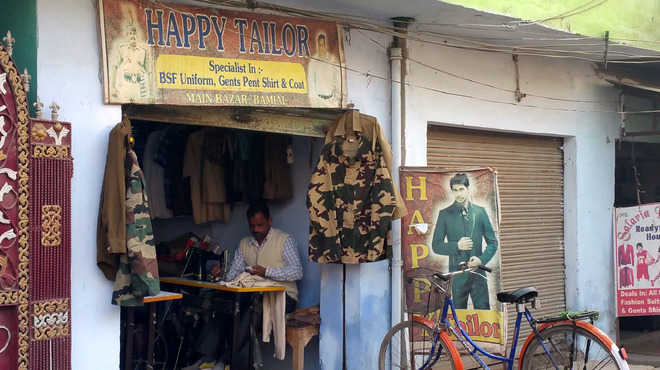
Despite several attacks reported to have been carried out by terrorists donning the Army uniform, such dresses continue to be sold openly in border villages.Happy, a shopkeeper who sells such dresses at Bamyal village, said whenever he sold such a dress to anyone, he would note down his name and phone number in a register. However, he could not produce that register when asked to do so.The situation was even grim in Pathankot town where numerous shops were found selling such dresses openly without even seeking the identity card of the buyers.According to Narayan Singh, a ex-serviceman from the area, the sale of such dresses should be allowed only in the cantonment area. Some serving Army personnel in the market accepted that they were not asked for any identity card or address proof while buying uniforms.
Jalandhar, January 3
Coming into action after reports that the terrorists who attacked the Pathankot Air Force base had come in Army fatigues, the DCP today issued orders under Section 144 of the CrPC asking all shopkeepers and tailors in the city engaged in stitching uniforms for police, defence personnel or paramilitary forces not to sell their items without taking a record of ID of buyer.The orders by the DCP, Sandeep Kumar, passed with effect from January 1 for two months, read that shopkeepers have to take self-attested photographs, rank, name, address, place of posting, phone number and other details of buyers before selling out uniform to them. The shopkeepers have been even asked to maintain the record and present it to the SHO concerned after every two months. The district police do not even have a list of shopkeepers engaged in the business, most of whom are concentrated around cantonment and the Rama Mandi area.He said he had instructed his staff to prepare a list of such traders in the Commissionerate area. — TNS
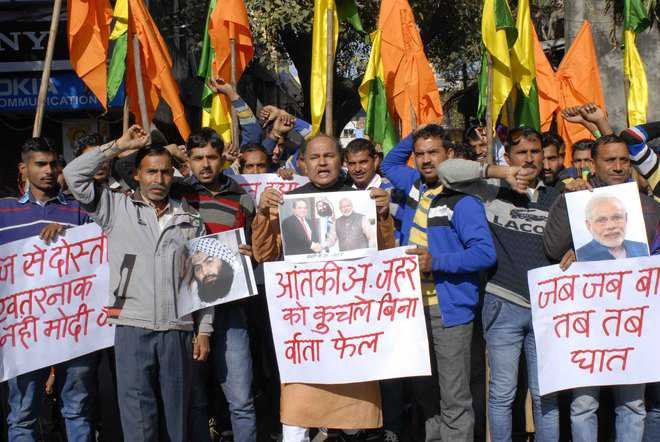
IT was coming. The moment Prime Minister Narendra Modi landed in Lahore, Pakistan, a unique visit of its kind, there had been apprehensions that there might be a spectacular attack on the Indian soil which may attempt to kill the prospects of future meetings and talks between the two countries.The attack on the Pathankot Indian Air Force base on Saturday fitted into that line of anxieties that govern the relationship between Delhi and Islamabad. Terrorists have started their work post Christmas Modi visit to Pakistan. This is a bad sign for Kashmir, where the people desperately want to escape the harshness of violence and see a life of peace on their land. Anything derailing the surprise and goodwill visits by the apprehension of the real-time terror attacks would be a death knell to their hopes. If the talks fail this time, there would not be a third visit to Lahore by any Indian Prime Minister.It’s immaterial whether the attack was planned before or after Modi’s visit to Pakistan, the terrorists have made a striking point that they were all out to tell all the peaceniks that their agenda would remain unchanged. The birthday diplomacy or the desire to improve the India-Pakistan ties was unacceptable to them.The target and the objective of the terrorists this time underlined the audacity of the attackers and the potential aim of torpedoing the Indo-Pak talks.Compared to today’s attack, the terrorists’ assaults on the Dinanagar police station and a BSF convoy in Udhampur were milder versions.The last time terrorists had attempted an attack was the Awantipore air base in south Kashmir. That time the terrorists could not penetrate into the airbase as they were neutralised outside it. There was another attempt at the Srinagar airport in January 2002. Security forces foiled that, too.Terrorists’ choice to attack the Air Force base in Pathankot was to send a message that they were capable of striking anywhere anytime and were not deterred by the fact that in the recent terror attacks, their colleagues were captured alive.Naved was captured alive after Udhampur attack in Jammu and Kashmir on August 5 last year. It was his revelations that led to the elimination of Abu Qasim. It also helped the security forces to cause a major dent to the Lashkar-e-Toiba in Kashmir.An attack on a police station or a convoy doesn’t cause as much alarm and concern as it does with the terror attack on an Air Force base where fighter aircraft are parked. This can raise an international concern and also raise questions about the national security. It’s a potential trigger for the groups within India to ask for cancellation of proposed talks with Pakistan. Secondly, the greater danger is that it also serves the purpose of the anti-dialogue militants and their patrons in Kashmir and Pakistan.The method of the attack in Pathankot bears close similarities to the attacks on the airbases of Pakistan where terrorists inflicted heavy loss to human lives and material. Today, Pathankot might have escaped with minor losses as compared to the terrorism-hit air force bases in Pakistan, but the fact is that more such attacks cannot be ruled out. It also establishes the fact that this group of attackers was inspired, motivated and trained by the same set of terrorist trainers who want to cause instability. The only difference in the Pathankot attack case is that the non-state actors — whether Jaish-e-Mohammad or any other terror group — were having the blessings of the state actors. The intentions of the Pakistan army and ISI have been suspected by Washington DC for despite getting the American aid Pakistan has not acted against terrorists in the manner it should have. There is no clear line defining the non-state and the state actors in Pakistan. These state actors had raised Taliban that destroyed Afghanistan and the militant outfits that destroyed the social, political and economic order in Jammu and Kashmir.Two things are clear: One, non-state actors having the patronage of some anti-dialogue state actors in Pakistan are active. Secondly, the terror attack in any part of the country would have serious psychological consequences in Kashmir where the mainstream and separatists alike are working in an apparent unison to further stir the cauldron of uncertainty for their respective agendas.With this kind of unsettling scenario, the attack is a very bad omen for the India-Pakistan talks as also for the internal situation in the Valley.

MUMBAI: Vice Admiral Sunil Lanba, PVSM, AVSM, will assume charge as Flag Officer Commanding-in-Chief Western Naval Command here on Sunday. He is an alumnus of the National Defence Academy and was commissioned in the Executive Branch of the Indian Navy in January 1978.
Kabul/New Delhi, January 3


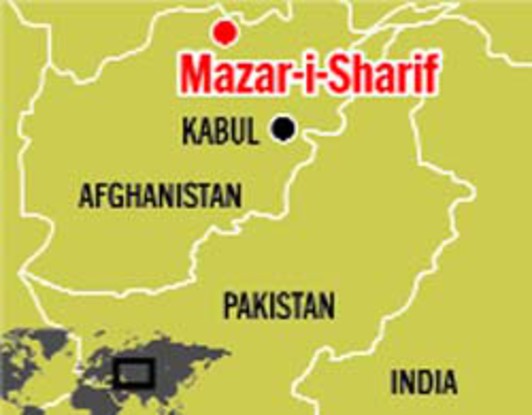
The Indian consulate in the Afghan city of Mazar-i-Sharif was attacked tonight by unidentified gunmen who tried to storm the building. An Indian official said all consulate personnel are safe, as explosions and gunfire rang out at the compound.“Everybody is safe,” B Sarkar, Consul General at the consulate, said. The mission in the northern Afghan city is manned by three Indian personnel.An External Affairs Ministry spokesman said there were no Indian casualties.Sarkar said the shooting lasted for 20 minutes. “They shot from some adjacent building but nobody could enter the consulate.”An unidentified Indian consulate official was quoted as saying: “We are being attacked. Fighting is going on.”No group claimed responsibility for the attack that came just days after Prime Minister Narendra Modi was in Afghan capital Kabul on a brief visit on December 25 during which he inaugurated the new building for Afghan Parliament built by India.Director General ITBP Krishna Chaudhary said: “ITBP personnel along with Afghan police are retaliating. We are effectively engaged and retaliating along with the Afghan forces posted at the consulate.”Sources said two of the four attackers are believed to have been killed in the retaliatory fire. However, a final confirmation will be given only after the bodies are seen.Pajhwok Afghan News, an Afghan media outlet, tweeted: “The number of attackers was 4, two of them killed but not confirmed by police yet.” In his address to Parliament, Modi had made a veiled attack against Pakistan, saying that Afghanistan will succeed only when terrorism no longer flows across the border and when nurseries and sanctuaries of terrorism are shut. Modi also made a veiled reference to Pakistan’s reservations about Indian involvement in Afghanistan. — PTI
काबुल, 3 जनवरी (एजेंसी)
अफगानिस्तान के मजार-ए-शरीफ शहर में भारतीय वाणिज्य दूतावास पर रविवार रात आतंकियों ने हमला करते हुए अंदर घुसने की कोशिश की। परिसर में विस्फोट और गोलीबारी हुई। मीडिया रिपोर्ट्स के मुताबिक 4 आतंकियों में से एक ने खुद को बम से उड़ा लिया, जबकि एक अन्य को वाणिज्य दूतावास में तैनात आईटीबीपी के जवानों ने मार गिराया। बाकी आतंकी पास की इमारत में जा छिपे और फायरिंग करने लगे। जल्द ही अफगानिस्तान के सुरक्षा बलों ने उन्हें घेर लिया। देर रात तक मुठभेड़ जारी थी।
एक भारतीय अधिकारी ने कहा कि वाणिज्य दूतावास के सभी कर्मी सुरक्षित हैं। दूतावास में महा वाणिज्य दूत बी. सरकार ने कहा कि गोलीबारी करीब 20 मिनट चली। हमलावरों ने पास की इमारत से गोलियां चलाईं, लेकिन कोई भी वाणिज्य दूतावास के अंदर नहीं घुस सका। वही मीडिया रिपोर्ट्स के मुताबिक इस गोलीबारी में 2 लोग जख्मी हुए हैं, हालांकि यह स्पष्ट नहीं हो पाया कि ये लोग दूतावास के हैं या नहीं।
ਕਾਬੁਲ, 3 ਜਨਵਰੀ
ਅਫ਼ਗ਼ਾਨਿਸਤਾਨ ਦੇ ਸ਼ਹਿਰ ਮਜ਼ਾਰ-ਏ-ਸ਼ਰੀਫ਼ ਵਿਚਲੇ ਭਾਰਤੀ ਕੌਂਸਲਖਾਨੇ ’ਤੇ ਅੱਜ ਅਤਿਵਾਦੀਆਂ ਨੇ ਹਮਲਾ ਕਰ ਦਿੱਤਾ। ਸੂਤਰਾਂ ਮੁਤਾਬਕ ਬੰਦੂਕਧਾਰੀਆਂ ਨੇ ਕੌਂਸਲਖਾਨੇ ਦੇ ਅਹਾਤੇ ਵਿੱਚ ਦਾਖਲ ਹੋਣ ਦੀ ਕੋਸ਼ਿਸ਼ ਕੀਤੀ। ਹਮਲਾਵਰਾਂ ਦੀ ਗਿਣਤੀ ਬਾਰੇ ਫਿਲਹਾਲ ਪਤਾ ਨਹੀਂ ਲੱਗਿਆ। ਹਮਲੇ ਦੌਰਾਨ ਦੋ ਧਮਾਕਿਆਂ ਦੀ ਆਵਾਜ਼ ਸੁਣੀ ਗੲੀ ਭਾਰਤ ਦੇ ਵਿਦੇਸ਼ ਮੰਤਰਾਲੇ ਨੇ ਕਿਹਾ ਹੈ ਕਿ ਹਾਲੇ ਤੱਕ ਕਿਸੇ ਦੀ ਮੌਤ ਦੀ ਖ਼ਬਰ ਨਹੀਂ ਮਿਲੀ।

French army first foreign contingent at R-Day

Books on Param Veer Chakra awardees launched

Reports claim shot-down balloon came from Pak

Through the district pass the strategically important lone rail and road links to Jammu & Kashmir
Ajay Banerjee,Tribune News Service,New Delhi, January 2


A narrow plain (just 30-km wide) lies between the Himalayas and the international border with Pakistan. Located at the eastern edge of this plain and nestled in the foothills at an altitude of 1,090 feet is the militarily vital town of Pathankot. It is the northern-most district of Punjab that is located at the confluence of the boundaries of J&K and Himachal Pradesh.The narrow 30-km plain is clearly India’s ‘jugular vein’ — the weakest point. India’s military prowess at Pathankot and around is tasked to ensure dominance in the topography marked by fast-flowing seasonal rivulets and jungles. Through these 30 km pass the lone rail and road connection to J&K. The national highway connecting Jammu is the lone link across the Ravi, allowing military and civilian movement and so is the lone rail link that carries passengers to Udhampur and Katra. The air base at Pathankot had been attacked by the Pakistan Air Force (PAF) during the 1965 and 1971 wars. Today’s attempt by terrorists to storm the base can be counted as the third attempt to target it even though it does not match the scale of the PAF attack. “Today’s attack had the potential to cause damage to planes and helicopters at the base. Good that it was contained,” says Commodore Uday Bhaskar (retd). Besides a MiG 21 fighter jet squadron, Pathankot is home to a squadron of attack copters that fly in tandem with ground-trawling tank regiments. The base also has UAVs, air defence guns and long-distance surveillance radars. A town having 1.56 lakh population, Pathankot houses Mamun cantonment, which is used as a launching ground. The Army has a division —some 15,000 men — complete with artillery guns and tanks. It is also the base for a new division which is part of the upcoming 17 Mountain Strike. Pathankot remains top priority for the IAF which has otherwise formed a formidable ‘ring fence’ of air fields like Adampur (Jalandhar), Halwara (Ludhiana), Bathinda, Sirsa and Ambala in Haryana and Suratgarh in Rajasthan. Air Commodore Kaiser Tufail (retd) of the PAF — known as an aviation historian — writes in his blog ‘aeronaut’ about the Pakistan design to damage the Pathankot runaway. “In 1971, Pathankot was singled out for two successive raids,” he says. SN Prasad in his book ‘The India Pakistan War of 1965’, an authorised account from the Ministry of Defence archives says the PAF, on the intervening night of September 6 and 7, 1965, launched an unusual attempt to destroy IAF aircraft and airfield installations. Paratroopers of the Special Services Group were air-dropped at night near Pathankot, Halwara and Adampur. Of the 180 Pakistani commandos, 136 were taken prisoner, 22 killed and the rest managed to escape. Pak phone number used to hire taxi Pathankot: The terrorists were in regular touch with their Pakistani handlers, who even arranged a taxi for them by calling from a mobile number of that country. Sources said the terrorists had first used a Toyota Innova on Friday and it has been found that the driver was called from a Pakistan number. Security agencies are questioning the driver and trying to find out whether he had any links with terrorists or was it a case of him not recognising a Pak number. Sacked IAF technician to be quizzed New Delhi: A sacked IAF official, arrested for allegedly sharing secret information with ISI, will be interrogated, investigators told a city court which extended his police custody till Monday. Ranjith KK, a Leading Aircraftman with IAF posted at Bathinda, was dismissed recently and later arrested. He had allegedly shared secret information with intelligence operatives suspected to be backed by ISI after being “honeytrapped” into an espionage racket.
Gujarat on high alert
Ahmedabad: The Gujarat Police have issued an alert and the security personnel have been told to take necessary steps to keep a check on suspicious activities in the wake of the terror attack in Punjab. “In the wake of today’s terror attack in Punjab, I have asked the police department and respective heads to remain alert. Based on some inputs available with us, I have ordered the police force to take all necessary steps and increase vigil across the state,” said PC Thakur, DGP.
Simran Sodhi & Ajay Banerjee,Tribune News Service,New Delhi, January 25

India and France today signed a memorandum of understanding (MoU) on the purchase of the Rafale fighter jets. The much-anticipated inter-governmental agreement (IGA) on Rafale will now be signed later, once the financial negotiations between the two sides are completed.Hectic negotiations had been going on for the past few days to enable the IGA to be signed during French President François Hollande’s visit.At the end of the delegation-level talks between Prime Minister Narendra Modi and Hollande, Modi said only the financial details needed to be worked out in finalising the purchase of Rafale jets from France.“Only financial aspects of the Rafale deal are left. The inter-governmental agreement has been finalised. It will be done soon,” said the Prime Minister. Foreign Secretary S Jaishankar, while briefing the media, later said only the MoU had been signed today and the IGA would be the next step.He said both countries had been able to reach an agreement on the non-financial side, while they were yet to agree on the financial side.The joint statement issued at the end of the delegation-level talks said: “The two leaders welcomed the conclusion of the inter-governmental agreement on the acquisition of 36 Rafale fighter aircraft in flyaway condition, except for some financial issues relating to the IGA which they agreed must be resolved as soon as possible.”India had announced that it would buy 36 Rafale fighters in a government-to-government deal during Modi’s Paris visit in April.Since then, negotiations had been going on about the pricing of the aircraft, the main sticking point in the financial side of the deal. The Tribune had first reported on January 16 that India was looking to go for a better price than take a hasty step at this stage.Sources indicate the cost negotiation committee of the Indian Air Force has met and suggested a price that does not match the expectations of French company Dassault Aviation, the maker of Rafale.The Indian side is doing a cost benefit analysis as it may end up paying nearly Rs 1,200 crore per plane, including arsenal, training and base facilities.In comparison, the last order for 42 Sukhoi-30 MKI fighter jets was agreed upon in 2010 and cost Rs 470 crore per plane. The IAF has told the Ministry of Defence that it needs at least 80 Rafale-type multi-role combat fighter jets to be battle-ready in the next few years.A “mere” 36 jets — presently on order — would not meet the shortfall due to the phasing out of fleet of MiG-21 and MiG-27 jets by 2022.Dassault, in a press release issued, today said: “During French President François Hollande’s visit to India, French and Indian governments signed an inter-governmental agreement paving the way for the conclusion of a contract for the sale of 36 Rafale fighters to India.“Dassault Aviation is very pleased with this progress.”


NEW DELHI: India signed an agreement with France on Monday to buy 36 Rafale fighter jets but said sorting out details of the multibillion euro deal such as pricing and post-sales servicing would take some more time.
PIBPrime Minister Narendra Modi and French President Francois Hollande take a Metro to Gurgaon where they inaugurated the interim secretariat of the International Solar Alliance on Monday.On the second day of French President Francois Hollande visit, the two sides also signed 13 pacts in various fields including railways and civil nuclear energy, with the French promising to invest $10 billion in next five years in India.
“…Leaving out financial aspect, India and France have signed inter-governmental agreement on purchase of 36 Rafale fighter jets. We expect that even the financial aspects… will be resolved as soon as possible,” Prime Minister Modi said at a joint press event with Hollande.
The French President, who will be the chief guest at the Republic Day celebrations on Tuesday, described the deal on Rafale as “a decisive step”.
Modi had announced India’s intention to buy 36 Rafales in Paris in April. Modi and Hollande had to step in after New Delhi scaled back the original plan to buy 126 Rafales and commercial negotiations between planemaker Dassault Aviation and Indian officials collapsed.
Dassault Aviation said on Monday it was supporting French authorities in their efforts to finalise a complete agreement within the next four weeks.
India desperately needs to upgrade its aging Soviet-era fleet plagued by engine troubles and poor availability. The Indian Air Force requires at least 44 fighter squadrons — with 18 planes each — to counter the combined threat from Pakistan and China.
Officials had hoped to seal the deal during Hollande’s visit but resolving the technicalities appeared more complicated than expected, leaving the French President to temper expectations and say such negotiations take time. India was steering clear of setting a deadline to seal the deal as it wanted to get the best price for the fighters, a government official said. HT wrote last week that France had indicated a maximum price of around euro 11.6 billion for the warplanes with full armament complement. India is negotiating to bring the price down to around euro 8 billion.
“What was signed today was an MoU and, when the financial part of it issettled, then obviously the inter-governmental agreement in its entirety will be concluded,” foreign secretary S Jaishankar later told mediapersons.
The agreement, government sources said, would be signed once the prices had been finalised which they hoped would take another four weeks.
The French leader arrived Sunday in Chandigarh, where he was received by Modi. Independent India’s first planned city, Chandigarh was designed by Swiss-French architect Le Corbusier and is one of three places that France has pledged to help develop as smart cities. The other two are Puducherry and Nagpur. France will also help modernise Ambala and Ludhiana railway stations. In a boost to the government’s Make in India campaign, French firm Alstom will manufacture 800 electric locomotives at Madhepura in Bihar.
Hollande said an agreement for France’s Areva to build six nuclear reactors in India should be concluded within a year. The two sides have been wrangling over the price of power from these units for more than a year.
“From nuclear cooperation to railway locomotives, we are sowing the seeds of an ever-tightening web of cooperation between our two countries,” Modi said.
HOLLANDE VISIT
Simran Sodhi,Tribune News Service,New Delhi, January 25


India and France today took a significant step forward in addressing the challenges of global terrorism and said there was an “urgent need to establish a comprehensive international legal framework to address the growing global menace of terrorism”. While the recent attacks on Paris and Pathankot found a common resonance in the bilateral discussions, the joint statement clearly called on Pakistan to bring the perpetrators of the recent attacks in Pathankot and Gurdaspur and also the perpetrators of the deadly Mumbai 2008 attacks to justice. “From Paris to Pathankot, we saw the gruesome face of the common challenge of terrorism…I also commend the strength of your resolve… President Hollande and I have agreed to scale up the range of our counter-terrorism cooperation in a manner that helps us to tangibly mitigate and reduce the threat of extremism and terrorism to our societies.“We are also of the view that the global community needs to act decisively against those who provide safe havens to terrorists, who nurture them through finances, training and infrastructure support,” Prime Minister Narendra Modi said at a joint press event with French President Francois Hollande.The joint statement on counter-terrorism issued today said: “Stressing that terrorism cannot be justified under any circumstance, regardless of its motivation, wherever and by whomsoever it is committed, both leaders asked for decisive actions to be taken against Lashkar-e-Toiba, Jaish-e-Mohammad, Hizb-ul-Mujahideen, Haqqani Network and other terrorist groups such as Al-Qaida.”“Condemning the recent terror attacks in Pathankot and Gurdaspur in India, the two countries reiterated their call for Pakistan to bring to justice their perpetrators and the perpetrators of the November 2008 terrorist attacks in Mumbai, which also caused the demise of two French citizens, and to ensure that such attacks do not recur in the future,” it said.The two leaders also strongly condemned the terrorist attacks that occurred in many parts of the world recently and “expressed their shared anguish and outrage at the loss of innocent lives in Paris, Bamako, Beirut, Tunis, San Bernardino, N’Djamena and the Lake Chad Basin Region, Kabul, Gurdaspur, Istanbul, Pathankot, Jalalabad, Jakarta, Ouagadougou and Charsadda.

NEW DELHI: The locally-produced light combat aircraft (LCA) is set to make its international debut. The LCA Tejas will fly outside Indian airspace for the first time at the Bahrain International airshow being held at the Sakhir airbase from January 21-23, a defence ministry spokesperson said on Friday.
The fighter is among the 15 weapon systems identified for export by the Defence Research and Development Organisation to help the country get into the international arms bazaar. The Indian Air Force plans to induct six squadrons (120 planes) of the LCA with upgrades, including a new electronic warfare suite, refuelling capacity, better missiles and improved radar.
A report released by the comptroller and auditor general in May 2015 had revealed that the LCA-Mark1 was riddled with 53 “significant shortfalls” that could compromise its survivability in combat.
Tribune News Service,New Delhi, January 23

Indigenously designed, developed, built and weaponised version of advanced light helicopter (ALH) — “Rudra” — will make its debut at the Republic Day parade. The helicopter produced by the Defence Ministry owned public sector giant Hindustan Aeronautics Limited (HAL) is being used by the Army since February 2013.The HAL is to produce 76 of these helicopters of which 60 are for the Indian Army’s Strike Corps formations — three of them headquartered at Mathura, Ambala and Bhopal. Armed helicopters fly in coordination with ground-based tank regiments. HAL handed over the first two Rudra helicopters to the Army’s Aviation wing in Bangalore in 2013 and since then more machines have been added.Rudra is equipped with a mix of weapons providing it with the capability to search and destroy any target. It carries a 20mm automatic cannon, which can fire at a rate of 750 rounds per minute with an effective range of 2,000 metres.The stub-wings of Rudra can be fitted with up to eight Helina (helicopter-launched Nag) anti-tank guided missiles, four MBDA mistral short-range air-to-air missiles or four rocket pods for 70mm rockets. The helicopter is equipped with Integrated Defensive Aids Suite (IDAS), radar warning receiver, IR jammer, flare and chaff dispenser. Pilots have a helmet-mounted sight and fixed sight facilitating firing of the onboard weapons. Future upgrades will include infra-red jammer, obstacle avoidance system for the Army version of the helicopter and Nuclear Biological and Chemical sensors. The helicopter is powered by French origin Turbomeca engines and has a maximum speed of 270 kmph with flying ceiling of 20,000 feet. Another first this time will be a covered bulletproof enclosure — that will have a roof. Last year, the dignitaries sat through rain.French President Francois Hollande will be the chief guest. The Army’s dog squad used as sniffers and explosive detectors will also figure in the parade. It will be after 27 years that the dogs will be part of the parade. Also plagued by monotony and security concerns of protecting a large number of high-risk individuals, this year’s parade will be shorter by 25 minutes (of 90 minutes).

ribune News Service,Jammu, January 1
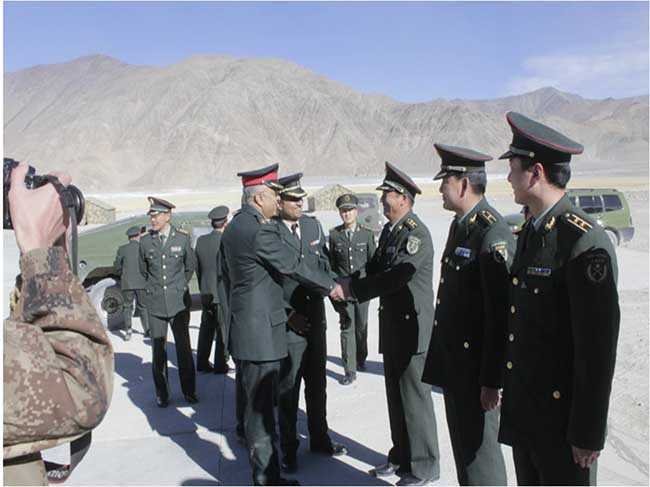
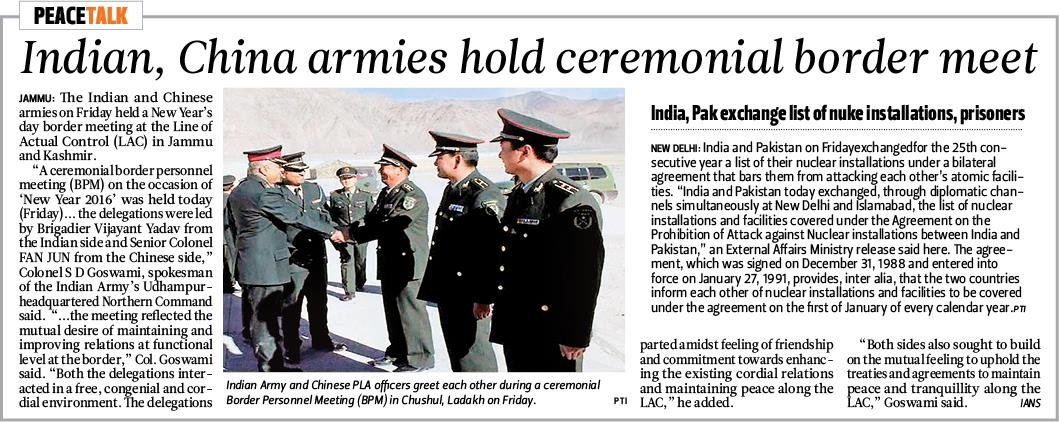
A ceremonial border personnel meeting between India and China was held on the Line of Actual Control (LAC) in the Chushul sector of eastern Ladakh on the New Year today. The meeting was held at the Moldo Garrison of the Chushul sector, said defence spokesperson SD Goswami.“Both the sides sought to build on the mutual feeling to uphold the treaties and agreements signed between the governments of the two sides to maintain peace and tranquility along the LAC,” said Goswami.The Indian delegation was led by Brigadier Vijyant Yadav whereas the Chinese side was represented by Senior Colonel Fan Jun.The meeting was marked by saluting the national flag of China by the members of both the delegations followed by ceremonial address by leaders of the two groups. The delegation heads exchanged New Year greetings and expressed mutual desire of maintaining and improving relations at functional level at the border, said the spokesperson. Both delegations interacted in a free, congenial and cordial environment, the spokesperson added.During the recent visit of Northern Command chief Lt Gen Hooda to Lanzhou Military Region, measures to maintain cordial relations, peace and tranquility were discussed between the two sides. Meanwhile, a culture programme showcasing vibrant Chinese culture and traditional grandeur was also organized on the occasion.
Suhail A Shah,Anantnag, January 1
Four persons, including two Army men, have been arrested in Kulgam district of south Kashmir for allegedly extorting money on gun point while posing as Hizbul Mujahideen militants.The Army men have been found involved in more than one case of extortion, the police said.The police were investigating an extortion complaint by a doctor from Khrewan village of the district when the role of the two Army men came under scrutiny.The accused soldiers have been identified as Muhammad Yousuf Teli and Muhammad Rafiq Khanday of Jammu and Kashmir Light Infantry. They are presently posted with the 19 Rashtriya Rifles camp in the Larkipora area of Kulgam district.The police said the accused Army men were the residents of the district.According to police report, an FIR (303-2015) under sections 34, 386 and 452 of the Ranbir Penal Code was registered against the accused after an extortion complaint by Dr Bila Beigh from the Khrewan Malpora area.Dr Beigh told the Tribune that two armed men, posing as Hizb militants, had held his family hostage on Sunday evening and ransacked their house, before decamping with Rs 32,000 and some electronic gadgets.“I was in Delhi when the incident took place. My sister and her husband were at my place and they were in deep shock,” Dr Beigh said.Station House Officer (SHO), Qazigund, Parvez Ahmad said it was Dr Beigh’s sister who had spotted one of the accused at the Emergency Hospital in Qazigund, where she works as a senior dental technician.“The police swung into action and arrested the identified man, who led us to his accomplice,” the SHO said.The two were identified Muzaffar Ahmad Bhat and Nisar Ahmad, he said.While the police were interrogating the arrested duo, one of Dr Beigh’s neighbours Muhammad Yousuf Teeli approached him and confessed to have provided weapons to the accused duo.“He pleaded for forgiveness and was worried that he will be thrown out of the Army,” Dr Beigh said. “I, however, informed the police regarding the incident and they picked up the threads from there,” he said. The police questioned Teeli and subsequently secured a confession from him of being involved in multiple extortion cases. “He also led us to one of his accomplices. Both have been produced in court and sent to remand,” the SHO said.The police officer said the Army men have also confessed to having carried out similar extortions across Kulgam and in neighbouring Anantnag district.






























