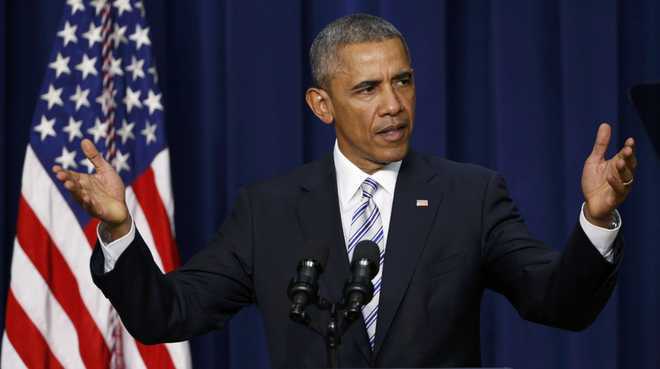
Prime Minister Narendra Modi’s latest meeting with US President Barack Obama was no different from their previous six engagements. Both sides have been smitten equally by the desire for a closer strategic embrace but find themselves having to move cautiously because of their existing commitments to other countries and their different belief systems. It was in line with this approach that the US declared India a major defence partner which, on paper, will lead to fewer formalities in transferring closely guarded defence technologies. Both countries also wrapped up a military cooperation agreement, besides making progress in facilitating the setting up of US nuclear plants in India.The two sides also broke fresh ground in bilateral security and defence cooperation by expanding technology cooperation to cover more systems, announcing further steps to deepen collaboration against terrorist threats and deciding to share terrorist screening information. On the global stage, the US expectedly supported India’s membership to the UNSC and other global organisations but in order to keep China in good humour, both sides consciously downplayed future plans for a joint endeavour in the South China Sea. Amidst the emphasis on security issues, the US has inserted itself as an early bird in the India drive to ramp up the share of renewable power in the total energy mix with a slew of agreements.While trade, defence, clean energy and security got their due, India could not wangle more work visas nor could it stop Washington from deducting social security payments from temporary workers. However, high net-worth Indians may not have to face a Shah Rukh Khan moment when they enter the US in the near future after both sides signed an MoU on an expedited traveller initiative. There were two other military agreements on the menu but were not signed because that would spell the end of India’s military trade with Russia. The US also desisted from using strong words against Pakistan, while India walked away with the satisfaction of having named its tormentor in the joint statement. In the end, existing compulsions put the brakes on a convergence that could have been faster.
All posts by webadmin
Dagshai Army school celebrates Founders’ Day
Tribune News Service
Solan, June 2
Army Public School, Dagshai, celebrated its 30th Founders’ Day yesterday. Lt Gen MM Narwane, SM, VSM, GOC, 2 Corps Brig OP Singh, Commandant 14 GTC and chairman of the school, was the chief guest.Gen Narwane complimented the staff and students for the excellent cultural programme and commendable classes X and XII board results. He paid tributes to Lt Major Udai Singh, an old student of the school, who had sacrificed his life while fighting against the militants. The Chief Guest also congratulated Rigzin Dolkar, an old student, who climbed the Mount Everest in May.Students displayed models at an exhibition, which drew appreciation from parents.A classical dance, orchestra, Himachali folk dance, Ladakhi song and koli dance delighted the audience.An English play ‘’The play that goes wrong’’, essentially a murder mystery that turned hilarious when everything went wrong drew much applause from the audience. The delivery of humorous dialogues and befitting expressions of the cast had the audience in peals.A western dance which showed how the brave and gallant soldiers fought fearlessly with their enemies was beautifully depicted in the song. Based on the biography of the greatest Sanskrit poet and dramatist, play Kalidasa was also appreciated by the audience.SK Mishra, principal, APS, read out the school report highlighting the achievements.Hitika Gupta was declared the aII-round best student for 2015-16.Subhash House won the inaugural swachhta trophy whereas Indira House lifted the best kept house trophy. Green House won the Hindi Calligraphy trophy. There was a clean sweep by Red House that won eight trophies, including the coveted cock house trophy.

Pakistan takes a hit G Parthasarathy After the F-16 debacle, the US drone attack has it in a fix

Catch-22: Will Pakistan heed US warning, with the Obama Admn on its way out?
THE past fortnight has been traumatic for Pakistan’s ruling elite. They could only look on as American drones crossed the Afghanistan-Pakistan border and eliminated Mullah Akhtar Mohammed Mansour, anointed leader of the Afghan Taliban by the ISI, barely a year earlier, in a public function at Kuchalak on the outskirts Quetta, the capital of Baluchistan. It was near the site of his appointment that the drones struck and killed Mansour. The drone strike occurred at a virtual stone’s throw away from the Pakistan army’s Command Staff College, its XII Corps Headquarters, its military recruitment centre and the ISI regional office. The strike signalled that Taliban leaders based in Quetta for over 15 years under ISI protection could no longer take their safety for granted.To add to their woes, the ISI and Pakistan’s ubiquitous army chief, Gen Raheel Sharif, were made to again look silly. General Sharif personally summoned the American Ambassador to warn the US of dire consequences for its action, described by him and other Pakistani notables, like Interior Minister Chaudhry Nissar, as a “violation of Pakistan’s sovereignty”. To add insult to injury, the Americans responded: “We will carry out strikes to remove terrorists who are actively pursuing, planning and directing attacks against US forces. The strike sends a clear message that those who target Americans and Afghan people are not to be given a safe haven. If you are going to lead attacks against our forces and Afghanistan’s forces, you are going to be targeted and you are not going to have safe havens.” It remains to be seen if the Americans seriously carry out these threats. They will, doubtless, be tested.From Pakistan’s point of view, the past fortnight has been a diplomatic nightmare. Just preceding the drone strike in Baluchistan, the US Congress made it clear that the new F-16s will not be provided free of cost, as in the past. Moreover, Pakistan had to witness Prime Minister Modi not only being feted and received by Iran’s Supreme Leader Sayyed Ali Hosseini Khamenei, but also a trilateral Iran-Afghanistan-India Summit. Agreement was reached at the summit to develop the Chabahar Port and an India-Iran-Afghanistan transport corridor, bypassing Pakistan. Moreover, India and Iran agreed to transform their trade relationship into a comprehensive economic partnership and to consult closely in combating threats of terrorism, radicalism, drug trafficking and cyber crime. The past week also saw the anointment of Mullah Haibatullah Akhunzada as the Taliban’s new leader. He is to be assisted by two deputies — Sirajuddin Haqqani, one of America’s most-wanted terrorists, and Mullah Omar’s son, Mullah Yaqoob. It is now clear that Pakistan would like to see the continuance of a Taliban leadership drawn from the Kandahar-based Ghilzai Pashtuns, bypassing the traditional leadership of Durrani Pashtuns, like President Hamid Karzai. Like Mullah Omar and Mullah Mansour, Mullah Akhunzada is a Kandahar-based Ghilzai Pashtun. He is not from the dominant Durrani tribe, from which Afghan rulers, since Ahmed Shah Abdali in the 18th century, have been traditionally drawn. The Pakistanis enacted a stunt to give Mullah Omar’s appointment a veneer of legitimacy and respectability by getting him to appear for the first time in public in 1996, at the main shrine in Kandahar, covered in a cloak, believed to have been worn by the Prophet Muhammad. Ahmed Shah Abdali had brought the cloak to Kandahar from Bukhara. One wonders what stunts the ISI will now resort to in order to similarly give Mullah Akhunzada a veneer of respectability and legitimacy.The entire so-called “peace process” for reconciliation between the Taliban and the Afghan government now lies in a shambles. This was an initiative doomed to fail, as the Taliban have no belief in democracy and were determined to use force to acquire power. The Americans were led up the garden path by both Pakistan and China, to support this process, little realising that while the they wanted a representative government in Kabul, China had an interest in seeing an ISI-sponsored regime in Kabul. Such a regime would do Pakistan’s bidding and spare China’s Xinjiang Province, where Muslims are persecuted, from terrorist violence. China had, after all, been one of the very few countries that had diplomatic contacts and even economic cooperation with the Taliban regime led by Mullah Omar in the 1990s.These developments have set the stage for more intensive Taliban attacks across Afghanistan in the coming months. The ISI’s favourite Taliban leader, Sirajuddin Haqqani, is the deputy leader, along with Mullah Yaqoob, son of Mullah Omar. It remains to be seen how the Americans will react to these developments. The State Department has threatened reprisals even on Pakistani soil if attacks in Afghanistan by Taliban insurgents based there continue. But the Obama Administration is now a ‘lame duck’. General Sharif, meanwhile, appears to be realising that he has perhaps bitten off more than he can chew by committing his soldiers to fight the Tehriq-e-Taliban in the tribal areas bordering Afghanistan. He has obviously learnt no lessons from history.India needs to stay the course in its existing policies on Afghanistan. Its image as a benevolent power will be further enhanced when the Salma Dam built by Indian engineers is commissioned in Afghanistan’s Herat province, bordering Iran, later this year. The presence of the leaders of Iran, Afghanistan and India for inking the agreement making the Chabahar Port a major gateway to Afghanistan and Central Asia has sent a powerful message across the entire region. The reported request of President Ashraf Ghani for more MI-25 attack helicopters needs to be considered after assessing the security situation in Afghanistan. When I last visited Kabul three years ago, I learnt that Pakistani visitors to the Kabul market often declared they were Indians to avoid public wrath against Pakistanis, which runs deep across Afghanistan. One hopes good sense will prevail and Pakistan will learn to behave with greater circumspection and consideration in dealing with its northern neighbour.


MY FATHER, LET MY COUNTRY AWAKE By Lt Gen PG KAMATH
1971 POW still alive in Pak jail, claim kin

Paramjit Kaur, daughter of Jugraj Singh, holds a photograph of her father during a press conference in Bathinda on Thursday. Tribune photo: Pawan Sharma
Sukhmeet Bhasin
Tribune News Service
Bathinda, May 26
The kin of sepoy Jugraj Singh who was declared dead in the 1971 Indo-Pak war today claimed that the former was alive and languishing in a Pakistan jail. They demanded that the Ministry of Defence should initiate step to release Jugraj from jail. Singh hails from Jeeda village in Bathinda district.Ex- servicemen Welfare Union state president Capt Bhagwant Singh Bhatti, Jugraj’s wife Gurmail Kaur, daughter Paramjit Kaur and son-in-law Lakhvir Singh said here today that soldier Jugraj joined the Bombay Engineer Group and after training was shifted to 102 Engineer Regiment.They stated that in 1971 Indo-Pak war, Jugraj Singh’s regiment was deployed at Ferozepur sector and during the war they received a letter from the regiment in which they were informed that he had died when a shell exploded on December 3, 1971, but his body could not be recovered.Paramjit said they were getting news that some soldiers had been captured by the Pakistan army and are lodged in jail there, so they were hoping that he is alive in some Pakistani jail.She said that they got to know that Indian spy, Satish Kumar, a resident of Ferozepur had returned after spending 12 years in a Pakistan jail and they had met him in 2012.She said they showed Kumar some photos of her father and he told them that he had met her father in the Shahi Qila in Lahore in 1974. Satish Kumar has also given an affidavit stating the same to the family.She also told that in 2004, they got information on All India Radio that he was alive in a Pakistan jail. They demanded that defence ministry should take up this issue with Pakistan government at the earliest and get Jugraj Singh released from jail. They also said that they have written to Deputy CM Sukhbir Singh Badal, former PM Manmohan Singh and Congress president Sonia Gandhi, but to no avail.
Demand for release
- The kin demanded that the Ministry of Defence should take steps to release Jugraj from jail
- They stated that in 1971 Indo-Pak war, Jugraj Singh’s regiment was deployed in Ferozepur sector and during the war they received a letter from the regiment in which they were informed that he had died when a shell exploded on December 3, 1971, but his body could not be recovered
- Paramjit said they got to know that Indian spy, Satish Kumar, a resident of Ferozepur had returned after spending 12 years in Pakistan jail and they had met him in 2012
Injured soldier dies, locals attend funeral of militants
KUPWARA GUNFIGHT Internet services suspended to prevent social media misuse
The marks on the bodies of the militants do not indicate that they were killed today. It seems they have been killed 6-7 days ago and brought here KUPWARA RESIDENTS

SRINAGAR: An army soldier, who was wounded during an encounter with militants in north Kashmir’s Kupwara district on Saturday, died on Sunday.
Meanwhile, thousands of people participated in the funeral of the five militants, who were killed in the encounter.
An army spokesman said Naik Gawade Pandurang Mahadev sustained head injuries during the gunfight in Chak Drugmulla village of Kupwara and was evacuated to 92 Base Hospital for treatment where he succumbed to his injuries on Sunday.
“He made a supreme sacrifice while fighting valiantly with the terrorists in Drugmulla village on May 21,” the spokesman said.
The mortal remains of the soldier will be flown to his village in Sindudurg district of Maharashtra after necessary formalities. Security forces said five militants were killed and two soldiers were wounded in a fierce gun battle in Drugmulla on Saturday.
‘STAGED GUNFIGHT’
On Sunday, thousands of people from the villages of Kupwara converged at Chak Drugmulla to participate in the funeral procession of the militants amid profreedom slogans.
After the militants were laid to rest in the morning, locals took to streets to protest.
Some locals alleged that the militants were killed in a “staged gun fight”. They said the state of dead bodies of the militants indicated that “they might have been killed a week back”. “The marks on the bodies of the militants do not indicate that they were killed today. It seems they have been killed 6-7 days ago and brought here,” the residents alleged.
Kupwara superintendent of police Aijaz Ahmad denied the allegations: “This is not true.” He said the militants were foreigners and seem to have infiltrated recently. Internet services were also suspended in Kupwara as authorities feared that situation could escalate owing to the spread of rumours.
Taliban leader Mansour dies in US drone attack
WASHINGTON: Afghan Taliban leader Mullah Akhtar Mansour was killed in a US drone strike in Pakistan, the Afghanistan government said Sunday. The US announced it had targeted the terror outfit’s chief but gave no official confirmation of his death.
Mansour — who took charge of the Taliban after Mullah Omar’s death became public in 2015 — posed a “continuing, imminent threat” to US personnel and Afghans, secretary of state John Kerry said. “If people want to stand in the way of peace, continue to threaten and kill and blow people up, we have no recourse but to respond and I think we responded appropriately.”
US department of defense press secretary Peter Cook said in a statement Saturday, “Today, the department of defense conducted an airstrike that targeted Taliban leader Mullah Mansour in a remote area of the AfghanistanPakistan border region. We are still assessing the results of the strike and will provide more information as it becomes available.” But unidentified officials told US media they believed Mansour was killed, along with another Taliban figure, when his convoy was attacked by multiple drones. The strike was reportedly authorised by President Barack Obama. Confirming the death, Afghan chief executive Abdullah Abdullah tweeted, “Taliban leader Akhtar Mansour was killed in a drone strike in Quetta, Pakistan, at 04.30pm yesterday.” He said the terror chief ’s car was attacked in Dahl Bandin, referring to a district in Pakistan’s Balochistan province. Kerry said the leaders of both Pakistan and Afghanistan were notified of the airstrike. He said he’d spoken to Pakistan Prime Minister Nawaz Sharif by phone.
Pakistan’s foreign office confirmed “this information was shared with the PM and the chief of army staff after the drone strike”. “While further investigations are being carried out, Pakistan wishes to once again state the drone attack was a violation of its sovereignty,” it said in a statement.
The foreign office said one Wali Muhammad, carrying a Pakistani passport and ID card, had entered Pakistan from the Taftan border on May 21. His passport bore a valid Iranian visa. He was travelling in a vehicle hired from a transport company in Taftan. This vehicle was found destroyed along the border with Afghanistan.
The driver, it said, has been identified as Muhammad Azam while the “identity of the second body is being verified”. There was no official statement from the Taliban.
The location of the attack would fuel further anger against Pakistan, often accused of harbouring terrorists. Al Qaeda chief Osama bin Laden was found and killed by US special forces in a hideout in Abbottabad in 2011. Khalid Sheikh Muhammad, the 9/11 mastermind, was caught in Faisalabad in 2003. And Americans believe the entire Haqqani Network leadership is based in Pakistan. “Since the death of Mullah Omar and Mansour’s assumption of leadership, the Taliban have conducted many attacks that have resulted in the death of tens of thousands of Afghan civilians and security forces as well as numerous US and coalition personnel,” Cook said.
He called Mansour “an obstacle to peace and reconciliation between the government of Afghanistan and the Taliban”. Mansour also integrated the Haqqani Network, an independent arm of the Taliban, into the outfit, according its leader Sirajuddin Haqqani a larger role. According to reports and analysts, Haqqani now calls the shots in planning Taliban military operations in Afghanistan, targeting the local government and US-led coalition forces.


We qualify for nuclear suppliers club: Pak to US