All posts by webadmin

Return part was most difficult, says Maj who led surgical strikes across border

Return part was most difficult, says Maj who led surgical strikes across border

New Delhi, September 10

The surgical strikes across the LoC were precise and conducted at a frenetic pace but the Major who led the daredevil mission says that the return was the most difficult part and bullets fired by the enemy soldiers were so close that these were whistling past the ears.The Army Major speaks about the stunning mission in a new book brought out on the first anniversary of surgical strikes in Pakistan-occupied Kashmir.The officer is referred to as Major Mike Tango in the book, titled “India’s Most Fearless: True Stories of Modern Military Heroes”.(Follow The Tribune on Facebook; and Twitter @thetribunechd)The Army had decided to use soldiers from the units that had suffered losses in the Uri attack for the elaborate revenge mission. A Ghatak platoon was formed and soldiers from the two units that had lost men were roped in to man border posts and provide crucial terrain intelligence and support to the mission that lay ahead.“Tactically, this was a smart move — few knew the lay of the frontier land better than they did. But there was another astute reason. Involving them in the mission would at least begin to lay the ghosts of Uri to rest,” says the book.“As team Leader, Maj Tango had chosen every man himself, including the officers and men who would play a supporting role. He was also acutely aware of the fact that the lives of 19 men were, quite literally, in his hands,” the book says.A total of four terror launch pads operated by Pakistan’s Inter-Services Intelligence (ISI) and protected by the Pakistan army were selected.“Through a series of masked communications over mobile, Maj Tango’s men contacted four ‘assets’ — two local villagers in PoK and two Pakistani nationals operating in the area, both moles in the dreaded Jaish-e-Mohammed terror group.“All the four assets separately confirmed the target information that was placed before them,” the book says. Written by Shiv Aroor and Rahul Singh and published by Penguin India, it tells 14 true stories of extraordinary courage and fearlessness, providing a glimpse into the kind of heroism India’s soldiers display in unthinkably hostile conditions and under grave provocation.The mission was brief — the soldiers were expected to reach their targets, study the latest intelligence they could possibly access with their satellite devices and then proceed to wipe out every man they saw there, the book says.Two of the terror launch pads identified as targets were well inside PoK and roughly 500 metres away from each other, it says. Both launch pads were close to Pakistan army posts for logistical and administrative purposes.“From the moment the firefight began until the last bullet was fired, it had been just over an hour. The frenetic pace of the assault meant the teams, now united after the split attack on two launch pads, would prepare to leave with only a very rough estimate of the number of terrorists they had managed to kill: 20. The figure would be corroborated days later by India’s external intelligence.As for the return, the Major decided to take not the route used to enter PoK but a different path that was longer and more circuitous, but comparatively safe. But while the Indian soldiers were returning, the Pakistan army posts opened fire with everything they had. “If I were a foot taller, I would have been hit many times over,” the Major recalled. Crossing in pairs as the ammunition hit the ground inches from them, Maj Tango’s team made it to the LoC before the sun was up, finally crossing it at 0430 hours.” — PTIStunning mission

“A total of 38-40 terrorists and two Pakistan army personnel were killed at the four targets. The three separate teams had simultaneously struck four launch pads across the LoC.” Book on surgical strikes

Return part was most difficult, says Major who led surgical strikes
Return part was most difficult, says Major who led surgical strikes
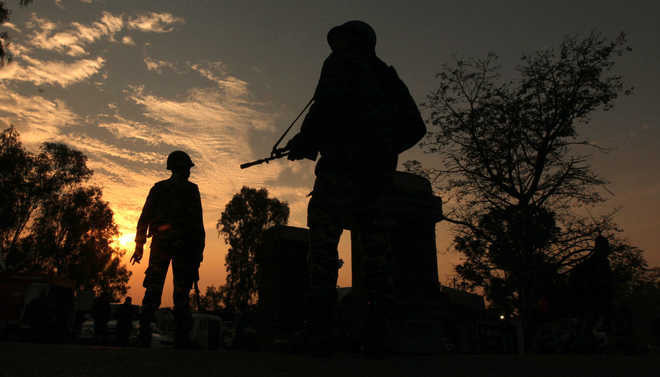
Photo for representation purpose only.

New Delhi, September 10The surgical strikes across the LoC were precise and conducted at frenetic pace but the major, who led the daredevil mission, says that the return was the most difficult part and bullets fired by the enemy soldiers were so close that these were whistling past the ears.The Army Major speaks about the stunning mission in a new book being brought out on the first anniversary of surgical strikes in Pakistan occupied Kashmir.(Follow The Tribune on Facebook; and Twitter @thetribunechd)The officer is referred to as Major Mike Tango in the book, titled “India’s Most Fearless: True Stories of Modern Military Heroes”.The Army had decided to use soldiers from the units that had suffered losses in the Uri attack for the elaborate revenge mission.A Ghatak platoon was formed and soldiers from the two units that had lost men were roped in to man border posts and provide crucial terrain intelligence and support to the mission that lay ahead.”Tactically, this was a smart move – few knew the lay of the frontier land better than they did. But there was another astute reason.”Involving them in the mission would at least begin to lay the ghosts of Uri to rest,” says the book.About the details of the planning, it says, “The target list was scrutinised along a top-secret chain of command that numbered barely a handful of people, with ‘need to know’ rules applicable throughout.”The options were vetted by designated officers from the Intelligence Bureau and the Research and Analysis Wing, before a final recommended brief was presented to the government.”Maj Tango was entrusted with the job of leading the operation to carry out the strikes.”As team Leader, Maj Tango had chosen every man himself, including the officers and men who would play a supporting role. He was also acutely aware of the fact that the lives of 19 men were, quite literally, in his hands,” the book says.Though Maj Tango chose the best men for the job, one thing was bothering him — the de-induction or the return.”That’s where I knew I could lose guys,” the book quotes him as recalling.”Even the actual attack was not something that flustered the commandos. It was the return, an uphill trek to the LoC that was the truly daunting part.”Their backs would be facing a blaze of fire from Pakistan Army posts, belatedly roused from their slumber. And the dominant position held by the posts would make the escaping warriors easy targets to spot and kill,” the book says.A total of four terror launch pads operated by Pakistan’s Inter-Services Intelligence (ISI) and protected by the Pakistan Army were selected.”Through a series of masked communications over mobile, Maj Tango’s men contacted four ‘assets’ — two local villagers in PoK and two Pakistani nationals operating in the area — both moles in the dreaded Jaish-e-Mohammed terror group, men who had been turned by Indian agencies a few years before.”All the four assets separately confirmed the target information that was placed before them. In terms of intelligence, there was nothing further for the team to do on this side of the LoC,” the book says.The book, written by Shiv Aroor and Rahul Singh and published by Penguin India, tells 14 true stories of extraordinary courage and fearlessness, providing a glimpse into the kind of heroism India’s soldiers display in unthinkably hostile conditions and under grave provocation.

Brief mission

The mission was brief — the soldiers were expected to reach their targets, study the latest intelligence they could possibly access with their satellite devices and then proceed to wipe out every man they saw there, the book says.The weapons and equipment were then finalised.”Maj Tango would be armed with his M4A1 5.56-mm carbine, the rest of the assault team with a mix of M4A1s and standard-issue Israeli Tavor TAR-21 assault rifles, Instalaza C90 disposable grenade launchers and Galil sniper rifles.Batteries on night-vision equipment were checked and other devices were charged too,” the book says.Two of the terror launch pads identified as targets for Maj Tango’s team were well inside PoK and roughly 500 metre away from each other, it says.”Each launch pad is really a transit staging area for terrorist infiltrators before they are sent across the LoC.Both launch pads were close to Pakistan Army posts for logistical and administrative purposes. ISI handlers would often visit these launch pads before infiltration attempts,” according the book.”From the moment the firefight began until the last bullet was fired, it had been just over an hour. The frenetic pace of the assault meant the teams, now united after the split attack on two launch pads, would prepare to leave with only a very rough estimate of the number of terrorists they had managed to kill: 20. The figure would be corroborated days later by India’s external intelligence.”A total of 38-40 terrorists and two Pakistan Army personnel were killed at the four targets. The three separate teams had simultaneously struck 4 launch pads across the LoC.Their entry into PoK had been coordinated and precisely timed,” it says.As for the return, the major decided to take not the route used to enter PoK but a different path that was longer and more circuitous, but comparatively safe.But while the Indian soldiers were returning, the Pakistan Army posts opened fire with everything they had — enraged by the cross-border strike.”At one point, the bullets were so close, they were whistling past our ears. There’s a familiar put-put sound when rounds fly very close to your head,” Maj. Tango recalls.”If I were a foot taller, I would have been hit many times over.”During the circuitous escape, the men were frequently flat on the ground as trees in their path were shredded to bits by hails of ammunition, the book says.”A particularly vulnerable 60-metre patch in the de-induction route gave the commandos their closest call. Still flat on their bellies, but with no natural feature hiding them, they needed to slither the full distance without being hit. Crossing in pairs as ammunition hit the ground inches from them, Maj Tango’s team made it to the LoC before the sun was up, finally crossing it at 0430 hours.” — PTI

India’s ‘China threat’ is to cover up internal failings: Chinese media

India is making up an imaginary “China threat” because of growing threats to its own national unity, a leading Chinese newspaper said on Tuesday.

“It is hard to understand India’s groundless ‘China threat’ theory,” said a report in the state-run Global Times by Long Xingchun, a research fellow at The Charhar Institute and director of the Centre for Indian Studies at China West Normal University.

“India probably just needs an enemy, even an imagined one. With multiple nationalities, religions and languages, plus intense internal conflicts and a strong centrifugal force pushing against national unity, India needs an external enemy as distraction.

“The previous arch-enemy Pakistan will no longer suffice as India grows into a big power. China, with large border areas in dispute and the memory of the 1962 war, naturally fills that place,” the report said.

The report questioned India’s decision to send troops into Doklam, which China says is its territory, leading to a dragging stand-off between the two armies. China has repeatedly told India to pull back its troops.

The report asked: “Is China really a strategic threat to India?”

It said the Siliguri Corridor on India’s northeast was on a plain rather than a plateau. “It only resembles a ‘chicken’s neck’ on a map, rather than a ‘neck’ in a geographical or military sense.

“Even if Chinese troops seize the 27-km wide corridor, this could in no way stop the movement of the Indian troops between the main bulk of Indian territory and its northeast. India knows this well enough and dwells on the ‘chicken’s neck’ to find an excuse for its intrusion into Doklam.”

It said New Delhi was worried that if its dragging border talks with China fail, Beijing will take back the areas claimed by China and held by India by force. “China is naturally seen as a threat.”

Accusing India of seeing South Asia as its backyard, the report said: “Close ties between China and Pakistan are a threat in India’s eyes although China maintains a neutral stance on the Kashmir conflict and encourages India and Pakistan to solve it in a peaceful manner.”

It said that while India worried about China’s growing naval might, Sri Lanka, the Maldives, Seychelles and Mauritius do not see a threat from Beijing.

The report said: “By preaching about the ‘China threat’, politicians gain votes, military officers gain budget, media gain circulation and scholars gain popularity…

“Taking China as a threat and adopting hostile measures against China, if overdone, may turn China into a real threat, and Indian elites should be careful how far they go.”


Army reforms alone won’t work

Integrate the three services to improve efficiency

The recently-concluded Doklam standoff is a stern warning of the importance of a credible military capacity. One of the continuing problems in the Indian military is the excessive number of civilian personnel in its ranks. This means that despite the impressive statistic of having a million plus military, less than half are combat personnel. The Narendra Modi government has reportedly ordered the implementation of many of the recommendations of the Shekatkar committee which seeks to redress this problem. If properly implemented, it would result in India adding an additional three divisions without having to increase the number of overall personnel.

The Indian military’s ‘tooth-to-tail’ ratio stands today at about one soldier to 1.15 civilians, when the number should preferably be reversed. A McKinsey study, using 2008 data from the Institute of International Strategic Studies, showed that in Israel the combat plus combat support component of the military was 44%. Relatively, Japan scored 40% while China had a figure of 34%. India, however, came in at a lowly 25%. Similar recommendations have been made over the decades. The Krishna Rao committee was able to abolish stretcher-bearers and animal transport units in the 1980s. But the real reforms required are still being avoided. The most important is the integration of the three services. For example, the army, air force and navy wastefully have their own separate logistics networks which results in considerable redundancy. Tri-service integration and the creation of theatre commands remains a bridge too far it seems even though it would arguably do more to enhance India’s combat readiness than almost any other policy change.

At least the military will have a powerful incentive to do its best to implement the changes. Military reforms are among the most difficult to carry out because of the sensitivities concerned and the web of vested interests that will oppose change in any form. Given their importance to national security, however, the government would do well to put the Shekatkar recommendations on the fast lane.


No proposal to scrap Sahayak system

No proposal to scrap Sahayak system
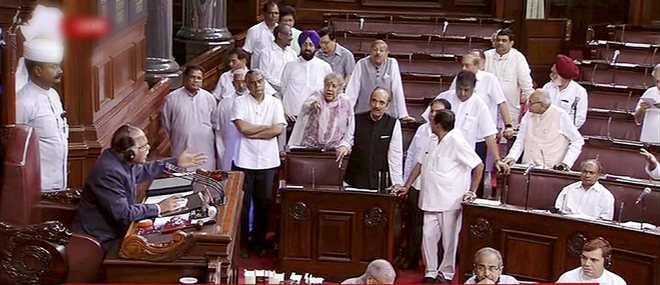
Congress members protest in the Rajya Sabha on Friday. PTI

No proposal is under consideration to scrap the Sahayak system in the Army, the government on Friday said, notwithstanding rising cases of jawans coming out openly against the colonial-era provision. The clarification by Minister of State for Defence Subhash Bhamre came in the Lok Sabha in response to a question. Under the Sahayak or buddy system, a solider is attached to officers and their duties include protecting the officers, maintaining their weapons and equipment and helping them in carrying out their responsibilities. ptiGovt aware of offensive WhatsApp videosInstances of ‘objectionable videos’ being uploaded through mobile phones and shared through WhatsApp have been noticed, the government informed Parliament on Friday. The messaging app provides a feature to report such content and a user can take screenshot and share it with appropriate law enforcement authorities, Minister for Electronics and IT, Ravi Shankar Prasad said in a written reply in the Rajya Sabha. pti


Lockdown in Punjab, Haryana, army called in, curfew in Sirsa

VERDICT TODAY Dera head to appear in CBI court, calls for peace, mobile internet, data, SMS services suspended; 22 trains cancelled; army called in Panchkula, Sirsa; all education institutions shut in 2 states, UT; HC pulls up Hry govt

CHANDIGARH: Punjab, Haryana and the Union Territory of Chandigarh went into lockdown on Thursday, shutting mobile Internet services, trains, schools, colleges and buses even as Dera Sacha Sauda head Gurmeet Ram Rahim Singh said he will be present in a CBI court during the pronouncement of verdict in an alleged rape case. The dera chief is an accused in the case.

APBSF personnel stand guard near the CBI court that will pronounce verdict in the rape case against Dera Sacha Sauda chief Gurmeet Ram Rahim Singh, in Panchkula on Thursday.

The two states and the UT administration, apprehensive of violence due to intelligence reports of dera supporters storing petrol, diesel and weapons, suspended mobile Internet and data services for the next 72 hours. The northern railways have cancelled 22 Chandigarhbound passenger trains with immediate effect. A joint control room has been set up in Chandigarh to deal with the volatile situation.

Army has been called in Panchkula and Sirsa where build-up of over 2 lakh and 1 lakh dera supporters, respectively, has kept the district authorities on tenterhooks. Later in the night, police started evicting dera followers from Panchkula and Chandigarh.

The Panchkula administration has requisitioned 25 columns of army from Ambala division, whereas two columns have been called in Sirsa where the dera headquarter is located. Curfew has also been imposed in Sirsa city and three nearby villages as a “precautionary measure”.

Haryana CM Manohar Lal Khattar spoke to Union home minister Rajnath Singh and defence minister Arun Jaitley requesting for additional forces.

The state government, which had failed to check the influx of dera supporters into Panchkula in the past two days despite prohibitory orders, got into action after being pulled up by the Punjab and Haryana high court for allowing them to reach the city where the special CBI court will deliver its verdict.

The high court said it could take action against the state police chief in case the state failed to ensure security. It also directed the central government to provide additional forces immediately to deal with any law and order situation, while also asking the dera to inform it about the efforts being made to defuse the situation.

The Haryana police have requested the DGPs, Punjab and Chandigarh, for making security arrangements to facilitate movement of Ram Rahim from Sirsa to Panchkula after his tweet that he will put in an appearance in the court. “Though I have pain in my back but I will abide by the law and appear in the court. I have firm belief in the God. Everyone should maintain calm,’’ read his tweet.

Dera spokesperson Aditya Insaan said the travel arrangements are being worked out by the administration and security agencies.

Punjab chief minister Capt Amarinder Singh also authorised the DGP to impose curfew, if necessary, to maintain law and order in the state.


Nawaz Sharif nailed Pakistani agencies steal a march

Nawaz Sharif nailed

THE Panama Papers, detailing the surreptitious salting away of ill-acquired wealth in offshore accounts by the crooked, have brought down several middling figures the world over. But it is the courts of Pakistan, decried by many as a failed state, that have unseated a serving Prime Minister, following the example of the more institutionally evolved Iceland. The Pakistan Supreme Court superbly paced its probe in the teeth of tenacious opposition by the Nawaz Sharif clan to deliver a verdict that no one has a grouse against. The judgment will set a precedent whereby Pakistani politicians, at all stages of their career, will have to explain the accumulation of wealth, thus increasing transparency and accountability in its political fabric.Compared to the prolonged foot-dragging in Pakistan, India was faster in responding to the biggest-ever data leak of offshore accounts. The courts readily accepted a plea by an ordinary litigant who sought a probe into charges against 500 individuals, including business tycoons, film stars and other movers and fixers. But a year later, the Supreme Court is yet to take a call on whether to form a special investigating team or hand over the case to the CBI. The petitioner’s allegation that the Central agencies are not interested in the probe has given rise to speculation whether the celebrities named in the leaks such as actor Amitabh Bachchan, real estate tycoon KP Singh and industrialist Gautam Adani’s elder brother would ever face the courts? Unfortunately, Indian agencies, despite their current zeal for targeting opposition politicians, were unable to swiftly prosecute all those named in the earlier Swiss leaks. The ongoing Panama case in the Supreme Court is not very visible in media but is at a decisive juncture. However, despite the groundswell of political and public support on tracking black money, some of it contrived, none of those indicted seem to be diving for cover. One of them, in fact, has become a brand ambassador of the GST, the Central Government’s most ambitious endeavour till date. With the Pakistan Supreme Court’s order having become the touchstone for probity, it is time India lifted its game as well.


Ethics in politic—-s Creeping immoral practices erode faith in democracy

Ethics in politics

To clean up the election process, the Election Commission and the Association for Democratic Reforms have made laudable efforts. But the humongous task cannot be accomplished without cooperation from the Centre. The BJP’s fight against corruption and black money does not seem to cover malpractices in elections. Making political funding transparent is not very high on its agenda. What happened during the recent Rajya Sabha election in Gujarat shows the party’s real face. The way it has captured power in Goa and Manipur may not pass the moral test.  Election Commissioner OP Rawat probably had all this in mind when he said on Thursday that “we are scripting a narrative that places maximum premium on winning at all costs — to the exclusion of ethical considerations.” It is not often that constitutional authorities speak out their minds or say without fear what needs to be said. Given the trolling the critics are subjected to by Modi bhakts in social media, not many dare to cross the Lakshman Rekha. In this context what Election Commissioner Rawat has said is daring: “In this narrative, poaching of legislators is extolled as smart political management, and strategic introduction of money for allurement, tough-minded use of state machinery for intimidation, etc, are all commended as resourcefulness.” The Election Commission has recovered from the low it touched when it overlooked poll code violations in Uttar Pradesh. The Commission redeemed its position when, exercising its constitutional power, it overruled the returning officer in Gujarat. The Association for Democratic Reforms has been making efforts towards cleansing the electoral process. Its latest report makes interesting revelations. The BJP has received the maximum donation of Rs 705.81 crore from 2,987 corporate donors in the last four years, while the Congress is way behind with Rs 198.16 crore from 167 corporate donors. That is on expected lines. What is not is that a party that is making PAN and Aadhaar compulsory for every financial transaction should itself be getting donations without PAN and address details. This is an issue the Election Commission can be accused of soft-pedalling. Opaque political funding is a bane of our democracy. 


Army orders high level inquiry by Major General into allegations against woman Military Intelligence officer

The inquiry had been ordered after the lady complained to the Chief of Army Staff and the Defence Minister in May this year levelling the allegations as well as producing photographs and video clips in support of her complaint.

indian armyThe woman officer from Military Intelligence (MI) had earlier been in the news when she took part in botched intelligence operation in Jorhat in Assam in 2011 while serving with 3 Corps Intelligence and Surveillance Unit. (Representative Image)


The Army has ordered a Court of Inquiry to look into the allegations levelled by a Colonel’s wife against a woman Major of the Corps of Military intelligence accusing her of having improper relations with her husband as well as some senior flag rank officers of the Army.

The inquiry, which is currently underway at Al Hilal military station near Palampur in Himachal Pradesh, is being presided upon by the General Officer Commanding of Yol-based 39 Mountain Division, Maj Gen VS Ranade. The two other members of the inquiry are Brigadier PPS Bajwa, Commander 33 Mountain Brigade and Colonel SK Dhawan. Two senior flag rank officers, a retired Lt General and a serving Major General have already been examined by the Court of Inquiry.

Given the nature of allegations and the involvement of a woman officer, another woman officer of the Army Medical Corps from 439 Field Ambulance Unit has been deputed as ‘member in attendance’ in the inquiry.

Highly placed sources in Western Command inform that the Colonel’s wife has already deposed in the Court of Inquiry. The inquiry had been ordered after the lady complained to the Chief of Army Staff and the Defence Minister in May this year levelling the allegations as well as producing photographs and video clips in support of her complaint.

It is also learnt that the inquiry has resorted depositions of witnesses through video conferencing in order to save time. Under the terms of reference of the inquiry, it has also been asked to suggest remedial measures to prevent the occurrence of such incidents in future.

The woman officer from Military Intelligence (MI) had earlier been in the news when she took part in botched intelligence operation in Jorhat in Assam in 2011 while serving with 3 Corps Intelligence and Surveillance Unit. The incident had resulted in a lot of controversy and the then Chief of Army Staff, General VK Singh, had issued a show cause notice to the then GOC 3 Corps, and later the Army Chief, Lt Gen Dalbir Singh, for improper supervision.

Later, the MI Major, who was a Captain at the time, was ordered to be tried summarily and was also given punishment. She had faced two charges under Section 63 of the Army Act and was accused of ‘An omission prejudicial to good order and military discipline”.

She was accused of not keeping proper command and control over the raiding party which conducted a counter-insurgency operation. In the same operation one 7.65 mm pistol and a cell phone were allegedly stolen by members of the military intelligence raiding party taking part in the operation. She faced a second charge for not maintaining a seizure memo of the confiscated documents and not taking a representative of the local police during the conduct of the said operation.


Walking the tightrope in China by Sandeep Dikshit

Amidst the military face-off at Doklam, China invited four Indian journalists for a week to convey its side of the story. Such exchanges, called fam-tours, or familiarisation visits, for foreign opinion makers — including the media and Parliamentarians — are the staple of every government. China has practised sophisticated diplomacy since imperial times and the scheduling of this visit in the middle of a tense standoff conveyed its own message

Sandeep Dikshit

The first glimpse of Beijing for a traveller from New Delhi is always groggy. The six-hour airtime interrupted by in-flight catering is inadequate for a straight long nap. Runway congestion in Delhi this time added another hour of bolt-upright sitting in the tightly arranged economy section of Air China.For chaperoned tours of Beijing, as this one was, there is a set pattern. Beijing is a compulsory destination. The second city is added according to the priorities of the Government-of-day. During the days of Jiang Zemin, aligned with the Shanghai faction of the Chinese Communist Party, Pudong, China’s city of a thousand skyscrapers was a must-see destination. When the populist leader Hu Jintao became President, it was common practice to pencil-in a town-on-the make — usually in the interiors, such as Luoyang, the city of Longmen grettos and the White Horse Temple on its outskirts — or model village houses in which befuddled residents were as yet unused to the modern toilet. Even when the Shanghai was on the ropes, the Chinese can’t resist showcasing Shanghai’s dazzling, giant saucer-shaped high-speed train terminal or the superfast Maglev to the airport, with a top speed of 430 kmph.

Brimming hostility

But this tour was different. Official China has never been as angry. The previous face-offs between Indian and Chinese soldiers never ever made it to the Chinese media. Now column after column brims with hostility, homilies and invectives. One day a China Daily editorial meticulously lists all the red lines crossed by Indian soldiers and their strategists in Doklam; the next day the Global Times picks up the cue. We are the chosen medium for Chinese messaging on Doklam. At each interaction, the message is the same but delivered differently: army officials prefer the in-your-face approach. The run-up of the diplomats is artful, the detailing meticulous and the warning wrapped in a soft tone that hardly registers.

The message

Because the times are tense and the message should not be diluted by other sights and sounds, the curtain draws with a trip to the 3rd Garrison Division of the People Liberation Army. It is these men and women who would man Tiananmen Square should China again face a call to democracy. At 35 degrees, the heat bounces from concrete pave walks in the city. But the Garrison is set between green rolling hills. Sitting in an air-conditioned room, a sweeping glass panel separates the amassed soldiers as they assault targets and hit bull’s eye with every volley. Some among us four may be overreacting when they feel the terrain is similar to Doklam. This is one of the designated spots for interaction with foreign military delegates. This is established by a bank of wall-mounted photo frames. The Pakistani delegations take up several slots but there is a solitary Indian delegation as well which visited the Garrison two months before Doklam unfolded. The message about Chinese army preparedness was reinforced with a drive across the town to an imposing multistoried building with the usual electronic access control systems. The army headquarters is much bigger, our permanent minder from the All China Journalists Association informs us. This is merely their information office. The tenor of the reception everywhere in official China is uniform. Steel gates slide away to admit the vehicle; the way to the lift and then the meeting hall is lined by beauties attired in the velvety-red Cheongsam or the two-piece Pein Fu. One of them is always in attendance at the interaction; gliding up softly to fill the cup of green tea by the elbow.  As compared to the Indian media presence in non-western countries such as Russia or Tokyo, the contingent here is sizeable. Most were not informed about the rare roll-out of Chinese officials, some of whom they have never sighted in their decades-long postings. It falls on us to battle the patchy free WiFi available in hotels (comparatively free WiFi connectivity in India is a dream) and on the streets to pass on some juicy bits to keep the kitchen fires of Beijing-posted Indian scribes going. 

State of non-communication

Government-focused reporting invariably produces news driblets every day in India but it is risky business in China for its government will only speak when it wants to. And sometimes this state of non-communication can last months. Currently, the roles are reversed. The Indian embassy shows no inclination to reach out except for the Intelligence boys who are curious. The rumour is the Indian envoy is reticent for fear of media misreporting tripping up his promotion chances.The army men rarely pull their punches. “We have the determination. If India continues going down the wrong path, we have the right to protect the lives of our troops. We have had several face-offs but we never had to issue a position paper.” The Chinese are taking their paper missiles seriously. The army, like all its counterparts, has a think tank and all its expert hands seem to be exploring the implications of the Doklam standoff.

Soft power

If Day One belonged to the military, the next day was dedicated to soft diplomacy. It was early and the traffic in Beijing was yet to get into gear. A man leaned on the bonnet of his Toyota as he supervised ill-dressed rural migrants positioning flowerpots around the two-block-long Ministry of Foreign Affairs. This was not the usual run-of-the-mill media briefing at the hi-tech hall that so often features on TV news. Petite but steely, Wang Wenji had opted to meet at one of the tasteful low-ceilinged cubicle framed by paper and silk guóhuà paintings, alternating with shui-mo variants of strong black lines and dotted brushstrokes. This time the message will be camouflaged. Her sofa framed by a delicate silk-and-walnut folding screen, Wang details China’s considerable experience in settling its land borders and wonders why India, with Bhutan tagging along, is the only exception. But the message from the diplomat who has details about all of China’s frontiers on her fingertips is stern: no substantial talks till the Indians stop interfering in Chinese territory.  There was more of soft diplomacy to the afternoon, intended to show that China was not closed to winds and ideas from overseas. At China Radio International (CRI), again in a sprawling behemoth of a building, located off Beijing’s Fifth Ring Road, teems with foreigners. The Hindi division has quite a few Indians while the adjoining Bengali news service has denizens from Kolkata and Dhaka. A Mauritian along with a Sri Lankan slurps milky tea in the canteen. The glass ceiling is evident though. Foreigners can only aspire to be worker bees but there is scope for creativity and experimentation for CRI has embraced all the three mediums.

Warnings in smiles

The next day was again devoted to tough love messaging. At the China Institute of International Studies, the Chief is a former diplomat who again wraps warnings in smiles and dulcet tones. But his number two is of an excitable age. Hackles on the Indian side go up as he fulminates against the “invasion”, the “biased” Indian media and the hazards of turning a deaf ear to Chinese protestations. “Calm down,” an Indian journalist advises while others smile uncomfortably. It was the same room where Gorbachev and Deng Xiaoping had once initiated border talks that lasted for two decades. A similar sense of déjà vu would have been in evidence then. In the evening, three Colonels spearhead a full-scale assault. Billed as an “India-China media seminar”, the local media was actually the audience. Once the Colonels realised the Indian side, though not speaking for their government, was not inclined to absorb recriminations and was prepared to give back as good as it got, the proceedings became interesting, and heated. Accusations of India at odds with all its neigbours were met by a listing of China’s troubles in the oceans around its periphery, while the Chinese journalists fidgeted. A hastily-passed note from one regretted the “unfriendly” attitude of the army colonels. But the grins returned when the meeting broke up. The officers were meant to semaphore and once the task was over, there were no hard feelings. One who had served in Doklan confessed that “you are stronger there.” The hard feelings sought to be tempered with the Kung Fu Show, a lavishly-mounted fusion of the modern with the traditional. The good cop returned into play again the next day. A pre-dawn flight to Zhanjiang, roughly the distance between Chandigarh and Kochi, brought about a complete change of scenery. The stiffness of Beijing devolved into an informal atmosphere. More locals packed its restaurants, the vegetation was wild and abundant compared to Beijing’s carefully manicured lawns and familiar vegetables like bitter gourd and pumpkin shared gastronomic space with scallops and oysters harvested from the famed South China Sea. 

Propositioning galore

Zhanjiang was a relief from the constant propositioning outside hotels in Beijing and Shanghai. The routine in Beijing is a one-two approach. An older woman will gingerly approach the foreigner. In flawless English, she will claim to have arrived from another city while her younger accomplice, smiling demurely all the time, is positioned as a city resident who wants to have “fun” but is too shy to make the offer. In contrast, Shanghai is a la carte: from offers to facilitate beer for a dollar to a “good time” with a woman, or even a boy. But the end result is the same, as an undocumented Bengali who stitched footballs during the day and solicited in the evening, had confessed. The victim ends up in a Hutong, one of the city’s narrow lanes, where roughnecks set to work on him. An Intelligence operation is slightly different, it is said, but journalists are very low-value targets. avy men have travelled the world and have learnt to talk the language of reasonableness. The headquarters of the South China Sea is sprawling but as was the case at the 3rd Garrison Division, a ship smelling of fresh paint but now obsolete as compared to its newer peers is the designated showpiece for foreigners. If the two armies are facing off some distance away, China’s sailors gave no indication. Their brief was to point out the difference between US naval forays in South China Sea — within 12 nautical miles of claimed Chinese territory — and Chinese ships in the Indian Ocean where they steer clear of the waters of other countries. Having opened its first foreign base in Africa, the Chinese naval men had the option to swagger. But they were sticking to Paramount Leader Deng Xiaoping’s dictum: “Hide your strengths, bide your time.” Chinese airlines have expanded at breakneck speed and in the process overextended themselves. They had a valid reason for the next day’s meltdown: a freak hail storm in Beijing. The flight for Zhanjiang landed after six hours. But the enforced stay at the airport was pleasant even for a relatively small city. Chic-looking restaurants, especially at hotels and in malls, are yet to become expensive rip-offs. Back in Beijing, another two-hour confinement in the aircraft was in store. The next day it was time to leave. The healthy routine of breakfast at 7 am, supper at 6 pm and unsweetened tea at all times had to be reluctantly given up. And what about shopping, did you say? The flight delays meant there were just two hours on the last day. But with skills honed by bargaining in bazaars here, this was more than adequate. 

sandeep4731@gmail.com


BRO DG inspects 7 strategic roads in Ladakh

Tribune News Service

Srinagar, July 20

As the diplomatic relations between India and China have flared up over Doklam in Sikkim, the Director General of the Border Roads Organisation visited Ladakh to inspect the strategic roads in the region.Lt Gen SK Shrivastava, Director General, Border Roads Organisation (BRO), is on a visit to Ladakh to take stock of the construction activities of various strategic road networks maintained and constructed by Project Himank.The DG’s visit began on July 18. On the first day, he undertook a detailed inspection of seven operationally, strategically and administratively critical roads, spanning a length of approximately 650 km in eastern Ladakh, an official statement said.The visit of the Director General to the cold desert assumes significance at a time when the relations between China and India are strained over the troop movement in the Doklam area of Sikkim. Ladakh is the most strategic region for India as it borders the country with China.Lt General Shrivastava interacted with the Chief Executive Councillor, Ladakh Autonomous Hill Development Council, Leh, and the General Officer Commanding of the 14 Corps to discuss issues relating to the development of road communication network required for meeting the development of the region.The Chief Engineer, Project Himank, Brig DM Purvimath, apprised the DG of various measures taken by Project Himank in linking unconnected areas despite odds. He held a detailed review of the operational requirement of the defence forces and promised all possible efforts from the BRO in this direction.