All posts by webadmin

Kapurthala Sainik School in tatters

Several parts of Jagatjit Palace were closed after being ‘declared unsafe’

Kapurthala Sainik School in tatters
The ceiling of the drawing room of Jagatjit Palace in a dilapidated condition due to paucity of funds. Tribune Photo: Malkiat Singh

Rachna Khaira

Tribune News Service

Jalandhar, March 28

While Chief Minister Capt Amarinder Singh recently proposed to set up two new Sainik School in the state, the one established in Kapurthala is on the brink of collapse due to paucity of funds.A majority of the Jagatjit Palace that houses the school were closed in the last one year after they were ‘declared unsafe’.Perturbed over the sad plight of the royal Jagatjit Palace, which was bought by the state government for Rs 16 lakh in 1961, the school authorities have now written to Capt Amarinder to come to their rescue.Though the state government in a Governors’ meet held in 1997 at New Delhi had agreed to sign a Memorandum of Agreement (MOA) with the Centre, it did not do so till date.School Principal Group Captain Shakti Sharma said as per the agreement, the Ministry of Defence was to frame rules and regulations of the school along with the admission policy and management, the state government was to provide a building and to release Rs 1.5 crore along with other constructional and infrastructural development funds.“The school was the third in the line of five Sainik Schools established in 1961 across the country. As the state government did not sign the MOA, we did not receive any dedicated annual grant. It was only last year that we received a grant of Rs 1 crore after 2012-13 but that too went away in clearing maintenance dues of the school accumulated all these years,” said Sharma.She said the only library established in Durbar hall of the school was closed on August 13 last year after its ceiling started collapsing.“As the school is established in a palace, it requires an enormous amount to maintain it. With no dedicated financial support from the state or the Central Government, we could not get the library repaired,” said Sharma.At present, around 618 students are studying in the school. The 12 hostels commissioned in 1963 are also on the brink of collapse and a majority of them have been declared unsafe.Cabinet Minister and Kapurthala MLA Rana Gurjit slammed the SAD-BJP combine for the dilapidated condition of the heritage building and alleged that the Badal family wanted to grab the 200 acres sprawling palace to use it for commercial purposes. “They wanted to close the school and utilise the palace for hotel purpose,” alleged Rana Gurjit.He, however, said he would soon take up the matter with the Chief Minister and the Ministry of Art and Culture to get a national heritage status for Jagatjit Palace.


PUNJAB’S CASE Building SYL canal a zero-sum game by K.R. Lakhanpal

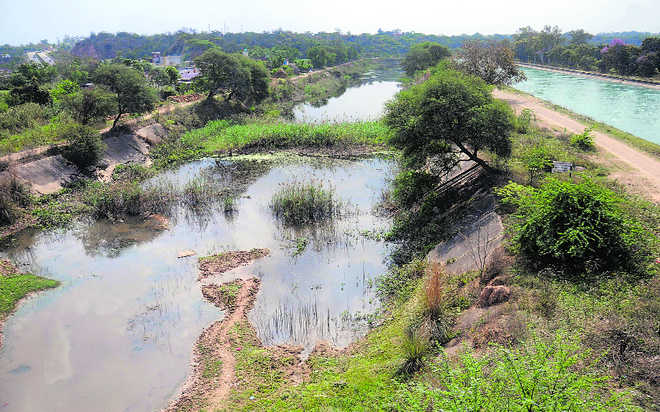
Construction of the canal without determining the total quantum of water that is available for distribution and its current usage through a fair process would be tantamount to putting the cart before the horse.
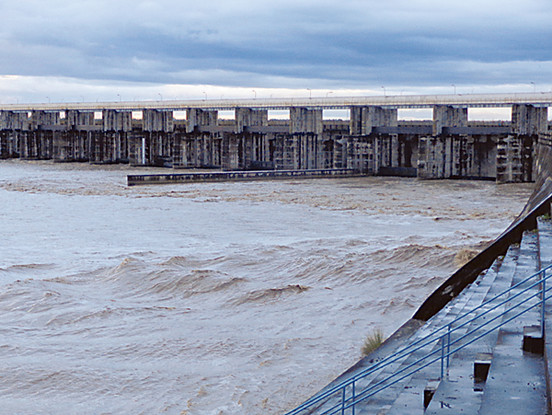
The Sutlej-Yamuna link canal, or SYL as it is popularly known, is a proposed 214 km long channel to connect the two rivers. The canal is required to carry surplus Ravi-Beas waters that have been allocated to Haryana under various agreements.The dispute regarding the sharing of river waters arose after Punjab was reorganised in 1966. Haryana demanded 4.8 MAF (million acre feet) share of water out of Punjab’s total 7.2 MAF share of water from the rivers, while Punjab claimed the entire quantity belonged to it. As no agreement could be reached, Haryana requested the Union government to intervene in the matter. In 1976, when the country was under an internal Emergency, an executive order was issued by the Union government, which allocated 3.5 MAF of water to each of the two states and the remaining 0.2 MAF to Delhi. The decision was met with opposition from various groups, including the All-India Sikh Students Federation, Damdami Taksal, Babbar Khalsa International and the Khalistan Liberation Force. In 1979, the Government of Punjab filed a suit in the Supreme Court challenging the 1976 executive order regarding sharing of waters between Punjab, Haryana and Rajasthan, and also vires of Section 78 of the Punjab Reorganisation Act, 1966.Haryana also filed a civil suit in the Supreme Court seeking directions for construction of the SYL canal. In 1976 Haryana unilaterally submitted a project report for construction of SYL Canal to the Govt. of India, and also provided a sum of Rs. 1.0 crore to Punjab for the purpose. An agreement was reached on 31st December, 1981 between Punjab, Haryana and Rajasthan under which Punjab’s share was increased to 4.22 MAF and that of Rajasthan to 8.6 MAF, while the share of Haryana from the revised availability of 17.17 MAF, remained the same. A provision for the construction of SYL Canal was also made. All states withdrew their suits following signing of the agreement and the construction of the canal was formally launched on the 8th April, 1982. In 1985, the Punjab Legislative Assembly repudiated the 1981 agreement. Following the Rajiv-Longowal accord, Eradi Tribunal was constituted on 2 April, 1986. On 30th January, 1987, the tribunal upheld the legality of agreements of 1955, 1976 and 1981 and also increased the shares of Punjab and Haryana, allocating them 5 and 3.83 MAF, respectively. The construction of the canal had to be abandoned in 1990 due to the gunning down of 30 labourers on the site of the canal in 1988 and the murder of a Chief Engineer and a Superintending Engineer in 1990 by the militants. Since then, the construction of the canal has been embroiled in disputes, in and outside of courts, between the warring states, culminating into the enactment of the Punjab Termination of Agreements Act, 2004, which abrogated all the previous river water agreements with the neighbouring non-riparian states, and the President of India making a reference to the Supreme Court of India under Article 143(1) of the Constitution of India, seeking its advisory opinion on the legality of the Punjab Termination of Agreements Act, 2004 and the honourable apex court, has returned the Presidential reference with its opinion. However, on 30-11-2016, the Honourable court directed status quo regarding land and property of SYL Canal. Haryana has now moved an application for execution of decree to construct SYL canal. The matter is now fixed for hearing before the apex court on the March 28.The introduction to the dispute is necessitated to put the issue in perspective and to trace its chequered and bloody past. Pursuing construction of the canal without first determining the total quantum of water that is available for distribution amongst various states, its current usage, and quantification of surplus water, if any, for allocation to Haryana through a process of fair and judicious adjudication under the relevant laws would only be tantamount to putting the cart before the horse. It is also to examine the myth that construction of the canal is a win-win and cost-free venture for both the stakeholders. That it is quite to the contrary is evident from the following:Firstly, the so-called agreements for sharing the river waters between different states are unilateral, arbitrary and a product of political expediency, rather than an outcome of a fair and judicious process of adjudication. When Punjab’s request for constituting a new tribunal was not acceded to and the Supreme Court decreed the Haryana suit for construction of the SYL canal, the state government was left with no alternative but to enact a law abrogating all such agreements to safeguard the interests of the farmers of the state. Even while doing so, the government took care to safeguard the current use of water by different states by a specific provision in Section 5 of the Termination of Agreements Act, 2004. It shows that the state’s intention is not to deny any state its fair share of waters.Secondly, even though the Presidential reference under Article 143(1) of the Constitution has been returned by the honourable apex court with its opinion, it is advisory in nature and the President is yet to take a view on this. As such, a window of opportunity still exists for the Union government to find a fair and just solution to this vexed issue by consulting all stakeholders. This must be seized to avoid miscarriage of justice that is bound to result from the single-minded pursuit of the construction of the canal.Thirdly, the award of the Eradi Tribunal, holding various agreements in the matter as legally tenable, cannot be enforced, as it is yet to be finally notified after publication and hearing objections of the stakeholders, as required under the provisions of the Inter-State River Water Disputes Act, 1956. In the meanwhile, the Eradi Tribunal has become defunct due to the death of its Chairman. Therefore, a fair solution would be to make a reference to a new Tribunal under the new law in the making, with new terms of reference having regard to ground realities.Fourthly, contrary to the popular belief that there is enough surplus water, which the State of Punjab is letting go down to Pakistan, rather than sharing it with its needy neighbours, there is just no surplus water. Therefore, any additional water to be given to Haryana over and above its current usage through the Bhakra Main Line (BML) system, consequent upon the completion of the SYL canal, will be through diversion and at the cost of its current users in Punjab. This will render large tracts of land in the south western Punjab a desert and will cause untold misery to lakhs of its farmers. It is also going to cost the nation dearly if apart from the cost of construction of the canal, costs arising out of loss of income and livelihood to Punjabi farmers, loss of water through leakage, seepage and evaporation over such long carrying system and the cost of lifting the water from the Western Yamuna Canal for use by Haryana farmers are also reckoned. If we add to it the incalculable cost of violence which the construction of the canal is likely to lead to, it sounds rather Tughlakesque.Fifthly, after a long flux of time of over 40 years since the issuance of the first order of allocation of waters in 1976, the order of the Supreme Court for the construction of the SYL canal has been rendered impracticable for implementation. Radical changes in agronomy, hydrology and ecology have taken place since. The most important of such changes is the change in the availability of water for allocation to different states, which is evident from the following table:Flow series Available water (in maf)

1921-1960 17.17

1981-2002 14.37

1981-2013 13.38

It would be observed from the data that the water availability has reduced from 17.17 MAF based on the 1921-1960 flow series to 13.38 MAF based on 1981-2013 series. Therefore, contrary to the common belief, there is no surplus water, Punjab is not misutilising even a cusec of water and the water flows to Pakistan occur mostly during the monsoon, because of inability to store.Sixthly, the waters of the Yamuna also formed an asset of erstwhile Punjab at the time of its reorganisation on November 1, 1966. As much as 2.64 MAF of Yamuna waters were being utilised in Haryana areas at that time. As per the agreement of 1994 amongst the states of UP, Haryana, Rajasthan, Himachal and Delhi, Haryana was allocated 4.65 MAF of Yamuna waters, an increase of 2.01 MAF over and above their utilisation at the time of reorganisation of Punjab. In the absence of construction of storage dams on the Yamuna, full utilisation of Yamuna waters is not being made and part of it is at present going waste.It may, therefore, be fair to conclude that the construction of the SYL canal is likely to be a zero-sum game, resulting in no net benefit to the nation. It will only result in a diversion of about 2 MAF of water from the current usage by farmers of Punjab to an inefficient future usage by farmers of Haryana and leave in its wake a tale of misery and violence. Such a misadventure is better avoided in the larger national interest, for which the Union government must intercede with the apex court and the legitimate water needs of Haryana be met by alternative innovative means.The writer is former Chief Secretary, Punjab. The views are personal

Why Punjab can’t share more

  • Water-sharing agreements engineered unilaterally and a product of political expediency, rather than judicious adjudication.
  • Presidential reference only Supreme Court’s advise to the President, who is yet to take a view. Thus, window for the Union government to find a just solution.
  • The award of the Eradi Tribunal not notified after hearing stakeholders. Also, has become defunct due Chairman’s death.
  • Punjab has no surplus water. Any more for Haryana will be at the cost of farmers in south Punjab. Water flows to Pakistan only in monsoon.
  • 40 years after Supreme Court’s first order, water availability has reduced from 17.17 MAF to 13.38 MAF, leaving little for Punjab to spare.
  • As per the agreement of 1994 amongst the various states (excluding Punjab), Haryana was allocated 4.65 MAF of Yamuna waters, an increase of 2.01 MAF over their utilisation at the time of Reorganisation


Punjab Cabinet expansion before Budget Session in June: CM

Punjab Cabinet expansion before Budget Session in June: CM
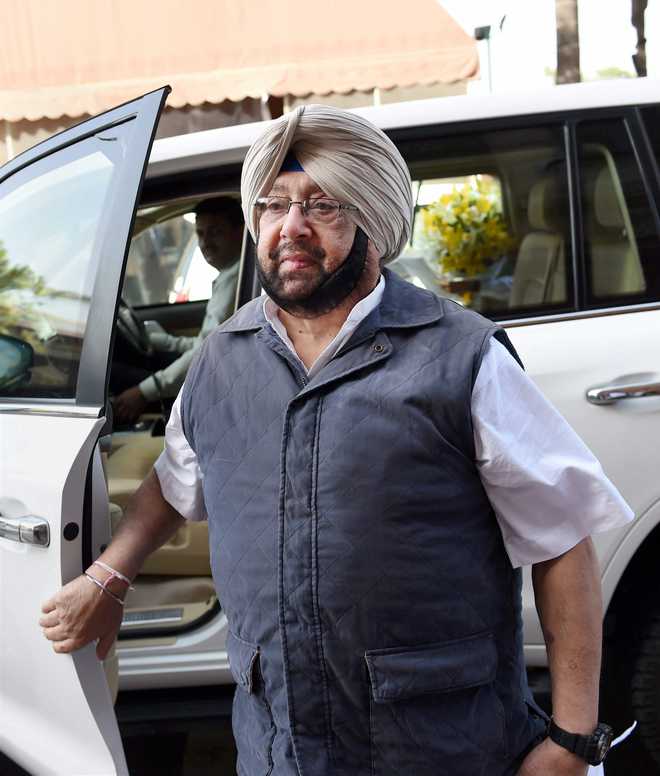
Punjab Chief Minister Amarinder Singh arriving for a meeting with Prime Minister Narendra Modi at Parliament House in New Delhi on Wednesday. PTI photo

Tribune News service

Chandigarh, March 23

Punjab Chief Minister Amarinder Singh on Thursday indicated that his first Cabinet expansion would be before the Budget Session in June.Amarinder said in a statement that Congress vice-president Rahul Gandhi had given him the freedom to choose his council of ministers and he saw seniority, experience and regional parity as key parameters for selection. Professionalism and experience would be given high priority for appointments to other government positions such as bureaucrats.  He said that his Cabinet would ensure all regions of the state were represented.The chief minister also justified his decision to continue with DGP Suresh Arora because he was a “professional man” while the chief secretary was changed because of his proximity to the previous regime.The chief minister has called a Cabinet meeting on March 27 to approve a vote-on-account that it will table in the first session of the new assembly that begins on Friday.


State on Modi’s doorstep for bailout

Ruchika M Khanna

Tribune News Service

Chandigarh, March 21

Having inherited a debt of Rs1.78 lakh crore from the previous Akali-BJP government, CM Capt Amarinder Singh, his Chief Principal Secretary Suresh Kumar and Finance Minister Manpreet Singh Badal will be meeting the Prime Minister Narendra Modi tomorrow, requesting him for restructuring its debt burden.The state will seek the intervention of the PMO for swapping 28 per cent of the state’s debt (Rs35,000 crore) with a low- cost option and urge him to reconsider the settlement of the legacy of food credit loan of Rs31,000 crore.Sources say the government wants the Centre to reconsider its approval, granted earlier this month for giving post facto assent to Punjab to avail a term loan of Rs30,000 crore to settle the food credit account.This loan had been taken by the state in November 2016, and the first instalment of interest, worth Rs810 crore was paid by Punjab in January this year, while the second instalment is due in April.The principal amount on this count is just Rs12,500 crore, but the interest on delay in settlement of loan has gone up to Rs18,500 crore. It is to settle this account that the state had to take a term loan of Rs30,000 crore. The repayment of this loan is to be made by floating bonds worth Rs31,000 crore.


‘India could nuke Pak if threatened’

WASHINGTON: There is increasing evidence that India could launch a pre-emptive first strike against Pakistan if it feared a nuclear attack was imminent, in a marked reversal of its wellknown no-first use policy, according to a nuclear strategist.

But this first strike will not be aimed at urban centres and conventional targets of a retaliatory strike intended to punish and prevent an escalation, but against Islamabad’s nuclear arsenal, to pre-empt a nuclear attack altogether.

“There is increasing evidence that India will not allow Pakistan to go first,” Vipin Narang, a nuclear strategist from the Massachusetts Institute of Technology, said at a conference on nuclear policy hosted by Carnegie, a think tank, on Monday.

“India’s opening salvo may not be conventional strikes trying to pick off just Nasr batteries (launch vehicles for Pakistan’s tactical battlefield nuclear warheads) in the theatre, but a full ‘comprehensive counterforce strike’ that attempts to completely disarm Pakistan of its nuclear weapons…,” he said. Comprehensive counterforce is an informal phrase for counterattack on a nuclear arsenal.

Relations between the neighbours are at the lowest since a string of militant attacks on Indian military installations which New Delhi blames on Pakistan-based militants.

As evidence for his theory, Narang cited recent remarks from leading Indian strategists and a book by Shivshankar Menon, who oversaw nuclear targeting for India as NSA to PM Manmohan Singh.

To buttress his theory, Narang cited this para from Menon’s book, “Choices: Inside the Making of Indian Foreign Policy”: “There is a potential gray area as to when India would use nuclear weapons first against another NWS (nuclear weapon state). Circumstances are conceivable in which India might find it useful to strike first, for instance, against an NWS that had declared it would certainly use its weapons, and if India were certain that adversary’s launch was imminent.” New Delhi declared its no-first use policy in 2003, undertaking to not start a nuclear war in a neighbourhood packed with nuclear actors Pakistan and China.


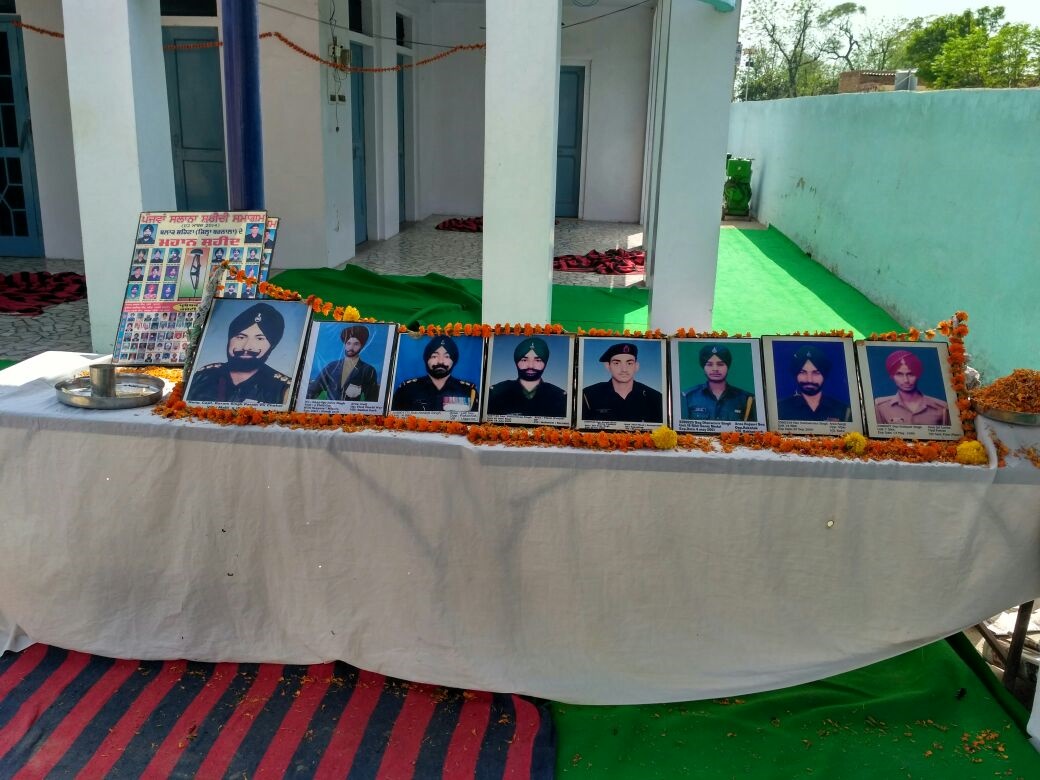
Remembering Martyrs Brig Indermohan Singh

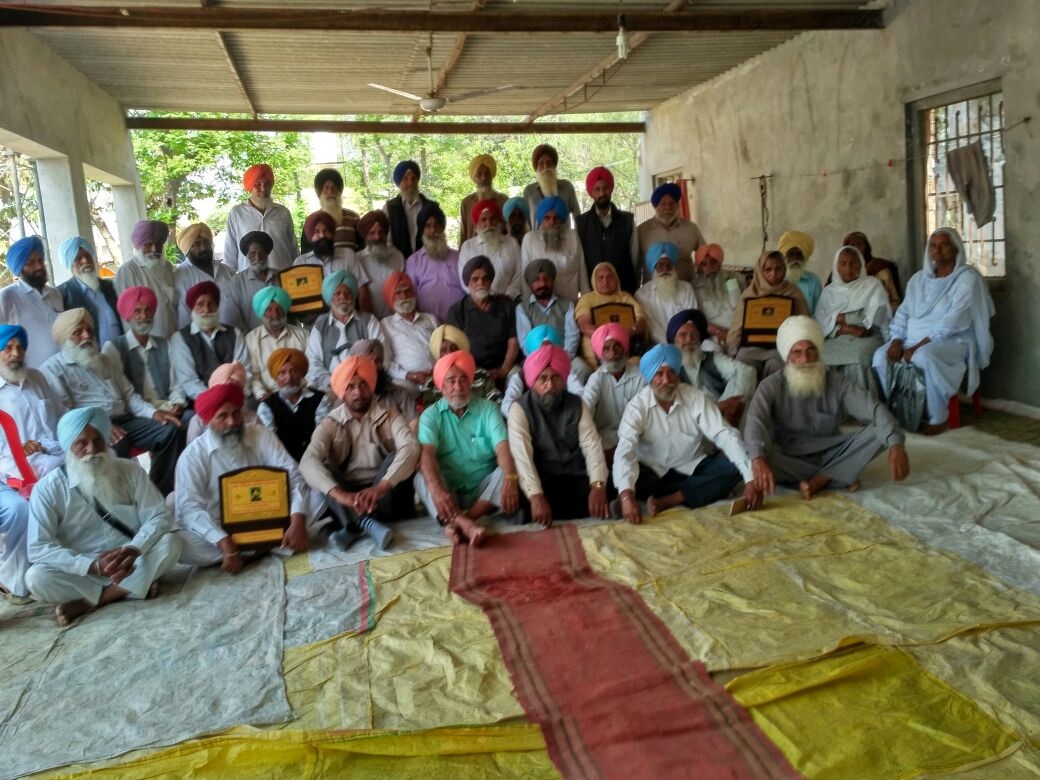
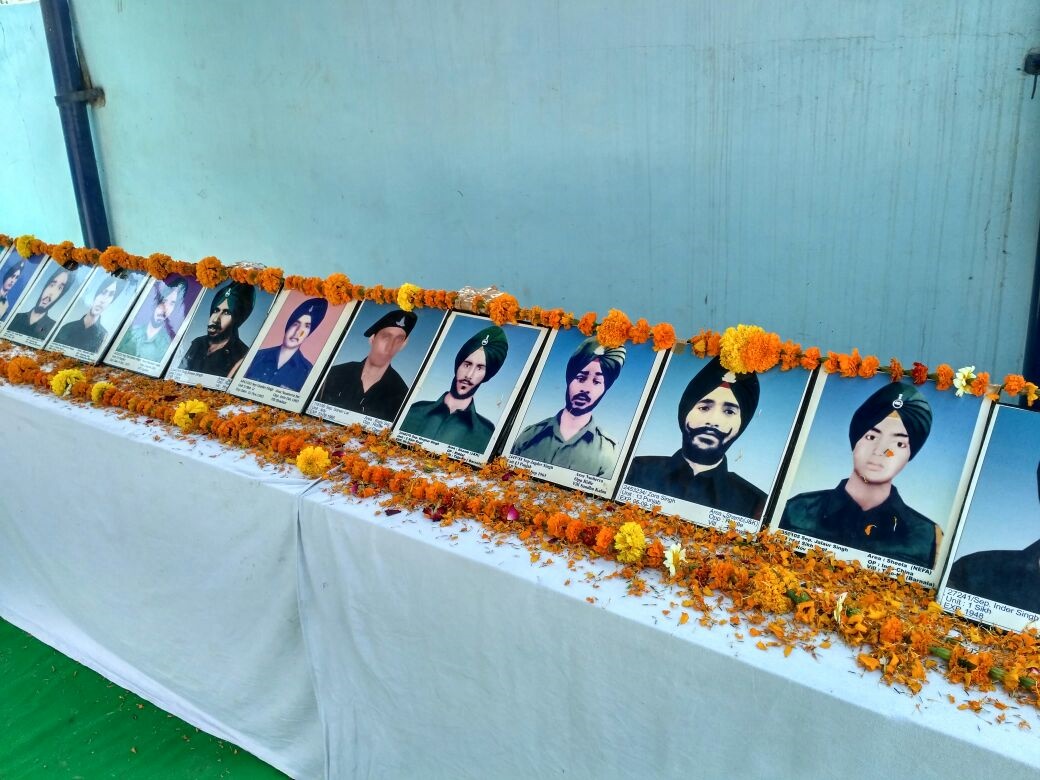
Sehna Block in Barnala commemorates it’s martyrs every year in March. The function was held on 19 Mar. It is held in a different village every year.

. Akhand Path is held in the village gurudwara followed by Langar. NOK are honoured.

There are twenty of them. Sehna village also has Muslim residents. One of the martyrs is a young Muslim soldier, Baddu Khan from engrs. His father, Gulzar Khan easily passes of as a village Sikh.   Sub Karam Singh, PVC,  Sikh Regt belongs to Sehna.

Displaying IMG-20170320-WA0064.jpg

IMG-20170320-WA0059 IMG-20170320-WA0061 IMG-20170320-WA0063


Manipur CM served as BSF constable in Jalandhar

Manipur CM served as BSF constable in Jalandhar
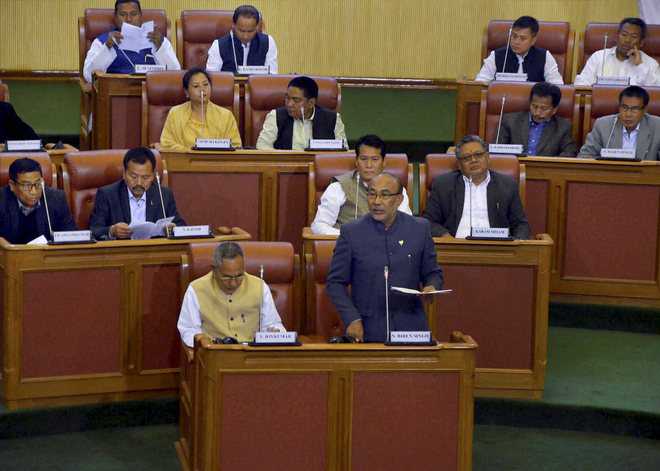
Manipur CM N Biren Singh in the Assembly on Monday. PTI

Tribune News Service

Jalandhar, March 20

N Biren Singh, country’s first sportsperson Chief Minister, was reportedly part of the BSF soccer team that won the Durand Cup by defeating Mohan Bagan in Jalandhar.BSF DIG RS Kataria says: “I have been told by football coach Suraj Bhan Handa that Biren served here in 1981 and was an ace football player. I am also told that he was a cheerful, energetic jawan who had a short stint here. He was just 20 then.”Another senior official said Biren was 18 when he was spotted by the BSF playing a football match in Imphal in 1979. “Recruited, he served the force representing its national football team for 14 years,” he said. The BSF personnel said there was an excitement about the development at the headquarters here. “We have begun keenly following the political activities of this ex-serviceman from our force through TV and newspaper reports,” he said.

New Manipur CM has a Punjab connection

JALANDHAR: The pride is palpable among Border Security Force (BSF) personnel at its Jalandhar headquarters for the western border, and the reason is close to the eastern extreme of India. One of the footballers from the BSF team here is now the chief minister of Manipur.

Officials here are busy finding more history and photographs of N Biren Singh, BJP’s first chief minister of Manipur who took oath on March 16. “Biren was posted in BSF as a constable,” Suraj Bhan Handa, the present coach of the team, said.

As per information from the BSF, Biren Singh came to Jalandhar in 1981 after he cleared the inter-frontier level in the force. His position was ‘right fullback’ on the field. Other officers say that as part of the team in Jalandhar, he also won the Durand Cup in 1981. Biren’s batchmates now reside in various parts of the nation. They remember the CM as a “jolly” and “funloving” person who was always popular.


Pardeep Kumar, who is a retired BSF employee and is now living in Siliguri, told HT that Biren and he stayed in the same room. “We would visit markets and go to watch movies,” said Kumar.

He added, “Biren had interest in politics at that time too, but his becoming a chief minister is something we batchmates are proud of.” He recalled that Biren Singh had a “very good diet” and was fond of rice. “He often cooked for himself.”

Vishwa Miter, who at present is the coach for Jammu Sports Council, said Biren was witty too. “We always talked to him in Punjabi, and he would understand little at first. With time, he started understanding the language.” Shyam Kumar Sharma, one of the coaches of Biren who now resides in Australia, said over phone that he was a great player and a true sportsperson.

As for the old pictures, the BSF officials are planning to get them framed and send to Biren Singh, the constable who is now CM.

Declare assets in 15 days: Yogi to officials

Curbing graft: Tells them to ensure implementation of ‘sankalp patra’ | Asks DGP to improve law and order

Declare assets in 15 days: Yogi to officials
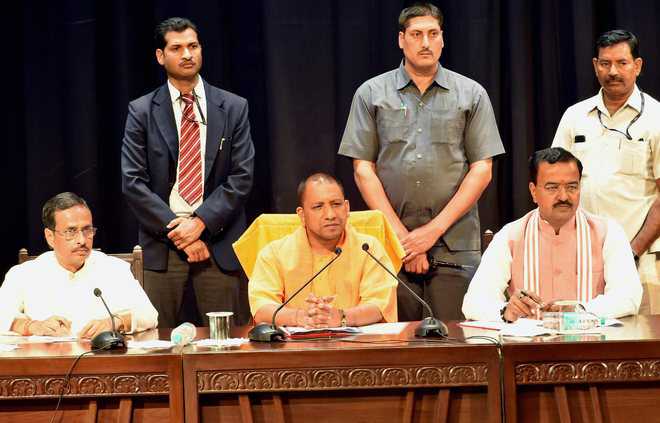
UP CM Yogi Adityanath with Deputy CMs Dinesh Sharma and Keshav Prasad Maurya at a meeting of police officers at Lok Bhawan in Lucknow on Monday. PTI

Lucknow, March 20

Uttar Pradesh CM Yogi Adityanath today directed officials to declare their assets within 15 days, following up on a similar order to ministers after assuming office yesterday, a move aimed at uprooting corruption.Separately, Adityanath directed state DGP Javeed Ahmed to ensure that there was no laxity in improving law and order situation, hours after a BSP leader was shot dead in Allahabad.At his first interaction with senior officials in Lok Bhawan, the CM also instructed them to ensure implementation of BJP’s ‘sankalp patra’ (manifesto). “It was an introductory meeting with UP government officials. The officials were told that the sankalp patra has to be implemented,” Deputy CM Keshav Prasad Maurya said.The CM also asked officials to declare their assets — immovable and movable — within 15 days, Maurya said. The meeting was attended by nearly 65 senior officials. The officials were given a copy of the BJP’s ‘sankalp patra’ and instructions have been issued to them to prepare a roadmap for their respective departments, a senior BJP leader said.“As uprooting corruption is the main agenda of our party, the CM in his first introductory meeting with his new ministers directed them to give details of their income, movable and immovable properties, within 15 days,” cabinet minister Srikant Sharma had said yesterday.Sources said Adityanath expressed concern over the attack on the BSP leader and stressed that restoring law and order was the top priority of his government.BSP leader Mohd Shami, 60, was last night gunned down by assailants close to his residence in Mauaima police station area, 40 km from Allahabad.The UP DGP has been asked to hold video conference with the district magistrates and the superintendents of police of all the 75 districts of the state to take stock of law and order situation and other administrative issues, they said.Deputy CMs Maurya and Dinesh Sharma also met Adityanath. Maurya told reporters that the first meeting of the state Cabinet would discuss all key issues mentioned in BJP’s ‘Sankalp Patra’, which include loan waiver to farmers and ban on mechanised slaughter houses.Sharma told mediapersons that his meeting was just a courtesy call. “We will work for the welfare of the people with full vigour and ensure that the work is visible on the ground,” he said. — PTI

‘Purifying’ CM’s bungalow

  • Hindu seers and priests on Monday made elaborate arrangements for sacred purifying rituals at the CM’s bungalow that will be the new home for Yogi Adityanath
  • Adityanath stayed at the VVIP guest house overnight and has decided not to enter the bungalow without conducting prayers and purification rituals
  • Even before dawn broke, seven priests from Gorakhpur and Allahabad trooped into the CM’s official residence to conduct prayers

Well begun A surprise break from past Cong work culture

For long used to slow or non-decisions, and the successive Congress-Akali Dal-BJP governments’ status quoist approach to issues confronting Punjab, it is a pleasant surprise to find a 75-year-old Chief Minister, who once enjoyed a reputation for a laid-back lifestyle, showing such youthful energy and getting through so many welcome decisions at the very first meeting of the state Cabinet with few ifs and buts. From containing the use of the red beacon, pruning security and limiting the annoying VIP culture to the bare minimum to reining in government expenditure, regulating transport, liquor, mining, cable and real estate businesses to proposing “conflict-of-interest” legislation — all are decisions in the right direction. The swiftness with which these have been taken shows a decisive leadership in command.Particularly significant is the proposed law to deny official positions to MLAs with business interests. There are Congressmen who too would be affected and they can scuttle the move. Given the extent of systemic corruption, the annual declaration of assets by those holding official positions is not enough; maybe Punjab needs to consider a Bihar-like law to seize properties of convicted politicians and civil servants. The direct transfer of subsidies will help plug leakages and an end to Inspector Raj, if enforced, would provide relief to industrialists. The abolition of the post of halqa in-charge should save people from police harassment. Depoliticising the police and the bureaucracy, however, should be the next step but would not be easy and would require efforts to make police and administrative reforms happen as outlined by the Supreme Court.There may be a case for the government to buy time by forming a committee to assess farmers’ debt or entrusting another panel the job of identifying unviable boards and corporations, but the decision to continue free power — that too unmetered — to all farmers regardless of their landholdings needs to be revisited since it encourages waste of scarce groundwater and ruinous cultivation of paddy. Farmers can be compensated with cash transfers over and above the MSP. To ensure that Saturday’s decisions are not lost in the bureaucratic maze, rigorous follow-up monitoring and action would be required at the CMO level.