Sanjha Morcha

All posts by webadmin

Obama tells India and Pak to reduce N-threat

NUCLEAR SUMMIT Says their military doctrines shouldn’t move in ‘wrong direction’

WASHINGTON: US President Barack Obama has flagged the Indian subcontinent as a challenge in the context of global nuclear security, saying India and Pakistan must ensure their military doctrines do not move in the “wrong direction”.

PTIPM Narendra Modi with Riyadh governor Prince Faisal bin Bandar bin Abdulaziz on his arrival in Saudi Arabia on Saturday.Obama made the remarks during a news conference held after the fourth and final Nuclear Security Summit hosted by him. He also listed the reduction of the nuclear arsenals of the United States and Russia, and North Korea’s atomic programme as other key challenges.

“The other area where I think we need to see progress is Pakistan and India, that subcontinent, making sure that as they develop military doctrines, that they are not continually moving in the wrong direction,” he told the news conference at the end of the two-day summit.

T hough Obama did not spell out his concer ns, his remarks appeared to be a reference to the growing atomic arsenals of India and Pakistan and the nuclear doctrines of the two countries.

Pakistan is believed to have the world’s fastest growing stockpile of nuclear weapons and US secretary of state John Kerry recently cited the example of the United States and Russia — which are working to reduce their arsenals — as he nudged Islamabad to cut the number of weapons and review its nuclear policy.

While India adopted a “no first use” policy soon after its nuclear blasts in 1998, Pakistan has not put in place a similar policy.

The world community has also expressed concern about Pakistan’s new policy of developing tactical or battlefield nuclear weapons to counter any possible military thrust by Indian forces. Obama said “one of the challenges” facing the US and Russia is that it is “very difficult to see huge reductions in our nuclear arsenal” unless both countries, as the largest possessors of nuclear weapons, are “prepared to lead the way”. Referring to the tensions arising from North Korea’s recent nuclear and missile tests, he said, “And we have to take a look at the Korean peninsula, because… North Korea is in a whole different category and poses the most immediate set of concerns for all of us, one that we are working internationally to focus on.”

Concerns about North Korea had figured in his trilateral meeting with the leaders of Japan and Korea and were “a major topic of discussion” with China’s President Xi Jinping, he added.

More needs to be done to prevent non-state actors from obtaining nuclear materials, world leaders said in a communiqué after the summit. The meet, attended by more than 50 world leaders, described the threat of nuclear and radiological terrorism as “one of the greatest challenges to international security”. The threat is “constantly evolving”, the communiqué said.

“We commit to fostering a peaceful and stable international environment by reducing the threat of nuclear terrorism and strengthening nuclear security,” it added. Obama also warned that terrorist groups such as al Qaeda and Islamic State will use nuclear weapons if they get hold of them.


Prez lauds Manipuris’ tolerance, pluralism

Prez lauds Manipuris’ tolerance, pluralism
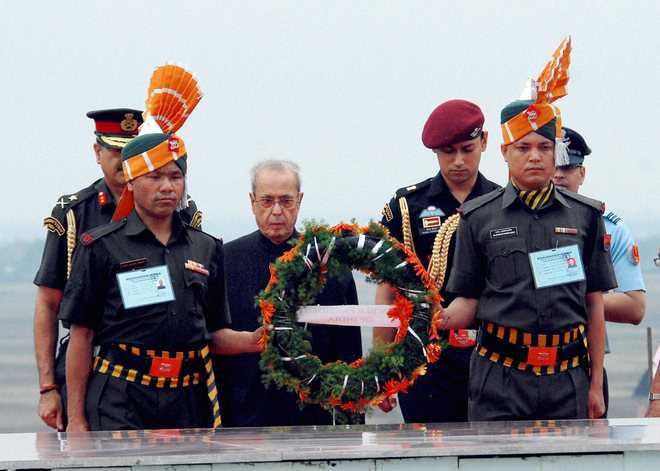
President Pranab Mukherjee pays homage at the Khongjom War Memorial in Thoubal district on Saturday. PTI

Imphal, April 23

President Pranab Mukherjee today praised the people of Manipur for their broad tolerance, pluralism and acceptance of universalism.“Truly, it (Manipur) is Jewel of India. It is not only for its rich culture variety or pristine beauty, for its brave men and women, but for its broad tolerance, pluralism, celebration of pluralism and acceptance of universalism,”he said.The President was here to participate in ‘Khongjom Day Observation’, observed every year to pay tribute to the brave sons of the state who made supreme sacrifice for the cause of their motherland.He also inaugurated Khongjom War Memorial and laid wreath there. Manipur is the place which is not only known for its blue hills and pristine beauty but for the endurance, tolerance and determination, he said. In the function, Mukherjee offered tributes to the fierce patriots from the state who fought the last battle of the Anglo-Manipuri War of 1891. “I join you in paying homage to the great sons and daughters of Manipur. They gave their today for our tomorrow,” he said. — PTI


Choosing optics over outcomes

The government’s Pakistan policy seems to be based on whims and is devoid of a real framework, writes JYOTIRADITYA SCINDIA

The Modi government has recently warmly welcomed and rolled out the red carpet for a Joint Investigation Team (JIT) from Pakistan to come and investigate the Pathankot airbase attacks. On the subject of export of terror to India, India has always maintained that there is no distinction between the activities of State and non-State actors in Pakistan and the latter are only used as a proxy by the Pakistani establishment (mainly the army and ISI) to further its agenda of targeting India. Now, by callously inviting the Pakistani JIT to India, the government has played right into the hands of the Pakistani establishment, which conveniently offers “non-State actors” as an excuse for its export of terrorism to India. Past Indian governments have worked extremely hard and had succeeded in pushing Pakistan into a corner, by diplomatically asserting that the Pakistani State is an active abettor of terror rather than purely victim to it. The recent actions of the Modi government have washed away years of this effort and effectively dismantled the box that Pakistan was caged in; the invite to the Pakistani JIT, which includes an ISI member, is tantamount to giving it a clean chit on terror incidents.

PIBPrime Minister Narendra Modi, who, before the elections, used to talk about showing ‘red eyes’ and loudly condemned writing ‘love letters’ to Pakistan, has today adopted the ‘pappi-jhappi’ doctrine to win over his Pakistan counterpart Nawaz SharifWhat is even more damning is that India is yet to get a Letter Rogatory (LR) — a request from a court to share evidence to help investigations — from Pakistan. In the absence of this letter, any evidence collected by the JIT could easily be challenged in a court of law and may not even enjoy judicial admissibility in Pakistan. So, while India may hand over conclusive proof of Maulana Masood Azhar’s and the JeM’s involvement in the Pathankot attack to the JIT, it may be de-linked from the judicial process against them in Pakistan, effectively beating the entire purpose of the said investigation. The Indian government has claimed to have received assurances from the Pakistani authorities about the non-requirement of the LR, but by accepting Pakistan’s explanation, India is being absolutely careless and not according the technicalities of another country’s judicial procedures the seriousness they deserve. This episode is but one example of the Modi government’s dismal policy vis-à-vis Pakistan, which has been marked by the absence of farsightedness, complete non-transparency and flip-flops.

Cross-border infiltration and terrorism have an unfortunate pattern of rearing their ugly heads whenever any high octane engagement is undertaken by India and Pakistan — the Lahore declaration under the earlier BJP government was followed by the Kargil War and PM Narendra Modi’s stopover in Lahore to attend PM Nawaz Sharif ’s birthday and his granddaughter’s wedding resulted in Pathankot. This government has conveniently chosen to emphasise optics over outcomes when it comes to its Pakistan policy. There is absolutely no framework for engagement with Pakistan and decisions seem to be made spontaneously and on a whim. Pakistan is yet another example of the BJP’s post-election U-turns and its penchant for managing headlines over managing policy. The same Modi who, before the elections, used to talk about showing “red eyes” and loudly condemned writing “love letters” to Pakistan, has today adopted the “pappi-jhappi” doctrine to win over Sharif. Sushma Swaraj, then leader of the Opposition and now external affairs minister, who used to forcefully demand suspension of talks with Pakistan until their “aatankvaad ke thikaane” were destroyed, now refers to the Indian PM’s surprise visit to Pakistan as “statesman-like”, tweeting “Padosi se aise hi rishte hone chahiyen”.

Even after coming to power, the U-turns and flip-flops haven’t ceased. The main conspirators of the Mumbai attacks have not been brought to justice, Pakistani diplomats have not stopped meeting the Hurriyat leaders, there have been close to a 1,000 ceasefire violations since the government took office and there have been repeated terror strikes in Jammu and Punjab — killing three in Kathua (March 2015), seven in Gurdaspur (July 2015), seven in Pathankot (January 2016) and five in Pampore (February 2016). What is the BJP’s, and more importantly the government’s, position on Pakistan? Is it “talks and terror can’t go together” or “the two countries will talk only if they have to discuss terror and not Kashmir” or “the perpetrators of 26/11 and Pathankot should be brought to justice before we talk” or “any third party involvement with the Hurriyat is where we draw the red line”? Alternatively, is Modi’s Pakistan policy based on exchanging saris and shawls with the Pakistan PM, and visiting Pakistan to wish him on his birthday and attend his granddaughter’s wedding? The country needs to know, the Opposition needs to know and perhaps, most importantly, ministers in the government need to know.

India needs to negotiate from a position of strength — that means we must decide not just when and where we talk to Pakistan, but also what we talk about. The Congress has always advocated peaceful, but results-oriented, negotiations to settle all disputes with Pakistan and dealt with the situation skilfully and sensitively when in power. It made sure Parliament and the Opposition were always taken into confidence and the media periodically briefed through a single channel of communication. Now what we have is absolute mayhem and confusion — even the senior-most ministers of the government are unaware of the PM’s visit to Pakistan, the visit of the Pakistani JIT and whether or not the JIT will be provided access to the Pathankot airbase. The desire for media attention and personal glory seems to have superseded national interest to yield foreign policy that is directionless, toothless and ineffective.


Hint of duress in Pak video of ‘spy’

NEW DELHI: India rejected a man’s purported video confession that Pakistan peddled on Tuesday to reaffirm its allegations about detaining an Indian naval officer for espionage and encouraging terrorist activities in Balochistan and Karachi.

AFP PHOTOPakistani Lt General Asim Bajwa (left) gives details about alleged spy Kulbhushan Yadav in Islamabad on Tuesday.Pakistani military spokesman Lt General Asim Bajwa began a media briefing with a six-minute video of the “Indian spy”, who makes a series of comments that match Islamabad’s allegations about India fuelling a separatist movement in Balochistan and inciting violence in financial capital Karachi.

The video features multiple quick edits and the audio appears to go out of sync from time to time, which hint that it was shot under duress.

India repeatedly denied both charges, saying the official took premature retirement from the navy and has nothing to do with the government.

The Indian foreign ministry said the man, identified as Kulbhushan Yadav, was harassed while operating a legitimate business from Iran.

“While we probe this aspect further, his presence now in Pakistan raises questions, including the possibility of his abduction from Iran,” it said and asked Pakistan to grant consular access to Yadav.

The man’s statements “clearly indicates tutoring”, the foreign ministry said and, hence, “We are naturally concerned about his wellbeing in these circumstances.”

The footage shows the man saying he began working as an intelligence recruit after the attack on 2001 Parliament in New Delhi in which nine people were killed. He apparently set up a small business in Iran that provided him cover for frequent trips to Pakistan before becoming an agent for Research and Analysis Wing (R&AW) — India’s external intelligence agency — in 2013.

He says he was caught trying to cross into Pakistan from Iran on March 3.

“Kulbhushan Yadav is a serving Indian naval officer whose primary mission was to foment terrorism in Karachi and Balochistan,” Lt General Bajwa said. “He converted to Islam and worked at Gadani under the cover of a scrap dealer.”

But there is no proof that the retired navy officer was detained in Balochistan, India had countered.

Yadav owns a small ship and used to carry cargo from ports in Iran to various destinations, sources told PTI. He could have been detained after he strayed into Pakistani waters and was being wrongly charged.


Defence strategy experts need of the hour, says ex-Army chief

Defence strategy experts need of the hour, says ex-Army chief
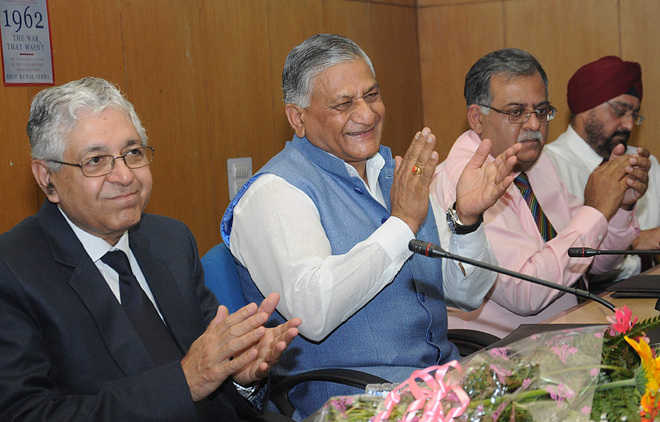
Union Minister of State for External Affairs Gen VK Singh (second from left) with VC Prof AK Grover and other dignitaries at Golden Jubliee Hall, PU, in Chandigarh, on Saturday. Tribune photo: Manoj Mahajan

Tribune News Service

Chandigarh, March 26

Indian universities should produce experts in defence strategic studies to guide military personnel not to repeat their old mistakes if any war is fought in the future. Former Army chief and Union Minister of State for External Affairs and Statistics and Programme Implementation (Independent Charge) Gen V K Singh stated this while addressing a seminar on ‘1962 War: an Appraisal’ at Panjab University here today. The event also marked the book release of “1962 The War That Wasn’t” by Shiv Kunal Verma.Referring to the PU Defence Studies Department where courses related to the strategic studies was going on, he said such departments were the need of the hour. He said in other developed countries special departments were created by the government so that specialisation and analysis of history and wars of the country could be done to understand the loopholes. This was done so that their soldiers did not repeat such mistakes in future wars. But in India, defence studies meant what we learn in NCC and nothing else, he said. During his address, he said those who did not learn from history suffered a lot in future.Referring to the 1962 war, he appreciated the courage of the Indian soldiers and said they performed well but the defeat was due to political establishment and leadership at the top of the military which lacked in taking the right decision at the right time. He stressed upon analysing the situation of 1962 war to learn what went wrong so that it should not be repeated by the military in the future.Clarifying the myth that after Independence,  the military was keen to go on war to show their might to the neighbours, he said during the 1962 war, military was not taken into confidence by political heads before taking a final call on the war. The political establishment cheated the military by not actively consulting it.Meanwhile, filmmaker and military historian Shiv Kunal Verma who authored the book “1962 The War That Wasn’t” mentioned that while signing the Panchsheel Agreement, India made concessions to China which was against the advice given by the military leadership. PU VC Prof Arun Kumar Grover called upon the Department of Defence and National Security Studies to reach out to the military leadership and retired military officers and create a think tank.  Gen Kulwant Singh, Maj Gen Rajendar Nath, Brig Amarjit Singh Behl and Brigadier DK Khullar also shared their views.The 1962 war veterans Maj Gen Rajendar Nath, Brigadier Amarjit Singh Behl and Brig DK Khullar were also present. They were given standing ovation by the audience.


At 99, Army tells war widow to get husband’s record from ‘Rangoon’

PUNJAB AND HARYANA HC ISSUES NOTICE TO ARMY ON PETITION FROM WIDOW OF WW II VETERAN ASKING FOR PENSION AFTER HUSBAND’S DEATH

CHANDIGARH: More than two years after Army authorities asked Gurdial Kaur, 99, the widow of a World War II veteran, to go to ‘Rangoon’ to get the records of her husband’s service before she could be paid pension after his death, the woman has finally petitioned the Punjab and Haryana high court and the Army authorities have been issued notice for April 12.

Gurdial, the widow of Naik Harnam Singh of the Myanmar (earlier Burma) Army, is entitled to family pension on the death of her husband in 2012, but has not been paid a penny since, with her application lost in the maze of the army’s maze of legalese and bureaucracy.

An instance of this is the army letter to her on October 8, 2013, that asked her to fetch her husband’s service record from Rangoon (the erstwhile capital of Myanmar), even as that country shifted its capital to a new city, Naypyidaw, in 2006.

As things stand now, even the Adjutant General Branch of the Army is not clear on which record office has to process her case. EVEN THE PRESIDENT WAS APPROACHED

When pension was first delayed to her after the death of her husband, she wrote to President Pranab Mukherjee for help who marked her letter to the ministry of defence. The letter then reached the army headquarters. The record offices of Artillery, Punjab Regiment, Bihar Regiment, Parachute and Army Air Defence claimed that they did not have any record pertaining to Naik Harnam Singh.

Finally, the office of Artillery Records who asked her to approach ‘Rangoon’ in Myanmar.

Gurdial then approached the high court in March this year claiming that her case was being kept in abeyance by the army even as there had been extensive correspondence between her and the army. In the petition, she claimed that the army officials had been totally devoid of any empathic approach towards her and had been merely engaged in internal discourse all the time.

She also claimed that her case was languishing from one table to another, from one record office to another, at the behest of the army authorities.

“I have not got anything so far. I can’t go from one office to another at this age,” she said. The last pension her husband got was of around ` 8,400.

After the British annexed Myanmar to the Indian province during their rule, a uniform system of administration throughout the colonial government was established. The system remained even after Myanmar’s separation from British India in 1937; whereby, many Indian nationals continued serving in Myanmar, as in the case of Harnam. He even served with the Myanmar Army during World War II.

As per the Myanmar government, in the event of death of the military personal concerned after retirement, the family pension was restricted to the period remaining up to 10 years from the date of retirement or up to the date on which the concerned personal would have attained the age of 65 years, whichever is earlier.

In 2009, the Indian government brought out a policy for paying pension to such employees. Harnam gained from the policy and continued to get pension till his death in 2012.

Soldier found dead at house in Rupnagar

An Armyman died under mysterious circumstances in his rented house on Friday. Naib subedar Gurnam Singh of 24 Punjab regiment, a native of Raipur Munney village near Nurpur Bedi, lived at Gillco Valley Colony and was posted near Srinagar

RUPNAGAR: An Armyman died under mysterious circumstances in his rented house on Friday night here. Naib subedar Gurnam Singh of 24 Punjab regiment, who belonged to Raipur Munney village near Nurpur Bedi, lived at Gillco Valley Colony here and was posted near Srinagar.

Gurnam’s brother, Darshan Singh, said the soldier was due to resume duty on Saturday after a break. He said that around 6.30am on Saturday, house owner Satpal Singh had called him up to say that Gurnam had died of electrocution from a faulty television set. The soldier leaves behind his wife, Manjit Kaur, and a daughter.

Police and forensic experts visited the spot and collected fingerprints and other evidence. The autopsy was done at the local civil hospital. City station house officer(SHO) Pawan Kumar said since the soldier’s family suspected no foul play in the death, police had initiated inquest proceedings under Section 174 of the Code of Criminal Procedure and they would wait for autopsy report.


DIVIDED ON THE HEIGHTS

FRIDAY, MARCH 18, 2016 BY INDIANDEFENSE NEWS
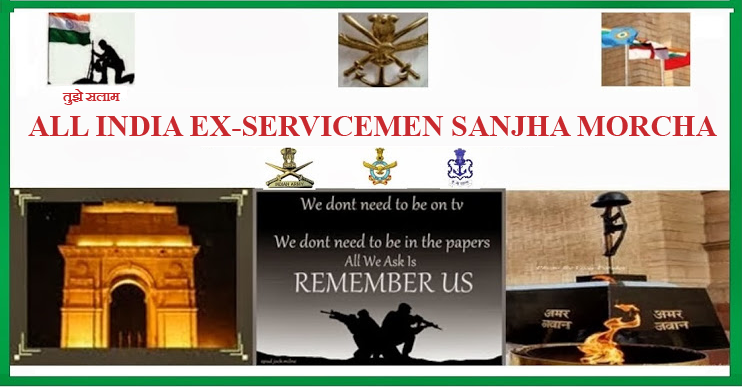
Geographically, Siachen is an integral part of Jammu and Kashmir as the “undivided” territory thereof spans from 72.5 degree East to 80.2 degree East longitude (west-east axis) and 37.1 degree North to 32.4 degree North latitude (north-south axis). Today’s ground position, however, is that Jammu and Kashmir is a “politically divided” territory and stands as “shared” geography between India and Pakistan. The Indian position, nevertheless, stands on professed political and legal provision, making Jammu and Kashmir one of India’s 29 states that constitute the Indian nation as defined, prescribed and described by Article 1 of the Constitution of India. In fact, the accession of Jammu and Kashmir (under which falls Siachen) to the Indian state on October 26, 1947 pre-dates the birth of the Republic of India on January 26, 1950. Thus prima facie, the scenario is this: geographically, Siachen (indisputably) stands within, and hence is part of, Jammu and Kashmir, and the latter is an integral part of the Republic of India. Hence Siachen is part and parcel of India.
Now, what is the exact location and position of Siachen? How does one get there? Theoretically, the access route lies through Drass, Kargil, Saraks, Turtuk (just north-west of Turtuk heights is Gulshan-e-Kabir under Pakistan) and further north to Siachen, which can be approached through one of the most deadly and difficult high altitude terrains of Diskit, Hunder, Sumur and Panamik leading to Siachen. That places Siachen – which is one of the largest glaciers outside of Polar region, with a length of more than 70 kilometre -in eastern Karakoram Himalayas between 35.2 degree North and 35.6 degree North latitude and 76.8 degree East and 77.3 degree East longitude with an elevation ranging between 4,000 metre to more than 7,000 metre above mean sea level. To make things clear further, it must be understood that the Siachen ‘valley glacier’ is one to eight kilometre wide and is fed by several tributary glaciers, the two most important being Teram Sher and Lolofond. The Nubra river, which constitutes part of the Indus drainage system, has its origins in the Siachen glacier.
Thus the location of Siachen gives it an indisputable and clear-cut position – under legal, geographical, constitutional and bona fide reasons -within the territorial jurisdiction of Jammu and Kashmir, which is one of the 29 states of “India, that is Bharat”. Understandably, therefore, the main interest, both tactical and strategic, for a nation like India has to be the spot – read Siachen – that is the highest point where India, China, Pakistan and Afghanistan meet. Hence, when India wrested Siachen on April 13, 1984, Pakistan could not complain. Being used to resorting to unprovoked violence and ceaseless aggression on its neighbour’s territory since October 22, 1947 Islamabad, for a change, was paid back in its own coin as India ensconced itself at the advantageous height overlooking adjacent areas in spite of the hazards and weather.
The question now is why is Pakistan so keen to see India withdraw from Siachen, which happens to be part of India’s legal territory? The answer lies in the fact that Islamabad sees Siachen as “un-demarcated”, which means an area that cannot be held or claimed by anyone without first defining the Line of Control beyond NJ-9842, which still stands “un-described, un-defined and un-demarcated”. Accordingly, Siachen lies outside the formally agreed LoC in Jammu and Kashmir but is an integral part of Pakistan’s Northern Areas. It is situated in an area over which Pakistan has “continuous administrative control since 1947”. If one were to use Pakistan’s logic of “continuous administrative control since 1947”, India’s claim over the Kashmir valley, Ladakh and Jammu is foolproof since this area, too, has been under India’s “continuous administrative control since 1947”.
The reality is that in 21st century geopolitics, there cannot simply be any no-man’s land in a land-locked terrain. It has to be a ‘either-yours-or-mine’ scenario. If it is not with India, Siachen would be taken by Pakistan. Remember Kargil 1999? Indian troops had deliberately moved away from the higher altitude to the lower terrain, thereby creating a ‘no-man’s land’ during winter. What happened thereafter? Pakistan filled the vacuum on the sly. India woke up from its slumber but how many did its soldiers die? Today we take pride in Kargil Day. It was victory no doubt but a pyrrhic victory after a monumental command failure that no one talks about these days. Do we want a repeat of Kargil 1999?
It must be kept in mind that although Siachen is a forbidding and difficult terrain, history compels India to station its armed forces there and hold on to the heights. When the 1963 Sino-Pak exchange of territory took place to cause disadvantage to their ‘common enemy, that is India, Jawaharlal Nehru had rightly uttered a word of caution in the Lok Sabha on March 5, 1963: “Pakistan’s Line of actual control… reached the Karakoram pass”. What would be the distance, ‘as the crow flies’, between Siachen and the Karakoram pass connecting China with Pakistan through which the $46 billion China-Pakistan economic corridor will run? One just has to go through a standard geographical atlas to understand the importance of Siachen and the inherent tactical advantage of the ‘heights’ in an area where four countries meet in a forbidding landlocked terrain.
Some forgetful Indians, who have read history but refuse to learn from it, must remember that India’s north-west has been penetrated at least 40 times by foreign invaders. Again it needs to be understood that no sooner than August 15, 1947, when India became independent, it started facing invasion from October 22, 1947. There has been no respite in the invasions that continue unabated to this day.
For India today, holding on to Siachen is not a choice but a compulsion in order to face the eternal reality of an external enemy and the perennial fury of nature. A third enemy seems to have cropped up within – corruption. Only the other day, it was reported that Pakistan’s Inter-Services Intelligence agents have penetrated the Indian system and are operating through a few men of the establishment, including senior army officers who, because of their corrupt ways, have thus jeopardized the lives of their comrades-in-arms. In this connection, a news report of March 14, 2008 comes to mind. It said that five personnel, including a brigadier, have been charge sheeted by the Jammu and Kashmir Police for allegedly replacing kerosene and diesel in tankers meant for troops in Siachen with water. One feels ashamed to refer to this report but in the light of the death of 10 soldiers of 19 Madras Regiment and the recent corruption cases against army generals, one sincerely hopes that India’s brave soldiers in Siachen will not have the misfortune of facing the enemy both within and without.
Army agrees to return state land by March 31

Army agrees to return state land by March 31
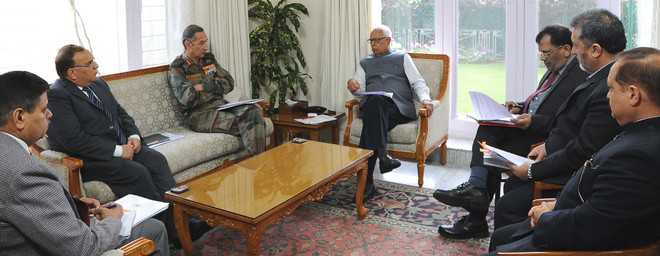
Governor NN Vohra during a meeting in Jammu. A Tribune PHOTO

Tribune News Service

Jammu, March 17

The Army today agreed to hand over vast lands under its possession to the state government before March 31.The decision in this regard was taken during a meeting between Governor NN Vohra Northern Command Chief Lt Gen D S Hooda here today.During the meeting, the Governor reviewed implementation of decisions taken in earlier civil-military liaison conferences in respect of all land matters relating to the Army.After discussions it was agreed that the Northern Command Headquarters would hand over 16.30 acre of state land held by it adjoining the Jammu University campus, 212 acre at the Tatoo Grounds, Srinagar, 456.60 kanal at High Grounds, Anantnag, land held by it at lower Khurba Thang in Kargil to the state government before March 31.Restoration of land under Army’s possession to the state was one of the major points in the “Agenda of Alliance” of the erstwhile PDP-BJP coalition government.In case of land at the lower plateau of Khurba Thang, it was agreed that the matter would be taken up before March 31 when Chief Secretary BR Sharma visits Kargil.The Chief Secretary has been named as the chairman of the committee set up to deal with all Army key location plan matters.Regarding the Tatoo Ground, the Governor and the Army commander will jointly visit the site before March 31 and discuss certain proposals regarding its utilisation.

Governor reviews security

  • Governor NN Vohra on Thursday reviewed internal and external security management issues during a meeting involving civil, police, Army and central Intelligence agencies here. The Governor was informed about the redeployments undertaken to strengthen security management in the aftermath of the Pampore terror attack. The meeting also discussed various important issues relating to the effective enforcement of the counter infiltration and counter terrorism grids along the international border and LoC in the Jammu and Kashmir regions.

Indian Army agrees to vacate large portions of land in Kashmir

Jammu: In a significant development, the Indian Army on Thursday decided to vacate huge portions of land held by it close to civilian habitations in Jammu and Kashmir and hand over the possession to the state government.

An official statement issued here said that “in extensive discussions” with Northern Command chief Lt. Gen. D.S. Hooda at Raj Bhavan on Thursday, Governor N.N. Vohra reviewed the implementation of decisions taken in earlier civil military liaison conferences on all land matters relating to the army.

It was agreed that the Northern Command would hand over 16.30 acres adjoining the Jammu University campus, 212 acres at Tatoo Grounds in Srinagar, 456.60 kanals at High Grounds in Anantnag, and also land held at lower Khurba Thang in Kargil.

The land at Khurba Thang would be taken over before March 31 when the chief secretary visits Kargil.

“Regarding the Tatoo Ground land, the governor and army commander will jointly visit the site, before March 31, to also discuss certain proposals regarding the utilisation of this land for creating a park, recreational facilities for youth etc.,” the statement said.

The governor directed that the committee headed by the chief secretary will visit Jammu University, Kargil and Anantnag to fulfill all formalities on the spot and take over the sites.

Vohra also arrived at an understanding with the army commander over the location of high altitude warfare school (HAWS) in Gulmarg. He will have a further meeting with Hooda.

“The meeting also discussed issues relating to the notification of firing ranges at various places. It was decided that the chief secretary shall pursue the pending issues with the ministry of defence, particularly regarding the enhancement of the scales of rent payable for the required areas of land.”

The demand to vacate these lands was high on the list of PDP president Mehbooba Mufti to pave the way for her heading the PDP-BJP coalition government in the state.