All posts by webadmin

Air Force officer conducts talk on disaster control for students

Air Force officer conducts talk on disaster control for students
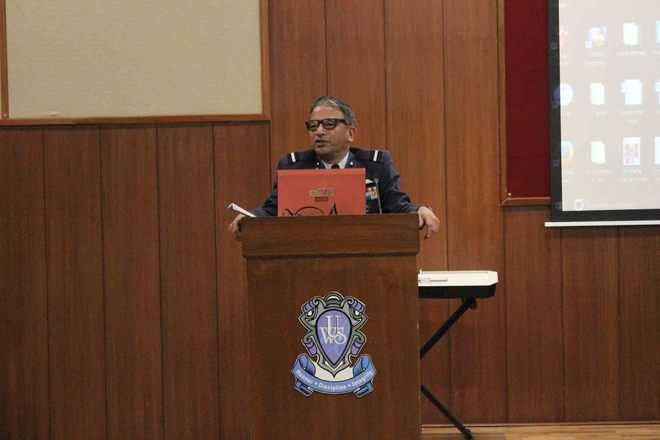
Air Commodore Nitin Sathe, Chairman of Air Force Selection Board, Dehradun, delivers a lecture on disaster mangement at Uniosn World School in Dehradun on Tuesday.

Tribune News service

Dehradun, November 16

Air Commodore Nitin Sathe conducted a session on disaster management for students of class X to XII of Unison World School on Tuesday evening.His session revolved around one of his two published books and an enthralling incident of his life— disaster management after Tsunami 2004— that he experienced at Bande Aceh, near Andaman and Nicobar Islands.Sathe described the initial signs, destruction and aftermath of the Tsunami that struck the coasts of Indonesia on December 24, 2004. Apart from this, he informed the students about the actions that were taken to revive life on the island and the resurrections over two years. Small and impressive lessons were propagated all throughout his speech, leaving a few eyes welled up with tears and a few minds thoughtful about the unfortunates in life. Towards the end of his lecture, Sathe spoke about ‘Predict, Prevent and Prepare-the three Ps of Disaster management’.Air Commodore Sathe is an alumnus of the National Defense Academy, Khadakwasla, and is at present the president of the Air Force Selection Board, Dehradun.


Ranbir is my legally adopted son, says a proud retired Col

Deepkamal Kaur

Tribune News Service

Jalandhar, October 1

A young Lt-Gen Ranbir Singh, DGMO, Indian Army, along with his wife and son.

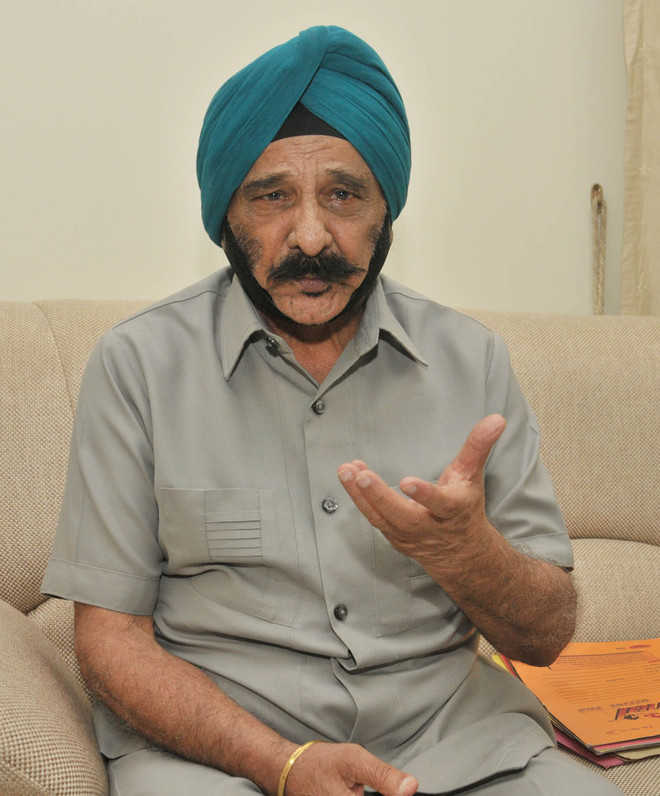
Former Deputy Director, Sainik Welfare, Lieut-Col Manmohan Singh (retd) is a busy man these days as several people from across the region have been calling on him to congratulate him on the feat of his adopted son Lieut-Gen Ranbir Singh, DGMO, Indian Army, who strategised the surgical strikes across the LOC two days ago.At his residence in Urban Estate here, the Lieut-Col said, “Since we did not have any child, I legally adopted my brother’s son Ranbir, whom we fondly call Babbu, at the age of three and a half years. My brother, who retired as a JCO, was residing at Ambala Jattan village near Garhdiwal in Hoshiarpur. Since there was no good education facility there, we brought him here and sent him to St Joseph’s Convent School, Lajpat Nagar, right from LKG.”Taking out old pictures, he recalls, “Ranbir was very intelligent but a bit lazy. I had to push him out of the bed early and he maintains the habit. At the Class V level, I made him study rigorously and prepare for admission to Sainik School Kapurthala. There he worked hard and got through in the National Defence Academy (NDA). He went to Khadakwasla, then the IMA in Dehradun and got commissioned in the Army in December 1980. He has been the only infantry general to have commanded an armoured division after Gen Sundarji.”He proudly tells, “Till date, he maintains all habits that I passed onto him. He is regular with early morning walks. I am a teetotaller and he too is. He is an avid book reader till date.”Says Lieut-Col Manmohan Singh, “He got married to a Marathi girl. They have a son, who is studying in the Delhi College of Engineering. My brother (Lieut-Gen Ranbir’s biological father) passed away at 50, while his wife and two daughters are in Vancouver for the past 20-25 years.”He further said, “Ranbir keeps coming here every four months or so. But this time, he won’t come till the tension defuses. Having been promoted as Lieut-Gen six-seven months ago, he was tipped to be the Corps Commander and get posted here. The incumbent here Lieut-Gen BS Sehrawat and Ranbir have been batchmates. In any case, he will have to serve as a Corps Commander for a year to be eligible as the Chief of Army. He has been accompanying Defence Minister Manohar Parrikar on his foreign tours. He has shown his capabilities and is among the front-runners now.”Lieut-Col Manmohan, who has been training youth for entry to Defence, paramilitary forces and police for the past over two decades, said he had been in Delhi with Lieut-Gen Ranbir a week ago and he remained very busy. “He comes home late even now. He calls me up daily after returning from work. He called me even on the day when they conducted the strike.”


IWT: Another Indo-Pak showdown in the offing?

NEW DELHI: India and Pakistan are possibly headed for another showdown on water after New Delhi said on Thursday it wouldn’t be party to a court of arbitration process on Kishenganga and Ratle hydroelectric projects, a demand by Islamabad that has been accepted by the World Bank.

The World Bank had brokered the Indus Waters Treaty (IWT) in 1960 and has a specific role in the resolution of differences. Kishanganga is a tributary of river Jhelum and the 330 MW project is coming up in Bandipora in J&K. The 850 MW Ratle project is on the Chenab in Doda district.

In a communication to the World Bank on Thursday, India said the stand taken by it to start two parallel process simultaneously—initiating the court of arbitration (COA) process as demanded by Pakistan and setting up neutral expert as demanded by India—was not “legally tenable” under IWT. “Our stand is very clear. We have asked World Bank to stop the process. What happens if the COA and neutral expert give contradictory judgment? Under the IWT, the judgment of the neutral expert can’t be revoked by the COA,” said a senior government official.

However, not heeding to India’s request, World Bank on Friday held a draw of lots in its headquarters in Washington to determine who will appoint three umpires to sit on the COA. The COA has seven members, two arbitrators each to be appointed by India and Pakistan, and three ‘umpires’ nominated by certain global dignitaries. If parties can’t agree on who will nominate the ‘umpires’, a draw of lots decides which three of the global dignitaries will nominate one ‘umpire’ each.

But the World Bank asked both countries to “agree to mediation” to resolve issues regarding the two projects. “What is clear, though, is that pursuing two concurrent processes under the treaty could make it unworkable over time and we therefore urge both parties to agree to mediation that the World Bank Group can help arrange. The two countries can also agree to suspend the two processes during the mediation process or at any time until the processes are concluded,” senior vice-president and World Bank group general counsel, Anne-Marie Leroy, told PTI.

On Thursday, external affairs ministry spokesperson Vikas Swarup said the government will examine options. India’s grouse is that the World Bank hasn’t followed the procedures in the treaty. India says Pakistan’s objections are technical and the bilateral Permanent Indus Commission (PIC) can address them. If PIC can’t resolve the matter, it is termed ‘difference’ and is addressed by neutral experts appointed on request by either party to World Bank.


Pak Army chief warns of ‘befitting response’ to any misadventure

Pak Army chief warns of ‘befitting response’ to any misadventure
The General flexes his muscle. Reuters

Lahore, October 1

Asserting that the highest state of vigil is being maintained along the Line of Control (LoC), Working Boundary and the international border, Pakistan’s Army Chief General Raheel Sharif has warned that any misadventure by Islamabad’s adversary will meet the most befitting response from the country.Sharif made the remarks during a visit to the Combat Reaction Training facility on Friday, established in the vicinity of Lahore Garrison.“Any misadventure by our adversary will meet the most befitting response from Pakistan. Pakistan can’t be coerced through any amount of malicious propaganda,” Dawn quoted Sharif as saying.His statement came amid heightening tensions between Islamabad and New Delhi in wake of terror attack in Uri sector in Jammu and Kashmir in which 19 Indian soldiers were killed.Indian Army conducted surgical strikes on terror launch pads across the Line of Control (LoC) in response to the terrorist attack at Uri sector.Two Pakistani soldiers and over 30 terrorists were reportedly killed in the attack.In a statement released by Inter-Services Public Relations (ISPR), the army chief exhorted all formation commanders to lay more emphasis on combat readiness, adding that training in peacetime is the only guarantor of winning a war, if imposed. ANI


India may deploy N-capable Rafale jets on China, Pak borders’

‘India may deploy N-capable Rafale jets on China, Pak borders’
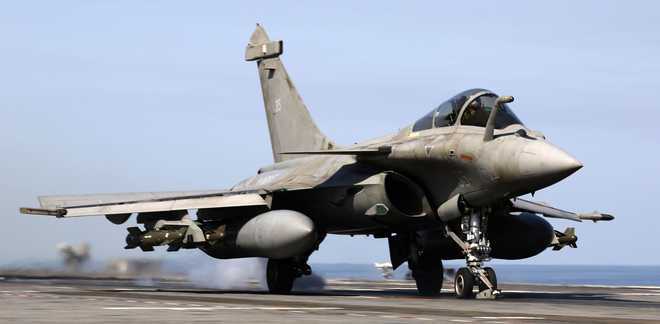
File photo of a Rafale fighter jet

Beijing, September 30

China apprehends that India will deploy the 36 nuclear-capable Rafale fighter jets to be acquired from France in the border regions of China and Pakistan to enhance its deterrence capability, a media report here said.

India will deploy the new French-made fighters in the disputed areas bordering Pakistan and China, state-run Global Times reported quoting Shenzhen Television.

A recent report by Stockholm International Peace Research Institute (SIPRI) said India is the largest arms importer in the world, the newspaper said.

(Follow The Tribune on Facebook; and Twitter @thetribunechd)

Increased arms imports into the Asian region are primarily due to the unstable security environment in the Middle East and concerns from China’s neighbours over its rise.

The Rafale fighters in flyaway condition carry tactical nuclear warheads, and this means India’s nuclear deterrence capability will be greatly improved, Shenzhen Television reported.

“India also wants to purchase the Rafale technology from Dassault but France refused, meaning France has no intention to help India promote its military industrial system,” Zhao Gancheng, director of South Asia Studies at the Shanghai Institutes for International Studies said.

While India is rapidly expanding its military capabilities spending an estimated $100 billion on new defence systems, many other countries with an advanced military industry are also competing for India’s market, such as Russia, the US and Israel, the daily quoted SIPRI report as saying.

Zhao said before this deal with France, India was also considering the US-made F-16s.

“India picked French-made jet fighters because they are cheaper and have a nuclear-deterrence capability,” he said.

SIPRI’s list of the top 10 arms importers for 2011-2015 has nine Asian or Asia-Pacific countries.

Many of China’s neighbours are also on the list of top 10 importers, such as Vietnam, South Korea and India, he said.

“Due to the South China Sea dispute and the increasing power of the Chinese navy, countries like Vietnam and the Philippines are very concerned, but the US is not helping China solve the problem peacefully,” said Song Zhongping, a Beijing-based military expert.

“The US government and media are hyping the ‘China Threat Theory,’ trying to convince countries in Asia that China is on the offensive,” he said. — PTI


The options before India KC Singh

The options before India
Now up in arms: The India-Pakistan bonhomie has been short-lived.

PRIME MINISTER Narendra Modi surprised India, the world, and certainly his host Pakistan Prime Minister Nawaz Sharif when he stopped over in Lahore en route to India from a Central Asian tour on the Christmas of 2015. India-Pakistan relations touched the warmth last seen during Vajpayee’s Lahore visit in 1999. But reality can often delude perception.On January 2, 2016, a fidayeen attack on the Pathankot air base, causing minimum loss of assets and lives, jolted India back to reality. Pakistan’s reaction was surprisingly empathetic, offering to investigate the role of conspirators in Pakistan. A Pakistan investigation team was welcomed by India in March 2016, including allowing them to visit the air base. This process stalled when an Indian team was denied similar access to Pakistan.January to July was a period of political drift in both J&K and Pakistan. Chief Minister Mufti Mohammad Sayeed died in January, five days after the Pathankot attack, and his daughter Mehbooba assumed office only in April. The Valley was drifting towards alienation as the agendas of the BJP and the PDP meshed poorly. Also in April, Nawaz Sharif left for London for a heart surgery. Rumours swirled of a soft coup and his imminent retirement. He did return in July, but enfeebled politically. In March, Pakistan arrested a former Indian Navy captain, Kulbhushan Yadav, in Balochistan, alleging abetment to terror. Once unrest exploded in the Valley after the killing of Hizbul Mujahideen leader Burhan Wani on July 8, Pakistan went on the rampage to discredit India internationally, alleging human rights breaches. It also fanned trouble by unleashing leaders of terror groups masquerading as heads of religious and educational charities. The Pakistan army also ratcheted up their trans-Line of Control induction of trained militants. Pakistan, for the umpteenth time, was misreading both the situation and the capacity of India to deal with it. Between July and August 15, Delhi concluded that Pakistan policy needed major re-calibration as the Pakistan government had succumbed to its army’s thesis that Kashmir had regressed to the 1990s’ level and time was ripe to compel India to make territorial concessions. A multi-layered counter-asymmetrical warfare strategy, which actually should have been on PM Modi’s table within months of assuming office, began to emerge. His Red Fort speech, after tentative articulation earlier in an all-party meeting, asked Pakistan to look within at its atrocities in Gilgit-Baltistan, PoK and Balochistan. The PM followed it up at Kozhikode and External Affairs Minister Sushma Swaraj in her address to the UN General Assembly on September 26. The ministries of water resources, commerce, etc., also swung into action. The full-spectrum response was to remain within treaty obligations, but interpreting them restrictively. The Uri attack complicated the government’s task as the BJP’s jingoistic pre-Lok Sabha election rhetoric resurfaced to haunt it. Their core followers expected instant and disproportionate response for the death of 19 soldiers. Ram Madhav, the bridge between the BJP and the RSS, sought “jaw for a tooth”. The government realised correctly that military options had only bad or worse outcomes. For instance, they would only strengthen Pakistan army’s domestic support, perhaps obtaining for retiring army chief Gen Raheel Sharif an extension. The army was given the freedom to respond locally — euphemism for Special Forces action. Modi soothed the aroused national feelings baying for Pakistani blood. Simultaneously, the focus was turned on Pakistan’s own rights record. Hints were dropped that India may give asylum to top Baloch leaders of the Bugti and Marri clans fighting Pakistan army’s depredations. The aim is to hurt Pakistan both materially and morally, as also have instruments that can be calibrated in response to Pakistan’s conduct. In Kozhikode, Modi shrewdly turned Bhutto’s slogan of “a thousand year war” into a call for war on poverty, illiteracy and unemployment in both nations. Among the emerging elements of the new doctrine is withdrawal of the MFN status. This may not hurt Pakistan much and may only enrich traders in the UAE who will become the conduit for the trade, but it signals new intent. The review of the Indus Waters Treaty contrariwise goes for Pakistan’s jugular. Many ill-informed comments have assumed it to be unilateral abandoning of the treaty. India has been oversensitive in the past to Pakistan’s objections to developing run-of-the-river hydel projects that the treaty allows. For instance, Baglihar on the Chenab was taken by Pakistan to a Swiss arbitrator, who ruled in 2007 largely in India’s favour. That design should be standard for future projects and India can ignore expected automatic bemoaning by Pakistan. That design allows pondage, which gives India leverage as the time of filling, if it coincides with the sowing season in Pakistan, can be used to cause havoc. This happened inadvertently the last time. Another salvo is Modi deciding to skip the SAARC Summit in November in Pakistan. This can be followed-up by a meeting of those SAARC members — Bangladesh, Afghanistan and Bhutan to start with — which have articulated concerns about the export of terror from Pakistan and joined India in boycotting the summit. Sub-regionalism, on thematic or territorial basis, will isolate Pakistan regionally. The aim thus is to punish Pakistan bilaterally and isolate it regionally and internationally. It would not happen overnight, or be easy, as China and its new ally Russia will buttress Pakistan, as indeed may Iran and some members of the Gulf Coordination Council like Saudi Arabia and the UAE. But smart diplomacy trumps armed response for which the military power differential between India and Pakistan needs to be wider than it is currently. The Economist notes that despite the defence budget of India being six times that of Pakistan at $ 51.3 billion, “India has proved strangely unable to build serious military muscle”. George Washington said: “To be prepared for war is one of the most effective means of preserving peace.” That entails more than acquiring 36 Rafale fighters in an ad hoc purchase. Meanwhile, the BJP must remember that ultimately the fight is over the hearts and minds in the Valley. No counter strategy will deter Pakistan if the wound at home is not healed or new ones opened by “rakshaks” of one cause or another. The writer is a former Secretary, Ministry of External Affairs


Well Done ; Indian Army barges into Mosque for playing anti-India Slogans and Songs on Loudspeakers

On Friday morning, some youths at Arhama Manigam used the public address system of their local mosque to play freedom songs and slogans which irritated Commanding Officer of 5 Rashtriya Riffles.

According to local sources, Army men cordoned off the mosque and entered in. “Soldiers entered the mosque, ransacked loudspeakers system, broke window panes and dragged us out”, a youth said.

A local youth said, the Indian Army men lost their patience and beat up the youth to pulp before some village elders came out to rescue us.

At least 40 people suffered injuries– among which a mother-son duo and fourteen others have been shifted to SK Institute of Medical Sciences in critical condition– after an Indian army unit ‘barged into a mosque and beat up people’ in Jammu and Kashmir’s Ganderbal district.

The men and women deserved the ruthless thrashing by the Indian Army for living on Indian soil and using a Mosque as a propaganda tool for shouting Freedom slogans.

At least 40 people including a 60-year-old woman Mukhte Begum along with her young son Riyaz sustained injuries. Most of the injured were treated at Public Health Centre in Manigam while the woman, Mukhte, along with fourteen others were termed critical and referred to SK Institute of Medical Sciences in the disputed region’s summer capital.

Meanwhile, Army’s Commanding Officer reached the health centre in Manigam and threatened medicos and para team not to attend the injured.

People were saved from the wrath of the Army only after the intervention of police.

In the other parts of the district, violent protests broke out after Friday prayers in which an SHO along with seven police cops and 5 CRPF men were injured. In Kujar Fatehpora, youths in large number fought stone battles with police and clashes at Saloora, Gangerhama, Khann Harran, Giraj, and Beehama resulted in the injuries to many.

People in large numbers at Tulamull took out a peaceful procession and shouted slogans favouring freedom of Kashmir.

comments by Kusum Arora

Like never before the Indian army has attacked a mosque for playing anti-India songs and chanting slogans. In a shocking incident local youths in Arhama Manigam mosque used a public meeting chanted anti India slogans and played songs in loud speaker. The Commanding Officer of 5 Rashtriya Riffles could not stand the anti-India slogans and barged into the mosque along with his men and broke the loudspeaker, mikes and audio sets.

In the clash, 40 people were injured who tried to attack the army and have been admitted to Public Health Centre in Manigam. Some people were critically injured and were admitted to SK Institute of Medical Sciences. According to some locals, the army waited for a while but when the slogans did not stop they had to enter into the mosque. Few people had to say that the men and women deserved beating for staying in Indian soil and calling out anti-India slogans.

The village elders later intervened and requested army to return back. The police also stopped the army from further attacking the slogan chanters. Following the development, many youths in part of Manigam protested and pelted stones which injured 7 police men and 5 CRPF jawans. Violent clash was also seen in Saloora, Gangerhama, Khann Harran, Giraj and Beehama areas which injured many police. The people chanted AZADI slogans against India and demanded freedom to Kashmir.

It is easy to blame army for barging into the mosque, but what we need to understand is army is not trained to be mere SPECTATORS when country is under attack. Our country did not spend crores training them to be peace messengers holding a rose. And for those who do not understand the language of peace, stick is used.

The routine habit of seculars is to first break law and then play victim card. India has seen enough theatrics in the name of secular politics. And this is exactly why separatists and law breakers demand the withdraw of AFSPA in Jammu Kashmir, so they have free hand to perform all their anti-India activities.


The Uri attack is a wake-up call for the strategic security community::::Gen Syed Ata Hasnain

The militant attack on an Indian Army base at Uri in Baramullah district in north Kashmir early on Sunday had more casualties than probably what even its planners had expected. This is because of secondary effect: 13 soldiers were burnt to death in their tents and shelters. The incident has impacted the nation’s psyche forcefully, and justifiably so. The call for retribution against Pakistan is intense. It will have to be satisfied as Pakistan’s carefully crafted policy of calibration to avoid crossing India’s tolerance level has gone awry. This happened twice before, after the attacks in Mumbai and on India’s Parliament. Yet, this time the effect on the public has been stronger because of the cumulative impact of the Pakistani-sponsored attacks in Poonch on September 10 and then Uri, and the 72-day-long street agitation in Kashmir, which has paralysed governance and disempowered the political community.

Click here for full coverage of Uri

The Uri incident is unlikely to have much effect on the Army’s unconventional task except enhancement of security. The real impact will be in the military-diplomatic relations with Pakistan. For a change, however, both Indian generals and diplomats want action against Pakistan. But they do not want a knee-jerk response but a planned offensive with strategic impact.

Read: Here’s how India can respond to the Uri terror attack

The conceptual nature of this response should be hybrid. It can start with a diplomatic one, but it should be energetic enough to make an impact on world capitals. Pakistan attempted this strategy after the Burhan Wani incident but its diplomatic stature is low and so the effect has been marginal.

India’s experienced diplomatic corps has a large number of well-connected, veteran ambassadors and they must be used for this high-energy campaign. The United Nations General Assembly starts today and the platform must be used to name and shame Pakistan. At the very least, sanctions should be demanded against Pakistan. Post-Uri, one fallout is certain: There will be no revival in the peace process or normalisation of relations with Pakistan.

Militarily, there are several options but launching a conventional operation against a nuclear neighbour must be weighed against potential dividends. The escalatory aspects resulting from actions that are lower in the ladder of options could lead to conventional limited or calibrated operations.

Surgical trans-LoC strikes: The Army has the capability to launch and absorb any response but the nation must be prepared for a near-permanent abrogation of the informal ceasefire that has been going on from November 2003.

The impact of this on people living near the LoC will be huge. Between 2003 and 2016, India did little to protect villagers from shelling. Sooner than later, the J&K’s political class will demand stoppage of hostilities. So the will to continue the fight against Pakistan has to remain intact.

Deeper strikes by Special Forces: Such strikes are an invitation for escalation of hostilities to a higher level and so this can only be a standby option.

Unconventional use of 4th Generation Warriors: This has been suggested by Gen Shankar Raychowdhury but it is not easy. Clandestine sub-conventional operations in undetermined areas will need time and energy and such operations have to be planned much in advance. This proxy war in Kashmir will not end soon and so the government must develop capability for such a response.

Hybrid warfare: India is facing this type of warfare and needs to develop a response. Strategic communication and information warfare to target people in Pakistan has become a compulsion.

Whichever is the response of the Indian government, the question that must be asked is this: Is that response something the Deep State has itself desired from its actions? For example, a study must be done to see whether we gain from the abrogation of the ceasefire or it is to Pakistan’s tactical advantage to enable infiltration.

Read: ‘India jumps the gun’: Pak media criticise ‘knee-jerk reaction’ after Uri attack

Last, but not the least, the government must take stock of the LoC fencing and surveillance equipment because most of them are more than 15 years old and not designed for daily use. The Centre must tell us when it last procured the thermal-imaging devices. Over the years, we have gained experience but critical audit of such tactical measures must be done regularly.

The Uri attack is a wake-up call for the strategic security community. If push comes to shove, the most robust of options will form the essence of India’s response.

Gen Syed Ata Hasnain is former GOC of the Srinagar-based 15 Corps. He earlier commanded the Uri brigade. He is now associated with Vivekananda International Foundation and Institute of Peace and Conflict Studies

The views expressed are personal

Rafale to widen arch of operations

MoD working on multiple options, next 5-6 yrs crucial for Air Force to induct technology

Rafale to widen arch of operations
The first of the Rafales will start coming in by September 2019 and the full fleet shall be operational by April 2022. File photo
Ajay Banerjee

Tribune News Service

New Delhi, September 24

Equipped with the latest missiles which widen the arch of offensive operations, the Rafale fighter will be a potential game-changer for India’s airborne capability on several fronts.India has signed a contract with France to buy 36 such jets at a cost of Rs 58,828 crore, a huge sum but modern technology does not come cheap.Chiefly the Rafale will provide: dependability of having the very latest technology-backed air-strike platform; ability to hit enemy targets which are further away due to its flight radius of some 1,000 km; be available for five sorties per day instead of three of the Sukhoi 30 MKI; a new set of onboard radars to help pilots navigate and also strike; a new set of missiles that hit targets further away; and infusion of new technology in the Indian Air Force that is presently operating at its lowest level of fighter jets in the past decade.The Rafale will bridge the shortfall of the fast-dwindling fighter squadrons. India needs 45 fighter squadrons to counter a combined threat from Pakistan and China. Currently, it has only 33, where each squadron has 18-20 jets. Of these, the vintage MiG-21 and MiG-27 form 11 squadrons. The Sukhoi 30-MKI populates 10 squadrons, the 1970s design British Jaguar six, followed by French Mirage 2000 and Soviet Union’s MiG-29 in two and three squadrons, respectively. The last three are being upgraded with better missiles and avionics.Rafale will be in some ways be superior to what the Chinese presently have in their arsenal, but Beijing is producing its own platforms and weapons and with the next generation J-20 fighter jet getting established, India will need to carry forward its plans rapidly and catch up with Beijing over the next five-six years by widening its ‘make in India’ footprint.The first of the Rafales will start coming in by September 2019 and the full fleet shall be operational by April 2022. In the intervening period, the Ministry of Defence (MoD) led by Manohar Parrikar, needs to focus on a multi-pronged approach to meet future needs. The Rafale deal was negotiated for 18 months – ‘lightning fast’ going by MoD’s record. As the good news filters in, the MoD is already working on multiple options – at least four of which are known – to bridge the technology gap of the IAF and add newer planes.The first is to quickly induct the 106 Tejas “Mark-1A”. The MoD has set a 2018 deadline for the first aircraft to be ready with a target to complete its production by 2022-23.  The second is to have an additional assembly line of Indian-made fighter jets. This could be a joint venture with a US or European company setting up a plant in collaboration with an Indian partner. The third is completion of the production schedule of 272 of the Sukhoi 30-MKI, expected by 2020. The fourth is to ink an agreement with Russia to co-develop and produce a fifth generation fighter aircraft (FGFA) with stealth features and the works.The Sukhois were ordered in phases since 1997, the IAF wants 272 of these in its fleet by 2020. The agreement for the FGFA is expected to be inked when Prime Minister Narendra Modi and Russian President Vladimir Putin meet next month.Make deal details public: AntonyNew Delhi: The Opposition Congress on Saturday expressed concern over the “diluted” Rafale aircraft agreement reached between India and France yesterday and demanded that details of the deal be made public.Former Defence Minister AK Antony raised several question marks on “sufficiency” of the deal asking the BJP-led government how it planned to arm the IAF with a mere 36 aircraft deal.“During the UPA’s tenure, it was decided to purchase 126 medium multi-role combat aircraft to meet the IAF’s urgent operational requirement. As per the IAF, 126 was the minimum operational need then. Today, the scenario is even more critical. What is the plan of the government?” said Antony, addressing reporters on Saturday.The former minister cited the sanctioned strength of the Air Force as 42 squadrons and said in the current volatile situation, the country needed more, and not less, jet strength. “The sanctioned strength is 42 squadrons and the available strength is 32 squadrons. By 2022, this strength will be reduced to 25 squadrons. How will the government equip the IAF with more aircraft,” asked Antony. Antony asked how the government would bridge the gap with respect to China and Pakistan who were augmenting their air strength. — TNSBoeing to supply Harpoon missiles to IndiaWashington: The US Department of Defence has given a $81 million contract to Boeing for the supply of all-weather, over-the-horizon Harpoon anti-ship missiles to India. According to the contract details, Boeing has been awarded $81,271,024 for firm-fixed-price modification to a previously awarded firm-fixed-price contract to exercise an option for the procurement of 22 Lot 89 Harpoon missiles, associated containers and components for the Government of India under the Foreign Military Sales programme. The missiles are expected to be ready in June 2018. PTI

Hisar ex-serviceman duped of `25 lakh

HISAR: A fake insurance agent has duped an ex-serviceman of Singhran village in this district of `25 lakh.

Rajender Kumar, a retired army man, on Wednesday submitted a complaint to inspector general of police (IGP), Hisar range, OP Singh, alleging that he received a call last month from an unknown person, posing as an insurance agent, who offered him “good insurance plans and fix-deposit schemes.”

Kumar said the caller asked him to provide his bank account number, ATM card number and other details. He said, “Within a week, the caller withdrew `25 lakh from my account and asked for more money. When I talked to my brother about the matter, he told me that I have become victim of a fraud. I approached the Mangali police post, but no action was taken.”

IGP Singh assured Kumar that he would get the matter properly investigated.

When contacted, the IGP said, “The matter has been forwarded to sadar police station for proper investigation.