All posts by webadmin

1965 Indo-Pak war hero remembered

1965 Indo-Pak war hero remembered

Floral tributes being paid to the 1965 Indo-Pak war hero, Major Surinder Prasad, at his memorial in Abohar. Tribune photo

Our Correspondent

Abohar, September 23

Representatives of various NGOs and some former Central and state government officials offered floral tributes at the Major Surinder Prasad memorial on Monday.

Wife of former Prime Minister Lal Bahadur Shastri, Lalita Shastri, inaugurated the memorial here in 1967. It was recently renovated by the Engineers Association with the help of Lions Club leader Naresh Khurana. Colonel (retd) Dilbagh Singh who participated in the 1965 and 1971 wars was also present to pay his tributes.

Chairman of Punjabi Sabhyachar Manch and former Sub-Divisional Magistrate BL Sikka said Surinder Prasad was the only son of former MLA and veteran Gandhian freedom fighter Master Teg Ram.

Alumnus of the local Municipal Board High School and DAV College, Jalandhar, Surinder Prasad was commissioned into 19 Maratha Light Infantry on December 17, 1961.

Manch president Gurcharan Singh Gill said in the 1965 Indo-Pak War, his battalion was given the responsibility of recapturing Thatti Jaimal village in the Khemkaran sector. As a company commander he succumbed to injuries sustained due to heavy shelling by the enemy. He was awarded Vir Chakra posthumously.

A prayer meeting was also held at the Samadhi Sthal in Major Surinder Park here.


Protesting against govt’s OROP provisions, defence veterans to start returning medals

The government had on Saturday formally notified the OROP scheme for the over 24 lakh ex-servicemen and six lakh war widows in the country, which was rejected by the protesting ex-servicemen. – See more at: http://indianexpress.com/article/india/india-news-india/protesting-against-govts-orop-provisions-defence-veterans-to-start-returning-medals/#sthash.pqZ6ER8Z.dpuf
War veterans will start returning their medals from tomorrow to protest the government notification on implementation of ‘one rank-one pension’, which they have rejected, and hit back at Defence Minister Manohar Parrikar for his comments that not all their demands can be met. “We have one and only demand and that is OROP. It was the government who inserted provisions that has made the issue complicated. We want OROP as per the definition. No junior should get more pension than his senior.
“In protest against the government notification, we will start returning our medals from tomorrow. On November 10-11, ex-servicemen across the country will start returning their medals. They have already informed the District Magistrates about this,” Group Captain V K Gandhi (retd), general secretary of Indian Ex-servicemen Movement (IESM), said. The government had on Saturday formally notified the OROP scheme for the over 24 lakh ex-servicemen and six lakh war widows in the country, which was rejected by the protesting ex-servicemen. Parrikar had said earlier in the day that everyone has the right to make a demand in democracy but not all demands can be fulfilled. He said “maximum” demands of the veterans have been fulfilled and that the judicial commission to be set up by the government will look into their “problems”. In Delhi, the medals will be returned outside Terminal 1 of the Indira Gandhi International Airport (IGIA) tomorrow, Gandhi said, adding selecting crowded places for the purpose was meant to educate the common man about the issue. The protesting ex-servicemen also met Delhi Chief Minister Arvind Kejriwal and briefed him about the OROP notification. “He called us today and asked us to brief him about the government notification. He has said in coming days he will take up the issue, address press conference and also visit the protesting ex-servicemen at Jantar Mantar,” Gandhi said after meeting Kejriwal. – See more at: http://indianexpress.com/article/india/india-news-india/protesting-against-govts-orop-provisions-defence-veterans-to-start-returning-medals/#sthash.pqZ6ER8Z.dpuf


Sidhu given political clearance to visit Kartarpur; Pak issues him visa

The letter Navjot Singh Sidhu wrote on November 7.

The letter Navjot Singh Sidhu wrote on November 6.

Sandeep Dikshit & Ruchika M Khanna
Tribune News Service
New Delhi/Chandigarh/Islamabad, November 7

Hours after Punjab Congress leader Navjot Singh Sidhu was given political clearance by the Centre on Thursday to take part in the Kartarpur corridor inauguration ceremony on the other side of the border, Pakistan issued him visa.

Political clearance has been granted to Sidhu to travel through the Kartarpur Sahib corridor on November 9, the sources in New Delhi said.

The Pakistan government invited Punjab Congress leader Sidhu — who also attended the groundbreaking ceremony of the Kartarpur Corridor — to attend Saturday’s inauguration.

A ruling party spokesperson had said that Sidhu, a personal friend of Pakistan Prime Minister Imran Khan since old cricketing days, accepted the invitation.

“Sidhu has been issued a visa and we will warmly welcome him on the opening ceremony,” Foreign Office spokesperson Mohammad Faisal said during his weekly media briefing here.

The passport waiver for Kartarpur pilgrims would extend up to one year as a special gesture on the 550th birth anniversary of Guru Nanak Dev, Faisal said.

Pakistan has also waived the USD 20 service charge per pilgrim per visit on November 9 and November 12, he said, adding that it has also waived the requirement of 10-day advance intimation for the mega ceremony.

Earlier in the day, Sidhu again wrote to the External Affairs Minister seeking permission to visit Kartarpur.

He said he would go to Pakistan as millions of devotees go on an eligible visa. He said since he has not got any response from the EAM, in spite of repeated reminders seeking permission, he would still go to Kartarpur.

Sidhu had on Wednesday also sought permission from the Centre for his clearance to visit Kartarpur. He had said he would visit Kartarpur via Wagah, if the approval to travel on Pakistan PM Imran Khan’s invite to him was not granted.

Sidhu has already missed the opportunity to be part of the official jatha. All Punjab MLAs were asked to apply, but Sidhu opted out. — With PTI inputs

Sidhu’s role can’t be overlooked, admit Cong leaders

http://

Ruchika M Khanna
Tribune News Service
Chandigarh, November 6

Nearly four months after his unceremonious exit from the Cabinet and attempts to push him to political oblivion, Navjot Singh Sidhu found support and praise from some of his “old friends” in the party.Cooperatives Minister Sukhjinder Singh Randhawa and MLA Pargat Singh came out openly in support of Sidhu, while PPCC chief Sunil Jakhar was subdued while giving him credit for the opening of the corridor. Even as some senior Congress ministers and leaders raked up the issue of Sidhu’s stand of not participating in the special commemorative session of the Vidhan Sabha and seeking permission to go to Pakistan, the leaders spoke of his “contribution” in getting the project through.

CM Capt Amarinder Singh has so far refused to give credit to Sidhu. In fact, the rift between the CM and Sidhu began after the latter went to Pakistan to attend the swearing-in ceremony of Pakistan PM Imran Khan, where Sidhu had claimed that Pakistan Army General Qamar Javed Bajwa had reportedly told him of the government proposal to construct the corridor. Sidhu was not present in the House today, and his name or his role over the matter was not mentioned during the session.

Randhawa told The Tribune that he gave credit to Sidhu for the construction of the corridor. “I, however, regret that Sidhu did not attend the session today. I would have loved to take him (Sidhu) along as part of the jatha to Kartarpur, and together we would have thanked Pak PM Imran Khan for fulfilling this long-pending demand of the Sikhs,” he said.

MLA Pargat Singh, who is among the few MLAs believed to be close to Sidhu, said the corridor was possible only because Guru Nanak had so desired. “But Sidhu and Imran Khan have played an important role. I would thank them and anyone else who has played a role in this,” he said. Even Jakhar said the contribution by Sidhu could not be ignored in getting the project through. “He played his part. But it is Baba Nanak who alone should get credit for the corridor,” he was quick to add.


A saint-soldier, one of the finest

SOLDIER’S CORNER
Lt Gen Harwant Singh (Retd)
2015_11$largeimg07_Saturday_2015_235146418

LT Gen Hanut Singh retired more than two decades ago and moved into an ashram in Dehradun. He had cut himself from the world and spent his time in deep meditation. It is said that it was in a state of meditation that he gave up life.
I first came to know him when he was an instructor in the gunnery wing of the Armoured Corps School and I was in a gunnery course. He displayed complete mastery over the subject and in his lectures there was conviction, motivation and deep understanding of the power of the tank gun. There was nothing in tank gunnery worth knowing other than what he knew and would so convincingly put across.
The next I came in close contact with him was when he was commanding 14 Independent Armoured Brigade, where I was one of the unit commanders.
Earlier, he had taken part in the 1971 war and had made a name for himself in the famous battle of Basantar. He had put into practice what he had been so convincingly and forcefully advocating as Commander of the School of Armoured Warfare. The more remarkable part of his play was taking his regiment across a deep minefield to be with the infantry, which had already crossed the obstacle system and was nervously awaiting the onslaught of the enemy counter-attack.
Being deeply spiritual, and completely fearless, he had pushed his regiment through that deep enemy minefield without waiting for a safe lane to be cleared by the engineers. Since time was at a premium, he took the decision to wade through the minefield. It was indeed a miracle that no mine came in his way. Maybe, on that fateful night, the Lord was his charioteer as He was of Arjuna at Kurukshetra. When the enemy counter-attack materialised on the bridgehead, he was there to take it on and bring about its complete destruction. While he was awarded the Maha Vir Chakra, he earned from the enemy the sobriquet “Fakhr-e-Hind” for his regiment.
He had the moral courage to say what he thought was right, regardless of the fallout. An illustrious commander, he possessed the taste and feeling of the heritage of the human mind. At the root of his unimpeachable character and the courage of conviction was his self-realisation through long hours of meditation and religious beliefs. His sense of discipline and martial spirit had been passed down by his forefathers.
Lt Gen Hanut Singh was gentle of manner and stood by his officers and men. While he meditated for long hours, this spiritual digression never came in the way of his duties. He had an acutely discerning mind and few were the people that he misjudged. He led a simple soldier’s life, free from frills and follies. He exhibited all that goes into the making of a saint-soldier.


The writer resides in Chandigarh


HOW ARTICLE 370 CAME TO BE

Union home minister Amit Shah on Monday announced the government has effectively scrapped Article 370 of the Constitution, removing special status given to the state of Jammu and Kashmir almost 70 years ago.

THE HISTORY OCTOBER 26, 1947:

The foundation for Article 370 stems from the Instrument of Accession (IOA) signed by the then ruler of Jammu and Kashmir, Raja Hari Singh. The document was part of the formal process by which all princely states in the country declared their consent to be included in the Union of India. In this case, however, J&K negotiated some conditions as part of its entry into India. As per the IOA, the state gave Union of India the power to legislate only three aspects: external affairs, communications and defence.

OCTOBER 17, 1949:

Article 370 is incorporated in the Indian Constitution, exempting the state of Jammu and Kashmir from Constitution of India. This cements the terms spelt out in the IOA.

1950-1954

Several Presidential Orders were issued during this period following discussions between the Constituent Assembly and Government of India. The first one was a formal announcement of the applicability of Art 370, while the one that came into force on May 14, 1954, was seen as the most crucial:

It extended Indian citizenship to J&K residents

It accorded the fundamental rights to the people of J&K It extended the jurisdiction of the Supreme Court to the state It announced the adding of Article 35A to Constitution, which gave special privileges to permanent residents by laying down restrictions on people from outside to purchase property, claim settlement or employment

NOVEMBER 17, 1956

The Constituent Assembly of J&K dissolved, without taking a decision on whether to scrap Article 370.

■ This left a situation in which Article 370 was deemed to have retained a more permanent place in the Constitution, where it is classified under Part XXI


वन रैंक-वन पेंशन योजना लागू, जारी हुई अधिसूचना

नयी दिल्ली, 7 नवंबर (ट्रिन्यू)
केंद्र सरकार ने पूर्व सैन्यकर्मियों के लिए ‘वन रैंक, वन पेंशन’ लागू करने के लिए अधिसूचना शनिवार देर शाम जारी कर दी।
बिहार चुनाव परिणाम आने से ठीक पहले सरकार ने इसकी घोषणा कर दी। रक्षा मंत्रालय के प्रवक्ता सितांशु ने बताया कि पहले के पेंशनभोगियों की पेंशन साल 2013 की सेवानिवृत्ति की पेंशन के आधार पर फिर से तय की जाएगी तथा इसका लाभ एक जुलाई, 2014 से मिलेगा। भविष्य में पेंशन हर पांच साल में फिर से तय की जाएगी। साल 2013 में समान रैंक और समान सेवा अवधि के साथ सेवानिवृत्त कर्मियों की न्यूनतम और अधिकतम पेंशन के औसत के अनुसार पेंशन फिर से तय की जाएगी। ओआरपी से संबंधित अन्य मामलों को देखने के लिये न्यायिक समिति का गठन किया जायेगा। इस बीच ‘इंडियन एक्स-सर्विसमेन मूवमेंट’ के प्रमुख मेजर जनरल सतबीर सिंह (सेवानिवृत्त) ने कहा कि अधिसूचना स्वीकार्य नहीं होगी।


Opening of Kartarpur corridor will show us it is possible to leave behind the past, walk to the future

Kartarpur agreement to be signed on October 24: Sources

It will be just a small step forward on a long and difficult road, which our two nations can only traverse together if Islamabad gives up its negative posturing vis-a-vis India

The corridor, I believe, has shown us that it is more than possible to bridge the differences that have assumed unnaturally grave proportions in these seven decades, writes Punjab CM Amarinder Singh.

Image result for capt amarinder singh

My connect with Kartarpur Sahib goes back to my childhood. I still remember how the gurdwara, just about 235 km from my hometown of Patiala (that’s less than the Chandigarh-Delhi distance), was always spoken of with great reverence in our family. Of course, that was majorly because of the historic importance of the site, where Sri Guru Nanak Dev ji died on September 22, 1539. But part of it was also because of the personal connection my family had with the gurdwara, whose present building was built in 1925 at a cost of Rs 1,35,600, donated by Maharaja Bhupindar Singh, the then ruler of Patiala and my grandfather, after the existing structure was ravaged by floods.

The desire to visit the revered gurdwara has always been strong within me. Today, just days before I see the cherished aspiration transform into enviable reality, I bow before the Great Guru for granting me this experience, and that too during his 550th Prakash Purb celebration.

I recall my personal meetings, in my previous term as chief minister, with former Pakistan President, General Pervez Musharraf, during which I had spoken extensively about the deep-rooted urge in every Sikh to visit the historic Kartarpur Sahib Gurdwara. Though he had responded positively to my request, which our former Prime Minister, Dr Manmohan Singh, had also subsequently pursued actively, things did not really move forward till November 2018, when the Government of India conveyed its decision to build the Kartarpur Sahib Corridor from Dera Baba Nanak in Gurdaspur district to the International Border (with Pakistan), in coordination with the Government of Punjab.

It was a momentous day for all of us here in Punjab, and we wasted no time in initiating the process of getting things in place for the construction of the corridor and the infrastructure around it. It took us less than two months to make the land required for the project available to the central government. The work on the corridor (4.190 km) was started on December 13, 2018. In addition, a Passenger Terminal Building Integrated Check Post (ICP) is also being constructed at the International Border in an area of about 50 acres by the Land Port Authority of India (LPAI), which will become operational before the corridor opens for pilgrims.

Working closely with the Centre, my government, I am pleased to state, has ensured that the corridor is ready to be inaugurated by the prime minister on November 9, and to receive the first jatha of pilgrims to Sri Kartarpur Sahib on the same day. That, with the blessings of Wahe Guru, I will have the honour of being a member of this jatha gives me a deep sense of joy and satisfaction.

What makes this achievement truly remarkable is that both India and Pakistan stuck to their deadlines against all odds, in the face of many disturbing and disruptive developments in the last one year, to fulfill their ends of the bargain. This gives me, and I am sure it gives the people of both countries, a powerful sense of optimism about the future.

However, the fructification of this optimism would depend, to a great extent, on how soon, and how effectively, Pakistan leverages the opportunity it has got in the shape of the Kartarpur Corridor. From where I see it, the corridor has the potential to stand out as a historic symbol of peace and hope of a better tomorrow for Indo-Pak relations.

The recent decision of the Union Ministry of Road Transport & Highways to name the stretch from the Indo/Pak Border-Dera Baba Nanak-Amritsar-Tarn Taran-Goindwal Sahib-Kapurthala Sultanpur Lodhi National Highway as “Sri Guru Nanak Dev Ji Marg” in the state of Punjab has further added to the aura of the corridor, which in many ways is a bridge of faith between India and Pakistan.

But the opening of the corridor next month will be just a small step forward on a long and difficult road, which our two nations can only traverse together if Islamabad gives up its negative posturing vis-a-vis India. As long as the Pakistan Army continues to support and sponsor cross-border terrorism, as long as our soldiers are killed by the men from across the border, and as long as the climate of mistrust and fear remains, there can be no real progress in easing the perpetual tension between our countries.

However, with my unwavering faith in the ideology of universal love and tolerance propagated by our revered first Guru, I am strongly of the view that the corridor will eventually pave the way for harmony between our two nations, whose people share common roots and a common aspiration for the future. It is my dream to see India and Pakistan connect with each other at an even deeper level, to walk beyond the 4.5 km of the Kartarpur Corridor and find new ways of burying the past, in my lifetime.

One small way of building on the trust that the corridor promises to nurture between the two countries is for Islamabad to waive the $20 fee it has imposed on pilgrims visiting the revered gurdwara. A gesture like that would really prove that Pakistan respects the sentiments of India’s people, and wants to strengthen people-to-people relations between the two nations.

The corridor, I believe, has shown us that it is more than possible to bridge the differences that have assumed unnaturally grave proportions in these seven decades. All that is needed is the will to do so. Let this corridor, then, become an icon of our collective future, and a beacon to show us the way to do it. Let it be the burial ground for hatred and mistrust, and for all those inimical forces that have obstructed peace between the two nations all these years. Terror and violence have no place in this Corridor of Peace — a truth that I am sure Islamabad realises, and hope it is ready to acknowledge.

What is needed now is the intent to bury the hatchet, which, in the given circumstances, is more the responsibility of Pakistan than of India. And now is the best time for the Imran Khan government to make the next move.

This article first appeared in the print edition on October 30, 2019 under the title ‘Journey to a beginning’. The writer is chief minister of Punjab.


PRECAUTIONARY MEASURES IN PLACE

WHAT HAPPENED?

AFP■ GOC 15 Corps KJS Dhillon (L) and J&K police chief Dilbagh Singh at a press conference in Srinagar on Friday.

Security forces launched searches along the routes of Baltal and Pahalgam leading to the shrine and recovered weapons, ammunition and explosives in the operations that have been going on for the past three days now, Lt Gen KJS Dhillon, General Officer Commanding of Army’s 15 Corps, said.

PAK INVOLVEMENT SUSPECTED

The Corps commander said Pakistan was desperate to disrupt peace in Kashmir. “Last three to four days, we were getting specific and confirmed intelligence inputs that terrorists led by Pakistan and Pakistan Army are trying to target the Shri Amarnathji yatra,” he said.

ADDITIONAL TROOPS

On reports of additional troops being sent to the Valley, Jammu and Kashmir DGP Dilbag Singh said security personnel were on regular duty and that the media reports were “exaggerated”. The DGP, however, refused to give the exact number of additional troops being sent to the Valley.

OPPOSITION REACTS

Opposition parties — including the National Conference and the Peoples Democratic Party — said that the government’s advisory asking pilgrims to suspend the yatra will create fear and panic


Indian Army wants more manpower for operations, plan to get troops from Army Service Corps

The supply company and the supply depot provide supplies to an army division and the brigades under it in both peace and field locations. The combined strength of the supply company and depot is about 200 troops, officials explained.
Army wants more manpower for operations, plans to get troops from Army Service Corps

NEW DELHI: The Indian Army is working towards ensuring that it has more manpower available for operations and related tasks by picking out troops from one of its services.

The army is working on a new model that involves combining the strength of the sole supply company of a second line transport battalion of the Army Service Corps under a division and a supply depot in peace stations. The supply company and the supply depot provide supplies to an army division and the brigades under i ..

Read more at:
//economictimes.indiatimes.com/articleshow/71692772.cms?from=mdr&utm_source=contentofinterest&utm_medium=text&utm_campaign=cppst

Gen Rawat warns Pak against repeating Kargil misadventure

20TH ANNIVERSARY Says deployment of additional force and alert troops have brought down infiltration rate in J&K

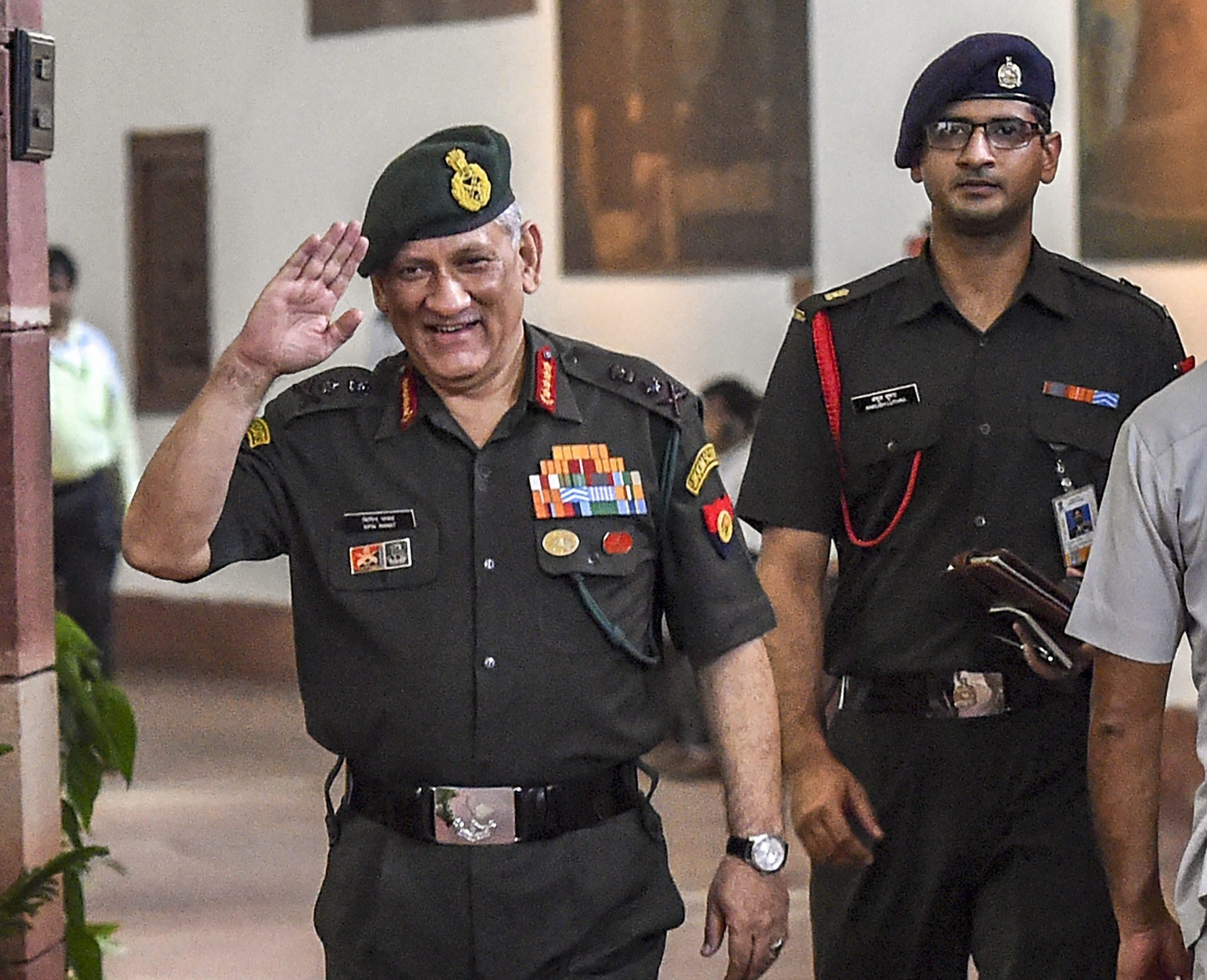
DRASS (KARGIL) : As India commemorated 20 years of Kargil war, army chief General Bipin Rawat warned Pakistan to never attempt to repeat such misadventure in future.

ANI PHOTO■ Army chief General Bipin Rawat with veteran Naik Deep Chand, who was injured in the Kargil war, in Drass on Thursday.

Speaking on the sidelines of a function in Drass sector, General Rawat said adversary (Pakistan) will never attempt to do this act again.

“I am quite sure that adversary will never attempt this again. In fact, this was a big misadventure undertaken by Pakistani army in 1999. They didn’t appreciate the will and intent of Indian political establishment and armed forces that they would never allow them to succeed,” he added.

Referring to the advantageous position Pakistani infiltrators occupied during the Kargil war, Rawat said no matter what heights they capture, the Indian Army will always get back to them and reclaim those heights.

“It was evident during the Kargil war in 1999,” the army chief added.

Commenting on the question of Pakistan’s denial about its involvement in Pulwama terror attack, Rawat said, “We are aware of the truth. So we are not carried away by any statement. Our intelligence agencies have given ample proof about what had happened in Pulwama.”

The army chief said what has happening in other places on the Line of Control in other places.

On being asked about infiltration after Balakot airstrike, Rawat said, “Infiltration has come down because of two reasons: One is because our troops are sitting alert and the second is that we have also inducted additional forces to strengthen the counter-infiltration grid.”