All posts by webadmin

Militants fire at J&K bank van in Kulgam; 5 policemen, 2 officials killed Hizbul claims attack

Police personnel paying tributes to five of their colleagues killed in a militant attack in south Kashmir’s Kulgam district on Monday.— Tribune photo: Mohammad Amin War

Suhail A Shah

Kulgam, May 1

Five policemen and two employees of the Jammu and Kashmir Bank were killed on Monday when some gunmen from militant organisation Hizbul Mujahideen struck a bank van carrying money in a village in south Kashmir’s Kulgam district.

A group of heavily armed militants began firing at a bank van that was returning to Kulgam district headquarters from Damhal Hanji Pora on Monday afternoon, a policeman said.

While four policemen and the two bank employees — the bank’s security guard one of them — were killed instantly, the fifth policeman died at a hospital later, the policeman said.However, it remains unclear if the van was robbed.“We have received seven dead bodies so far, including 5 policemen and two bank employees,” a doctor at Kulgam district hospital said.

(Follow The Tribune on Facebook; and Twitter @thetribunechd)

Among the policemen killed is an Assistant Sub Inspector of Police.

The militants reportedly took four service rifles belonging to the policemen, but this is still unverified.

Hizbul Mujahideen later claimed the attack. A spokesperson from the militant group told a local news agency that its fighters had taken with four weapons from the scene of attack.Several bank robberies have been reported in the Valley since November last year — the last one a failed attempt at a bank in Anantnag two days ago, also at Jammu and Kashmir Bank — with police citing the central government’s measure to scrap old high-value banknotes and introducing new ones in November as the possible reason for the sudden spurt. (With PTI inputs)


Pakistani national living with Indian identity arrested in Haryana

Pakistani national living with Indian identity arrested in Haryana
The Pakistani national even holds a PAN card. ANI

Jhajjar, May 26

A Pakistani national has been detained for staying in a temple here under a fake identity.An Aadhaar card and a PAN card issued in his name, and a Pakistani passport have been seized from him.As per the passport, his name is Raja and he is a resident of Hindu Colony, Larkana, in Pakistan’s Sindh province, the police said.

(Follow The Tribune on Facebook; and Twitter @thetribunechd)

“Raja, a Hindu, came to India in 2013 and his visa expired last year. He had been living in Iskcon temple in Bahadurgarh for the past nine months,” Superintendent of Police B Satheesh Balan said.The date of birth on his passport is different from what is mentioned on Aadhaar and PAN cards, the police said.A team of the Intelligence Bureau and the police are questioning him. PTI


head lines ::::29 Apr 2017

breakl line

LASHKAR BEHIND KUPWARA ATTACK

NO DOUBT, ARMY FOR PEOPLE LT GEN R.S SUJLANA (RETD)

SUKMA: AVOIDABLE TRAGEDY ANIL CHOWDHRY

TRACKING WHAT LEADERS SAY AFTER MAOIST ATTACKS

IAS OFFICERS TO AID OF MARTYR KIN 

7TH CENTRAL PAY COMMISSION PANEL SUBMITS REPORT, SUGGESTS MODIFICATIONS IN ALLOWANCES

REPORT OFFENSIVE WHATSAPP, FB POSTS, ARMY TELLS ITS STAFF ALARM OVER MESSAGES AIRING DISCONTENT OVER PAY PANEL HIKE

CAPTAIN DIRECTS RATIONALISATION OF PROPERTY PRICES IN CITIES

MODI’S HAWAI BAATEIN DREAMS FOR THE PRIVILEGED SOLD TO THE MASSES

INFIDELITY, MURDER, PATRIOTISM: A HOT MIX!

SPOTLIGHT FADES AFTER MASSACRE, KIN OF CRPF MEN LEFT IN THE LURCH

WON’T TALK TO SEPARATISTS: GOVT TO SC

ROHTANG OPENED, LEH ROAD’S TURN NOW

DELHI GOVT CANCELS HOLIDAYS ON BIRTH/DEATH ANNIVERSARIES OF VIPS

MALEGAON BLAST PUROHIT MOVES SC FOR BAIL BOMBAY HC REJECTED PLEA ON APRIL 25

GOVT TO SC: NO TALKS WITH J&K SEPARATISTS COURT ASKS HC BAR TO SUGGEST ROADMAP FOR DIALOGUE

breakl line

FOR PUNJAB NEWS

CLICK AT THE SCROLLING NEWS HEADING FOR DETAILS AT RIGHT COLUMN TOP::WHATS NEW

breakl line


Govt supports Army’s ‘preemptive’ actions across LoC

Govt supports Army's 'preemptive' actions across LoC
Defence Minister Arun Jaitley. PTI file

New Delhi, May 23

The government on Tuesday came out in support of the Army’s action against Pakistani posts along the LoC involved in aiding infiltration of terrorists into India, saying such measures are needed for peace in Jammu and Kashmir.

Defence Minister Arun Jaitley said the Army is taking such “preemptive” and “measured” actions to counter terrorism in the Kashmir Valley.

Also read:  Army targets Pakistani posts across LoC; releases video

(Follow The Tribune on Facebook; and Twitter @thetribunechd)

His response came after the Army today said it had launched “punitive fire assaults” on Pakistani positions across the Line of Control, inflicting “some damage”.

“Government supports the actions of Indian Army across LoC. Such actions are needed to ensure peace in J&K,” Jaitley tweeted.

“Indian Army is taking preemptive and measured actions to counter terrorism in valley and disengage Pak posts across LoC supporting infiltration,” he said on Twitter.

The Army also released a video of the military action which showed some structures in a forested area crumbling in a heap under the impact of repeated shelling.

The Indian Army did not give much operational details of the retributive assault across the Line of Control (LoC) against Pakistan Army positions in Naushera sector of Jammu and Kashmir, which were “aiding” infiltration.

However, sources in the force said the strike was carried out on May 9, nine days after two Indian security personnel were beheaded by Pakistan’s Border Action Team. —PTI


PDP leader killed in militant attack at Pulwama in Kashmir

PDP leader killed in militant attack at Pulwama in Kashmir
The site of the militant attack in Pulwama. ANI photo

Majid Jahangir

Tribune News Service

Srinagar, April 24

Ruling Peoples Democratic Party (PDP) leader Abdul Ghani Dar was shot dead in a militant attack in Pulwama in south Kashmir on Monday.Police said PDP district president, Pulwama, Dar was fired upon by militants at Pinglina on the outskirts of Pulwama town.

(Follow The Tribune on Facebook; and Twitter @thetribunechd)

“His vehicle was intercepted by militants at Pinglina and he was fired upon. The injured Dar was shifted to a Srinagar hospital where he succumbed to his injuries,” they said.The attack on the PDP leader came on a day when Jammu and Kashmir Chief Minister Mehbooba Mufti held a meeting with Prime Minister Narendra Modi in New Delhi and discussed the prevailing situation in the state.

Mehbooba says PM amenable to talks to ease Kashmir situation

Prime Minister Narendra Modi with Jammu and Kashmir Chief Minister Mehbooba Mufti. —PIB

New Delhi, April 24Jammu and Kashmir Chief Minister Mehbooba Mufti on Monday said the Prime Minister appeared amenable to holding talks with stakeholders in a bid to arrest the deteriorating situation in the Valley.However, she cautioned that “an atmosphere needs to be created” for a dialogue.“Talks cannot happen amid stone-pelting and firing of bullets,” she told reporters after a 20-minute meeting with Prime Minister Narendra Modi at his residence.

(Follow The Tribune on Facebook; and Twitter @thetribunechd)

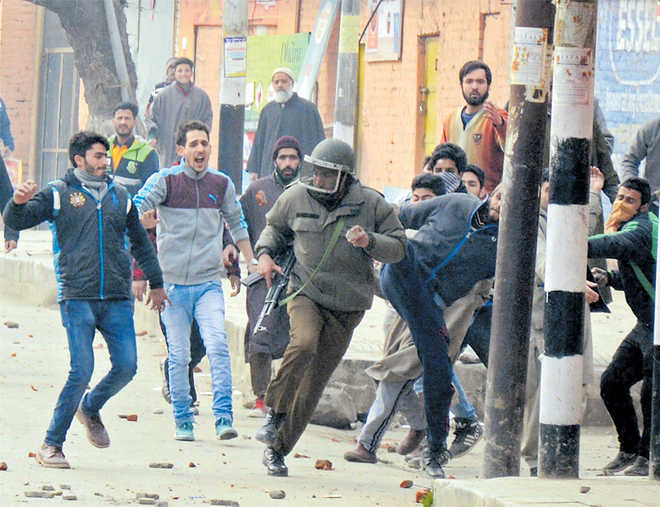
At the meeting, she invoked former Prime Minister Atal Bihari Vajpayee’s policy on Kashmir, saying the thread should be picked up from where he had left it–an apparent suggestion for talks with separatists.“The Prime Minister has an intention of holding talks after the situation becomes normal,” Mehbooba told reporters.Kashmir is in the grip of increased violence since the April 9 bypoll for the Srinagar Lok Sabha constituency. The security forces are under intense pressure as they are faced with almost daily protests and stone-pelting.The army and the CRPF have received some praise for showing restraint under provocation, and also come under criticism, especially after a video showed a civilian tied to a jeep as a human shield as it drove through the streets to avoid being attacked.“Talks are the only option,” Mehbooba said. “How long can you have a confrontation?”“Talks with Hurriyat (Conference) had taken place when Vajpayee ji was the Prime Minister and LK Advani ji was the Deputy Prime Minister. We need to start from where Vajpayee ji left. Talks are the only way out,” she said.Referring to the increase in stone-pelting incidents in the Valley, she said there were some young people who were “disillusioned” while some were being “instigated”, often through the use of social media sites such as Facebook and WhatsApp.Rising tensions between the coalition partners, the PDP and the BJP, over the handling of the security situation in Kashmir also came up at the meeting.The coalition also came under strain when the PDP lost a seat in the recently held MLC polls when an independent MLA voted in favour of BJP candidate Vikram Randhawa, leading to his victory.“Whatever happened should not have taken place. But this is an internal matter and we will resolve it with the BJP,” she said.She also raised the Indus water treaty issue, saying it was causing a huge loss of Rs 20,000 crore to the state.Mehbooba said the Prime Minister assured her that efforts would be made to see how the state would be compensated for this.The Jammu and Kashmir Chief Minister said the situation in Kashmir would be discussed in a meeting of the Unified Command on Tuesday.The GOC-in-C Northern Command, GOC 16 Corps, GOC 15 Corps, DGP J&K, IG BSF, IG CRPF, senior officers of the IB and RAW and Deputy Chief Minister Nirmal Singh will also participate in the meeting in Srinagar. PTI


Award for Major who tied Kashmiri to jeep

Tribune News Service

New Delhi, May 22

Major Leetul Gogoi, who was accused of tying a Kashmiri man on the bonnet of a jeep to ward off stone pelters in Kashmir, has been given a commendation certificate by the Army Chief for “sustained efforts in counter-insurgency operations”.(Follow The Tribune on Facebook; and Twitter @thetribunechd)The award is seen as a backing for the action of the officer, who belongs to the 53 Rashtriya Rifles, even as the Army maintained that a court of inquiry (CoI) into the incident was “”under finalisation.”The Army Chief’s “Commendation Card” is considered a prestigious award. It  is given for distinguished services and devotion to duty.Two days ago, Punjab Chief Minister Capt Amarinder Singh had, in an opinion piece in a newspaper, said the Major deserved a distinguished services medal for using a human shield against stone-pelters in Kashmir.Major Gogoi was in the spotlight after a video, shot during the April 9 Srinagar Lok Sabha bypoll and posted on the social media, showed a man tied on the bonnet of an Army jeep at Budgam in Jammu and Kashmir. A probe by the Jammu and Kashmir Police, which lodged an FIR against the security forces in light of the incident, revealed that it was Major Gogoi who had tied the man to the jeep’s bonnet as a “human shield”. A court of inquiry was ordered subsequently. Defence Minister Arun Jaitley, referring to the incident on Friday, had backed the officer, saying it should not be forgotten that the officer had the responsibility to save the lives of those involved in the election process as well as the crowd that had gathered. “Let us not forget the Army is a responsible institution,” he had emphasised.

Officer who tied man to jeep in Kashmir awarded for counter-insurgency ops

Officer who tied man to jeep in Kashmir awarded for counter-insurgency ops
The Army is still to conclude an inquiry into the ‘human shield’ incident.

Tribune News Service

New Delhi, May 22

Army chief General Bipin Rawat has issued a ‘Commendation Card’ to Major Leetul Gogoi for sustained efforts in counter-insurgency operations.Major Gogoi was accused of tying up a Kashmiri youth in front of jeep to ward off stone pelters.

(Follow The Tribune on Facebook; and Twitter @thetribunechd)

The award for Major Gogoi is seen as a backing of the action of the officer belonging to the 53 Rashtriya Rifles even as the Army maintained that a court of inquiry (CoI) into the incident is “under finalisation”.

“Major Gogoi has been awarded Chief of Army Staff’s Commendation Card for sustained efforts in counter-insurgency operations,” Army spokesperson Col Aman Anand said.

Sources said Major Gogoi was given the award during Gen Rawat’s visit to Jammu and Kashmir last week.

They said the CoI into the incident is still under finalisation.The Army Chief’s ‘Commendation Card’ is considered a prestigious award and is given for distinguished services and devotion to duties.A video, showing the man tied to the army vehicle during polling in the Srinagar Lok Sabha by-election on April 9, had triggered a public outcry, prompting the Army to institute a probe.The CoI was tasked to look into the circumstance that prompted Major Gogoi to tie the Kashmiri youth to the jeep’s bonnet as a “human shield”. — With PTI inputs


clip

clip


Ex-servicemen cell in CM’s office gets going

Tribune News Service

Chandigarh, April 21

A month after Capt Amarinder Singh took oath as Chief Minister, the Ex-Servicemen Cell — promised by him to redress issues concerning defence veterans — has become functional.

The cell, part of the Chief Minister’s Office, will be headed by Capt Amarinder.

unnamed (4)

His senior adviser Lt Gen TS Shergil (retd) is the cell’s senior vice-chairman and Maj Gen SPS Grewal is the vice-chairman.“The notification for the cell was issued yesterday and it is mandated to look into all government schemes concerning ex-servicemen,” Gurkirat Kirpal Singh, Secretary Defence Services Welfare (SDSW), Punjab said. “The cell’s scope may be widened in time to cover other aspects listed in the party’s election manifesto.” Other members include Director, Defence Services Welfare; Director, Punjab Ex-Servicemen Corporation; Director, Centre for Training and Employment of Punjab Youth; and Director, Mahatma Gandhi Institute of Public Administration (MGIPA), Chandigarh. The SDSW will be the member-secretary.The cell will also supervise the implementation of the Guardians of Governance (GoG) scheme that envisions deploying ex-servicemen to oversee the implementation of government schemes and to keep a watch on the working of officials at the grassroots level.In the coming weeks, MGIPA will train about 12,000 ex-servicemen who are to be enrolled for the GoG. Each veteran enrolled under the scheme: who should not be a member of any political party, should not be engaged in any full-time employment, have a clean record, be physically fit to move around and able to operate a smart phone will be required to undergo a five-day training programme that would be held at the district level. “We expect the GoG to be functional by July 1, by which time we would have recruited and trained the people involved,” Gurkirat said.


Defence ministry finalises strategic partnership policy to boost private sector role in weapon production

HIGHLIGHTS

  • The SP policy, which will now go to the Cabinet Committee on Security for final approval
  • This is a clear message to the DRDO that they have largely failed to deliver the goods over the decades

NEW DELHI: The “broad contours” of the long-awaited “strategic partnership (SP)” policy to boost the Indian private sector’s role in production of cutting-edge weapon systems, in collaboration with global armament majors through joint ventures here, was finalized by the defence ministry on Saturday.

The defence acquisitions council (DAC), chaired by defence minister Arun Jaitley, also gave the green signal to the Army to go ahead with its long-term plan to induct three squadrons (39 choppers) of attack helicopters for its three “strike” corps, among other modernization proposals, said sources.

But the main takeaway was the SP policy under the “Make in India” thrust of the Modi government, which initially opens up four major segments of fighter jets, helicopters, submarines and armoured vehicles (tanks and infantry combat vehicles) for private sectors players.

TOI was the first to report that the SP policy would be cleared by the DAC this month as a major step towards building a robust domestic defence-industrial base, the absence of which means that India still imports 65% of its military requirements and can be strategically choked by foreign powers in times of conflicts.

The SP policy, which will now go to the Cabinet Committee on Security for final approval after the “smaller details” are worked out, is a clear message to the DRDO and its 50 labs, five defence PSUs, four shipyards, and the 41 factories under the Ordnance Factory Board (OFB) that they have largely failed to deliver the goods over the decades.

However, due to the stiff resistance put up by the public sector lobby against the SP policy, defence PSUs, shipyards and OFB will also be eligible to compete with private sector companies for selection as SPs in the submarine and armoured vehicle segments.

As per the SP roadmap, which will take almost a year to unfold, officials said only one company will be selected as the SP at a time in each of the four segments in “a transparent and competitive process” for the long-term partnership.

The defence ministry will select the companies on the basis of adequate financial strength (Rs 4,000 crore in annual turnover over the last three fiscals, capital assets of Rs 2,000 crore etc), demonstrable manufacturing and technical expertise, existing infrastructure and the ability to absorb technology from their foreign partners. A company’s record of “willful default, debt restructuring and non-performing assets” will also be taken into account by the defence ministry.

The foreign companies or original equipment manufacturers (OEMs) will be selected, in a separate but parallel process, primarily on the basis of the “range, depth and scope” of the transfer of technology (ToT) they are willing to offer. Other criteria will include the indigenous content, eco-system development, supplier base and future R&D, among other things.

“The policy is aimed at developing the defence industrial ecosystem in the country through the involvement of major Indian corporates as well as the MSME sector. It will give a boost to the `Make in India’ policy and set the Indian industry on the path to acquire cutting-edge capabilities which will contribute to the building of self-reliance in the vital sector of national security requirements,” said an official.

Polls in conflict zones: A Kashmiri lesson Syed Ata Hasnain

CRPF personnel standing guard at a polling station during repoll in Srinagar Lok Sabha constituency in Budgam district of Kashmir. (Photo: PTI/File)

CRPF personnel standing guard at a polling station during repoll in Srinagar Lok Sabha constituency in Budgam district of Kashmir. (Photo: PTI/File)

Jammu and Kashmir is in election mode, and two important

Lok Sabha byelections are in process. The turnout in Srinagar

was abysmal, and the same would have happened in Anantnag

too if it hadn’t been postponed for six weeks. Of course, there

is no guarantee of normal polling on May 25, when the bypoll

is now scheduled. In Srinagar, the violence made more news

than the turnout, with eight lives lost.

Having been associated with most elections in J&K since 1989,

I can recall heated discussions whenever they took place. But

none revolved around the real issue – conduct of democratic

processes of any significance in an internal security scenario

that has proxy war at the core. The United Nations, for

instance, invariably seeks to hold elections as the grand finale

of any peace process in a conflict zone in which peacekeeping

operations have been in place. The finest examples are

Cambodia and Mozambique, both of which had proxy internal

conflicts of Cold War vintage, and ended in situations of

stability with elected governments; both have their run with

problems, but none of the magnitude of pre-election periods.

Democracy is presumed to be a great leveler and empowers the

very people who fight each other or the state; and gives them a

chance to enter an era of stability and aspire to improve their

lives. It is supposed to make the voice of the silent majority

relevant, and a chance for their children to lead better lives. It

is also meant to iron out differences and let the majority view

prevail. However, a million-dollar question always remains: is

democracy necessarily the end process of seeking peace in a

conflict zone, or is it a facilitator that enables the advent of

peace? There’s no better place to examine this than Kashmir,

which has seen turbulence and conflict for the past 28 years –

conflict driven by the proxy support of an adversary, a mix of

ideology and politics and confused aspirations. It’s a classic

case where the democratic process has been in place alongside

conflict for almost 21 years (since 1996).

The current context of the conflict goes back to 1989, but the

background is too well known. Let it suffice that the trigger

was an allegedly rigged election (1987) but it was just a trigger.

The actual conflict emerged for historical reasons, more so due

to external support for secession and internal mismanagement.

A couple of points from 1989 to 1996 are relevant. During this

time the sentiment for separatism was strong in Kashmir and

some other Muslim areas south of the Pir Panjal. Why was it

considered necessary that Assembly elections be held in 1996

without awaiting full stabilisation? Obviously polls were seen

as a stability facilitator. India was under intense pressure

internationally amid the Pakistani campaign to paint it

black. New Delhi had, however, weathered a serious onslaught

by US assistant secretary of state Robin Raphel, an ardent

Pakistan backer. The foreign element of the militancy – the

pipeline of the non-Pakistani Mujahideen – had dried up. The

Ikhwanul Muslimeen, the counter group set up by India, was

reasonably effective at that time. The decision to hold

Assembly elections at that juncture was extremely bold, and

well thought out. The turnout percentage was not the essence;

the event itself was, including the installation of an elected

government. Its strategic messaging was massive. The turnout

didn’t prove too bad either. The years 1996-97 were crucial for

India. Pakistan had successfully installed a Taliban-led

government in Kabul, and could focus its attention much more

on J&K. The decision to risk elections was also aimed at

countering the Pakistani propaganda that J&K was in chaos. It

also firmly communicated India’s resolve after another

landmark event was used for strategic messaging; this was the

joint resolution of the two Houses of India’s Parliament on

February 22, 1994 that the entire kingdom of the erstwhile

Maharaja of Kashmir belonged to India.

The 1996 elections brought a legitimately-elected government

to power. It gave an impetus to political activity, but given the

security situation it was risky for legislators to venture into

their constituencies. In areas close to the Line of Control it was

easier, and that’s where political activity flourished. This led to

the creation of the PDP at the instance of Mufti Muhammad

Sayeed, adding more variety to Kashmiri politics. Where

politics and elections failed the people of Kashmir in particular,

and not J&K, was the inability of the political class to involve

the people in more governance-based issues at the ground

level. There were few legislators willing to undertake personal

risk to enable active engagement with people. The stream of

elections since 1996 did create awkward moments, and some

sense of confusion in the minds of mainland India.

Among the reasons for confusion was, first, the improving

voting turnout percentage. Yet after government formation,

support to anti-national activity continued by some who had

taken part in the elections. Most of this was in the form of

over ground support. The Indian public largely assumes that

voting in elections affirms faith in the Indian Constitution.

Some Kashmiris aligned against India, however, say they vote

only for the purpose of their administrative needs, but don’t

have faith in the Constitution or accession to India. Second, on

a similar note, many young boys turn out for recruitment to the

Army or paramilitary forces every time a drive is held. It is

claimed many are stone-throwers. My experience shows this is

not true. There are many young people who may not have any

love for India, but they don’t necessarily indulge in any form of violence.

They carry deep-rooted alienation, and at the first instance of a

chance of employment they shed their inhibitions; quite apart from the stone thrower variety.  Classically,

this is a case for psychologists and sociologists to study in more detail.

Alienation and dislike amounting to hatred are very powerful

emotions that can’t be glossed over. Psychologists should

suggest methods of communication to deal with this alienation.

A lot of people believe that applying principles of rationality

may fetch dividends. This means people should use elections to

convey their true feelings. They shouldn’t use violence but

voice democratic dissent against issues they strongly feel

about. This advice is, however, fine for straightforward security

situations, but not where vicious proxy wars are under way.

The separatists invariably oppose elections, but with varying

degrees of seriousness. When they sense there is a public desire

for betterment through “roti, kapda aur makan”, the objections

are low-key, but at politically sensitive moments the level of

discouragement is again very high.

The current impasse is the most challenging in the short history

of J&K’s electoral processes since 1989. The separatists will be

elated by the government’s failure to control violence as well

as the low turnout. The Opposition parties don’t seem to

mind this either as it gives them a chance to browbeat the

government.

Elections may perhaps not be the best way to counter violence.

They may actually provide circumstances for more violence.

But elections can’t be wished away either in a democratic

nation – and that is where the dichotomy lies.


Return to governance Captain faces an uphill task

Return to governance

Coming to grips with the Punjab reality, which, it turns out, is harsher than expected, the Congress government is yet to give the impression that it knows how to clear the mess.

The diversion or non-utilisation of Central funds by the previous Badal government has hurt urban renewal and city cleanup plans and delayed the development of Ludhiana, Jalandhar and Amritsar as smart cities.

That the BJP as a coalition partner kept silent over all this is a bit surprising. It did not care to guard its urban vote territory nor did it object to the unauthorised fund diversion for the benefit of Akali panchayats or for extra spending on development works in the constituencies of the extended Badal Parivar at the cost of the rest of Punjab.  One lesser known instance of Akali misrule that has surfaced now — which seems hard to believe — is that for 10 years water bills were not issued to domestic users as civic officials kept collecting bribes in return. After the elections in March the Local Bodies Department hurriedly dispatched water bills in the range of Rs 30,000 and Rs 60,000.

How and why the previous Local Bodies Minister allowed this to happen is hard to understand.  During the interim period the state was under the Election Commission, the power authorities took on the powerful free loaders and recovered some long-pending power dues. The freebie culture still persists but some change is visible. Institutions continue to pay for pre-poll sops. PSPCL suffered a Rs 2,000-crore loss in 2016-17. A sectoral overhaul is required. Instead, concessional power has been promised to industry, burdening the state’s already beleaguered treasury.  It is time for consolidation and common sense. Driven by a burning ambition to become the Punjab Chief Minister one last time before taking retirement, Capt Amarinder Singh promised whatever the voters had asked for.

It is a BJP-ruled Centre he deals with and his opponent in the Amritsar election is the Finance Minister. If he still expects a Central package, it is a case of self-delusion. Running the state affairs and restoring a semblance of governance to Punjab requires hard decisions. The Captain is yet to establish that he has the stamina and the stature to lead the state purposefully and passionately.