It has increased its deployment to 59 columns, focusing on Madhopur Headworks to assist in early restoration
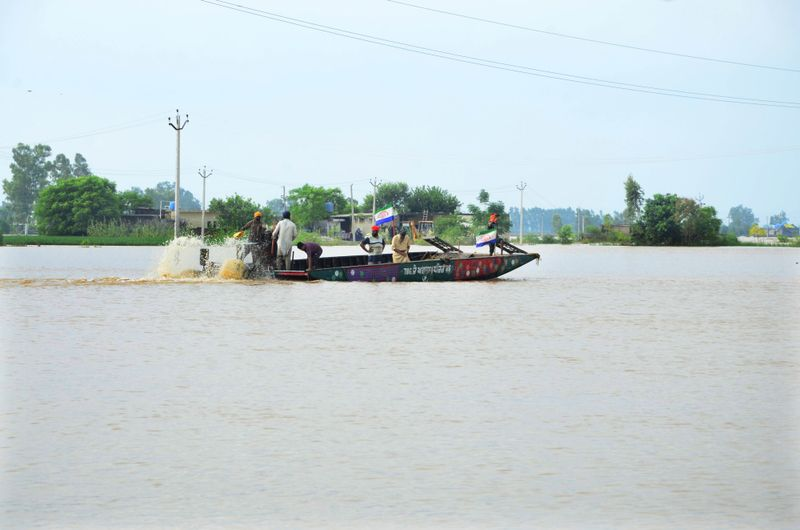
The Western Command has stepped up its Humanitarian Assistance and Disaster Relief (HADR) operations in flood-ravaged areas of Punjab, Himachal Pradesh, and Jammu and Kashmir, increasing its deployment to 59 columns, including 17 Engineer Task Forces. Heavy engineering equipment has also been mobilised to expedite repair and restoration works, with teams working round-the-clock to repair breaches and reopen critical lifelines.
Presently, an Indian Army team is deployed at Madhopur Headworks, which suffered heavy damage from high river water levels, to assist in early restoration. The operations were launched on August 26, and since then, 82 HADR missions have been executed. The Army has evacuated more than 6,000 persons, including approximately 300 paramilitary personnel, and provided medical assistance to over 13,000 persons, according to a spokesperson for the Western Command.
Essential supplies, including medicines, water, and 48 tonnes of rations, have been delivered to flood-affected areas via air drops and ground columns. Army Aviation and Indian Air Force assets, comprising three Dhruv ALHs, six MI-17s, six Cheetah helicopters, and one Chinook, have flown sorties totalling almost 300 hours to support relief efforts.
The Army is working in close coordination with the civil administration, National Disaster Response Force, and State Disaster Response Force to ensure optimal use of resources, timely relief, restoration of essential services, and rebuilding of damaged infrastructure. A flood control and water-level monitoring cell has been established at all headquarters, functioning round-the-clock to monitor water levels across major headworks, including Bhakra Dam, Ranjit Sagar Dam, and other critical points.
In the aftermath of recent floods, sustained efforts have been made to restore connectivity to a number of border outposts and adjoining areas that had been temporarily cut off. Dedicated engineer detachments have been deployed across affected regions to undertake urgent tasks critical to restoring normalcy and ensuring the safety of local communities.
Special attention has been given to areas severely impacted, where rapid restoration of infrastructure was vital for both operational and humanitarian reasons. Key engineering works include diversion of floodwaters in vulnerable pockets, repair of damaged bridges, restoration of washed-away stretches of road, and strengthening of embankments and anti-flood bundhs.
Built 3 years ago, Shamti bypass in Solan sinks after rain
A sizable portion of the 5.14-km Shamti bypass in Solan district has caved in at Sheothal village following relentless rain barely three years after it was constructed. Several houses located below the road have been endangered due to continuous subsidence. A house has been vacated as a precautionary measure.
Gaping potholes are visible on the road reflecting shoddy construction work. A part of the road has become inaccessible, forcing the police to depute men to divert traffic.
Conceived to decongest Solan, this arterial road, now poses a threat to residents due to rapid land subsidence. Cracks, which appeared on the road surface last week, are widening with each passing day, thus raising fear among residents of potential damage to their houses and arable land.
Celebrities come forward to aid in flood relief work in Punjab
Diljit Dosanjh, Karan Aujla, Jasbir Jassi, Satinder Sartaj, Sunanda Sharma, Gippy Grewal and others, come forward to offer their ‘sewa’ for ‘Sarbat da Bhala’
Nimrat Kaur and (inside) Randeep Hooda, personalities from the entertainment world, have supported flood relief work. Vishal Kumar
“Nanak Naam Chardi Kala, Tere Bhaane Sarbat da Bhala.” This simple Sikh prayer forms the central belief of Sikhism. It seeks in the name of God, with high spirit, a positive mindset and his blessings, prosperity for all.
At a time when Punjab has been wrecked by devastating floods and its people displaced and in despair, Punjab’s on-screen heroes have turned real-life heroes by actively offering practical support on ground. In Chardikala, the big names of Punjabi entertainment industry, including Diljit Dosanjh, Karan Aujla, Jasbir Jassi, Satinder Sartaj, Sunanda Sharma, Gippy Grewal and others, have come forward to offer their ‘sewa’ for ‘Sarbat da Bhala’. Joining the relief efforts across flood affected areas in Fazilka, Gurdaspur and Amritsar, several celebrated names of the Punjabi entertainment industry are working as volunteers and offering support in relief and rescue operations and pledging long-term rehabilitation support for villages.
One of the first ones to come forward with food and relief material for displaced families was Satinder Sartaj, through his Sartaj Foundation, which has already distributed relief material to more than 500 families and is currently working on ground operations in Ajnala and Fazilka. Diljit Dosanjh’s Saanjh Foundation is working to provide relief and reaching out to evaluate the damage due to floods in remote villages of Ajnala.
As Diljit begins his Aura tour across Australia and New Zealand, Sonali Singh along with her team, landed in Amritsar three days back and is working closely with volunteers of Global Sikh Foundation to distribute solar lights, tents, medicines and other essential items. Diljit Dosanjh’s Saanjh Foundation has pledged to adopt 10 of the most severely impacted villages in Amritsar and Gurdaspur, coordinating with NGOs and local authorities to ensure long-term rehabilitation of flood victims. Ammy Virk and his team have announced to adopt 200 homes, offering shelter and stability to families who’ve lost their dwelling, aiming to restore hope and dignity. Bollywood actor Vicky Kaushal has pledged support to Global Sikh Foundation, to run free ambulance and medical vans.
Singer-actor and now producer Gippy Grewal had been sending truckloads of silage for cattle and cattle feed for affected areas, knowing how cattle health is at risk in this hour. Grewal’s local teams at Ajnala and Fazilka are working together with villagers and the local authorities to reach out to people stuck in remote areas. Karan Aujla, Bunty Bains and Gurbaaz Singh have donated rescue boats while Sunanda Sharma and Raj Kundra visited the relief camps at Ajnala to interact with rescued families, offering emotional as well as inspirational support.
Punjabi mainstream singers have long been facing criticism, for glorifying guns, alcohol and misogyny, with individual singers, including Diljit, Aujla, AP Dhillon and Guru Randhawa being the target of online trolling. Now, these very singers have stepped forward to offer humanitarian aid, with accountability and commitment towards their people, their land.
Singer Guru Randhawa has set up two relief camps at Dera Baba Nanak and village Dharowali. Parminder Singh, a local villager from Dharowali, who is leading relief operations of Guru Randhawa’s team, said, “We received a call from Randhawa as he was interested in sending us financial help for relief work. Our camps provided dry ration, medicines, drinking water and cattle feed initially to 40-50 houses in two villages of Dera Baba Nanak. Currently, we are in Kharar Khurd village in Ajnala, where no help had reached and we are working to reach people stuck here,” he said. Parminder is a farmer and lost 15 acres of fertile land to floods. “We are all in this together. We need to hold and lift each other now,” he said.
A surgeon’s refreshingly different account of the Kargil War
Colonel Arup Ratan Basu’s humane and compassionate book, “The Kargil War Surgeon’s Testimony” looks at war, not through the eyes of one trained to take lives but one saving them
All wars are invariably followed by books, but these are usually about the blood and glory, strategy and logistics, victories and failures. Colonel Arup Ratan Basu’s book is delightfully different: while being both humble and unassuming, it is also humane and compassionate, shedding light on the usually ignored ‘backroom boys’ who provide the spine to the arms that fight on the frontlines. Basu is a general surgeon, and this book is a personal account of the two months he spent in the Army field hospital at Kargil. It is special and refreshingly different in that it looks at war, not through the eyes of one trained to take lives but one trained to save them.
Freshly commissioned as a surgeon in the Army Medical Corps in December 1998, he was dispatched to Kargil on his first posting where war had just broken out between India and Pakistan. He is candid enough to admit that he was not prepared to be thrust into the jaws of war, ministering to casualties with the most basic of facilities. A field hospital is only the first responder, its job being to stabilise the wounded before shifting them to base hospitals for more advanced care, but that is in theory only, as Colonel Basu soon found out. Severely wounded soldiers have to be saved during the proverbial ‘golden hour’, sometimes with complicated operations field hospitals are ill-equipped to handle. But this reasoning cannot be an alibi, it has to be confronted as a challenge.
The wounded came every night for two months from sectors which are now household names — Batalik, Dras, Kargil; Colonel Basu and his team worked and operated at night and rested during the day. He gives us the reason for this peculiar time schedule: Indian soldiers, attempting to climb up the lofty mountains on which the Pakistanis were perched, could only do so at night. Casualties, therefore, occurred at night, but could be evacuated out of the battle zones only the same night (if lucky) but usually on the next night since during the day they would be sitting ducks for the enemy soldiers. So, they arrived at the field hospital at night, were attended to, and, if required, referred to Srinagar by chopper the next day. Interestingly, the author soon discovered that the number of casualties arriving every day was a fairly accurate barometer of how the war was progressing!
Doctors are the unsung heroes of any war, and the figures of the Kargil field hospital prove it: during his short two-month tenure there Colonel Basu surgically treated 350 casualties and operated on 250, that’s a mind-boggling 4 operations a day! He lost only two of his patients. It says something about the grit and commitment of Army doctors that he had to perform complex surgical procedures which even a state-of-the-art corporate hospital in a metro would find a challenge — splenectomy, thoracotomy, intestine resection and anastomosis; each of these would have ordinarily required a team of specialists. Colonel Basu counts as one of his triumphs his success in saving a havildar’s gangrenous, splinter-shattered arm from amputation by adopting some dexterous surgical procedures. His peers at the base hospitals, where his patients were forwarded for advanced care, soon conferred on him the well-deserved title of the Surgeon of Kargil!
Basu’s job afforded him many opportunities to interact with his patients, and he learnt a lot about the war from them, details of which have to be believed because they came from people who have lived them: how the “disconnect” of our Army field commanders led to the intelligence failure to anticipate that Pakistan was up to something on the commanding heights of the border, in spite of being informed by the shepherds and the Bakerwals that something was amiss; the complete initial unpreparedness of our soldiers to fight in these heights, without adequate clothing, footwear, snow tents, acclimatisation, even food, a prime reason for the high rate of casualties — 527 dead and 1,363 wounded; how the tide of war turned with the introduction of the Bofors guns; the deceitful nature of the Pakistan army, which planted mines even as they vacated the occupied areas when ceasefire was declared.
There are moments of great poignancy too. As when news filters down to the field hospital of the handing over of the bodies of the gallant Capt Saurabh Kalia and his six-man patrol; the anger and sorrow at learning of the horrible mutilation and tortures inflicted on them before their murder in cold blood. Or when Basu is informed to be ready to receive a special casualty; it turned out to be that of Squadron Leader Ajay Ahuja, whose MIG was shot down as he was trying to rescue Flt Lt Nachiketa whose plane had also been shot down.
Nachiketa was lucky — he was released after a week or so in captivity when India took up his case at international fora. Ahuja was not so lucky: when Colonel Basu examined his dead body, he found clear signs of torture and cold-blooded murder of a PoW. What happened to the Geneva Convention? he asks. Did the government fail in mounting pressure for his release, as it did for Nachiketa, he wonders. But he realises that though wars throw up many questions, they provide few answers.
It was not all shelling and surgery at the hospital, though. Soon enough, it was swarmed by journalists (Barkha Dutt, CNN, Reuters) and celebrities, for as news of the remarkable work being done here got around, Colonel Basu himself became a celebrity of sorts! The glamorous visitors included Javed Akhtar, Shabana Azmi, Suneil Shetty, Salman Khan, Raveena Tandon, Vinod Khanna, Javed Jaffrey, Bachendri Pal the Everester. They were a bit of a nuisance, at times, with their airs, but they were wonderful as morale boosters for the wounded jawans. The author recounts how one patient, bed-ridden with intense back pain and sciatica, jumped out of his bed to get himself happily photographed with the stars, hopping from frame to frame, his pain dissipated! This was noticed by the Commandant, who promptly had the chap discharged and sent off to the frontlines.
Kargil is located on the banks of the Suru river, originating from the snowfields and glaciers of Trishul. The last chapter is devoted to this river, which had seen so much bloodshed and disruption in these few months, and longed to return to the peace and tranquility its vales once enjoyed. The book ends with a number of poignant questions asked by the river: Why did our neighbours [Pakistan] have to tread into our territory, the territory that never belonged to them? Why did they cause so much destruction? Was it all worth it? There are also questions asked of the river by the gallant soldiers who laid down their lives for their country: Did we not do right in defending your vale? Have you forgotten us too, Suru, as all the others have? Why should you remember this tale, when my countrymen have forgotten me? Do you think that I deserved to die this way?
Questions that will haunt the reader for a long time. For they have no answers.
— The writer is a former IAS officer
Why Punjab’s dams shouldn’t be blamed for flooding state : Ex-BBMB Sec Singla
In Ludhiana’s Sasrali village, residents and the Army joined forces to protect the banks of the Sutlej River from rising floodwaters. Community efforts, sandbagging, and timely intervention helped prevent damage to homes and farmland. Authorities continue monitoring water levels and providing assistance, highlighting strong local resilience and coordination during this flood situation in Punjab.
While achievements like India being ready with its indigenously developed Vikram 3201 microchip brought in positivity, denial of bail to Umar Khalid and Sharjeel Imam in the Delhi 2020 riots after spending 5 years in jail raised viable questions about UAPA
After Himachal and Jammu and Kashmir, the rain gods continued to wreak havoc in the villages and towns of Punjab. The incessant flooding obliterated familiar markers on the Radcliffe Line in Ferozepur where parts of the border fencing that divides India from Pakistan have been submerged. It’s as if geography is taking its revenge on history, writes Editor-in-Chief Jyoti Malhotra in her edit Water will find a way, in India & Pak. The Bhakra dam has never been desilted since it was built in 1963. She has many formidable questions for which people need answers — If this is true about the Bhakra Nangal on the Sutlej, could it also be true about the Pong dam and the Ranjit Sagar dam? Does it follow that the dam officials had to release water from these dams this monsoon — which caused the flooding in Punjab — because they were concerned about protecting the integrity of the dam structure? If these dams had been desilted over the years, would they have been capable of carrying much more water?
In their Op-ed piece Floodwaters expose cracks in Punjab’s governance, JNU professor Seema Bathla and Ravi Kiran, Assistant Professor, Government College, Sri Muktsar Sahib,underline the need for a proactive, long-term strategy that addresses the fundamental causes of floods and the need for coordinated efforts between neighbouring states. A review of dam management protocols, a state-wide project for desiltation and a robust farmer-centric crop insurance policy is what they recommend.
In yet another informative article, science commentator Dinesh C Sharma explains in his edit piece Wake-up call on the climate front that the changing monsoon patterns are linked to larger patterns of climate change. Enumerating the solutions, he writes we need to make all our public policies compliant with climate change, review the Environmental Impact Assessment regime and conduct a ‘climate audit’ of all existing infrastructure — hydel projects, national highways, road and railway bridges, airports — not from a financial perspective but to check if it is climate-resilient.
With the SCO meet held in Tianjin earlier this week, among India, China and Russia, the weakest link in this chain is the India-China relationship, says former Ambassador to China Gautam Bambawale in his Op-ed piece Beyond photo-ops: Realities of India-China ties. The outstanding boundary question imposes limitations on how much India-China relations can improve, he writes. It is time for quiet backroom discussions and negotiations between India and China.
Amid the changing geopolitics induced by Trump 2.0, there are some good vibes coming in from Europe. Germany’s partnership with India will weather the current storms that are shaking up the international order, writes Germany’s Ambassador to India Philipp Ackermann in his Op-ed piece Berlin bets on Indian talent for stronger ties. Many German companies have made Bengaluru a cornerstone of their R&D strategies and many Indian students trust the quality of German public universities and are placing their future on Germany.
A fallout of Trump’s tariff plan, the Centre announced the removal of 11 per cent import duty on cotton. That it has come at the time of harvest is a recipe for disaster, writes Sukhpal Singh, Chairman, Punjab State Farmers’ and Farm Workers’ Commission in his Oped Cotton imports spell disaster for farmers. The irony is that this decision came days after PM Modi assured the farmers that the government would not compromise on their interest at any cost. Supporting the cause of the farmers is another Op-ed piece Why India needs an agricultural policy where Kirti Kisan Union general secretary Rajinder Singh Deep Singh Wala writes that the pressure of corporate and imperialistic countries has been deciding the fate of our food and farmers. A policy that is advantageous to the farmers, not corporate giants, is needed, he writes.
The Delhi High Court refused bail to Umar Khalid and Sharjeel Imam in the Delhi 2020 riots. By declaring their involvement “graver” without showing how, the court avoids the hard question of equality before law, says Supreme Court senior advocate Sanjay Hegde in his Op-ed piece Burying justice in the Umar Khalid trial. This case is not just about Khalid or Imam, it is about the space for dissent in India. Five years in jail without trial for words and protests is not proportionate; it is punishment without conviction, he notes.
In a positive development, the ISRO presented the indigenously developed Vikram 3201 microchip at the Semicon conference marking a huge milestone in the nation’s self-reliance in the semiconductor technology. ‘Vikram’ is expected to find valuable applications in strategic and industrial sectors, besides playing a major role in space missions, explains IISER Mohali’s visiting Professor TV Venkateswaran in his Op-ed piece Why ISRO’s Vikram 3201 is a game-changer. The work on semiconductor technology was driven by necessity as ISRO heavily relied on imported processors earlier. Sanctions imposed after the 1998 Pokhran tests sharply highlighted the importance of developing home-grown strategic technology, he explains further.
Punjab farmers allowed to sell silt from fields sans green nod
Punjab Cabinet approves one-time measure to clear agri land by Dec 31
In a one-time measure, the Punjab Cabinet on Monday permitted flood-hit farmers to mine and sell silt deposited by rivers in their fields without obtaining green nod.
They will be allowed to clear their silt-laden fields by December 31.
The move is expected to help farmers recover their losses suffered due to state’s worst floods in decades.
The approval to the Jehda Khet, Ohdi Ret initiative was given at a meeting chaired by Chief Minister Bhagwant Mann via videoconferencing from a Mohali hospital, where he is undergoing treatment for a bacterial infection.
Mann is expected to be discharged from the hospital in a day or so. Meanwhile, a spokesperson said silt had accumulated in fields at 2,064 villages. “Therefore, in a major reprieve to farmers, it has been decided that they will be allowed to remove silt from their fields and sell it if they wish to. They will be allowed to remove silt from their land without any permit by December 31,” the spokesperson said.
The spokesperson said the removal of silt from agricultural land by way of this one-time measure would not be considered mining of minerals. The deputy commissioners concerned shall declare the list of affected villages in a district where it could be done.
According to initial estimates, standing crops over 4.3 lakh acres had submerged.
After the meeting, Mann ordered the kin of the each dead Rs 4 lakh.
He said no instalment or interest on loans will be changed for debt taken from co-operative and agricultural development banks for next six months. Dairy farmers will also get compensation for the loss of cattle.
Other decisions
The Cabinet also granted prosecution sanction against former Punjab Minister Bikram Singh Majithia under Section 19 of the Prevention of Corruption Act, 1988.
As per advice of the Advocate General, the matter with regard to granting of prosecution sanction of former minister first needs to be discussed in the Council of Ministers and thereafter it will be sent to the Governor for passing of a formal order.
An amendment to the Punjab Town Improvement Act, 1922, was also approved to enable urban local bodies of the state to utilise funds of improvement trusts through the Municipal Development Fund, which was established by the state government to undertake urban infrastructure works for which allocation is received from the state Budget every year.
The Cabinet also gave green signal to the Custom Milling Policy for Kharif Marketing Season (2025-26), starting from September 16 with procurement of paddy to be completed by November 30, 2025.
With an aim to allot mines in a more efficient manner, generate more revenue and increase more supply, the Cabinet gave nod to make amendments to modalities for their auction, granting of mining rights and period of auction under the Punjab State Minor Mineral Policy, 2023 and relevant rules of Punjab Minor Minerals Rules, 2013.
It gave approval to constitute the Punjab State Mineral Exploration Trust (SMET) to oversee the planned development of the mineral resources and their exploration in the state.
The Cabinet approved the creation of 1,007 posts in the School Education Department and regularisation of services of non-teaching staff under Samagra Shiksha Abhiyaan (SSA) against these posts.
It granted nod to the Punjab Community Service Guidelines, 2025, with an aim to bring uniformity across district courts of the states of Punjab, Haryana and UT Chandigarh for effective implementation of three new criminal laws where sentence of community service is passed under Section 23(2) of the BNSS, or Section 18(1)(c) of Juvenile Justice Act 2015 or other laws throughout the country.
The cabinet gave nod to ensure pay protection on transfer (merger) of rural medical officers working under the Zila Parishad to the Department of Health and Family Welfare.
In order to strengthen police stations to ensure effective investigations, particularly in relation to drug cases and other organised crimes, the Cabinet gave nod to the creation of 1,600 new NGO’s posts (ASI, SI and Inspector) in district cadre.Haryana CM meets Mann at hospital
Haryana Chief Minister Nayab Singh Saini on Monday created a buzz in the political circles when he reached the private hospital in Mohali to enquire about the health of CM Bhagwant Mann. He stayed with Mann for 20 minutes, where, according to officials in Haryana “… the two leaders had a discussion on several important issues”.
“He also asked the CM about the flood situation in Punjab and assured him of all possible help,” the officials added.
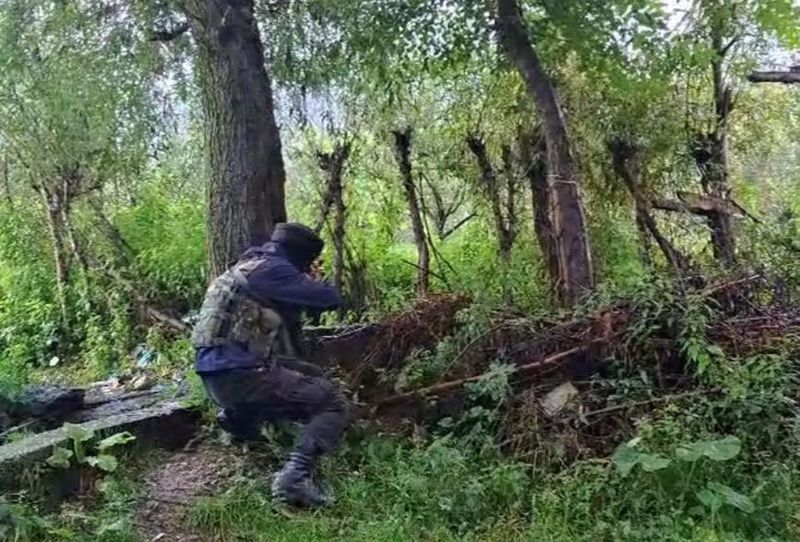
Two soldiers, including a junior commissioned officer (JCO), and two militants were killed in a gunbattle in Kulgam district of south Kashmir on Monday.
Police officials said based on specific intelligence, a joint team of the Jammu and Kashmir Police’s Special Operations Group, the Army and the CRPF launched a search and cordon operation in the Guddar forest area.
Sources told The Tribune that there were inputs about the presence of a group of militants in the vicinity of the area that saw one of the longest anti-terror operations last month. The gunfight had continued for 11 days. In that operation, two Army personnel and a militant were killed, while other militants had managed to escape.
Srinagar-based Chinar Corps wrote on X on Monday morning that after the joint search operation was launched, “vigilant troops observed suspicious activity”. Upon being challenged, “terrorists opened fire, prompting a fierce exchange of gunfire”.
The Army said during the gunfight, one terrorist was eliminated while a junior commissioned officer suffered injuries. Later, the Army said another terrorist had been killed in the operation while another soldier also suffered injuries.
“The identity of the terrorists is being ascertained,” the Army said.
The sources said on Monday evening, both injured soldiers succumbed to their injuries.
Late on Monday night, the Army posted on X, “The Chinar Corps honours the supreme sacrifice of the bravehearts — Subedar Perbhat Gaur and Lance Naik Narender Sindhu — in the line of duty for the nation. Their courage and dedication will forever inspire us.”
“The Army expresses deepest condolences and stands in solidarity with the bereaved families. The operation continues,” the Army said.
The sources said one of the two militants killed in the encounter was a foreign terrorist. The sources said it would be “premature” to say if group involved in Monday’s gunbattle was the same that had escaped last month.
Advertisement
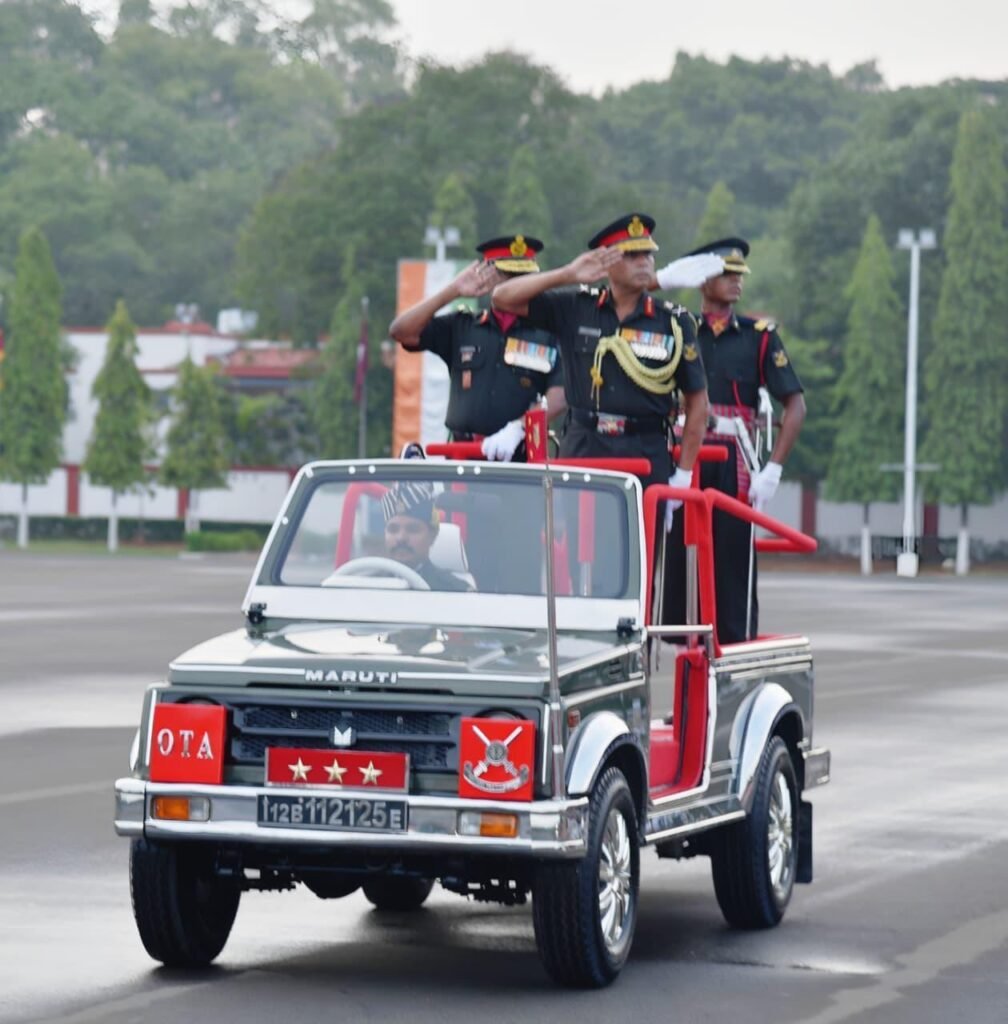
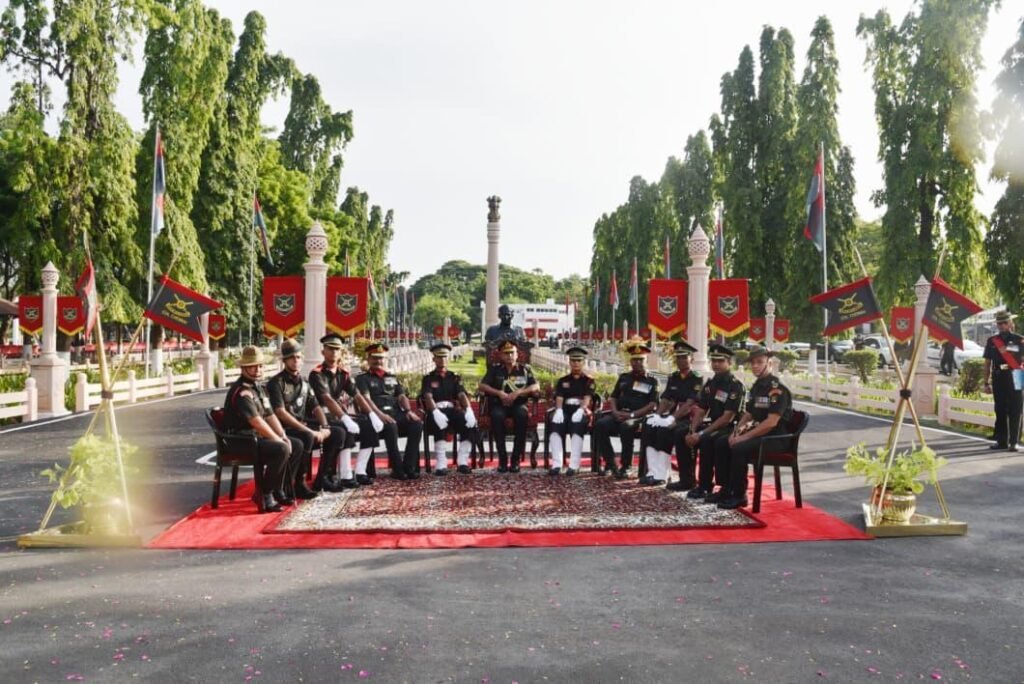
PASSING OUT PARADE OF OFFICERS TRAINING SCHOOL : CHENNAI 06 SEP 2025