All posts by webadmin

NZ: Wrong to say we opposed India’s bid Wants criterion fixed to let non-NPT states into club

KV Prasad & Simran Sodhi

Tribune News Service

New Delhi, June 26

New Zealand today said it would be wrong to say that it opposed India’s entry into the Nuclear Suppliers Group (NSG). Rather, it wanted a criterion to be fixed for the entry of non-NPT (Non-Proliferation Treaty) states into the NSG.  In an email response exclusively to The Tribune, a spokesperson of New Zealand’s Foreign Minister Murray McCully sought to set the record straight.India’s entry into the NSG was rejected by the plenary session of the NSG in Seoul. While India has blamed “one country”, meaning China, for blocking its bid to the NSG, it remains a fact that there were other countries (besides China) that had reservations on letting in a country that has not signed the NPT. Turkey, Brazil, Austria, Switzerland, along with New Zealand, had their reservations on the Indian application to become a member of the NSG.“It is quite wrong to describe New Zealand as opposed to India’s membership of the NSG. New Zealand has a long history of taking a principled stand against nuclear weapons and their proliferation. New Zealand believes that it is very important for NSG members to consider carefully what criteria should be used in assessing applications from non-NPT states. “This was New Zealand’s position at the NSG plenary meeting which just ended in Seoul. India is the first applicant for membership of the NSG which is not a member of the cornerstone Nuclear Non-Proliferation Treaty (NPT). All members of the NPT make legally binding commitments on nuclear disarmament and non-proliferation. We believe constructive discussions should lead to a pathway against which India’s application can be properly considered,” said a spokesperson in the office of McCully.President Pranab Mukherjee had recently visited New Zealand and it was reliably learnt that the President had raised the NSG issue with the New Zealand leadership. However, it seems India was not able to deal with the reservations expressed by New Zealand.


NSG may meet again

New Delhi, June 26

The Nuclear Suppliers Group, whose membership India failed to get two days back, is likely to meet again before the end of the year to specially discuss the process for allowing non-NPT signatories into the 48-nation grouping, thus providing another chance to India to press its claim.Sources said  that at the suggestion of Mexico, it has been decided that another meeting of NSG should be held before the end of the year to consider the criteria for allowing non-NPT signatories like India into the group. Normally, the next meeting of NSG would have been held sometime next year.Sources added that Mexico’s suggestion was opposed by China but found support from a large number of countries, including the US. A panel for informal consultations on India’s membership has also been set up by the NSG and it will be headed by Argentine Ambassador Rafael Grossi.Grossi’s appointment came even as a top US official said that the NSG session in Seoul had ended with a “path forward” for India’s acceptance as a member. — PTI


Top US diplomat to visit India to discuss bilateral issues

Top US diplomat to visit India to discuss bilateral issues
Of late, there have been enough bilateral parleys. PTI

Washington, June 25

A top American diplomat would visit India next week to discuss bilateral and global issues in support of the joint US-India efforts to sustain the rules-based global order, the State Department has said.Under Secretary of State for Political Affairs Thomas Shannon will visit New Delhi and Kolkata from June 28 to July 1, the State Department said on Friday.In addition to meeting his Indian counterparts, he will also meet with members of civil society, including representatives of various religious communities, it said.“While in New Delhi, the Under Secretary will meet with government leaders to discuss a range of bilateral and global issues in support of joint US-India efforts to sustain the rules-based global order,” the State Department said.He will visit the Indian Foreign Service Institute to deliver remarks and meet with Indian diplomats.In Kolkata, Shannon will meet with government officials and members of the US Consulate General.He will also chair a roundtable discussion with journalists at the American Center and visit several local cultural sites. PTI


China: ‘Large differences’ over having India in NSG

China: ‘Large differences’ over having India in NSG

BEIJING, June 12

China said on Sunday that more talks were needed to build a consensus on which countries can join the main group controlling access to sensitive nuclear technology, after a push by the United States to include India.China is seen as leading opposition to the US move to include India in the 48-nation Nuclear Suppliers Group (NSG), but even New Zealand, Turkey, South Africa and Austria oppose Indian membership, according to diplomats.The NSG aims to prevent the proliferation of nuclear weapons by restricting the sale of items that can be used to make those arms.India already enjoys most of the benefits of membership under a 2008 exemption to NSG rules granted to support its nuclear cooperation deal with Washington, even though India has developed atomic weapons and never signed the nuclear Non-Proliferation Treaty (NPT), the main global arms control pact.“Large differences” remain over the issue of non-NPT countries joining the NSG, Chinese Foreign Ministry spokesman Hong Lei said in an online statement.“With regard to what to do on the issue of non-NPT signatories joining (NSG), China consistently supports having ample discussion on this to seek consensus and agreement and come to a unanimous decision,” Hong said.“The NPT is the political and legal basis for the entire international non-proliferation system,” Hong said, adding that China would support the group in further talks to come to a consensus at an early date.Opponents argue that granting India membership would undermine efforts to prevent proliferation and also infuriate Pakistan.A decision on Indian membership is not expected before an NSG plenary meeting in Seoul on June 20, but diplomats have said Washington has been pressuring hold-outs. Most of the hold-outs oppose  admitting a non-NPT state such as India and argue that if it is to be admitted, it should be under criteria that apply equally to all states rather than under a “tailor-made” solution for a US ally. — Reuters‘Issue not taken up in Vienna’Beijing: China insisted that there “was no deliberation” on the bid by India and other nations at the Vienna meeting that took place last week. “There was no deliberation on any items related to the accession to the NSG by India or any other countries that are not signatories to the Treaty on the Non-Proliferation of Nuclear Weapons (NPT),” Chinese Foreign Ministry Spokesperson Hong Lei said.      He added that NSG Chair Argentine Ambassador Rafael Mariano Grossi convened an unofficial meeting of the 48-member group on June 9. However, diplomatic sources said earlier that India’s membership was discussed at the meeting and talks had remained inconclusive. PTIRelevance of Nuclear Suppliers GroupThe Nuclear Suppliers Group looks after critical issues relating to the nuclear sector and its members are allowed to trade in and export nuclear technology. The NSG works under the principle of unanimity and even one country’s vote against India will scuttle its bid.


India’s vision can’t be realised by bashing Beijing: Chinese media

India’s vision can’t be realised by bashing Beijing: Chinese media
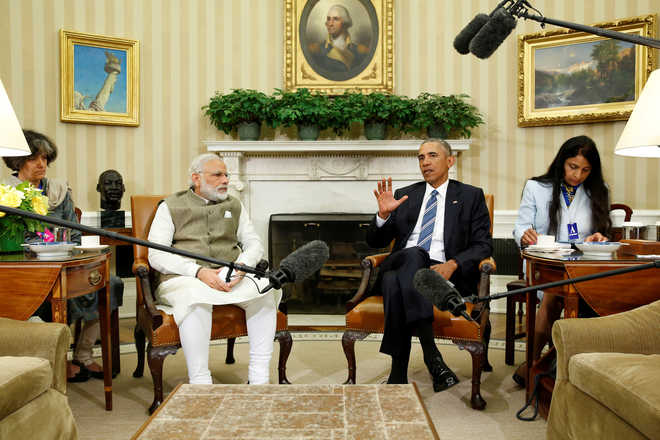
Prime Minister Narendra Modi and US President Barack Obama make remarks to reporters after their meeting in the Oval Office at the White House in Washington, US on June 7. Reuters photo

Beijing, June 8

India cannot rise by “containing” China or picking one side against the other, a Chinese state-run paper said on Wednesday, taking note of the Indo-US ties which are being ramped up to an “unprecedented level”.“Four visits to the US and seven meetings with President Barack Obama in two years–Indian Prime Minister Narendra Modi has ramped up the India-US relationship to an unprecedented level. How the two countries will engage with each other has raised heated discussions,” an op-ed article in state-run Global Times said.“Picking one side or camp against the other is not the way India will rise. New Delhi is looking into a multi-faceted diplomacy. The well-performing Indian economy will give incentives to the country to be more confident with multilateralism and to seek balanced international relations.“Although rivalling China in many aspects, India knows its great vision cannot be realised by bashing or containing China. Instead, they should expand cooperation, explore the potentials and build mutual trust for their own good. China is more of a help than a competitor for India. This will eventually constitute India’s fundamental understanding of China,” it said referring to Modi’s current visit to the US.With Modi’s visit, New Delhi hopes there will be breakthroughs in many aspects, especially business and trade, security cooperation and nuclear issues, the article titled ‘India’s vision cannot be realised by containing China’ said.“The transformation of the geopolitical landscape is the major driver drawing the US and India much closer.Washington’s rebalance to the Asia-Pacific makes the US realise India’s strategic significance, economic potential and ideological commonality,” it said.“India hopes that by consolidating its relationship with the US, it could gain leverage in development and forge an international status that is worthy of its potential. Modi has riveted his interactions with the US on this simple outlook to make India a veritable powerhouse. He was eager to boost a broader and better economic relationship with the US.“He urged the signing of the Logistics Exchange Memorandum of Agreement, a landmark deal promoting logistics and defence cooperation with the US and he also expects an endorsement from the US to help India become a member of the Nuclear Suppliers Group, the last step to solidify India’s status as a nuclear powerhouse,” the article said.As for Washington, it is always hoping that India could serve as its right hand to counterbalance China’s rise. But so far, Washington’s calculations do not work well. Turning down Washington’s invitation to join a patrol in the South China Sea, New Delhi has no intention to cast away its founding principles: independence and non-alignment, it said.“In the process of fulfilling its ambition to be a major power, India has always employed independent and pragmatic approaches. A balance between other major powers will be its primary and optimal choice,” the article added. PTI

Banjar valley a heaven in majestic Himalayas

Banjar valley a heaven in majestic Himalayas

Abhinav Vashisht

Kullu, June 6

For those looking for solace, the Banjar valley is the perfect destination. Be it domestic tourists or foreigners, all make a beeline for the picturesque place. Rivers, lakes, waterfalls, mountain ranges, evergreen forest, grasslands, historic buildings and temples are a major tourist attraction here.The Great Himalayan National Park (GHNP) was declared a world heritage site in June 2014 and since then new avenues have opened up for entrepreneurs associated with tourism industry in the Banjar valley.Scenic Jibhi village and Shoja valley attract a large number of foreign and domestic tourists. The villages have witnessed an increase in the number of guest houses over the years.Pilgrims throng the temple and the lake at Seolsar in large numbers.Davinder, managing director, Jibhi Inn, said the best part was that the area was unexplored unlike other hill stations. “A traveller gets to see a lot of new places here,” he said.The Banjar valley can be approached from the Chandigarh-Manali highway. It is the ideal destination for nature lovers and trekkers. Davinder said: “The valley is surrounded by pine trees and snow-covered majestic peaks. There are various trekking routes, small streams and old temples. Water bodies are popular for various games and fishing. Picturesque spots like Sarehul Lake, Chaini Fort, Sharingi Bagi Temple and Shringa Rishi Temple delight the visitors.” Having splendid mountain ranges and forests, Jibhi is the unexplored heaven in the heart of the Himalayas.

About Banjar valley

  • Banjar is situated at the height of 1,356 m (4515.48 feet) from the sea level
  • The place lies on the alternative route to Kullu from Shimla
  • The main route is via Bilaspur and Mandi. The alternative route goes from Theog, Aani, Jalori Pass, Banjar and joins the main route at Aut
  • The valley is in the middle Himalayan range. Going towards east, the peaksprogressively get taller, finally giving way to the great Himalayan range, wherethe peaks are as high as 4,500 m and above

Pak denies consular access to ‘spy’ Jadhav

Islamabad, June 4

Pakistan has denied consular access to Kulbhushan Jadhav arrested allegedly for spying and conducting subversive activities in Balochistan province and Karachi city of Pakistan.“After due consideration, it has been decided not to grant consular access to Jadhav,” Dawn online on Saturday quoted a top security source as saying. The reason behind the decision was cited as Jadhav’s involvement in “subversive activities” in Pakistan, the source said.Pakistani forces had arrested Jadhav from Balochistan province in March. It was said that the retired navy officer was “a serving officer in the Indian Navy and deputed to Research and Analysis Wing ”.The External Affairs Ministry said Jadhav worked in the Indian Navy and Gautam Bambawale, Indian High Commissioner in Islamabad, sought consular access to him. “The said individual has no link with the government since his premature retirement from Indian Navy. We have sought consular access to him,” MEA spokesman Vikas Swarup said. —


PEOPLE: TALKING POINT Downhill in Kashmir

Arun Joshi in Srinagar
The working groups formed in 2006 to address ‘internal’ and ‘external’ issues have been forgotten, their recommendations no one remembers. Meanwhile, violence wanes and waxes: it’s like walking one step forward and two steps back. The Tribune team goes on the trail of those 10 years since 2006.

Downhill in Kashmir

A car bomb exploded at Srinagar airport before then Prime Minister Manmohan Singh arrived to preside over the second roundtable on Kashmir on May 24, 2006. That was a loud and clear message for Delhi as well as the participants of the conference trying peace initiative.Fast forward to May 23, 2016: militants gunned down three policemen in the heart of the city, indicating nothing has changed apparently in the past 10 years as far the nature of violence is concerned. The graph has been undulating but the spirit of engineering violent events is very much alive. Psychologically, it is a downslide; the measures that were supposed to engage the people, translate their hopes into something tangible have not appeared on the horizon. Not that the promises failed to appear, but a feeling is deepening that what they have in hand is also being taken away. Over the years, many issues have formed the forceful narrative. These are: repeal, or at least review, of the special laws such as the Armed Forces Special Powers Act (AFSPA), and a draw-down of security forces, return of Kashmiri Pandit migrants, an amnesty and return of militants languishing in Pakistan and Pakistan occupied Kashmir to their homes in the state, economic improvement, a sense of empowerment and ownership with the return of the National Hydro-Electric Projects Corporation projects and an end to discrimination with Jammu and Ladakh regions.This is not a separatist or mainstream narrative. It is the people’s narrative. Though there is a contention on a few issues given the backdrop of the place to which the people belong, the fact is that the state needs a helping hand to be able to get out of the quagmire it finds itself in after militancy erupted in the late 1980s. The terrible past of the ’80s led to an onslaught on the relations among communities, resulting in mass migration of minorities and political leaders and massacres within the Valley and outside. Pakistan played a big role to mess up things in Kashmir. Pakistani establishment could succeed, because as late Chief Minister Mufti Mohammad Sayeed said: “A fertile ground was created in the Valley.” The stifling of space for the mainstream opposition gave wings to separatist forces: the Hurriyat Conference is a reincarnation of the Muslim United Front. The charges of rigged Assembly elections of 1987 and a ham-handed manner in which minor protests were dubbed as pro-Pakistan demonstrations presented Pakistan something on the platter.The Round Table Conference (RTC), a colonial-era idea, was sought to be revived because relations with Pakistan were improving. The better climate was visible following cessation of hostilities on borders, opening of the cross-LoC routes and a deepening yearning for peace. Manmohan Singh and Pakistan President Pervez Musharraf were moving forward towards normalizing ties through track-II.The basic idea of the RTCs – which started in February 2006   was to bring together all viewpoints to form some kind of a consensus on the road ahead. The separatists, as expected, boycotted. The Syed Ali Shah Geelani group said: “We had nothing to do with the exercise which doesn’t term Kashmir as a dispute.” The Mirwaiz faction that had held talks with Centre four times said: “It is an exercise for the mainstream Indian parties; we will participate if the RTC is for us (separatists) only.” That was it.The whole of Srinagar was locked down by the presence of Prime Minister Manmohan Singh as he announced five working groups aimed at tackling both “internal and external dimensions.” The working groups were to study the Centre-state relations with regard to the self-rule of PDP and address the demand for restoration of autonomy raised by the National Conference. The people hoped that India, by talking of “external” dimension, had accepted the reality that things would move vis-à-vis Pakistan. The PM left a day earlier than scheduled, cutting off his plan to have “shikara ride” on the Dal lake as the word reached him that it was a curfew for tourists and locals alike. He wanted to give a meaning to his words about genuine relief to the people. The working groups’ recommendations were lost in the bureaucratic wrangles. The “national interest first” mindset, countered by “Kashmir-on-the-top” and the resistance within the parties to the RTC have at the end of 10 years made them a forgotten chapter. The promises lost in the contesting narratives started a downhill journey for Kashmir. There is no break in sight.


Army pays tribute to braveheart

Tribune News Service

Srinagar, May 28

The Army today paid a befitting tribute with full military honours to Havildar Hangpan Dada, killed during an operation in the Nowgam sector of frontier Kupwara district on Friday.The homage was paid in a solemn ceremony at Badami Bagh Cantonment in Srinagar.A defence spokesman said the slain jawan led his team from the front and located a group of militants in the forward area of the Nowgam sector on May 26 morning, killing three militants.Laying a wreath to salute the slain soldier’s final journey, Lt Gen Satish Dua, Chinar Corps commander, said such exemplary acts always served as an inspiration for the serving generation.“This ultimate sacrifice in the line of duty will continue to motivate the Chinar Corps fraternally,” he said.The mortal remains of the soldier were taken to his native village for last rites.


Remove self-imposed terrorism hurdle: PM to Pak

short by Bhavika Bhuwalka / 10:22 am on 28 May 2016,Saturday
Prime Minister Narendra Modi has said that Pakistan needs to “remove the self-imposed obstacle of terrorism” to improve ties between the two countries. He said, “Pakistan’s failure to take effective action in punishing the perpetrators of terror attacks limits the forward progress in our ties.” Instead of fighting with each other, the countries should together fight against poverty, Modi added.
Path to peace is a two-way street: PM Modi tells Pakistan

“We are ready to take the first step, but the path to peace is a two-way street,” Modi said.

| Washington | Updated: May 28, 2016 12:15 am

narendra modi, Pakistan, Modi Pakistan, Modi Pak, Modi Pak terrorism, Modi WSJ interview, Modi WSJ storyPrime Minister Narendra ModiTelling Pakistan that the path to peace is a “two-way street”, Prime Minister Narendra Modi said Islamabad needs to remove the “self-imposed” obstacle of terrorism which is coming in the way of Indo-Pak friendship.
Modi also asked Pakistan to play its part by putting a complete stop to any kind of support to terrorism – “whether state or non-state”. “In my view, our ties can truly scale great heights once Pakistan removes the self-imposed obstacle of terrorism in the path of our relationship.

“We are ready to take the first step, but the path to peace is a two-way street,” Modi told The Wall Street Journal, in comments posted on its website today. He said he has always maintained that instead of fighting with each other, India and Pakistan should together fight against poverty.

-“Naturally we expect Pakistan to play its part,” he said. “But, there can be no compromise on terrorism. It can only be stopped if all support to terrorism, whether state or non-state, is completely stopped. “Pakistan’s failure to take effective action in punishing the perpetrators of terror attacks limits the forward progress in our ties,” said the Prime Minister. Modi said his government’s proactive agenda for a peaceful and prosperous neighbourhood began from the very first day of his government. “I have said that the future that I wish for India is the future that I dream for my neighbours. My visit to Lahore was a clear projection of this belief,” he said. Ruling out a change in India’s decades-old policy of non-alignment, Modi said that despite the border dispute, there have been no clashes with China, pointing out the “new way” in today’s “interdependent world” unlike the last century. “There is no reason to change India’s non-alignment policy that is a legacy and has been in place. But this is true that today, unlike before, India is not standing in a corner. It is the world’s largest democracy and fastest growing economy. “We are acutely conscious of our responsibilities both in the region and internationally,” he said. Modi’s significant comment on India’s Non-Aligned Movement (NAM), which many now also prefer to call as strategic autonomy, came in response to a question on China’s assertiveness. “The US is very keen on India, the rising power that India is, to be part of, if not an alliance, then at least a grouping that can stand up to some extent to China. Where do you see India taking a position on the global stage?” he was asked. “We don’t have any fighting with China today. We have a boundary dispute, but there is no tension or clashes. People-to-people contacts have increased. Trade has increased. Chinese investment in India has gone up. India’s investment in China has grown,” Modi said. “Despite the border dispute, there haven’t been any clashes. Not one bullet has been fired in 30 years,” he said. “So the general impression that exists, that’s not the reality.” Modi appeared to be appreciative of China’s Maritime Silk Road initiative. “We feel that the world needs to hear more from China on this initiative, especially its intent and objective,” he said. With a 7,500 kilometre-long coastline, India has a natural and immediate interest in the developments in the Indo-Pacific region, he said, adding that India has excellent relationships with the littoral states of the Indian Ocean. “India is a net security provider in the Indian Ocean region. We, therefore, watch very carefully any developments that have implications for peace and stability in this region,” he noted. Talking about India’s ties with the US, Modi said many of the values between the two countries match. “Our friendship has endured, be it a Republican government or a Democratic. It is true that Obama and I have a special friendship, a special wavelength,” he said ahead of his travel to the US next month – his fourth visit to the country after becoming the Prime Minister. “Beyond our bilateral relationship, whether it is global warming or terrorism, we have similar thoughts, so we work together. “But India doesn’t make its policies in reference to a third country. Nor should it,” Modi said. He said India and the US have enjoyed a warm relationship, regardless of whether America has a Republican or Democratic administration. “During the last two years, President Obama and I have led the momentum; we are capturing the true strength and scale of our strategic, political and economic opportunities, and people to people ties. Our ties have gone beyond the Beltway and beyond South Block,” he said. “Our concerns and threats overlap. We have a growing partnership to address common global challenges viz. terrorism, cyber security and global warming. We also have a robust and growing defence cooperation. Our aim to go beyond a buyer-seller relationship towards a strong investment and manufacturing partnership,” he added. Modi said unlike the last century, when the world was divided into two camps, this is not true anymore. “Today, the whole world is interdependent. “Even if you look at the relationship between China and the US, there are areas where they have substantial differences but there are also areas where they have worked closely. “That’s the new way,” he said. “If we want to ensure the success of this interdependent world, I think countries need to cooperate but at the same time we also need to ensure that there is a respect for international norms and international rules,” he said. –


Modi’s Kashmir score card: Do walk the talk

Arun Joshi
PM Narendra Modi had endorsed former PM Atal Bihari Vajpayee’s mantra of jambhooriyat, insaniyat and Kashmiriyat that had struck a chord in Kashmir. Two years on, the hype is yet to get translated into action.

Modi’s Kashmir score card:  Do walk the talk
Supporters of the ruling Bharatiya Janata Party (BJP) wear a mask depicting the Prime Minister during Prime Minister Narendra Modi”s first election campaign rally in Srinagar at the Sher-i-Kashmir Cricket stadium. Tribune Photo: Amin War

Kashmir is a difficult and challenging terrain for any Prime Minister of the country.  It builds personalities who seize opportunities and introduce appealing concepts of their respective brand of politics in a bold fashion— as did former Prime Minister Atal Behari Vajpayee who used the soil of Kashmir to extend a hand of friendship to Pakistan. It also is a graveyard of  many a reputation — Manmohan Singh who  started his innings with a commitment  to build a “naya” or New Kashmir but ended with no grand results to show at the end of his decade-long tenure as Prime Minister.  Prime Minister Narendra Modi had more than one opportunity to transform the political, psychological and economic landscape of all the three regions of the state, particularly the Valley, in the past two years. His biggest strength is  the massive electoral mandate  and the personality cult. Despite a mood of  trepidation  in  this  only Muslim majority state of the country there was also a hope that  he   might  chart a new course to  give a  real-time meaning to the three mantras of his illustrious predecessor   Vajpayee  who had envisioned  a solution through insaniyat (humanity), jambhooriyat (democracy) and  Kashmiriyat (a concept denoting the Valley’s composite culture)  way back in 2000. Modi reiterated his commitment to follow Vajpayee’s path in 2014, 2015 and 2016  to reach out to the people of Kashmir, but the  Valley is  waiting for these  pronouncements to be translated into action on the ground.  The wait is getting longer as there are no visible steps being taken by New Delhi to  know what is  wrong and how it can be rectified. Manmohan Singh pragmatically  acknowledged the “internal and external  dimensions” of the issue. His attempt was reflected in the five working groups that he had constituted to determine  the extent of the problem  at various fronts and to find out ways and means to address those. Simultaneously, he had  opened channels of communication with Pakistan. As summed up by former Chief Minister Omar Abdullah in 2006, “There was a golden opportunity to resolve the K issue…” The internal situation in Pakistan  in 2007, following the dismissal of Chief Justice Iftikhar Choudhary followed by  26/11  halted the process.Prime Minister Modi’s opening  was  stunningly remarkable. The South-Asian neighbourhood  appeared on his foreign policy  horizon. Pakistani Prime Minister Nawaz Sharif was among the leaders who attended Modi’s swearing-in ceremony. That was a grand gesture and there was a rethink in some quarters in Jammu and Kashmir about the image and attitude of Modi toward Pakistan and what all he wanted to achieve by this approach.  A hope had sprung up for them.A conspicuous part of  Nawaz Sharif’s visit to Delhi was that Hurriyat leaders from Kashmir were neither invited, nor did they insist on talks with  the visiting Pakistan Prime Minister. Back home, Nawaz  Sharif had to face a lot of flak for this miss. But some Hurriyat leaders sensed a chance of success of a process between two countries and were willing to wait for their turn to express their viewpoint. Mirwaiz Umar Farooq  felt that  if the two countries could make progress on their own, the Kashmir issue could be resolved  with the involvement of leaders of Kashmir at some stage.  He has  been consistent in his belief that the process would lead to results and  expectation of instant results could damage the process. Kashmir is a decades-old issue and it cannot be resolved overnight.   Notwithstanding the Prime Minister’s endorsement of  the PDP-BJP government in the state, the PDP-BJP government is stuck in its own contradictions. Its  attempts  to regain lost paradise  are hobbled by the situation, scepticism and lack of adequate support on the ground. The PDP is unsure which side to tilt and the state’s BJP leadership is clueless about Kashmir because they have never stepped out of  their cocoons in Jammu.  And, the result is that the common Kashmiri feels distanced and hemmed in by the one-sided narrative in which either the idea of composite culture or the idea of India is missing. When Modi took over,  there existed a breathing space for the idea of India in the Valley and forces of peace were visible. Radicalism had started appearing on the scene, but there were strong voices upholding the traditional values of Kashmir. The way he started visiting Jammu and Kashmir and unfolded the economic initiatives  in the Railways, power and connectivity sectors,  generated the hope of  progress on the political front as well.  But doubts surfaced  after the Foreign-Secretary level talk were called off, following a meeting of the Hurriyat leaders with Pakistan High Commissioner Abdul Basit  in August, 2014. The fierce exchange of fire on borders, coupled with the rhetoric of the Assembly election campaign, despite the fact that there was no mention about the abrogation of Article 370 in the  BJP’s vision document, suspicion gained ground. The moment  the BJP as a political party  embarked on 44-plus mission Kashmir, the Muslims felt  as if a tempest was  about to hit their boat of identity. The BJP   was more keen on securing a political victory   than showcasing itself as Vajpayee’s party, announcements to that effect notwithstanding. In between, the Prime Minister had sounded a right note during the September 2014 floods,  when he  declared that the treasury of the Centre was open to provide relief to the marooned people in Jammu and Kashmir. But when things started moving at a snail’s pace in response to the state government’s plea for early release of the sum of money for the  relief and rehabilitation, all those who stoked doubts had a field day. The announcement of Rs 80,000 crore in November 2015 could not succeed in damage control. Today,  the alienation  in Kashmir is “more than 100 per cent,” quipped a young journalist in his twenties. This statement  or perception is enough  to  disturb the sleep. Hordes of villagers  thronging to  disrupt the Army’s operations against militants and thousands attending the funeral of  militants is a picture to which one cannot shut one’s eyes. Two years have not made a difference the way people of Jammu and Kashmir were expecting.  May be something really good happens in the third year.
ajoshi57@gmail.com