Sanjha Morcha

All posts by webadmin

IAF pilots get feel of Rafale fighter jets

Tribune News Service

New Delhi, September 3

Even as the Congress and the BJP carry with their slugfest over the Rafale fighter jet deal, Indian Air Force pilots are now getting a feel of the French Air Force-operated jets that are presently in India on transit visit of three days.

Three Rafale are now at the IAF base in Gwalior, Madhya Pradesh, where IAF pilots and their French counterparts will do “joint flying’. Gwalior is the base of Mirage 2000 jets, made by Dassault aviation, also the makers of Rafale. Last week, IAF pilots had a feel of the Rafale in Australia at a multi-nation exercise “Pitch Black”.

India’s own 36 Rafale start arriving only in September 2019. The Rafale jets in India are a part of the French Air Force organised mission ‘PEGASE’ in the Asia-Pacific region. One Atlas A-400M military transport aircraft, one C-135 re-fuelling aircraft and one Airbus A310 cargo aircraft are also in India.

The planes are returning back to France from a detachment in Australia. “This operational mission aims to reinforce France’s presence in this region of strategic interest”, said a statement of the French Embassy here. The French team is on a three-day stopover at the Air Force Stations in Gwalior and Agra


Indian Army is hiring engineering graduates, Rs 51,600​ to be paid as stipend

Untitled-3

The Indian Army has invited applications from unmarried men and women engineering graduates and also from widows of defence personnel for grant of Short Service Commission (SSC) in all arms/services. The course will commence in April 2019 at Officers Training Academy in Chennai.

Total number of vacancies: 191
Duration of course: 49 weeks
Cost of training: Government expense
Fixed stipend for cadet training: Rs 51,600

EDUCATIONAL QUALIFICATION
Candidates who have passed the requisite Engineering Degree course or are in the final year of Engineering Degree course are eligible to apply.
For widows of defence personnel:
(I) SSCW (Non Tech) (Non UPSC)- Graduation in any discipline.
(ii) SSCW (Tech)- BE/B Tech In any Engineering stream
AGE LIMIT 
For SSC (T)-52 Men and SSCW (T) 23 Women – 20 to 27 years
For widows of defence personnel- A maximum of 35 years

SELECTION PROCEDURE
Candidates will be shortlisted on the basis of the applications submitted. The shortlisted candidate will be intimated via email. Candidates will be put through two stage selection procedure at the SSB. Those who clear Stage I will go to Stage II. Duration of SSB interviews is five days. The candid ..
Read more at:
//economictimes.indiatimes.com/articleshow/65214129.cms?utm_source=contentofinterest&utm_medium=text&utm_campaign=cppst


Rain, lightning leave 16 dead, 12 hurt in UP Met dept issues warning for next two days

Rain, lightning leave 16 dead, 12 hurt in UP

Lucknow, September 2

As many as 16 people died and 12 were injured in rain-related incidents across Uttar Pradesh since Saturday, officials said on Sunday, with the meteorological department predicting rainfall throughout the state for the next two days.

Shahjahanpur bore the brunt of the weather’s onslaught on Saturday as six persons, including four children, were killed in incidents of lightning strike while seven were injured.

A statement by the office of the UP Relief Commissioner said on Sunday, “Six persons  lost their lives in Shahjahanpur while three died in Sitapur district of the state.”

“Two people died each in Auraiyya and Amethi. One person each died in Lakhimpur Khiri, Rae Bareli and Unnao. All the deaths took place yesterday,” it said.

Eighteen animals perished and 461 houses/huts were damaged, the statement said.

The meteorological department said widespread rain is predicted in eastern and western parts of the state on Monday and Tuesday.

District Magistrate Amrit Tripathi said some youngsters were grazing cattle in Shamsherpur village on Saturday when a sudden downpour forced them to take shelter under a tree where they were hit by lightning.

“Financial assistance of Rs 4 lakh is being made available to kin of the deceased,” he said. — PTI


IAF rescues 14 stranded in Lalitpur, Jhansi 

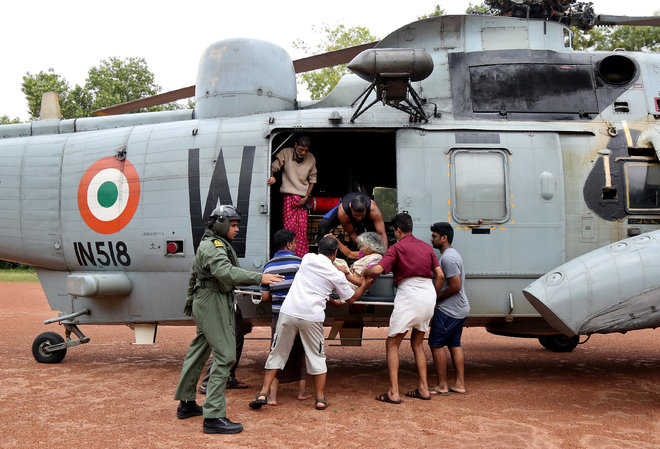
Lucknow: Air Force personnel on Sunday rescued 14 persons stranded in Lalitpur and Jhansi districts of Uttar Pradesh due to heavy rain, officials said. Six people were marooned in a village of Lalitpur while eight fishermen were stranded on an island near Erech dam on the Betwa in Garautha tehsil of Jhansi.


Ex-serviceman guns down wife Used his licensed gun for committing crime | Was facing some serious health problem

Nikhil Bhardwaj

Tribune News Service

Ludhiana July 22

An ex-serviceman allegedly killed his wife with his licensed double-barrel gun at Jassian village, Haibowal, on Sunday.The accused is reportedly suffering from some serious health issues, due to which he was under depression.After the neighbours heard the gun shot sound, they arrived to inquire and found that the woman was lying in a pool of blood. She was immediately rushed to the Civil Hospital, where she was declared dead by doctors.The deceased has been identified as Baljit Kaur (55), while her husband has been identified as Darshan Lal (60).The ex-serviceman did not escape after killing his wife and when the police arrived, he was taken in custody.ACP (West) Gurpreet Singh said Darshan Lal got voluntary retirement about four years ago. Due to some serious kidney problem, he was undergoing dialysis twice a week. He had four daughters and a son, who is the youngest among the siblings. Two of the daughters are married.On Sunday morning, he asked his wife to give him his gun, as he wanted to clean it. Initially, his wife did not agree to hand him over the gun on the pretext that he was facing serious health issues and he could not handle the same. After his insistence, his wife handed him over the gun and went to the kitchen to do household chores.“After cleaning his gun, Darshan went to the kitchen and aimed at his wife from close range. The bullet hit the woman and she fell down. The neighbours thought that some LPG cylinder had exploded at the ex-serviceman’s house. They immediately rushed inside the house to inquire and were stunned to see the woman lying in a pool of blood. They immediately took the woman to the hospital, but she was already dead,” the ACP said, adding that the accused was arrested and would be produced in court tomorrow.clip


IAF plans to fly AN-32 with blend of bio-fuel on R-Day

IAF plans to fly AN-32 with blend of bio-fuel on R-Day

Ajay Banerjee

Tribune News Service

New Delhi, August 19

In an effort to go ‘green’, the Indian Air Force intends to fly planes using a blend of bio-fuel with aviation turbine fuel (ATF).The plan is to fly AN-32 — a transport plane — over the Rajpath at the forthcoming Republic Day parade in January 2019, says the August 2018 ‘issue brief’ of the IAF-backed think-tank, the Centre for Air Power Studies (CAPS).The move could reduce the import bill of oil and in turn augment farm incomes in India, says Wing Commander Asheesh Srivastava, a research fellow at CAPS, in the ‘issue brief’ that has been put in public domain on the website of the CAPS.IAF Chief Air Chief Marshal BS Dhanoa while addressing an industry seminar on ‘Technology infusion and indigenisation plans of the IAF’ held last month spoke about the IAF’s effort in joining hands with various institutes for this purpose.The Air Chief has offered IAF’s aircraft and entire range of in-house testing facilities along with financial support to the project under the IAF’s indigenisation (R&D) fund.The fuel will need to be tested and validated using the expertise of the Indian Institute of Petroleum (IIP), Dehradun, Defence Research and Development Organisation’s Centre for Military Airworthiness & Certification and Directorate General of Aeronautical Quality Assurance.Once proven, the technology can be commercialised across the country to augment farmers’ income. Farm waste and few more forest products may soon have to be re-classified as ‘cash crops’ in lieu of ‘non-edible waste’ and could herald a new era in economics of the Indian aviation industry, which aligns with the Prime Minister Narendra Modi’s vision on biofuels, argues the CAPS paper.The IAF and Indian aviation industry would join the select group of nations who have flown military and commercial aircraft on indigenous bio-jet fuel.The ultimate aim is to fly fighter aircraft with bio-jet fuel just as the United States Air Force (USAF) did in 2010, the difference being that unlike the US case, the fuel would be sourced from non-food produce, harvested from non-agriculture land holdings.Bio-fuel planned to be produced in India is sourced from non-edible vegetable oil, therefore, negating the ‘Food vs Fuel’ debate.Going ‘green’ 

  • The Air Chief has offered IAF’s aircraft and entire range of in-house testing facilities along with financial support to the project under the IAF’s indigenisation (R&D) fund
  • Once proven, the technology can be commercialised across the country to augment farmers’ income.

These #KargilHeroes Are Indian Army’s Only 2 Serving Param Vir Chakra Awardees!

When a soldier decides to go beyond the call of duty on the battlefield, it is but a split second decision.

Such distinguished acts of valour are recognised by the Param Vir Chakra award of the Indian Army, and Subedar Yogendra Yadav and Naib Subedar Sanjay Kumar are the only serving awardees in the Indian Army.

Yadav was only 19 when he received the award. Serving the nation runs in Yadav’s blood—he is the son of a former soldier and was recruited to The Grenadiers, an infantry regiment of the Indian Army when he was only a 16-year-old.

Kumar was a 23-year old jawan, in the 13 JAK Rifles at the time of the Kargil war.

Both these soldiers displayed exemplary bravery in the face of seemingly insurmountable danger, and this is the story of the events as they unfolded amongst the snow-capped mountains and deep valleys.

It was the summer of 1999. Yadav had come home to Bulandshahr on May 5 for his wedding and returned on May 20 to join his battalion in Drass, where the soldiers were given a mission—capture the Tololing Peak, held by Pakistani intruders.

Subedar Major Yogendra Singh Yadav, who won the Param Vir Chakra for exemplary bravery in Kargil. Image Credit:Indian Defence Education

It was a brutal contest, and in 21 days, the Indian Army lost two officers, two junior commissioned officers and 21 jawans.

Speaking to the Hindustan Times, Yadav says that there was a certain eerie normalcy about death.

Enlisted with 18 Grenadiers, he was part of the ‘Ghatak’ commando platoon, tasked with attacking Pakistani posts from a steep, unused path. Yadav and his fellow soldiers climbed two nights and a day and reached the Pakistani post at the top of the hilltop.

“We had to use ropes to climb the final stretch. Even though we tried to climb soundlessly, some rocks slipped, and the enemy opened fire on us. Only seven of us made it to the top,” Yadav recounts to HT.

In the ensuing battle, the soldiers killed four Pakistani soldiers, and then holed up in their bunker. After enduring five hours of crossfire, the men decided to conserve their ammunition and wait.

The Pakistani soldiers took them for dead and were in for a shock when they came back to check. Yadav and the other soldiers opened fire and killed all enemy soldiers except one, who returned with reinforcements and attacked Yadav and his team.

Only Yadav survived, careful to play dead even as enemy soldiers kept pumping bullets into dead Indian soldiers, and discussed what they would do next.

While a bullet hit Yadav’s chest, it ricocheted after hitting coins in his wallet. He took that as a sign that he would live and be able to warn his comrades. Yadav, with 18 bullets in his body, and a bone jutting out of his left arm, lobbed a grenade at a departing soldier, who fled thinking the Indians had returned. Yadav took this chance to crawl down a nullah, to warn his platoon. He was later hospitalised and took 16 months to recover.

Naib Subedar Sanjay Kumar, a soldier in the 13th Battalion, Jammu and Kashmir Rifles, volunteered to be the leading scout of the attacking column whose mission was to capture Flat Top of Point 4875 in the Mushkoh Valley on 4 July.

Naib Subedar Sanjay Kumar who won the Param Vir Chakra, for his gallantry during the Kargil War. Photo Source
Naib Subedar Sanjay Kumar who won the Param Vir Chakra, for his gallantry during the Kargil War. Photo Source: Aditya Kalia

Kumar is a Himachali, and is used to climbing mountains. The team scaled the cliff, and was pinned down by machine gun fire, from an enemy bunker around 150 metres away.

Displaying unreal bravery, Kumar crawled up the ledge alone, along a flank and charged toward the enemy, facing a hail of automatic fire.

Without a care for his safety, he engaged the enemy in hand-to-hand combat, and killed three intruders, sustaining severe injuries, which he ignored and charged into the second bunker, shocking the enemy, who beat a hasty retreat.

Despite bleeding profusely, Kumar didn’t want to be evacuated, and that bolstered the courage of his comrades, who wrested the area of Flat Top from the enemy.


You may also like: Sher Shah of Kargil: The Story of Indian Army Legend, Captain Vikram Batra


The Kargil war ended up changing the lives of the two heroes forever. However, despite their immense courage and selflessness in the face of grave danger, they wear their bravery lightly, with Yadav saying that they did what “had to be done.”

(Edited by Gayatri Mishra)


Scholar Warrior: The South Asia Round-up power of interaction in effective leadership by Lt Gen Syed Ata Hasnain, PVSM, UYSM, AVSM, SM, VSM**(Retd)

One of the best recalls a veteran military leader can make is of his perception of the ways of different leaders with whom he served in his years in uniform. This is as much applicable to anyone who has shouldered responsibility and worked alongside various leaders in any profession. Usually we depend on case studies of iconic leaders to get a measure of leadership traits. However, while that is good we tend to ignore many of the traits found in the people we work with because our tendency is to pooh-pooh these as being of no academic value. Leadership is much better learnt through observation and experiences of the peer group in the same working environment.

What does dismay me is the fact that most leaders in India from different professions never bother to introspect to see whether the leadership they provide is appropriate or tweaking that is necessary for better effect. That is because as people rise in the hierarchy they tend to get more and more isolated from those who serve under them. One of the finest ways of feedback is direct interaction but that’s something most leaders shy from. Second-hand information fed to a leader through some system set up by him is going to give him the feedback he would love to receive. It will be idolatry and never realistic. What most senior leaders never realize is that the middle men would like nothing better than to keep them away from the rank and file because then their own power remains undiluted and the superior is yet dependent on them for information and feedback. Direct interaction also assists in explaining ideas which are against the grain of routine thinking especially when there is a need to make large scale changes in method of functioning and execution. There is nothing like a new idea being sold by the originator of the idea himself or his core group of advisers.

As a Unit Commander I recall that our corps commander was a tremendously dynamic personality. However, he never took information coming to him at face value. Instead of the usual one morning visit to a unit to get to place a face against a name as far as the Commanding Officer (CO) was concerned, he chose to visit a station for four days spending a full day each with infantry unit and a day with the brigade headquarters. He dined with the Junior Commissioned Officers (JCOs) at their messes, a tradition now slowly dying. I remember the JCOs felt empowered to speak their minds and he clarified many things they did not understand. He then had an exclusive session with all officers and it was not one involving just him speaking to the officers on issues under focus. His opening sentence was –“tell me what is troubling you”? The unfortunate thing which needs immediate correction is the habit of senior officers addressing officers on various issues of interest and never leaving time for free and frank interaction. Even if they do a general open house isn’t the most effective way of doing it. In the Services it is always good to take small groups and have a more intimate discussion with them. An event with middle rank commanders, one with junior officers and one with troops is ideal.

My contact with the corporate world reveals to me that direct interaction is something most senior corporate leaders never resort to. A good ‘eye to eye’ kind of program is not usually their forte. However, wherever they do so the environment in the organization is altogether different.  Promotion of self-interest is a human tendency and when feedback is left to the interim leadership it may not always be for the organizational good. That is one of the prime reasons why senior leaders must be often seen by the rank and file to inspire more trust and confidence so that feedback sessions become more realistic.

From experience I can recall my experiment while in command both as a Division and Corps commander. Usually every other night after 1 AM I interacted with a few LoC posts and Rashtriya Rifles units in the hinterland; many times, logistics units were included within the scope of this interaction. At the outset there was tremendous apprehension lower down when the calls were made and many an Officer, JCO or Jawan requested the signal exchange for more time to be ready to speak. However, it was important for me to set the right note of positivity so in none of the initial interactions was anything professional discussed; it was all about welfare, leave, state of accommodation, clothing, rations ad the quantum of rest being received in the tense environment. Two things were achieved with this slow ice breaking. First, the officers and men lower-down knew that even as they were awake during majority of the nights so was their Corps Commander. Second, as time passed people realized that they were not being admonished nor was the call for the sake of any negative communication. Feedback conveyed that people started eagerly awaiting the chance to speak to the Corps Commander.  That is when I started to make this more professional. Inquiries made to officers were to determine whether a piece of intelligence available to me had also been passed down to them in time to enable them to act upon it. That ensured that dissemination of intelligence by staff was done by the fastest possible means instead of leaving it to the conventional ways by which it reached the required recipient after the event. When avalanche warnings were issued in winter this form of interaction was effective to determine whether the people in the path of potential avalanches were aware and had taken effective measures against them. My belief in the system was reinforced when on many an occasion I discovered that a piece of crucial information had not reached someone who was to act upon it.

There may be some apprehension that direct interaction is a form of interference with and infringement of the command channels and for a senior commander to speak to officers or troops at lower levels belies trust in the interim appointments. There is no doubt that command channels are sacrosanct in the armed forces with laid down responsibilities. However, that does not place communication with lower ranks in strait jackets. Officer leaders have to understand how much and how far they must go in adopting this method without causing hostility. Where something contributes to organization effectiveness stepping a few levels down to interact only enhances confidence and trust.

As earlier brought out when a new idea or doctrine is under test there is initial inertia and its effectiveness depends largely on its enthusiastic acceptance by the environment. If the rank and file are unconvinced and the commanders in the chain are unable to sound convincing it is for senior commanders to step in and enhance the credibility of what is on trial. Here again there is nothing as effective as direct interaction. While attempting to execute the doctrine of balanced hard and soft power in the Valley and doubly ensuring the security of posts and troops at the LoC we adopted a system of speaking to all incoming units and troops under induction training at the Corps Battle School (CBS) every three weeks or so. With strength of almost 3000-4000 officers and men, issues of concern which would be passed down anyway through the command channel were conveyed with examples from experience in simple language. Each unit had a few points conveyed relevant to its future area of responsibility. Feedback was lesser at these events as the troops were as yet inexperienced in the environment and the necessity being of reinforced training with an attempt to imprint the threats and nuances of the operative environment directly into their minds. Officers could then find it easier to explain in the language of troops and the repetitions only helped in embedding what precautions were needed to be taken by them and how they could be more effective from the first day of their responsibility.

That brings me to the concept of ideating, a kind of brain storming though that may not be the best description. It is based on the belief that everyone with experience has some ideas to contribute. Ideating sessions should be conducted with a select group of functionaries from different levels all acting as representatives of their peer groups. Pre-ideating sessions contribute towards more refined ideas and must be restricted to one theme or stream of thinking. I experimented with this while in command at division and corps level having also experienced how the same were conducted in UK. Interestingly ideating sessions there comprised even a few people not even remotely concerned with the subject so that some innovative wild card ideas could also find their way into discussion. In each such session one or two rapporteurs were always present so that no idea of worth was ever missed. It was my dream that some Army Chief would consider it worth the while to conduct ideating sessions at the Army House with a group no larger than 20-25 comprising representation from each rank and as far as possible each Arm and Service. Flag officers must conduct these informal gatherings once in a quarter or so with the themes spelled out well before so that effective and meaningful discussion takes place. I found even training institutions in UK resorting to this.

Lastly, there are many complaints around the world from different armies that the quality of the officer cadres is diminishing because of the lack of deeper professional understanding, intellect and the resistance to innovative thinking. I may not entirely agree with that notion but there can be no getting away from the fact that the officer cadres of today need more intellectual orientation; they are reasonably well experienced on ground. It is not a bad idea to start from within house by provision of more literature by the Army Training Command. It is in this field that studies based upon leadership experience of officers at different ranks and even of JCOs and other ranks could be initiated.


Cadre review in Army under contemplation: Lt Gen Mathson

Our Correspondent

Jaipur, July 19

On the issue of changing the 200-year-old British-established military ranks’ nomenclature, the South Western Army Commander GOC-in-Chief Lt General Cherish Mathson on Thursday said there was a review going on and nothing has been decided yet though “we are all to offer our recommendations to the army”.”It is a process that has started, and as and when its decided, it will be promulgated in Army,” Mathson told media at high tea after inaugurating a two-day “Defence Correspondents Course” here. Asked about cadre review, especially of Colonel to Major General at the time of retirement, he said, “It is just a thought process at this moment. It is under a deliberation state. We are to offer our recommendations. Let it come to a shape.” Recently, in defence circles in Delhi, an Indian Army internal note said the minimum rank for officers at the time of retirement should be Major General. It has suggested the number of regular commissioned officers to be reduced, the rank of Brigadier be done away with while quicker promotions be given to all officers.On Army’s idea of abolishing cantonments mooted recently, the Commander said, “I do not think there would be any problem in it. Many areas in Nasirabad and Ambala have been exercised for the use of the civilians. I am very much in favour-that is what highest level has considered.”On stone-pelting incidents in Kashmir, Lt Gen Mathson said the forces could not reply to stone throwers and it is the civil administration and the government’s responsibility to control this. Though this has been brought under control now, he claimed.On enemy country’s social media warfare against India on borders, he said the younger generation has got an inclination toward such fake news, views or messages. “Very important thing is that we should all identify such fake news affecting us. We need to control it on social media too.”


Kargil war: Pak onslaught on fragile ecosystem

Arun Joshi

My thoughts were thrown back to the Kargil war of 1999 as I stood in front of War Memorial in Drass — the second coldest place in the world after Siberia that had borne the maximum brunt of the nearly two-month-long conflict. An officer of the Indian Army was narrating the tales of incredible valour of the soldiers who sacrificed their “today for our tomorrow”. The Indian Army had scripted a fresh chapter in mountain warfare. Tiger and Tololing hills bear a testimony to that.The Pakistan army had broken an “unwritten agreement” by intruding and capturing the abandoned 400 Indian posts during the winter of 1998-1999 covering a 150-km stretch overlooking critical portions of the Srinagar-Leh highway with the geostrategic objective of cutting off the Indian access to the Siachen glacier — reckoned as the highest battlefield of the world at a height ranging between18,000 feet and 21,000 feet.This is called treachery. But, what happened thereafter is a bigger treachery that Pakistan committed with humankind. The Indian Army was forced to set up a new corps — 14 Corps — and station its troops on the trans-Himalayan heights ranging from 14,000 feet to 18,000 feet. Pakistan also stationed its troops at the heights on their side after facing a humiliating defeat in its misadventure. With so much interference on the Himalayan heights where so many glaciers rested untouched became routes of all-terrain vehicles. The results are there for all to see. The glaciers have receded and the water flow has diminished in rivers.Had the Pakistan army not done what it did, the size and the glory of the glaciers would have stayed as they were in 1999. Pakistan is guilty of unleashing this disastrous situation. And, it sounds absurd when Pakistan leaders accuse India of choking the natural flow of waters to their side.The years since 1999 have taken a toll on the environment. This is a cause-and-effect phenomenon and the climate change worsened the situation. Thousands of toxic smoke-emitting vehicles on both sides of the Line of Control that divides Jammu and Kashmir between India and Pakistan carry arms, ammunition and ration by passing through a fragile ecosystem. Thousands of troops of India and Pakistan now remain stationed at the heights throughout winter. This situation of increased human interference with nature is the creation of Pakistan 19 years ago.Earlier, there was no such interference when nature would replenish the glaciers with heavy snowfall.Pakistan has a lot of explaining to do and also to tell the people of this state that why it undertook that misadventure that led to permanent interference with nature. What is happening on this side of the LoC is happening in Gilgit-Baltistan on the other side of the dividing line, too.The temperatures are unacceptably high. There is a danger of the temperatures going still higher.It is a scientifically proven fact that diesel vehicle emissions are unhealthy for the environment. Its soot and particles pollute the air and damage the forests. It is dreadful to imagine the damage the multiplication of such vehicles has caused to the fragile environment since 1999. It is continuing.All wars are bad, but what Pakistan did in 1999 inflicted environmental disaster on the generations to come. The glaciers are receding in these Himalayan heights, and the day is not far when the whole of Pakistan would curse the architects of the Kargil intrusion. Parched fields and shortage of drinking water have already become a reality.


J&K police tells Supreme Court AFSPA does not prohibit registration of an FIR against Army personnel

An Army officer, Major Aditya Kumar, was named in a complaint over the shooting of three civilians in Shopian in January.

J&K police tells Supreme Court AFSPA does not prohibit registration of an FIR against Army personnel

In an affidavit filed with the Supreme Court on Friday, the Jammu and Kashmir police defended the registration of a first information report against an Army unit over the deaths of three civilians in Army firing in South Kashmir’s Shopian district in January. It contradicted the stand taken earlier by the government of India.

During a hearing before the apex court in March, Attorney General KK Venugopal, appearing for the Union government, had said that under Section 7 of the Jammu and Kashmir Armed Forces (Special Powers) Act, no FIR can be lodged against Army personnel without the prior sanction of the Union government. The three-judge bench ordered a stay in the investigations, while noting that “Major Aditya is an Army officer and cannot be treated like ordinary criminals by the J&K police.”The Armed Forces (Special Powers) Act gives the military sweeping powers to search and arrest, and to open fire if they deem it necessary for “the maintenance of Public Order”, and to do so with a degree of immunity from prosecution.

In its affidavit, the Jammu and Kashmir Police pointed out that the Code of Criminal Procedure calls for the compulsory registration of FIRs in cases of cognisable offences. “No person-specific or class-specific exception is carved out in this principle to exclude any individual or class of persons against whom FIR should not be registered in a case where information of a cognisable offence is prima facie disclosed,” the affidavit said. “The concerned police officer is duty bound to register the FIR.”

Responding to allegations that the police was functioning under political pressure, the affidavit states that no material had been presented that could ascertain the police’s lack of fairness in the probe. “It is false and vehemently denied that the police agencies are influenced by extraneous agencies or political entities or were non functioning or that there was voluntary omission or inaction on part of any civil authority,” it said.

The Shopian shooting

On January 27, residents of Shopian’s Ganowpora village clashed with personnel of the Indian Army after the Army sought the removal of flags associated with the Islamic State from the house of a slain militant.The Army claimed it had opened fire in self-defence. Residents of the village, however, offered a different version of events. They claimed that stone pelting had broken out around 11 am that day, bringing soldiers from a nearby 44 Rashtriya Rifles camp to the spot, and that the soldiers had retreated soon afterwards. Later, residents claim, soldiers returned in greater numbers and resorted to firing from within Army vehicles, killing two civilians. A third man later died of his injuries in hospital.

An FIR filed by the police in January mentioned a Major Aditya Kumar as being head of the unit that opened fire on civilians. The FIR was initially registered under sections dealing with murder, attempt to murder and acts endangering life. After the Army responded with its version of events, the police added sections dealing with rioting with weapons, unlawful assembly, voluntarily causing grievous hurt, mischief causing damage to property, and punishment for attempting to commit offences punishable with imprisonment for life, or imprisonment.

The investigation was being conducted by a deputy superintendent of police in Shopian.

Kumar’s father, Karamveer Singh, moved the Supreme Court against the FIR, invoking the Armed Forces (Jammu and Kashmir) Special Powers Act. The police now “vehemently denies the unfounded and baseless apprehensions and allegations pleaded in the writ petition claiming that justice will not be done”. It said that Singh’s petition was devoid of merit and deserved to be dismissed.

‘Not a determination of guilt’

The affidavit states that the FIR did not arraign Kumar and that an investigation by the police “does not violate any fundamental right of any person, not even that of an accused, much less of a stranger to the investigation proceedings”.

The affidavit also points to observations made by the Supreme Court on Section 7 of the Armed Forces (Jammu and Kashmir) Special Powers Act in 2012, in the Pathribal fake encounter case. Drawing on that case, the affidavit stated that “even under the AFSPA, the Army Act or under any other law in force, there is no prohibition of registration of FIR against an army personnel or a requirement to seek a sanction prior to registration of a FIR against an army personnel”.

The police also defended its action by arguing: “The registration of FIR is not a determination of guilt against any party. It is merely the starting point of investigation to ascertain the true and correct facts relating to a cognisable offence and to ascertain whether a cognisable offence has actually been committed or not.”

It also argued that not investigating a charges of cognisable offence “would constitute a serious breach of the relevant statutory provisions” as well as violate the victims’ right to life under Article 21 of the Constitution.

Widening the debate

Also on Friday, a separate application filed in the Supreme Court by the Jammu and Kashmir government’s counsel, Shoeb Alam, seeks to make four North Eastern states where the Armed Forces Special Powers Act is in place “parties to the present proceedings”.

“As on date the Armed Forces Special Powers Act is applicable in the states of Assam, Nagaland, Manipur, Arunachal Pradesh, Meghalaya and Jammu & Kashmir,” the application said. “Reopening this settled issue and the re-examination of the 2012 Judgment will require the aforesaid states to be heard since the powers of the police in these states in regard to registration of FIR against army personnel involved in cognisable offences will be directly affected. The aforementioned states, thus are necessary parties to the present proceedings.”

It then proceeded to suggest that all states in India may be involved in the discussion, “since the powers of the police of all states in regard to registration of FIR against army personnel involved in cognisable offences may be directly affected”.
Support our journalism by subscrib