Indian women peacekeepers to leave Liberia


CHANDIGARH: India and France pledged on Sunday to step up cooperation for fighting terrorism against the backdrop of deadly attacks on both countries in recent months, as Prime Minister Narendra Modi and President Francois Hollande shared concerns over the global menace.
SANJEEV SHARMA/HTFrench President Francois Hollande with Prime Minister Narendra Modi at the Rock Garden in Chandigarh on Sunday.Indian and French companies signed 16 pacts, including an agreement between Airbus Group and Mahindra for manufacture of military helicopters and three MoUs under the “Smart City” theme, after the French President touched down in Chandigarh, a city designed by Swiss-French architect Le Corbusier.
Hollande, who will be the chief guest at the Republic Day celebrations in the Capital, said one of the main agendas of his three-day visit was to foster ties between Paris and New Delhi to tackle terrorism.
His comments came on the heels of a series of coordinated attacks in Paris last year claimed by the Islamic State, as well as a deadly terror strike at Punjab’s Pathankot airbase by Pakistani militants this month.
“I will talk about two (things): first, security, because we are affected by regional crisis and also terrorism. Both countries have been hit,” he said at a business summit in Chandigarh. “So, together we will increase our exchanges, cooperation between services and act to reinforce our military equipment. It is part of the agenda for this trip,” he added. “Following the success of the 2015 Paris climate conference in December, we are going to translate our common drive to implement as fast as possible the Paris agreement in launching here the solar alliance.”
Modi said he had invited Hollande as a show of solidarity after last year’s shootings and bombings by Islamic terrorists in Paris that killed 130 and evoked memories of the 26/11 Mumbai attacks of 2008.
“The day Paris was hit by terror, I decided that our Republic Day parade guest must be France as our people are united against the enemies of humanity,” the PM said in his speech, while he also lauded France’s decision to invest $1 billion every year in India in various sectors and underscored the country’s “business-friendly” profile.
Pakistan’s nuclear warheads which are estimated to be between 110-130 are aimed at deterring India from taking military action against it, a latest Congressional report has said.
The report also expressed concern that Islamabad’s “full spectrum deterrence” doctrine has increased risk of nuclear conflict between the two South Asian neighbours.
“Pakistan’s nuclear arsenal probably consists of approximately 110-130 nuclear warheads, although it could have more. Islamabad is producing fissile material, adding to related production facilities, deploying additional nuclear weapons, and new types of delivery vehicles,” Congressional Research Service (CRS) said in its latest report.
In its 28-page report, the CRS noted that Pakistan’s nuclear arsenal is widely regarded as designed to dissuade India from taking military action against it, but Islamabad’s expansion of its nuclear arsenal, development of new types of nuclear weapons and adoption of a doctrine called “full spectrum deterrence” have led some observers to express concern about an increased risk of nuclear conflict between Pakistan and India, which also continues to expand its nuclear arsenal.
CRS is the independent research wing of the US Congress, which prepares periodic reports by eminent experts on a wide range of issues so as to help lawmakers take informed decisions.
Reports of CRS are not considered as an official view of the US Congress.
“Pakistan has in recent years taken a number of steps to increase international confidence in the security of its nuclear arsenal,” said the CRS report authored by Paul K Kerr and Mary Beth Nikitin.
Moreover, Pakistani and US officials argue that, since the 2004 revelations about a procurement network run by former Pakistani nuclear official A Q Khan, Islamabad has taken a number of steps to improve its nuclear security and to prevent further proliferation of nuclear-related technologies and materials, it said.
A number of important initiatives, such as strengthened export control laws, improved personnel security, and international nuclear security cooperation programmes, have improved Pakistan’s nuclear security, the CRS said.
“However, instability in Pakistan has called the extent and durability of these reforms into question. Some observers fear radical takeover of the Pakistani government or diversion of material or technology by personnel within Pakistan’s nuclear complex,” the CRS said.
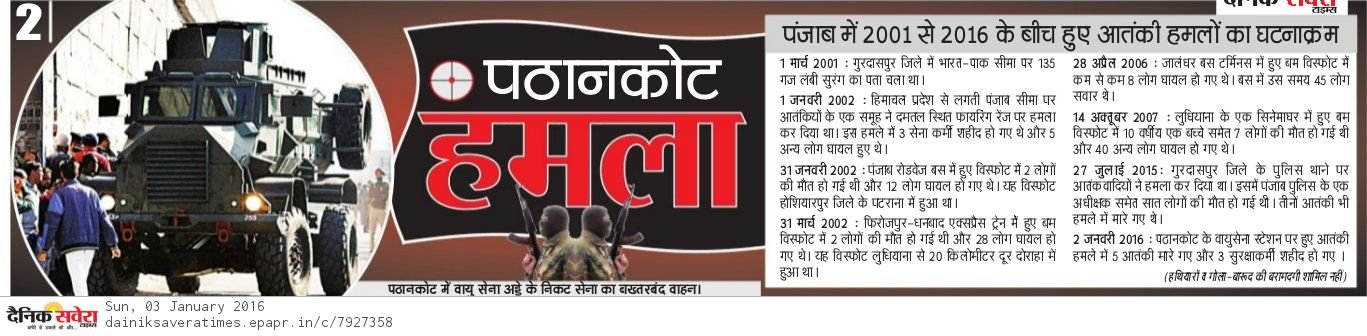
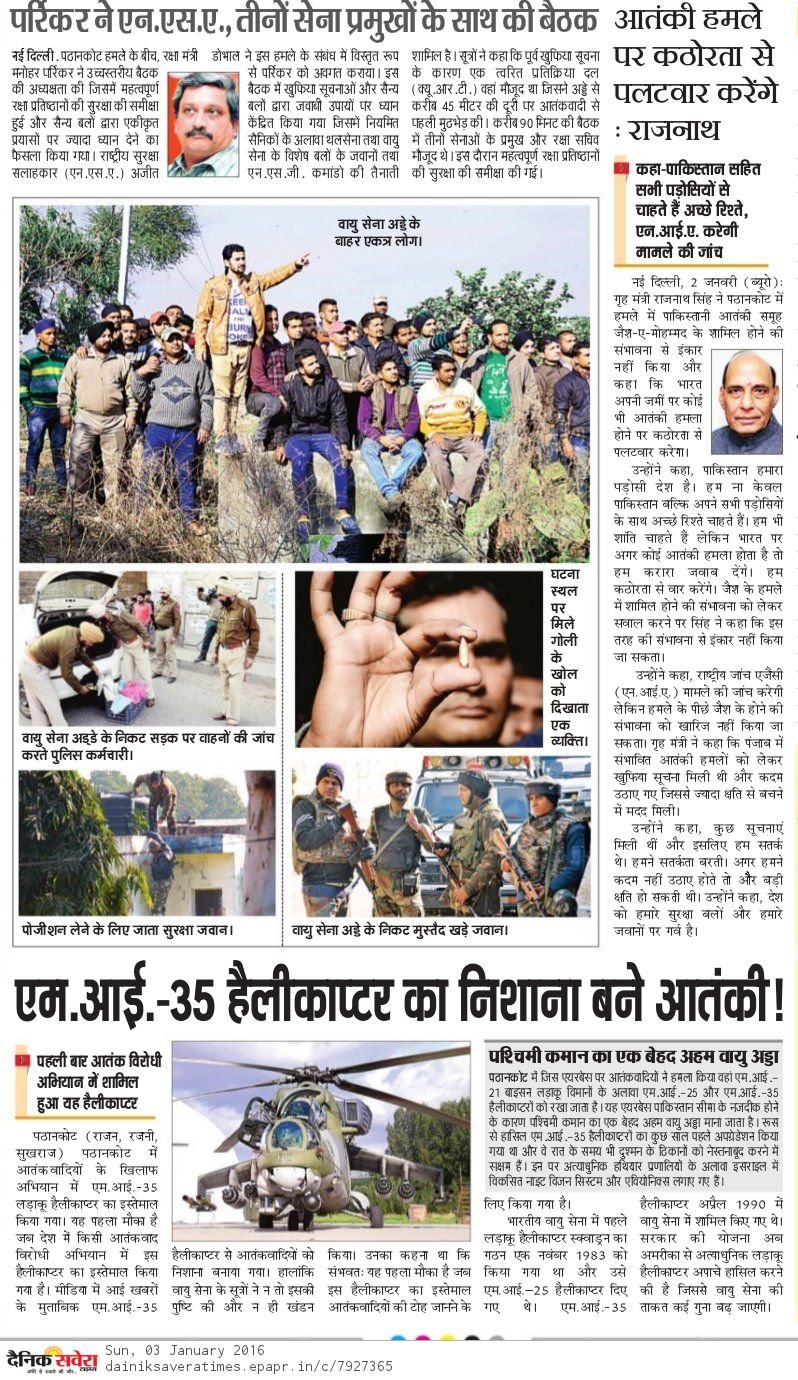
PATHANKOT: Indian security forces killed five Pakistani terrorists who launched a pre-dawn attack on Saturday on a strategic air force base in Punjab’s Pathankot district, setting off a fierce 15-hour operation that also left three security personnel dead and about a dozen injured.
AP PHOTOSoldiers on the rooftop of a building outside the air force base in Pathankot on Saturday.
The attack on the airbase, which is home to a large fleet of MiG-21 and MiG-25 fighter planes, was seen as an attempt to undo recent progress in India’s relationship with Pakistan. It came barely a week after Prime Minister Narendra Modi made an unannounced visit to Lahore to meet with his Pakistani counterpart Nawaz Sharif in a sign of possible thawing of relations between the two countries.
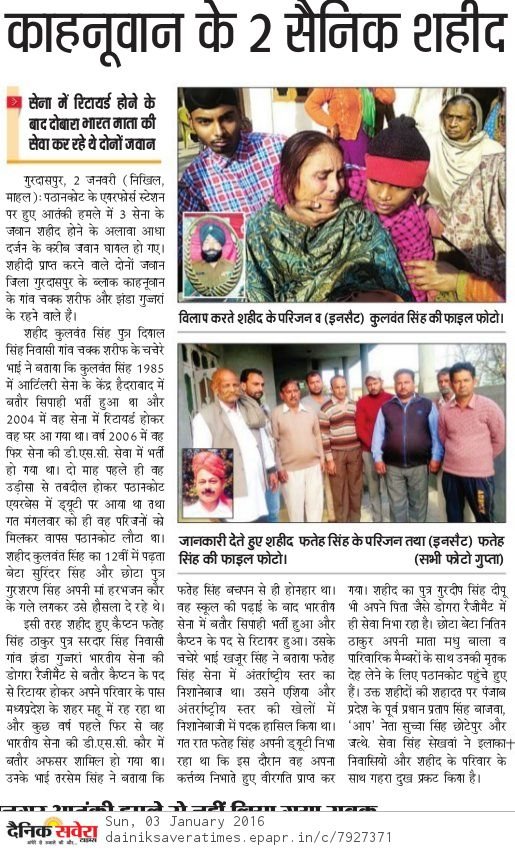
Two of the slain security personnel were from the Defence Security Corps, including Commonwealth championship gold medal-winning shooter Fateh Singh, besides an airman whose identity was not given.
“Enemies of humanity who can’t see India progress, such elements attacked in Pathankot but our security forces did not let them succeed,” Prime Minister Modi said in Mysuru.
Gunshots rocked the airbase around 3.30am on Saturday as a group of five men in army-style clothing — believed to be operatives of the Pakistan-based terror group Jaish-e-Mohammed — launched the daring operation less than 24 hours after an alert was sounded in the state over the abduction of Gurdaspur superintendent of police (SP) Salwinder Singh by suspected Pakistani terrorists.
Elite National Security Guard (NSG) commandos, army personnel and a SWAT team of the Punjab Police were rushed to the area following the abduction and assault on Salwinder and the interception of mobile phone calls made by the terrorists to their Pakistan-based handlers.
“From the moment the terrorists’ presence was confirmed on Friday, Punjab Police and central security agencies worked in tandem and rapidly mobilised all resources in real time. That’s what accounted for the success of the operation,” said Suresh Arora, Punjab director general of police (DGP).
Sources said 168 NSG commandos led by Major General Dushyant Singh were flown in from Delhi on Friday night.
Though the terrorists still managed to storm the base, they were unable to penetrate the area where the fighter aircraft, helicopters and other military equipment were kept, said IAF spokeswoman Rochelle D’Silva. The entire area turned into a virtual war zone as gunshots rang continuously while helicopter gunships provided air cover in an operation closely monitored by national security adviser Ajit Doval.
Doval also attended a meeting later in the day with defence minister Manohar Parrikar who cut short his stay in Goa and returned to Delhi following the attack. The meeting was also attended by the three service chiefs.
Although police initially said the gunbattle ended by 8am, shots and explosions could be heard from inside the base until noon. At least one helicopter could be seen firing at an area inside the facility.
The bodies of four attackers were recovered from the scene while the body of a fifth was recovered in the evening outside the base, where security forces had launched a massive search operation.
Though there were conflicting reports about the presence of a sixth gunman, home minister Rajnath Singh said five had been killed till search operations were called off for the day.
A defence source said the terrorists were from JeM, a group blamed for the December 2001 attack on Parliament that killed 11 people, and had probably infiltrated about three days ago. Pathankot — located at the trijunction of Punjab, Jammu and Kashmir and Himachal Pradesh — is on a highway that connects insurgency-hit J&K with the rest of the country.
The Indian Army Chief, General Dalbir Singh Suhag, has assured that soldiers will be provided with bulletproof jackets very soon. Speaking at an annual press conference in Delhi last week, he said that the process of procuring 1.86 lakh jackets has passed the technical trials. Currently the jackets are undergoing field trials.

There have been many setbacks in the entire process of purchasing these 1.86 lakh jackets since 2009, before the government issued a fresh proposal in 2012 and changed the qualitative requirements. As the technical trials have been cleared now, there isn’t much that can hamper the remaining procedure.
“In the field trials stage we just check the user comfort, weight etc. and no real technical issues. In case of bulletproof jackets, this stage is unlikely to create any bottleneck,” a senior Army official told The Economic Times.
Initially, 50,000 bulletproof jackets are being purchased as per the old qualitative guidelines to fulfil the urgent and essential requirements of soldier. These jackets are in the cost negotiation stage right now and will be available in a few months.
HANDIGARH: The Chandigarh Bench of Armed Forces Tribunal (AFT) has ordered to conduct reassessment medical board of 1971 war veteran who got injured in Pakistan bombing in the war.
Petitioner Bhag Singh, 72, resident of Mohali, joined the army in 1959 and participated in 1962 war, 1965 war and 1971 war. He was awarded nine medals during his service.
In 1971 war, he suffered injury due to bombing by Pakistan on the Wagah border of Punjab, when bomb shells pierced into his left thigh. He was moved to military hospital, Amritsar, where surgical operation was performed and the petitioner was downgraded to the lower medical category. He was discharged from service on medical grounds and was granted disability pension for two years, from August 1, 1974, to May 15, 1976, for 20% disability.
Bhag Singh was brought before the resurvey medical board in the year 1976, which declared the disability of the petitioner having improved to between 11 % to 14 %. As a result his disability element of pension was stopped.
Later, he developed pain and swelling in his left thigh in the year 1981 and remained under medical treatment for about six years when he was referred to Post Graduate Institute of Medical Education and Research (PGIMER), Chandigarh, by Command Hospital, Chandimandir. The PGIMER authorities extracted number of embedded bomb shell pieces from his thigh during the surgical operations in 1987.
Since then, he made a number of representations to the defence authorities for war injury pension, but in vain.
Bhim Sen Sehgal, chairman of All Indian Ex-servicemen Welfare Association (AIEWA), who appeared on behalf of Bhag Singh, said Bhag Singh had been fighting for over 40 years and now the AFT had given a ray of hope by ordering director general, Armed Forces Medical Services, New Delhi, to convene a reassessment medical board.


TNS & Agencies,New Delhi, December 29
A dismissed Air Force official, who allegedly shared secret information with intelligence operatives suspected to be backed by Pakistan’s ISI after being “honeytrapped” into an espionage racket, has been arrested from Bhatinda in Punjab by the Delhi Police.The accused, Ranjith KK, was produced before the court and remanded in four-day police custody for interrogation. He could be taken to Jaisalmer and Gwalior for further interrogation. Ranjith was a leading aircraft man with the IAF at Bhatinda. He was dismissed recently and arrested after a combined operation by the Delhi Police’s Crime Branch, Military Intelligence and Air Force Liaisoning Unit (LU), Joint Commissioner of Police (Crime) Ravindra Yadav said.Ranjith, a native of Malappuram district in Kerala, had joined the Indian Air Force in 2010. He has been booked under provisions of the Official Secrets Act, said the police.”With his arrest, the police have come across a honeytrapping module, backed by intelligence agents from across the border, which creates fictitious accounts (cyber entities) in popular social networking sites, pretending to be women, befriend defence personnel and officials from security forces and allegedly lure them into espionage,” a senior police official said.Ranjith was deceived by a cyber entity by the name Damini McNaught, who posed as an executive of UK- based news magazine. She interviewed Ranjith and then assigned him the task of getting the information. She deceived him by saying that the information would be published and he would get due monetary benefits for this, the Joint Commissioner said.
NEW DELHI: Pakistan’s intelligence agencies are using fake social media accounts with female names to befriend, lure and sometimes blackmail India’s defence personnel into committing espionage, Delhi Police told a city court on Tuesday.
The revelations came after the arrest of former leading aircraftsman KK Ranjith from Punjab’s Bathinda airforce base for allegedly sharing secret documents with Pakistani agencies.
“In May 2012, the LAC came in contact with Pakistan intelligence officer Damini McNaught who cultivated the air force man by luring him to work as a defence analyst for a UK-based magazine,” cops told the court.
They said the 24-year-old single man – who was arrested under the Official Secrets Act on Monday — also had another female handler named Alphonsine Davis. Cross-border spies fooled Ranjith by calling his mobile phone over the internet with the other party introducing herself – in a British accent – as McNaught and posing as an executive of a UK-based news magazine.
During the brief hearing, cops said Ranjith passed “sensitive information related to the Air Force and other vital defence information through Facebook and email to Damini and Alphonsine”. For this, he got `30,000 in total in two separate payments of `25,000 and`5,000 made on October 13 and 14, they alleged.
But he may not have been the only one to be trapped. “A few serving defence personnel are being pulled into the espionage network through these honey traps. Some fictitious Facebook accounts of women are being used for this,” joint commissioner of police (crime branch) Ravindra Yadav told IANS.
The court granted four days’ police custody and said Ranjith would be produced before the court concerned on January 2.