All posts by webadmin

Assam Rifles jawan killed in Manipur blast

Assam Rifles jawan killed in Manipur blast

Imphal, June 30

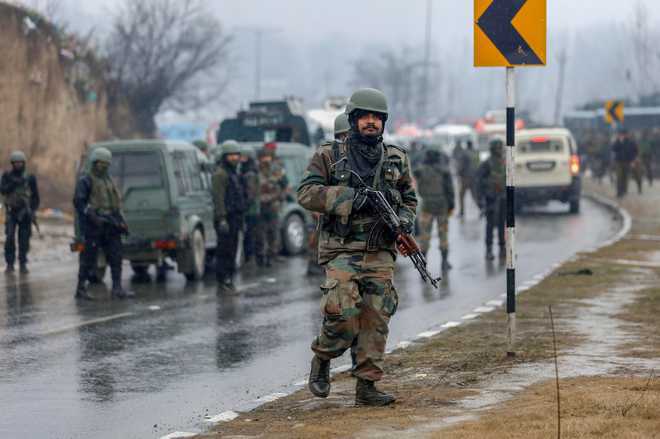
Militants triggered an IED blast at an Assam Rifles check-post in Manipur today, killing an Assam Rifles jawan and injuring two paramilitary men.The IED, planted at 27 Assam Rifles check-post at Ramva in Ukhrul district, exploded at 7.20 am.(Follow The Tribune on Facebook; and Twitter @thetribunechd)The slain jawan was identified as Rifleman Biju Sorupuwar from Lakhimpur district in Assam. Rifleman Yashpal and Havildar Nihar Ranjan Das were airlifted to Leimakhong Army Hospital.On June 15, an Assam Rifles jawan was killed in a blast in the same district. — PTI 


Panel to check misuse of defence land

Vijay Mohan

Tribune News Service

Chandigarh, May 17

In the backdrop of misuse of defence land and financial irregularities in the management leases consistently cropping up in various parliamentary and audit reports, the MoD has constituted a committee to study the optimum use of defence land for regulating its commercial exploitation.The committee, in an order issued earlier this month, has asked military establishments to furnish details of rent, licence fee, allied charges and other revenue generated from commercial establishments running on defence land for trend analysis.The ministry owns around 17.54 lakh acres throughout the country. The land is managed by the three Services as well as other organisations functioning under the ministry like the Defence Research and Development Organisation, Ordnance Factory Board etc. A small portion of land or buildings at military stations and cantonments is leased out to private parties for commercial activities like shopping centres for the benefit of local residents or for cultivation.The Public Accounts Committee of Parliament has observed that the aspect of commercial use of defence land, its misuse and non-crediting of income from land and properties into government account by local military authorities are repeatedly objected to, but no tangible action has been taken to rectify the situation.Commenting on the “dismal” state of management of leases, the committee pointed out that 2,500 acres, valuing Rs 7,11,033 crore, had been given on lease, but the annual rent was only Rs 2.31 crore, which was a pittance given the value of land. Moreover, in several thousand cases, either no visible efforts were made to renew the leases or requests for renewal were not received or the status of leases was unknown. Unabated encroachments on defence land also continued.“Despite instances of unsatisfactory management of defence estates being repeatedly highlighted in audit reports, there was no significant improvement. Cases relating to misuse of defence land by the local military authorities, unauthorised occupation of land by the ex-lessees due to non-renewal of lease in time and consequent loss of revenue continued to persist,” the Comptroller and Auditor General (CAG) had observed in one of its recent reports.

Committee’s brief

  • To study the optimum use of defence land for regulating its commercial exploitation
  • It has already sought details of rent, licence fee, allied charges and other revenue generated from commercial establishments running on defence land

India’s opposition can affect China-Pakistan Economic Corridor in short run: Chinese media

The construction of the USD 50 billion China-Pakistan Economic Corridor may be hit in the short run due to India’s objections but if Beijing and Islamabad are firm about their cooperation, they can dispel New Delhi’s doubts, a report in state-run Chinese media said.

India is protesting against the CPEC as it passes through the Pakistan-occupied Kashmir (PoK).

“Some people believe obstruction by India may become a stumbling block to the development of the China Pakistan Economic Corridor (CPEC),” an article in the official daily Global Times said.

In fact, India’s “rejection” is mainly because the corridor passes through Pakistan-occupied Kashmir. The corridor’s construction may be affected in the short term, but from a long-term perspective, China and Pakistan can dispel India’s doubt to the maximum degree if they are firm about their cooperation and actively interact with neighbouring countries, it said.

The article written by a researcher who worked in Pakistan said Chinese investments there could make profits.

“The return rate of the CPEC for China is generally higher than that in other countries. Pakistan is required to pay 17 per cent of the investment deposit for each project,” it said, providing rare details about the conditions laid down for Chinese investments in Pakistan.

“At present, China has invested in 51 projects in the CPEC, with 19 already complete. Pakistan has announced that the total investment has reached USD 50 billion. That number is based on projects that are currently running, and the final number will exceed it,” the article said.

In addition to the CPEC, China has invested in more than 200 projects in Pakistan. Its investment in the Hualong One Nuclear Power project near Karachi amounted to USD 6.5 billion, it said.

The investments mainly focus on energy and infrastructure, which are urgently needed for Pakistan’s economic development.

It also sought to dispel fear about Chinese workers’ safety in Pakistan after two Chinese were killed in Balochistan allegedly by the Islamic State militants.

“Many Chinese have serious concerns about the security environment and prospects of the CPEC after the recent kidnapping and alleged murder of their compatriots there,” the article said.

“But I found the misgivings were not necessary after carrying out on-the-spot research at Chinese and local enterprises in Pakistan, and visiting scholars and research fellows at various universities and think tanks,” it said.

Despite the recent tragedy, the overall security situation in Pakistan has improved, the article said.

“Attacks on Chinese people mainly occurred in Balochistan, where the security situation has been truly deteriorating,” it said.


Militants fire at Army patrol in Tral

Militants fire at Army patrol in Tral
Union Minister Prakash Javadekar

Tribune News Service

Srinagar, May 13

Militants attacked an Army patrol in the Tral area of south Kashmir’s Pulwama district this morning. No one was, however, injured in the firing.Sources said an Army party had gone to Seer Jageer village, some 40 km from Srinagar, for mapping the area when militants fired at it.“The fire was retaliated and the area was immediately cordoned off to track the militants,” police sources said. There was no contact with the militants during the search that followed. The operation was later called off.The militants, sources said, managed to escape from the area soon after firing at the Army patrol.The firing took place days after a young Kashmiri Army officer was killed by militants in neighbouring Shopian district. The Army officer was home on leave to attend the wedding of a relative.South Kashmir has witnessed a spurt in militant attacks this month.


Pak knows it cannot defeat India: JavadekarBengaluru: Union Minister Prakash Javadekar on Saturday said incidents like the attack on an Army patrol in Kashmir by terrorists were part of the tactics by Pakistan, which knew it could not fight and win a conventional war with India. “There are no two opinions. Pakistan knows that it cannot defeat India. They cannot fight a war against India and therefore what they are doing is, it is their strategy. But it will be defeated, even as they are isolated in the international forum,” he told reporters here. Javadekar was replying to a query on terrorists opening fire on a patrol party of the Army in Tral township of south Kashmir’s Pulwama district earlier in the day. PTI


Wife’s efforts yield result as J&K cop is home from Pak jail

Dinesh Manhotra

Tribune News Service

Jammu, June 22

The fiesty Sukhvinder Kour was for once at a loss for words when she got wind through the media that among the four Indian prisoners released by Pakistan today on humanitarian grounds was her husband.A constable in the Jammu and Kashmir Police, Sohan Lal Choudhary had inadvertently crossed over to Pakistan on May 11, 2014, while working in his fields on the International Border. His village Gulabgarh is a stone’s throw from the border near the Suchetgarh post.  (Follow The Tribune on Facebook; and Twitter @thetribunechd)“We have been eagerly awaiting this news for more than three years. I have no words to express my feelings,” Sukhvinder Kour said. Sohan Lal was taken into custody by the Pakistan Rangers and was shifted to Lahore Jail, where he was lodged till his release today.“As Sohan Lal was mentally disturbed during those days, he had mistakenly crossed the border three years back,” she recalled. Since then, it has been a persistent struggle for Sukhvinder to meet anyone who could be of help to get him back home, and to keep alive the issue. “We  approached all forums,” she said, adding that it was all due to the media’s constant pressure that the authorities worked assiduously to secure his release. “We met politicians, officials and senior BSF officers,” she said, expressing her gratitude to the Border Security Force for effectively taking up the issue with the Rangers.When Sohan Lal had crossed over to Pakistan, his younger daughter Mahima was in UKG and elder one Anjali in Class IV. Anjali, who’s now in Class VII, had written to PM  Narendra Modi and Union Home Minister Rajnath Singh for help in getting her father home. The other prisoners repatriated via the Attari-Wagah border were Suraj Ram, Mohammad Maqbool Lone and Abdul Majid.


Srinagar-Leh highway reopens

Srinagar-Leh highway reopens
An Army convoy passes through the Zojila Pass on Friday. Tribune Photo: Yawar Kabli

Tribune News Service

Srinagar, May 12

After remaining closed for over four months, the Srinagar-Leh national highway was thrown open to vehicular traffic here today.The 434-km-long highway serves an important link between the people of Ladakh and Kashmir and thousands of soldiers stationed in the Ladakh region. The highway traverses through the Himalayas at Zojila pass and then the Zanskar Mountain Range at Fatula to enter into Ladakh.“The challenge was to identify the road alignment when there was huge accumulation of snow,” an officer said.The highway was closed on January 3 and was open today by GOC of the Srinagar-based 15 Corps Lieutenant General JS Sandhu and GOC of the Leh-based 14 Corps Lt Gen PJS Pannu in Zojila. Lt Gen Sandhu complimented the Border Roads Organisation personnel for clearing the highway.


Dagshai school boy tops state in NDA exam

Dagshai school boy tops state in NDA exam
Sameer Sharma

Tribune News Service

Solan, June 19

Sameer Sharma has done the Army Public School, Dagshai, proud by securing the second position in the All-India rankings of the National Defence Academy (NDA) released by the UPSC recently. Sameer, who passed out from the school this year, cleared the NDA in his first attempt.He has also topped among all schools of the state and all Army Public Schools in the NDA. His performance in the Class XII board examination has also been excellent in which he scored 95.2 per cent marks to top the school and he scored a perfect 100 in physics and 98 in IP.The NDA entrance exam was held in September last year and nearly 5 lakh Class XII students had appeared in it.Son of JWO (IAF) Lalit Kumar Sharma, Sameer hails from Mohali. His mother Seema Sharma owns a saloon.He was enrolled in Class VIII of the school. He has won many accolades and prizes of proficiency during his stay. He was also adjudged the Best Student of the Year 2016-17.Principal SK Mishra while terming it as a proud moment for the school said the school had a special cell which not only encouraged students to appear in the NDA but also arranged special classes.Ravi Sharma, in-charge, NDA classes, said a sense of respect and admiration was imbued in the students so that they could join the armed forces.


A Modi show that wasn’t Sandeep Dikshit South Asia satellite — a case of too little, too late

A Modi show that wasn’t
NOT THE ONE: Chinese micro satellite startups seem to have an edge.

IDEALLY, Prime Minister Narendra Modi should have hoped that last week’s launch of the South Asia satellite had the trappings of the ceremony on May 26, 2014, in the forecourt of Rashtrapati Bhavan when, for the first time, most SAARC heads of government came for the swearing-in of an Indian Prime Minister. Contrary to the media buildup, the India-funded and built South Asian satellite might have come too late in the day. The neighbours, with no exception, are wary of South Block’s foreign policy currently supervised by a medley comprising dyed-in-the-wool diplomats, kin of high officials in the Modi government and nominated individuals from the RSS.On the technical side as well, the satellite has too few frills in its antennas to encourage the South Asian heads to once again head to Delhi for a joint photo session with Prime Minister Modi. The satellite’s limited technical specifications (equipped only with Ku band transponders that are good for videos and photos) are further weighed down by the absence of freedom to download whenever or whatever they want to because India is yet to put up satellite ground stations on their respective soils. This means the countries will have to request ISRO for specific images and video feeds. Or the participating countries must work out a sharing protocol with ISRO. This is much like their existing arrangements with commercial satellite companies offering similar services except that the partnership of South Asian countries with ISRO is free of cost but may bring bureaucratic red tape in its wake.The satellite is being touted as a Narendra Modi initiative. Facts tell a slightly different story. It began as a UPA project after the country’s external intelligence agency, Research and Analysis Wing (RAW), sounded a series of warnings in late 2012 about the inroads being made into the South Asian space segment by China. If anything, the UPA should be faulted for letting time slip by after the Joint Intelligence Committee weighed the issue in February 2013 and urged ISRO to accelerate its marketing and persuasion efforts. Chinese space companies have started setting up offices in Sri Lanka and Bangladesh, the two SAARC countries (besides Pakistan) that are likely to be big consumers of satellite services.Pundits have drawn attention to the geopolitical symbolism of this project in which Pakistan is the only sour note. In other words, they are indirectly admitting that the satellite might not be of much help to the SAARC countries. But its launch does display a unity of purpose in space that has eluded the South Asian neighbours on the ground despite Narendra Modi’s best efforts. India’s pan South Asia barrier-free road travel project first ran aground on Pakistan’s refusal to buy into it. Islamabad’s opposition inadvertently excluded another SAARC member, Afghanistan, from the project because all terrestrial links from India (as well as Bangladesh, Nepal and Bhutan) must go through Pakistan. When Narendra Modi tried to push through the truncated SAARC Motor Vehicles Agreement — renamed BBIN (Bangladesh, Bhutan, India and Nepal) — eternally-loyal Bhutan jumped the ship. Its Parliament refused to endorse the BBIN agreement on the grounds that unruly Indians with their badly maintained vehicles and poor driving skills will cause havoc and pollution on their serene roads. Another major country, Sri Lanka, will also have limited use of the South Asian satellite’s offerings because China has made substantial inroads and is well poised to be Colombo’s premier partner in the space segment. Bangladesh too is unwilling to be tied to the Indian coat-tail in cutting edge areas — nuclear plant, submarines, as also space.This leaves just Bhutan and Maldives who will substantially gain from the satellite but will be modest users. Even Afghanistan currently utilises an old Indian satellite with assistance from the French.Why hasn’t ISRO, which rewrote the world record for simultaneously launching the maximum number of satellites in one go and sent the cheapest-ever mission to Mars, unable to make breakthroughs like the Chinese companies? Is the much-vaunted ISRO expertise concentrated in a narrow segment? The reason may lie in the aftershocks of the Antrix-Devas affair. The latter is the marketing arm of ISRO and it has to pay heavy penalties to the private company Antrix for backing out of a joint venture. The government cancelled the Antrix-Devas contract after the Comptroller and Auditor General found a number of procedural violations. The controversy even claimed the scalp of the then ISRO chairman, Madhavan Nair.ISRO now stands in danger of losing its global preeminent position of being the most cost-effective launcher of micro satellites as Chinese start-up companies are already actively scouring the world for opportunities. ISRO is likely to be attractive only to customers who have security issues with Chinese companies. This means the Western block, and they too have existing tieups for the large satellites where ISRO still has no capability. The problem lies in the Modi government’s inability to come up with a revamped Satellite Communications Policy to replace the 20-year-old version that has licence-permit raj written all over it. Three years after it took power, there is no word whether the BJP government is interested in taking a look at the draft policy left behind by the UPA government. The Chinese are snapping at ISRO’s heels and data rates for satellite communication in India is many times costlier than the tariffs in the US. The time to bite the bullet may well pass India by.From a national security perspective too, India is yet to integrate different policies for space communication, security and remote sensing. The Prime Minister has often spoken of an integrated space in all aspects of policy making. The Joint Doctrine of the armed forces is an example of deeds following words. But it is easier for governments to make the armed forces do its bidding than breaking down walls between civilian departments.That is why South Block is still struggling with an integrated transport policy. But India cannot afford to allow its various users of space to work in silos when the worldwide trend is of integration. The neighbourhood policy is also in disarray. The accent on Hindutva might have made neighbours with a different religious disposition wary of their domestic audience perceiving them as being in too close an Indian embrace. What could have been an occasion to highlight pan-South Asianism has turned out to be a missed opportunity. 


Centenarian ex-serviceman felicitated

Centenarian ex-serviceman felicitated
Capt Jawala Singh Grewal, who turned 100 in April, being felicitated by Major-General Harvijay Singh, Directorate-General of Signals, Army Headquarters, Delhi, in Ludhiana on Sunday. Tribune photo

Tribune News Service

Ludhiana, June 18

Capt Jawala Singh Grewal, who celebrated his 100th birthday on April 1, was enrolled in the Army (Corps of Signals) on February 19, 1937, and he retired from service on April 1, 1972.To felicitate the centenarian, senior officer Major-General Harvijay Singh, Directorate-General of Signals, Army Headquarters, came from Delhi and presented him with a token amount of Rs 1 lakh on behalf of the Indian Army at a small ceremony organised at his residence at Punjab Mata Nagar, Pakhowal Road, in Ludhiana today.On the occasion, the local Army officers also interacted with him and he, in turn, recounted his days in the Army and gave advice on various issues. He expressed satisfaction on various facilities being made available to ex-serviceman and thanked everyone present for the felicitation.The Major-General assured the veteran and his family of all help from the Army and the Corps of Signals fraternity.


India, US officials discuss maritime security cooperation

India, US officials discuss maritime security cooperation
Last month, US Pacific Command Commander Admiral Harry Harris had emphasised on increasing cooperation in between the two countries in the maritime security area. File photo

Washington, May 11

Top Indian and American officials discussed ways to strengthen maritime security cooperation during the two-day India-US Maritime Security Dialogue in Rhode Island.

The officials also reviewed the implementation of the decisions taken at the first Maritime Security Dialogue between the two countries.

According to an official readout of the meeting that ended on Wednesday, “The two sides exchanged views on maritime developments in the Asia-Pacific and Indian Ocean Region and considered steps to further strengthen bilateral maritime security cooperation.”

The Indian delegation was led by Joint Secretary (disarmament and international security affairs) Pankaj Sharma while the American delegation was led by David Helvey, the Acting Assistant Secretary of Defence for Asian and Pacific Security Affairs.

The next round of the dialogues will take place in India.

Last month, US Pacific Command Commander Admiral Harry Harris had emphasised on increasing cooperation in between the two countries in the maritime security area. — PTI