All posts by webadmin

Army briefs Governor on border mgmt in Rajouri

Army briefs Governor on border mgmt  in Rajouri
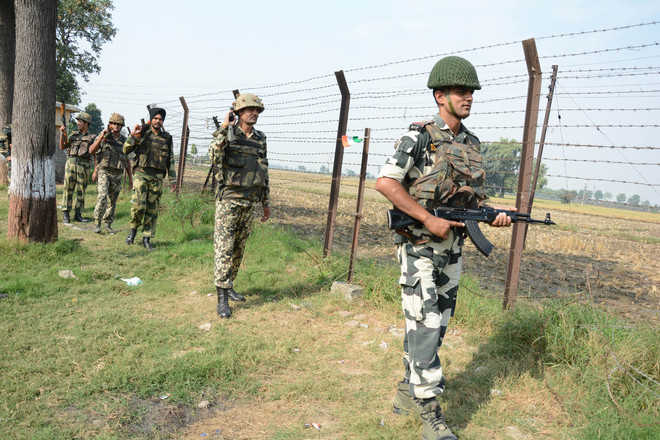
Governor NN Vohra in a forward area in Rajouri. Tribune Photo

Tribune News Service

Jammu, November 22

On a daylong visit to frontier areas of Rajouri district today, Governor NN Vohra received a comprehensive briefing from Maj Gen Suchindra, General Officer Commanding, 25 Division, about the management of the entire stretch of the Line of Control which comes in the area of responsibility of the Army formation.The Governor was also informed about the help which the Army provides to the people living in the border belt who undergo considerable suffering when the Pakistan army violates the ceasefire agreement and resorts to cross-border firing, which has been happening far too often this year.The Governor was also briefed by Shahid Iqbal, Deputy Commissioner, Rajouri, and his senior officials about the problems faced by the villagers along the LoC and the rescue, relief and rehabilitation support being provided by the district administration.The Governor advised the Deputy Commissioner to particularly ensure that the academic schedules of the schoolstudents were interrupted to the least possible extent.The Rajouri Deputy Commissioner also briefed the Governor about the shelter sheds being constructed for the safety of the locals in the villages which were being affected by Pakistan firing.The Governor spent a considerable time in an extensive discussion with Arvind Kumar Ishar, Director, Krishi Vigyan Kendra (KVK), Rajouri. They talked about the work done by the KVK to upgrade the activities in the agriculture and all allied sectors.The Governor asked the Deputy Commissioner to convene an early meeting with the Chief Agricultural Officer, all Block Development Officers, Rural Development Department staff, KVK Director and subject-matter specialists to review the entire agriculture sector. He said they should lay down clear targets for the establishment of integrated farming units, dairy farming, poultry farming, fish breeding, beekeeping, distribution of quality fruit plants and improved seed varieties. He told the DC to ensure that the existing wheat, paddy, maize, potato, fodder and vegetable seeds were replaced within a clear time frame by the best high-yielding seeds.The Governor observed that enough was not being collectively done by the Agriculture Department and the KVK to ensure rapid increase in production and productivity of all crops per hectare. He called upon the DC to take urgent charge of the crucial work.Review agricultural sector, officials told  The Governor asked the Deputy Commissioner to convene an early meeting with the Chief Agricultural Officer, all Block Development Officers, Rural Development Department staff, KVK Director and subject-matter specialists to review the entire agriculture sector. He said they should lay down clear targets for the establishment of integrated farming units, dairy farming, poultry farming, fish breeding, beekeeping, distribution of quality fruit plants and improved seed varieties.


Towards a good and simple tax by Mythili Bhusnurmath

There is need to take a break from tinkering with the GST rates. The focus, instead, should now be on the plumbing, ie on the processes and technology backbone — GSTN — even as we work to get the remaining sectors in the GST fold.

Towards a good and simple tax

Mythili Bhusnurmath

Senior consultant, National Council of Applied Economic Research Much  was expected from the Goods and Services Tax (GST) Council meet in Guwahati early November. In the event, it exceeded all expectations. Contrary to reports in the run-up to the meet, of fireworks between Opposition state finance ministers and the ruling NDA, the council demonstrated, for the 23rd time (!), its ability, and willingness, to come together to find common ground on admittedly complex issues. The sweeping rationalisation (read reduction) of rates and simplification of procedures is, no doubt, the biggest takeaway from the Guwahati meet. Yes, it is true that frequent tinkering reflects poorly on the tax regime introduced less than six months ago. But what is notable is that, as in past council meetings, all decisions were taken unanimously in the true spirit of ‘cooperative federalism’. This is no mean feat in a country as diverse as India. Not only are issues and challenges very different across states, there is also very little in common even on basic items of consumption, making agreement on rates and exemptions a Herculean task. The oft-quoted example here is of how coconut oil is an item of everyday consumption in Kerala but a cosmetic in most other states. If despite all these challenges, the GST Council was able to reduce rates on 211 items spread across all tax brackets, cut the rate on standalone restaurants from 28 to 5 per cent (without input tax credit), raise the threshold limit for the composition scheme to Rs 1.5 crore, extend the deadline for filing GST returns and simplify the filing process, it is a remarkable achievement. So, is it win-win for all concerned — the union and state governments, businesses and consumers? Not quite! Then, what are the sticking points? 

Flaws in GST

1. Exclusion of key sectorsOn the conceptual side, the biggest flaw is the exclusion of some key sectors, notably real estate, electricity and alcohol, from the GST regime. (Petroleum is also presently outside GST, but there is a provision to include it later). These sectors contribute about 37% of the tax revenue in most states, so keeping them outside the purview of GST takes away greatly from the GST’s USP of ‘one nation, one tax’ and related benefit of transparency and audit trail. The essence of GST is transparency and audit trail, which makes it is next to impossible for the ultimate beneficiaries to escape the tax net. In fact, it is the perfect antidote for the transgressions in the real estate sector, where a majority of the transactions escape the tax authorities’ radar. States, however, are reluctant to give up their taxing powers in respect of stamp duties levied on real estate transactions. Likewise, alcohol and tobacco are big cash cows for state governments; hence the reluctance to cede taxing powers. 2. Procedural & compliance issuesThe other major sticking points relate to procedural and compliance issues. Both are likely to ease now that the limit for the composition scheme has been raised to Rs 1.5 lakh and returns can be filed quarterly, instead of monthly. This will give both taxpayers and the IT backbone, the GST Network (GSTN), some respite. The GSTN has done a commendable job: since the rollout of GST on July 1, the portal has handled over 2.26 crore returns. But it has not proved equal to the gargantuan task of handling so many returns and in a very short period of time. The tendency of businesses to file returns at the very last minute compounds the problem. The net result is that despite the GSTN’s claim that the system is robust, taxpayers are far from happy. According to the vast majority, the GSTN system frequently stalls, with the result that it takes hours to file returns. With familiarity with computers being poor and net connectivity, even in the metros, patchy, chaos is inevitable. Online filing by close to 100 lakh businesses, many of which are filing returns for the first time, is bound to challenge the best of systems and GSTN.   3. Reverse charge mechanism issueThere are a couple of other niggling issues. Under GST, the buyer is required to pay tax on behalf of the supplier when he buys goods and services from unregistered dealers (known as reverse charge mechanism). This creates problems for small dealers since buyers are reluctant to pay when they are unable to claim input tax credit immediately. At the previous meeting of the Council, reverse charge provisions were deferred till March 31, 2018. However, as of now, the relief is only temporary potentially leaving small businesses at the mercy of large corporates post March 2018.

4. Invoice matching

Invoice matching (matching of individual invoices with returns) is another problematic area that needs to be addressed. Perhaps the Council could defer this till the GSTN stabilises so that reconciliation problems do not delay tax credits. E-way bills, meant to facilitate seamless inter-state transport of goods and eliminate corruption at border check posts, have been deferred for now; but given their centrality to facilitating quick and smooth movement of goods, must not fall prey to lobbying by unscrupulous elements.      Any tax reform as complex as GST is bound to be a work in progress, at least for the first few years. An ideal GST should cover all sectors and have few rates. But what we have is a partial GST, many rates, and worse, frequent tweaks. But does that weaken it to such an extent that it takes away from all that GST stands for: viz a simpler tax regime, broader tax base, no tax cascades, enhanced export competitiveness, greater regional equity, and, most importantly, greater transparency? No! Provided we allow rates to stabilise and focus on improving the plumbing, viz the processes and technology backbone, even as we work to get the remaining sectors into GST, we would still have a better system, warts and all, than earlier.


Two Assam Rifles jawans killed in Manipur ambush

Two Assam Rifles jawans killed in Manipur ambush
One AK-47 and two unexploded Improvised explosive devices (IEDs) were also recovered. ANI file

Chandel (Manipur), November 15

At least two Assam Rifles jawans and one militant were killed in an ongoing encounter in Chandel’s Sajik Tampak in Manipur.

(Follow The Tribune on Facebook; and Twitter @thetribunechd)

One AK-47 and two unexploded Improvised explosive devices (IEDs) were also recovered.

A search operation by 4 Assam Rifles (28 Sector) was launched earlier in the day, when armed militants ambushed the Regiment at Chamoli Top at around 05:30 am.

Firing is under way.

More details are awaited. — ANI


Why OROP is important for ex-servicemen BY Col Dabby S de Mello (Retd)

The concept was formulated after deliberations keeping all stakeholders in the loop. It was approved by both UPA- as well as NDA-dominated Parliaments.

Why OROP is important for ex-servicemen
Ex-servicemen protesting for OROP at Jantar Mantar, New Delhi, recently. PTI

Aquestion often asked: “Why One Rank One Pension (OROP) only for military retirees?” Before attempting an answer, it is important to know that the acronym OROP is not an entirely a correct definition of the issue. It should have been “Same Rank, Same Service Tenure, Same Pension” — SRSSTSP. Since it would have been quite a mouthful, the term OROP became common.OROP, the genesis

Maj-Gen Rajinder Singh ‘Sparrow’Shergill,  a Cavalry Officer, hero of Zojila and twice Mahavir Chakra awardee, after his retirement and, as a sitting MP in the early eighties, spoke thus in Parliament: “I have the honour to state that I retired from the army as a Maj-Gen and have two sons serving in the army. Assuming that they also retire as Maj-Gens and, after retirement, if they stayed under the same roof as I, the sons would be getting more pension than their father because the father retired earlier. What a dichotomy!” Mrs Indira Gandhi, then Prime Minister heard the General Officer with rapt attention and understood what he spoke. A sharp woman, she was immediately convinced in principle and realised the dilemma of Maj-Gen ‘Sparrow’, and that of all military retirees, needed holistic consideration/re-evaluation. The same day in 1983, she constituted a committee headed by KP Singhdeo, a Brigadier in Territorial Army and a sitting MP from Odisha, to examine the issue and suggest measures to bring parity in pensions of the past and future defence retirees, on a basic premise of natural justice, that no senior may be brought lower than his junior — a concept which is now understood as One Rank One Pension.The present government, in its pre-election gambit to woo ex-servicemen in 2013, promised to fulfill this long overdue and legitimate entitlement. However, in a display of bad faith, on November 7, 2015, the NDA government drove the last nail in the coffin by diluting and granting a falsely labeled OROP.Why OROP only for military retirees?Any organisation that has service conditions similar to that of the soldiers of the Defence Forces has a rightful case for OROP. The average soldier retires at young age of 35, just when his domestic responsibilities are waxing, and risks both his life and limbs as part of his duty and obligation to the nation. His fundamental rights are curtailed by the law, under sovereign guarantee that his needs will be cared for and therefore he has no institution to fall back to except the government. Unlike the police and every other organization in India, soldiers are prohibited from forming unions or associations to fight for justice. Not to mention the type of hard field service locations that he has to endure, and implications on his family, affecting financial life, and, looming early retirement. The latter is because the state requires a young and fit force, and because its pyramidal structure cannot absorb him, he is let go in the prime of his life. In a nutshell, OROP to the military retirees is meant basically to compensate for their mandatory early retirement.Why no OROP to other uniformed servicesRegarding no OROP to other uniformed services Central Armed Police Forces (CAPF) like BSF, CRPF, ITBPF etc, the answer is in the questionnaire: (a) Irrespective of their rank, they can serve up to 57 years unlike the military personal who are made to retire at 35 and upwards depending upon their rank. (b) The CAPF are assured minimum three promotions, but for defense forces, there is no such assurance. The service conditions of Defence Forces and CAPF too are different. The concept of “One Rank One Pension” was formulated after deliberations keeping all stakeholders in the loop. The concept was approved by two Parliaments, UPA- as well as NDA-led, but even after more than three years of the latter, it is yet to be implemented in its entirety.The government brazenly continues to deny the ex-servicemen (ESM) their due- their promised OROP, not realising that today’s soldier is tomorrow’s ESM and his morale is the nation’s biggest strength. It is neither statesmanship nor good governance and is not in the overall interest of the security of India. Why are faujis still protesting?If the NDA government loftily claims that OROP to military retirees has been granted, then why are faujis still protesting? It is because the government, in November 2015, arbitrarily altered the approved definition of OROP, equalised the pension of the past defense pensioners by giving them one time raise and maliciously termed it as OROP. The veterans felt let down at that sellout and decided to continue their peaceful protest from Jantar Mantar, asking the government for the approved and promised OROP in its entirety. Surely they are not foolish enough to continue to agitate if the actual OROP had been granted.The NDA government should well heed the warning: the defence fraternity of near five crore is a formidable electorate. Military veterans (many of them war-decorated), mostly in their twilight years, have been protesting peacefully from a footpath near Jantar Mantar for the past 28 months, asking the government to fulfill the promise of granting them correct OROP. The government continues to remain in denial mode. The exservicemen have no one to fall back to except their civilian brethren. Shouldn’t the people of the country sit up, lend their ears and peacefully be their voice too? For, didn’t these retired soldiers keep you all safe when they were young and in active service? 


Have Aadhaar? Book 12 Rly tickets a month online

New Delhi, November 3

The Railways has increased the monthly cap on tickets booked on the ICRTC portal from six to 12 for Aadhaar-verified passengers.The move, which came into effect on October 26, is believed to be an innovative way for the railways to encourage passengers to link their Aadhaar numbers to their online booking accounts on IRCTC. — PTI


Making arms in India Is the government missing the bus?

Making arms in India

IN yet another front-page news item on Tuesday, the country was informed about the government’s supposedly unrelenting drive to make defence equipment in India. We may revel over the dedication of the Kalams and the Natarajans to their craft, but the hard reality is that India remains bracketed with Saudi Arabia as the world’s leading importer of military hardware. Exhaustive reports by successive parliamentary committees have laid bare the cupboard of Indian R&D in military. Hence, the drive to somehow inveigle foreign defence manufacturers into setting up shop in India. The latest government initiative to promote domestic manufacturing of military hardware is to make the licences valid for lifetime and scrapping the system of renewal.This latest tweaking of rules is not a good advertisement for the government’s avowed intention of making the country a hub for defence manufacturing. A government with very little distractions that come from having a comfortable majority in the Lok Sabha should not be engaged in breaking down inter-ministerial silos in its third year in office. The same is the fate with making big ticket items like fighter planes, tanks and warships in the private sector. The musical chairs with the Defence Minister’s office contributed to delays in choosing companies that will partner global defence giants to make their equipment in India. But for a couple of exceptions, the “chosen” Indian partner is a novice in the complex field of defence manufacturing and may not encourage the foreign partner to test the waters for fear of being scalded.Inexplicably, the Modi government has dragged its feet on an overhaul of the existing public sector-heavy defence manufacturing industry. A company like Hindustan Aeronautics Limited should have been hived off into specialised units — helicopters, fighters, transporters, drones etc — and privatised. A foreign partner would have felt more comfortable joining hands with companies that have domain knowledge about defence manufacturing. The only success on the horizon is for making Russian helicopters in India. For the real high-end items, the government’s game plan of roping in friendly corporates with no past record of high-tech manufacturing will not yield quick results.


MAJ GEN SATBIR MUST LEARN FROM Gurdaspur Lok Sabha Elections , Message for Military Leadership?

medals

Its a high time Maj Gen Satbir to stop his Claim as  the only Messiah for OROP and State Govt King Maker during elections. He has forgotten that  majority of ESM from all over India Participated in the initial agitation to give it a concrete momentum along with contribution of  hard earned money  to make it a success but Maj Gen Satbir has no love lost for anyone except his own Balle Balle.  It was by default that Mr Natish became the CM of Bihar not any miracle done by Maj Gen Satbir Singh  as Claimed by him with his collar high.

He himself  w2as never  on a firm footing  to support which  Political Party.  A wavy mindset to chose AAP/BJP/Congress/Akali. Where does  he stand now with his Fauji Janta Party (FJP) as a creator and Patron of the same.  Where is he now for Gujarat and Himachal State elections and his followers. ESM came to  Jantar Mantar as all organisation of ESM big or small joined the agitation , and all weree efefcted ,its not Satbir Leadership or his personality which attracted ESM fro all over India . Maj Gen Satbir seeing donation coming in lakhs which  commutative in crores , he took the lead as usual and as per his personality traits and slowly and steady isolated himself from all other ESM organisations along with his ever green team and took over the central stage.

He has prolonged the agitation and stretched too far that non of the Govt agencies at any level including Top brass of Services  wants to discuss  any issue regarding OROP with him . He himself need to be blamed for his isolation and today he wants MahaRally of ESM  at Janatr Mantar on 29 Oct 2017.  Further he has damaged the cause of agitation by giving a  political angle to the whole agitation .He is now holding on to JM for sake of self pride as  he has no way to get out from Jantar Mantar Now, which will be his personal defeat..

In Punjab also he just came to Jallander in  Feb a month before elections  afyter his negotiations with APP and Akali’s failed he wanted to cash on Congress seeing the wave of public and ESM . At Rally and did not allow Capt Amarinder to speak to the ESM and convert the Jallander rally to Jantar Mantar  Slogans “ SADA HAQ ATHE RAKH”

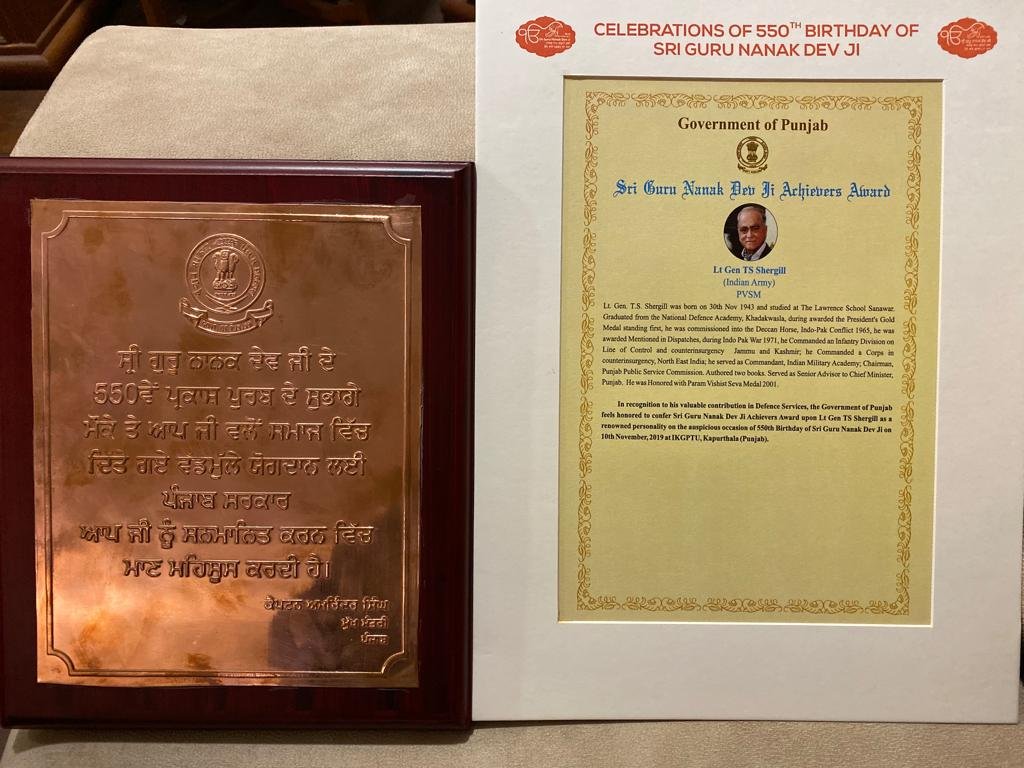
The latest fiddle was his  support APP candidate of his equivalent rank during Gurdaspur By Elections, totally overlooking the fact that now ESM know s what he wants . He wants A Rajiya sabha Seat , which is the only point he gave to Capt Amaninder Singh else or other 12 points had been included in the Congress manifesto handed over by Sanjha Morcha and discussed at length during a meeting with S.Manpreet Badal ,Lt Gen TS Sher Gill,Lt Gen Jasbir Singh Dhaliwal,Maj Gen SPS Grewal, Brig JS Jaswal,Brig Indermohan Singh,Col Bhag Singh,Col Ranjit Singh Boparai and Col Charanjit Singh. The points he gave were the repetition of Points after knowing what points Sanjha Morcha has given from its  Gen Secy.

Political fall out from Gurdaspur Lok Sabha polls , BJP and AAP can burn the midnight oil to find out cause/s of their dismal performance.
 What concerns is the OUTRIGHT rejection of TWO STAR MILITARY OFFICER supported by Maj Gen Satbir,Col SS Sohi,Col MS Bajwa,Col Rangi ,Brig Harwant Singh, Brig KS Khalon, in a constituency having nearly quarter million military personnel and their families as eligible voters.
Gurdaspur Lok Sabha constituency comprises of following nine Vidhan Sabha constituencies:-
·         Batala
·         Bhoa
·         Dera Baba Nanak
·         Dina Nagar
·         Fatehgarh Churian
·         Gurdaspur
·         Pathankot
·         Qadian
·         Sujanpur
During  official visit to Gurdaspur to attend the ex servicemen rally in 2004,the  percentage of families had a person in Military in every  village.  One of the  ESM  said “Sahab ye poncho ki kis gharan mein FAUJI UNIFORM nahi tangi hai”.
Without getting into the digital storm by quoting figures, it would suffice to mention that ex-servicemen and serving population in this constituency could be as high as quarter million (2.5 lakh) in 2017.
It was around 1.98 lakh in 2004. Figures quoted should be viewed with around 10% deviation either way.
What is astonishing about the election results is the skewed manner of voting without bringing political affiliations into the picture. Political candidate Sunil Jakhar (I call him a political candidate because he is son of Late Balram Jakhar) received nearly 63% of the votes polled (0.51 mn out of 0.83mn), Businessman candidate Swaran Singh received 38% of the votes polled (0.31 mn out of 0.83 mn). Military candidate (a Two Star Officer) received a mere 2.7% votes (23,579 out of 0.83 mn, losing his deposit) in a constituency ‘INFESTED’ with ex-servicemen (mostly soldiers) and their family.
Military Leadership must look at the result seriously. 
Is it a vote of ‘NO TRUST’ in Military leadership by the Soldiers?  so is the Case of Maj Gen Satbir Singh agitation stands and his support to APP candidate Stood.  ,
Serving military officers, perhaps, need to take note. Does an outright rejection of a TWO STAR officer convey something? who lost without a  grace.. Earlier Gen JJ Singh tried his luck at Patiala and result was both have landed up as “JAMANT JABHAT” Is there a need for self introspection by Senior Military Leadership?
and
Maj Gen Satbir trying to call Maha Rally at Janatar Mantar on 29 Oct 2017 must look within  himself /introspection how many ESM will  join him. He  own his own have isolated from the major ESM community except ESM from Arty/Gunners. God bless him in his efforts as he has no welfare plan for ESM or their families nor he ever visited any of the Martyr Families of JCO’ and OR’s or announced any momentary help from the crores he received in donations at Jantar Mantar in Cash and by Cheque and from abroad transferred in personal accounts as alleged by ESM fro abroad.
  Still time for Maj Gen Satbir to leave the Janatr Mantr Gracefully , to safe Guard his balance credit-ability as he will not be able to regain his lost Glory anymore.
  Last but not the least he should think off how to get the medals back from the Govt, approx 25000, belonging to ESM from all over India, BUT he is the last man to do it, as he got what he wanted terms of collection of donations in Crores.

DISCONTENT IN INDIAN ARMED FORCES by by Air Marshal R. S. Bedi (retd)

A few decades ago a senior former bureaucrat wrote in his book that it was not possible for the Armed Forces to stage a coup in India. The argument was simply based on the fact that Indian society was a complex body comprising different castes, religions, languages and ethnicities.
No General, however popular, could be sure of the total loyalty and backing of so diverse a force as the Indian Armed Forces. He was perhaps right. Despite this, the fear in the corridors of power continued to persist, for many a fledgling democracy was falling prey to ambitions of men in uniform. There lay the genesis of the process of downsizing and subordinating the Indian Armed Forces.
At present, the state of affairs in the Armed Forces is somewhat disturbing.
• The cumulative effect of years of neglect of the Armed Forces has begun to manifest. Today’s soldier is educated, conscious of his status and standing. His aspirations are growing with the fast-changing environment around him. This, perhaps, is the main reason for repeated incidents of indiscipline in the Army.
• The men were never so verbose and openly daring as they are now in expressing their dissatisfaction. The palpable resentment of the mass of the Armed Forces against the government doesn’t augur well for the future.
Year after year, the Armed Forces have been given a raw deal. They are downgraded with regular periodicity and denuded of power due to them. Enough has been said about their dwindling status. Even the paramilitary forces seem to be overtaking them in many respects.
• The bureaucracy has tightened its grip to the extent that orders from the highest in the government establishment are either diluted or not implemented in proper spirit.
Realising deep discontent in the Armed Forces in regard to the Sixth Pay Commission award, the Prime Minister ordered a high-powered committee to look into the Armed Forces’ grievances. The bureaucracy got away with impunity without delivering. The problem continues to simmer. There is mounting discontentment over the government’s inability to set things right. The political leadership that should, in fact, be the epicentre of power is gradually becoming ineffective.
The retired community, less shackled with rules and regulations, is far more verbose and has even resorted to rallies and dharnas to express their dissatisfaction. They surrendered their hard-earned medals to their Commander-in-Chief to protest against the step-motherly treatment meted out to them. The president showed scant regard for this desperate act of the soldiers.
• Surprisingly, even the paramilitary forces are better placed and better looked after by their Home Ministry than the Armed Forces by their Defence Ministry. In the case of the latter, the Services first struggle with their own ministry to get past it to secure government approval for anything that it needs. The reason not generally known for the paramilitary forces to be under the Home Ministry instead of the Defence Ministry in itself assures them somewhat better treatment.
• They don’t have to fight with their own ministry as do the Armed Forces.
The Armed Forces are not in any major decision-making loop, not even in regard to national security.
This is when the country is on the verge of completing its nuclear triad and acquiring strategic weapons. Presently, no uniformed personnel serve in the Ministry of Defence despite the recommendations made by various committees in the past to make decision-making more informed and rational. Many a committee, including the one on Kargil, has made such recommendations but none has been implemented by the all-powerful bureaucracy.
It’s a pity that despite the highly specialised staff available at the Services headquarters, the political establishment relies totally on the (inept self-serving) Ministry of Defence civil servants drawn from diverse backgrounds. Since the Services have a limited access to the political establishment, they are unable to make any worthwhile contribution to matters of national importance. The Chiefs can hardly meet the Prime Minister. Meeting the Defence Minister is not a routine affair either.
The plight of the soldier has not moved the conscience of the government.
He is taken for granted and tasked to perform what his civilian compatriots prefer not to do or perhaps consider it too dangerous to stake their lives.
• He is killed almost every day which is just a matter of statistics for the government. Only his family sheds tears for they will have to struggle for the rest of their lives; first with the bureaucracy to get what is due to them and then try to subsist with growing responsibilities and scarce resources. His status and emoluments are perhaps among the lowest in the government hierarchy. Yet he does not come out in the streets to protest.
• But now the discontentment is no more confined to whispers. It is getting louder by the day. Questions are asked but unfortunately the answers are not forthcoming. How long will the mandarins in the North and South Blocks ignore the writing on the wall?
The military leadership has been sounding the government at various levels but to no avail. In a rare display of political magnanimity, the Defence Minister wrote to the Prime Minister a couple of months ago with an implicit warning in regard to the deteriorating state of affairs in the Armed Forces. The Prime Minister acted ‘promptly’ and asked the bureaucracy, the same people who are largely responsible for creating the mess, to look into it.
The bureaucrats, as is their wont, refused to include representatives from the Armed Forces whose problems they are supposed to resolve. Obviously, one doesn’t expect much from them in the absence of their voice being heard directly. In the end, some cosmetic changes will be brought about, but the problem will linger on.
TODAY’S INDIAN ARMY IS NO MORE THE SAME AS IT WAS A DECADE AGO. TO TAKE THEM FOR GRANTED WITHOUT RESPONDING TO THEIR GENUINE NEEDS WOULD BE A SERIOUS MISTAKE.
• They are no more reticent and subdued. At least, three cases have been reported in the recent past of revolts against officers. It may be the tip of the iceberg. In any case, it is a reflection of deteriorating standards and morale of men in uniform. Whatever be the reasons for dissatisfaction—pay, pension, food, facilities or status—once the intensity of feelings reaches the critical stage, the consequences may be serious.
The naval mutiny in 1946 was led by signalman M. S. Khan and Telegraphist Madan Singh as a strike in protest against the general conditions of service, inadequate facilities and poor quality of food. The revolt spread fast throughout British India from Karachi to Calcutta and ultimately came to involve nearly 20,000 sailors on 78 ships and 20 shore establishments.
So was the 1857 Mutiny inspired by an ordinary soldier called Pandey in Meerut that soon escalated into other mutinies and civilian rebellions.
The Indian Air Force too was gradually sucked in the naval strike. And so was the Indian Army. The NCOs defied the orders from their British superiors. In Madras and Poona, the British garrison faced a revolt in the ranks of the Indian Army. In fact, widespread rioting took place from Calcutta to Karachi.
Even the British Air Force revolted against the conditions of service in January 1946. The mutiny began in Karachi and spread to 60 RAF stations in India, Ceylon and Singapore. Lord Wavel, then Viceroy of India, stated that the action of the British airmen inspired both Indian Navy and Air Force mutinies. Revolts and rebellions are not necessarily led by the officer class; in fact, often by men whose only concern is their conditions of service and welfare.
• • Today the discontent is far more pronounced than ever before. Whether it is the lackadaisical attitude of the government or a wilful decision is hard to say.
BUT IT WOULD BE A GROSS MISTAKE TO IGNORE THE WRITING ON THE WALL AND THE LESSONS OF HISTORY SO SOON.
Courtesy:Facebook Post By Col.Mahip Chadha.

Re 1/minute satphone calls for armed forces

Re 1/minute satphone calls for armed forces
No rental will be charged from security forces from Thursday. Tribune file

New Delhi, October 18

Telecom Minister Manoj Sinha today said paramilitary and armed forces would be able to make calls to their families using satellite phone at Re 1 per minute from tomorrow.The current call rate for most such connections was Rs 5 per minute, although some subsidised ones cost Re 1. “On the eve of Diwali, we are announcing that armed forces and paramilitary forces stationed in remote areas and tough terrains on borders will be able to make satellite phone calls at Re 1 per minute. This will enable them to talk to their families for longer duration,” Sinha said.(Follow The Tribune on Facebook; and Twitter @thetribunechd)The minister also announced that no rental would be charged from security forces from tomorrow. “At present, Rs 500 monthly rent is charged for satellite phone connections,” he said.Satellite phone service was earlier being provided by Tata Communications, but now it would be provided by the state-run telecom firm BSNL. The call charge was Re 1 in 2009-10 to begin with, to be revised every five years.At present, there are 2,500 satellite phone connections operational in the country. “We have a capacity of 5,000. We are informing the defence and home ministries that more connections can be given,” Sinha said. — PTI


Navy inducts its newest anti­submarine warship

SHINING ARMOUR INS Kiltan to strengthen force’s ability to detect, target hostile vessels

NEW DELHI: The Indian Navy inducted its newest anti-submarine warfare (ASW) corvette on Monday, boosting the force’s capability to detect and target hostile vessels and to provide protection to Indian warships.

Defence minister Nirmala Sitharaman commissioned the indigenously built INS Kiltan into the navy at the Naval Dockyard at Visakhapatnam in the presence of navy chief Admiral Sunil Lanba.

“INS Kiltan strengthens our defence system and will be a shining armour in our ‘Make in India’ programme as it is totally built here,” Sitharaman said on the occasion.

Kiltan is the latest indigenous warship after Shivalik class, Kolkata class and sister ships INS Kamorta and INS Kadmatt to have joined the Indian Navy’s arsenal wherein a plethora of weapons and sensors have been integrated to provide a Common Operational Picture (COP), an official release said.

It is the navy’s first major warship to have a superstructure of carbon fibre composite material imported from Sweden, resulting in improved stealth features and lower weight and maintenance costs. INS Kiltan is 100 tonnes lighter than the previous corvettes.

INS Kiltan is also the first major warship to have undertaken sea trials of all major weapons and sensors as a pilot project prior to delivery by the shipyard to Indian Navy. It is ready to be operationally deployed.

The ship, measuring 109 meters long and 14 meters at the beam, is propelled by four diesel engines to achieve speeds in excess of 25 knots and has an endurance of around 3,500 nautical miles.

INS Kiltan’s weapons include heavy weight torpedoes, ASW rockets, 76 mm caliber medium range gun and two multi-barrel 30 mm guns.

The ship gets its name from an island in the strategically located Lakshadweep and Minicoy islands.

(With agency inputs)