All posts by webadmin

Mann ki Baat on, to Pak

Sacrifice of our 18 jawans will not go in vain. We will isolate Pak in the world

One country in Asia is exporting terror everywhere, they want bloodshed

Terrorists should clearly hear out that India will never forget the Uri attack

Leaders of neighbouring country are reading out the script of terrorists

Our soldiers have defeated 17 attempts by fidayeen attackers sent by neighbour


Vibha Sharma

Tribune News Service

Kozhikode, September 24

After the Uri attack, India was anticipating a strong reaction from Prime Minister Narendra Modi against Pakistan. And they got it today here at the Calicut beach where he used the platform of the BJP National Council meeting to take on the neighbouring country.

He said Pakistan was “exporting terror” and India would never forget the sacrifices made by its 18 soldiers.

Labelling Pakistan a “haven of terrorism”, the PM also used the opportunity of a public rally here to “talk” to the people of Pakistan, warning them that their “hukmaran (rulers)” were misguiding them. This was an obvious dig at Pakistan Prime Minister Nawaz Sharif for his speech praising Burhan Wani at the UN General Assembly and his latest diatribe calling Uri a result of the “reaction” of people to the situation in Kashmir.

(Follow The Tribune on Facebook; and Twitter @thetribunechd)

Making a comparison between India, “a country of peace, unity and amity which has a bright future”, and Pakistan, “an exporter of terrorists”, the Prime Minister also sought to mark Pakistan in the neighbourhood as a country intent on keeping Asia “blood-soaked and backward”.

The smart balancing act saw him soothe frayed nerves of people demanding strong action against the troublesome neighbour. “The country will never forget the sacrifices made by the 18 bravehearts in Uri. There is anger in the country, let the terrorists know India will never forget the Uri incident,” he said.

And then, speaking directly to the “people of Pakistan”, perhaps a rare attempt by a world leader to engage with the people of another country, he said they should ask their “hukmaran” why when “India is exporting software, they (Pakistan) are exporting terrorists”. Striking a statesman-like posture, Modi said India was willing to go on a war with Pakistan but over social maladies like poverty, unemployment and illiteracy. “Let us wage a war and see who wins it,” he said.

The attempt evoked varied reactions. While many political observers dubbed this as an attempt to “incite” the people of Pakistan, others saw it a smart attempt to show India as one-up, which would also cater to its current circumstances.

As per Modi, the rulers of Pakistan were reading out speeches written by heads of terrorist organisations and “singing the Kashmir song but the day is not far when the people of Pakistan will wage a war against their own leaders”.

“Your leaders, trying to misguide you, talk of waging a war against India for 1,000 years. Let me tell you, the kind of government we have in India, we are ready,” he said.

In an apparent effort to address the criticism that his government has been unable to thwart terrorist incidents, Modi said as many as 17 attempts were made in the last few months to push in terrorists, and the security forces stationed at the border had foiled these, killing more than 110 terrorists.

“Our security forces have fought bravely and saved the country from 17 possible terrorist incidents. In one successful attempt of the neighbouring country, 18 brave men were martyred. If the 17 attempts would have been successful, they could have caused so much destruction,” he said.

Trying to answer questions raised about what action his government was taking, he said India would isolate Pakistan on the global stage. “We will force you to be alone in the world,” he said. Not just India, the entire world held Pakistan responsible for  being a haven of terrorism, he said.

Pak calls off key trade exhibitionIslamabad/New Delhi: Pakistan has cancelled a trade exhibition which was scheduled to be held next month in India, amid heightened tension between the two neighbours. The third edition of ‘Aalishaan Pakistan exhibition’ was scheduled to be held in October in New Delhi. The exhibition was meant to promote bilateral trade between the two countries. PTIIslamabad wants Bugti extraditedIslamabad: Pakistan is to contact Interpol to extradite Baloch leader Brahamdagh Bugti, who is seeking political asylum in India. “The Federal Investigation Agency will send a formal reference to Interpol within a few days for the extradition,” Interior Minister Chaudhry Nisar Ali said. His statement came after India said it was examining Bugti’s application for political asylum. The Baloch Republican Party chief visited the Indian consulate in Geneva to inquire about the process of seeking asylum. IANSQUOTESToday I am speaking to the people of Pakistan directly. Before 1947, your ancestors used to consider undivided India their land, worshipped it.  Please ask your leaders, you have PoK. You cannot manage it. Bangladesh used to be yours, you couldn’t manage it. You cannot manage Gilgit, Baltistan, Pakhtun, Balochistan, Sindh…  and you are talking about Kashmir. People of Pakistan must ask their leaders to first give secure lives to their citizens. Ask your leaders, both our countries got freedom together. Why does India export software and your country export terrorists? If you have what it takes, let’s compete to end poverty in our countries. — Prime Minister Narendra ModiUri could be ‘reaction’ to Kashmir situation: SharifUri attack can be the reaction of atrocities in Kashmir, as the relatives and near and dear ones of those killed and blinded were hurt  and outraged… how could India accuse us just hours after the Uri incident without any inquiry? —Nawaz Sharif, Pak PM

https://youtu.be/dPzn87UNks8

http://


Keep US close, Russia closer G Parthasarathy

Keep US close, Russia closer
Next level: The pace of India-US ties was set during the UPA regime.

DURING his recent visit to the US, Defence Minister Manohar Parrikar signed the LEMOA with his American counterpart, Ashton Carter. The memorandum outlined a framework for the provision of supplies like food, fuel and berthing for visiting naval ships and on overflight and landing facilities for military aircraft. The opposition Congress and the Left cried “foul” and accused the government of mortgaging the country’s sovereignty, the country’s policy of “non-alignment”, and even its “strategic autonomy”. This, despite the fact that the agreement contained provisions for providing such facilities, only on a case-by-case basis.The present agreement logically follows the remarkable transformation in India-US relations, during the presidency of George Bush, by the actions of the two UPA government stalwarts — Prime Minister Manmohan Singh and Mr Pranab Mukherjee. It was Mr Mukherjee, as defence minister, who signed a 10-year agreement in June 2005, titled “New Framework for the US India Defence Relationship (NDFR)”,  with his American counterpart, Donald Rumsfeld. This framework covered a wide range of activities, including collaboration in multinational operations, when such operations were found to be in “their common interest”. Such cooperation was envisaged in areas like terrorism and curbing nuclear weapons proliferation. There has been a substantial increase in military-to-military cooperation, arms acquisitions and joint exercises between the two militaries, since then. Negotiations, thereafter, continued for signing three framework agreements in defence cooperation, logistics, communications and information security and geospatial information.The most pathbreaking agreement that India has signed in this century came barely a month later, when PM Manmohan Singh and President Bush agreed that the US would end nuclear sanctions against India. They also agreed to persuade other nuclear suppliers to end global nuclear sanctions imposed on India after its nuclear test in 1974, by the establishment of the Nuclear Suppliers Group. President Bush stood by his word and even personally intervened with then Chinese President Hu Jintao to fall in line. In the meantime, in August 2008, Mr Mukherjee, then external affairs minister, signed an agreement with his counterpart, Condoleezza Rice, for the resumption of bilateral nuclear cooperation. The question, which remains, is whether India historically ever provided facilities for positioning foreign warships and aircraft on its soil?India has historically shaped its military cooperation with foreign powers, from the days of its first PM, Jawaharlal Nehru, based on geopolitical realities, and not ideology. Even before the Sino-Indian border conflict broke out in 1962, the CIA was permitted to position facilities along the border with China, to monitor Chinese nuclear tests. Panicking after the humiliation heaped on India in the 1962 conflict, a desperate Nehru wrote to President Kennedy, appealing him to deploy 12 squadrons of fighters and two squadrons of fighter bombers, together with radar cover, on Indian soil. The US was permitted to use a staging base in Charbatia, Odisha, for flying its U2 spy planes over China.  Strangely, our non-alignment was such in the 1950s that we fought shy of seeking defence equipment from the Soviet Union, despite signs of a growing Sino-Soviet rift!In less than a decade, thereafter, the geopolitical situation turned upside down, with Nixon and Mao embarking on a clandestine love affair, midwifed by Pakistan. This “love affair” came to light when Henry Kissinger flew secretly to China from Pakistan. Indira Gandhi had no hesitation in entering into a defence agreement with the Soviet Union to deal with the emerging US-China-Pakistan axis. The Soviet Union had proposed a bilateral treaty with India in 1969, when its defence minister Marshal Grechko visited India. The draft treaty proposed by the Soviets gathered dust for two years in South Block. It was spruced up once it became clear that a Sino-US-Pakistan axis was emerging to counter the Soviet Union and, incidentally, India also, even as the Pakistan army proceeded with its genocide in Bangladesh.Once this geopolitical reality was recognised in Moscow and New Delhi, DP Dhar was sent to Moscow to finalise the treaty in the first week of August 1971. Sardar Swaran Singh and Andrei Gromyko signed the treaty on August 21, 1971. Despite our claims of being “non-aligned”, there was a clear military provision in Article 9 of the Indo-Soviet Treaty. It read: “In the event of either party (India and the Soviet Union) being subjected to an attack or a threat thereof, the High Contracting Parties shall immediately enter into mutual consultations, in order to remove the threat and to take appropriate effective measures, to ensure peace and security of their countries.” I was then a young First Secretary in Moscow and took notes in meetings as events unfolded. When the conflict broke out in December 1971, the Soviets, though isolated, vetoed every effort by the US-China axis to stop us from liberating Bangladesh. According to what the Soviets told us, they had deployed mechanised forces and airpower on their borders with China and warned China of serious consequences if it militarily intervened. A Russian nuclear submarine followed the USS Enterprise, as it crossed the Straits of Malacca.The world situation has changed drastically since the 1970s.  What has, however, continued, is the Sino-Pakistan axis, with a growingly powerful China providing Pakistan with nuclear weapons and ballistic missile capabilities, while enhancing Pakistan’s maritime, air and land power. The China-Pakistan Economic Corridor is being accompanied with the establishment of a direct fibre optic link between the headquarters of the Western Theatre Command of China’s People’s Liberation Army in Kashgar (in China’s Muslim-majority Xinjiang province) and the GHQ of the Pakistan army in Rawalpindi. Signing defence cooperation agreements with the US does not mean we are compromising our “strategic autonomy”. We will continue to differ with the US on some of its policies; in Syria and elsewhere. We should understand Russian imperatives in its immediate neighbourhood, in Crimea and elsewhere, while strengthening defence and energy cooperation with Moscow. We should spare no effort to enhance mutual trust and confidence in the India-Russia relationship. In the meantime, both India and China hopefully share a common interest in maintaining peace and tranquility along their borders. The 2005 agreement outlining the guidelines for a settlement of the border issue remains the most viable framework for moving forward.

In a first, Geelani mourns death of soldiers in Uri

SRINAGAR: The chairman of the hardline faction of the Hurriyat Conference, Syed Ali Shah Geelani, on Monday expressed grief over the loss of lives in the Uri militant attack.

Commenting on the death of 18 soldiers in the attack on an army base camp in Uri, Geelani said, “We as human beings feel pain and with sincere heart believe to promote universal brotherhood. We never derive pleasure from human sufferings, and the forces personnel that lost their lives were humans.” This is perhaps the first time that Geelani, a doggedly proPakistan hawk among the separatists, has mourned the killing of security personnel in Kashmir.

At the same time, he slammed politicians for creating a warlike situation. Geelani also flayed the media for “adding fuel to an already volatile situation”. Taking a dig at “local stooges”, he said in a bid to gain favours from their masters, they blamed Pakistan without assigning any logic.


Indians will struggle to explain security lapse in Uri

URI ATTACK DOES NOT SEEM TO BE HEADED FOR THE SAME DESTINY AS PATHANKOT. THE DURATION OF THE ATTACK WAS MUCH SHORTER, THE DAMAGE DONE, MUCH WORSE

After the Pathankot attack in January this year, warmongers in both Pakistan and India were dealt a humiliating defeat. Prime Minister Narendra Modi, despite being a right-wing political phenom, eschewed impulsiveness and chose to wait for Pakistan’s response.

Prime Minister Nawaz Sharif, despite having a record of offering only symbolic resistance to antiIndia voices in Pakistan, set up an unprecedented series of moves by the Pakistani government to work to answer post-attack questions.

India and Pakistan cooperated to an unprecedented degree in the Pathankot investigation. This is why, unlike the 2007 Samjhauta Express bombing and the Mumbai attacks of 2008, Pathankot was not a defining event in the relationship.

The Uri attack does not seem to be headed for the same destiny as Pathankot. For starters, the duration of the attack was much shorter, the damage done, much worse.

It is also an attack in which Indian authorities will struggle to explain how an army installation in Kashmir, close to the Line of Control, could lose soldiers who were asleep in their tents. What kind of security protocols does the Indian Army follow in Kashmir, already in the grip of the most tension in recent memory, that such an attack could even be conceived?

Of course, the most significant difference between Pathankot and Uri is the context of PakistanIndia relations. Pathankot was designed to disrupt the momentum that Messrs Sharif and Modi had built up since their embrace at the Paris climate change summit toward the end of 2015. A meeting of their national security advisors in Bangkok was quickly followed by a Christmas Day visit to Lahore by Modi that had even the worst cynics dreaming of a real chance at regional normalisation. Pathankot disrupted that momentum, but it did not totally destroy it. Nonstate actors should never be given that power over the security of a billion and a half people.

Uri is indeed different because it comes at a time when hopes of better relations between Pakistan and India have already derailed. Doubling down repression in Kashmir, and the baiting of Pakistan during Modi’s August 15 speech means no détente was intended or scheduled.

As the UN General Assembly gets underway this coming week, the world was preparing to be treated to the ungainly spectacle of the two countries trading barbs with each other both inside the General Assembly hall, and outside it.

The Uri attack does not change that – it makes it much worse. Warmongers in both countries want war. They were denied their bloodlust after Pathankot. It may take some very special leadership to deny them again. Can we be sure that Messrs Modi and Sharif will provide it?


Why Uri military base is vulnerable to militant attacks

URI HAS BEEN TARGETED BY MILITANTS BEFORE. A RAID IN DECEMBER 2014, ALSO NEAR URI, HAD KILLED 8 SOLDIERS, THREE POLICEMEN

SRINAGAR: The Uri military base attacked by militants on Sunday morning is one of the most important garrisons in Kashmir and guards the Line of Control (LoC), which is India’s de-facto border with Pakistan.

AP PHOTOSoldiers arrive at the military base in Uri town of Baramulla district near the Line of Control in north Kashmir on Sunday.

The base is strategically important for two reasons: It serves to thwart aggression from Pakistan and guard against infiltration attempts by militants since armed insurgency erupted in Kashmir in 1989.

The base — the brigade headquarters that houses 12,000-13,000 soldiers — is close to the border and it is from here that men and material are sent to the LoC.

However, the base is also vulnerable as it can be approached from the LoC on three sides, one of them as close as six kilometres.

Though there are armed sentries round-the-clock, a large number of the soldiers at the base are in transit, making them relatively relaxed than when on duty.

What caused the large number of casualties and injuries in Sunday’s attack was the fact the base had a large number of troops turning over after their tour of duty, sources said. They were stationed in tents and temporary shelters which caught fire. Several of the dead and injured received burn injuries.

The base is also located in the plains and is under constant observation from Pakistani army posts higher in the mountains.

A project of the National Hydro Power Corporation also been constructed in the area, mostly underground to prevent damage in case a war breaks out.

Uri – a garrison town with little anti-India sentiment – has been targeted by militants before. A raid in December 2014, also near Uri, had killed eight soldiers and three policemen.

An army official said that the attack was not on the 12 Brigade headquarters but on a rear administrative base close to the brigade.

Rear administrative base is a place where the army units deployed on the LoC “leave their non-operational and other administrative stores behind”.

The official said the Army deploys some personnel on guard to look after the stores. In effect, it means that minimum troops are kept in the rear. Former GOC 15 Corps in Kashmir, Lt Gen (Retd) Syed Ata Hasnain tweeted “such places very vulnerable (sic).”


Army reach out to the deprived on Eid

Army reach out to the deprived on Eid
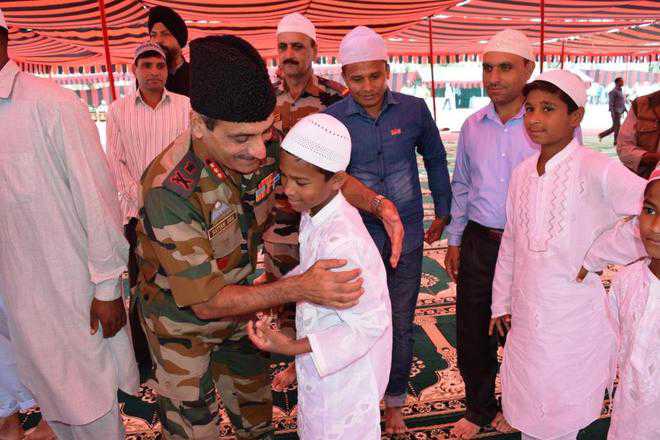
Chinar Corps Commander Lt Gen Satish Dua during the Eid celebrations at the Jammu and Kashmir Light Infantry Regimental Centre in Rangreth on Tuesday. Tribune photo

Tribune Reporters

Srinagar, September 13

The Army today celebrated Eid-ul-Azha with people across the Valley. With the message of peace, the festival was celebrated with traditional solemnity and spirit of brotherhood in all parts of Kashmir, a defence spokesman said.“In a unique humanitarian gesture, the Chinar Corps formations and units observed the ‘festival of sacrifice’ by reaching out to the underprivileged sections of society and offering them ‘sacrificial goats’, sweets and other gifts,” the spokesman said.The Army soldiers joined the people in different parts of Kashmir in offering prayers and sharing “Eidis.”“A conscious effort was made to be with the underprivileged and bereaved children in orphanages in numerous places, including Qasbanagam, Bijbehara, Salar, Tral, Galandhar, Nambal, Wessu and Kakapora in south Kashmir and Nihalpura, Baramulla, Bemiyar, Pattan, Mantrigam,Wagura, Mazbugh and Seelu in north Kashmir,” he said.The Army in remote areas along the Line of Control in Gulmarg, Uri, Tangdhar, Keran, Machhal and Gurez sectors also joined the people in celebrating the festival.The JAKLl Regimental Centre, Rangreth, also witnessed a confluence of soldiers and locals from a wide cross-section of society. Similar initiatives were also undertaken in Zangli, Kupwara, Shalateng, Awantipura, Bandipura, Anantnag and several other areas.Chinar Corps Commander Lt Gen Satish Dua joined the troops and people in offering prayers at the JAKLl Regimental Centre.Celebrates festival with Poonch residentsJammu: The Eid-ul-Azha festival was celebrated with fervour and zeal by the Army units based at Daraba today in Poonch.The festival was celebrated with great enthusiasm with troops of all communities and a large number of locals from Balakote, Dhargloon, Sandote, Goldh, Lanjot and nearby villages taking part.People from all segments of society attended and greeted each other on the pious occasion.


MiG-21 crashes near Barmer, pilots safe

MiG-21 crashes near Barmer, pilots safe
After the crash. ANI

Our Correspondent

Jaipur, September 10

In the second such incident in less than three months, a MiG-21 trainer jet of the Air Force crashed near Barmer in Rajasthan today. Both the pilots were able to eject safely.The plane had taken off on a routine sortie from Uttarlai airbase and crashed in an open field near Malio Ki Dhani, about 20 km from Barmer. The plane caught fire as it fell in an agriculture field around 12.15 pm. (Follow The Tribune on Facebook; and Twitter @thetribunechd)No loss of property was reported from the ground, said a defence spokesperson, adding that a court of inquiry had been ordered. On June 13, a MiG-27 had crashed in a residential area of Jodhpur. Three persons had received minor injuries as it dashed against the wall of a house where a number of people were present. 


India needs 4 times defence budget to meet 2020 coal target

johyu

The government has estimated that by the year 2020, India will need 1.5 billion tonnes of coal. But an India Spend analysis of a recent report by Brookings India indicates that even by a generous estimate, the country’s need for coal will not exceed 1.2 billion tonnes over the next four years.

There is another reason to scale down this target as, to achieve it, the government would have to invest around Rs 10 lakh crore ($ 149 billion), according to a June 2016 Price Waterhouse Coopers (PwC) report. That is four times India’s annual defence budget.

Laying down the government target early last year, Union Coal Secretary Anil Swarup had apportioned coal-production thus: “What we have worked on is that a billion tonnes will come from Coal India Limited (CIL) and 500 to 600 million tonnes (MT) from the private sector.”

A state-owned company that accounts for 80 per cent of India’s coal production, CIL has indeed increased its output by 74 MT over the past two years, as Factchecker reported in August 2016. But it is unlikely that it will get the government the yield it hopes for, we find.

To estimate India’s coal needs after six years, the Brookings report focuses on three sets of data:

1. Base growth rate: In this case, the report analysed two different scenarios:

Scenario 1: Non-power-sector demand was extrapolated based on gross domestic product (GDP) and assumptions were made that demand and production would be elastic –responsiveness of production to rise in demand and prices. Power demand was calculated on upcoming thermal power capacity (examining all plants under construction, their locations, technology, and status, assuming a similar plant load factor (PLF) — or the capacity utilisation of a power plant — as in financial year 2014-15.

Assumptions for the non-power sector include the following: 8 per cent GDP growth, respective sectoral GDP changes due to supply and demand and continued imports proportionate to imports in the base year 2014-15. This scenario puts the estimate at 1,311 MT.

Scenario 2: The non-power-sector demand was kept the same as scenario 1. A power-demand calculation was made assuming i) no power cuts by 2020 b) electrification to unconnected rural consumers and reduction in distribution losses. This scenario pegs the estimate at 1,228 MT, a more realistic figure, as per the report.

2. High Coal: This method, which pegs India’s coal requirement at 1,291 MT, is optimistic and assumes no imports of thermal coal (imports of coking coal — used to primarily manufacture steel — however, are assumed to continue), a high GDP growth of 8 per cent, 100 per cent electrification with no power cuts, and a modest growth of renewable energy. The assumption is that renewable energy does not displace coal very much as a source of power generation.

Although the health costs to India of using coal to generate electricity are about $4.6 billion (Rs 29,400 crore) annually, which is the cost of setting up five power plants of 1,000 MW each, or 2 per cent of India’s installed capacity, every year, India may have little option but to focus on coal as the primary source of electricity, with the need for coal-fired electricity estimated to increase three times by 2030, as IndiaSpend reported in May 2015.

Coal generates over 75 per cent of India’s electricity and is among the cheapest energy sources available. But its main advantage over other feasible alternatives is that it is largely immune to interference from nature — quakes, floods, droughts — economic vagaries and artificial accidents.

3. Low Coal: This scenario assumes a partial improvement in supply quality with imports in the same proportion as in 2014-15, and pegs the requirement at 1,139 MT.

Today, about 45 MT ((7.4 per cent) of India’s coal production comes from private miners. Achieving the government target of 500 MT by 2020 would require an unprecedented 11 times growth or a compounded annual growth rate (CAGR) of 61 per cent in the private sector.

If CIL and the other mining PSUs are to reach the 1-billion-tonne target, they will need to grow at an aggregated 12 per cent CAGR. If the growth target is limited to just CIL, then the company’s CAGR will stand at 15 per cent. The report notes that although CIL did achieve 8.5 per cent year-on-year growth in 2015-16 — its best ever — it still missed its target by 12 MT, settling for 538 MT in the last fiscal.

Thus, the 12 per cent growth for CIL seems unlikely, especially in the future over a larger base. A 12 per cent growth on a 500 base (production around 500 MT mark) — CIL produced 538 MT in 2015-16 — is easier than on an 800 base (production around 800 MT), which means CIL must produce more than 800 million tonnes in the future.

The PwC report observed that India would need to reform land acquisition, ensure enough water, augment logistics infrastructures, develop coal washeries, and train workers to create an environment that would ensure the 1.5-billion-tonne target.

“The development of the sector will be critical to India’s economic growth. Major policy changes over the past couple of years have given the necessary impetus to the sector,” wrote Kameswara Rao, Energy, Utilities and Mining Leader, PwC India, in the report. “The government will have to lead the growth of the sector by creating favourable conditions in terms of infrastructure, funding, technology upgradation and skill development.”

–IANS