
All posts by webadmin

Tributes paid to 1971 war heroes at Chandimandir

Tribune News Service,Chandigarh, December 16

2015_12$largeimg17_Thursday_2015_015511024
Remembering the heroes: War widows pay tributes to martyrs at Veer Smriti War Memorial to commemorate the 44th anniversary of the 1971 Indo-Pak War in Chandimandir on Wednesday. A Tribune photograph

Commemorating the 44th anniversary of the 1971 Indo-Pak War, tributes were paid to martyrs during a solemn ceremony organised at the Veer Smriti War Memorial at the Western Command headquarters in Chandimandir today.Wreaths were laid by the General Officer Commanding-in-Chief, Western Command, Lt Gen KJ Singh, former Army chief Gen VP Malik, several retired senior officers as well as war widows.A ceremonial guard reversed arms while buglers sounded the Last Post followed by the Rouse, as a mark of respect to the fallen soldiers. A large number of serving and retired officers and other ranks attended the ceremony.As part of the Vijay Diwas celebrations, a befitting tribute was also paid to Second Lieutenant Arun Khetrapal, who was decorated posthumously with Param Vir Chakra, the highest gallantry award, for his actions on the western front during the war. Poona Horse, Kheterpal’s regiment, sent a ceremonial guard for the occasion and wreaths were laid at his statue installed near the entrance of Chandimandir. Several of his course mates and regimental officers, some of who became Lieutenant Generals, as well as officers and men from the regiment were present on the occasion.War widows and the kin of martyrs of the tricity were also felicitated by Anita Singh, regional president, Army Wives Welfare Association (AWWA).The day is celebrated every year to commemorate the spectacular victory achieved by the Indian armed forces on both eastern as well as western fronts in 1971.It was on this day 44 years ago that over 90,000 Pakistani troops surrendered before the Indian Army, resulting in the creation of Bangladesh.
Army averted hostage crisis in Pathankot

CHANDIMANDIR: Swift action by the army averted a hostage situation during the Pathankot attack. On January 3, the army managed to timely evacuate six air force personnel from the first floor of a building stormed by a group of terrorists.

Giving details, Western Command chief Lt General KJ Singh said: “The ultras had split into two teams. While there were four members in one group, the other team had two members. One of the terrorists of the second group entered the Other Ranks (ORs) accommodation. The army swiftly moved in and managed to evacuate the six IAF men one by one through ropes.” The twostorey building was later blown up by security forces.

Lt Gen Singh said the building had steel doors. “It was almost like a bunker. So, explosives had to be used to destroy the building,” he added.

On why National Security Guard (NSG) teams were deployed when the army was present right next door, he replied, “NSG, army and IAF’s Garuda commandos were involved in the action. The decision to deploy NSG was taken at the top level that included the three service chiefs. They (NSG) were deployed as strategic assets were involved. There could have been a hostage situation as 11,000 people were inside the base.

“Usually, the airbase stops operations in such situations, but here it remained fully functional. The IAF was able to carry out surveillance sorties,” he added. The Western Command deployed nine columns of troops, including special forces, for the operation. A platoon of Infantry Fighting Vehicles, a bomb disposal squad, nine mine protected vehicles and an air evacuation were also ready to deal with any emergency situation.

DIFFICULT TERRAIN, VAST AREA,

“It’s a huge area and a difficult terrain. The buildings at the base are laid out in a sequential manner and these have to sanitised one by one. Also, with families inside, the troops had to be extra cautious,” he said.

The terrorists used to remain dormant for some time and then resort to fire. “The actual engagement was of just 10 hours and not of 95 hours as being stated by the media.”

ARMY’S ROLE NOT LIMITED

The Western Command chief clarified that the army’s role was not limited. “Defence Security Corps personnel and Garuda commandos made the first contact with the ultras when Jagdish Chand snatched a gun from a terrorist and killed him. Then second contact was made by security forces, including an army column. An integrated fire base was used and then the NSG came. Later, the NSG neutralised the group consisting of four terrorists,” he added.

The army had recovered a pamphletof Jaish-E-Mohammad (JeM), radio sets, AK-47s and antitank grenades from terrorists.

INPUT ON POSSIBLE STRIKE CAME ON JAN 1

“On January 1, we received a definitive input that around six to eight terrorists had sneaked in and their target was the Pathankot airbase,” said the Western Command chief. He said the input was received from both central agencies and Punjab Police. “We immediately took preemptive action. A red alert was sounded and quick reaction teams (QRTs) were put in place. Security of strategic installations was also beefed up,” he added.

On allegations that Punjab Police had failed to share inputs on time, he said the inquiry was on and he won’t comment on it. He also refused to comment on from where the terrorists entered India. The NIA was looking into all aspects, he said.On whether terrorists received local support, he said: “It can’t be ruled out. The NIA is looking into this aspect.”

Panic in Gurdaspur after two spotted in military fatigues

GURDASPUR: Panic gripped Punjab’s Gurdaspur town on Wednesday when residents of villages on the outskirts reported seeing two men in fatigues acting suspiciously near an army cantonment.

Police cordoned off the area and enforced a blackout within a 5km radius as the spot is a short distance away from the Pathankot air force base where six terrorists and seven Indian soldiers were killed in a days-long encounter.

The local administration made announcements through loudspeakers at two gurdwaras about the presence of suspected Pakistani terrorists, with authorities saying they could target the Tibri military station.

The facility has a large number of army establishments from various regiments as well as their families. Witnesses said the two men were wearing sunglasses, were heavily armed and when confronted hid in a nearby sugarcane field.

Gurdaspur DCA bhinav Trikha, SSP Gurpreet Singh Toor and senior army officers rushed to the area. “The villagers informed us about two suspicious men in army fatigues close to the cantonment. We have since launched a search operation,” Toor told AFP.

Officials also said army formations have been put on alert following reports that five terrorists have sneaked into the border area of Gurdaspur and Pathankot.

Missing pieces in the Pathankot puzzle

MYSTERY As investigators rummage through leads and trails of the audacious Pathankot attack, Pawan Sharma and Aseem Bassi try to put together the jigsaw puzzle of the terror plot that was hatched on Pakistan soil.

Where did the second group of terrorists come from?

RAVI KUMAR/HT(Above) NIA officials hearing versions of SP Salwinder Singh (red turban) and his cook Madan Gopal (left) regarding their abduction, in Pathankot on Wednesday.Security agencies have almost concluded that terrorists were in two separate groups. Yet what’s baffling is how the two terrorists travelled and sneaked inside the air force base in view of evidence— based on the first-person account of Rajesh Verma, whose throat was slit but he survived, and Gurdaspur superintendent of police (SP) Salwinder Singh—that they were waylaid by four ultras.

The presence of four terrorists in one group has been settled by versions of the police officer and his cook, Madan Gopal.

But, security sleuths don’t rule out the possibility that two ultras could still be on the loose. The combination of two in one group and four in the other is puzzling security experts. How the group of four ultras reached Pathankot is clear from the killing of taxi driver Ikagar Singh and the carjack of the SP’s XUV. There is not a shred of evidence so far to indicate how the first group of two travelled up to Pathankot and who helped them.

Did both terror groups enter airbase together?

There is no clarity on whether the six terrorists sneaked inside the air force facility together or in separate groups. It’s also a mystery whether both groups were in touch with each other.

Security officials say both groups had one wireless set each to establish contact. One walkie-talkie set was recovered from the abandoned vehicle of the abducted Punjab police officer who was mysteriously let off. A similar walkie-talkie set was found from the ultras killed by the security forces.

Sources say the terrorists entered the airbase by climbing its rear boundary wall that has barbed wire. It is learnt that one glove–ostensibly that of an ultra—was found entangled with the wire.

“It is likely that they scaled the rear wall to enter the airbase. But where did the other two terrorists came from needs to be ascertained,” a source said.

Why was the SP let off?

Police officers say the SP was freed due to his religion, and the cook due to his age. After dumping the SP and his cook with their hands tied behind the back, the ultras realised later that the person they had let off was an SP (a call came on his phone and the caller said it was the SP sahib’s phone). Then they went back to search him. But the SP and his cook had fled. The SP’s mind-boggling statement to his interrogators that he was let off by the ultras “as they did not want to harm him due to his religion” has bounced

more questions than answers.

From where did terrorists cross international border?

How the terrorists made an entry into the country’s frontline defence establishment is in the realm of speculation. Even as the BSF has been maintaining that the terrorists did not infiltrate from the Bamial sector, the traces of mud inside the abandoned taxi of killed driver Ikagar Singh suggest that they used the riverine route. Which path they used to reach this side of the border is going to leave the top brass of the security forces red-faced.

Reports are doing the rounds that terrorists used the Bamial sector to reach the air force base. It is also not known if ultras had any local support. Though the defence minister had said that the terrorists were heavily armed, highly motivated and on a suicide mission, the question bothering everybody is if they had local support as they moved through villages and later to the airbase.

How did they manage to carry back-breaking load of ammunition?

Another question that has foxed security agencies is how the terrorists managed to carry so much ammunition and weapons with them. Did they use porters? As per Verma’s version, the backpacks the ultras were carrying were very heavy. So far there is no clarity on whether they had any local support.


Self-defence course begins at Nagrota

Tribune News Service,Jammu, December 16

A week-long self-defence course was started at the Nagrota Military Station from today. The course received a huge response and was attended by wives of 40 officers, 170 Junior Commissioned Officers (JCOs) and other ranks and about 300 girls.Self-defence is being taught by Sujit Singh, an instructor of taekwondo. He is presently the secretary general of the Mumbai Taekwondo Association and has trained of many Bollywood celebrities in Mumbai.Sheela Nimbholkar, zonal president, AWWA, laid stress on the importance of self-defence training for women and girls. She motivated them to participate in the course and benefit from it.

Army remembers 1971 war victory

Tribune News Service,Srinagar, December 16

The Chinar Corps celebrated the 44rd anniversary of the Indian victory in the 1971 Indo-Pak War in the true military traditionby remembering the heroes and soldiers killed during the war.A brief but solemn ceremony was organised in the Badami Bagh Cantonment, for the serving soldiersand ex-servicemen.“The event was attended by a large number of Army and civilian persons. Lt Gen Satish Dua, General Officer Commanding, Chinar Corps, paid homageto the martyrs by layinga wreath at the War Memorial in the Badami Bagh Cantonment,” said a defence spokesman.December 16 is celebrated as Vijay Diwas to commemorate the Indian Army’s victory in the 1971 Indo-Pak War.The war came to anend with the total capitulation of the Pakistaniarmy in erstwhile East Pakistan and led to the creation of Bangladesh.In this war, the Indian Army captured the maximum number of prisoners of war since the end of the Second World War.The Chinar Corps was responsible for the entire Jammu and Kashmir during the war and achieved many successes.Speaking on the occasion, the General Officer Commanding, Chinar Corps, recounted the sacrifices made by Army personnel and the tremendous achievements of the Chinar Corps during the conflict.“A victory of such a magnitude would not have been possible without the tremendous sacrifice by the soldiers,” said Lt Gen Dua.He reiterated the Army’s resolve to stand by the people in all efforts towards a better future.Similar functions were organised at different Army formations and units in the Kashmir valley, in which the spirit of camaraderie and brotherhood was overwhelming.


Army helps Poonch teenager regain sight

DK Sudan

Poonch, December 16

Muhammad Arif (18), who hails from Gali Pindi village in Poonch district, had lost his eyesight 12 years ago when lightning struck his house. He has recovered his vision now. The Army unit deployed in the area has made it possible for him to get back his vision.The news that Arif could get back his vision had brought joy to his family. However, doctors had declared that he could not get back his vision.Arif said, “I remember that I was in Class III when I lost my eyesight. A bright spark of lightning struck my house and I lost eyesight. My parents visited almost all hospitals in the state to get my eyes treated. All doctors refused, saying my eyes could not be treated.”“When my parents heard that the 12 Jat Regiment would organise a free eye camp at Sekloo village in Mandi tehsil last month, it again gave a ray hope to us,” Arif said.“I do not know how, but they did it. I thank the Army for the valuable help. I try to recognise my family members and friends from their voices, which I have been hearing for the past 12 years. I am very happy now,” Arif said.Arif’s sister Shamim Akhter said, “He was in Class III when he lost his eyesight. We used to help him do his daily activities as he was unable to do anything on his own.”“The 12 Jat unit has extended a helping hand and helped us get back his vision. He does everything on his own now and is more enthusiastic to take admission in school as a regular student. We are thankful to the 12 Jat Regiment,” Shamim said.Maj Arnav explained that they took Arif to the Army Hospital in Rajouri and consulted doctors there. He said they went in for eye surgery and succeeded in getting back his vision. Maj Arnav said, “We just did our job and are happy that the Army did it.”


दिल्ली : OROP को लेकर पूर्व सैनिकों ने निकाली आक्रोश रैली

http://www.ndtv.com/video/player/news/ex-servicemen-rally-in-delhi-against-orop-announcement/394687

वन रैंक वन पेंशन की मांग को लेकर पूर्व सैनिकों ने दिल्ली के जंतर मंतर पर सैनिक आक्रोश रैली निकाली। रैली में उन्होंने ऐलान किया कि वह 26 जनवरी की परेड का बहिष्कार करेंगे, साथ ही पूर्व सैनिकों ने अपने लोगों से बीजेपी और उसके सहयोगी दलों को वोट न देने की भी अपील की।

Ex-Army man rides bike to spread awareness on OROP

Tribune News Service,Patiala, December 12

2015_12$largeimg13_Sunday_2015_011438182

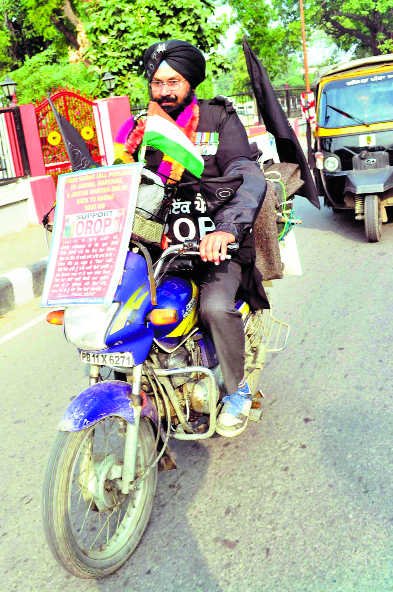
In an attempt to garner support and create awareness regarding the ongoing struggle of the ex-servicemen for the one rank, one pension (OROP), former Army man Harjinder Singh undertook an extensive motorbike ride across Punjab, Haryana, Chandigarh and Jammu and Kashmir  where he collected the soil of the places that hold significance for the defense forces. He started his campaign on December 5 and travelled along the Indo-Pak border and went to many important places such as Asal Utar. He even visited the national memorial dedicated to Shahid Bhagat Singh. He will now carry the soil to New Delhi to participate in the maha rally organised by the ex-servicemen in support of the cause. Kuldip Singh Grewal, president of the State Ex-Servicemen Welfare Association (SEWA), said they had already rejected the truncated OROP.


New OROP rules to benefit superseded men in uniform

NEW DELHI: The government is now examining whether it should slightly relax the norms for denial of one rank, one pension (OROP) benefits to all military personnel who seek premature retirement (PMR).

Though the final decision will be taken after defence ministerManohar Parrikar returns from his ongoing visit to the US on December 12, sources said the “thought process” was that OROP could be granted to superseded officers who take PMR after continuing in service for four additional years.

Similarly, jawans and junior commissioned officers will get OROP if they have served three additional years after being overlooked for promotions. “But officers who opt for PMR without being passed over for promotions will not be eligible for OROP,” said a source.
According to the notification issued by the defence ministry on November 7, all military officers and jawans opting for PMR from now onwards — without exception – will not be eligible for OROP benefits. This has led to tremendous unease in the armed forces, who bank upon hundreds of officers and thousands of jawans taking PMR every year to keep themselves young and fighting fit.

“The entire cadre management of the forces, which have a steeply-pyramidal promotional structure, is dependent on these officers and jawans taking PMR after finishing their pensionable service. This ensures recruitment of young and fresh blood,” said a senior officer.

“If the superseded officers and jawans stay on in service to ensure they get OROP, they will block vacancies and reverse all the measures being implemented to reduce the age profile of the forces,” he added.

The government was earlier also forced to clarify that military personnel who had in the past opted for PMR would get OROP but fresh cases would be kept out of its ambit. In other words, it would be effective only prospectively.

Incidentally, it will cost the government an additional Rs 8,000-10,000 crore every year to implement OROP for the over 24 lakh ex-servicemen and six lakh widows around the country, as was reported by TOI earlier.


India, Pakistan back on talks table, NSAs meet in Bangkok

2015_12$largeimg07_Monday_2015_005320169 (1)
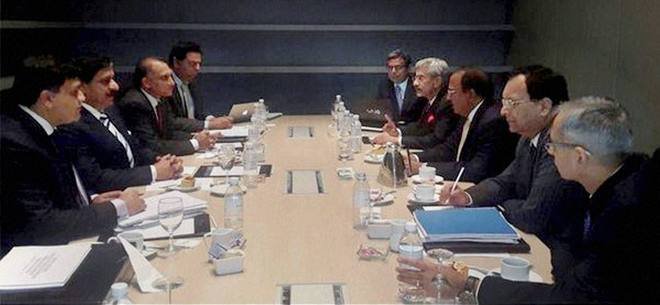
NSA Ajit Doval (3R) and Foreign Secretary S Jaishankar (4R) with their Pakistani counterparts Naseer Khan Janjua (2L) and Aizaz Ahmad Chaudhry (3L) during a meeting in Bangkok on Sunday

KV Prasad
Tribune News Service
New Delhi, December 6
India and Pakistan today broke ice through a meeting of the National Security Advisers in Bangkok, a move aimed at improving the atmosphere ahead of External Affairs Minister Sushma Swaraj’s visit to Pakistan this week.
Indian National Security Adviser Ajit Doval met Lt General Naseer Khan Janjua (retd) in the Thai capital. The meeting was kept under wraps.
Foreign Secretary S Jaishankar and three others were in the delegation that met the Pakistan team away from the media glare to take forward the brief meeting Prime Ministers of India and Pakistan had in Paris recently.
“Discussions were held in a candid, cordial and constructive atmosphere. They were guided by the vision of the two leaders for a peaceful, stable and prosperous South Asia. Discussions covered peace and security, terrorism, Jammu and Kashmir, and other issues, including tranquility along the Line of Control. It was agreed to carry forward the constructive engagement,” a joint press release issued at the end of the meeting said.
By holding the talks at a neutral venue, both sides managed to keep it secret, away from the media glare and Pakistan could do without insisting on having a word with the Hurriyat, a move that became a spoiler on two earlier occasions.
In August 2014, India pulled out of the Foreign Secretary-level talks after Pakistan High Commissioner Abdul Basit met separatist leaders.
Sources here suggested the discussions went on for about four hours and all issues of concern, including India’s accent on the need to tackle terror by Pakistan, figured.
Besides Doval and Jaishankar, the delegation included former IB chief Asif Ibrahim, currently Modi’s special envoy on counter-terrorism, joint secretaries in PMO Javed Ashraf and Vinay Kwatra.
This is the first meeting between the NSAs of India and Pakistan since the scheduled talks during August were called off after acrimonious war of words over the agenda with Islamabad insisting on taking up Jammu and Kashmir and New Delhi preferring to go by the Ufa statement focusing on terror.
In August, it could have been Sartaj Aziz, then holding twin charge as Foreign Affairs and National Security Adviser to Pakistan Prime Minister Nawaz Sharif. However, during October Pakistan appointed Lt General Janjua as the NSA.
After the Ufa meeting in July, both Prime Ministers agreed the two NSAs will meet and discuss terror to be followed by one between the Directors General of Military Operations and Heads of Border Security Force and Pakistan Rangers. Of this, only the last engagement went as scheduled.
That the NSA talks happened ahead of External Affairs Minister Sushma Swaraj’s visit to Pakistan for the Heart of Asia conference on Afghanistan being hosted there on Wednesday should also open the door for a meeting with Aziz.
BJP spokesperson Nalin Kohli said the statement at Bangkok “clearly shows that it is continuum. Substantive issues of the spirit of Ufa statement are well reflected”, while former Union Minister Manish Tewari sought to know what changed between September and December for this meeting to take place.

Terror, J&K on agenda

The meeting between National Security Advisers Ajit Doval and Lt General Naseer Khan Janjua (retd) in Bangkok was kept under wraps
The two sides discussed peace and security, terrorism, Jammu and Kashmir, besides tranquility along the LoC
The meeting follows discussions between PMs Narendra Modi and Nawaz Sharif on the sidelines of climate talks in Paris on November 30
n The previous engagement between the NSAs in August was called off after Pakistan insisted on discussing J-K


Soldier, 2 militants killed in Handwara encounter

Majid Jahangir
Tribune News Service
Srinagar, December 4
2015_12$largeimg05_Saturday_2015_002747004
A soldier of the Army’s elite counter-insurgency unit and two unidentified militants were killed in a firefight in north Kashmir’s frontier Kupwara district on Friday. The slain soldier has been identified as Naik Satish Kumar of Bhiwani, Haryana.
The firefight broke out in the Bawan Rajwar forest area in Handwara, nearly 90 km from here, after a joint party of the Army and the police were combing the thick forest area after information about the presence of four or five Lashkar-e-Toiba militants.
A search operation was jointly launched by 21 Rashtriya Rifles Battalion, Special Operations Group of the J&K Police and elite para commandos to track the group which had been on the run in the forest for the past nearly two weeks.
“As the combing was going on, militants this afternoon opened fire, which was retaliated by the forces. In the ensuing gunfight, two unidentified militants were killed and two soldiers of 21 Rashtriya Rifles were injured. One of the injured soldiers later succumbed to his injuries,” a police officer said.
Defence spokesman Col NN Joshi said: “The firefight has stopped, but the combing operation is underway. We have recovered two AK rifles, one under barrel grenade launcher, two radio sets and other war-like stores from the encounter site.”
Sources said the same group of militants had a brief contact with security forces on the evening of November 21 in the same area. The militants at that time, however, managed to escape. Today’s combing was an extension of the operation that was launched on November 21.
The firefight in Handwara forests comes at a time when a massive search operation continues in the adjoining Manigam forest of Kupwara for the past three weeks. In the Manigam operation, Commanding Officer of 21 Rashtriya Rifles Col Santosh Mahadik was killed and the second in Command of 160 Territorial Army Lt Col K S Natt was critically wounded and is battling for his life in a Delhi hospital.

Combing operation
A search operation was jointly launched by 21 Rashtriya Rifles Battalion, Special Operations Group of the J&K Police and elite para commandos to track the militant group which had been on the run in the Handwara forest for the past nearly two weeks.The firefight in Handwara forests comes at a time when a massive search operation continues in the adjoining Manigam forest of Kupwara for the past three weeks. In the Manigam operation, Commanding Officer of 21 Rashtriya Rifles Col Santosh Mahadik was killed


3 new Commanders to take charge

Vijay Mohan
Tribune News Service
Chandigarh, November 29
Changes at the apex level in the Army are in the offing with the imminent retirement of several top commanders and some other officers completing their tenures. Lt General Rajan Bakshi, General Officer commanding-in-Chief, Central Command, is hanging up his boots on Monday and the slot is expected to be filled by Lt General BS Negi.
An infantry officer of 1978 seniority, Lt General Negi had earlier commanded the Leh-based 14 Corps that is responsible for the Siachen Glacier and the Line of Actual Control with China.
He moved as Commandant of the Indian Military Academy (IMA), Dehradun in August. The names of two Lt Generals are doing the rounds for being posted as the IMA Chief.
Lt General Bipin Rawat, also an infantry officer of 1978 seniority who is presently heading 3 Corps at Dimapur in the East, is tipped to take over the reigns of the Southern Command at Pune, while Lt General Sarath Chand, an officer of 1979 seniority who is the GOC 4 Corps, is tipped to take over South Western Command at Jaipur when the respective incumbent commanders retire shortly.
Lt General Ashok Ambre has been appointed as the GOC of 9 Corps based at Yol under the control of the Western Command.
He relieves Lt General Rajeev Tiwari, who has been posted as the GOC Bengal Area at Kolkata. Lt General Amarjit Singh, GOC of the Ambala-based 2 Corps is also completing his tenure and is expected to move to Army Headquarters as a Principal Staff Officer. An officer from the Mechanised Infantry is tipped to take over 2 Corps.
Three top officers — Lt General KJ Singh, GOC-in-C, Western Command, Lt General DS Hooda, GOC-in-C, Northern Command Command, and Lt General MMS Rai, Vice Chief of Army Staff — would retire in the latter half of next year.
Already some names of prospective officers who could be elevated as Army Commanders to fill these appointments are doing the rounds in the military establishment.

Change of guard

Lt General Rajan Bakshi, GOC-in-Chief, Central Command, will retire on Monday and is expected to be replaced by Lieutenant General BS Negi
Lt General Bipin Rawat, who heads 3 Corps at Dimapur, is likely to take charge of Southern Command at Pune
Lt General Sarath Chand, GOC, 4 Corps, is tipped to take over South Western Command at Jaipur
Lt General Ashok Ambre has been appointed the GOC, 9 Corps, based at Yol under the control of the Western Command
Lt General Amarjit Singh, GOC, 2 Corps, is expected to move to Army Headquarters as Principal Staff Officer after completing his tenure




























