All posts by webadmin

Around 130 Pak nuclear warheads aimed at deterring India: US govt report

Pakistan’s nuclear warheads which are estimated to be between 110-130 are aimed at deterring India from taking military action against it, a latest Congressional report has said.

The report also expressed concern that Islamabad’s “full spectrum deterrence” doctrine has increased risk of nuclear conflict between the two South Asian neighbours.

“Pakistan’s nuclear arsenal probably consists of approximately 110-130 nuclear warheads, although it could have more. Islamabad is producing fissile material, adding to related production facilities, deploying additional nuclear weapons, and new types of delivery vehicles,” Congressional Research Service (CRS) said in its latest report.

In its 28-page report, the CRS noted that Pakistan’s nuclear arsenal is widely regarded as designed to dissuade India from taking military action against it, but Islamabad’s expansion of its nuclear arsenal, development of new types of nuclear weapons and adoption of a doctrine called “full spectrum deterrence” have led some observers to express concern about an increased risk of nuclear conflict between Pakistan and India, which also continues to expand its nuclear arsenal.

CRS is the independent research wing of the US Congress, which prepares periodic reports by eminent experts on a wide range of issues so as to help lawmakers take informed decisions.

Reports of CRS are not considered as an official view of the US Congress.

“Pakistan has in recent years taken a number of steps to increase international confidence in the security of its nuclear arsenal,” said the CRS report authored by Paul K Kerr and Mary Beth Nikitin.

Moreover, Pakistani and US officials argue that, since the 2004 revelations about a procurement network run by former Pakistani nuclear official A Q Khan, Islamabad has taken a number of steps to improve its nuclear security and to prevent further proliferation of nuclear-related technologies and materials, it said.

A number of important initiatives, such as strengthened export control laws, improved personnel security, and international nuclear security cooperation programmes, have improved Pakistan’s nuclear security, the CRS said.

“However, instability in Pakistan has called the extent and durability of these reforms into question. Some observers fear radical takeover of the Pakistani government or diversion of material or technology by personnel within Pakistan’s nuclear complex,” the CRS said.


PAK TERRORISTS TARGET PEACE TALKS

PATHANKOT AIRBASE ATTACK Three securitymen die in pre-dawn strike; five Jaish militants gunned down 15-HOUR OPERATION Infiltrators in army fatigues entered via Bamiyal area along India-Pakistan border HIGH-VALUE TARGET IAF aircraft had been shifted as pre

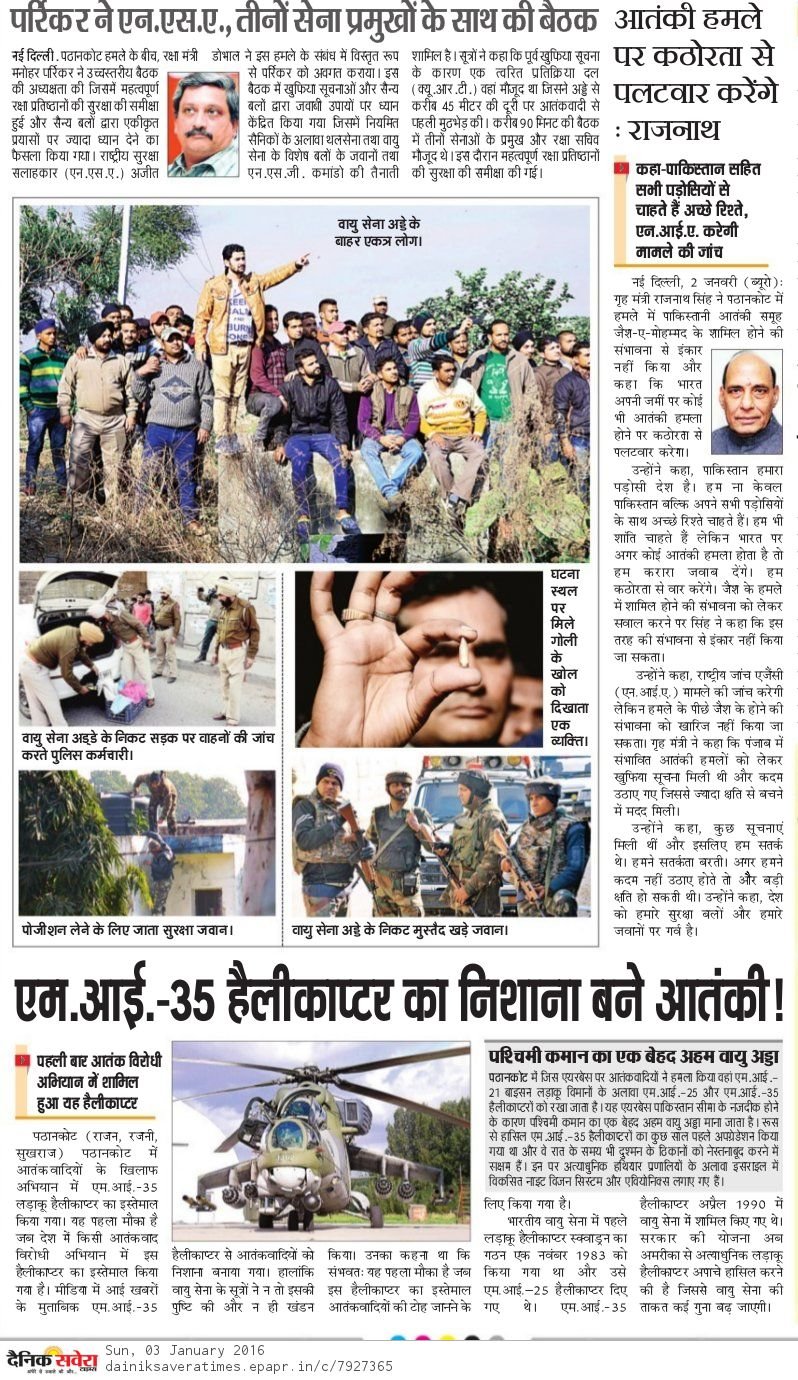
PATHANKOT: Indian security forces killed five Pakistani terrorists who launched a pre-dawn attack on Saturday on a strategic air force base in Punjab’s Pathankot district, setting off a fierce 15-hour operation that also left three security personnel dead and about a dozen injured.

AP PHOTOSoldiers on the rooftop of a building outside the air force base in Pathankot on Saturday.

The attack on the airbase, which is home to a large fleet of MiG-21 and MiG-25 fighter planes, was seen as an attempt to undo recent progress in India’s relationship with Pakistan. It came barely a week after Prime Minister Narendra Modi made an unannounced visit to Lahore to meet with his Pakistani counterpart Nawaz Sharif in a sign of possible thawing of relations between the two countries.

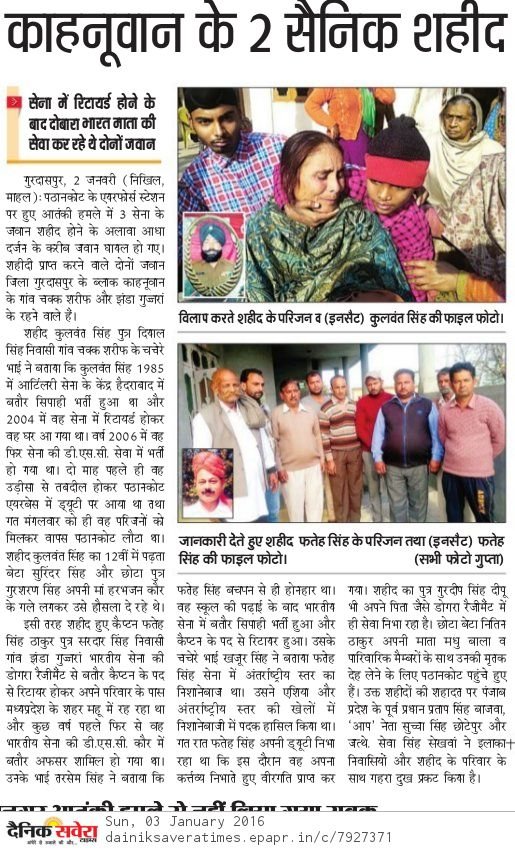
Two of the slain security personnel were from the Defence Security Corps, including Commonwealth championship gold medal-winning shooter Fateh Singh, besides an airman whose identity was not given.

“Enemies of humanity who can’t see India progress, such elements attacked in Pathankot but our security forces did not let them succeed,” Prime Minister Modi said in Mysuru.

Gunshots rocked the airbase around 3.30am on Saturday as a group of five men in army-style clothing — believed to be operatives of the Pakistan-based terror group Jaish-e-Mohammed — launched the daring operation less than 24 hours after an alert was sounded in the state over the abduction of Gurdaspur superintendent of police (SP) Salwinder Singh by suspected Pakistani terrorists.

Elite National Security Guard (NSG) commandos, army personnel and a SWAT team of the Punjab Police were rushed to the area following the abduction and assault on Salwinder and the interception of mobile phone calls made by the terrorists to their Pakistan-based handlers.

“From the moment the terrorists’ presence was confirmed on Friday, Punjab Police and central security agencies worked in tandem and rapidly mobilised all resources in real time. That’s what accounted for the success of the operation,” said Suresh Arora, Punjab director general of police (DGP).

Sources said 168 NSG commandos led by Major General Dushyant Singh were flown in from Delhi on Friday night.

Though the terrorists still managed to storm the base, they were unable to penetrate the area where the fighter aircraft, helicopters and other military equipment were kept, said IAF spokeswoman Rochelle D’Silva. The entire area turned into a virtual war zone as gunshots rang continuously while helicopter gunships provided air cover in an operation closely monitored by national security adviser Ajit Doval.

Doval also attended a meeting later in the day with defence minister Manohar Parrikar who cut short his stay in Goa and returned to Delhi following the attack. The meeting was also attended by the three service chiefs.

Although police initially said the gunbattle ended by 8am, shots and explosions could be heard from inside the base until noon. At least one helicopter could be seen firing at an area inside the facility.

The bodies of four attackers were recovered from the scene while the body of a fifth was recovered in the evening outside the base, where security forces had launched a massive search operation.

Though there were conflicting reports about the presence of a sixth gunman, home minister Rajnath Singh said five had been killed till search operations were called off for the day.

A defence source said the terrorists were from JeM, a group blamed for the December 2001 attack on Parliament that killed 11 people, and had probably infiltrated about three days ago. Pathankot — located at the trijunction of Punjab, Jammu and Kashmir and Himachal Pradesh — is on a highway that connects insurgency-hit J&K with the rest of the country.

4f6a6b8e-8d95-479e-9598-d4078eae079a7175d600-4e1d-4bb1-b12f-6d2413a0a63f  48367340-0f98-4828-89c8-ea95229c8ee8


Soldiers in the Indian Army to Soon Get 1.86 Lakh Bulletproof Jackets

The Indian Army Chief, General Dalbir Singh Suhag, has assured that soldiers will be provided with bulletproof jackets very soon. Speaking at an annual press conference in Delhi last week, he said that the process of procuring 1.86 lakh jackets has passed the technical trials. Currently the jackets are undergoing field trials.

According to a report in The Economic Times, this is the first time that the process of acquisition has cleared the technical stage since the procurement process began in 2009.

indian army

Picture for representation. Source: Wikimedia

There have been many setbacks in the entire process of purchasing these 1.86 lakh jackets since 2009, before the government issued a fresh proposal in 2012 and changed the qualitative requirements. As the technical trials have been cleared now, there isn’t much that can hamper the remaining procedure.

“In the field trials stage we just check the user comfort, weight etc. and no real technical issues. In case of bulletproof jackets, this stage is unlikely to create any bottleneck,” a senior Army official told The Economic Times.

Initially, 50,000 bulletproof jackets are being purchased as per the old qualitative guidelines to fulfil the urgent and essential requirements of soldier. These jackets are in the cost negotiation stage right now and will be available in a few months.


AFT: Convene reassessment medical board for veteran

HANDIGARH: The Chandigarh Bench of Armed Forces Tribunal (AFT) has ordered to conduct reassessment medical board of 1971 war veteran who got injured in Pakistan bombing in the war.

Petitioner Bhag Singh, 72, resident of Mohali, joined the army in 1959 and participated in 1962 war, 1965 war and 1971 war. He was awarded nine medals during his service.

In 1971 war, he suffered injury due to bombing by Pakistan on the Wagah border of Punjab, when bomb shells pierced into his left thigh. He was moved to military hospital, Amritsar, where surgical operation was performed and the petitioner was downgraded to the lower medical category. He was discharged from service on medical grounds and was granted disability pension for two years, from August 1, 1974, to May 15, 1976, for 20% disability.

Bhag Singh was brought before the resurvey medical board in the year 1976, which declared the disability of the petitioner having improved to between 11 % to 14 %. As a result his disability element of pension was stopped.

Later, he developed pain and swelling in his left thigh in the year 1981 and remained under medical treatment for about six years when he was referred to Post Graduate Institute of Medical Education and Research (PGIMER), Chandigarh, by Command Hospital, Chandimandir. The PGIMER authorities extracted number of embedded bomb shell pieces from his thigh during the surgical operations in 1987.

Since then, he made a number of representations to the defence authorities for war injury pension, but in vain.

Bhim Sen Sehgal, chairman of All Indian Ex-servicemen Welfare Association (AIEWA), who appeared on behalf of Bhag Singh, said Bhag Singh had been fighting for over 40 years and now the AFT had given a ray of hope by ordering director general, Armed Forces Medical Services, New Delhi, to convene a reassessment medical board.


Security up after terror group call intercepted

short by Aarushi Maheshwari / 06:06 pm on 20 Jan 2016,Wednesday
Security has been beefed up in the nation ahead of the Republic Day, as central agencies have intercepted a call from Bangladeshi terror outfit Hizb-ut-Tahrir (HTB). An attack could be reportedly carried out on January 23 by the HTB with the help of Jaish-e-Mohammad, Indian Mujahidin and Lashkar-e-Taiba. Security agencies including the BSF and Indian Army have been alerted.
2 militants killed in encounter in J&K’s Pulwama
short by Smrithin Satishan / 11:39 am on 20 Jan 2016,Wednesday
Two militants, who were reportedly holed up inside a villager’s house in Pulwama district of south Kashmir, were killed on Wednesday in an encounter between militants and security forces, according to a police official. The operation, which started after a brief lull on Wednesday, had begun on Tuesday evening and will continue till the area is secure.
ISRO launches India’s 5th navigation satellite
short by Smrithin Satishan / 11:30 am on 20 Jan 2016,Wednesday
Indian Space Research Organisation (ISRO) on Wednesday successfully launched India’s fifth navigation satellite IRNSS-1E from the spaceport at Sriharikota. “PSLV-C31 successfully places navigation satellite IRNSS-1E into the orbit,” ISRO said post the launch. The system which consists of seven satellites will provide real-time data on the position of objects to aid road, air and maritime traffic.
Pathankot attack suspect arrested from Haridwar
short by Aditya Kashyap / 01:08 am on 20 Jan 2016,Wednesday
The Intelligence Bureau (IB) on Tuesday arrested a person, from Manglaur town in Haridwar district, suspected to have links with the recent terrorist attack on the Pathankot air base. Notably, this comes amid intelligence reports which claim Pakistan is yet to arrest Masood Azhar, the prime suspect in the attacks and the chief of the terrorist group Jaish-e-Mohammad (JeM).
NCR on alert as IG’s beaconed SUV gets stolen
short by Smrithin Satishan / 08:33 pm on 20 Jan 2016,Wednesday
An alert was sounded on Wednesday in the NCR after a blue beacon fitted Tata Safari SUV belonging to an Inspector General of Indo Tibetan Border Police was stolen from sector 23 on Tuesday. Officials have launched a manhunt owing to the upcoming Republic day alert in the capital. Delhi Police Commissioner BS Bassi has requested the public for assistance.

Sacked IAF official held for spying in Bathinda

TNS & Agencies,New Delhi, December 29

2015_12$largeimg30_Wednesday_2015_012616952

A dismissed Air Force official, who allegedly shared secret information with intelligence operatives suspected to be backed by Pakistan’s ISI after being “honeytrapped” into an espionage racket, has been arrested from Bhatinda in Punjab by the Delhi Police.The accused, Ranjith KK, was produced before the court and remanded in four-day police custody for interrogation. He could be taken to Jaisalmer and Gwalior for further interrogation. Ranjith was a leading aircraft man with the IAF at Bhatinda. He was dismissed recently and arrested after a combined operation by the Delhi Police’s Crime Branch, Military Intelligence and Air Force Liaisoning Unit (LU), Joint Commissioner of Police (Crime) Ravindra Yadav said.Ranjith, a native of Malappuram district in Kerala, had joined the Indian Air Force in 2010. He has been booked under provisions of the Official Secrets Act, said the police.”With his arrest, the police have come across a honeytrapping module, backed by intelligence agents from across the border, which creates fictitious accounts (cyber entities) in popular social networking sites, pretending to be women, befriend defence personnel and officials from security forces and allegedly lure them into espionage,” a senior police official said.Ranjith was deceived by a cyber entity by the name Damini McNaught, who posed as an executive of UK- based news magazine. She interviewed Ranjith and then assigned him the task of getting the information. She deceived him by saying that the information would  be published and he would get due monetary benefits for this, the Joint Commissioner said.

Honey-trapping module busted

  • With the arrest of IAF official Ranjith KK, the police have come across a honey-trapping module, backed byintelligence agents from across the border
  • The module involves creation of fictitious accounts on social networking sites. Pretending to be women, agents befriend defence personnel and lure them into espionage
  • Ranjith was deceived by a cyber entity by the name Damini McNaught, with whom he shared Air Force-related information, in exchange for money

Dismissed IAF man held in Bathinda for ISI spying

NEW DELHI: Pakistan’s intelligence agencies are using fake social media accounts with female names to befriend, lure and sometimes blackmail India’s defence personnel into committing espionage, Delhi Police told a city court on Tuesday.

The revelations came after the arrest of former leading aircraftsman KK Ranjith from Punjab’s Bathinda airforce base for allegedly sharing secret documents with Pakistani agencies.

“In May 2012, the LAC came in contact with Pakistan intelligence officer Damini McNaught who cultivated the air force man by luring him to work as a defence analyst for a UK-based magazine,” cops told the court.

They said the 24-year-old single man – who was arrested under the Official Secrets Act on Monday — also had another female handler named Alphonsine Davis. Cross-border spies fooled Ranjith by calling his mobile phone over the internet with the other party introducing herself – in a British accent – as McNaught and posing as an executive of a UK-based news magazine.

“She even interviewed LAC Ranjith and assigned him the task of getting the information. She deceived him by saying the information will be published and he will get due monetary benefits for this,” said the team, led by ACP KPS Malhotra.

During the brief hearing, cops said Ranjith passed “sensitive information related to the Air Force and other vital defence information through Facebook and email to Damini and Alphonsine”. For this, he got `30,000 in total in two separate payments of `25,000 and`5,000 made on October 13 and 14, they alleged.

But he may not have been the only one to be trapped. “A few serving defence personnel are being pulled into the espionage network through these honey traps. Some fictitious Facebook accounts of women are being used for this,” joint commissioner of police (crime branch) Ravindra Yadav told IANS.

The court granted four days’ police custody and said Ranjith would be produced before the court concerned on January 2.

62405


Armored Fist: Russian T-90s Will Be a Welcome Boost To Iran’s Tank Corps

SOURCE: SPUTNIK

With Iran on track to receiving access to about $30 billion of $100 billion in assets previously frozen by sanctions, Russian journalist and military analyst Alexander Sitnikov pondered just how much of the released funds may be spent on upgrading the country’s defense capability, including its tank forces.

Commenting on Central Bank of Iran Governor Valiollah Seif’s recent announcement that Iran would spend much of the $30 billion in freed funds on the import of essential goods, Sitnikov, a columnist for the independent Russian newspaper Svobodnaya Pressa, suggested that it seems likely that a significant portion of the money will go toward upgrading Iran’s military potential, which according to Western experts, has declined in recent years.

“This can be assumed based on the statements of Supreme Leader Ayatollah Khamenei on the country’s urgent need to strengthen the country’s military,” the analyst explained.

In accordance with the Joint Comprehensive Plan of Action (JCPOA), the international agreement on Iran’s nuclear program reached in Vienna last July, Tehran is not allowed to build or test missile systems, or to purchase advanced conventional weapons from abroad. However, Sitnikov added, “it’s important to note that the JCPOA does not deprive Iran of its right to self-defense.”

“This last formulation,” the analyst recalled, “was controversial from the beginning. US Senate Armed Services Committee Chairman John McCain was categorically against lifting the comprehensive arms embargo. Nevertheless, the supporters of only limited restrictions ultimately won on the grounds that older weapons wouldn’t threaten Iran’s neighbors, especially Saudi Arabia.”

Western experts, Sitnikov noted, are in general agreement that Iran’s military potential and fighting capacity have deteriorated significantly as a result of sanctions. The journalist cited IHS Janes defense analyst Ben Moses, who told Politico last year that Iran’s military capabilities are “very weak.”

“Iran, in total weapons procurement last year, spent $550 million,” Moses calculated. “If you look at Saudi Arabia’s defense imports, they were $7 billion last year. The UAE imported $4 billion. Oman [imported] $1 billion, which is twice as much as the Iranian total.”

A “refresh” of the country’s military, according to Moses, would cost an estimated $40 billion. “And Iranian politicians and military officials are putting forth similar figures,” Sitnikov added.

In fact, the journalist suggested, “the urgent need to carry out a military modernization was the main reason Khamenei agreed to the nuclear deal. Influential Saudi political analyst Jama Khashoggi [had earlier] predicted that if Assad’s army were defeated, mobile detachments of the Islamic State (Daesh/ISIL) would invade Iran and spread chaos there. And dealing with them, the Syrian experience has shown, is only possible with the help of a mobile armored force.”

Last month, commenting on the Sputnik article regarding the possible delivery of Russian T-90s to Iran, Veterans Today magazine managing editor Jim W. Dean lamented that the West’s “stupid sanctions policies” had effectively robbed Western weapons companies of potential weapons contracts for the near future.

“Sure, Iran might want some Western technology, which it is openly courting for areas like increased oil recovery help for its older oil wells, but for major weapons that would be very risky,” Dean noted.

“However,” Sitnikov noted, “Iran is not only motivated [to purchase Russian weaponry] by a sense of grievance toward the West. Events in Ukraine and the war in Syria have demonstrated the capabilities of Russian-made tanks, whose reputation had previously suffered serious damage during the disastrous war with Saddam Hussein.”

“On the whole,” the analyst explained, “the choice of weapons is influenced by many factors, including the fact that the T-90 was created on the basis of the legendary Cold War-era T-72 –the very same tank which was supposed to march toward the English Channel through the Fulda Gap…In the 80s, Western experts considered it a very balanced and cost-effective fighting machine, and more reliable than the T-64, which was not very well liked by Soviet tank crews, to put it mildly.”

“The history of the [T-90’s] creation, its characteristics, repairability and ease of operation are all important factors. Nevertheless, military men, including Iranian ones, understand that armor, despite its high cost and formidability, are an ‘expendable’ resource. Over 100 of the 140 M1A1 tanks supplied by the US to Iraq between 2010 and 2012 were destroyed (that is, virtually the entire force; the rest have not seen fighting). Daesh militants claimed that they were easy to destroy.”

“In other words,” Sitnikov explained, “in a real war, when the operation is poorly planned, all tanks, no matter how expensive, will burn. The US now wants $2.4 billion from the Iraqis for the next batch of 170 M1A1s, or approximately the same amount India paid for its 1,000 T-90s.”

In the final analysis, Sitnikov notes, “in a conflict, numbers matter. Out of the 700 old T-72s which Syria bought from the USSR, at least 300 are still in service, despite their obsolete protection and many years of bloody fighting. And what’s important is that in the Syrians’ view, these tanks have played a very important role. In short, Tehran knows what it’s buying.”


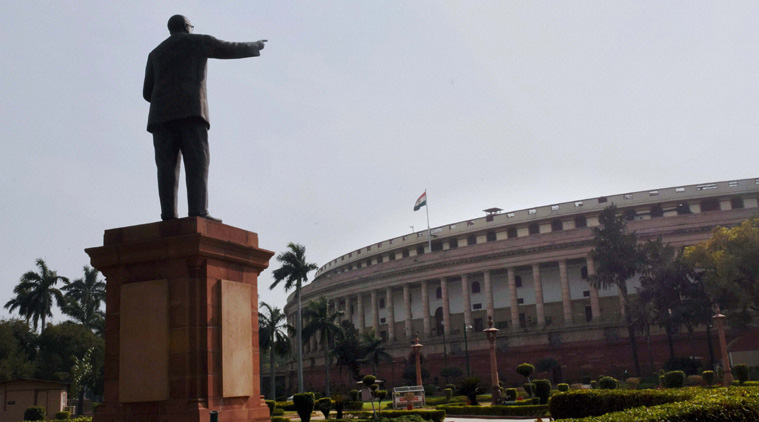
Government moves to double MPs’ salary to Rs 2.8 lakh a month

The proposal, currently with the Finance Ministry, also suggests that basic pension should be raised from Rs 20,000 per month to Rs 35,000.

parliament-7591

The government has proposed increasing the monthly salary of an MP from Rs 50,000 to Rs 1 lakh, constituency allowance from Rs 45,000 to Rs 90,000 and secretarial assistance plus office allowance from Rs 45,000 to Rs 90,000.

The central government seems set to double the salaries and allowances of Parliamentarians. If a proposal in this regard is approved by the Finance Ministry, every MP will get Rs 2.8 lakh per month. Their pension, too, will see a jump.

watch vedio  below

https://www.youtube.com/watch?v=XYlkvjpFjsc

The government has proposed increasing the monthly salary of an MP from Rs 50,000 to Rs 1 lakh, constituency allowance from Rs 45,000 to Rs 90,000 and secretarial assistance plus office allowance from Rs 45,000 to Rs 90,000. The proposal, currently with the Finance Ministry, also suggests that basic pension should be raised from Rs 20,000 per month to Rs 35,000. Those who have served for more than five years would get an additional amount — the number of years multiplied by Rs 2,000. Currently, the additional amount is the number of years multiplied by Rs 1,500.

If the Finance Ministry agrees to allocate the amount, Parliament will amend the Salary, Allowance and Pension of Members of Parliament (Amendment) Bill to incorporate the changes, sources said. “The ministry is expected to accept the proposals,” said a top government official.

The Finance Minister had allocated Rs 295.25 crore for Lok Sabha MPs and Rs 121.96 crore for Rajya Sabha MPs — which includes expenses such as travel — in his last budget.

IAF BASE ATTACKED Driver’s killing was a professional’s job

5Jupinderjit Singh,Tribune News Service,Chandigarh, January 9

2016_1$largeimg10_Sunday_2016_011527507

Allegedly attacked by militants in the wee hours of January 1, curiously the nature of injury on  deceased taxi driver Ikaagar Singh’s neck and that of the injured jeweller Rajesh Verma is very different. Both were allegedly assaulted by a sharp-edged weapon.Doctors who conducted the  medico-legal examination say Ikaagar’s throat may have been slit by a professional killer. But the same could not be said about the jeweller, who survived the attack.Officials wonder if Ikaagar and Rajesh were attacked by different terrorists who formed part of the group that let off Salwinder Singh, SP, or by different groups of militants. Doctors and police officials say Ikaagar’s injuries show he may have put up a resistance against the attackers. But in case of Rajesh, there are no such signs.  Ikaagar’s body had stab wounds in the chest and the stomach.Investigators are yet to declare Ikaagar clean as a phone call from Pakistan was received on his phone. But Satnam Singh, the deceased’s brother, says his brother scuffled with the militants and that is enough proof of his innocence. “My brother fought the terrorists. He tried to overturn the car to stop the terrorists from reaching their target. That is why the Chief Minister has acknowledged his sacrifice. On the other hand, a trained police officer with years of experience could not do anything,” he remarked.While Ikaagar’s body was found near Kathlore bridge on way to Pathankot from Kohlian village chowk, his Innova car was found abandoned 2 km from Kohlian village town towards Pakistan. Two tyres of the car were deflated.Ikaagar lived in an impressive house in Bhagwal village. He had bought a second-hand Mahindra Scorpio worth Rs 3 lakh two weeks ago for which he took a loan.The police are trying to ascertain if Ikaagar had any other source of income as his life style was opulent. “On the one hand they declare him a martyr and on the other, they have doubts about him. Why would he have struggled with the terrorists if he was hand in glove with them? Why did terrorists kill him and not the SP,” asked Ikagaar’s brother.The Punjab government has declared Ikaagar a martyr even though the investigations are yet to be completed. The family has been paid a compensation of Rs 5 lakh and the government has promised a job for his sister or wife.The narrow street to his house is being paved again. It would be a huge embarrassment for the government if found that Ikagaar had ties with anti-social elements.


Governor briefed on security along LoC, border

Tribune News Servic,Jammu, December 22

2015_12$largeimg22_Tuesday_2015_235325382

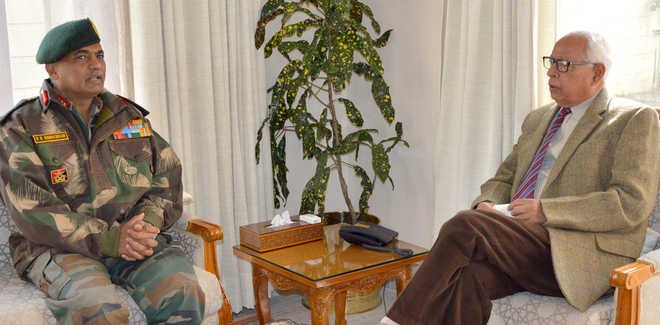
Governor NN Vohra today reviewed the security scenario on the Line of Control (LoC) and international border and discussed measures that could enhance transparency in the administrative set-up.In a meeting, General Officer Commanding of 16 Corps, Lt Gen RR Nimbhorkar briefed the Governor about the situation along the LoC and the emerging security environment during the current winter.The Governor discussed with Lt Gen Nimbhorkar several issues related to more effective surveillance of the international border and further strengthening of the counter-infiltration grid. The Governor also spoke about security concerns in the hinterland.In a separate meeting, Chief Information Commissioner GR Sufi apprised the Governor about the efforts being made by the Commission for enabling implementation of the Right to Information Act, 2009, in the state and enhance awareness among the masses regarding their right to seek relevant information from all public offices under the Act.The Governor discussed with Sufi the measures which could be taken to further enhance transparency in the functioning of the administrative apparatus in Jammu and Kashmir.The Governor also met Ranjeet Singh, national president of the Bahujan Kranti Party (BKP) (Marxvad-Ambedkarvad). BKP president Ranjeet Singh submitted a memorandum to the Governor regarding the BKP’s demands.The demands included bringing about constitutional and statutory provisions for improving the electoral process, particularly deleting the names of contesting candidates from ballot paper; election-related expenditure being met by the government instead of candidates and political parties; elections being contested on the basis of party ideology and not in the name of any individual; grant of right to political parties to recall elected candidates; terminating recognition of political parties which fail to fulfil 75 per cent of promises mentioned in their election manifestos; and doing away with MPLAD and constituency development funds.

Army holds blood donation camp

A blood donation camp was organised by the Jammu and Kashmir Light Infantry Regimental Centre under the aegis of the Chinar Corps, on its Rangreth here on Monday.The camp was inaugurated by the Officiating Commandant, JAK LI Regimental Centre, Col AA Bapat.A defence spokesperson said the camp was organised with a view to augment the stock of blood at the civil hospital in Srinagar.“Nearly 50 Army personnel from the Regimental Centre donated blood. The blood units collected were provided to Lal Ded Hospital in Srinagar,” the spokesperson said.Senior officials of the Public Health Department present during the event mentioned that the blood will meet the urgent surgical requirement at the hospital.