All posts by webadmin

Comments by Veterans on OROP

Dear General Satbir sir,
No one is in better picture than you with regards to OROP, therfore I will restrain myself from review of the situation.
I submit the following for your consideration:-
1. Whatever has been achieved is from Jantar Mantar has been achieved. I see no point in continuation of our fight from JM in the existing form as it is not likely to yield any further results with the kind of sensitivity of our Govt. therefore we should call off the protest from JM. There is no point in frittering away our energy & resources.
2. We should file a petition in supreme Court in the wake of parliament’s passing it twice duly ratified by the President.
3. We should keep the issue alive by holding periodic press conf for the sake of Media. .
4. We should hold massive rallies of single day duration in Delhi once in every 4-8 weeks with a view to keep the torch burning amongst ESM & public. Similar action is recoomended in various states & Districts by respective Local ESM.

I have made these suggestions for immediate action. Long term strategy can be thought, deliberated & decided. You already have that in mind. But the Supreme Court Option is necessitated.

Not withstanding my suggestions whatever you decide, we will cooperate.
With this assurance & Regards
919456364035 (1)
Brig Vijay Kumar
Dehradun


In One Rank One Pension, Rs. 8,000 Crore Diwali Gift for Veterans

NEW DELHI: Over 25 lakh veterans across the country will get at least Rs. 3,000 to 5,000 more in pensions – depending on their last rank and years of service. And this will cost the exchequer a minimum of Rs. 8,000 crore to start with.
The increased pension will be paid with effect from July 1, 2014.
The Government today issued the much awaited One Rank One Pension or OROP scheme. Although, a formal announcement on OROP was made on September 5, no official order was issued because of Bihar elections and the Election Commission’s Model Code of Conduct.
Defence Minister Manohar Parrikar signed the official notification today evening making good his promise that the government will implement OROP before Diwali.
Pension arrears to widows and gallantry award winners will be paid in one go, the government said showing sensitivity. Others will get arrears in four equal instalments. But it was clear that veterans may not find all their demands met.
Pensions for all veterans will be equalized every five years although veterans want it equalized every two years at least. The government says this would be an administrative nightmare.
Reacting to the notification, Major General Satbir Singh (Retd) said that the notification “is not accepted”. “This is ‘One Rank Five Pension’ and not ‘One Rank One Pension’,” he told news agency news agency ANI.

“This is injustice to the soldiers, we’ll fight with the government in court,” he said.
Also, in future, soldiers who quit without completing their full term irrespective of whether they have made it to the next rank will not get OROP. For instance, if a Colonel who doesn’t make it to the next rank – Brigadier – retires before 54 years – when he completes his full term – will not get OROP.
This is also not acceptable to veterans. They claim that this forces soldiers to continue with the forces without any future prospects. Also they claim this is in contrary to keeping the forces young.
Further, the Government has appointed a one man judicial commission to examine issues. Force issues while veterans want the committee to comprise soldiers only.


Not what India wanted by Maj Gen Ashok Mehta (retd)

Not what India wanted
THE BAGGAGE: Seen as the key architect of ending the 30-year war against the LTTE, Gotabaya has been critical of India.

Maj Gen Ashok Mehta (retd)
Defence Commentator

THE winner in the seventh Sri Lankan executive presidential election is Sri Lanka Podujana Peramuna’s  (SLPP) Nandasena Gotabaya Rajapaksa. National security trumped economy, democracy and reconciliation. That an authoritarian regime in which Gota played a key role in ending the country’s insurgency has bounced back to power,  after only five years, is not surprising,  given the lackadaisical record of the incumbent United National Party  government. This time, there was no grand alliance to stop the Gota juggernaut.

The key to winning a presidential election in Sri Lanka is garnering the minority Tamil and Muslim vote, given that rival contenders are usually neck and neck in majority Sinhalese areas. In order to vanquish Gota, the National Democratic Front’s Sajith Premadasa had to eat into Gota’s Sinhalese constituency. The reverse happened. Not only did Gota outvote Sajith in the south, but also made a dent in his minority vote in the north-east. In the last two presidential elections, like this time, too, the minorities voted en bloc in favour of Gota’s elder brother, former President Mahinda Rajapaksa’s opponents. The election was not finely balanced as expected. A New York think tank, Eurasia Group, got it wrong, predicting a 55% chance of a Premadasa victory over 45% for Rajapaksa.

Gota, a former Colonel from Gajaba Regiment and Mahinda’s defence secretary, is seen as the key architect of ending the 30-year war against the dreaded LTTE. Due to the 19th amendment, Gota was an early bird in the contest whereas the opposition could not pick its contender till six weeks before the elections. Initially, Gota came out as a reluctant debutant, a soldier discomfited in a politician’s role. But the lure of an executive president’s job, even if diminished by the 19th amendment, is still the ultimate aphrodisiac. Under Mahinda’s divine shadow, Gota’s campaign gathered momentum, notwithstanding his linkages to ‘white van’ disappearances, murder of a journalist, sundry corruption charges and alleged human rights violations in the war. It is a near miracle that he managed to keep his head above water. He had to renounce his US citizenship mandated by 19A.

Ironically, this year’s Easter Sunday bombings in Colombo by six local Muslim suicide bombers linked to Daesh, which caused catastrophic casualties and damage,  came as a godsend to Gota. It shot up national security, as internal stability was rocked after a decade of peace. The colossal bungling of the incumbent regime during the tragedy made people yearn for the return of the Rajpaksas. Two other challenges meant to undercut Gota’s chances did not work — a former army commander, Gen Mahesh Senanayake, who distinguished himself after the Easter Sunday bombings, standing as President; and Premadasa announcing that if he won he would appoint Gen Sarath Fonseka, another former army commander and a war hero who unsuccessfully contested presidential elections against Mahinda in 2010, as his defence minister.

In an atmosphere charged with extreme nationalism and reverence for the military, Gota announced he would release all army personnel in jail for alleged human rights violations, and that no war hero would be investigated for excesses during the war, thus countermanding the government’s commitments to the Human Rights Council in Geneva, when Colombo co-sponsored US resolution 30/1 in 2015.  

The UNP’s youthful Sajith Premadasa, the underdog, was a late entrant and gave his best, but could not switch economy and development to replace national security, which was on top of the election agenda, because his government’s record on them was shoddy. His father, a one-term President assassinated by the LTTE, was renowned for his housing programme for the poor, which he replicated. In the end, Sajith could not convince the southern majority Sinhalese that he was their choice for President. While Gota was victorious in nearly all 15 southern provinces, Sajith won just the five north-eastern and Nuwara Eliya provinces. That was insufficient to out-Gota the Rajapaksas.

PM Modi was quick to congratulate Gota. That India was part of the plot to dislodge Mahinda in 2015 is New Delhi’s worst-kept secret. Mahinda has openly accused R&AW of engineering his defeat. Gota’s younger brother and chief strategist, Basil Rajapaksa, a former commerce minister in Mahinda era, has said Mahinda is their supreme leader, adding that while India is their closest neighbour and friend (Mahinda used to call India a relative) — and that they will depend on it for political security — they will count on China for economic development. How this will play out of the ground with Gota, who was critical of India during the war, at the helm only time will tell.

New Delhi now emphasises it will work with a President Sri Lankans elect. Sri Lanka is at a crossroads. Will Gota follow his brother Mahinda’s anti-West (and anti-India) path or contrary to what he has said in his campaign about withdrawing from international agreements, a more balanced policy?

President Gotabaya Rajapaksa was sworn in, with a government headed by PM Ranil Wickremesinghe of the opposition United National Party. Another awkward interregnum could follow as parliamentary elections are due in mid-2020, and extendable by 53 days, the time consumed in the constitutional crisis this year. Till then, cohabitation could be explosive and ended by the President dismissing the government four-and-a- half years into its term, and advancing elections, expecting SLPP victory with Mahinda Rajapaksa as PM. Recently Mahinda said: ‘The real power is with PM’!



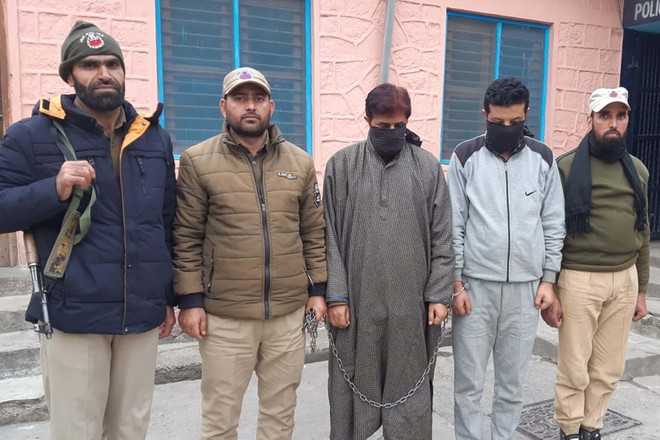
Fake Army recruitment racket busted in Ramban dist, 2 held

Fake Army recruitment racket busted in Ramban dist, 2 held
The accused in the Jammu and Kashmir police custody on Thursday.

our correspondent

Jammu, November 14

Two persons have been arrested for allegedly running a fake Army recruitment racket and duping several people of lakhs of rupees in Ramban districts on Thursday.

The police claimed that Mohammad Qasim, resident of Kangan district, Ganderbal, and Ashiq Yousuf, resident of Lar, Ganderbal, duped many persons hailing from Bishna, Kupwara, Banihal, Ramban and Samba of Jammu and Kashmir of lakhs of rupees.

The police said a Banihal youth in a written complaint alleged that Mohammad Qasim duped him and his friends of Rs 1.5 lakh on pretext of providing job in the Army (TA) by providing fake joining orders.

However, the police arrested both the accused and recovered fake appointment order copies and joining letters of the Army from their possession.

The police claimed that during questioning both the accused confessed to the crime.


BSF’s hi-tech interpretation centre at Attari soon

BSF’s hi-tech interpretation centre at Attari soon

Vijay Mohan

Tribune News Service

Chandigarh, November 13

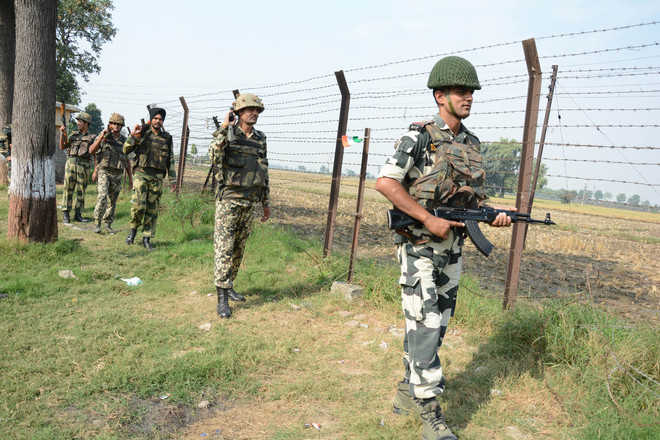
To showcase its history and role, the Border Security Force (BSF) is setting up a hi-tech interpretation centre at the joint check post at Attari on the border with Pakistan.

The Retreat at Attari attracts about 15,000 visitors from across the country and abroad on weekdays and up to 25,000 on weekends or holidays. This, the BSF believes, is an ideal venue to project its activities.

“The process of setting up an interpretation centre has commenced and the entire work of conceptualisation, designing, construction and installation of display items will be outsourced on a turnkey basis,” a BSF officer said. “The project is expected to complete in about two years,” he said.

The centre will have several galleries with different themes, such as the history of the force, its role and allocated tasks, deployment on the eastern and western theatres, counter-insurgency and internal security duties, international peace-keeping missions, organisation and rank structure, achievers and martyrs. There will be a separate gallery for displaying weapons, surveillance equipment and communication gadgets used by the border guarding force. Another gallery will be dedicated to BSF’s specialised wings, such artillery, air wing, marine wing, commando wing, camel squads and dog squads.

Feats on display

  • The centre will have several galleries with different themes, such as the history of the force, allocated tasks and deployment on the eastern and western theatres among others
  • There will be a separate gallery for displaying weapons, surveillance equipment and communication gadgets used by the force


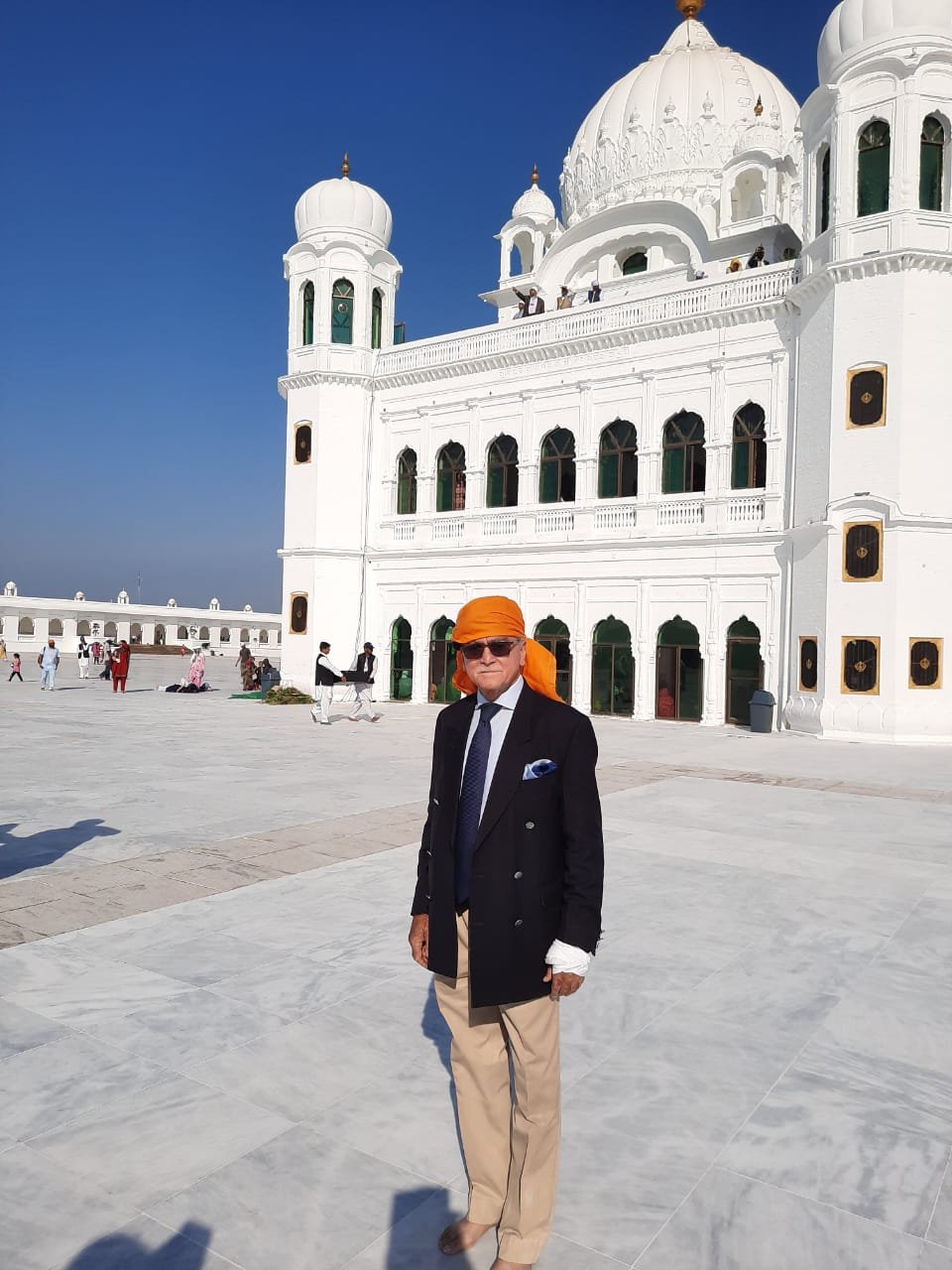
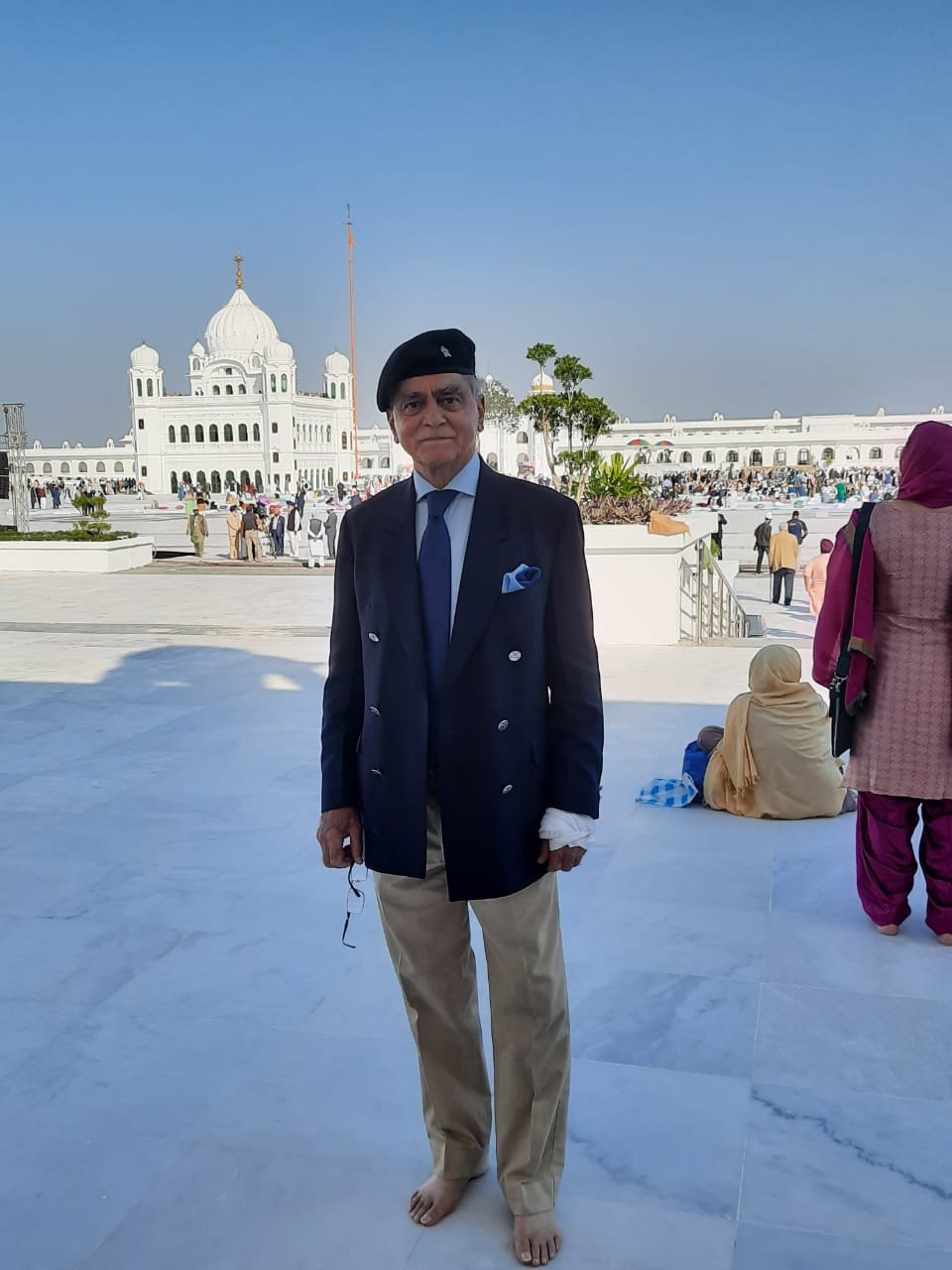
At Baba Nanak’s dwar, in Pakistan

Manohar Singh Gill

I was born in Aldinpur, a kilometre from Tarn Taran, Punjab. The township was founded by Guru Arjan, the fifth Guru, who stayed there for 25 years, till tortured and martyred by Emperor Jahangir in Lahore. I believe Guru Nanak is the daata of everything in Sikhism, but Guru Nanak and Sikhism would have disappeared a century after him but for the compiling of Guru Granth Sahib by Guru Arjan. His father, Guru Ram Das, initiated the construction of Darbar Sahib, Amritsar, but died soon after. Guru Arjan compiled Guru Granth Sahib, completed the Darbar Sahib, and installed Guru Granth Sahib there. If there were no Guru Arjan and Granth Sahib, Guru Nanak’s teachings would have faded.

His field of action was West Punjab, beyond the Ravi, in a pre-dominant Muslim population. I prefer to call him Baba Nanak, a more loving and affectionate term. None of the later Gurus were so addressed. I said in Parliament and repeat, that the partition was not of India, but of Punjab. We lost all the rich canal colonies and were cleaned out from the West. The Sikhs with their fortitude made a new life in the East, in poor and limited land.

What was the Muslim feeling for Baba Nanak? I have been to Pakistan a number of times. I asked to be taken to Kartarpur. It was not open to the Sikhs and there was no keenness on either side to do so. On my visit, I travelled alone, with no security, just a friend, to Kartarpur. I asked the local MP that I wanted to meet at least 400 people from the surrounding villages. He was happy to oblige. I believed that Baba Nanak was for the masses, most of all the poor. Therefore, I wanted to meet the Muslim population. The gurdwara was small, in a few acres; it had five Sikhs for service and stood in isolation away from any village. The villagers had come in large numbers; pilao had been made and charpais laid out. I wanted some singers of Bulleh Shah, Waris Shah and others. Three men sang for me. Baba Nanak, without the Sikhs, still had his shardhalus. They came regularly, in large numbers, to seek his solace. Baba’s dwar continued to have raunaq.

When I became MP in 2004, I went for the first time to Dera Baba Nanak, on our side, in Gurdaspur. I was shocked. People came, bowed in the dust, cried and went home. In the Punjab Government, officers like me, and all ministers simply ignored Dera Baba Nanak. Once I realised what I had missed, I began to make continuous propaganda in all language papers and in any other way. I demanded that the 4-km path be opened, with security wire put on the sides, and police on duty on either side. The Sikhs should be allowed, without passports or visas, to walk across, pray and come back. There was indifferent silence on both sides. When I went to Pakistan, I was interviewed as a former Chief Election Commissioner. I always asked to speak on Kartarpur. I put it to them that the Indian Government was sending Muslim pilgrims to Mecca at state cost and deliberately said that all world faiths can visit there “Meccas” and why then were they not allowing Sikhs to walk over to Kartarpur, our ‘Mecca’. As it happens, Baba Nanak’s main shrines, Nankana Sahib, Kartarpur and Panja Sahib are all in Pakistan. I believed this was an issue even for the UN, as we were the only people so punished.

I am giving this past not to claim anything. I believe Baba Nanak is doing this for us, in this year of remembrance. Our prayers have been heard. I thank the people of Pakistan for finally seeing the light. The work on both sides and the tremendous world interest will only promote what Baba Nanak preached. First, “Naa koi Hindu, Naa Musalman”, we see no other. “Sabna jiyan kaa ik daata”, let me not ever forget, says Baba Nanak. In our morning, evening prayers, in our ardas, our final prayer, is, “Nanak Naam Chardi Kala, Tere Bhane Sarbat Daa Bhala.” Remembering your Name and your highest being, I pray for the benefit of all.

— The writer is a former MP and CEC


Corridor may help resolve conflicts: Ex-PM Wants Kartarpur model to be replicated in future as well

http://

Ruchika M Khanna
Tribune News Service
Chandigarh, November 6

The special commemorative session of the Vidhan Sabha, convened to mark the 550th birth anniversary of Guru Nanak, saw the Congress taking “Panthic hues” and the party’s former Prime Minister Manmohan Singh talking of how Punjab was moving away from the Guru’s philosophy, as its youth were getting addicted to drugs, air and water were polluted and culture being eroded.

The session was attended by Vice-President M Venkaiah Naidu, Governors of Punjab and Haryana VP Singh Badnore and Satyadeo Narain Arya and Chief Ministers Capt Amarinder Singh and ML Khattar. The session also saw legislators from both Punjab and Haryana sit in the Vidhan Sabha hall after more than 50 years.

Raising “jaikaras” and chanting hymns, five Congress MLAs — Parminder Singh Pinky, Kulbir Singh Zira, Fatehjung Bajwa, Varindermeet Singh Pahra, and Darshan Brar — came barefoot, wearing siropas and chanted hymns, even as Aam Aadmi Party and Akali-BJP MLAs looked on. The five MLAs were joined by other Congress MLAs who stood there and raised the “jaikara” with them, just as the VIP guests came in.

Naidu began his speech in chaste Punjabi and used several quotes of the first Sikh Guru on creating an ideal society. Incidentally, he was the only one to have also addressed former CM and Akali Dal patriarch Parkash Singh Badal before he beginning his speech, even as Manmohan Singh, Capt Amarinder and Speaker Rana KP chose to ignore him in their addresses.

Naidu hoped that the opening of the corridor would be a sign of peace, harmony and humanism, and contribute to the realisation of Guru Nanak’s vision of an ideal society. “In a world that is increasingly fragmented with narrow tunnel vision, bigotry and dogmatism, we needall the strength to dispelthe darkness that constantly threatens to envelop individuals, communities and nations,” he added.

Manmohan Singh said the Kartarpur model should be replicated in the future too as a lasting resolution of conflicts. “I appeal to you all to spread Guru Nanak’s message of love and respect to ensure an equitable society. Guru’s eternal message of oneness of God, religious tolerance and peace could pave the way to end sectarian violence, which was the biggest challenge facing the world,” he said.

Capt Amarinder gave a call for the protection of nature to save the future generations from the devastating effects of environmental pollution. Recalling the Guru’s ideology “Pavan Guru, Pani Pita, Mata Dharat Mahat” (Air is the guru, water the father, and earth the mother), he underlined the intrinsic bond between nature and mankind.

Bills passed

The House unanimously passed a Bill to establish Jagat Guru Nanak Dev Punjab State Open University in Patiala. However, opposition MLAs raised question as to why another university was being set up in the royal city. Parminder Dhindsa said it should be established at Sultanpur Lodhi.

Lunch diplomacy

  • At the special lunch after the session, Capt Amarinder and his bete noire Parkash S Badal sat on the same table, though at a distance. Haryana Dy CM Dushyant Chautala sat next to Badal
  • Sukhdev Dhindsa sat close to the CM, while Bikram Majithia at the other corner
  • After the lunch, Amarinder’s wife Preneet Kaur walked up to Badal and enquired about his well-being
  • Vice-President Venkaiah Naidu, former PM Manmohan Singh, Haryana Chief Minister Manohar Lal Khattar, and both Punjab and Haryana Governors did not stay back for lunch
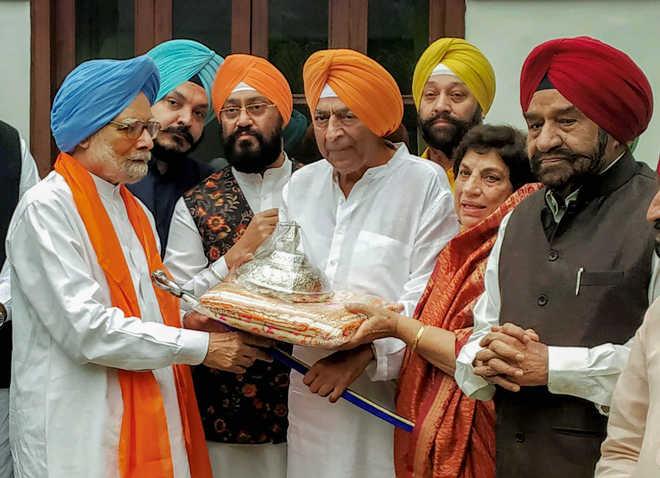
  • Chhatra’, ‘rumala’ for Kartarpur Sahib handed over to Manmohan Singh

  • ‘Chhatra’, ‘rumala’ for Kartarpur Sahib handed over to Manmohan Singh
  • A delegation of Delhi Congress leaders led by DPCC President Subhash Chopra felicitate former prime minister Manmohan Singh ahead of his visit to Gurdwara Darbar Sahib in Pakistan through Kartarpur corridor, at formers residence in New Delhi, Thursday, Nov. 7, 2019. (PTI Photo)

Sepoy cremated with state honours

Sepoy cremated with state honours
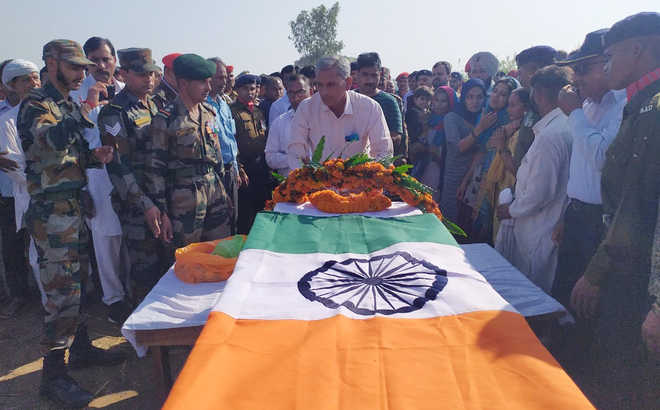
Family members and officials pay their last respects to Sepoy Randeep Singh at Dera Hariyoli village.

Tribune News Service

Ambala, November 4

Sepoy Randeep Singh, a resident of Dera Hariyoli in Ambala, was cremated with state honours at his native village on Monday. Randeep died of heart attack in Sikkim while on duty in the wee hours on Saturday.

Commanding Officer Rajat Sehrawat, Subedar Major Haripal, Mullana MLA Varun Chaudhary, DSP Amit Bhatia, Tehsildar Punyadeep Sharma and a large number of other people laid wreaths and paid their tributes as a mark of respect to the deceased Army man.

Randeep (33) of the 27th Rajput Regiment was posted at Nathu La Pass. He is survived by wife Anjali and two minor daughters Manvi (6) and Riya (3). He joined Army in 2005.

Randeep felt pain in his chest on Friday and then again on Saturday, following which he was taken to the military hospital for treatment where he breathed his last.

Meanwhile, kin of the Army man marked their resentment after not finding any senior district official or government representative at the cremation. They said no senior official has visited the family yet.

However, the district administration maintained that representatives from the administration, Zila Sainik Board and the police attended the last rites of the Army man.

Ex-serviceman Shripal Singh, Randeep’s uncle-in-law, said, “We were told that Randeep is unwell and has been taken to military hospital, but there was no official information about his demise. We came to know about his death only after my niece read a status on social media, which was posted by Randeep’s colleague on Saturday morning.”

“We were told that Randeep died due to heart attack. He was on duty at Nathu La Pass when experienced chest pain. It is sad that no senior official has visited the family even after three days of his demise.”


AFT: Pay military pensioners as per length of service

AFT: Pay military pensioners as per length of service

Vijay Mohan
Tribune News Service
Chandigarh, October 30

In a decision that will come as a major relief to military pensioners, the Armed Forces Tribunal (AFT) has ruled that the pension payable to such individuals should be calculated on the basis of actual length of service rendered by them, not as per the theoretical ‘maximum terms of engagement’ prescribed for their rank.

Allowing the petition of a 96-yrear-old IAF veteran, Master Warrant Officer Chander Bhan, the AFT’s Chandigarh Bench comprising Justice Virender Singh and Vice Admiral AG Thapliyal has ruled that the master policy of the Ministry of Defence (MoD), as approved by the Cabinet, is clear on the point that pension is now to be regulated as per the rank and length of service, irrespective of the date of retirement.

Bhan, who had joined the erstwhile Royal Indian Air Force in 1944 and was released from service in 1980, had contended that while he had served for 36 years, he was being paid the pension applicable to 28 years of service under the One Rank One Pension on the pretext that though he had served longer, the maximum terms of engagement mentioned in rules for his rank was only 28 years. Hence, in accordance with the implementation instructions issued by the MoD, pension was to be restricted as per maximum terms applicable for the rank held by a person at the time of retirement.

The Bench held that the implementation instructions could not pose any additional impediment since it would amount  to dividing pensioners based upon the maximum terms of engagement applicable at different dates of retirement. The Bench also observed that the earlier accepted recommendations of pay commissions had pegged pension to a maximum term of 33 years and the same could not be reduced through administrative instructions. It added that it was also arbitrary to pay pension for a lesser length of service when he was made to serve much longer.

Incidentally, this was the last judgment by Justice Virender Singh who retired this month after having served as the AFT chairperson. The AFT is currently functioning with only two judicial members against the sanctioned strength of 17. The remaining two members are scheduled to retire in December this year. Though the MoD has advertised vacancies, the appointments would be subject to the outcome of a case challenging AFT rules that is pending before the Supreme Court.

Win for 96-year-old

  • Allowing the petition of a 96-yrear-old IAF veteran, Master Warrant Officer Chander Bhan, the AFT’s Chandigarh Bench has ruled that the master policy of the Ministry of Defence is clear on the point that pension is now to be regulated as per the rank and length of service, irrespective of the date of retirement