Pakistan today said it had informed the European Union and major world capitals about the arrest of an Indian “spy” from restive Balochistan province and asked Iran to provide details of his “spy network”.Kulbhushan Yadav, alleged chief operative of the Research and Analysis Wing (RAW), was arrested by Pakistani security agencies from Chaman, near Quetta, last week.Foreign Office spokesperson Nafees Zakaria said major world capitals and EU had been informed about the arrest of a serving Indian Navy officer for planning “subversive activities” in Pakistan.The entire world has seen the admission statement of the Indian agent, Zakaria said, referring to the so-called “confessional video” of Yadav released earlier this week by the Pakistan army.Zakaria said Pakistan had earlier provided the United Nations with evidence of Indian interference and terror activities in Pakistan.India has acknowledged Yadav as a retired Indian Navy officer, but denied the allegation that he was in any way connected to the government.“The said individual has no link with the government since his premature retirement from the Navy,” said a statement issued by India’s Ministry of External Affairs, while demanding counsellor access to him. — PTI
Iran fumes over complicity charge
Iran on Thursday warned Pakistan that some reports in Pakistani media linking the arrest of Kulbhushan Yadav with Tehran could have “negative implications” on bilateral ties
The Iranian embassy issued a statement after media hints that Tehran might have knowledge about Yadav
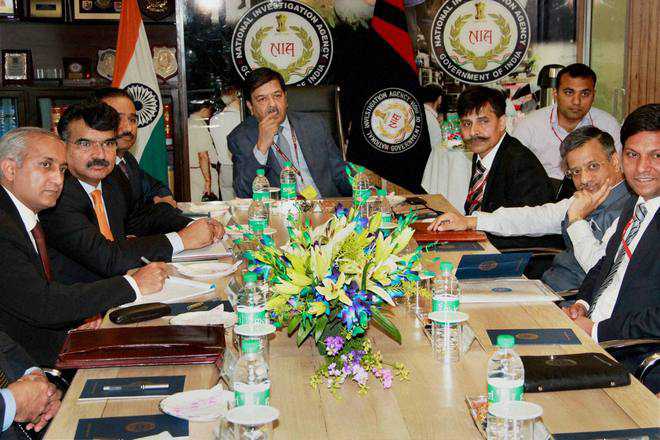
NIA Director-General Sharad Kumar chairs a meeting with Pakistan’s Joint Investigation Team members in New Delhi on Monday. PTI
Shaurya Karanbir Gurung & Mukesh Ranjan
Tribune News Service
New Delhi, March 28
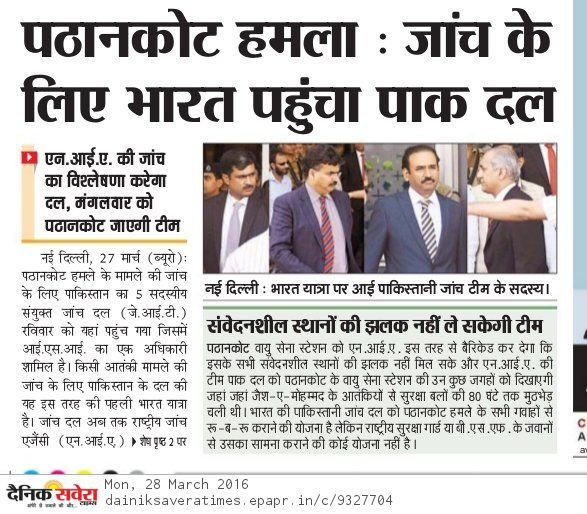
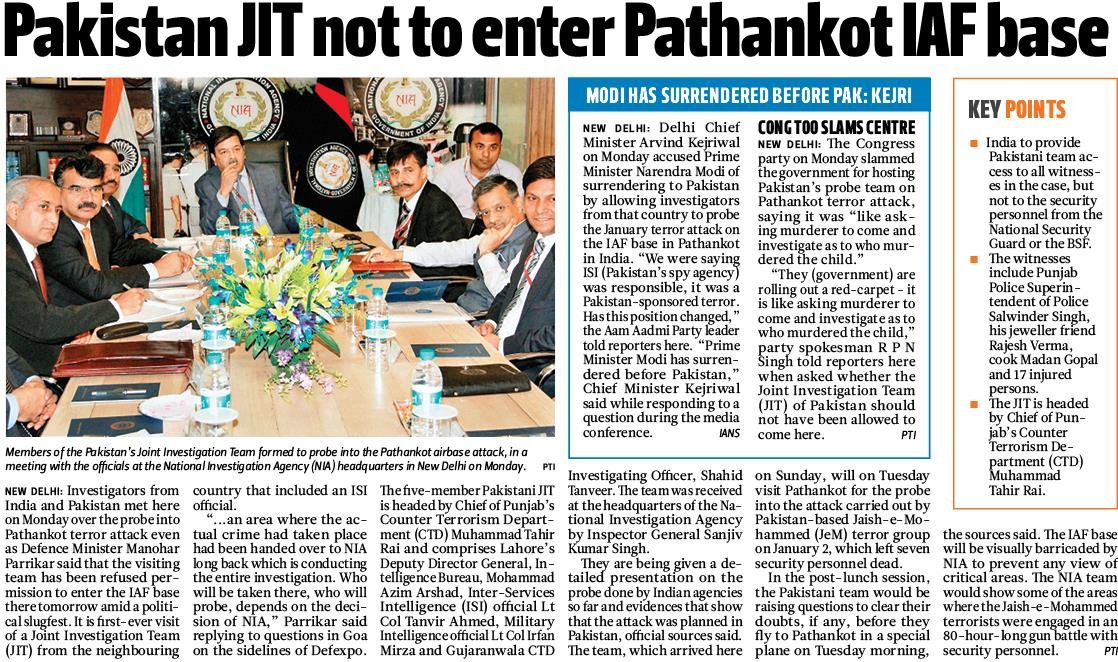
India today shared with Pakistan’s Joint Investigation Team (JIT) the details establishing Pakistan nationals’ role in the Pathankot air base attack as the team met Indian investigators.The JIT members, it is learnt, did not raise objections to the evidences of the involvement of terror group Jaish-e-Mohammed (JeM) and other Pakistan nationals.A day after their arrival, the JIT members reached the National Investigation Agency (NIA) headquarters, where they were briefed about the probe carried out so far.After daylong deliberations with the team, NIA Director-General Sharad Kumar, while talking to The Tribune, said: “We are ready to share all information and evidences available with us as part of our investigation. Our probe is transparent and we have nothing to hide. But we need cooperation and reciprocity from Pakistan in the interest of the investigation to reach a conclusion.”During the interaction, the Indian investigators gave a presentation to the visiting officials on the findings of the investigation so far.India put forth evidences that allegedly linked JeM’s head Maulana Masood Azhar and the leadership to the attack, an NIA source said.“We have evidences and intercepts of the conversations between the slain terrorists and their JeM bosses, including Azhar and his brother Rauf Asgar. We also have a video of Asgar declaring that he sent the terrorists,” said the source.Right before the attack, Azhar was in contact with Asgar, the JeM’s commander, who was further in touch with their key planner and handler Kashif Jaan, explained the source. In most conversations, Kashif was talking to the terrorists from Bahawalpur in Pakistan. “He was dictating to them how the plan had to be executed. The JeM bosses, including Kashif, had escorted the terrorists to the point of infiltration into India,” said the source, adding India had sought voice samples of Azhar, Asgar and Kashif.India also showed to the JIT photographs of the arms and ammunition — carried by the terrorists — allegedly bearing Pakistan marking, said the source. Clothes, medicines, shoes, food packets, thermal wear and even wire cutters were also allegedly brought from Pakistan.One of the terrorists had spoken to his cousin and mother based in Pakistan before the attack, said the source. The NIA showed proof of this conversation to the JIT and demanded the DNA samples of the terrorist’s mother from Pakistan.“We have shown them the evidences (in relation to the JeM and Pakistan’s link to the attack) and the JIT has not raised objections,” said an NIA officer. India had also sent Letter Rogatories (LRs) to Pakistan, seeking evidences in connection with the attack. India also asked the JIT to respond to the LRs, if they wanted to cooperate with the investigation.While the NIA officer denied the Pakistan team making requests regarding the attack’s investigation, sources said the JIT demanded the call data records and the IMEI numbers of the mobile phones, belonging to Punjab Police Superintendent Salwinder Singh, his wife, gunman, the base commander of the Pathankot Air Force Station and others related to the case.Singh with his jeweller friend Rajesh Verma and cook Madan Gopal were allegedly abducted on the night of December 31-January 1 by the terrorists, who had attacked the airbase on January 2. The JIT further demanded the sketch and the CCTV footage of the gun battle, a copy of an alert issued to the airbase, details of security measures taken by the base commander, said the source. It also wanted a report on the alleged border crossing and the BSF deployment along the International Border with Pakistan. The Pakistan team sought access to the Garud commandos, National Security Guards and any witnesses who have seen the terrorists. The team asked the Indian side to give the autopsy report, DNA samples and the details of itemsrecovered from the terrorists.
No objections raised
India shared intercepts of conversations between slain terrorists and their JeM bosses besides photos of arms and ammunition bearing Pak markings, an NIA source said. “We have shown them the evidences and the JIT has not raised objections,” an officer said
Limited air base access
Amid attacks by the Opposition over allowing Pak team to probe the attack, Defence Minister Manohar Parrikar said the JIT would be given access to an isolated crime spot and not the entire air base during Tuesday’s visit.
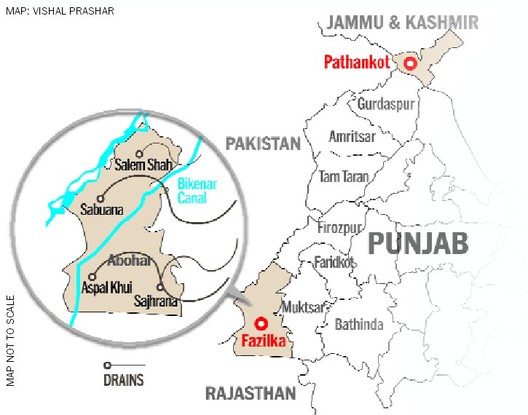
Living near the border is like being perched on a live wire. The entire border belt starting from Fazilka up to Gurdaspur is an example of how things have become increasingly difficult for villagers over the years. There are no jobs, no worthwhile healthcare and crops in large tracts have been damaged by water-logging. Coupled with this is the tense security situation post Pathankot and Dinanagar terror attacks. Sarbjit Dhaliwal & Prashant Saxena travel along the route
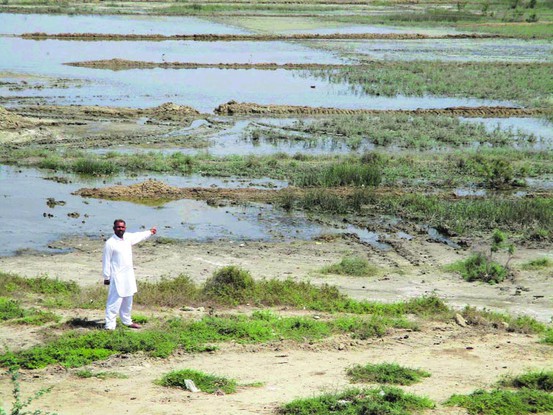
A farmer points to a pool of drained out water in a vast stretch in Fazilka. Tribune Photo
There are signs of dystrophic malfunction in government machinery as you move beyond vast stretches of agricultural land along the Indo-Pak border from Abohar-Fazilka up to Pathankot. As the wheat crop takes a golden hue, the barbed fencing demarcating the two sides becomes invisible. You don’t even remember the names of villages; their very existence tends to be strangely surrealistic, a kind of reassertion of the ennui of the last over 67 years of partitioned history. One village here, another across the fence, tons of wheat here and tons there, roars of ‘Bharat mata ki jai’ inches within and ‘jive jive Pakistan’ a few yards away. For those looking for a radical dissimilarity in anything of substance, here’s some laconic levity in the tedium: Both sides live off water, land and air! And since this side is clearly visible, there is a perception of a deliberate attempt to keep the people off their main occupation: vast swathes of farmland lie waterlogged in the Fazilka belt, because of the natural gradient that sends even sewage water being drained out of Muktsar, the home district of Chief Minister Parkash Singh Badal, to these areas. There has been no crop for the last about two years as frothy, murky water has turned the soil into saline crust.
An Indian farmer works in his field under the supervision of a BSF jawan across the fence, an area allowed for cultivation, in the Amritsar sector
Official communications are slow and verbose, as officials blame Pakistan for building a bandh on their side restricting the natural flow. Indebtedness among farmers is thus rampant, and coupled with the lack of job avenues, the voices of resentment are getting louder. Trading activity across Sadiqe and Husseniwala, locked after wars with Pakistan, is something everyone wants resumed, but no one knows how. In the gamut of living, there are undiagnosed diseases among children at Teja Rohela, where some kind of muscular dystrophy or bone deformity has affected many children: they can’t walk, they crawl. Though various government and NGO surveys blame bad water and soil, none has reached a definite conclusion. There are no hospitals, only Job’s comforters. As The Tribune team travels along Fazilka-Ferozepur-Amritsar-Pathankot border route, there is much more, something well-wrapped in government files, and something such plain sight that no one really cares to feel.
Driven to debt
In village like Shajrana, well-off farmers are now feeling helpless. “Farmers with up to 80-acre land are forced to buy wheat because no crop grows in their fields due to water logging,” says Om Singh, sarpanch of the village. In and around the village, about 700 acres have been rendered infertile. “Many who once owned tractors work as labourers,” says Om Singh. “Most of the villagers are under debt.” There are pools of accumulated water in fields at Shajrana village. There is vast web of drains in the Abohar-Fazilka-Jalandhar belt. These include Aspal, Khui Kheria, Sajhrana, Bam, Salem Shah and Fazilka drains. Many of them emerge from the Muktsar region. The perception among people, especially, the ones living in the village near border in Fazilka district, is that since CM Badal wanted to get rid of water-logging in his home town Muktsar, several new drains were dug up in the area. Starting from the Lambi constituency and other parts of Muktsar these drain out into the Fazilka belt.”The Abulkhurana drain is a big nuisance. It carries filthy sewer water of Abohar town,” says Sohan Lal, a farmer and member of Panchayat Samiti. He says farmers plan to move the high court.But officials of the drainage department reject such accusations. The natural flow of water is towards Fazilka. So, water is bound to flow to that side before falling into the Sutlej. “Over the years, the state government has spent about Rs 3,000 crore in the entire Fazilka-Muktsar region solve water-logging,” says an official of the drainage department. Secretary Irrigation KS Pannu says Rs 90 crore were spent on anti-water-logging measures in Fazilka district in 2014-15 and Rs 120 crore were spent during the last fiscal year. Government officials in Fazilka blame Pakistan. Some of the drains end up in the main creek of the Sutlej that crisscrosses the international Border in Ferozepur-Fazilka belt. Farmers accuse Pakistan of blocking the flow of drains in its territory by building a bandh. Under the Indus Water Treaty-1960, Pakistan is supposed to de-silt and maintain the drains such as the ones at Salimshah, Fazilka, Hudiara and Kasur Nala which flow from the Indian side to its territory. They say the spillover from the drains often floods their crops. “We own 50 acres near the border. We also have a small tract of land across the fence on the border. We grow paddy and wheat. Flooding caused by Pakistan has made us unable to harvest last four crops. We did not get any compensation,” says Milkh Raj of Beriwala village.Additional Deputy Commissioner Development Charandev Singh Mann says about Rs 152 crore was given as compensation to farmers whose cotton crop was damaged by white fly besides about Rs 18 crore to the landless labourers affected by crop failure.Secretary Irrigation KS Pannu says the Punjab Government has written to Commissioner (Indus), Ministry of Water Resources, to take up de-silting and de-weeding of the Fazilka and other drains with Pakistan in their territory. “We have sent additional information sought by the Commissioner. De-weeding is also required inside the Indian territory.”There are hundreds of farmers who own land across the fence in about 212 villages located along the border in the Punjab region. They have been demanding relaxation in restrictions on movement. Recently when a parliamentary committee attached to the Home Affairs visited the border belt, Akali MP member Prem Singh Chandumajra suggested the government exchanged some land across the fence, wherever possible, with Pakistan. This can relieve the pressure on farmers.
Ray of hope
Hussainiwala and Sadiqe border posts were transit points until the Indo-Pak war in 1971. Trucks loaded with grapes and dry fruits arrived from Afghanistan and unloaded at the Hussaniwala post. Before Partition, there was a direct rail link between Delhi-Ferozepur-Lahore via Kasur. This line was intact till 1971. Now, all trade is done through the Attari-Wagah border post. With the opening of Hussainiwala and Sadiqe, the entire scenario in the border belt will change. It would create jobs, make industrialists think about setting up units near the border to avoid transportation cost and engineer the process of development, especially the manufacturing sector. Whenever, any senior Minister visits the memorial of Shaheed Bhagat Singh and other martyrs, people of the area demand only one thing: reopen the Hussaniwala and Sadiqe posts.
Teja Rohela’s curse
As she tries to tell the name of her five-year-old bedridden grandson, her voice starts sinking. “He was about one when he started facing difficulty in standing straight and moving about. Since then, we have spent thousands of rupees on his treatment, but there is no relief,” says Paro as she watches Swaran.”He remains confined to bed mostly. He cannot sit without support, cannot eat anything himself and even cannot remove flies from his face,” she says. There is 10-year-old Jashandeep. He crawls. His family too, has no hope. There about 14 other boys and girls in the Teja Rohela village, at a short distance from border near Fazilka, suffering from some kind of degenerative disorders like dystrophy. “These families are poor and under heavy debts,” says Raj Singh, who is holds a professional degree to teach special children.Health experts have not been able to pinpoint the exact reason. “No one has come forward to help us. We feel left out. For us, government and doctors don’t exist,” says Varinder, mother of a sick boy.state Health Minister Surjit Kumar Jayani and AAP’s convener Arvind Kejriwal have visited the village and met the families. Experts from diverse fields such as health and environment have also visited the place. But nothing has happened and villagers continue to depend on costly private health institutions.
Shadow of terror
Post Pathankot and Dinanagar terror attacks there is no visible panic among people. Yet they have bitter memories of 1965 and 1971 wars. Pardeep Kumar, who lives in a village near the border in Fazilka, says his house was damaged in both the wars. Even during the Kargil war, people of his village were asked to vacate the village because the Army had moved in close to the border. Villagers want senior security officials to stay at least a week in these areas to have the first-hand experience of the difficulties. Near the Dinanagar police station as well as around Pathankot airbase, heavy civilian population makes the two places vulnerable to attacks. Deputy Commissioner of Pathankot Amit Kumar says he has directed officials to remove unauthorized establishments from the periphery of the defence installations. The civil administration cannot interfere in the land owned by defence forces. The DC said there would be a meeting between civil and defence officials next month on ways to remove encroachment.(With inputs from Praful Nagpal, Anirudh Gupta)Border basics553 km Length of Indo-Pak border in Punjab
461 KmFenced and withfloodlights
River stretches are not fenced
Rampant unemployment
The only industry in the vast stretch of the Fazilka-Jalalabad-Ferozepur is rice mills.
The number of workers (per lakh population) in factories in Fazilka district is 514, Pathankot 376 and 868 in Gurdaspur. It is 155 in Tarn Taran.
Amritsar is the only district where the number of such workers is 1,336. Reason: Amritsar is located at a considerable distance from the border.
The number of registered factories in Pathankot is 140 and Fazilka 208, Tarn Taran 60 andFerozepur 540.
Of the total 6,62698 workers employed in registered factories, the number is just 2,616 in Pathankot, 5,560 in Fazilka, and 1,843 in Tarn Taran.
IN the 1950s, China constructed a strategic road connecting Tibet to its Xinjiang province through Aksai Chin area of J&K. The intrusion became one of the triggers for the 1962 India-China war.In 1963,
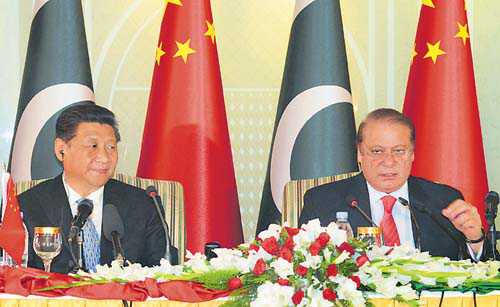
China signed a border agreement with Pakistan in which Pakistan unilaterally ceded Shaqsgam valley, another part of J&K (called Gilgit-Baltistan now) to it. Both nations then built the Karakoram highway linking Kashgar in Xinjiang to Abbottabad of Pakistan.In April 2015, China and Pakistan signed accords worth $46 billion to build the China-Pakistan Economic Corridor (CPEC) through Gilgit-Baltistan. This will extend to Gwadar Port in Pakistan and give China access to the Indian Ocean and beyond.When China signed the boundary agreement with Pakistan in 1963, the objective given in its Article 1 was to ‘formally delimit and demarcate the boundary between China’s Xinjiang and the contiguous areas, the defence of which is under the actual control of Pakistan’. Article 6 stated ‘the two parties have agreed that after the settlement of the Kashmir dispute between Pakistan and India, the sovereign authority concerned will re-open negotiations with the Government of the People’s Republic of China on the boundary so as to sign a formal boundary treaty to replace the present agreement. In the event of that sovereign authority being Pakistan, the provision of this agreement and the protocol shall be maintained in the formal treaty.’ (Note the doubt over the status of J&K and China making sure of its national interest in future.)India and China resumed boundary talks in the early 1990s. But China has refused to disclose its perception of the Line of Actual Control which could lead to a boundary settlement.During the Kargil conflict, China preferred to go along with the overwhelming world opinion. It advised Pakistan to withdraw its forces and abide by the LoC. But nearly a decade later, when India refused to cede Tawang in the Special Representatives-level boundary dialogue, China made a perceptible pro-Pakistan shift in its stance on J&K. It started issuing ‘stapled visas’ to Indian citizens of J&K, and refused visa to the GOC-in-C, Northern Command, for military-level exchanges. Around the same time, China increased its civil and military presence in Gilgit-Baltistan, purportedly to improve the infrastructure in this area. Senge H Sering, a scholar from Gilgit-Baltistan, wrote: “China has a huge and long-term presence in Gilgit-Baltistan and is building extensive road, bridge and telecom networks to sustain it. The drivers compelling China to develop Karakoram Corridor are diverse and mainly pertain to its economic, strategic and political ambitions.” According to India’s Ministry of Defence, the length of China-India boundary, measured from the extreme eastern side (India-China-Burma junction) to the extreme north-western end of POK is 4,056 km. This includes 2,175 km in the western sector, 556 km in the central sector, and 1,325 km in the eastern sector. But Chinese officials and the media started mentioning the length of the China-India boundary as nearly 2,000 km. This was first stated by China Daily in its report on the 13th round of boundary talks between China and India. In 2010, People’s Daily wrote that China and India share a nearly 2,000-km border and disputed areas cover about 125,000 sqkm on both sides. After the 14th round of border talks held in Beijing on November 29-30, 2010, the party-controlled Global Times quoted former ambassador to India, Zhou Gang: “The Sino-Indian border stretches for about 2,000 km and the two countries have never officially mapped it out. For a long time, the two sides abided by a traditional customary line based on their respective administrative regions.” Another former ambassador to India, Cheng Ruisheng, said in a TV interview: “China and India share roughly a 2,000 km border which has never been formally delineated.” Chinese officials and media have not only persisted with China-India border being only 2,000 km, but also attempted to correct figures, whenever quoted by Indian officials.It is apparent that China, which had never openly questioned the Indian estimate of the length of common border earlier is now unilaterally seeking to exclude the Chinese-occupied territory in the Ladakh sector of J&K. It is also questioning India’s locus standi to discuss this part of the border due to Pakistan’s claims to this area. This may be an indication that China does not recognise India’s claims of sovereignty over J&K.In the 2015 accord, China and Pakistan have agreed to work on 51 projects comprising network of roads, rails, pipelines and power plants, mostly in the area covered by the CPEC. The money will be lent by Chinese state and its banks to Chinese companies to carry out the work, thereby making it a commercial venture, with direct impact on China’s slackening economy. China also obtained a commitment from Pakistan for the security of the project and the workforce involved. The Pakistan army has raised a special security division for this, with headquarters in Diamer district of Gilgit-Baltistan. To ensure security at the Arabian Sea end, China will sell eight submarines to Pakistan, which would double its fleet.If and when CPEC is completed, it will be a political, economic and strategic game changer in the region. China’s control of Shaqsgam and other valleys of Gilgit-Baltistan will enable this area to be linked with its military and industrial complexes of northwestern Tibet.India claims that China is in occupation of nearly 38,000 sqkm of Indian territory in Ladakh region. Along with 5,500 sqkm of territory ceded by Pakistan, China occupies over 20,000 sqkm of Gilgit-Baltistan covering Shaqsgam, Raskam and Aghil valleys. The China-Pakistan collusion has enhanced strategic importance of Siachen sector whose northern part overlooks Shaqsgam valley.Beijing’s new position underlines its centrality in J&K. While our debate on Kashmir is focussed on Pakistan, China has emerged as a decisive new factor. Just as the Chinese decision to call Arunachal Pradesh ‘South Tibet’ has begun to gain international traction, repeated references to the length of China-India border as 2,000 km will impact the global discourse over J&K. India has to come to terms with the changing geo-politics in its north-western region where its two fronts with Pakistan and China come together. Henry Kissinger in his book On China emphasises the difference between Chinese ‘comprehensive approaches’ to ‘segmented policy making’ by other nations. He states that the Chinese think in civilisational terms. They are willing to strategise in long cycles and create levers of power based on realpolitik rather than morality. The Chinese style of dealing with strategic decisions is “thorough analysis; careful preparation; attention to psychological and political factors; quest for surprise; and rapid conclusion”. It would be useful to know and learn from Chinese strategic thinking.— The writer is a former Army Chief
London, April 6Scientists have discovered a new biochemical process, which reveals how the lungs operate during normal functioning and during asthma — a chronic respiratory condition marked by difficulty in breathing.The study conducted in mouse model reveals how air enters and leaves the lungs.The findings showed that disrupting these biochemical pathways in a mouse model could prevent airway narrowing and maintain normal lung function.”The fundamental biochemical process that we have discovered will ultimately allow us to better design ways to develop new treatments for those suffering from asthma and chronic obstructive pulmonary disease (COPD),” said one of the researchers Andrew Tobin, professor at the University of Leicester in Britain.It is too early to say whether these results apply to humans, the researchers maintained in the study published in the journal Proceedings of the National Academy of Sciences.The lung is made up of tiny tubes called airways, surrounded by muscles that allow air in and out of the lung.In asthma and other airway diseases such as COPD, the airway muscle contracts causing the airways to become narrow and restricting the flow of air in and out of the lung.”This breakthrough will lay the essential foundations on which to build new strategies to combat airway diseases such as asthma,” added Tobin.According to the World Health Organisation estimates, 235 million people worldwide currently suffer from asthma with over 80 percent of asthma deaths occurring in low and lower-middle income countries. The disease is predicted to increase worldwide over the next 10 years. — IANS
Military Capabilities Indian Army faces further financial issues in creating new mountain strike corps
The Indian Army is facing further financial issues in creating its new 17 Mountain Strike Corps (MSC), after the service’s fiscal year (FY) 2016-17 budget plans allocated few resources for the project.
In total the creation of the 90,270-strong 17 MSC is set to cost INR646.78 billion (USD214.33 million). Yet the Indian Army’s INR1.1 trillion operating outlay for fiscal year (FY) 2016-17 included just INR265.08 billion of capital allocation for new equipment and modernisation, of which 75% is committed to previous acquisitions.
The 17 MSC is being created for deployment by 2021 along the 4,057 km Line of Actual Control (LoAC) with China.
he Indian Air Force has renamed West Bengal’s Panagarh airbase as ‘Air Force Station Arjan Singh’ after the former IAF chief. “It is… the first time that we have taken a conscious decision to rename an airbase after an individual,” an officer said. Notably, Singh, having the rank of ‘Marshal of the IAF’, is the IAF’s only ‘five-star’ rank officer.
Panagarh airbase renamed in honour of Arjan Singh
Panagarh/New Delhi, Apr 15 (PTI) The key airbase at Panagarh in West Bengal has been renamed as Air Force Station Arjan Singh in honour of the Marshal of the Air Force, who turned 97 today.
The renaming of the Air Force Station was announced by Chief of Air Staff Arup Raha at a function in Delhi to mark Singhs birthday.
Addressing a simple renaming ceremony in Panagarh, Air Officer Commanding-in-Chief, Eastern Air Command Air Marshal C Hari Kumar said, “It is a proud moment for the Indian Air Force and the state of West Bengal.”
“He is an icon and a role model. We have to work hard to ensure that the name is suitably looked after in terms of capability and performance. It is for the first time that we have taken a conscious decision to rename an airbase after an individual,” Air Marshal Kumar said.
An icon of the Indian military history, Singh, the first Indian Air Force Chief to lead a young IAF into war in 1965, was hardly 44 years of age when entrusted with the responsibility.
Air Force Station Arjan Singh in Panagarh, approximately 150 kms from Kolkata, will house the C-130J military transport aircraft, capable of carrying out special operations. These planes will be flying with the Mountain Strike Corps along areas bordering China. PTI NIK SAP SMN SC SMN
The Gurgaon police arrested 75-year-old Wing Commander CK Sharma (retd) late last night for alleged misappropriation of funds of the organisation formed to spearhead the protest for ‘one rank,one pension’.An FIR was registered against Sharma, Maj-Gen Satbir Singh (retd) and Capt VK Gandhi (retd) on a magistrate’s orders after Lt-Gen Raj Kadiyan (retd) , chairman of the Indian Ex-Servicemen Movement, accused them of siphoning off Rs 14 lakh from the organisation between January and July 2013. All three were office-bearers of the organisation that was founded in 2008. The society’s account was maintained in a private bank. The arrest was made after his anticipatory bail application was rejected by the ADJ, Gurgaon. Sharma was the organisation’s treasurer. —TNS
We don’t treat you as enemy, Parrikar to tell China today
Defence Minister Manohar Parrikar, when he leaves for China tomorrow, will carry an important message for Beijing’s top leadership: “We don’t treat you as an enemy and nor does India equate China and Pakistan.”Parrikar, who was scheduled to leave on April 17, has advanced his visit by a day so that he can fly Air India instead of flying out on a Chinese airline the next day. He also opted out of using a personal jet. He will be in Shanghai to meet the Indian business community before flying off to Beijing.In China, his meetings with the government start on April 18 where he would tell the leadership that India does not hyphenate Pakistan-China and both are separate countries for New Delhi, said sources while telling the key agenda points for Parrikar’s meetings.He will address issues of cooperation in the Indian Ocean. China and India already conduct coordinated anti-piracy patrols along the Yemen and North-East Africa coastline of the ocean. China is sensitive to maintain security of the sea lines of communications used by merchant ships as millions of tonnes of its crude oils pass very close to India’s west coast and also close to the Andaman and Nicobar islands on the east edge of Bay of Bengal.Parrikar and his high-level team will be discussing expansion of military exchanges at senior levels and allow each other’s officers into top military institutions like the National Defence College in Delhi.China is preparing to send its troops for UN peacekeeping mission and India has more than 50 years of experience in such missions.The Indian delegation will be meeting Chinese premier Li Keqiang followed by a meeting with General Fan and latter with Defence Minister Chang Wanquan. Parrikar will also visit the headquarters of the Chengdu Military area command which is tasked to face India.He shall be accompanied by Defence Secretary G Mohun Kumar, Director General of Military Operations (DGMO) Lt Gen Ranbir Singh, Vice Chief of the Indian Air Force Air Marshall BS Dhanoa and Chief of the Navy’s Western Command Vice Admiral Sunil Lanba.
The visit’s agenda
Defence Minister Manohar Parrikar will address issues of cooperation in the Indian Ocean. China and India already conduct joint anti-piracy patrols along the Yemen and North-East Africa coastline of the ocean
Parrikar and his high-level team will be discussing expansion of military exchanges at senior levels and allow each other’s officers into top military institutions like the National Defence College in Delhi
China is preparing to send its troops for UN peacekeeping mission and India has more than 50 years of experience in such missions
State Stalwarts
DEFENCE MINISTER
Minister Rajnath Singh
ALL HUMANS ARE ONE CREATED BY GOD
HINDUS,MUSLIMS,SIKHS.ISAI SAB HAI BHAI BHAI
CHIEF PATRON ALL INDIA SANJHA MORCHA
LT GEN JASBIR SINGH DHALIWAL, DOGRA
SENIOR PATRON ALL INDIA SANJHA MORCHA
MAJOR GEN HARVIJAY SINGH, SENA MEDAL ,corps of signals
.
.
PATRON ALL INDIA SANJHA MORCHA
MAJ GEN RAMINDER GURAYA ,MADRAS REGIMENT
sanjhamorcha303@gmail.com
PRESIDENT SOUTH ALL INDIA SANJHA MORCHA
COL SS RAJAN BOMBAY SAPPERS,
PRESIDENT UTTARAKHAND ALL INDIA SANJHA MORCHA
COL B M THAPA ,BENGAL SAPPERSS
PRESIDENT HARAYANA STATE CUM COORDINATOR ESM
BRIG DALJIT THUKRAL ,BENGAL SAPPERS
PRESIDENT TRICITY
COL B S BRAR (BHUPI BRAR)
PRESIDENT CHANDIGARH ZONE
COL SHANJIT SINGH BHULLAR
.
.
PRESIDENT PANCHKULA ZONE AND ZIRAKPUR
COL SWARAN SINGH
INDIAN DEFENCE FORCES
DEFENCE FORCES INTEGRATED LOGO
INDIAN AIR FORCE
Air Officer C-in-C WESTERN AIR COMMAND
AIR MSHL S PRABHAKARAN AVSM VM
AOC-IN-C, EASTERN AIR COMMAND
Air Marshal Inderpal Singh Walia
AOC-in-C SOUTH WESTERN AIR COMMAND
Air Marshal Vikram Singh
AOC-IN-C, SOUTHERN AIR COMMAND
Air Marshal J.Chalapati
AOC-IN-C TRAINING COMMAND
AIR MARSHAL SK GHOTIA VSM
AOC-IN-C MAINTENANCE COMMAND
Air Marshal Jagdish Chandra
Flag Officer Commanding in Chief, Western Naval Command
ice Admiral R Hari Kumar, PVSM, AVSM, VSM
Flag Officer Commanding in Chief, Eastern Naval Command
Vice Admiral Sanjay Bhalla, AVSM, NM
Flag Officer Commanding in Chief, Southern Naval Command