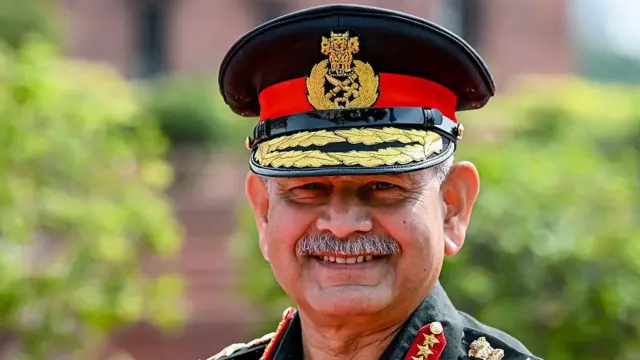
सेना प्रमुख जनरल उपेंद्र द्विवेदी के भूगोल वाले बयान पर बोली पाकिस्तान की सेना
इमेज कैप्शन,भारत के सेना प्रमुख जनरल उपेंद्र द्विवेदी के ‘ऑपरेशन सिंदूर’ पर दिया गया ताज़ा बयान सुर्ख़ियों में है
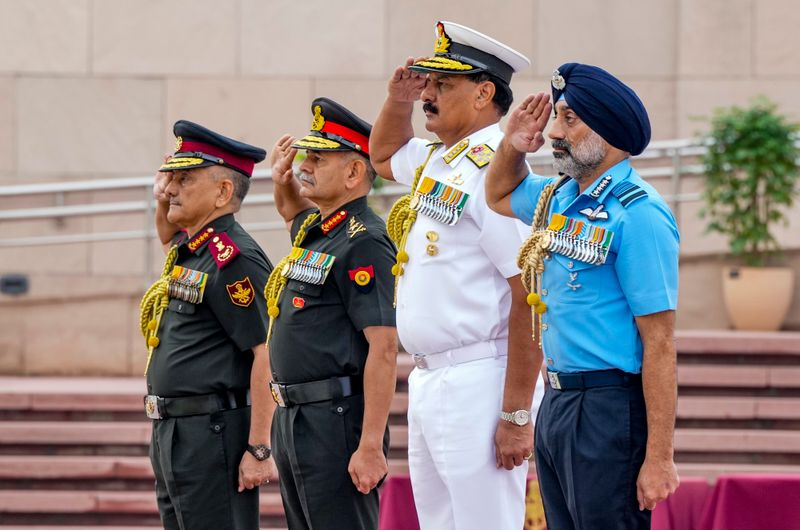
भारत के सेना प्रमुख जनरल उपेंद्र द्विवेदी की ओर से ‘ऑपरेशन सिंदूर’ के बारे में दिए गए ताज़ा बयान के बाद पाकिस्तान ने कहा है कि ‘पड़ोसी देश का सुरक्षा प्रतिष्ठान आक्रामकता के लिए बहाने ढूंढ रहा है.’
बीबीसी उर्दू के मुताबिक़ पाकिस्तानी सेना के इंटर सर्विस पब्लिक रिलेशन्स (आईएसपीआर) ने अपने बयान में भारत के रक्षा मंत्री, सेना प्रमुख और वायुसेना प्रमुख के बयानों का हवाला देते हुए कहा है कि जहां तक पाकिस्तान को “नक़्शे से मिटाने की मंशा” है तो भारत ये साफ़ तौर पर जान ले कि “अगर ऐसे हालात आए तो दोनों तरफ़ नुक़सान होगा.”
भारत के सेना प्रमुख जनरल उपेंद्र द्विवेदी ने शुक्रवार को राजस्थान में कहा था कि अगर पाकिस्तान को इतिहास और भूगोल में रहना है तो उसे ‘राज्य प्रायोजित आतंकवाद’ को रोकना होगा.
इससे पहले रक्षा मंत्री राजनाथ सिंह ने सर क्रीक मामले में और वायुसेना प्रमुख अमर प्रीत सिंह ने भारत-पाकिस्तान सैन्य संघर्ष के बारे में बयान दिया था.
Indian Army approves ‘Saksham’ counter-UAS grid to enhance drone detection, neutralisation capabilities
The indigenous system developed by BEL, uses AI-driven technologies suited for future combat systems, enabling scalability and upgradability as threats evolve
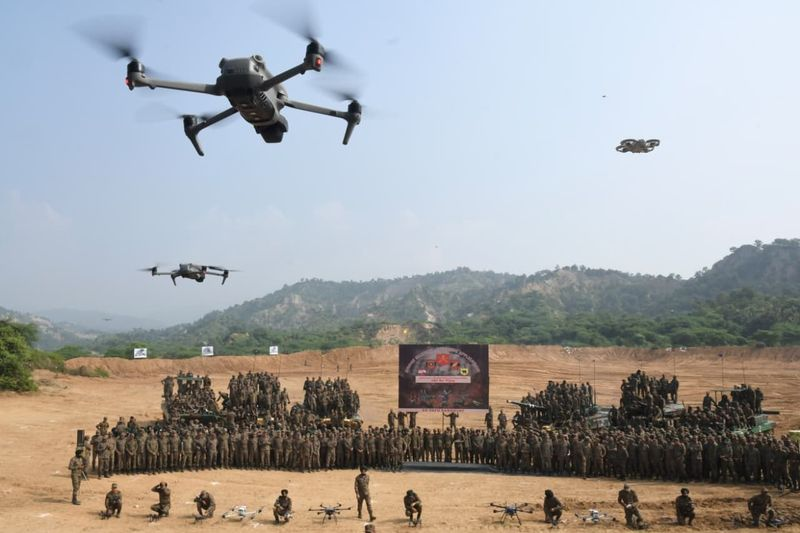
he Army has green-lit the procurement of a specialised, dedicated grid of radars and sensors that will detect and track enemy drones, while automatically providing the ground commander the best options to neutralise the threat.
Options for shooting down a drone can be via a lethal shot or by sending a powerful radio-wave to disable it.In military parlance, it’s called the ‘counter-unmanned aerial system (C-UAS) grid system’ and it ensures complete airspace security against aerial threats.
To ensure speedy induction, the project has been approved under the fast-track procurement (FTP) route, with rollout to all field formations targeted within the next one year, sources said.
The Army will procure an indigenous system named ‘Saksham’, produced by the public sector company Bharat Electronics Limited (BEL). This system is intended to secure airspace up to 10,000 feet above the ground. The need for a comprehensive counter-UAS grid became especially clear during Operation Sindoor, when hostile drone activity demanded swift detection and a coordinated response.
The ‘Saksham’ system is conceived as a high-end command and control system and will operate over Army’s own secure data network.
It will provide an integrated picture to all formations in real time within a defined battle area. It will integrate own and enemy UAVs data to offer automated decision-support and real-time visualisation for field commanders.
It uses AI-driven technologies suited for future combat systems, enabling scalability and upgradability as threats evolve. Once operational, ‘Saksham’ will serve as the backbone of the Indian Army’s counter-UAS grid, giving commanders a unified view of both ground and aerial threats. It will enhance decision-making speed, ensure rapid engagement and secure control over airspace to protect troops, infrastructure and assets on the ground from aerial incursions.
With future wars to be fought, not just on land but also in the air directly above it, the new approach ensures that the airspace immediately above the land-forces remains under watch and control, allowing unrestricted movement for own assets while detecting, tracking, and neutralising hostile drones or aircraft.
With future wars to be fought not just on land but also in the air, the new approach ensures that airspace above the land-forces remains under watch and control, allowing unrestricted movement for own assets while detecting, tracking and neutralising hostile drones or aircraft.
The induction is aligned with the Indian Army’s Decade of Transformation (2023-2032).
Key capabilities
Real-time generation of a picture of enemy drones.
Integration of weapons and sensors for synchronised response.
AI-enabled threat analysis for predictive identification and faster decision-making.
Seamless interoperability with other airspace management systems of the Indian Army.
EXACTLY five months ago, India and Pakistan agreed on a ceasefire, bringing to a surprisingly quick end their nearly four-day-long war. India announced the ‘suspension’ of Operation Sindoor, indicating that it could be resumed if Pakistan failed to mend its ways. Subsequently, several political and military leaders have reiterated this tough stand.
The operation was conceived and executed with precision by our defence forces, especially the Indian Air Force (IAF), in retaliation to the Pahalgam terror attack. Citizens of the country have all along been supportive of our Prime Minister’s leadership and his quick reaction. Adventurism of the cowardly kind that underlines terror strikes require such measured responses.
Op Sindoor achieved its main objective of hitting terror sites in Pakistan. The perpetrators and sponsors of terrorism got a strong message that there was a price to pay for their actions. Prudence and good sense dictate that India should avoid sabre-rattling and also resist the temptation of becoming complacent. However, recent statements by our defence top brass and the PM’s remark equating Op Sindoor with India’s win over Pakistan in the Asia Cup cricket final are signs of attempts to politicise our defence services as well as sports. This is a regrettable trend.
Senior officers of the armed forces are not known to brag repeatedly on news channels. They prefer their achievements to speak for themselves. These feats are widely reported in the print and electronic media. The people of India are visibly proud of their troops. When military leaders are called upon to drive home a point repeatedly during TV talk shows and press conferences, the law of diminishing returns threatens to play spoilsport.
Politicisation of sports is, to a great extent, even worse. The Olympic movement was started in ancient Greece to bring together warring states — Athens, Sparta and their neighbours such as Macedon and Crete — in opposition to the expanding Persian Empire. Instead of Greeks shedding each other’s blood in wars to prove one state’s superiority over the other, sports competitions were organised to promote unity.
I admit that this analogy may not be apt for our perennial conflict with Pakistan. But what is certain is that even in the worst of times, Indian and Pakistani cricketers have maintained their personal friendships. Their battle on the cricket field never extended beyond the boundary. Indian cricketer-turned-politician Navjot Singh Sidhu was present when former captain Imran Khan was sworn in as the Prime Minister of Pakistan in 2018. It was Imran who had invited Sidhu to attend the oath-taking ceremony.
A story narrated by a friend merits a recall. A Pakistani fast bowler had decided to keep his distance from then Indian captain Sourav Ganguly as he felt that the latter was a snob. One day, both happened to be in a hotel lounge after a match. Ganguly got up and poured himself a cup of tea. He poured a second cup, walked up to the bowler and offered it to him. The Pakistani player was left bewildered. He had misjudged the Indian and he told this to the great batsman himself. Friendship took centre stage.
Indian and Pakistani cricketers have shared such friendships off the field for decades. The cordial interaction between Ravi Shastri and Wasim Akram in the commentary box sums up this phenomenon.
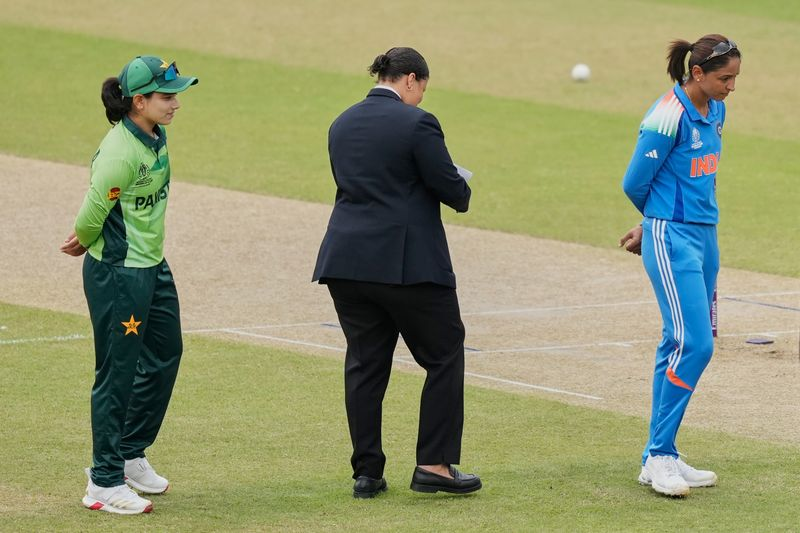
Cricket is as much a passion in Pakistan as it is in India. Victory in an India-Pakistan match may not match a triumph on the battlefield, but the sporting rivalry has never spilled over to the dressing room or elsewhere. That is set to change now. Sporting culture will be compromised. Beyond that, basic human values will go for a toss with the refusal to shake hands.
The instructions to our cricketers to avoid a handshake with their Pakistani rivals before or after a match have set a wrong precedent. This decision must have been taken by our political leadership and communicated through the BCCI to the captains of our men’s and women’s teams — Suryakumar Yadav and Harmanpreet Kaur.
This gesture conveyed a message to the public in India and Pakistan that we are enemies in all aspects. That is unfortunate. The crime of unleashing terrorism and killing civilians is condemnable and unpardonable. The Army and the political rulers of Pakistan have resorted to this cowardly option because they are weaker, both militarily and economically. Pakistan’s leadership has condemned its country to the status of a pariah in the comity of nations. It is essential for the Pakistani people to open their eyes to this truth. Cricketers not shaking hands is bound to have an effect to the contrary.
It is necessary for our political leadership to assess the impact of politicising sports and exposing our top defence officers to the media glare. I doubt if world leaders will let such moves pass without scrutiny. It does not concern them, so they may not comment. But they will think poorly of us. Our refusal to shake hands must not have gone down well particularly with cricket-playing countries such as England, Australia, New Zealand, South Africa, West Indies, Sri Lanka and Bangladesh.
Our leadership should review its instructions to sports bodies because sports needs to be isolated from politics.
India, Australia to deepen cooperation for ‘free and open’ Indo-Pacific
Two countries also sign arrangement on mutual submarine rescue support and cooperation
India and Australia today discussed a new roadmap for mutual maritime security collaboration aimed at deepening cooperation to ensure a “free, open and resilient Indo-Pacific”.
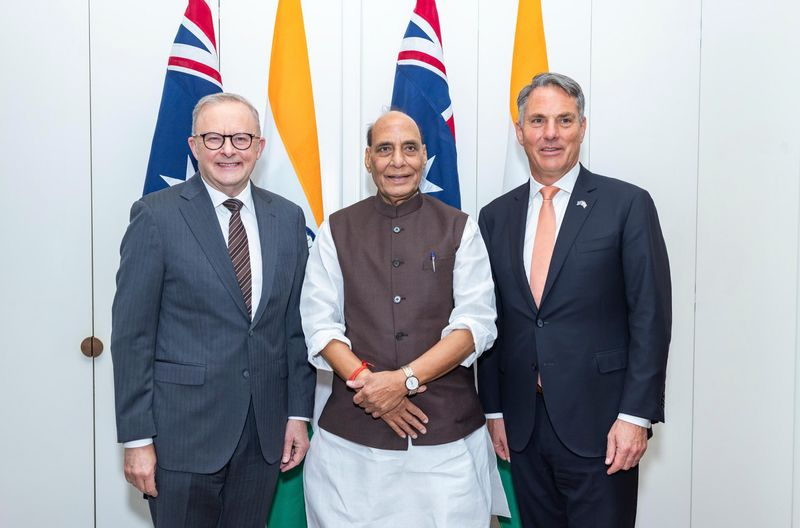
Defence Minister Rajnath Singh, who is on a two-day visit to Australia (October 9-10), held a bilateral meeting with Australia’s Deputy Prime Minister and Defence Minister Richard Marles in Canberra.
A joint statement issued after the meeting said, “The ministers affirmed the importance of maintaining a free, open, peaceful, stable and prosperous Indo-Pacific.”
The statement added that both sides reaffirmed strong support for freedom of navigation and overflight, unimpeded trade and other lawful uses of the sea in accordance with international law, particularly the 1982 United Nations Convention on the Law of the Sea (UNCLOS).
The phrase “free and open Indo-Pacific” is often used as a euphemism for countering Chinese assertiveness in the region, particularly in the South China Sea. India and Australia are part of the four-nation Quad grouping along with the US and Japan. The four nations are scheduled to conduct a joint military exercise next month at Guam, a US base in the Western Pacific.
The two sides also discussed a joint maritime security collaboration roadmap to advance maritime cooperation and looked forward to renewing the 2009 Joint Declaration on Defence and Security Cooperation.
The expansion of the bilateral defence architecture will include the institution of an annual Defence Ministers’ Dialogue. Both sides also agreed to pursue defence collaboration in emerging technologies through the Joint Working Group on Defence Industry, Research and Materiel, the statement said.
India and Australia also signed an arrangement on mutual submarine rescue support and cooperation. The two countries already collaborate on maritime domain awareness and anti-submarine warfare operations, including coordinated patrols by their P-8I maritime patrol aircraft in the Indian Ocean.
They also agreed to continue aircraft deployments from each other’s territories to build operational familiarity.
The ministers welcomed Australia’s first defence trade mission to India from October 7 to 10, focused on connecting Australian firms with Indian counterparts, particularly in the C5ISR domain — command, control, communications, computers, cyber-defence, intelligence, surveillance and reconnaissance.
Defence and security cooperation has emerged as one of the strongest pillars of the bilateral partnership. Over the past decade, the number of annual defence exercises, meetings and activities has tripled, with 33 such engagements held in 2024 alone.
Earlier in the day, Singh was welcomed at the Australian Parliament House, where he also witnessed parliamentary proceedings in Canberra.
He also met Prime Minister Anthony Albanese and Foreign Minister Penny Wong, broadly focusing on imparting more dynamism to the relations.
Did Pakistan strike Afghanistan’: 2 explosions heard in Kabul, Taliban says it is investigating
Pakistan strikes against Afghanistan are huge escalation, says US ex-envoy Khalilzad
One or more loud explosions were heard late on Thursday evening in the Afghan capital of Kabul, according to the Taliban administration and eyewitnesses.
It was not immediately clear what caused the blast.
Zabihullah Mujahid, the spokesman for the Taliban administration, said in a statement that an explosion had been heard and an investigation was underway. He added that so far no reports of casualties or damage had been received. Witnesses, including a Reuters witness, said they heard at least two explosions at around 9:50pm local time.
Meanwhile, former US envoy Zalmay Khalilzad expressed concern over the alleged “strikes carried out by Pakistan in Kabul” terming it as a “huge escalation”, which poses dangerous risks.
In a post on X on Friday, Khalilzad called for dialogue between Islamabad and Kabul, stating that military escalation is not the answer. He said negotiations should take place between Kabul and Islamabad to deal with the terrorist sanctuaries on both sides of the Durand Line.
“Today’s Pakistani strikes against Afghanistan’s capital are a huge escalation and pose dangerous risks. In recent days, Taliban operatives have been active in Pakistan attacking ISIS and killing a number of its leaders. The Pakistanis have been recklessly backing ISIS operatives against Afghanistan and their own Baluch nationalist insurgency. The Afghans, in turn, have been permissive towards the TTP, the Pakistani Taliban. Military escalation between #Pakistan and #Afghanistan is not the answer. It is unlikely to work and will increase death and destruction in both countries. There is an alternative with better prospects: negotiations between Kabul and Islamabad to deal with the terrorist sanctuaries on both sides of the Durand line.”
Late on Thursday evening, a spokesperson of Afghanistan, Zabihullah, said that an explosion was heard in Kabul; however, no reports of damage have emerged so far, and investigations are underway.
“The sound of an explosion was heard in the city of Kabul. However, no one should worry, it is all well and good, the investigation of the incident is underway, no report of any damage has been given so far. The sound of an explosion was heard in Kabul. The investigation is underway, no report of any damage has been given so far, it is all well and good.”
On October 10, Dawn reported that Pakistan’s Defence Minister Khawaja Asif told the National Assembly, that “collateral damage” cannot be ruled out in response if Pak security forces come under attack and added that “enough is enough”.
The escalation by Pakistan comes amid the backdrop of Afghanistan’s acting foreign minister Amir Khan Muttaqi arrived in New Delhi on Thursday on a week-long visit to India.
Muttaqi October 9-16 visit, marks the first high-level delegation from Kabul to New Delhi since the Taliban took control of Afghanistan in August 2021.
This is the second Taliban government in Afghanistan since 1996.
ANI, Reuters inputs
Beyond proposed $100,000 mandatory filing fee, US plans more rules on H-1B visas
So far, annual cap is set at 65,000 visas, with an additional 20,000 reserved for individuals with a US master’s degree or higher
The Donald Trump administration is moving forward with plans to significantly overhaul the H-1B visa programme, aiming to impose stricter rules on how employers can use the visa and who qualifies for it.
Beyond the proposed $100,000 mandatory filing fee, new immigration restrictions are also being considered.The US Department of Homeland Security (DHS) has listed a proposed rule in its regulatory agenda titled “Reforming the H-1B Nonimmigrant Visa Classification Program.” The proposal includes a range of changes, such as:
Reviewing eligibility for cap exemptions Increased scrutiny of employers who have violated programme rules
Tighter regulations on third-party placements
Enhanced oversight and compliance mechanisms
According to the DHS, these reforms aim to “improve the integrity of the H-1B program and better protect US workers’ wages and working conditions.”
The proposed rule is expected to be published in December 2025, as per the Federal Register.
Earlier reports indicated the Trump administration is also considering replacing the current H-1B lottery system with a wage-based selection process, favoring higher-paid roles to ensure that only top-tier foreign talent is prioritised.
Why H-1B visa is important
The H-1B visa, established under the 1990 Immigration Act, allows US employers to temporarily hire highly skilled foreign workers in specialty occupations, particularly in science, technology, engineering, and mathematics (STEM) fields. It serves as a key pathway for skilled professionals—especially from India—to work and eventually seek permanent residency in the US
The annual cap is set at 65,000 visas, with an additional 20,000 reserved for individuals with a U.S. master’s degree or higher. These are typically distributed through a lottery system, although certain employers such as universities and nonprofits are exempt from the cap.
According to the Pew Research Center, nearly 75 per cent of H-1B approvals in 2023 were granted to Indian nationals. Since 2012, at least 60 per cent of all approved H-1B applications have been for computer-related occupations. However, the visa is also widely used by sectors like healthcare, finance and academia.
Despite criticism of the programme, research shows that H-1B workers often earn equal or higher wages compared to their American counterparts with similar qualifications. US law mandates that employers must pay H-1B workers the higher of either the actual wage paid to comparable US workers or the prevailing wage in the occupation, in addition to paying government fees exceeding $6,000 in many cases.
If the proposed changes go into effect, they could significantly impact thousands of Indian students and professionals seeking to work in the US.
LIST OF CONTRIBUTORS FOR SANJHA MORCHA RENEWAL OF WEBSITE TO GOOGLE :LAST DATE 11 OCT 2025
To come into force on April 1 | Evaluation twice a year
The Army has introduced new fitness parameters, making physical tests mandatory for all ranks — Agniveer to General. These shall apply to the entire 13 lakh-strong force.
Sources said under the new framework — called the combined physical test (CPT) — the existing Battle Physical Efficiency Test (BPET) and the Physical Proficiency Test (PPT) had been merged. The comprehensive assessment would reflect the evolving operational requirements of modern warfare.
A new grading system has been introduced with the parameters for completing the tests being graded as super excellent, excellent, good and satisfactory. The test scores will be included in the annual confidential reports (ACRs), affecting promotions and evaluations.
The test will be conducted twice a year and will be applicable to all personnel up to the age of 60 — Lieutenant General-rank officers, the senior-most after the Army Chief, retire at 60. The Army Chief serves till the age of 62.
At present, the BPET is conducted till 45 years of age while the PPT is conducted till 50 years of age.
The new rules will come into force on April 1, 2026. The preparatory work at each Army unit across the country will start on October 15.
The test parameters will vary for each age group. The test will be an age-based benchmark for a fair and inclusive assessment and will be rank-neutral and gender-neutral. Parameters of terrain and climate, where the test will be conducted, have been factored in. For units in high-altitude areas — 9000-ft plus — the parameters have been relaxed.
Among the age-variable tests, the soldiers will have to do a 3.2-km run, besides a specified number of push-ups and sit-ups. Younger soldiers will even need to display their ability to do vertical rope climbing.
A unit operational efficiency test has been introduced for the first time. This entails the entire unit carrying out route marches to foster collective physical endurance — needed in battle — and to ensure coordination.
The sources said the CPT aimed to establish a realistic, inclusive and standardised testing regime that recognised the diverse environmental conditions and demographics across the force. Despite increasing technological advancements, physical endurance, agility and mental resilience remained fundamental to combat readiness.
The new framework has been developed through an extensive study of data from previous assessments of the physical test. The Army Training Command and the Adjutant General’s Branch have given their inputs which have been benchmarked against “Khelo India” standards and those of foreign armies.
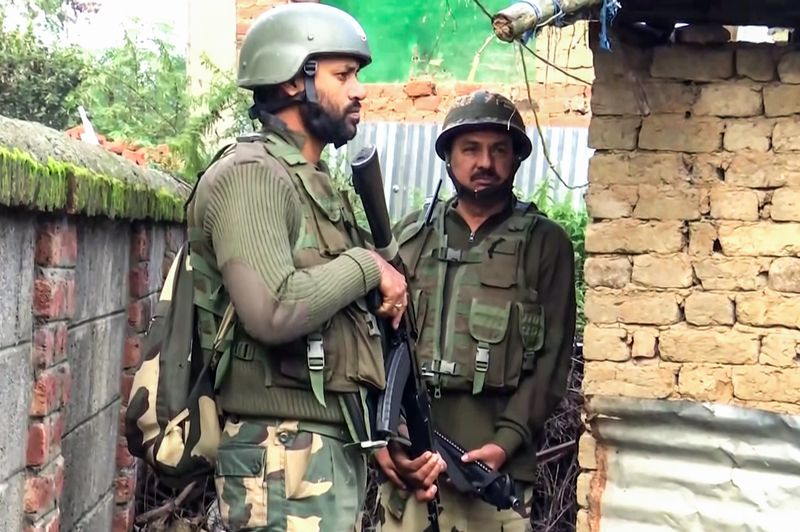
2 soldiers missing in south Kashmir forest, massive search op underway
Two Army soldiers have gone missing in the forest areas of South Kashmir’s Anantnag district, prompting security forces to launch a massive search operation.
Army’s Srinagar-based Chinar Corps said on X late on Wednesday night, “On the intervening night of October 6 and 7, an operational team in the Kishtwar range encountered a severe snowstorm and whiteout conditions in the mountains of south Kashmir. Since then, two soldiers have lost communication. Intense search and rescue operations have been launched, but progress has been hampered by prevailing adverse weather conditions.”
Locals from nearby villages stated that an “intense search” is in progress following the disappearance. A resident of Ahlan Bala, located near the Gadool forest, told The Tribune that the location where the soldiers went missing is approximately nine kilometers from the last village.
“There was heavy rainfall in the area, and the higher reaches experienced snowfall. It’s very difficult to say where they might have gone,” the local said.
The Gadool forests have seen militant activity in the past. In September 2023, three security personnel — Col Manpreet Singh, Maj Ashish Donchak, and Jammu and Kashmir Police DSP Humayun Muzamil — were killed in a fierce gunfight in the same area. That operation lasted several days and ended with the killing of two militants.
In 2024, a Territorial Army soldier also went missing during a search operation in the same forest. His body was later recovered by security forces.
Security officials remain cautious about drawing conclusions. “The weather conditions in the area were extremely bad. At this point, we cannot confirm whether militants are involved. Our focus is on locating the missing soldiers,” an official said.
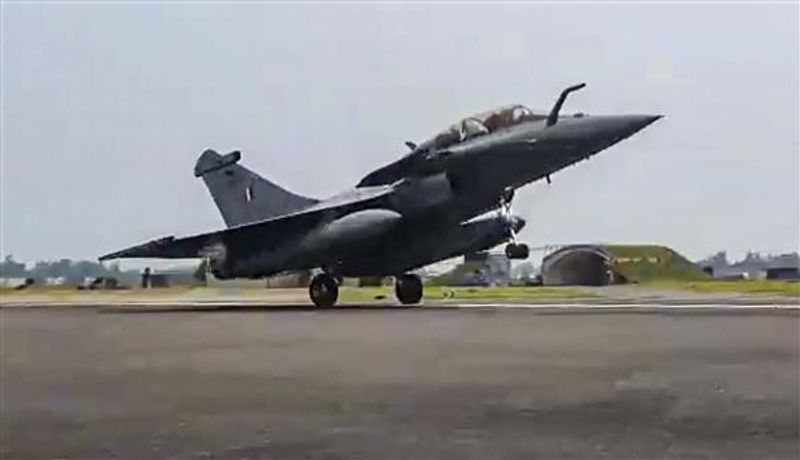
Rafale, Sukhoi and S-400 squadrons awarded ‘Unit Citations’
IAF chief Air Chief Marshal AP Singh awarded these at the Air Force day parade at Hindon air bases
Indian Air Force’s (IAF) fighter jet and missile squadrons which played a key part in Operation Sindoor were today awarded ‘Unit Citations’ appreciating their role in the skirmish with Pakistan in May this year.
IAF chief Air Chief Marshal AP Singh awarded the citations at the Air Force day parade at Hindon air bases, east of the National capital.
Citations were awarded to a squadron of Rafale jets and Sukhoi 30-MKI jets.
The Sukhoi 30-MKI jet squadron number 222 that did the maximum damage to Pakistan Air Force (PAF) bases on May 10 was awarded the citation. The IAF’s Sukhoi jets launched BrahMos missiles onto the PAF air bases, 13 of them were damaged leading to a call by Pakistan seeking cessation of hostilities. The 17 squadron, that flies the Rafale, was also awarded for its role. On May 7, when operation Sindoor was started, the precision missiles on board the French-orgin jet hit at terrorist camps in Pakistan.
Notably, a S-400 air defence missile squadron was also given the ‘unit Citation’. The Russian origin system which has a mix of radars and long-range hit at several Pakistan planes and missiles. Last month IAF Chief hailed the S-400 long-range surface-to-air missile system and called it a “game-changer” in saying the S-400 denied the enemy freedom to operate even inside its own territory.
The IAF chief also awarded a ‘citation’ to a squadron of loitering ammunition. The squadron uses special drones which do a ‘kamikaze’ strike and self-destruct at target.
The loitering ammunition was used to strike a targets in Pakistan.
State Stalwarts
DEFENCE MINISTER
Minister Rajnath Singh
ALL HUMANS ARE ONE CREATED BY GOD
HINDUS,MUSLIMS,SIKHS.ISAI SAB HAI BHAI BHAI
CHIEF PATRON ALL INDIA SANJHA MORCHA
LT GEN JASBIR SINGH DHALIWAL, DOGRA
SENIOR PATRON ALL INDIA SANJHA MORCHA
MAJOR GEN HARVIJAY SINGH, SENA MEDAL ,corps of signals
.
.
PATRON ALL INDIA SANJHA MORCHA
MAJ GEN RAMINDER GURAYA ,MADRAS REGIMENT
sanjhamorcha303@gmail.com
PRESIDENT SOUTH ALL INDIA SANJHA MORCHA
COL SS RAJAN BOMBAY SAPPERS,
PRESIDENT UTTARAKHAND ALL INDIA SANJHA MORCHA
COL B M THAPA ,BENGAL SAPPERSS
PRESIDENT HARAYANA STATE CUM COORDINATOR ESM
BRIG DALJIT THUKRAL ,BENGAL SAPPERS
PRESIDENT TRICITY
COL B S BRAR (BHUPI BRAR)
PRESIDENT CHANDIGARH ZONE
COL SHANJIT SINGH BHULLAR
.
.
PRESIDENT PANCHKULA ZONE AND ZIRAKPUR
COL SWARAN SINGH
INDIAN DEFENCE FORCES
DEFENCE FORCES INTEGRATED LOGO
INDIAN AIR FORCE
Air Officer C-in-C WESTERN AIR COMMAND
AIR MSHL S PRABHAKARAN AVSM VM
AOC-IN-C, EASTERN AIR COMMAND
Air Marshal Inderpal Singh Walia
AOC-in-C SOUTH WESTERN AIR COMMAND
Air Marshal Vikram Singh
AOC-IN-C, SOUTHERN AIR COMMAND
Air Marshal J.Chalapati
AOC-IN-C TRAINING COMMAND
AIR MARSHAL SK GHOTIA VSM
AOC-IN-C MAINTENANCE COMMAND
Air Marshal Jagdish Chandra
Flag Officer Commanding in Chief, Western Naval Command
ice Admiral R Hari Kumar, PVSM, AVSM, VSM
Flag Officer Commanding in Chief, Eastern Naval Command
Vice Admiral Sanjay Bhalla, AVSM, NM
Flag Officer Commanding in Chief, Southern Naval Command