










Sanjha Morcha

Pakistan should clamp down on terror groups like LeT, JeM: US lawmaker

Speaking at an exhibition organised by the Indian Embassy on the ‘Human Cost of Terrorism’, Brad Sherman remembers the victims of the Pahalgam attack on the first anniversary of the incident

US Congressman Brad Sherman has called on Pakistan to clamp down on terror groups such as Lashkar-e-Taiba (LeT), which has been linked to the 2025 Pahalgam terror attack.

Speaking at an exhibition organised by the Indian Embassy here on the ‘Human Cost of Terrorism’, Sherman remembered the victims of the Pahalgam attack on the first anniversary of the incident.

“The attackers, identified as The Resistance Front, targeted innocent people, reportedly separating victims by religion. The group is widely seen as linked to Lashkar-e-Taiba, which has found sanctuary in Pakistan,” Sherman said at the exhibition on Wednesday evening.

“We must use this moment to demand that the Pakistani government clamp down on Lashkar-e-Taiba, Jaish-e-Mohammed and other terrorist groups,” the Democrat leader said.

The exhibition, organised at Capitol Hill, comes at a time when Pakistan is projecting itself as a peacemaker by mediating efforts to end the seven-week US-Iran war.

The event was attended by lawmakers from both Democratic and Republican parties.

The digital exhibition also displays major terror attacks perpetrated across the world, including the 1993 Mumbai bomb blasts, the 2008 Mumbai terror attacks and the Pahalgam attack. It also identifies the terror outfits responsible for the attacks, including several Pakistan-based individuals and entities such as Lashkar-e-Taiba terror group.

“The special exhibition essentially serves to remind us of a few things. One, the scourge of terror upon humanity remains determined to destroy our societies. Countries around the world need to come together and remain resolute in defeating terrorism,” India’s Ambassador to the US Vinay Mohan Kwatra told reporters.

Kwatra said Prime Minister Narendra Modi has been clear about India’s unwavering resolve to deal with and defeat the scourge of terrorism.
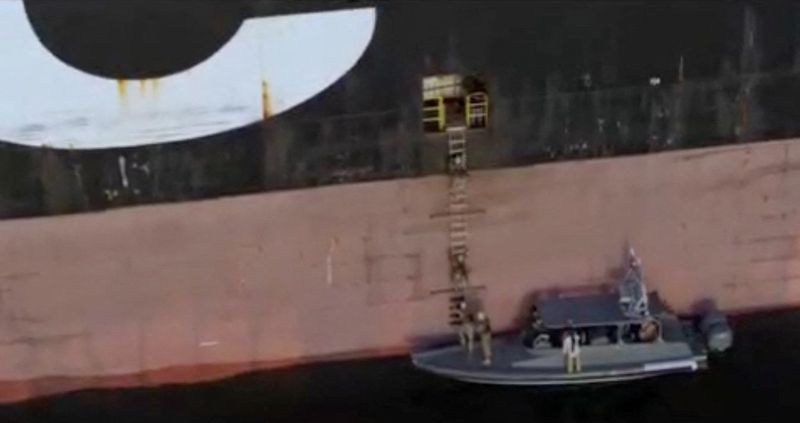
Iran-Israel war LIVE Updates: Iran attacks 3 ships in Strait of Hormuz as Trump indefinitely extends ceasefire

US President Donald Trump said the United States was indefinitely extending its ceasefire with Iran as a new round of peace talks was on hold.

Pakistan had planned to host a second round of talks, but the White House suspended Vice President JD Vance’s planned trip to Islamabad as Iran rebuffed efforts to restart negotiations. Iran acknowledged the ceasefire extension but didn’t say Tehran was ready to attend a new round of talks to end the war, state television reported on Wednesday.

Meanwhile, Iran’s semiofficial news agencies are reporting that the paramilitary Revolutionary Guard has attacked a third ship on Wednesday in the Strait of Hormuz, throwing into question efforts to end the war. Nour News, Fars and Mehr all reported the attack by the Guard on a vessel called the Euphoria. They said the vessel had become “stranded” on the Iranian coast, without elaborating. The Guard has seized the other two ships that were attacked, Iranian state television separately reported. With AP


SSC (NT) -1 Course of the Indian Army Celebrates Diamond Jubilee

A Timeless Beacon of Courage, Camaraderie and Unbreakable Spirit in New Delhi, on 24 April 2026.

Sixty years ago, on 24 April 1966, a band of young officers marched out of the Officers Training School, Madras, as the pioneering SSC (NT) – 1 Course of the Indian Army.

Today, these legends—now in their eighties—are reuniting with the same fire, the same pride, and the same unbreakable bond that once defined them. From the United States, Canada, and every corner of India, they arrive at the Manekshaw Centre, the National War Memorial, and the Akash Air Force Mess on 24 and 25 April 2026, accompanied by their devoted spouses, to celebrate their Diamond Jubilee.


This is no ordinary reunion. Many walk with difficulty, many carry hearts scarred by service and time, yet their eyes shine with the same indomitable “josh” that carried them through battlefields and boardrooms alike. They are the trailblazers—the very first trial course after the Emergency Commissions. Their success proved the Short Service Commission concept, lighting the path for every officer who followed. Today, the 121 SS (NT) and SS (W) 35 Courses proudly marches on from OTA Chennai, standing on the shoulders of these giants. We did not have women entry in those days.

Their lives have been the ultimate test of character – a thrilling roller-coaster of duty, sacrifice and resilience.

After five years of stellar service incl 1971 War , only 40% earned Permanent Commission.

Undaunted, 32 cleared the Civil Services Examination, others joined the Paramilitary Forces, and the rest forged their own destinies with quiet courage and dignity. No setback could break their spirit.

Post-retirement, the invisible threads of brotherhood pulled them back together.

Today, a vibrant WhatsApp family of over 110 course-mates keeps the flame alive—monthly station-wise gatherings, weekly Thursday Zoom calls, and unforgettable journeys across Mussoorie, Nainital, Kasauli, the Mediterranean cruise, and Europe.

The Golden Jubilee was celebrated with joy in Chennai in 2016.

The Diamond Jubilee unfolds in three magnificent phases: a sun-kissed Goa-Lakshadweep-Mumbai cruise by 25 members, during 18-21 MARch, the grand Delhi reunion this weekend, and a heartfelt homecoming at their Alma Mater in September 2026.

At the heart of the Delhi celebrations, the coursemates will bow their heads in gratitude at the National War Memorial, honouring the 155 brothers-in-arms who have answered the final roll call. A specially crafted Coffee Table Book, capturing six decades of valour, laughter and legacy, will be released by General N.C. Vij, PVSM, UYSM, AVSM, the 21st Chief of the Army Staff. Old eyes will meet after sixty years, hands will clasp once more, and stories of shared glory will echo through the halls.
For some, this may be their last grand assembly. Yet the excitement is electric, the camaraderie deeper than ever, and the pride is fiercer than on the day they were commissioned.

To the young officers of tomorrow, the SSNT-1 Course sends a powerful message: True leadership is not about the years you serve, but the spirit you carry forever. It is about bonds that outlast time, resilience that laughs at adversity, and a love for the nation that never fades.

You are the future. Draw strength from this legacy. March with the same fire.

Jai Hind! Long live the SSC (NT) – 1 Course.

Long live the Indian Army.


HEADLINES : 22APR 2016

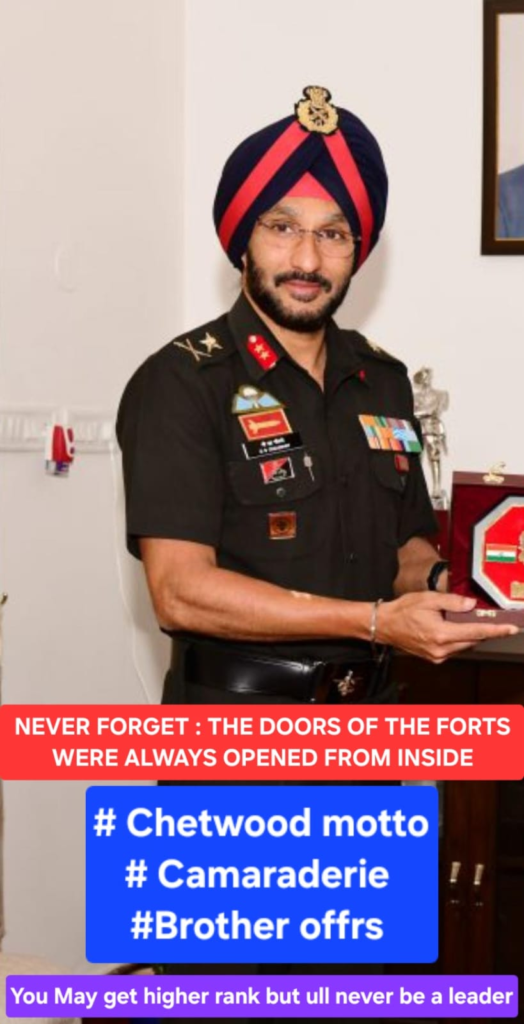
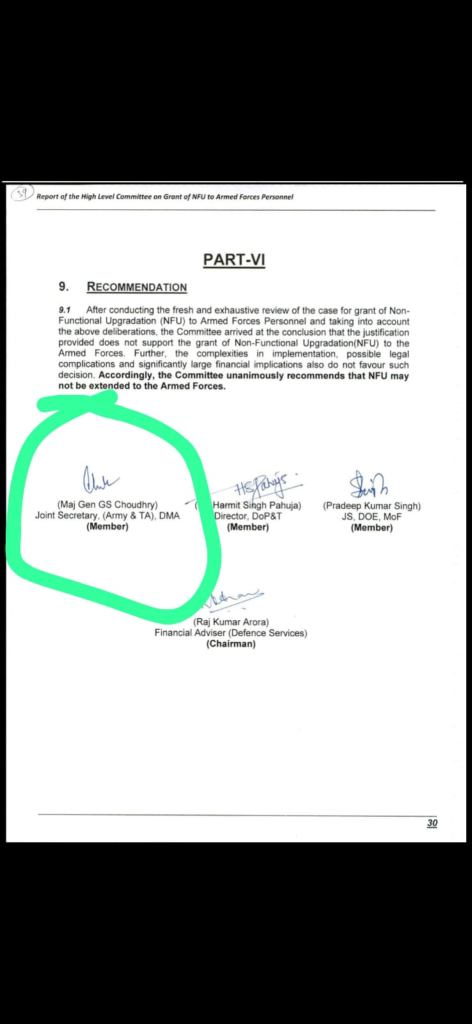
MAJ GEN IN UNIFORM BETRAYED ARM FORCES FOR NON GRANT OF NFU

Inter-ministerial panel rejects military officers’ plea for pay parity

Army commemorates veteran’s 100th b’day in Chandimandir OF Brig Wazir Singh Choudhary (retd)EX EME

Army’s first woman canoeist bags India’s first international gold in canoeing

MoD Signs ₹975 Crore Contracts For Indigenous TRAWL Assemblies To Boost Army’s Minefield Breaching Capability

Lessons from Pahalgam

CM Omar Abdullah on his way to Nowshera inspects the ongoing works on the Sungal Tunnel project and reviews the progress on site

Pahalgam tragedy: Braveheart ponywallah’s family provided house by Maharashtra Deputy CM Shinde

India’s silent heroism in Korean war to be honoured with new memorial in South Korea

MoD inks Rs 975-cr deal for anti-mine equipment

Pahalgam terror attack: How security forces tracked and killed attackers

World on edge as US puts Vance’s Pakistan visit on hold after Iran fails to join talks

India-UK defence cooperation deepens as CDS Anil Chauhan meets UK counterpart in London


Inter-ministerial panel rejects military officers’ plea for pay parity

Cites legal, financial hurdles for denial of non-functional upgradation | Hearing in Supreme Court today

An inter-ministerial high-level committee has rejected a plea seeking parity in status and salary for middle-level officers of the armed forces with their civilian counterparts.

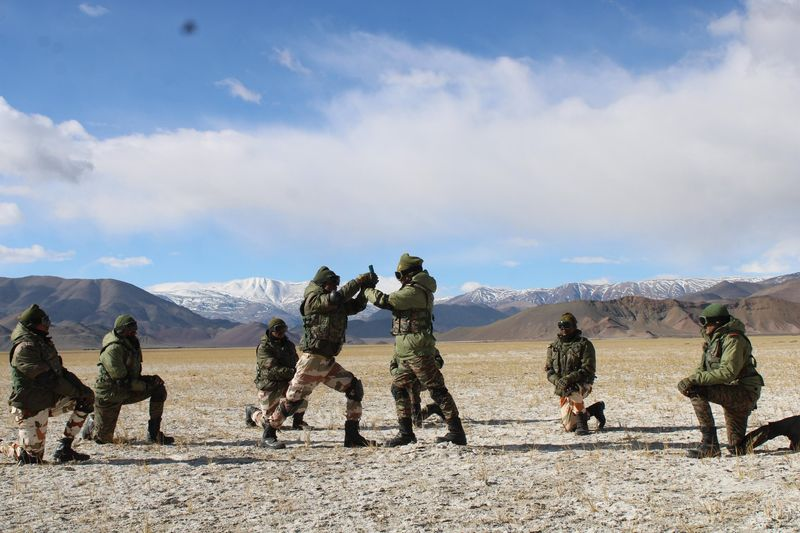
Army personnel undergoing training Photo: Indian Army

An inter-ministerial high-level committee has rejected a plea seeking parity in status and salary for middle-level officers of the armed forces with their civilian counterparts.

Called non-functional upgradation (NFU), it is given to the entire civilian bureaucracy and police. It results in a higher pay band after a certain number of years of service. Armed forces personnel do not receive this higher pay band.

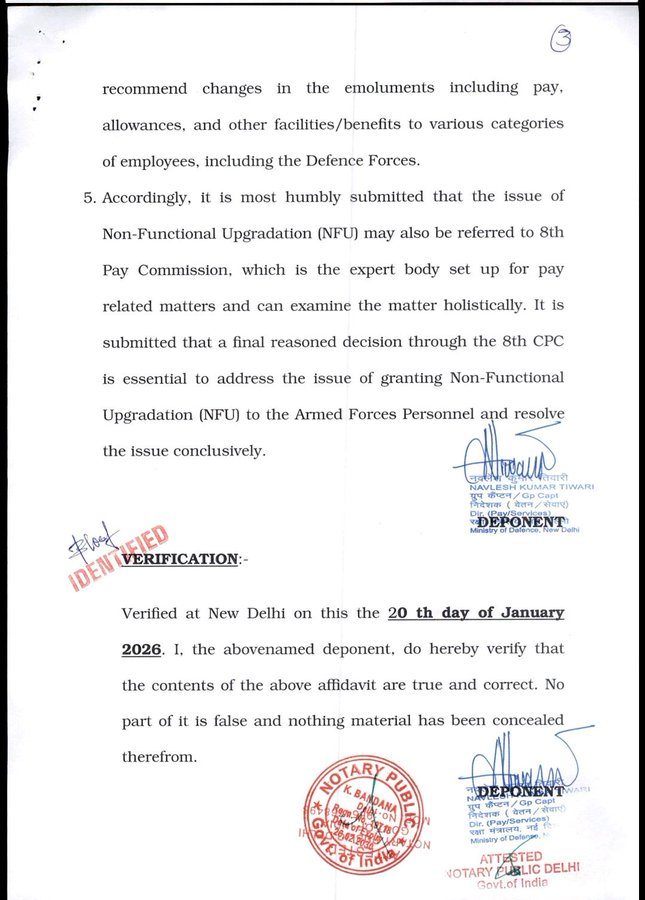
The committee has suggested that the issue be referred to the 8th Central Pay Commission, which has already been set up.

The matter is listed for hearing in the Supreme Court tomorrow, and the court may accept or reject the committee’s findings.

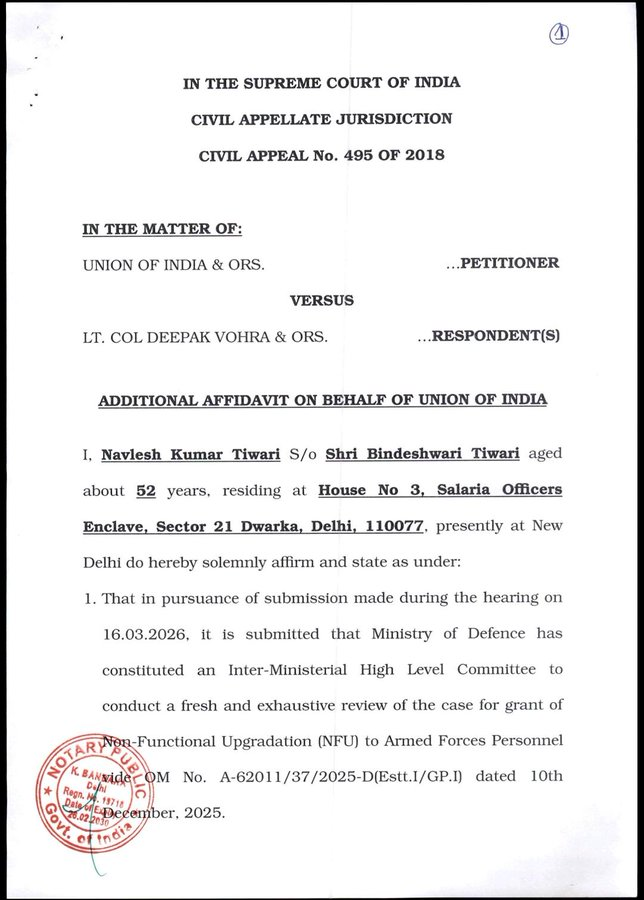
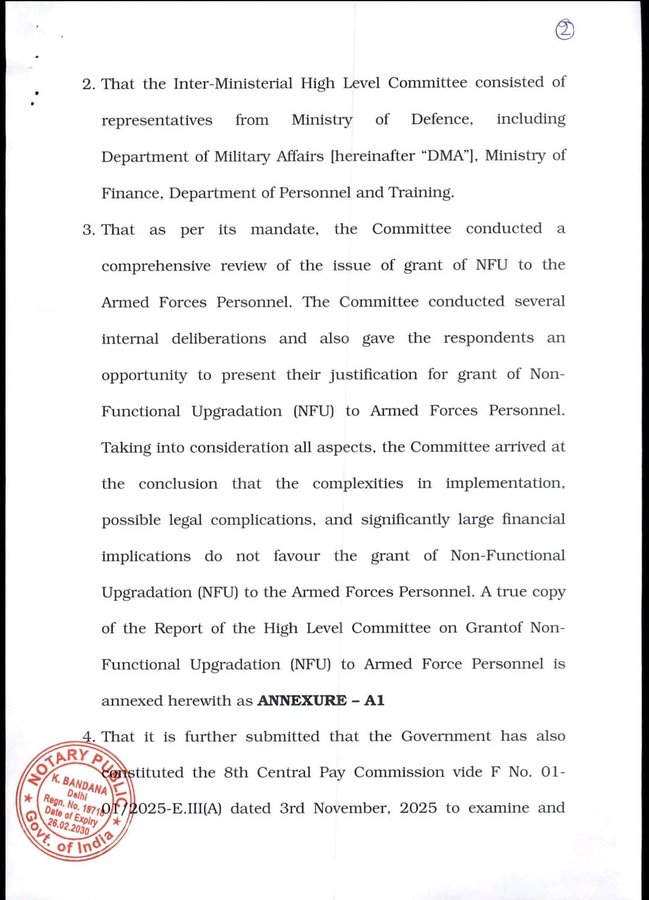
On Tuesday, the ‘Pay and Salary Cell’ of the Ministry of Defence filed an additional affidavit in the Supreme Court, citing the findings of the inter-ministerial high-level committee. It said, “Taking into consideration all aspects, the committee arrived at the conclusion that the complexities in implementation, possible legal complications and significantly large financial implications do not favour the grant of NFU to armed forces personnel.”

The committee was set up in January this year to conduct a “fresh and exhaustive review” of the demand for salary upgradation for armed forces personnel who do not get promoted beyond a certain rank due to paucity of vacancies, despite serving for a specified number of years.

The MoD formed the committee after the Supreme Court, while hearing the matter in December 2025, directed the ministry to re-examine the issue. Respondents and legal representatives of those who moved the court were invited by the MoD for an interaction.

The MoD affidavit said the committee held several internal deliberations and also provided the respondents an opportunity to present their justification for the grant of NFU.

In December 2016, the Armed Forces Tribunal in Delhi had granted NFU to armed forces personnel. The government challenged the order in the Supreme Court, where the case has since been pending.


Army commemorates veteran’s 100th b’day in Chandimandir OF Brig Wazir Singh Choudhary (retd)EX EME

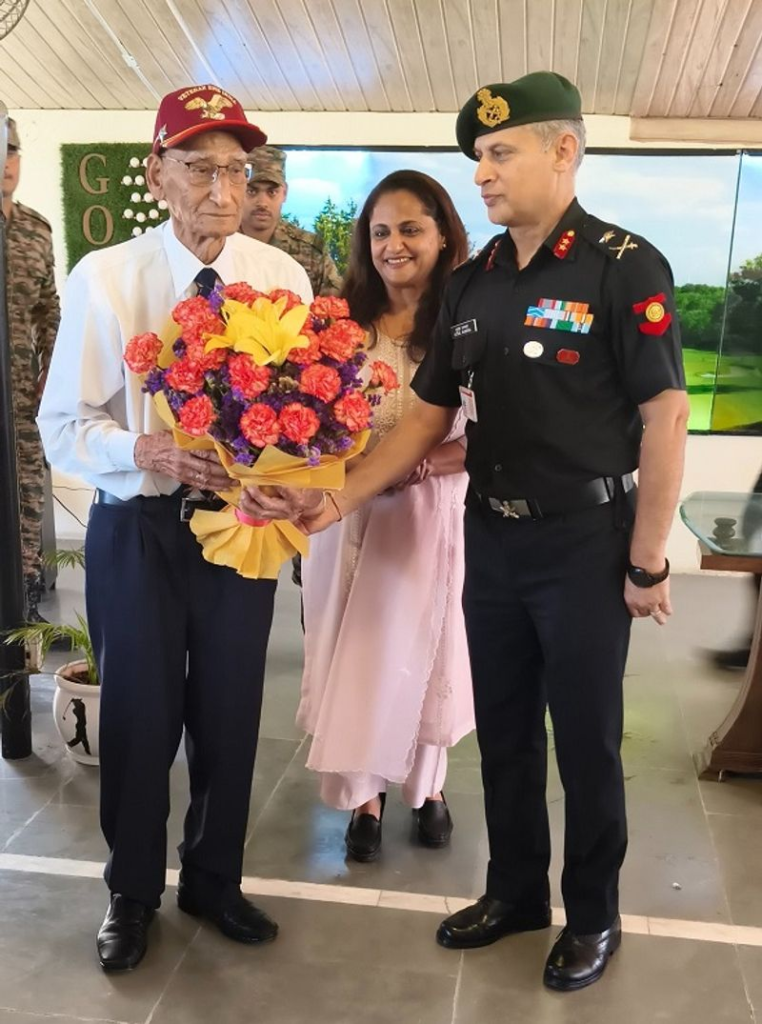
Western Command felicitates Brig Wazir Singh Choudhary (retd) on the occasion of his 100th birthday in Chandimandir on Tuesday. Photo sent by Vijay Mohan

Commemorating the 100th birthday of its veteran, Brig Wazir Singh Choudhary (retd), the Army today hosted him at Chandimandir and felicitated him. Lt Gen Pushpendra Singh, General Officer Commanding-in-Chief, Western Command, also extended his greetings to him.

Maj Gen Sunil Rampal, head of the EME Branch at the Headquarters, Western Command, on behalf of the Director-General, EME, and all ranks, extended heartfelt greetings and presented a commemorative medallion to Brigadier Choudhary.

After completing his engineering in 1948, Brigadier Choudhary joined the Indian Military Academy in 1949 and was commissioned into the Corps of Electrical and Mechanical Engineering (EME) the following year.

He participated in the 1965 and 1971 wars with Pakistan, and was awarded the Chief of Army Staff’s commendation for his services. He retired in 1979 as Commandant of the 515 Army Base Workshop in Bangalore, and settled in Panchkula. Hailing from Gujranwala (now in Pakistan), his family migrated to India during the Partition and initially settled in Amritsar. An avid golfer, he has won several tournaments, including those for seniors, and even at this ripe age takes to the greens occasionally.


Army’s first woman canoeist bags India’s first international gold in canoeing

Havildar Megha Pradeep clinched two golds in the C1 200-meters and C1 500-meters category, and a silver in the C2 500-meters category at 2026 Canoe Sprint Asian Games Test Event in Miyoshi City

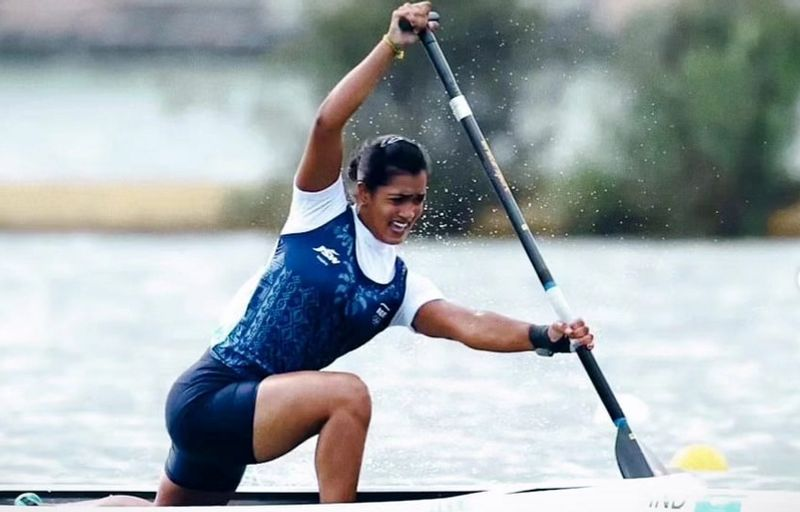
The first woman canoeist to join the Indian Army has blazed a trail, bagging the country’s first gold medal at an international event in the high-intensity paddling sport.

Havildar Megha Pradeep clinched two golds in the C1 200-meters and C1 500-meters category, and a silver in the C2 500-meters category at 2026 Canoe Sprint Asian Games Test Event in Miyoshi City, the Army said on Monday.

The event is a key qualifier for the 2026 Asian Games that are scheduled to be held in Japan, in which 45 countries are expected to participate.

In 2025, Oinam Binita Chanu from Odisha had won gold in kayaking at Canoe Sprint International President Cup in Uttarakhand, in which 21 countries had participated. Another woman kayaker, Prachi Yadav, won a gold in 2023 Asian Para Games for athletes with physical disabilities.

Canoeing and kayaking are different in the sense that the design of the boats and the seating positions are different. Canoes are open and use a single-bladed paddle while kayaks are closed-top and use a double-bladed paddle. All these have a bearing on balance, speed and manoeuvrability.

Besides Megha, two Army paddlers outshone at the meet, with Naib Subedar Sunil Singh bagging the gold in C1 200-m and C1 500-m, and Subedar Raju Rawat getting the silver in C2 500-m.

A C1 event is a high-speed flatwater race where one paddler kneels in a canoe and uses a single-bladed paddle to propel the boat, whereas a C2 event involves two paddlers in an open canoe, requiring synchronised power.

Canoe sprint is an extremely intense discipline requiring elite cardiovascular endurance, explosive power and exceptional balance as the athletes have to kneel in a narrow, unstable boat and paddle on only one side.

The athletes had trained at the Army Kayaking and Canoeing Node, which is managed by Bengal Engineer Group and Centre at Roorkee in Uttarakhand.

Megha became the first female athlete recruited into the Army Kayak and Canoe Node, marking a historic step for women in Indian water sports as part of the Army’s drive to enrol promising women sportspersons after entry into the rank and file was opened for females in 2022 under the Agnipath scheme.

Her defining breakthrough came at the 2024 Asian Canoe Sprint Championships in Tokyo, where she won a bronze medal in the women’s C1 500-m event, opening India’s medal tally and establishing herself among Asia’s elite canoeists.

While Megha has won gold medals at national events, the 21-year old’s international rise began with a silver medal at 2023 Junior Asian Canoe Sprint Championships and a bronze in the women’s C1 500-m at the 2024 Asian Canoe Sprint Championships in Tokyo.

At 2025 U23 World Championships in Portugal, she became the first Indian woman to reach the C1 500-m finals. Though she finished 17th, it was a historic milestone for Indian canoeing on the global stage.

Several women sportspersons recruited into the Army have also performed well in other disciplines, bagging gold in international events like boxing.


MoD Signs ₹975 Crore Contracts For Indigenous TRAWL Assemblies To Boost Army’s Minefield Breaching Capability

The Ministry of Defence has taken a significant step towards strengthening the Indian Army’s operational capabilities by signing contracts worth approximately ₹975 crore with Bharat Earth Movers Limited (BEML) and Electro Pneumatics and Hydraulics (India) Private Limited.

The contracts, concluded in New Delhi on 21 April 2026 in the presence of Defence Secretary Rajesh Kumar Singh, are for the procurement of TRAWL Assembly systems designed for T-72 and T-90 tanks.

The TRAWL Assembly, developed by the Defence Research and Development Organisation (DRDO), is a critical piece of equipment that will substantially enhance the Army’s minefield breaching capability.

By enabling the creation of Vehicle Safe Lanes through minefields containing anti-tank mines with proximity magnetic fuses, the system will improve the Army’s ability to manoeuvre in hostile environments.

This added capacity is expected to significantly bolster the operational effectiveness of armoured formations in combat scenarios.

The procurement falls under the Buy (Indian-Indigenously Designed, Developed and Manufactured) category, underscoring the government’s commitment to the Aatmanirbhar Bharat initiative.

Geopolitical Strategy India

This move not only modernises India’s defence infrastructure but also empowers indigenous industries to take a leading role in equipping the armed forces.

The project is anticipated to generate substantial direct and indirect employment opportunities, particularly by encouraging the participation of the MSME sector in the manufacture of components.

The contracts represent a convergence of strategic necessity and industrial empowerment. By equipping frontline tanks with advanced minefield breaching systems, the Indian Army will gain a decisive edge in battlefield mobility. At the same time, the initiative strengthens the domestic defence manufacturing ecosystem, ensuring that critical capabilities are developed and sustained within the country.

This dual benefit highlights the broader vision of self-reliance in defence production, where operational readiness and industrial growth go hand in hand.


Lessons from Pahalgam

Pakistan unwilling to shun terrorism despite paying an enormous economic, social & political price

article_Author
Vivek Katju

THE Pahalgam terror attack’s first anniversary should be an occasion for a sober reflection on terrorism, its regional and international manifestations, global patterns and the places where it has become endemic. It’s time for the Indian establishment and the political class to make a dispassionate assessment of how India has handled Pakistan-sponsored terrorism over the past three-and-a-half decades, especially since 2014.

Pakistan has repeatedly used force against India in a bid to achieve its security and foreign policy objectives. The despatch of tribal raiders to Kashmir in 1947, Operation Gibraltar and Operation Grand Slam in 1965, the initiation of hostilities in 1971 and the Kargil war in 1999 are illustrative.

Terrorism targeting India has become part of Pakistan’s security doctrine. It is particularly striking that Pakistan has raised the bogey of nuclear weapons as a shield. In doing so, it has turned on its head the doctrine that has prevailed among nuclear states. Pakistan is unwilling to shun terrorism despite paying an enormous economic, social and political price for it. That is a lesson which the Pahalgam attack reaffirmed.

India worsted Pakistan each time it used conventional force. This was so even when it was surprised, as in Kargil. However, has it got the better of terrorism originating from Pakistan? Has India succeeded in containing it, let alone eliminating it? Sadly, the answer to these questions is ‘no’. Till the Uri attack of 2016, India used diplomatic means to make the global community exert pressure on Pakistan to abandon the path of terror. On each occasion, the major powers assured India that they would deter Pakistan, but did nothing to this effect. It continued to promote terrorism, confident that it would not have to face the consequences. This, too, is a lesson reinforced by Pahalgam.

India also tried to engage Pakistan in a composite dialogue from 1998 onwards, but these efforts were unable to withstand a major terror attack. The last time India attempted to go down this road was in December 2015, when it agreed to a comprehensive dialogue. Prime Minister Narendra Modi paid a surprise visit to Lahore on Christmas that year, but it was a wasted effort because just a week later, the Pathankot airbase was attacked by terrorists.