



Sanjha Morcha

Iran-Israel War LIVE updates: ‘Clock is ticking’: Trump’s new ultimatum to Iran

Israeli military vehicles and soldiers in a village in southern Lebanon as the Israeli army operates in it as seen from the Israeli side of the border on Thursday. Image credit/Reuters

US President Donald Trump on Thursday downplayed the pressure on him to end the war, saying that a deal will be made if it is good for the US.

In a post on Truth Social, he said, “With Iran, please be advised that I am possibly the least pressured person ever to be in this position. I have all the time in the World, but Iran doesn’t — The clock is ticking!”

A member of Iranian Parliament’s National Security and Foreign Policy Committee, Mahmoud Nabavian, has said that the negotiation talks held with the US in Pakistan was a mistake.

Nabavian posted a snippet of his interview to SNN TV, where he noted that discussing its nuclear issue in Pakistan was a ‘strategic mistake’.

In a post on X, he said, “Putting the nuclear issue on the negotiation table in Pakistan was a strategic mistake.”

Guyana says tanker seized by US ‘fraudulently’ flying Guyana flag

April 24, 2026 8:55 am

Guyana: The South American nation of Guyana said that a tanker seized by the United States in Asia for allegedly carrying sanctioned Iranian crude oil was “fraudulently flying the Guyana flag”. AP

Iran’s central bank confirms Hormuz toll revenue deposited in cash

April 24, 2026 8:50 am

Iran’s central bank has confirmed that revenue from newly introduced transit fees for vessels passing through the Strait of Hormuz has been successfully deposited, putting to rest speculation over the form of payment, Iranian state media reported. The clarification follows earlier media claims suggesting that Iran was collecting transit fees in digital currencies such as Bitcoin or other cryptocurrencies.

Trump answers big nuclear use question

April 24, 2026 8:48 am

US President Donald Trump on Thursday ruled out striking Iran with a nuclear weapon, after his previous threats to completely destroy Iranian civilisation. “No, I wouldn’t use it,” Trump told reporters at the White House. “Why would I use a nuclear weapon when we’ve, in a very conventional way, decimated them without it?” he asked. Trump also added that nuclear weapon should never be allowed to be used by anybody.

Lebanon-Israel ceasefire extended by 3 weeks after Oval Office meeting

April 24, 2026 8:17 am

Lebanon and Israel extended their ceasefire for three weeks after a high-level meeting at the White House, US President Donald Trump said on Thursday. Trump hosted Israel’s ambassador to Washington Yechiel Leiter and Lebanese ambassador to the US Nada Moawad in the Oval Office for a second round of US-facilitated talks, a day after Israeli strikes killed at least five people including a journalist. Reuters


HEADLINES : 23APR 2016

Lt Gen SS Dhaiya Col Comdt Bengal sappers visit to 52 ER

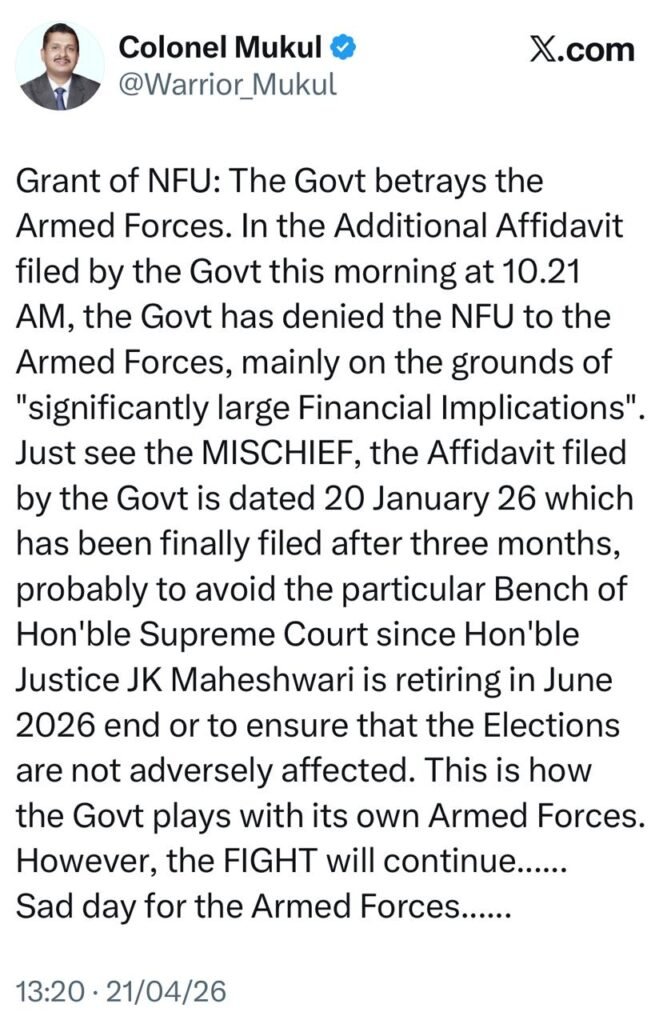
Legal Exp by MOD 2014-25

How defence forces been sidelined by not including their representative in Pay Commission : only civil servants :

WORLD’S MOST POWERFUL COUNTRY IS THAT COUNTRY WHICH HONOURS IT’S MILITARY VETERANS & SOLDIERS!

In news over his unpublished controversial memoir, Gen Naravane pens new book

Patiala admn seeks Army’s help to evacuate protesting farmer Gurjeet Singh Khalsa from tower

Why China is building villages near LAC

India, Germany ink defence industrial roadmap to boost tech sharing

Pakistan should clamp down on terror groups like LeT, JeM: US lawmaker

Iran-Israel war LIVE Updates: Iran attacks 3 ships in Strait of Hormuz as Trump indefinitely extends ceasefire

SSC (NT) -1 Course of the Indian Army Celebrates Diamond Jubilee


Lt Gen SS Dhaiya Col Comdt Bengal sappers visit to 52 ER

I visited 52 Engr Regt, CHAK DE on 22 Apr.
Heartening to see the multifarious and effective involvement in comb engineering, op infra development, innovation and HR Mgt by the team – speaks of good foundation and excellent unit TARTEEB.
Some phenomenal work done by the Regt in one of the most active Div of IA.
God bless Bengal Sappers
Lt Gen SS Dhaiya

WORLD’S MOST POWERFUL COUNTRY IS THAT COUNTRY WHICH HONOURS IT’S MILITARY VETERANS & SOLDIERS!

President helps homeless veteran in need

“On a bitterly cold December evening in 1997, President Bill Clinton was leaving a holiday concert at the Kennedy Center when he noticed a homeless veteran sitting outside the entrance, shivering in a thin jacket & holding a cardboard sign that simply read ‘Marine – Desert Storm – Hungry.’ What happened next shocked everyone in the presidential motorcade. Clinton immediately stopped, took off his own overcoat, draped it around the stunned man’s shoulders, & sat down on the freezing concrete beside him to talk. The veteran, forty-two-year-old Marcus Williams, later recounted to reporters that the President didn’t ask him what went wrong or lecture him about getting help, instead, Clinton asked about his service, which battles he’d seen, & whether anyone had properly thanked him for his sacrifice. Secret Service Agent Larry Cockell documented in his memoir that Clinton spent twenty-five minutes sitting on that sidewalk in the bitter cold, & when Marcus mentioned he hadn’t eaten in two days, the President sent an agent to get food from a nearby restaurant & insisted on staying until Marcus had finished eating. What makes this story so incredibly moving is what Clinton said to Marcus before leaving, words that Marcus repeated to social workers, shelter staff, & eventually his own children years later when he’d gotten back on his feet: ‘Brother, this country failed you when you came home, & I’m sorry, but your story isn’t over yet, & I’m going to make sure someone follows up to help you write the next chapter.’ True to his word, Clinton personally called the VA the next morning, & Marcus was enrolled in a comprehensive support program within forty-eight hours that included housing, job training, & mental health services. Marcus Williams eventually became a veterans’ advocate, & he told the Washington Post in 2015 something that still gives me chills: ‘The most powerful man in the world sat on frozen concrete with a forgotten Marine & made me feel like I still mattered, that’s the moment I decided to fight my way back.’ He reminds us that dignity & hope can be restored with one genuine conversation, one warm coat, & the willingness to sit beside someone the world has walked past.

GOD BLESS BHARAT


In news over his unpublished controversial memoir, Gen Naravane pens new book

It is a lively exploration of the ‘underexplored, bizarre and often wildly amusing aspects’ of the Indian armed forces

A chance glance at Shashi Tharoor’s ‘A Wonderland of Words’ at a friend’s house two years ago gave former Army chief Gen Manoj Naravane the idea of his new book – a lively exploration of the “underexplored, bizarre and often wildly amusing aspects” of the Indian armed forces.

The general, who was in the news recently over his unpublished controversial memoir ‘Four Stars of Destiny’, mentions some of the most riveting nuggets about the legends and lore of the Indian Army, Navy and Air Force in his book ‘The Curious and the Classified: Unearthing Military Myths and Mysteries’.

In its introduction, he writes about how he was impressed by Tharoor’s book, which is a collection of essays centred around the idiosyncrasies of the English language.

“If such a captivating book could be written on the quirks and peculiarities of the English language, how about a similar one about the Indian Army,” Gen Naravane, who served as the 28th chief of the Army Staff from December 2019 to April 2022, wondered.

“The germ of this idea had popped up in my mind on the very first day when I looked at the book, but I could start thinking about it seriously only in mid-2025…,” he writes.

In the book, published by Rupa, Gen Naravane shares several vignettes – how the popular cheer of ‘Chak de phatte’ actually has its roots in the Sikh army of the 17th and 18th centuries or the inspiration behind the foot-tapping number ‘Badluram ka badan’. Badluram was killed in action in the decisive Battle of Kohima in 1944.

“Be it the enduring spirit of Baba Harbhajan, the fate of INS Khukri, the extraordinary sagas of airmen and their call signs, or the raw courage of Pedongi, the military mule, you will find it all and more in this thoroughly entertaining yet meticulously researched foray into the underexplored, bizarre and often wildly amusing aspects of our armed forces,” the publishers said in a statement.

On ‘Badluram ka badan’, which has become the regimental anthem of the Assam Regiment and sung at the Attestation Parade (Kasam Parade) at their Regimental Centre in Happy Valley, Shillong, during passing-out ceremonies, the general describes how the song, complete with marching, stomping, clapping and spirited footwork, has even transcended borders.

Badluram was a rifleman in the 1st Battalion of the Assam Regiment, who was part of the garrison deployed at Kohima, and was killed in the early stages of the clash.

“After his death, Badluram’s CQM (Company Quartermaster), either by accident or design, never removed his name from the ration strength. As long as the supply lines remained open, rations authorised for Badluram continued to arrive, accumulating into a small surplus.

“When the Japanese forces besieged the unit at Kohima and supply lines were cut, it was that extra ration stock that saved countless lives,” the book says.

In 1946, Major MT Proktor, moved by the saga of how the absurdity of drawing rations for a dead man long after he was gone eventually served to save lives, composed the marching song ‘Badluram ka badan’.

Gen Naravane said he was keen to have the tales appeal to the wider population, be anecdotal rather than academic, and yet have an underlying theme highlighting the military ethos.

“They could not be based on some obscure military facts buried in some dusty archive. They had to be closer to the surface in order to resonate with a wide readership through aspects the latter could identify with, possibly through frequent encountering though sans any knowledge of the historical background or importance,” he writes.

All the stories, according to him, have their origin in some real-life event, which, over a period of time, has got embellished through telling and retelling.

The purpose of each story is to bring to life momentous events or characters, to bridge the gap between the Armed Forces and civilian society while giving a glimpse into our world, he adds.

According to the general, his book is “supposed to be an entertaining read and not a serious academic endeavour intended to be a competitive exam aid”.

Amid reports of unauthorised copies of Gen Naravane’s ‘Four Stars of Destiny’ in circulation, publisher Penguin Random House India had in February said it holds the exclusive publishing rights to the memoir and clarified that the book has not yet been published.


Gen Naravane had also clarified that no copies of the book “in print or digital form have been published, distributed, sold” or otherwise made available to the public


Patiala admn seeks Army’s help to evacuate protesting farmer Gurjeet Singh Khalsa from tower

The Patiala administration has requested the Home Affairs Department to seek assistance from the Army to evacuate Punjab farmer Gurjeet Singh Khalsa, 43, who will end his 560-day protest atop a 400-ft BSNL tower on April 24.

Khalsa on Sunday had agreed to climb down the tower he had mounted seeking an anti-sacrilege law in October 2024. The development came hours after Punjab Governor Gulab Chand Kataria gave his nod to the Jaagat Jot Sri Guru Granth Sahib Satkar (Amendment) Bill, 2026, paving the way for the enactment of the law.

The administration has sought Army’s help in terms of men and equipment to bring down Khalsa, given the gravity of the situation and the threat involved in coming down the tower.

Meanwhile, Samana tower morcha members are holding an akhand path near the protest site at Baba Banda Singh Bahadur Chowk, with the dharna ending on the day of the bhog on Friday. A resident of Kheri Nagaiyan village in Patiala, Khalsa told The Tribune that he would wait for bhog of the akhand path to conclude and come down in the presence of people, who had been protesting in his support.


Why China is building villages near LAC

NEW DELHI- China has constructed hundreds of so-called “Xiaokang” or “well-off” villages along its border areas facing India, particularly opposite Arunachal Pradesh, according to senior officials of the Indian Army. The development has raised strategic concerns regarding the evolving security dynamics along the Line of Actual Control (LAC).

Lieutenant General Rajiv Ghai, Deputy Chief of Army Staff (Strategy), highlighted the issue during a seminar organised by the Assam Rifles in collaboration with the United Service Institution (USI) in New Delhi. The seminar examined emerging security challenges in India’s Northeast region.

According to the Army, China has built around 628 Xiaokang villages along its northern borders over the last two decades. Of these, approximately 72 percent — nearly 450 villages — are located across from India’s northeastern states.

China is constructing hundreds of “Xiaokang” (moderately prosperous) dual-use villages along the Line of Actual Control (LAC) to solidify territorial claims, enhance surveillance, and support military logistics. These settlements, often placed in contested areas, serve as civilian-military, fortified outposts to reinforce China’s sovereignty claims and create a, permanent,, controlled population. ChinaPower Project +2

Key Reasons for Construction:

  • Solidifying Territorial Claims: These villages, often built in disputed border regions, allow China to use “salami-slicing” tactics to alter the status quo and justify their claims by creating “settled populations”.
  • Dual-Use Infrastructure: The villages are designed for both civilian habitation and rapid military deployment, enabling them to function as cantonments for patrolling troops.
  • Military-Civil Fusion: By moving citizens from inner provinces to the border, China aims to maintain a constant civilian presence that supports military operations, provides intelligence, and improves logistical support.
  • Strengthening Border Defense: These “border defense villages” help in managing the security of the Tibet Autonomous Region (TAR) and managing the borderlands more tightly.
  • Countering India: The villages often mirror increased Indian infrastructure development, particularly near Arunachal Pradesh and Uttarakhand, aiming to counter India’s presence directly. The Indian Express +6

These initiatives are part of a broader strategy to assert dominance in the region and increase pressure on India along the entire border.


India, Germany ink defence industrial roadmap to boost tech sharing

The document was signed in Berlin after Defence Minister Rajnath Singh met his German counterpart Boris Pistorius

India and Germany on Wednesday inked a “defence industrial roadmap” to enable technology sharing and explore opportunities in emerging domains.

Described by sources as a “two-way street”, the roadmap will allow Indian companies bidding for contracts in the German military equipment market to partner with German firms under a formal government-to-government framework.

Conversely, it is expected to facilitate cooperation as India and Germany move closer to finalising a deal to co-produce next-generation conventional submarines in India.

The document was signed in Berlin after Defence Minister Rajnath Singh met his German counterpart Boris Pistorius during his three-day visit (April 21 to 23).

“Exchanged views on a wide range of issues, including deepening our defence cooperation,” Singh posted on X.

The Ministry of Defence said the two ministers discussed bilateral security issues, including priority areas for co-development and co-production of defence equipment, particularly in niche technologies. They also reaffirmed their commitment to enhancing military-to-military cooperation as a key pillar of the strategic partnership.

The roadmap comes as German firm ThyssenKrupp Marine Systems has tied up with Mazagon Dock Shipbuilders Limited to build six submarines in a deal estimated at around $8 billion, with discussions in the final stages before a formal contract is signed.

In June last year, the two companies signed a memorandum of understanding to collaborate on building stealth submarines equipped with air-independent propulsion (AIP) technology, enabling them to remain submerged for longer durations.

TKMS is a global leader in non-nuclear submarines based on AIP technology, which allows submarines to stay underwater for extended periods. India has sought operational AIP capabilities that could enable submarines to remain submerged for up to six days.

The agreement aims to combine German technology with MDL’s manufacturing capabilities. Under the arrangement, TKMS will contribute to engineering and design, and provide consultancy support, while MDL will be responsible for construction and delivery. The submarines will be built in India with significant local content.

Singh is also expected to interact with key representatives of the German defence industry to promote joint development and co-production under the Make in India initiative.

Earlier, the minister laid a wreath at the Bundeswehr Memorial, honouring personnel who died in the line of duty.

When asked about India’s role in facilitating peace in West Asia, Singh said: “India has tried, but everything has its time. It is possible that tomorrow the time may come when India plays a role and achieves success. We cannot rule out this possibility.”