





Sanjha Morcha

Russia-Ukraine war impacts supply of aircraft spares, spurs IAF to step up indigenisation efforts

Russia-Ukraine war impacts supply of aircraft spares, spurs IAF to step up indigenisation efforts

Tribune News Service

Vijay Mohan

Chandigarh, August 17

The ongoing Russia-Ukraine conflict has impacted the supply chain of spare parts for aircraft, both in terms of availability of items as well as increased monetary costs, forcing the Indian Air Force to spur up its indigenisation efforts.

“The conflict has had a strong impact on the availability of spares for Russian-origin aircraft and in the bargain we have gone in for indigenisation of certain parts and components that we would not have pursued otherwise,” Air Commodore Rajeev Shrivastava, Air Officer Commanding, No.3 Base Repair Depot (BRD) said on Thursday.

Located at Chandigarh, 3 BRD is responsible for the maintenance and overhaul of Russian-origin helicopters in the IAF’s inventory and AN-32 aircraft engines as well as developing technology for the indigenous production of aero-spares.

Air Commodore Shrivastava said that the depot has already indigenised over 15,000 types of spares for the IAF’s Mi-17 series of helicopters as well as the Kamov variants in service with the Navy.

The conflict has further given an impetus to the indigenisation efforts and over the next five years, it is endeavoured to end dependence on foreign suppliers. The indigenisation of many components and complex sub-systems has been completed and many projects are at an advanced stage, he added.

The IAF has a large fleet of Mi-17 medium lift helicopters (MLH) that form the back bone of its vertical lift component. These include the older Mi-17 and the Mi-17 1V as well as the latest Mi-17 V5 variant, totaling about 270 platforms.

“The biggest challenge of the depot has been sustenance of the huge MLH fleet with limited or no support from the original equipment manufacturers in terms of supply of critical spares,” Air Commodore Shrivastava said.

“We have been mitigating the challenge through life revision studies, outsourcing, innovative in-house technology, reclamation and indigenisation in collaboration with the industry and academia,” he added.

For example, the IAF is undertaking a project with the Punjab Engineering College, Chandigarh, to develop an artificial intelligence based tool for health monitoring and preventive maintenance of Mi-17 aero-engines.

The depot, in association with Defence Research and Development Organisation and other public and private agencies, has also developed the capability to overhaul the Mi-17 V5 variant and its aggregates indigenously, for which there had been no transfer of technology from Russia.

According to IAF officers, the overhaul of a Mi-17 overseas costs about Rs 6 crore per aircraft with a time cycle of about 12 months. With indigenous capability, this is reduced to just Rs 80 lakh per aircraft with a time frame of four months.

Though the IAF began overhauling the older variants of the Mi-17 in 1992 for which Russia had then transferred technology, the project to develop indigenous technology for the 1V and V5 versions, which have different engines, avionics suits and flight parameters, began in 2019.

The Mi-17 requires to be overhauled after 2,000 flying hours or 10 years. The IAF’s projected requirement is to overhaul about 30 helicopters every year, for which it is working out a plan for roping in the private sector to provide manpower, equipment and spares and execute specified tasks under its control and supervision.


GRSE-built stealth frigate INS Vindhyagiri launched in Kolkata

GRSE-built stealth frigate INS Vindhyagiri launched in Kolkata

PTI

Kolkata, August 17

President Droupadi Murmu on Thursday launched ‘Vindhyagiri’, an advanced stealth frigate, at Garden Reach Shipbuilders and Engineers Ltd’s (GRSE) facility on the banks of the Hooghly river here.

West Bengal Governor CV Ananda Bose and Chief Minister Mamata Banerjee were also present on the occasion.

This is the sixth of seven ships built under ‘Project 17 Alpha’ for the Navy.

The first five ships of the project were launched between 2019 and 2022.

This is the third and last stealth frigate that the Kolkata-based warship maker was contracted to build for the Navy under the project.

The official said that 75 per cent of orders for equipment and systems of P17A ships are from indigenous firms, including micro, small and medium enterprises (MSMEs).

The state-of-the-art ship will be fitted with the latest gadgets and undergo extensive trials before being handed over to the Indian Navy for commissioning into service.

P17A ships are guided missile frigates, each of which is 149 metres long, with the displacement of approximately 6,670 tonnes and a speed of 28 knots, according to a GRSE official. These are capable of neutralising threats in all three dimensions of air, surface and sub-surface.

Earlier in the day, the president launched ‘My Bengal, Addiction Free Bengal’ campaign under the ‘Nasha Mukt Bharat Abhiyan’ organised by Brahma Kumaris at the Raj Bhavan.

This is Murmu’s second visit to West Bengal after being elected the president last year. She visited the state in March.

Security was tightened in the city in view of the president’s visit with traffic being regulated on several roads, officials said.


Vindhyagiri adds to India’s naval prowess

Vindhyagiri adds to India’s naval prowess

Advertisement

Tribune News Service

New Delhi, August 17

President Droupadi Murmu today launched ‘Vindhyagiri’, an advanced stealth frigate, at Garden Reach Shipbuilders and Engineers Ltd’s facility at Kolkatta.

She said the production of the advanced frigate was a symbol of Atmanirbhar Bharat and of technological advancement made by the country. This is the sixth warship of Project 17A, a follow on to the Shivalik Class frigates but with improved stealth features, advanced weapons, sensors and platform management systems.

Warships have been designed in-house by the Directorate of Naval Design. Around 75 per cent of the equipment and systems were sourced from indigenous firms, including micro, small and medium enterprises.

P17A ships are guided missile frigates, each of which is 149 metres long, with the displacement of 6,670 tonnes and a speed of 28 knots.

Indigenous weapons include medium range surface-to-air missiles; BrahMos surface-to-surface missiles; indigenous torpedo tube launchers and anti-submarine rocket launchers; and 76mm super rapid gun mount. A total of seven ships are being made.

Stealth frigate

Length: 149 metres

Weight: 6,670 tonnes

Speed: 28 knots

6th of 7 ships built under ‘Project 17 Alpha’; first five launched between 2019 & 2022

75% of orders for equipment and systems of P17A ships are from indigenous firms


CAG audit findings

Need to probe irregularities in health scheme

CAG audit findings

A performance audit of the Ayushman Bharat-Pradhan Mantri Jan Arogya Yojana (AB-PMJAY) by the Comptroller and Auditor General of India (CAG) has detected glaring irregularities and deficiencies in the implementation of the Union Government’s flagship scheme, which was launched in 2018 with the aim of reducing the out-of-pocket medical expenditure of the poor and vulnerable sections of the population. As per the CAG report, tabled in Parliament last week, Rs 6.97 crore was paid for the treatment of 3,446 patients who had earlier been shown as deceased in the AB-PMJAY database. No less shocking is the fact that around 7.5 lakh beneficiaries under the scheme were linked to one mobile number, 9999999999. A total of 1,285 beneficiaries were linked to Aadhaar number 000000000000!

After the damning report was tabled, the government informed the Lok Sabha on Friday that 210 hospitals had been de-empanelled and the licences of 188 others suspended due to their involvement in activities non-compliant with the guidelines issued by the National Health Authority (NHA) or the state health authority. The NHA’s National Anti-Fraud Unit is tasked with the detection, deterrence and prevention of fraud and abuse under AB-PMJAY, but its efficacy is under a cloud in view of the audit findings.

The CAG report comes as an embarrassment for the BJP-led government, which has repeatedly reaffirmed its commitment to eradicating corruption. It’s apparent that fake or ineligible beneficiaries are undermining this premier welfare scheme, which caters to around 55 crore people in the country. An in-depth investigation is the need of the hour to unearth the nexus between hospital staffers, middlemen and government officials. The loopholes must be plugged on priority, failing which the fight against corruption — summed up by PM Modi’s famous promise, ‘Na khaoonga na khaane doonga’ — would suffer a big jolt, and that too in the run-up to the high-stakes Lok Sabha elections.


Punjab floods: Army, NDRF teams rescue 300 people from Kapurthala villages; 5,500 sent to relief camps in Hoshiarpur; situation grim in Rupnagar district

Kapurthala/Gurdaspur, August 17

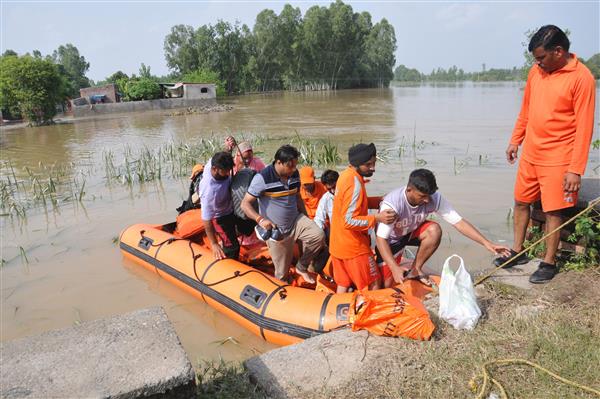
Army and NDRF teams on Thursday rescued nearly 300 people from marooned villages in Punjab’s Kapurthala as relief and rescue work continued in some of the flood affected districts in the state.

NDRF teams rescuing people to safer locations from flood-hit Haler Janardhan village of Mukerian in Hoshiarpur on Thursday. Tribune photo: Malkiat Singh
Monsoon fury: 44K in 130 Punjab villages hit by flood, 9,000 shifted, Gurdaspur bears brunt

Kapurthala Deputy Commissioner Karnail Singh said six teams of the National Disaster Response Force (NDRF) and Army pressed six boats to rescue the people caught in the floods and all those evacuated have been shifted to relief camps.

Monsoon fury: 35 villages submerged after 3 breaches in dhussi bundh

A total of 22 villages have been affected by floods in the Beas river due to release of excess water from Bhakra Dam, he said while expressing hope that the situation would improve by Friday.

He said some flood affected people are living inside ‘dhusi bundhs’ (embankments) in ‘deras’ to look after their fields, while nearly 40 people are reluctant to leave their marooned houses and their cattle.

Monsoon fury: 52 villages inundated in Gurdaspur district

Some parts of Hoshiarpur, Gurdaspur and Rupnagar and Kapurthala districts were submerged following the release of excess water from Pong and Bhakra dams this week.

Monsoon fury: Army, NDRF assist in rescue operations

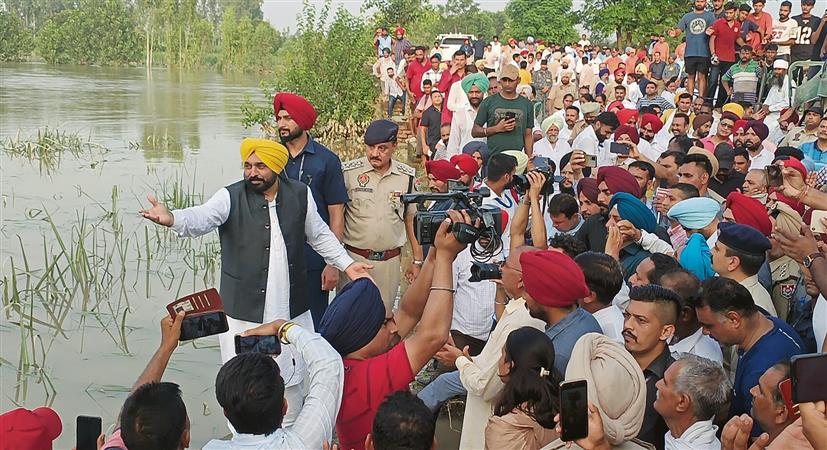
In the afternoon, Punjab Chief Minister Bhagwant Mann toured the flood affected areas of Hoshiarpur district in a boat to take stock of the situation.

Mann said the entire government machinery including the helicopter of state government is at disposal of people in this hour of crisis.

The chief minister said the state government has already ordered a “special girdawari (survey)” to ascertain the loss incurred to people due to floods in the state.

Mann assured the people that his government will “compensate the people even if they had lost a hen or a goat due to the floods”.

He said there is no need for people to panic as the state government is there to extend all help to those affected.

The flood situation in Rupnagar district remained grim as more water was being released into the Sutlej river from Bhakra Dam.

The Army is assisting in the rescue operations and NDRF teams are working round-the-clock to prevent breaches and to rescue the people trapped in marooned villages.

Punjab minister Harjot Singh Bains has been camping in the district and is supervising the rescue and relief operations.

The Army and NDRF teams were also assisting in the rescue and relief work in some of the affected areas of Gurdaspur district. Medical teams in the district have been sent to houses via boats to check on people stuck in their homes for three days and those who don’t want to move out, officials said.

In Kapurthala, one person was feared to have drowned in the flood waters of Beas river in Mand areas of village Talwandi Kuka in the Bholath sub-division when he was rescuing his cattle, officials said on Thursday.

In Chandigarh, Chief Minister Mann told reporters that the latest flooding in some areas of the state was caused by heavy rains in neighbouring Himachal Pradesh and subsequent release of excess water from the Pong and Bhakra dams.

The Bhakra Beas Management Board (BBMB), which manages the Bhakra and the Pong dams, on Wednesday said it will release excess water in a controlled manner for the next four to five days to take the level in their reservoirs to a safe limit. The Bhakra dam on the Sutlej and the Pong dam on the Beas—both in Himachal Pradesh—are brimming after heavy rain in their respective catchment areas.

Last month too, several parts of Punjab were affected by a downpour in the state between July 9 and 11 that flooded vast tracts of farmlands and other areas, besides paralysing daily life.

Mann said the water levels in Bhakra and Pong dams stand at 1,676 feet and 1,396 feet, respectively, and the water was being released in a controlled way.

In Harike, he said the water released from Pong and Bhakra gets collected and added “we are releasing water from there”.

“We are in regular touch with the Himachal Pradesh government and BBMB authorities and we are hopeful that water will recede by evening,” he said.

Mann reiterated that his government has urged the Centre to relax the norms for increasing disaster relief for flood victims.

In Hoshiarpur, the floodwater level in the villages near the banks of the Beas in Mukerian, Tanda, Dasuya and Talwara areas of this district slightly decreased on Thursday.

However, in the affected villages, the floodwater has caused significant damage to the residents’ household belongings. Moreover, the crops standing in the flooded fields have also been adversely affected.

Raminder Singh, the Chief Agriculture Officer of Hoshiarpur, stated that standing crops, particularly paddy, spanning approximately 5,000 acres of farmland, have suffered severe damage in the flood-affected regions.

Approximately 90 per cent of the paddy crop has been adversely affected, he said.

Hoshiarpur Deputy Commissioner Komal Mittal said that the National Disaster Response Force, State Disaster Response Force and some non-governmental organisations are still engaged in the work of evacuating the people trapped in the flood-hit regions in the district.

More than 5,500 inhabitants of the flood-affected villages have been sent to relief camps and safer places. Mittal appealed to the affected people to voluntarily vacate their houses and go to safer places or the relief camps established by the local administration.

Teams of the Health Department and the Animal Husbandry Department are engaged in relief work in flood-affected regions to save the people from water-borne diseases, she said.


Advanced Study complex ‘sinking’, officials send SOS

Advanced Study complex ‘sinking’, officials send SOS

Subhash Rajta

Shimla, August 17

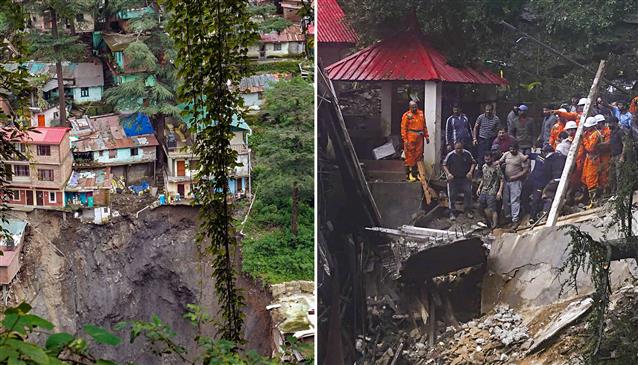
The Indian Institute of Advanced Study (IIAS), Shimla, has written to the Union Ministry of Education and the local authorities for risk assessment of the complex in the wake of a massive landslide on Monday morning that left around 20 persons buried inside a temple in Summer Hill.

The landslide apparently triggered off from the edge of the outer lawns of the institute, taking away with it a fenced pathway of the institute and several deodar trees right in front of the lawns. “The IIAS has written to the authorities for risk assessment and preventive measures for the safety of the complex. The officials from the State Disaster Management Authority and the Meteorological Department have also visited the spot,” said a source from the institute.

The IIAS has covered the edge of the outer lawns with plastic sheets to ensure there was no water seepage into the slide-hit muddy area. Such was the intensity of the landslide that it took away portions of two roads, and a sizeable chunk of the Shimla-Kalka heritage railway track, before razing the temple, about 700-800 metres downhill from the IIAS.

App for flood forecast launched

New Delhi: Amid floods across the country, the Central Water Commission has launched a mobile application, FloodWatch.

A road inside the complex, close to the main building, is sinking too. While it has been sinking for a while now, the landslide incident has made the authorities cautious. “We are altering the course of the water on the road to ensure it doesn’t flow towards the sinking side,” said the source.

Even as it’s widely believed a cloudburst triggered off the landslide, sources in the weather department think otherwise. According to them, neither the rain intensity was as high as required for a cloudburst nor was the impact area as large as witnessed in case of a cloudburst.


Gods must be angry’: Spine-chilling videos show houses, people being washed away in Himachal Pradesh; rail track, car hang precariously in air

'Gods must be angry': Spine-chilling videos show houses, people being washed away in Himachal Pradesh; rail track, car hang precariously in air

Tribune Web Desk

Chandigarh, August 17

It’s without a doubt a “mountain-like challenge” for Himachal Pradesh.

As the state was trying to recover from July’s rain fury, it was battered by the recent heavy rain, which has again thrown life out of gear.

In four days, over 70 people were killed in landslides and cloudburst as houses fell like a pack of cards in parts of the state

Since the onset of monsoon on June 24, 170 incidents of cloudburst and landslide have been reported in the state and about 9,600 houses partially or completely damaged.

In one video, a whole patch of road has been washed away from outside a house and what remains is a car parked precariously.

Another video shows the Unesco world heritage Shimla-Kalka railway line damaged near Summer Hill in Shimla after a landslide swept away a 50-metre bridge, leaving a portion of the track hanging.

The heritage track has suffered damage at five to six places with the most affected stretch being between Shimla and Shoghi.

Seven members of a family, including three children, were inside the Shiv temple when it collapsed. In all, 13 bodies have been recovered and 10 are feared buried.

Sunita Sharma, a relative of a victim, said, “I have just one request, find them and bring them to us. We will accept them dead or alive. We have been waiting for four days,” adding, “God must be angry, We don’t know why God did this to us.”

Vinod, the brother of one of the missing persons, said, “The administration should make such areas safe, and have some kind of system in place to ensure that the water recedes immediately.”

Mehar Singh, neigbour of a victim, said, “We performed the last rites of four members of a family  on Tuesday. They lost their three generations.”

“Look at our roads in Himachal. What’s the point of this kind of development when it comes at a price, and it’s we locals who have to pay for it,” said Shivani, a resident of Shimla.

Nineteen people died in rain-related incidents in Mandi district on Monday. Seven members of a family, including a two-year-old child, were killed in a landslide late on Sunday night in Seghli panchayat while six bodies were recovered at Sambhal near Pandoh. A video showed flashflood taking away everything that came in its way.


69 more villages in Gurdaspur hit by flood in a day; officials fear worse as more rain is expected in Himachal Pradesh

Tribune News Service

Gurdaspur, August 17

Several teams of the National Disaster Response Force, Army and the BSF have been pressed into service for rescue operations in flood-hit areas of Punjab’s Hoshiarpur, Gurdaspur and Rupnagar districts.

Large parts of these three districts have been inundated following the release of excess water from the Bhakra and the Pong dams, said officials.

Against Wednesday’s figure of 45, flood waters on Thursday entered 114 villages in Punjab. Officials fear the worst may come in a day as heavy rain is expected in Himachal Pradesh. Another worry was that the VIP visits are hampering rescue operations, say officials.

The water level in the Beas and the Sutlej rivers rose following the release of water from the dams’ reservoirs.

The Bhakra dam on the Sutlej river and the Pong dam on the Beas river — both in Himachal Pradesh — are brimming after heavy rain in their respective catchment areas.

Several people in low-lying regions and villages on the banks of the rivers in Punjab were evacuated to safety even as district administrations appealed to people in the flood-hit areas to move to safer locations.

The Gurdaspur district administration announced holidays in government and private schools in flood-hit villages till further orders while the authorities in Rupnagar declared holidays in schools and anganwadi centres in the affected areas on August 17 and 18.

Many villagers, carrying essentials on their shoulders, could be seen wading through flood-hit areas to safer places. Some villagers even engaged their tractor-trolleys to take the stranded people to safety and provide relief material.

Regular announcements are being made for people to move to safety. With PTI


Green tribunal had flagged Shimla’s vulnerability to natural disasters

Green tribunal had flagged Shimla’s vulnerability to natural disasters

New Delhi, August 17

Even as landslides hit Shimla killing more than 70 people, the Himachal Pradesh Government remains engaged in a legal battle in the Supreme Court against an order of the National Green Tribunal (NGT) that asked it to follow environmental norms in formulating its development plan for the state capital.

Notified in June this year by the Himachal Pradesh Government, the draft Shimla Development Plan—“Vision 2041”, seeks to regulate construction activities in the state capital, including the number of floors, habitable attic and garage in a building.

It allows construction in 17 green belts with certain restrictions, including in the core area where construction activity was banned by the NGT. Two floors with a habitable attic and parking in core areas and three stories with parking and a habitable attic in non-core areas would also be permissible.

Responding to the Himachal Pradesh Government’s Town and Country Planning Department’s application dated July 24, Yogendra Mohan Sengupta – on whose plea the NGT had passed the order –has told the top court that the NGT had in its November 16, 2017 order flagged Shimla’s vulnerability to natural disasters and the additional uncontrolled constructions which was making the situation worse.

The NGT had said by allowing and undertaking constructions in the ecologically fragile areas, the principle of Sustainable Development and Precautionary Principle along with the Public Trust doctrine have been violated which has increased the vulnerability of Shimla to man-made and natural disasters.

Such unplanned and indiscriminate development in the core, non-core, green and rural areas within the Shimla planning area had given rise to serious environmental and ecological concerns, the NGT had noted.

Sengupta said the state government had approached the high court but there was no stay on the NGT order. “The State of Himachal Pradesh, instead of preparing a Development Plan by adhering to the directions issued by Ld. Tribunal, prepared a Draft Development Plan in contravention of the directions given by the Ld. Tribunal,” he submitted.

On October 14, 2022, the NGT had stayed the Shimla Development Plan approved by the previous government in February 2022, terming it illegal and in conflict with earlier orders passed in 2017 to regulate haphazard construction.

The state government had challenged this order before the HC but now it has been transferred to the top court.

“The final Development Plan is therefore, clearly in violation of the judgment and directions given by the Ld. Tribunal on 16.11.2017 and Order dated 14.10.2022 and directly infringes on the Rule of Law,” Sengupta submitted.

The final Shimla Development Plan can’t be acted upon unless the top court considered the NGT orders and their alleged violations by the Himachal Pradesh Government and issued appropriate directions in consonance with the principle of sustainable development and precautionary principle, Sengupta contended.

A Supreme Court Bench led by Justice BR Gavai – which had on July 28 emphasised the need to maintain a balance between development and environment – is likely to examine the draft Shimla Development Plan on August 22. It had on July 12 permitted the state government to place on record the final development plan.

On May 3, the Bench had directed the Himachal Pradesh Government to consider the 97 objections to the draft development plan, decide them and publish the final development plan in six weeks. However, it had restrained the state government from giving effect to it for a month from the date of its publication. No construction should be permitted on the basis of the draft development plan, it had ordered.


I-Day speech

2024 poll battle on PM’s mind
I-Day speech

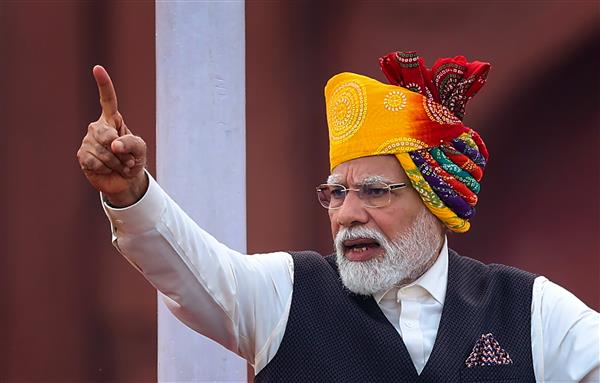
AS expected, Prime Minister Narendra Modi’s last Independence Day speech before the 2024 General Election had an ample dose of political messaging. Exuding confidence as he ended his 10th consecutive address to the nation from the ramparts of the Red Fort, he said he would be back for the 11th time next year. Instead of his trademark references to the people of the country as ‘my beloved brothers and sisters’ or ‘my fellow citizens’, he chose an all-embracing alternative: ‘my 140 crore family members’. The switch could not have been incidental. In the face of anti-incumbency, a resurgent Opposition and worrying inflationary trends, every vote counts. The campaign for securing a third term is well and truly underway.

Coming just after his Parliament speech, PM Modi’s August 15 address did not have big surprises. Its focus was on the nation turning its face to the future, and his government’s role in effecting transformative changes. The world no longer has doubts about India, the PM reiterated, dwelling on the upcoming G20 summit in detail. Accused of ignoring Manipur, his remark that the nation is with the state and the victims is reassuring, but it is unlikely to stem criticism of the handling of the crisis.

Given the safety concerns regarding Indian drugs, the call to ensure that there is no compromise on quality is of vital importance. The outreach to various social groups is in sync with election preparedness. Having ‘lakhpati didis’ in villages and training 15,000 self-help groups to operate drones for agri-tech purposes is aimed at engaging with women, a key section of the electorate the PM has been investing in. The PM’s remark that the time is ripe to embrace development centred around values has a ring of positivity, but on-ground developments reflect a different reality.