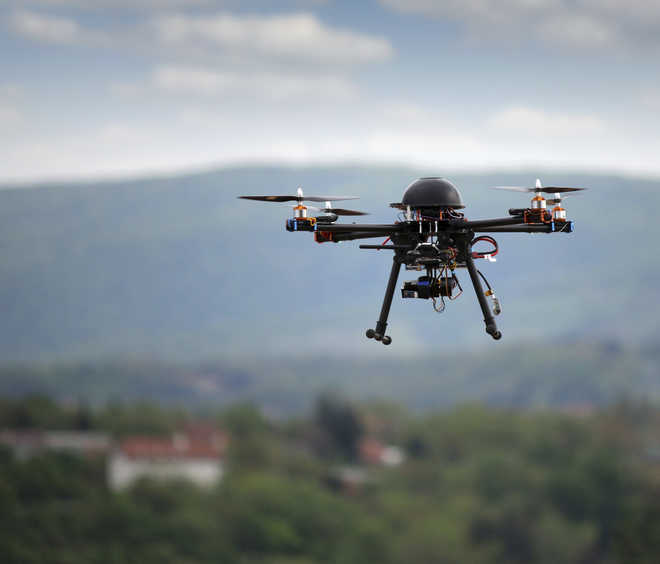
China has developed an unmanned aerial vehicle (UAV) with plateau operations capabilities and plans to deploy it at Line of Actual Control with India in Kailash mountain range, sources said.
The UAV has been developed in Shaanxi and completed its first flying and control task at Gar Gunsa in Tibet Autonomous Region, the sources said.
The flight was undertaken by the Hailan Aviation team. “The UAV took off from an elevation of 4,700 metre — Baga Township — and completed its task of patrolling, control and search operation in the Kailash mountain region,” said the source.
The Kailash mountain range originates from the southern bank of Pangong Tso and runs northwest to southeast for over 60 km. It had been contested by India and China after the border dispute started in May last year.
The Kailash Ridge is characterised by rugged, broken terrain with heights varying between 4,000-5,500m. The ridge’s key features include Gurung Hill, Spanggur Gap, Muggar Hill, Mukhpari, Helmet Top, Rezang La and Rechin La.
It dominates Chushul Bowl — an important communications centre.
Last year, after the border dispute at the northern bank of Pangong Tso in Eastern Ladakh, China made an attempt to take over Kailash mountain range on the night of August 29 and August 30, 2020.
Indian Army thwarted Chinese People’s Liberation Army attempt and took control over most of the hills in the Kailash range.
Indian troops pre-empted this PLA activity on the Southern Bank of Pangong Tso Lake, undertook measures to strengthen their positions and thwarted Chinese intentions to unilaterally change facts on ground, Indian Army had stated.
This exposed Chinese deployment of its forces in Moldo.
In February this year, India and China started disengagement at the southern and northern bank of the Pangong Lake at Line of Actual Control. The disengagement happened after several rounds of military and diplomatic talks.
As per agreement, Indian troops vacated the mountain hills in Southern bank of Pangong Lake.
China moved back to Finger 8 and Indian troops pulled back to the Dhan Singh Thapa post between Finger 2 and 3.
The north bank of the lake is divided into 8 Fingers. The mountain spur jutting into the lake are referred to as Finger in military parlance.
India claims Line of Actual Control at Finger 8 and had been holding on to the area till Finger 4 but in a clear alteration of status quo the Chinese have been camping at Finger 4 and have set up fortifications between Finger 5 and 8.
Since then Indian and Chinese military have met twice to resolve border disputes at other friction areas like Hot Springs, Gogra and 900 square km Depsang plains.
Amid this, China has again started enhancing troops, artillery and armour deployment in three sectors of Line of Actual Control — western (Ladakh), middle (Uttarakhand, Himachal) and eastern (Sikkim, Arunachal).
The Indian forces are keeping a close watch on Chinese activities at LAC. IANS
The ATAGS is manufactured by Bharat Forge Ltd. Via Indian Ministry of Defense.
As the Indian armed forces replaces its Eastern Bloc and Russian arms and equipment a very particular trend has brought back a national heritage that peaked during the Mughal era (1626-1856). After a ruinous decline spanning the British Raj and the decades following its independence, India now boasts a military-industrial sector that’s not just diverse but at the cutting edge in one specific technology: towed howitzers.
India’s military-industrial sector is divided between the powerful Ordnance Factories Board (OFB), whose activities are directed by the Ministry of Defense (MOD), and the conglomerates whose diversified holdings employ millions. The two are now integrating their efforts to quicken India’s rise as a world power.
This remarkable dynamic pitting the OFB versus the leading private sector manufacturers, both of whom are simultaneously cooperating and competing, led to so much artillery being developed that production now surpasses demand. The reason for this is simple. With the Indian Army’s terrible reputation for slow procurement and excess spending on imported products, supplying it is next to impossible. More so with the strong relationship forged by Washington, DC and Delhi that allowed the Indian Army to acquire BAE Systems’ 155mm M777 towed howitzer. So no matter how many contenders there are none have a guaranteed chance of winning the army’s artillery contract.
Now that a long-term rivalry with China is underway the Indian Army is resisting the government’s attempts at national self-sufficiency by trying to import over a thousand howitzers from abroad. This triggered a scramble by foreign manufacturers to find partners who can possibly win the same lucrative contract. As if this weren’t problematic enough the OFB, which is a network of state-owned factories, has a proven catalog of towed artillery weapons that’s still growing without further orders coming in.
Foremost among the OFB’s towed howitzers is the 155mm Dhanush based on the Swedish-made FH77B. The Indian Army acquired hundreds of the latter in the 1980s and these proved themselves during the Kargil War in 1998. Just like today a government effort to support national industry pushed for a local replacement of the FH77B and the resulting technology transfer led to the Dhanush. Boasting a four-wheel carriage, a hydraulic arm to assist loading, and a redesigned 45 caliber barrel, the Dhanush fires different ammunition types (including rocket-assisted projectiles) as far as 38 kilometers away.
Competing with the OFB’s Dhanush is a similar 155mm towed howitzer called the Advanced Towed Artillery Gun System or ATAGS from Bharat Forge Ltd. The steel foundry owned by the Kalyani Group produced a towed howitzer similar to the Dhanush and is completing its testing phase before entering service at an unspecified date. Of course, the ATAGS is export approved and the Kalyani Group welcomes serious inquiries from outside India. In what looks like a concerted attempts at taking over the narrow domestic market for towed howitzers Kalyani Group allowed Bharat Forge Ltd. to develop another 155mm artillery piece called the Bharat-52 based on Israel’s Soltam/ATHOS towed howitzer.
Not to be outdone, the OFB manufactures the same howitzer under the name “Sharang”–a caliber upgrade applied to the Soviet vintage 130mm M-46 once used by the army.
Another Indian manufacturer, Larsen & Toubro or L&T, acquired licenses for two world-class artillery weapons. These are the French-made TRAJAN or TRF1 155mm towed howitzer and the South Korean-made K9 Thunder self-propelled howitzer rebranded as the “Vajra.” The Vajra is now the primary self-propelled howitzer of the Indian Army after it retired its locally made Catapult, Soviet vintage 2S1 Gvozdika, and British-made Abbot self-propelled howitzers. The success of the Vajra didn’t extend to the TRAJAN, however, and the Kalyani Group’s lightweight or ultralight 155mm and 105mm howitzers (separate from Bharat Forge Ltd.’s artillery projects) further diminished L&T’s offering.
The Indian Army is looking for a truck howitzer as well, albeit in an ill-defined and haphazard manner. Once again, Kalyani Group rose to the challenge with a lightweight 155mm truck howitzer pitted against TATA Defence’s licensed Denel T5 truck howitzer and the OFB’s attempt at the same using a locally made 8×8 truck. The foreign contenders were serious as well, with the French-made CAESAR and the Israeli-made ATMOS vying for the army’s favor. Taken as a whole, India’s military-industrial sector is able to mass-produce several models of 155mm towed howitzers (Dhanush, Sharang, ATAGS, Bharat-52, Bharat ULH, TRAJAN, and possibly the Denel G5) and just as many self-propelled howitzers far beyond the requirements set by the army.
It’s worth mentioning smaller artillery calibers along with mortars and recoilless rifles are manufactured by the OFB. These are export approved in case the Indian Army can’t make up its mind on what’s needed for deterring China and Pakistan over contested borders. What can no longer be ignored, with the manufacturing base it has and the export potential its national champions may exploit, is India’s status as the world’s artillery capital.
China defends contentious CPEC, says it is economic initiative and has not affected its stand on Kashmir issue
China on Monday again defended its controversial USD 60 billion CPEC project with Pakistan, disregarding India’s protests as it is being laid through Pakistan-occupied Kashmir, saying it is an economic initiative and has not affected its principled stand on the Kashmir issue.
Leaders of China and Pakistan have praised the progress of the China-Pakistan Economic Corridor (CPEC) in recent days as the two close allies celebrated the establishment of 70 years of their diplomatic relations.
India has protested to China over the CPEC, the flagship project of China’s Belt and Road Initiative (BRI), as it traverses through Pakistan-occupied Kashmir (PoK).
The massive infrastructure project connects China’s Xinjiang province with Gwadar port in Pakistan’s Balochistan province.
China has been defending the CPEC, saying it is an economic project not aimed at any third country.
Answering questions on the CPEC at a media briefing on Monday, Foreign Ministry spokesman Zhao Lijian said that the CPEC as one of the pioneering projects under the BRI has made important and major progress in infrastructure, energy, ports and industrial parks.
He said the Belt and Road Initiative is an open international economic cooperation initiative with objectives of enhancing regional connectivity and achieving common development.
“We are also extending the CPEC to regional countries, including Afghanistan. This will not only boost faster economic development in Pakistan, but also regional connectivity,” he said.
Asked how China sees regional prosperity being furthered by the CPEC in view of India’s position that it passes through Indian territory illegally occupied by Pakistan, Zhao said the project has not affected China’s principled position on Kashmir.
“China has stated its principled position on Kashmir many times. The CPEC is an economic initiative that targets no third country. It is not about territorial disputes and does not affect our principled position on the issue of Kashmir,” he said.
On the CPEC’s extension to Afghanistan, he said, “on third party participation in the CPEC, China is having discussions with third parties, including Afghanistan”.
“The two sides are having consultations through diplomatic channels. We notice that Afghanistan imports and exports goods through Gwadar and Karachi ports. High-speed highways are also being extended to Afghanistan,” he added.
In a message to his Pakistani counterpart Arif Alvi on Friday on the 70th anniversary of the establishment of the China-Pakistan diplomatic relations, President Xi Jinping said the CPEC has achieved remarkable results.
Pakistan Prime Minister Imran Khan said at a high-level meeting in Islamabad that the CPEC will bring economic progress not only to Pakistan but the entire region. PTI
INDIAN ARMY’S INCREASED DEPLOYMENT ALONG LAC LIKELY TO BECOME A PERMANENT FIXTURE
The continuing threat posed by China’s People’s Liberation Army remains ominously palpable along India’s northern Himalayan borders by Rahul Bedi Chandigarh: The Indian Army’s (IA’s) deployment and high state of operational alert along the disputed line of actual control (LAC) in eastern Ladakh is likely to become permanent for the foreseeable future to foreclose any further military adventurism by China. And though public and media discourse over the military impasse in Ladakh has somewhat abated domestically in recent weeks, overtaken by the deadly second COVID-19 wave ravaging the country, the continuing threat posed by the People’s Liberation Army or PLA remains ominously palpable along India’s northern Himalayan borders. The IA chief of staff General MM Navarane reiterated this recently when he told varied media outlets on May 19 that the PLA was refusing to disengage from Gogra, Hot Springs and Demchok, areas it had occupied over a year ago, following routine military exercises on the adjoining Tibetan plateau. General Navarane paradoxically stated that 50,000-60,000 IA troops continue to be stationed along the LAC, even though ‘trust’ between the two rivals was ‘building’. However, the PLA, the army chief said, continued to block Indian patrols in the strategically located Depsang Plains in northwest Ladakh, in addition to rapidly upgrading their overall military infrastructure along the LAC including roads, troop billets, helipads and surface-to-air (SAM) missile bases in ‘depth areas’. He likewise confirmed that India too was not lagging behind the Chinese military in this regard, indirectly indicating the inevitability of the IA’s deployment in the region being long-drawn-out. Several serving and retired IA officers too told The Wire that the army’s year-long deployment at heights of over 12,000 feet across the LAC in Ladakh would persevere for long, as there was no indication whatsoever of any PLA pullback or de-escalation from several critical areas it had forcibly ingressed. “For all practical purposes the LAC has been converted into the line of control or LOC with Pakistan, but without the customary exchange of artillery, mortar and small arms fire, at least for now,” said military analyst Brigadier Rahul Bhonsle of the New Delhi-based Security Risks Group. This enduring placement of men and material in this region is, at the very least, going to be economically challenging, he declared, adding that above all the government needed to fast-track political and diplomatic efforts to defuse this seemingly intractable situation with Beijing. The only pullback by both armies, so far, took place in late February from the southern and northern banks of the Pangong Tso Lake, where troops were arrayed cheek-by-jowl for over eight months in a militarily incendiary situation across a 20-25 km stretch on the eastern side of the LAC. This extraction followed the 10th round of bilateral army commander talks, following which there has been no such further interaction, and neither is one imminently anticipated. Major General A.P. Singh, who was chief of operational logistics in Ladakh till 2013, too does not anticipate any further Chinese withdrawal, as indicated by the PLA currently conducting its annual summer exercises, paralleling last years’ manoeuvres, in exactly the same region abutting the LAC. Therefore, he believes that this leaves the IA no option but to deploy permanently to the area, but much closer to the LAC, to obviate further Chinese mischief, for which additional infrastructure would need to be built, at great expense. However, he cautioned that for several years to come, these deployments would be mirrored in an almost eyeball-to-eyeball configuration by both sides, begetting additional operational hazards and to an extent paralleling the IA’s positioning on the LoC. Furthermore, other veterans said that the IA would need to keep additional troops in reserve in the area to deal swiftly with any ‘adverse eventuality’ by the Chinese along the 800 km-odd long LAC in Ladakh. Accordingly, the IA was re-orienting two infantry divisions of its Mathura-based 1 strike corps – one of three such ‘sword arm’ formations, with the other two headquartered at Ambala (2 Corps) and Bhopal (21 Corps) – into a Mountain Strike Corps or MSC. “The dismantling in 2018 of the designated MSC and the hurried conversion of 1 Corps to a MSC indicates an inefficient approach to capacity building” admitted General Singh. The two-star officer was referring to Prime Minister Narendra Modi’s Hindu nationalist Bharatiya Janata Party (BJP) administration scrapping plans three years ago to raise the new 90,270-strong 17 MSC for deployment against China, headquartered at Panagarh in West Bengal. Approved by the Ministry of Defence (MoD) in 2013 for Rs 600 billion, the proposed MSC was to comprise two high-altitude infantry divisions of about 30,000-40,000 personnel, including special forces, supplemented by one artillery division, two independent armoured brigades, assorted helicopter units and corresponding engineering and ancillary support. In total the MSC would have necessitated some 250 unit and formation headquarters stretching along the LAC, but the project was called off in July 2018 after some 90 of these were set up by diverting personnel from existing formations and materiel from the army’s already depleted war wastage reserves (WWR).This was prompted largely by the BJP governments confidence in burgeoning political, diplomatic and economic Sino-Indian ties, following some 18 meetings between Modi and Chinese President Xi Jinping. Official sources said these bilateral interactions made India chary of appearing militarily belligerent towards Beijing and challenging the PLA by raising the MSC resulting in its abandonment. The IA meekly acquiesced, lulled into a false sense of security by the government, concentrating instead its bellicosity towards Pakistan. Meanwhile, the avoidable face-off in Ladakh, has morphed into yet another of the country’s operationally active territorial irritations, which have periodically- and inevitably- been outsourced to the military, despite their obvious limitations in resolving such crises. It’s also ironic that 74 years after independence, over a third of India’s 15,200km long land borders remain unresolved. And rather than conclusively firm up its frontiers, like all other countries, despite the myriad complexities involved, successive Indian governments had proven inept at dealing with its two irridentist neighbours to achieve this goal. This in turn had catapulted India into becoming the world’s third largest military spender in 2020, after the US and China. According to the Stockholm International Peace Research Institute, or SIPRI, the US had spent $778 billion on defence in 2020, China $252 billion and India $72.9 billion, even during a year wracked by the COVID-19 pandemic and when the global gross domestic product (GDP) of all countries had appreciably declined. India’s economy too was no exception, and presently the ongoing second virus wave augurs an even greater financial downturn at a time when the military threat from China tangibly persisted. India’s unsettled borders, comprise the 3,488 km long LAC with China, the 747 km-long LoC with Pakistan alongside the 76 km long Siachen Glacier/Saltoro Range territory. Other than the massive financial burden, militarily manning all these putative frontiers over decades had also posed a colossal human and logistic burden on the country. Besides, India’s territorial disputes with both its militarily collaborative neighbours were also amongst the world’s longest running, and further rendered chillingly threatening as the nuclear arsenals of China and Pakistan were controlled by their respective militaries. Till May 2020, when the PLA breached the LAC at eight spots in Ladakh, the unmarked frontier between the neighbours was peaceably patrolled by the neighbouring armies in accordance with five mutually agreed, but Beijing-driven protocols, albeit with no tangible indicators for a final settlement. These complex procedures were agreed 1993 onwards by the two sides to maintain Peace and Tranquility along the LAC and prevailed till last year’s incursions that miraculously and inexplicably evaded India’s three-tier surveillance grid. This comprised joint ground patrols by the IA and the Indo-Tibetan Border Police (ITBP) and concomitant monitoring by unmanned aerial vehicles (UAVs) and satellites. Over a year later there has been no explanation for this monumental lapse from either the military, or the equally financially flush security establishment and it’s highly unlikely that there ever will be. However, these periodically upgraded arrangements agreed upon by Delhi and Beijing suited both sides. India prudently accepted them, as both in manpower and financial resources, it could ill afford to oversee the LAC, like it actively did the LoC with a weaker and indigent Pakistan. China, for its part, looked upon these Border Defence Cooperation Agreements or BDCAs as an opportunity to gain time to peaceably grow its economy. But adroitly, Beijing kept the LAC issue suitably nebulous, via numerous stratagems India did little to oppose, with the devious objective of providing China eventual leverage in manipulating the boundary issue to its advantage. Beijing’s carpe diem moment came after the first round of the coronavirus pandemic erupted in India in January 2020 that not only its government, but also its military which displayed laxity and inattentiveness, not only in detecting the PLAs ingress, but also in timely deploying to the invaded areas. Within weeks thereafter, the PLA’s territory-grab led to the first clash between the two armies in 45 years in June 2020, in which 20 IA soldiers, including a colonel-level officer, died. It was only eight months later in February 2021 that Beijing’s state-owned media disclosed that four PLA soldiers too were killed in the skirmish, that involved hand-to-hand combat and the employment, by Chinese soldiers, of bespoke clubs studded with nails. India’s troop and equipment build-up followed, as did hurried- and costly- construction of infrastructure to house it and the hugely expensive import of Arctic tents and winter clothing for the impending winter when temperatures average around minus 25 degrees Celsius, dropping even to minus 35 degrees Celsius and a wind chill factor of even greater intensity. Official sources said the MoD had spent an ‘unbudgeted’ Rs 208 billion in Financial Year 2020-21 to procure ammunition, missiles, stores and varied ordnance to meet the Chinese ingress, further burdening the country’s depreciating kitty. Analysts and diplomats, however, concede that though the army’s swift deployment did deter the Chinese, it also delivered a ‘body blow’ to India’s complacent and unimaginative military planning doctrinally, logistically, and above all financially, especially in dire economic times. But serendipitously and with Karmic-like resignation, military and security planners are presently monitoring the LAC calamity, which, even if it were to magically evaporate, would still necessitate permanently manning the LAC, leaving nothing to trust.
How Israel destroyed more than two dozen fighter jets
Video 5.11 minutes Lets now show an awe-inspiring sight to the eyes. How Israel destroyed more than two dozen fighter jets of *Turkey, Lebanon, Jordan and Libya* at night with its laser guided attack. Enjoy the unique confluence of the best Israeli modern technology in the world of war.
CHINESE BLOGGER WHO ‘SLANDERED’ PLA OVER BORDER CLASH WITH INDIA ARRESTED IN UAE, FACES EXTRADITION
The Galwan Valley clash between the Indian Army and China’s People’s Liberation Army (PLA) last June was the deadliest border flare-up between the two Asian powerhouses since the 1962 war. India said at the time that it had lost 20 soldiers in the incident. In February this year, China disclosed that four PLA troops were killed in the altercation Chinese blogger Wang Jingyu, who is wanted in his home country after questioning the authorities over the border dispute with India, has been arrested in the United Arab Emirates (UAE) and is now facing extradition to China, one of his friends told Sputnik. “Wang was arrested at the Dubai Airport on 5 April, while he was on his way from Istanbul to New York on an Emirates flight”, said Baosheng Guo, a Chinese dissident living in the US. In February 2021, Wang, a native of Chongqing, questioned the People’s Liberation Army (PLA) over waiting for eight months before revealing the number of dead soldiers in the border clash with India. In a post on the Chinese microblogging site Weibo, he also doubted the PLA had truthfully revealed its casualties during the border clash with India. In February, Beijing for the first time revealed that it had suffered four casualties in the Galwan Valley border clash with India in June last year. The state-backed PLA Daily also disclosed the names of the four soldiers, almost eight months after India unveiled that the clash with Chinese troops at the Ladakh border site had left 20 of its soldiers dead. Local police said that Wang had “slandered” the war heroes and issued a lookout notice against him, as he was charged under a 2018 Heroes and Martyrs Protection Law, which prohibits activities “diminishing” the valour of martyrs. Living in Istanbul since moving from China back in 2019, Wang told his friends that he started to receive messages from “Chinese police” after his controversial posts on Weibo. “He was in Istanbul all the while. On 5 April, he bought a plane ticket to New York via Dubai”, says Baosheng. Wang, currently at a detention centre in the UAE, was arrested on charges of criticising Islam upon arrival at Dubai Airport, per his case record with Dubai’s Public Prosecutor Office. He was absolved of his charge on Thursday, after which he was told by his lawyer that he could be extradited to China. Chinese Embassy officials in the UAE have already made several visits to the jail as they try to convince Wang to “cooperate” in the extradition back to his home country. The UAE and China signed an extradition agreement back in 2004, but it was only in 2017 that the first fugitive was deported to China from the Gulf country, Xinhua reported. In the case of Wang, the Chinese Embassy is already said to have invoked the extradition agreement. The teen dissident holds a People’s Republic of China (PRC) passport. Baosheng says that it is “not clear” if he has an American Green Card. Besides calling up his friends, including Baosheng, Wang also contacted several journalists from the detention centre in a bid to highlight his case.
Army brass frowns as CO writes to Sonu Sood for help with Covid facility equipment
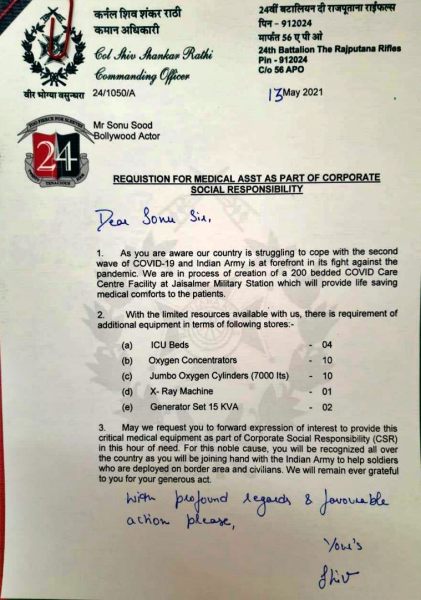
The CO highlighted certain equipment which were required by the hospital, including four ICU beds, ten oxygen concentrators, ten jumbo oxygen cylinders, one X-Ray machine and two 15 KVA generator sets.
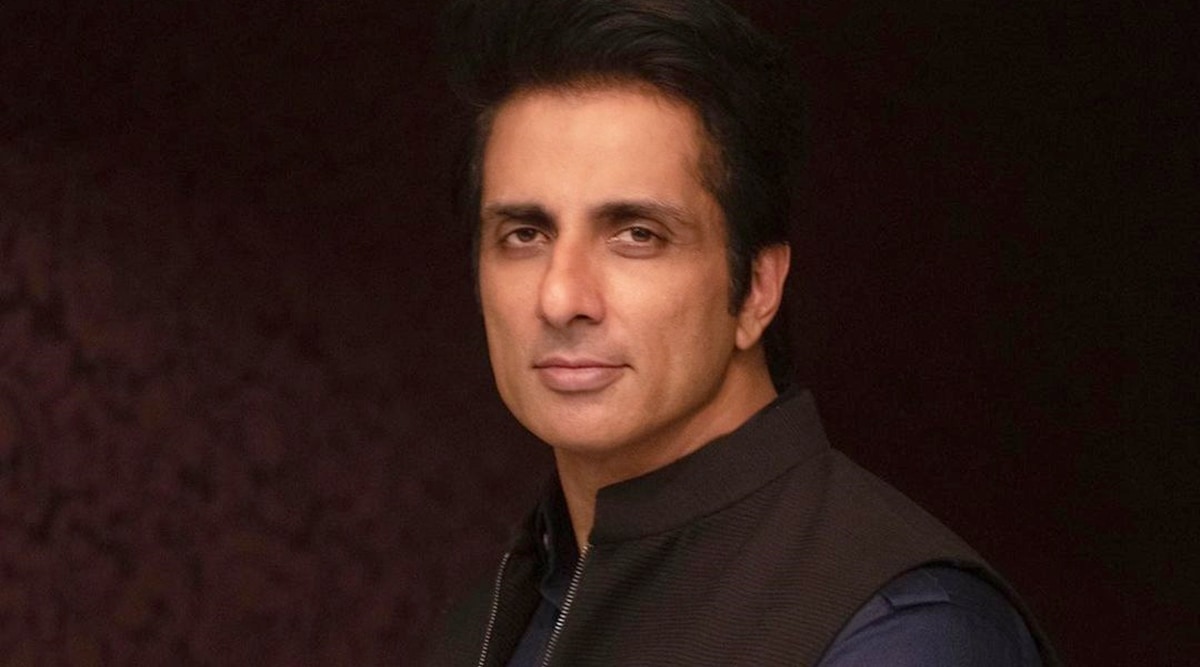
Sonu Sood has been helping people receive medical help during the coronavirus pandemic. (Photo: Instagram/sonu_sood)
A letter written by the Commanding Officer of an infantry battalion stationed in Jaisalmer to Bollywood star Sonu Sood, requesting for help in procuring equipment for a Covid-19 facility, has gone viral on social media resulting in senior brass of the Army frowning at the act.
In a letter dated May 13, the CO of the battalion apprised the movie star, who has been at the forefront of helping people in the Covid pandemic, that the Army was setting up a 200-bed Covid care centre facility at the Jaisalmer military station.
He highlighted certain equipment which were required by the hospital, including four ICU beds, ten oxygen concentrators, ten jumbo oxygen cylinders, one X-Ray machine and two 15 KVA generator sets.
Requesting Sood to provide the equipment as part of the “Corporate Social Responsibility”, the letter states that his generous act will be remembered.
A senior officer in Army HQs New Delhi confirmed that the letter was written to Sonu Sood but added that it appeared to have been written in “over enthusiasm”. The Army has set up several Covid hospitals across the country from its own resources to help the civilian state administrations. In Rajasthan itself, a 50-bed hospital was set up and operationalised today in Sri Ganganagar.
Subscribe to receive the day’s headlines from The Indian Express straight in your inbox
However, this is easier said than done Gone are the days when battles dragged on for years. Now battles are instant. It’s all about striking swiftly and stealthily. And to do this, you need instant decision making and state-of-the-art weaponry. How does the chain of command work in India? Is there scope for improvement? And what about our weapons? Can they keep up with the rest of the world? India’s defence is split into three services. The Air Force the Navy and the Army. They have their own headquarters bases and leadership. It’s been this way for decades. But this system has drawbacks. There is a lot of duplication of work and unnecessary bureaucracy. For example, Indian airspace is defended by all three services. They are tracking threats on separate frequencies with their own radars. But every army headquarters is located next to an airbase. So two agencies are doing the same work sitting right next to each other. – talk about the wastage of resources and manpower. If Army, during a combing operation, wants some air support, the in-charge calls up the Air Force. The Air Force will then churn this request through its ranks. The problem here is clear. The person in charge of the operation does not have complete control over the assets. This was the story every time India went to war. The Air Force had its own plan. And the Army was doing its own thing. But modern war machines cannot function like this. And India is realising it. The defence establishment is moving towards what is called “Theaterisation”. This is how the US and China organise their forces. In India, there’s a talk of five commands – the northern command to deal with China, the western command on the Pakistan side, peninsula command in southern India, a maritime command to patrol the seas and an air defence command to protect the airspace. So how is this different from the current set-up? The commands are unified establishments. This means the army the navy and the air force will function together under one command. No more shuttling between agencies for orders. All three services will answer to a single commander. In military circles they call this jointness and integration. India cannot underestimate the mindset problem. The three services are used to autonomy. Both the Air Force and Navy fear the army will dominate joint commands. This could lead to a turf war, a territorial battle for assets, funds and for influence. The other big challenge is logistics. If you appoint a commander what happens to the chiefs of staff? Do the soldiers still report to them? Or will commanders take over operational control? Same is the thing with assets. The air force only has 31 squadrons. Can they spread their assets wide enough to support every command? These are some of the big challenges to joint theatres. The US has a tried and tested the system. But India cannot copy it. India’s tri-service chief has ruled this out. Chief of Defence Staff Bipin Rawat says India will develop its own system of joint theatres. The military is tight-lipped about the plans. But reports say they should be operational by next year. Hopefully, this will solve the bottlenecks in decision-making. An army is only as good as the weapons it has. This is where India has struggled in the past with outdated weapons aircraft and ships. The only way to overhaul this is through defence spending. Now on paper, India is the third largest spender in the world behind the US and China. A break-up of India’s defence budget shows that 50 per cent of the funds go to salaries and pensions. So at the start of every month half the money is already gone. Where does that leave India’s modernisation plans? These are figures from this year’s budget. The total allocation was 4.78 lakh crore Rupees. After pensions, salaries and other expenses, 1.35 lakh crore Rupees were left. Just 28 per cent of the total budget. For a country with two belligerent neighbours this is simply inadequate. What Are India’s Options? One, is to keep expanding the defence bill. But as this pandemic has shown India needs to put more money in public health and infrastructure. So a big defence bill could be highly unpopular. What about reforming pensions? Maybe extend the retirement age of officers? Every time someone suggests this there is backlash from veterans. And the situation isn’t getting any better. We need active deployments in the east and west. Which means more soldiers more salaries and more pensions. Where will the money come from? A viable option is to trim the loose ends. Streamline acquisitions, cut down on duplication of work. Right now, every service has its own wish list. There is no synergy between them on acquisitions. The goal is to get them all together so that India’s defence establishment has one wish list not three. All of this is easier said than done. The bureaucrats are sure to oppose a unified command. They hate being side lined. Also, we need to be ready for squabbles between generals, admirals and air marshals. But these worries shouldn’t concern India much because unification of command is like a rebirth for the military. Every big power has gone through it and and they are better off with the new system.
The ATAGS is manufactured by Bharat Forge Ltd. Via Indian Ministry of Defense.
As the Indian armed forces replaces its Eastern Bloc and Russian arms and equipment a very particular trend has brought back a national heritage that peaked during the Mughal era (1626-1856). After a ruinous decline spanning the British Raj and the decades following its independence, India now boasts a military-industrial sector that’s not just diverse but at the cutting edge in one specific technology: towed howitzers.
India’s military-industrial sector is divided between the powerful Ordnance Factories Board (OFB), whose activities are directed by the Ministry of Defense (MOD), and the conglomerates whose diversified holdings employ millions. The two are now integrating their efforts to quicken India’s rise as a world power.
This remarkable dynamic pitting the OFB versus the leading private sector manufacturers, both of whom are simultaneously cooperating and competing, led to so much artillery being developed that production now surpasses demand. The reason for this is simple. With the Indian Army’s terrible reputation for slow procurement and excess spending on imported products, supplying it is next to impossible. More so with the strong relationship forged by Washington, DC and Delhi that allowed the Indian Army to acquire BAE Systems’ 155mm M777 towed howitzer. So no matter how many contenders there are none have a guaranteed chance of winning the army’s artillery contract.
Now that a long-term rivalry with China is underway the Indian Army is resisting the government’s attempts at national self-sufficiency by trying to import over a thousand howitzers from abroad. This triggered a scramble by foreign manufacturers to find partners who can possibly win the same lucrative contract. As if this weren’t problematic enough the OFB, which is a network of state-owned factories, has a proven catalog of towed artillery weapons that’s still growing without further orders coming in.
Foremost among the OFB’s towed howitzers is the 155mm Dhanush based on the Swedish-made FH77B. The Indian Army acquired hundreds of the latter in the 1980s and these proved themselves during the Kargil War in 1998. Just like today a government effort to support national industry pushed for a local replacement of the FH77B and the resulting technology transfer led to the Dhanush. Boasting a four-wheel carriage, a hydraulic arm to assist loading, and a redesigned 45 caliber barrel, the Dhanush fires different ammunition types (including rocket-assisted projectiles) as far as 38 kilometers away.
Competing with the OFB’s Dhanush is a similar 155mm towed howitzer called the Advanced Towed Artillery Gun System or ATAGS from Bharat Forge Ltd. The steel foundry owned by the Kalyani Group produced a towed howitzer similar to the Dhanush and is completing its testing phase before entering service at an unspecified date. Of course, the ATAGS is export approved and the Kalyani Group welcomes serious inquiries from outside India. In what looks like a concerted attempts at taking over the narrow domestic market for towed howitzers Kalyani Group allowed Bharat Forge Ltd. to develop another 155mm artillery piece called the Bharat-52 based on Israel’s Soltam/ATHOS towed howitzer.
Not to be outdone, the OFB manufactures the same howitzer under the name “Sharang”–a caliber upgrade applied to the Soviet vintage 130mm M-46 once used by the army.
Another Indian manufacturer, Larsen & Toubro or L&T, acquired licenses for two world-class artillery weapons. These are the French-made TRAJAN or TRF1 155mm towed howitzer and the South Korean-made K9 Thunder self-propelled howitzer rebranded as the “Vajra.” The Vajra is now the primary self-propelled howitzer of the Indian Army after it retired its locally made Catapult, Soviet vintage 2S1 Gvozdika, and British-made Abbot self-propelled howitzers. The success of the Vajra didn’t extend to the TRAJAN, however, and the Kalyani Group’s lightweight or ultralight 155mm and 105mm howitzers (separate from Bharat Forge Ltd.’s artillery projects) further diminished L&T’s offering.
The Indian Army is looking for a truck howitzer as well, albeit in an ill-defined and haphazard manner. Once again, Kalyani Group rose to the challenge with a lightweight 155mm truck howitzer pitted against TATA Defence’s licensed Denel T5 truck howitzer and the OFB’s attempt at the same using a locally made 8×8 truck. The foreign contenders were serious as well, with the French-made CAESAR and the Israeli-made ATMOS vying for the army’s favor. Taken as a whole, India’s military-industrial sector is able to mass-produce several models of 155mm towed howitzers (Dhanush, Sharang, ATAGS, Bharat-52, Bharat ULH, TRAJAN, and possibly the Denel G5) and just as many self-propelled howitzers far beyond the requirements set by the army.
It’s worth mentioning smaller artillery calibers along with mortars and recoilless rifles are manufactured by the OFB. These are export approved in case the Indian Army can’t make up its mind on what’s needed for deterring China and Pakistan over contested borders. What can no longer be ignored, with the manufacturing base it has and the export potential its national champions may exploit, is India’s status as the world’s artillery capital.
China has used its contacts with Pakistan to establish close ties with the Taliban in the hope that they would not allow militants to infiltrate into Xinjiang. The Taliban’s extremist policies have never constrained China from feting Taliban delegations in Beijing. The Afghan authorities have been unhappy at the frequency of China’s meetings with the Taliban leaders and Beijing’s unwillingness to brief them on these discussions.
Duality: China has been engaging with both the Taliban and the Afghan government. Reuters
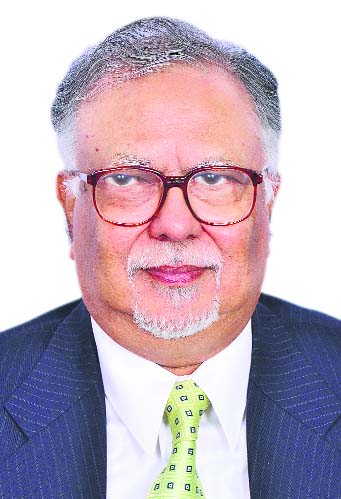
Yogesh Gupta
Former Ambassador
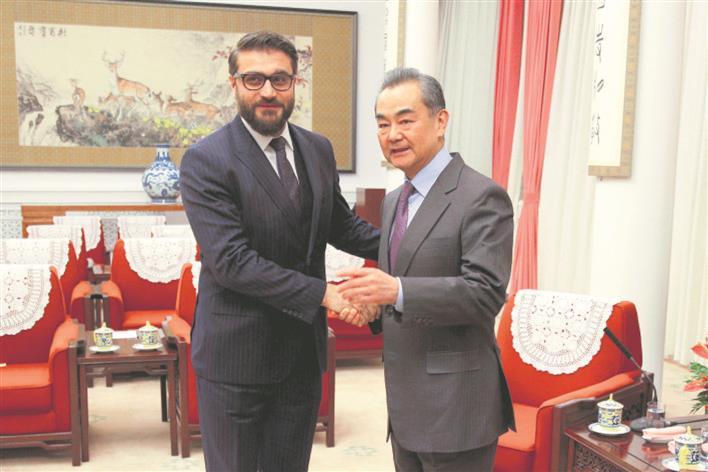
Speaking at the Heart of Asia virtual conference last month, Chinese Foreign Minister Wang Yi said that the “foreign military forces should withdraw from Afghanistan in an orderly manner and resolutely prevent various terrorist forces from creating chaos”. Wang assured that China would work with all other parties to bring peace to every corner of Afghanistan at an early date and deliver the benefits of development to the Afghan people.
Earlier, China had criticised the presence of NATO forces in Afghanistan, taking the moral high ground, though their security role actually helped Beijing in checking the activities of extremist groups such as the East Turkestan Islamic Movement (ETIM). China’s fear of Uighur militants belonging to ETIM has grown over the last five years, as many have relocated from Syria to the Badakshan province of Afghanistan, neighbouring Xinjiang where China has initiated a vast campaign to incarcerate them in camps (prisons) for re-education.
China has also been concerned about the support, which the Al Qaeda (which maintains close ties with the Taliban) could provide to the ETIM militants and the infiltration of Islamic State (IS) fighters into Xinjiang. After the deterioration of China’s relations with the US recently, its worry is that the US could use its continued military presence in Afghanistan to support Uighur dissidents seeking independence from Beijing. At a meeting with the Foreign Ministers of five Central Asian states on May 12 at Xian, the Chinese Foreign Minister suggested that they should not allow the US to station its forces and equipment in Central Asia after its military withdrawal from Afghanistan.
China had reached the conclusion that the US and the Afghan government could not defeat the Taliban and it would either come into power or control substantial Afghan territory. China had started maintaining close ties with the Taliban since 1999; in December 2000, China’s Ambassador to Pakistan Lu Shulin met Taliban leader Mullah Omar in Kandahar. China has used its contacts with Pakistan to establish close ties with the Taliban in the hope that they would not allow ETIM militants to infiltrate into Xinjiang. The Taliban have sought Beijing’s support for getting international legitimacy and aid.
China has adopted a dual policy of maintaining close ties with both the Taliban and the Afghan government. The Taliban’s ultra-conservative outlook and extremist policies have never constrained China from feting numerous Taliban delegations in Beijing in the hope that the Taliban would not allow the ETIM to establish bases and grow its network in Afghanistan. Most significant of these was the visit by the Taliban’s Deputy Leader, Mullah Abdul Ghani Barader to Beijing in June 2019. The Afghan government has been unhappy at the frequency of China’s meetings with the Taliban leaders and the former’s unwillingness to brief them on these discussions.
China’s defence ministry said in 2018 that it had supported Afghanistan’s defence and counter-terrorism efforts by providing about $70 million in military aid from 2016 to 2018. In early 2018, China had tried to bolster its military presence in Badakshan province’s Wakhan corridor, the narrow stretch of Afghan territory connecting with the Chinese border by building a military base there, deploying an army brigade with trainers for the Afghan security forces and its own communication facilities. Fearing that the Chinese could use these to eavesdrop on Afghanistan and its international allies, Kabul refused. An upset China then stationed some troops in Tajikistan across the border from the Wakhan corridor. It has also cultivated local Afghan politicians and powerbrokers to build its influence, independent of Kabul for meeting its security and other needs.
Former Afghan President Hamid Karzai and the present incumbent, Ashraf Ghani, tried to court Beijing in the hope that it would use its influence to pressurise Pakistan to sever its ties with the Taliban and increase its economic investment in Afghanistan. China did nothing of that sort. Even the promised Chinese investment of $100 million in its Belt and Road Initiative (BRI) in Afghanistan and the extraction of copper at Mes Aynak mines or oil in the three oil fields in the Afghan provinces of Faryab and Sar-i-Pul (estimated to hold 87 million barrels of oil) never materialised due to political reasons.
In 2017, China exported $532 million worth of goods to Afghanistan against the latter’s export of barely $2.86 million to China (versus Afghanistan’s $411 million exports to India in the same year). In her September 19, 2019, testimony to the US Congress, Alice Wells, US Acting Assistant Secretary of State, remarked that “China had not contributed to the economic development of Afghanistan and that the BRI was just a slogan.”
China has viewed India as a rival, was unhappy about the Indian military presence, its defence and large economic assistance to Afghanistan and the growth of India’s influence there. Following President Biden’s announcement about the withdrawal of the US troops from Afghanistan by September 11, 2021, China’s major worry is that the conflict between the Afghan government and the Taliban will escalate, pushing the country into a civil war. It will create an environment for the growth of extremist groups such as Al Qaeda, IS, ETIM and others. The ability of China’s “iron brother” Pakistan and close friend Taliban to prevent the growth and infiltration of these extremist groups into Xinjiang will be severely constrained as their main pre-occupation would be the military victory and takeover of Afghanistan.
Though China has indicated its preference for a moderate Islamic government which curbs the growth of all extremist forces in Afghanistan, it knows that it can’t dictate its choice to the orthodox Taliban. After the departure of US troops, China is hoping to work for a UN or multilateral presence in Afghanistan to moderate the Taliban’s extremist inclinations. It will also use its influence with Pakistan and its deep pockets to safeguard its security interests with whatever political dispensation comes into power in Kabul and the north-eastern part of Afghanistan.
State Stalwarts
DEFENCE MINISTER
Minister Rajnath Singh
ALL HUMANS ARE ONE CREATED BY GOD
HINDUS,MUSLIMS,SIKHS.ISAI SAB HAI BHAI BHAI
CHIEF PATRON ALL INDIA SANJHA MORCHA
LT GEN JASBIR SINGH DHALIWAL, DOGRA
SENIOR PATRON ALL INDIA SANJHA MORCHA
MAJOR GEN HARVIJAY SINGH, SENA MEDAL ,corps of signals
.
.
PATRON ALL INDIA SANJHA MORCHA
MAJ GEN RAMINDER GURAYA ,MADRAS REGIMENT
sanjhamorcha303@gmail.com
PRESIDENT SOUTH ALL INDIA SANJHA MORCHA
COL SS RAJAN BOMBAY SAPPERS,
PRESIDENT UTTARAKHAND ALL INDIA SANJHA MORCHA
COL B M THAPA ,BENGAL SAPPERSS
PRESIDENT HARAYANA STATE CUM COORDINATOR ESM
BRIG DALJIT THUKRAL ,BENGAL SAPPERS
PRESIDENT TRICITY
COL B S BRAR (BHUPI BRAR)
PRESIDENT CHANDIGARH ZONE
COL SHANJIT SINGH BHULLAR
.
.
PRESIDENT PANCHKULA ZONE AND ZIRAKPUR
COL SWARAN SINGH
INDIAN DEFENCE FORCES
DEFENCE FORCES INTEGRATED LOGO
INDIAN AIR FORCE
Air Officer C-in-C WESTERN AIR COMMAND
AIR MSHL S PRABHAKARAN AVSM VM
AOC-IN-C, EASTERN AIR COMMAND
Air Marshal Inderpal Singh Walia
AOC-in-C SOUTH WESTERN AIR COMMAND
Air Marshal Vikram Singh
AOC-IN-C, SOUTHERN AIR COMMAND
Air Marshal J.Chalapati
AOC-IN-C TRAINING COMMAND
AIR MARSHAL SK GHOTIA VSM
AOC-IN-C MAINTENANCE COMMAND
Air Marshal Jagdish Chandra
Flag Officer Commanding in Chief, Western Naval Command
ice Admiral R Hari Kumar, PVSM, AVSM, VSM
Flag Officer Commanding in Chief, Eastern Naval Command
Vice Admiral Sanjay Bhalla, AVSM, NM
Flag Officer Commanding in Chief, Southern Naval Command























 Sonu Sood has been helping people receive medical help during the coronavirus pandemic. (Photo: Instagram/sonu_sood)