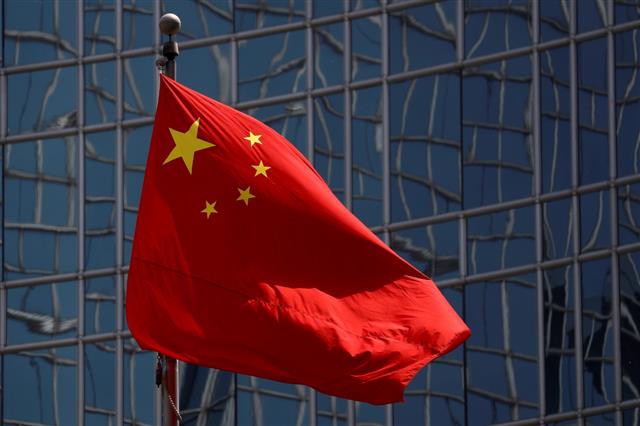
Naravane’s visit to the region came amid the Indian Army’s continued standoff with the Chinese military in some of the friction points in eastern Ladakh NEW DELHI: Army Chief Gen MM Naravane reviewed India’s operational readiness along the border with China in the Arunachal Pradesh sector during a two-day visit to the North-eastern region that began on Thursday. His visit to the region came amid the Indian Army’s continued standoff with the Chinese military in some of the friction points in eastern Ladakh. Officials said Gen Naravane arrived at Dimapur in Nagaland on Thursday to review the operational readiness along the Northern borders of Arunachal Pradesh and the security situation in the hinterland in the North-eastern region. “On arrival at the Corps headquarters in Dimapur, the Army Chief was briefed by Lt Gen Johnson Mathew, General Officer Commanding of Spear Corps and the Division Commanders on the prevailing situation and operational preparedness along the Northern borders,” the Army said. It said the Chief of Army Staff complimented all ranks for maintaining excellent vigil and exhorted them to stay alert and keep watch on activities along the Line of Actual Control (LAC). On Wednesday, Gen Naravane said that the Army will maintain an enhanced presence on the entire northern front from Ladakh to Arunachal Pradesh till “de-escalation” is achieved. In view of the border row with China in eastern Ladakh, the Army last year significantly ramped up deployment of troops in all sensitive areas along the nearly 3,500-km-long LAC including in the Sikkim and Arunachal sectors The Indian Air Force (IAF) also deployed additional fighter jets and attack helicopters in key bases looking after the airspace along the LAC in the Arunachal sector. India and China were locked in a military standoff at multiple friction points in eastern Ladakh since early May last year but they have completed the withdrawal of troops and weapons from the North and South banks of Pangong lake in February following a series of military and diplomatic talks. The two sides are now engaged in talks to extend the disengagement process to the remaining friction points. There was no visible forward movement in disengagement of troops in the remaining friction points as the Chinese side did not show flexibility in their approach on it at the 11th round of military talks with the Indian Army on April 9.
IAF pilot killed as MiG-21 Bison crashes during training in Punjab’s Moga
The aircraft crashed into a field and caught fire killing pilot Squadron Leader Abhinav Choudhary. A Court of Inquiry has been ordered go ascertain the cause of the accident.
Moga: An IAF MiG-21 Bison aircraft crashed during heavy rain in a field in Punjab’s Moga district, killing its pilot Squadron Leader Abhinav Choudhary, officials said
“The aircraft crashed in a field and caught fire. It was raining heavily at the time,” Singh said, adding that there was no other loss of life or damage to property
The pilot’s body was found about two kilometres from the crash site, barely 200 metres from a couple of big ‘havelis’.
Had the aircraft crashed over these houses, it could have caused heavy casualties, Singh told PTI over the phone.
He said the pilot appeared to have deployed a parachute in a bid to land safely. It seems he broke his neck upon impact on the ground, he added
According to the information we got, the aircraft had taken off from Suratgarh in Rajasthan for Jagraon near Ludhiana and was on the way back after a training sortie when it crashed, Singh said.
He added that IAF officials from Halwara and Bathinda with medical teams and ambulances had reached the crash site, about 12 km from Baghapurana town on the Mudki road.
“There was an aircraft accident last night involving a Bison aircraft of IAF in the western sector. The pilot, Sqn Ldr Abhinav Choudhary, sustained fatal injuries. IAF condoles the tragic loss and stands firmly with the bereaved family,” the IAF said in a tweet.
“A Court of Inquiry has been ordered to ascertain the cause of the accident,” it added.
A 120-year-old woman has become an inspiration for people living in rural areas of Jammu and Kashmir’s Udhampur district after she took a lead in her remote hamlet to get vaccinated against COVID-19, prompting Northern Army Commander Lieutenant General Y K Joshi to felicitate the centenarian at her home on Friday.
In an environment where vaccine hesitancy has been witnessed among sections of the public, 120-year-old Dholi Devi got herself the shot on May 17 that has been able to transform the mindset of the local population, an army officer said.
“Dholi Devi represents the voice of hope during the pandemic gloom and the entire village has now voluntarily come forward for inoculation inspired by her,” he said.
Speaking to reporters, Devi said she is 120-years-old and took the vaccination and faced no problem at all.
Her grandson Chaman Lal said, “She got vaccinated at this age. She faced no problem and had no fever. Her appeal to all is to get vaccinated”.
Impressed by her initiative, Lt Gen Joshi, a Kargil War hero, drove to the house of Dholi Devi in Gar Katiyas village of Dudu tehsil in the district, and honoured the senior citizen amid the presence of locals and top army officers.
Army officers said the centenarian has single-handedly inspired an entire village to make the vaccination drive a huge success.
“Devi, who is 120-years-old, is a living legend and epitomises good health in a time in which even the young people are struggling to keep their immunity intact,” they said.
The army commander acknowledged the inspirational act of Dholi Devi while felicitating her and sensitised the civilian population about the benefits of COVID vaccination drive, they said.
Joshi also interacted with Devi and the healthcare workers in the village while appreciating them for their selfless service to the people and their dedication in taking the vaccination drive to the remotest areas in the Union territory.
The Indian Army has been taking steps to fight the misinformation regarding the vaccination drive in the UT.
Massive outreach programmes have been launched to empower the people by providing them the right information and equipping them with the knowledge necessary in the fight against the pandemic. PTI
How do Covid hospitals set up by DRDO operate & what’s the role of armed forces
The DRDO has set up five temporary hospitals to treat Covid patients. More are planned to handle a possible third wave. But the agency’s role has primarily been of a project executing body.
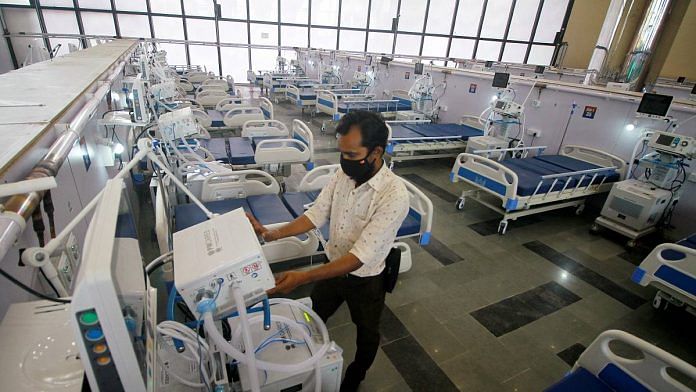
A staff checks the equipment at the ICU of a Covid hospital set up by the DRDO in Varanasi |
New Delhi: To help the country’s civil administration tackle the surge in Covid cases in the second wave of the pandemic, temporary hospitals have been set up across the country by the Defence Research and Development Organisation (DRDO) in the past few weeks.
Five such hospitals were established to begin with, in the immediate aftermath of the surge in Covid cases.https://bb09608bf0f72a03f2da4be847d6649f.safeframe.googlesyndication.com/safeframe/1-0-38/html/container.html
This included a 750-bed Sardar Vallabhbhai Patel Covid hospital in Delhi, a 900-bed Dhanvantari hospital in Gujarat’s Ahmedabad, a 500-bed ESI hospital in Patna, a 750-bed Pandit Rajan Mishra hospital in Varanasi, and a 500-bed Atal Bihari Vajpayee hospital in Lucknow.
Of these, the Delhi hospital had been opened last year after the pandemic hit the country, but closed operations after cases dipped. It was revived after the country was hit by a second surge. Similarly the Patna facility had exited before, but the DRDO helped update it to deal with the second pandemic wave.
More such facilities are now being set up across the country, also to prepare for a possible third Covid wave.
But what has been the exact role of the DRDO in making these units operational?
While the DRDO is the executing body, top defence sources told ThePrint that the cost of construction of the hospitals and equipping them with the requisite medical infrastructure are being met from donations, state government funds and the PM CARES fund.
Staff for the hospitals are being drawn from among military doctors, as well as nursing and other staff from the three wings of the armed forces, who have been mobilised from all parts of the country.
Defence sources said the DRDO’s primary role has been that of a project executing body, which has been issuing contracts to private firms for the construction of these hospitals. It has also been involved in urgent procurement of essential equipment and consumables for the hospitals, such as PPE kits.
“The DRDO has also been closely supervising and managing the work being done by private agencies engaged in the construction,” a defence official said.
The official added that most of the contracts for construction of these hospitals are “fabrication (construction) contracts” given out by the Chief Executive (Directorate of Civil Works & Estates) in DRDO.
The state governments are assisting the DRDO with infrastructure such as electricity and water connections and other necessary permissions in setting up these hospitals.
All the five DRDO hospitals are level three hospitals that offer complete facilities for the treatment of Covid patients, such as oxygen and ventilator support, and have been upgraded with more beds and other equipment in the weeks following the openings.
An Integrated Command and Control Centre has been set up to monitor admissions of patients in Varanasi and Lucknow.
Sources said the hospitals may continue operations even when the number of Covid cases decline.
In addition, more temporary hospitals are being set up by the DRDO to prepare for more Covid cases or a possible third wave of the pandemic.
While a 500-bed hospital in Haryana’s Panipat has been partially opened for Covid patients, the DRDO is also providing assistance in setting up a 1,200-bed hospital in Gujarat’s Gandhinagar, which will be funded by Tata Trusts.
More hospitals are planned to come up in Uttarakhand’s Haldwani and Rishikesh, Jammu and Kashmir, Guwahati in Assam, and Sikkim.
In addition to the temporary hospitals being facilitated by the DRDO, commanders of local military formations across the country have been also setting up other auxiliary medical facilities, in consultation with the state governments.
Additional infrastructure has also been put into place at several military hospitals, some of which are admitting Covid positive cases from the civilian population.
The state-run Hindustan Aeronautics Limited (HAL) is also setting up two Covid treatment facilities in UP’s Lucknow and Maharashtra’s Nashik. HAL has already constructed a facility for the Karnataka government in Bengaluru.
Though set up and run by the armed forces, defence sources said these facilities are being administered by local governments, and no preference is being given to patients from armed forces.
All the hospitals set up by the DRDO are being manned by teams of military doctors and support staff, mobilised from across the country.
A total of 1,306 military medical staff have been deployed at the five hospitals that are currently operational. This includes doctors — general and specialists, nursing staff, and technical and support staff.
Of the five, the Dhanvantari hospital in Ahmedabad has the maximum number of military medical staff, a total of 371.
The Sardar Vallabhbhai Patel Covid hospital in New Delhi has 321 medical staff from the military, while the Atal Bihari Vajpayee Covid Hospital in Lucknow has 281. Pandit Rajan Mishra Covid facility in Varanasi has 160, while 173 medical staff from the military have been deployed at the ESI Hospital in Patna.
Additionally, the medical staff at each hospital also includes technical and support staff from the military.
Hospitals like Ahmedabad’s Dhanvantari also has civilian doctors attending to patients. Defence sources said 25 additional doctors and 39 paramedics from other agencies, such as ITBP and CAPFs, have also been deployed here.
Similarly, 99 additional doctors from other agencies are serving at the Delhi Covid facility set up by the DRDO.
Owing to the large number of medical staff from the military who have been deployed at these facilities, many military veterans have in the past few days questioned why it is being said that the DRDO or HAL have set up these hospitals, when they are being run by military doctors and staff.
Former Navy chief Admiral Arun Prakash (retd) too tweeted, “Let’s give credit where due!”
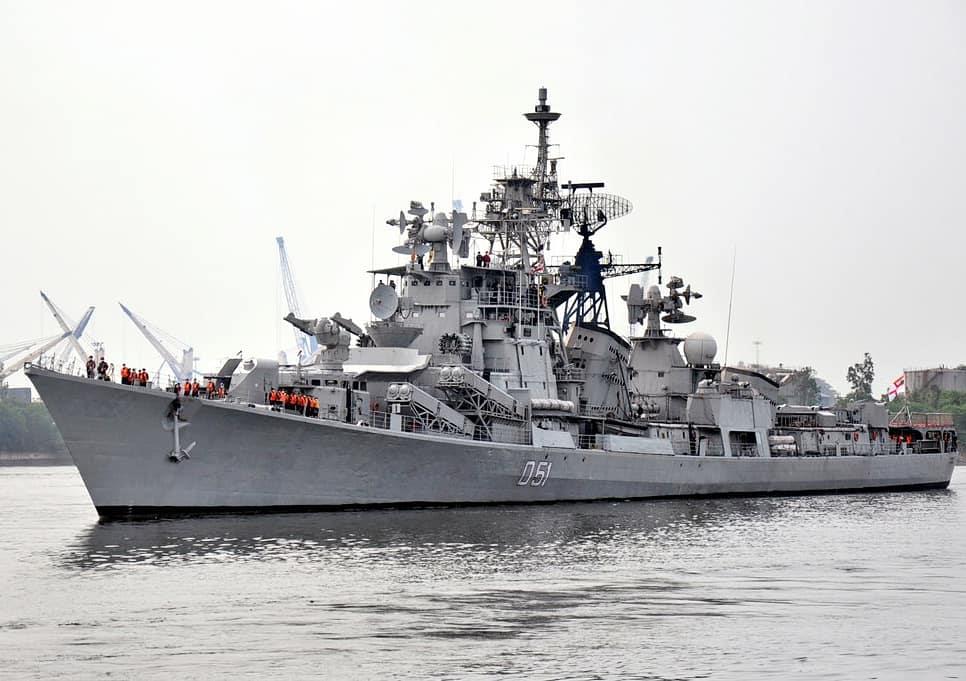
The keel of the ship was laid on September 11, 1976, and she was launched on September 17, 1977
NS Rajput was constructed in the 61 Communards shipyard in Nikolaev (now Ukraine). Source: Twitter/@IndianNavy.
New Delhi, May 22
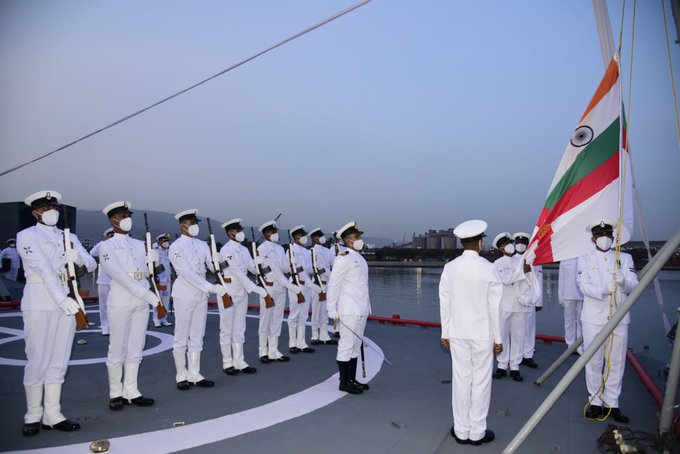
The Indian Navy’s Kashin-class destroyer INS Rajput, the first warship to be fitted with a long-range BrahMos missile, was decommissioned on Friday after 41 years of service.
The destroyer, built by the erstwhile USSR and commissioned on May 4, 1980, had the distinction of being part of both the Western and Eastern fleets.
Indian Navy spokesperson Commander Vivek Madhwal said the warship was decommissioned in a low-key event at the naval dockyard in Visakhapatnam.
“In her glorious service to the nation, the ship has been helmed by 31 commanding officers. The ship, since its commissioning, sailed a distance of over 7,87,194 nautical miles which is equivalent to navigating around the world 36.5 times and 3.8 times the distance from Earth to Moon,” he said in a statement.
Besides BrahMos, the warship was equipped with an array of weapons and sensors including anti-aircraft guns, torpedoes, and anti-submarine rocket launchers.
The ship participated in several key missions in the last four decades, including operation Aman off Sri Lanka that was launched to assist the Indian Peace Keeping Forces (IPKF) and Operation Cactus to resolve a hostage situation off the Maldives.
In addition, the ship participated in numerous bilateral and multi-national exercises. It was also the first Indian Naval Ship to be affiliated with an Army regiment—the Rajput regiment.
INS Rajput was constructed in the 61 Communards shipyard in Nikolaev (now Ukraine) under her original Russian name “Nadezhny”, meaning “hope”. The keel of the ship was laid on September 11, 1976, and she was launched on September 17, 1977.
The ship was commissioned as INS Rajput at Poti, Georgia by I K Gujral, the then Indian Ambassador to the USSR, with Captain Gulab Mohanlal Hiranandani as her first commanding officer.
“The ship was decommissioned in a solemn and low-key event due to the coronavirus pandemic when the national flag, naval ensign, and the decommissioning pennant were lowered at sunset time in the presence of Vice Admiral Ajendra Bahadur Singh, the flag officer commanding-in-chief eastern naval command,” Commander Madhwal said. — PTI
Army establishes 50-bed Covid facility at Sri Ganganagar
he Indian Army would also provide dedicated medical staff and equipment to fight the pandemic. — Tribune Photo
Tribune News Service Chandigarh, May 21
The Indian Army’s Sudharshan Chakra Division on Friday dedicated a 50-bed hospital to civilians in Sri Ganganagar—located at the Southern Punjab border—to combat the rapid surge in coronavirus cases.
The level-2 facility would provide Covid related medical care—including oxygen—to affected civilians in the district and adjoining areas, according to an official statement.
Army doctors and para-medical officials have set up a medical facility with the assistance of the district administration, and Jan Sewa Hospital in record time. The Indian Army would also provide dedicated medical staff and equipment to fight the pandemic.
Ambulances have been made available. Admission to the facility would be co-ordinated by the District Medical Administration and Jan Sewa Hospital.
Hoshiarpur DC: Armed forces preparatory institute will be ready by Dec
The project would be completed at a cost of Rs27 crore. Tribune photo
Hoshiarpur, May 21
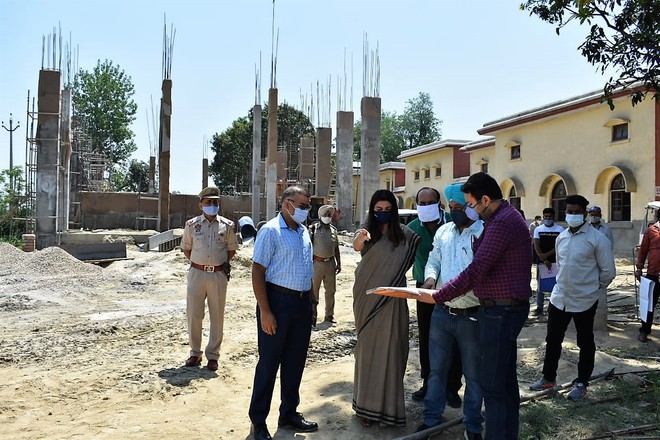
The construction work of Sardar Bahadur Amin Chand Soni Armed Forces Preparatory Institute will be completed by the end of December as the 30 per cent works of the project has already been completed.
Deputy Commissioner Apneet Riyait, who along with other officers concerned, visited the site of this prestigious institute at Bajwara village and informed that the work was in full swing and the pace of construction would be accelerated in days to come. She also directed the officers to maintain quality in each and every aspect of the project, which would be immensely helpful to facilitate more youth from Punjab to join defence services as a career.
Reviewing the status of construction work, the Deputy Commissioner said the project would be completed at a cost of Rs 27 crore spread over 12.75 acres. She said that ultra-modern training would be provided to as many as 270 candidates by fulfilling the dream of boys and girls from the region to serve the nation in defence services. SDM Amit Mahajan and other official of the PWD Department were also present on the occasion. — OC
CHINA BUILDS KEY HIGHWAY THROUGH BRAHMAPUTRA CANYON IN TIBET CLOSE TO ARUNACHAL PRADESH BORDER
Beijing: China has completed the construction of a strategic highway through the Brahmaputra Canyon, stated to be the world’s deepest, close to the Arunachal Pradesh border ahead of its plan to build a mega-dam over the gorge. Construction of a highway costing USD 310 million passing through the Yarlung Zangbo Grand Canyon, known as the world’s deepest gorge with a maximum depth of 6,009 meters, was completed on Saturday last, state-run Xinhua news agency reported. The mighty Brahmaputra river is known as Yarlung Zangbo in Tibet. A 2,114-meter tunnel was dug through on Saturday morning, marking the completion of the major construction of the 67.22-km road connecting Pad Township in the city of Nyingchi and Medog County, cutting travel time by eight hours. Medog is the last county in Tibet, which is located close to the Arunachal Pradesh border. China claims Arunachal Pradesh as part of South Tibet, which is firmly rejected by India. The India-China border dispute covers the 3,488-km-long Line of Actual Control (LAC). The new highway was built on the former hiking route between Nyingchi’s Pad Township and Baibung Township, Medog County, with an altitude difference of up to 2,892 meters between the highest and lowest spots of the road, the report said. It is the second significant passageway to Medog, following the first one connecting the county and Zhamog Township, Bomi County. After the new highway opens to traffic, the road length connecting the city proper of Nyingchi and Medog County will be shortened to 180 kms from 346 kms, cutting travel time by eight hours. The highway project was started in 2014, with an estimated investment of over 2 billion yuan, about USD 310 million, it said. China has already cleared a plan to build a mega-dam over Brahmaputra Canyon by the country’s Parliament, the National People’s Congress (NPC) in March this year, sparking concerns in India. A recent report by the Hong Kong-based South China Morning Post said engineers have also expressed concern about the threats posed by landslides and barrier lakes to the dam. The Brahmaputra is the longest river in Tibet and its valley is the world’s deepest with a 7,000-metre drop from the highest mountain peak to the lowest basin.
‘INDIA-CHINA TIES AT CROSSROADS… TENSIONS CONTINUE ON LAC’: JAISHANKAR
The external affairs ministry too said the process of disengagement of Indian and Chinese troops at friction points in Ladakh sector remains “unfinished” The India-China relationship is at the crossroads and New Delhi cannot think of cooperating with Beijing in other areas as long as tensions continue on the Line of Actual Control (LAC), external affairs minister S Jaishankar said on Thursday. The external affairs ministry too said the process of disengagement of Indian and Chinese troops at friction points in Ladakh sector remains “unfinished” and the full restoration of peace and tranquillity in border areas alone will lead to progress in bilateral ties. Jaishankar’s remarks, made during a virtual interview at the FT-Indian Express webinar, came in the wake of calls by the Chinese leadership for setting aside the border standoff that began a year ago and focusing on cooperation in other areas such as trade and investment. He accused China of moving away from the consensus on stabilising the border, which emerged from former prime minister Rajiv Gandhi’s ground breaking visit to China in 1988. This consensus led to important border agreements in 1993 and 1996 that created three decades of peace and tranquillity on the LAC, he noted. “I think the relationship is at a crossroads and which direction we go depends on whether the Chinese side would adhere to the consensus, whether it would follow through on the agreements which we both have done for so many decades,” Jaishankar said. “Because what is very clear in the last year is that border tensions cannot continue with cooperation in other areas,” he added. Jaishankar pointed out it took 26 years for the two sides to recover from the fallout of the border war of 1962 and to forge consensus on the handling of the LAC, including two border agreements. “Those agreements essentially stipulated that you wouldn’t bring large armed forces to the border and that peace and tranquillity on the LAC would be observed, there would be no attempt to change the status quo unilaterally. What we saw last year was actually China departing from the 1988 consensus,” he said. “If you disturb the peace and tranquillity, if you have bloodshed, if there is intimidation, if there is continuing friction at the border, then obviously it is going to tell on the relationship,” he added. Twenty Indian soldiers and at least four Chinese troops were killed in a brutal clash in Galwan Valley last June, the first incident involving fatalities along the LAC in 45 years. The two sides pulled back frontline troops from the north and south banks of Pangong Lake in February but the disengagement process stalled soon after despite more rounds of military and diplomatic talks. When external affairs ministry spokesperson Arindam Bagchi was asked about the situation on the LAC at a weekly news briefing, he replied that Jaishankar had told his Chinese counterpart Wang Yi in their most recent conversation on April 30 that “while the process of disengagement had commenced earlier this year, it remained unfinished”. Jaishankar had emphasised this process should be completed at the earliest, Bagchi said. “Full restoration of peace and tranquillity in the border areas would enable progress in this bilateral relationship,” he added. The two sides had agreed to maintain stability on the ground and “avoid any new incidents”, and India expects that neither side would take “any action that is not in keeping with these understandings,” Bagchi said. Jaishankar also told the webinar that India’s interest extends from deep into the Indo-Pacific region to Africa and Europe, and that the country’s growing relationship with the US shouldn’t be viewed through a Cold War prism. The Quadrilateral Security Dialogue or Quad, he said, brings together countries with a growing degree of comfort with each other and a shared interest in global and regional challenges such as connectivity, maritime security, resilient supply chains and vaccines. “Today, the Quad fills a gap which cannot be addressed simply by four bilateral relationships aggregated, and a multilateral or regional structure which isn’t there. Something has to fill that space [and the] Quad helps to fill the gap,” he added.
China developing Tibetan border villages near Arunachal Pradesh, Bhutan, Nepal: White paper
Paper titled ‘Tibet Since 1951: Liberation, Development and Prosperity’ says developing border areas, improving people’s lives in Tibet has become important
The India-China border dispute covers the 3,488-km-long Line of Actual Control (LAC) of which 1,126 km is located in Arunachal Pradesh. Reuters file photo
Beijing, May 21
China is ramping up efforts to develop the infrastructure in remote villages located along Tibet’s border with India, Bhutan, and Nepal, according to a white paper on Tibet issued by the Chinese government on Friday.
Developing the border areas and improving people’s lives in Tibet has become important as the strategic Himalayan region shares 4,000-km long external borderline, the document titled ‘Tibet Since 1951: Liberation, Development and Prosperity’ said.
The inhabitants of the contiguous areas experience harsh living and working conditions and a high incidence of poverty. Governments at all levels have been making constant efforts to develop border areas and improve people’s lives, it said.
The document said that under the guidance of the ruling Communist Party, the financial allocation has been increasing year by year for border development in Tibet.
The development of China’s border areas by establishing new villages with added emphasis on security has been accorded a priority since President Xi Jinping came to power in 2012.
The India-China border dispute covers the 3,488-km-long Line of Actual Control (LAC) of which 1,126 km is located in Arunachal Pradesh. China claims Arunachal Pradesh as South Tibet, which India has firmly rejected.
China also shares an over 477-km-long border with Bhutan which is yet to be delineated and 1,389 kms of border with Nepal.
The border village development was highlighted when President Xi wrote a letter to a Tibetan herdsman family in Lhunze County close to Arunachal Pradesh in 2017 asking them to “set down roots” to safeguard the “Chinese territory” and focus on developing their hometown.
“Without the peace in the territory, there will be no peaceful lives for the millions of families,” Xi wrote in his much-publicised letter focussing on border development.
Particularly since Xi came to power, border villages, townships, and counties in Tibet have been granted more preferential state policies on infrastructure construction, covering water, electricity, roads, and housing, it said.
In 2017, the Plan of Tibet Autonomous Region on the Construction of Villages of Moderate Prosperity in Border Areas (2017-2020) was released, designed to ensure better access to housing, water, electricity, roads, communications and the internet, to improve education, technology, culture, healthcare and social security in border villages, and to boost industries in border areas.
By the end of 2020, first-tier and second-tier border villages had access to highways, all border townships and towns were connected to the main power grid, and all border villages had access to postal services, mobile communications, and safe drinking water, it said.
The Tibet Autonomous Region also has built a comprehensive transport network composed of highways, railways, air routes and pipelines since its peaceful liberation in 1951 it said.
The region has built 118,800 km of highways over the decades, said the document.
“Now, 94 per cent of towns and 76 per cent of administrative villages in the region have direct access to asphalt and concrete roads,” it said.
Tibet last year has announced USD 2.09 billion plan to build three new airports and the expansion of the Lhasa Gonggar Airport.
The three new airports will be built in Lhunze, Tingri and Burang counties.
China has already built airports at Bamda in Qamdo, Mainling in Nyingchi, Xigaze, and in Ngari. Tibet now has 140 domestic and international air routes in operation, reaching 66 cities, the white paper said. — PTI
State Stalwarts
DEFENCE MINISTER
Minister Rajnath Singh
ALL HUMANS ARE ONE CREATED BY GOD
HINDUS,MUSLIMS,SIKHS.ISAI SAB HAI BHAI BHAI
CHIEF PATRON ALL INDIA SANJHA MORCHA
LT GEN JASBIR SINGH DHALIWAL, DOGRA
SENIOR PATRON ALL INDIA SANJHA MORCHA
MAJOR GEN HARVIJAY SINGH, SENA MEDAL ,corps of signals
.
.
PATRON ALL INDIA SANJHA MORCHA
MAJ GEN RAMINDER GURAYA ,MADRAS REGIMENT
sanjhamorcha303@gmail.com
PRESIDENT SOUTH ALL INDIA SANJHA MORCHA
COL SS RAJAN BOMBAY SAPPERS,
PRESIDENT UTTARAKHAND ALL INDIA SANJHA MORCHA
COL B M THAPA ,BENGAL SAPPERSS
PRESIDENT HARAYANA STATE CUM COORDINATOR ESM
BRIG DALJIT THUKRAL ,BENGAL SAPPERS
PRESIDENT TRICITY
COL B S BRAR (BHUPI BRAR)
PRESIDENT CHANDIGARH ZONE
COL SHANJIT SINGH BHULLAR
.
.
PRESIDENT PANCHKULA ZONE AND ZIRAKPUR
COL SWARAN SINGH
INDIAN DEFENCE FORCES
DEFENCE FORCES INTEGRATED LOGO
INDIAN AIR FORCE
Air Officer C-in-C WESTERN AIR COMMAND
AIR MSHL S PRABHAKARAN AVSM VM
AOC-IN-C, EASTERN AIR COMMAND
Air Marshal Inderpal Singh Walia
AOC-in-C SOUTH WESTERN AIR COMMAND
Air Marshal Vikram Singh
AOC-IN-C, SOUTHERN AIR COMMAND
Air Marshal J.Chalapati
AOC-IN-C TRAINING COMMAND
AIR MARSHAL SK GHOTIA VSM
AOC-IN-C MAINTENANCE COMMAND
Air Marshal Jagdish Chandra
Flag Officer Commanding in Chief, Western Naval Command
ice Admiral R Hari Kumar, PVSM, AVSM, VSM
Flag Officer Commanding in Chief, Eastern Naval Command
Vice Admiral Sanjay Bhalla, AVSM, NM
Flag Officer Commanding in Chief, Southern Naval Command