









Sanjha Morcha

Why Bajwa must act on Jadhav’s petition by Lt Gen Bhopinder Singh (retd)

Bhopinder Singh's profile photowriter

General Qamar Bajwa’s fair honouring of the mercy petition wouldn’t be an act of fear, but a fearless step to invoke, imbibe and institutionalise internationally accepted norms of jurisprudence, that could make Pakistan look more dignified in the eyes of the world

Lt Gen Bhopinder Singh (retd)ODDLY for a democratic country, the Chief of Pakistani Army, General Qamar Bajwa is the last word in reviewing the Kulbhushan Jadhav mercy petition, even though the COAS is officially at level/article 6 in the official Pakistani “Warrant of Precedence”. Ostensibly re-reviewing “evidence”, that was earlier rejected by Bajwa’s own borough, the Field General Court Martial (FGCM) under the Pakistan Army Act. The chances of General Bajwa overruling previous tribunals and standing up against the “manufactured emotions”are dim, and therefore the fears of a premediated formality, without sincerity. Constraining General Bajwa’s individual discretion is the unsubtle reality of the institutional turf-wars between the troika elements that rules Pakistan — the Military, the Politicos and the now temporarily reigned-in, clergy. The self-combusting tinderbox of the inegalitarian Pakistani society is struggling with its “self-image”, an image that got historically shaped and regularly provoked by the competing elements of the troika, for legitimising their own relevance.  The troika furiously competes with each other on religious piety, India-centricity (especially Kashmir) and on feeding existential fears. So, even the Pakistani Army subsumes the larger religio-politico sentiment in its motto, “Iman, Taqwa, Jihad fi Sabilillah” (Faith, piety and struggle in the way of God), in a sharp contrast to the very functional, “Service before Self” as the defining-DNA for the Indian Army. The contours of the Pakistani armed forces meander expansively into the realm of diplomacy, commerce, civilian policies and the overall, national governance. Unsurprisingly, 35 out of the 70 years of Pakistani independence has seen the Generals ruling officially, and in the remainder 35 years, the files for mercy petitions are still not culminating at the Aiwan-e-Sadr (President House in Islamabad),  in the garrison town of Rawalpindi. This extended political mandate for the Pakistani Army disallows “letting-down” the nation, as the Kulbhushan Jadhav case feeds the pathological wantonness of a captured “Indian spy”! This algebra of governance and institutional one-upmanship, has saddled the Pakistani existence with a costly legacy of deep-rooted religiosity that is emerging in frankensteinian outpourings like the Tehrik-e-Taliban, Lashkar-e-Jhangvi etc. who are now consuming their own progenitors. The militant mutations of the Pakistani palace intrigues has led to collateral damages internally, in the realm of sectarianism (the Shia-Sunni divide), regionalism (Baloch movement) and even on religious schools (Barelvi-Wahabbi divide). Ultimately, the Pakistani army is left to undo the pet projects of the past, through bloody military operations like Zarb-e-Azb (which officially killed nearly 500 Pakistani military personnel and nearly 3,500 “militants”). This cause-effect of the past policies is silently acknowledged by the Pakistani military, while the politicos remain brazen, discredited and mired in the “Panamagates”, while the clergy remains temporarily “in-check,”though thriving in the narrow alleys amongst hungry believers. Amidst this cauldron of modern Pakistan, the critical introspection by the still-deified Pakistani military (especially after the horrific Army school attack in Peshawar), offers the only glimmer of hope as it is the sole institution, publically capable of redrawing the narrative of Pakistani policies and governance, without fear or compunctions of either losing the votes (as feared by the politicians) or the puritanical adherents (as feared by the clergy). The Pakistani military is slowly retracting from its past, albeit, still very selectively and partially. For General Bajwa, dismissing the Kulbhushan mercy petition would be the easiest perpetuation of the existing morass and “sameness”, whereas any possible “refuting”, “staying” or even “pending-the final-ICJ decision”, of the mercy petition could herald a radical change. General Bajwa’s fair honouring of the mercy petition wouldn’t be an act of fear, but a fearless step to invoke, imbibe and institutionalise the internationally accepted norms of jurisprudence. From the infamy as the “safe haven for terrorism” to finding Osama bin Laden on the periphery of a garrison town, the Pakistani military could shed its shady past, and actually walk the talk of its hallowed Jihad-fi-Sabilillah, amidst which, a verse aptly states, “Oh, ye who believe stand out firmly for God as witness To fair dealings, And let not the hatred of other people to you make you swerve to wrong and depart from justice”. Ironically, the Indian request is only for a free and fair trial and not a ‘pardon’ — it is therefore incumbent on the General to honour the sworn commitment to “justice” — a behavioural trait that is not expected from a politician or a mullah, but de rigueur from a professional soldier!General Bajwa has the choice to define himself in the mould of Generals’ Zia-ul-Haq and Pervez Musharaf, or, be the befitting leader of an apolitically professional army like General Asif Janjua or even the more recent, General Raheel Sharif. The infantry officer from ’16 Baloch’ (“Ghazi ya Shaheed” Regiment, or “Victorious or Martyr”), owes his soldering instincts, codes and ethos to overcome the crisis of morality, political-duplicity and existential “purpose”, to showcase the nobility of a just soldier in himself, and not succumb to the bloodlust of a populist politician or the bigoted zealot, in trying to appease to the masses. Soldiers are meant to fight, and India and Pakistan have fought many times — we had 90,000 Pakistani prisoners-of-war in 1971, but we chose to treat all in strict accordance  with the Geneva Convention, rule 1925. The Pakistani General may chose semantic technicalities of a POW versus a “spy”, but the international concern on the Kulbhushan Jadhav as stated by the International Court of Justice, may be the lodestar for General Bajwa to reconsider dispassionately, along with considering the tragic outcome of Pakistan’s past policies and politics, very passionately.The writer is a former Lt Governor of Andaman & Nicobar 


US again lists Pak as a safe haven for terrorists

PAKISTAN DID NOT TAKE SUFFICIENT ACTION AGAINST LET AND JEM, WHICH CONTINUED TO TRAIN THERE, SAYS STATE DEPT REPORT

WASHINGTON: Pakistan remained in the dock in the Trump administration’s first worldwide assessment of terrorism and related threats, released on Wednesday, for not doing enough to combat terrorist groups and individuals operating from its soil.

The state department’s 2016 Country Reports on Terrorism named Lashkar-e-Taiba (LeT) and Jaish-e-Mohammad(JeM), the groups behind most terror attacks in India, and the Haqqani network, which has attacked US-led coalition forces in Afghanistan, as organisations that operate from safe havens in Pakistan.

In language lifted from its previous iterations, the latest report said, “Pakistan did not take sufficient action against other externally focused groups, such as Lashkar-e-Taiba and Jaish-e-Mohammad in 2016, which continued to operate, train, organise, and fundraise in Pakistan.”

The report stated further, “The Pakistani military and security forces undertook operations against groups that conducted attacks within Pakistan such as Tehrik-e-Taliban Pakistan (but they) did not take substantial action against the Afghan Taliban or HQN (Haqqani network), or substantially limit their ability to threaten US interests in Afghanistan…”

As before, Pakistan figured on the list of countries in the report that the US says provide safe haven to terrorist groups such as Haqqani Network, LeT and JeM.

“Although LeT is banned in Pakistan,” it said, “LeT’s wings Jamaat-ud-Dawa and Falah-i-Insaniat Foundation were able to openly engage in fundraising,” it said. The report said India continued to blame Pakistan for cross-border attacks in Jammu and Kashmir. In January, India experienced a terrorist attack against an Indian military facility in Pathankot, Punjab, which was blamed by authorities on JeM.


Army pays tributes to soldier killed in Naugam sector

Tribune News Service

Srinagar, July 19

The Army today paid tributes to Rifleman Bimal Sinjali who died in a fire from across the Line of Control (LoC) in the Naugam sector of Kupwara district on Tuesday.Lt Gen JS Sandhu, General Officer Commanding of the Srinagar-based Chinar Corps (15 Corps), and all ranks paid homage to the soldier at a ceremony held at the Badamibagh Cantonment here today.In a show of solidarity, officers of other security agencies also paid last respects to the martyr.Rifleman Bimal Sinjali sustained bullet injuries in a fire from across the LoC while he was deployed at a forward post in the Naugam Sector. He was provided immediate first aid and evacuated from the post but succumbed to the injuries, an Army spokesman here said.Rifleman Sinjali, 21, had joined the Army in 2015 and hailed from Sirukhark village in Baglung, Nepal. He is survived by his wife Yashoda Sinjali and a one-year-old son.His mortal remains were flown for last rites to Subathu, Himachal Pradesh, where he would be laid to rest with full military honours.In this hour of grief, the Army stands in solidarity with the bereaved family and remains committed to their dignity and well-being, the spokesman said.Sepoy Jaspreet Singh gets tearful adieuJammu: The Army on Wednesday paid tributes to Sepoy Jaspreet Singh, who was killed on the LoC on Tuesday while responding valiantly to unprovoked firing by Pakistan. A wreath-laying ceremony was organised at Rajouri where wreaths on the behalf of the GOC-in-C, Northern Command; GOC, 16 Corps, and all ranks were laid. TNS


Army’s Poona Horse turns 200

Image result for Army’s Poona Horse

Image result for Army’s Poona Horse

New Delhi, July 17The Poona Horse, a tank regiment of the Army, which took part in the 1948 Hyderabad operation and 1965 and 1971 India-Pakistan wars, has turned 200, an Army official said today.Within six months of its raising on July 15, 1817, at Sirur, near Poona, the regiment proved its mettle at the Battle of Coregaum and was awarded the first battle honour.“As part of British Indian Army for 130 years, the regiment fought in 13 countries. Displaying raw and fearless courage and raising its flag at each juncture, the regiment has been conferred with 34 battle honours,” Lt. Gen. Ajai Singh (retd), who has served the regiment, said. — PTI

Image result for Army’s Poona Horse

NCOs during 1965 war, Hony Capts Nahar Singh, Ajaib Singh Malhi and Malkiat Singh Grewal, flanked by Hodson’s Horse soldiers in ceremonial dress at USI, …

Image result for Army’s Poona Horse

INS Sahyadri affiliated to Indian Army’s Poona Horse


A CAREER SPENT IN COUNTER­INSURGENCY OPERATIONS

In his long service in counter­insurgency operations, Brigadier Sanjive Kumar Singh always led his troops from the front and by example. He was the pivotal liaison with Kuka Parray, the top Ikhwani and his group of turned terrorists.

THE BATTLE OF HAIFA, IN A SENSE, WAS THE FIRST SUCCESSFUL TEST OF INDIAN MILITARY LEADERSHIP AT THE MICRO LEVEL IN MODERN TIMES

Brigadier Sanjive Kumar Singh, a third-generation infantryman and a popular figure in Chandigarh, looks back with satisfaction at a career of 36 years with extensive experience in counter-insurgency operations in Jammu and Kashmir and the North East.

WIKIMEDIA COMMONSMysore and Bengal Lancers with Bikanir Camel Corps in the Sinai Desert, 1915.As a young Captain, he carried out reconnaissance across the LoC (Line of Control) in Siachen, monitoring Pakistani troop movements in 1984.

Serving with the Assam Rifles in Imphal, he established an effective intelligence network which led to successful operations against NSCN (Nationalist Socialist Council of Nagaland) insurgents and PLA (People’s Liberation Amry of Manipur) separatists.

Commanding a company of 16th Rajputana Rifles in Kupwara in the 90s, he worked with Jallaluddin Chaudhary, a top surrendered militant whose information he developed to carry out successful operations.

This was the time when Captain Sanjay Chauhan of his battalion carried out a daring operation, disguised as a Pakistani terrorist in the Rajwar forests, killing ten terrorists before his four-man team was overwhelmed.

Posted on the staff with HQ 5 Sector, Rashtriya Rifles, Sanjive synchronised terrorist surrenders.

He was the pivotal liaison with Kuka Parray, the top Ikhwani and his group of turned terrorists.

This was the crucial time when strenuous efforts resulted in the restoration of uniformity which led to the holding of assembly elections in 1996 — a singular achievement of the security forces.

Commanding his battalion in the Mahadev Gap and in Naushera-Pir Badesar, Sanjive used unconventional methods to lay ambushes on the LoC leading to an appreciable fall in infiltration.

As many as 35 terrorists were killed with the recovery of a huge amount of weapons and ammunition.

Finally, as deputy commander of Victor Force in South Kashmir, the handsome Brigadier used his long experience of counter-insurgency to coordinate area dominance in his formation’s zone and the incidentfree organisation of two Amarnath Yatras.

I feel privileged to have been his friend for over 40 years.

LAST HURRAH OF THE OLD INDIAN HORSED CAVALRY

There was considerable excitement in the media when the Prime Minister visited the Haifa War Cemetery in Israel giving our people an education they lacked.

Haifa, a Turkish rear guard position was captured by two regiments of the States Forces — Jodhpur Lancers and Mysore Lancers (now part of 61st Cavalry).

The main lesson that emerged from World War I was the redundancy of horsed cavalry as an arm of decision because of advances in warfare.

Haifa, a fortified town was taken by a full-fledged old-style cavalry charge by the Jodhpur Lancers followed by their Mysore comrades.

In a sense, it was the last great hurrah of the old Indian horsed cavalry.

Another unique distinction that these regiments shared has eluded the media and historians.

They were led to victory by Indian officers at a time when the first Indian commissioned officers were barely making an entry into the British Indian Army.

It would take another quarter of a century before the first Indian took command of a unit.

TALK ON THE BATTLE OF TIGER HILL

Brigadier MPS Bajwa who commanded the formation that captured Tiger Hill, will talk about the Battle of Tiger Hill during the 1999 Kargil War on July 19, Wednesday, at the Centre for Research in Rural and Industrial Development, Sector 19A at 10.30am.

This is part of the Centre for Indian Military History’s War Experiences Talks.


Wake up, it is already too late on China front

Arun Joshi

Tribune News Service

The Indian establishment has been lax in its response to the emerging challenges in Kashmir, resulting in China flexing its interventionist muscles as a big brother to resolve the issue between India and Pakistan. This is a marked change from its earlier stand that this was a bilateral issue between Delhi and Islamabad.Delhi has a reason to take Beijing’s interventionist instincts seriously, not only that China is a bigger country with almost a superpower status but also because of its known hostilities towards India — Doklam standoff being the latest — and its friendly ties with chronic India-obsessed Pakistan. China has drawn closer to Kashmir as it has virtually colonised Pakistan-occupied Kashmir and poses a serious threat to India’s strategic Siachen glacier which Pakistan has been eyeing for decades now.China’s foreign ministry spokesperson Geng Shuan on Wednesday summed up intentions of his country in 90 words vis-à-vis Kashmir in response to a question that centered on the Organisation of Islamic Conference’s condemnation of the “tense situation in the Indian administered Kashmir.” His words: “China hopes relevant parties to do more to help with regional peace and stability and refrain from escalating the tension. China stands ready to play a constructive role to improve the relations between Pakistan and India,” were an obliging statement to Islamabad’s unending calls to the international community to intervene in resolving the Kashmir issue.Pakistan would definitely be emboldened by this and Kashmiri separatists have already started dreaming of their wish being fulfilled by Beijing. Prominent separatist Shabir Shah has advised India to take “China’s words seriously” implying that Delhi should prepare itself for international intervention on the Kashmir issue, while other separatists Syed Ali Shah Geelani and Mirwaiz Umar Farooq have elevated the status of China as one of the “stakeholders in Kashmir”. This campaign had started in early 2000s and now it has reached a point where Beijing is suggesting openly its intervention, while it itself is guilty of intrusion from across the Line of Actual Control (LAC), especially in the Ladakh sector. It is in illegal occupation of 38,000 sq km of J&K territory.The Chinese foreign ministry’s assertive suggestion, almost sounding like a threat couched in diplomatic lexicon, has come after Chinese media hinted that the Chinese army would enter Kashmir at the “request of Pakistan.” The context should be viewed against the backdrop of intrusions and standoff along the LAC, China aggressively dictating the stoppage of development works in Ladakh as also forcibly chasing away Indian shepherds and their livestock from pastures on the Indian side of the LAC. The Indian foreign ministry has adopted a squeamish approach and never asked China to demarcate border in clear terms. This has its own pitfalls.As of now the situation is very serious because China is now openly supporting the idea of intervention, which is a nectar to the separatist sentiment in Kashmir. And, it needs to be admitted that rhetoric of “integral part” is unable to hide the grim situation in the Valley, where every symbol of India is under attack.


India, US, Japan begin Malabar naval drill

India, US, Japan begin Malabar naval drill
File photo of the US Ship Nimitz. Reuters

Chennai, July 10

The Indian, US and Japanese navies on Monday began the Malabar Naval Exercise-2017 aimed at achieving deeper military ties between the three nations.

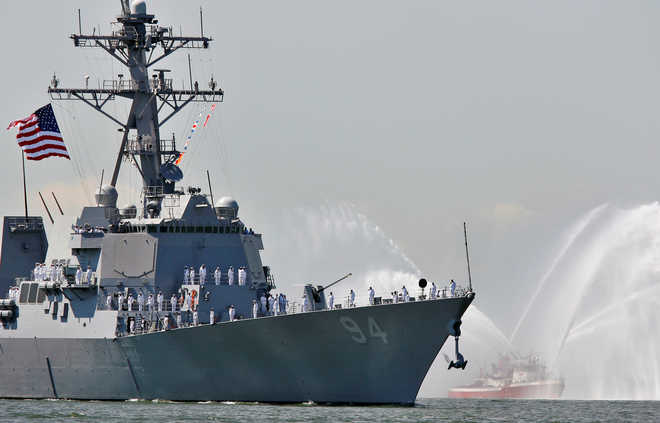
Taking part in the trilateral naval exercise in the Bay of Bengal would be US Ship Nimitz (CVN68), guided missile cruise USS Princeton (CG59), guided missile destroyers USS Howard (DDG83), USS Shoup (DDG86) and USS Kidd (DDG100), a Poseidon P-8A aircraft as well as a Los Angeles fast-attack submarine.

Besides, Japan Maritime Self-Defence Force ships JS Izumo (DDH 183), JS Sazanami (DD1 13) along with Indian Naval Ship Jalashwa and INS Vikramaditya would participate in the joint Naval exercise, an official press release said.

The 21st edition of the exercise, conducted ashore and at sea, would include professional exchanges on carrier strike group operations, maritime patrol and reconnaissance operations, surface and anti-submarine warfare.

Medical operations, damage control, explosive ordinance disposal, helicopter operations and anti-submarine warfare would also take place.

The at-sea exercise includes events such as submarine familiarisation, air defence exercises, medical evacuation drills, surface ware fare exercises, communication exercise and search and rescue operations.

Indian, Japanese and US maritime forces have an understanding and knowledge of shared working environment at sea. As members of Indo-Asia Pacific operations, the three maritime forces would look forward to continuing to strengthen the bonds and personal relationships, a press release said.

The Malabar exercise is taking place amid the military standoff between armies of the India and China in the Sikkim section and Beijing ramping up its naval presence in the South China Sea. PTI


TA jawan, wife killed in Poonch as Pak shell lands at their house

TA jawan, wife killed in Poonch as Pak shell lands at their house
There have been 23 incidents of ceasefire violation in June. — Tribune file photo

Tribune News Service

Jammu, July 8

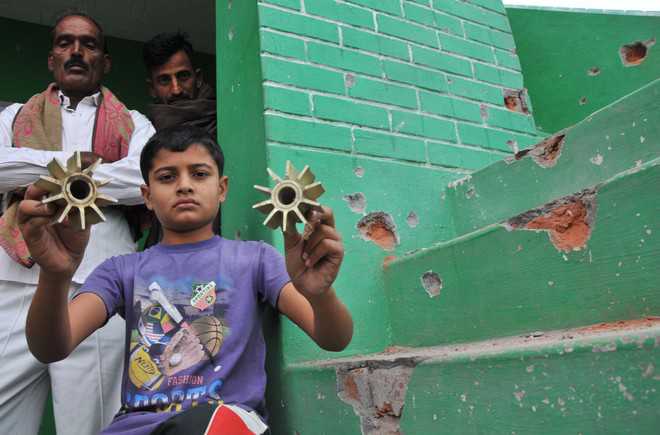
A Territorial Army jawan who was on leave and his wife died and a few others were injured on Saturday as Pakistan Army violated ceasefire in Poonch sector.A shell landed on the house of jawan Muhammad Showkat, killing the couple.The Pakistan Army initiated unprovoked and indiscriminate firing from small arms, automatic weapons and mortars on Indian Army posts along the Line of Control (LoC) in Poonch sector from 0630 hours, a defence spokesman said.

(Follow The Tribune on Facebook; and Twitter @thetribunechd)

The Indian troops retaliated effectively, he said.The Pakistani troops rained mortar bomb shells and resorted to heavy firing targeting civilian villages as well, a police officer said.“Very heavy shelling is going on. So far two civilians have died in Pakistani shelling at Khadi Karmara village along the LoC,” he said, adding that some other people suffered injuries. With PTI


Military standoff, civil distance China fires another salvo, high-level group to sort out

Military standoff, civil distance

Ajay Banerjee

Tribune News Service

New Delhi, July 5

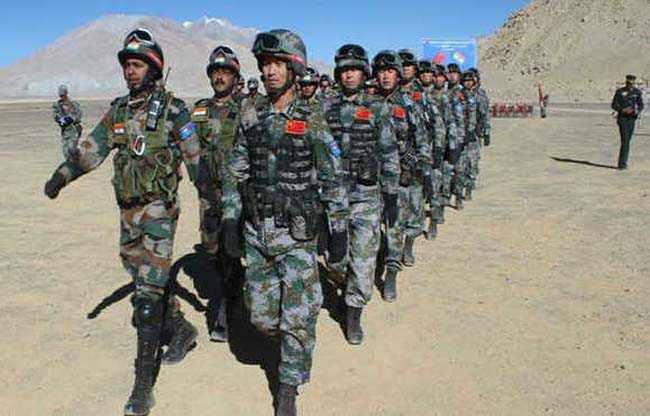
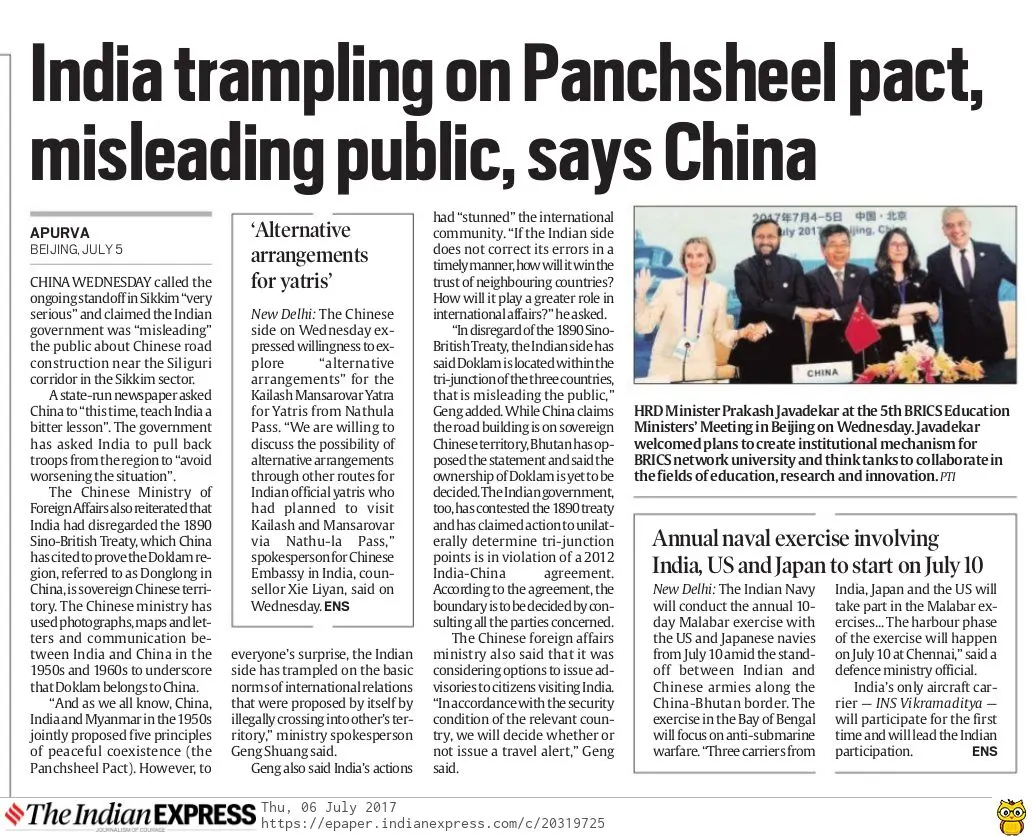
China today again asked India to pull back troops from Doklam in the Sikkim sector to “avoid worsening of the situation” as it accused New Delhi of “trampling on” the Panchsheel pact by “illegally entering” its territory.It was weighing options on a travel alert for citizens visiting India, China added, charging India with “misleading” the public by saying that the Chinese had built a road near the Siliguri corridor.(Follow The Tribune on Facebook; and Twitter @thetribunechd) Amid the military standoff, on-ground postures of the forces are, for now, “non-aggressive” as a high-level dedicated group set up in 2012 is mandated to discuss such flare-ups.  The military standoff is being conducted from a “civil distance” even as both sides have dug in heels at a spot on the Doklam plateau (10,000 feet) at the tri-junction of India, Bhutan and China. Both sides have pitched in tents and maintain a line for supplies, indicating readiness for a long haul. The area is disputed between Bhutan and China. India is there to help a friend.In January 2012, the two countries established a “Working Mechanism for Consultation and Coordination on India-China Border Affairs”. It has representatives of the Ministry of External Affairs as also the Ministry of Defence of either side.Its mandate under Article VI of the agreement says: “The working mechanism will address issues and situations that may arise in the border areas that affect the maintenance of peace and tranquility and will work actively towards maintaining the friendly atmosphere between the two countries.”It is tasked with meeting at fixed intervals and “emergency consultations” can be convened mutually.In the past, similar standoffs have been resolved through diplomacy. The two countries do not have a demarcated border and the Line of Actual Control (LAC) is the de facto boundary all along the 3,488-km frontier.The Border Defence Cooperation Agreement inked in 2013 says: “If the forces come face to face… both sides shall exercise maximum self-restraint, refrain from provocative action, not use force or threaten to use force, and prevent exchange of fire.”

With agency inputs


clip


In a first, IAF to take part in multi-national Blue Flag exercise in Israel

For the first time , the Indian Air Force (IAF) will take part in the multi-national Blue Flag exercise in Israel scheduled to be held in November this year.

According to a report in Sputnik, this year’s Blue Flag exercise will be the largest multi-national air exercise in Israel in which the US, Italy, France, Germany, Greece, and Poland will also participate.

Around 100 fighter aircraft of eight air forces are expected to conduct advanced sorties involving air-to-air battles, air-to-ground attacks with high-level manoeuvring in this air exercise.

In addition to the eight participating countries including India, around 35 countries are expected to attend as observers to the Blue Flag exercise.


In a clear sign of deepening defence relations between India and Israel, more than 55 Indian defence firms had participated at the ISDEF exhibition in Tel Aviv in June this year.

Narendra Modi visited Israel earlier this month and became the first-ever Indian Prime Minister to pay an official visit to Tel Aviv.