Sanjha Morcha

Infiltration bid in Kupwara, 3 militants gunned down

Infiltration bid in Kupwara, 3 militants gunned down
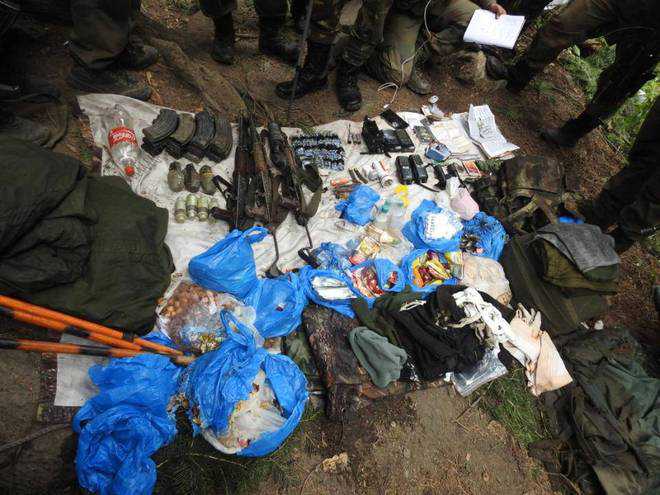
The ammunition recovered from the infiltrators in Kupwara.

Majid Jahangir

Tribune News Service

Srinagar, July 10

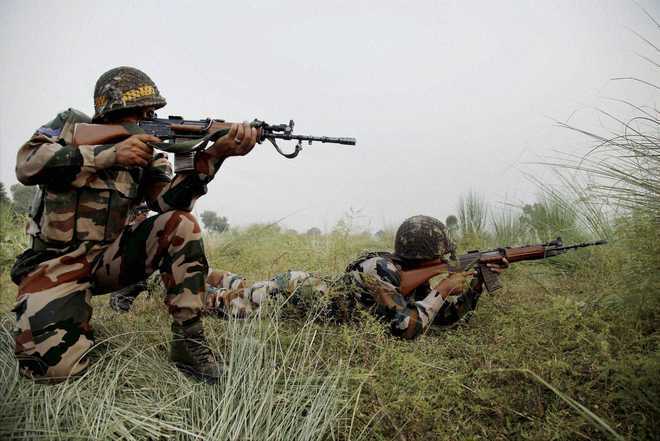
Three unidentified militants were killed during a gunfight as the Army foiled a fresh infiltration in north Kashmir’s Kupwara district.The gunfight erupted around midnight when the Army detected a group of militants close to the Line of Control in the Nowgam sector, 120 km northwest of Srinagar. They were trying to sneak into the Valley.“The militants were detected by the soldiers on duty close to the LoC. When they were challenged, the terrorists resorted to indiscriminate firing and were killed in the ensuing gun battle,” said Army Brigadier Neeraj Kumar Soni.Brig Soni said the search operation lasted over 18 hours resulting in elimination of militants and recovery of a large cache of war-like stores.The identity and the group affiliation of the slain militants could not be established immediately.This is the third infiltration that was successfully foiled in the Nowgam sector in the past two months.Militants have stepped up efforts to sneak into the Valley and sources said over 20 militants have managed to infiltrate ending May. Prior to the Nowgam gunfight, 32 militants were killed along the LoC in the Kashmir region by the Army.


Sandeep a welder-turned-LeT militant

Majid Jahangir

Tribune News Service

Srinagar, July 10

Sandeep Kumar Sharma in his twenties is possibly the first Hindu militant from outside state to be booked by the J&K Police for being part of the Lashkar-e-Toiba group.Investigations by the J&K Police have revealed that Sandeep, alias Adil, of Muzaffarnagar tehsil in Uttar Pardesh, was a welder and first came to the Valley in 2012. Since then, he had been working as a welder in south Kashmir during summer.“During winter, he would go to Patiala for employment. While working in Punjab, he came in contact with Shahid Ahmed, a resident of Kulgam, who was also working in Punjab. This year, he along with some of his Kashmir-based associates came from Patiala to Kashmir to loot ATMs and carry out other robberies in south Kashmir,” Inspector General of Police, Kashmir, Muneer Khan said in Srinagar.“After coming from Punjab, Sandeep along with Shahid, Muneeb Shah and Muzaffar Shah (whom he met in Patiala) started living in rented accommodation at Wanpoh in Kulgam for carrying out the robberies. They later met hardcore terrorist Shakoor Ahmad Dar of the Lashkar. The meeting with Shakoor was arranged by Muneeb and his associates and that was the beginning of Sandeep’s criminal activities. The militant utilised the services of Sandeep for looting ATMs. Four ATMs were looted and the booty was shared with Lashkar militants,” the IGP said.“Thereafter Sandeep became a hardcore terrorist and participated in at least three militant actions.”Sandeep was nabbed from the same house where Lashkar commander Bashir Lashkari was killed earlier this month. There have been few instances in the past where Hindus from far-flung areas of Rajouri, Reasi and Doda districts of the Jammu region have joined militant ranks, mainly of the Hizbul Mujahideen. Muslim militants from outside the state have also been killed in Kashmir in the over two-decade-long militancy.

In between looted ATMs

  • Sandeep, alias Adil, of Muzaffarnagar tehsil in Uttar Pradesh, was a welder and first came to the Valley in 2012. He worked as a welder in south Kashmir during summer
  • During winter, he would go to Patiala for employment. This year, Sandeep along with some of his Kashmir-based associates came from Patiala to Kashmir to loot ATMs
  • Thereafter, Sandeep became a hardcore terrorist and participated in at least three militant actions

IAF MiG-23 plane crash-lands in Jodhpur, all 4 occupants eject safely

IAF MiG-23 plane crash-lands in Jodhpur, all 4 occupants eject safely
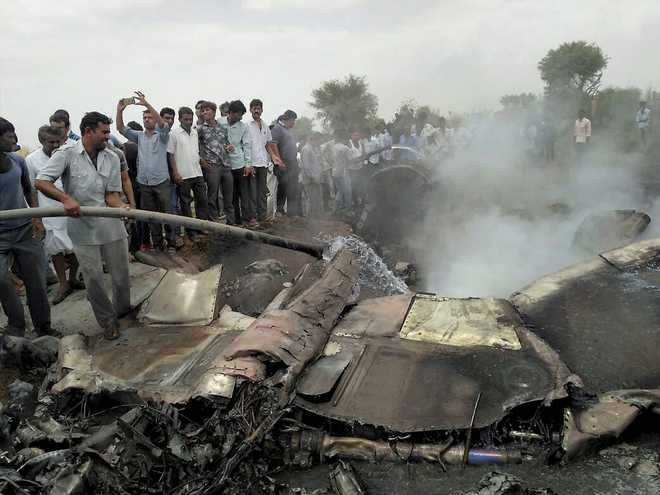
People help in dousing the fire caught by a MiG-23 trainer aircraft of the IAF after it crashed in the Balesar near Jodhpur on Thursday. PTI

Yash Goyal

Jaipur, July 6

An IAF MiG-23 trainer plane on Thursday crash-landed at Gopasar, 60 km from Jodhpur district. The four occupants, including the two pilots, ejected out safely.The accident occurred around noon.After crash-landing in the field, the plane caught fire, SP Rural Ravi told The Tribune.

(Follow The Tribune on Facebook; and Twitter @thetribunechd)

All four occupants, including the two pilots, were safe as they bailed out safely, the SP said, adding that the fire was being doused. No civilian was affected either, he said. Cops from Balesar police post rushed to the spot, SHO Moolsingh Bhati said. A court of inquiry has been ordered.  People help in dousing the fire caught by a MiG-23 trainer aircraft of the IAF after it crashed in the Balesar near Jodhpur on Thursday. PTI Yash Goyal Jaipur, July 6 An IAF MiG-23 trainer plane on Thursday crash-landed at Gopasar, 60 km from Jodhpur district. The four occupants, including the two pilots, ejected out safely. The accident occurred around noon. After crash-landing in the field, the plane caught fire, SP Rural Ravi told The Tribune. (Follow The Tribune on Facebook; and Twitter @thetribunechd) All four occupants, including the two pilots, were safe as they bailed out safely, the SP said, adding that the fire was being doused.  No civilian was affected either, he said. Cops from Balesar police post rushed to the spot, SHO Moolsingh Bhati said.  A court of inquiry has been ordered.

MiG TRAINER AIRCRAFT CRASHES


First sign of thaw at Sikkim border China offers to discuss alternative routes for Kailash Mansarovar Yatra

First sign of thaw at Sikkim border
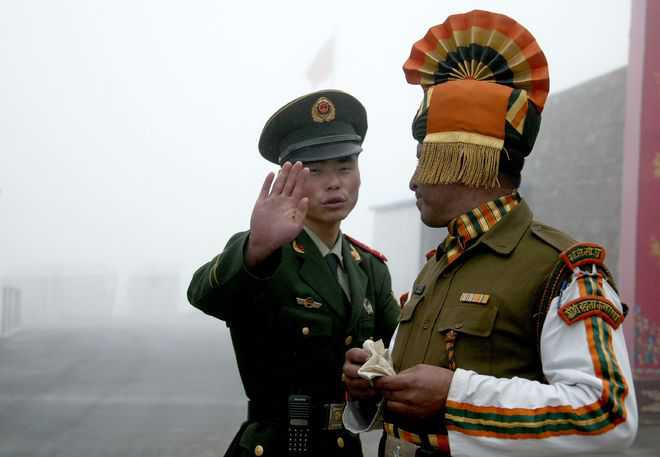
A Chinese soldier and an Indian soldier at the Nathu La border crossing. File photo

Tribune News Service

New Delhi, July 5

In what possibly is the first sign of attempts to de-escalate India-China tension at Sikkim border, Beijing today said it was willing to consider alternative arrangements through other routes for Kailash Mansarovar Yatra pilgrims who had planned the journey via Nathu La. “The official pilgrimage through Lipuleku Pass and non-official yatra through Lhasa and Purang are still on the rails,” Xie Liyan, spokesperson of the Chinese embassy in India, said here.(Follow The Tribune on Facebook; and Twitter @thetribunechd) “Indian yatra to Kailash Mansarovar is an important part of China-India people-to-people and cultural exchanges… The two sides agreed that a total of 350 yatris in seven batches would take part in yatras to Xizang through Nathu La this year,” she said. “However, days before the departure of the yatris, the Indian border troops crossed into the Chinese territory and obstructed the Chinese border troops’ normal activities in Doka La. To ensure the safe and smooth visit of Indian yatris, China had to halt their entry into Xizang through Nathu La,” she said.The spokesperson also said the Chinese side had notified the Indian side through diplomatic channels. “China consistently respects the Indian people’s religious sentiments and attaches importance to the pilgrimage,” she said. 


LoC flare-up: India, Pak DGMOs speak over hotline

LoC flare-up: India, Pak DGMOs speak over hotline
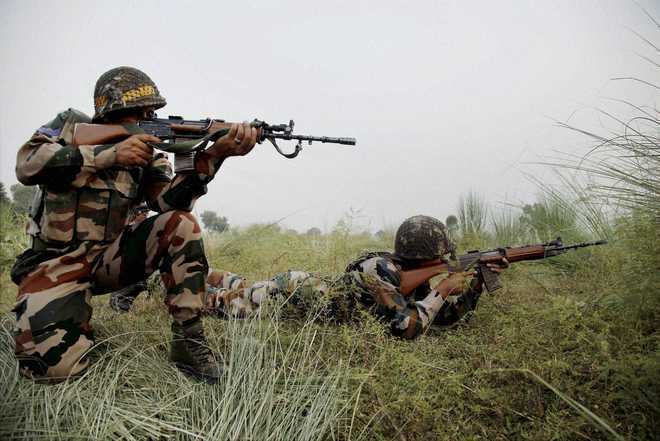
The 749-km-long LoC divides the state of Jammu and Kashmir between the two countries. — Tribune file photo

Ajay Banerjee

Tribune News Service

New Delhi, July 17

India’s Director-General of Military Operations (DGMO) on Monday made it clear to his Pakistani counterpart that the Indian Army was sincere in maintaining peace along the Line of Control (LoC) as long Pakistan reciprocated the same. However, the Indian Army will retaliate to any firing from across the LoC.

(Follow The Tribune on Facebook; and Twitter @thetribunechd)

The 749-km-long LoC divides the state of Jammu and Kashmir between the two countries, with Pakistan illegally occupying the western flank.

The DGMO Lt Gen AK Bhatt spoke to his Pakistani counterpart DGMO Maj Gen Sahir Shamshad Mirza over the telephonic hotline. “The Indian Army is sincere in its effort of maintaining peace and tranquillity along the LoC provided there was reciprocity”. This piece of advice from Lt Gen Bhatt had come after he had told his counterpart that “the Indian Army reserved the right to retaliate appropriately to any incident of violation of ceasefire along the LoC”.

All violations of the November 2003 agreed upon ceasefire pact were initiated by the Pakistani Army and the Indian Army only responded appropriately to them, the Indian DGMO told his counterpart, Indian Army spokesperson Colonel Aman Anand said on Monday.

Apart from these, firing by Indian troops was initiated against armed intruders when attempting to infiltrate from close proximity of Pakistani Army posts.

The trend of infiltration from Pakistan along the LoC continued with active support of Pakistani Army forward posts impacting peace and tranquillity along the LoC and also the internal security situation.

This was evident from continued attempts of sniping and targeting of our troops undertaken through cross border actions duly supported by Pakistani Army troops, the Indian DGMO said.

Pakistan had requested for the DGMO-level telephonic talks. Otherwise, officials—not necessarily the DGMO—from both the sides speak to each other every Tuesday.

During the talks, the Pakistani DGMO raised the issues of targeting of Pakistani Army troops which resulted in the death of four Pakistani soldiers and one civilian in Athmuqam Sector of Pakistan occupied Kashmir opposite Indian Keren sector in Kupwara district of J&K.


Indian Army rejects Pak military’s claim of killing four soldiers

Indian Army rejects Pak military's claim of killing four soldiers
The Indian Army response came after the Pakistani military claimed that it had killed four Indian soldiers and destroyed two Indian checkposts being used to target civilians. File photo

Islamabad/New Delhi, July 10

The Indian Army on Monday denied Pakistan military’s claims that it killed four Indian soldiers in cross-border firing on Monday.

“Pakistan Army has been violating the ceasefire on a regular basis. It has deliberately targeted civilian areas during these across the Line of Control firing incidents,” an Indian Army spokesperson said in New Delhi, adding that the Indian Army did not suffer any casualties this month.

(Follow The Tribune on Facebook; and Twitter @thetribunechd)

“As a mature and accountable institution, the Indian Army keeps the public informed of casualties suffered through an established and transparent system. In case of occurrence of fatal casualties, tribute is paid to the soldier through the official Twitter handle and Facebook page. State funeral is also organised as a mark of respect,” the official said.

The Indian Army, however, said in one such incident of targeted and unprovoked shelling of civilian areas by Pakistan on Saturday, Havildar Md Shaukat, a serving soldier, and his wife died while he was at his home during leave.

The Indian Army response came after the Pakistani military claimed that it had killed four Indian soldiers and destroyed two Indian checkposts being used to target civilians.

The Pakistan Army claimed that its firing came in response to alleged “unprovoked firing” by India on Monday, “targeting innocent civilians”.

It claimed that the Indian firing resulted in the death of five of its citizens.

The Pakistan Army also released a video dated July 9 to substantiate its claim.

“Pakistan Army befittingly responded on July 9, causing substantial losses to men and material. Two Indian Army posts firing on innocent civilians have been destroyed. Four Indian soldiers killed,” Army Spokesman Maj Gen Asif Ghafoor tweeted, while sharing the video.

The Pakistan Army will continue to protect civilians from “unprovoked Indian aggression” at all costs, he said. — PTI


Battle over, but martyrs’ families wage war in life

Parents remember their children who sacrificed their lives for the nation at an event dedicated

Aakanksha N Bhardwaj

Tribune News Service

Jalandhar, July 26

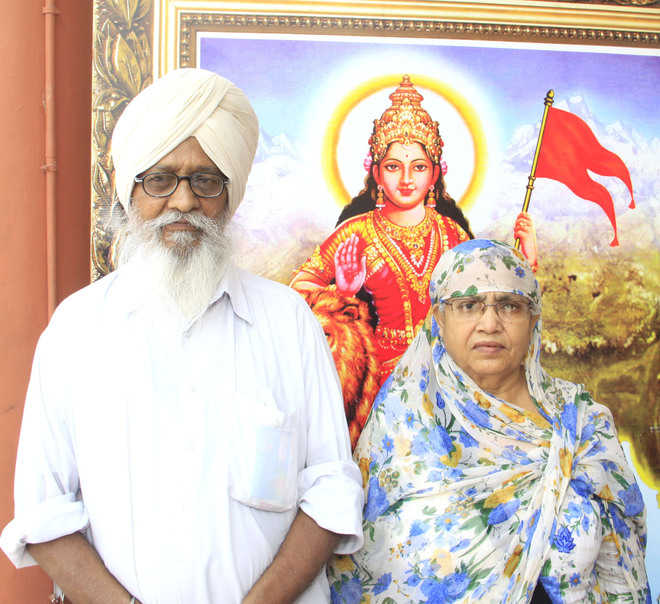
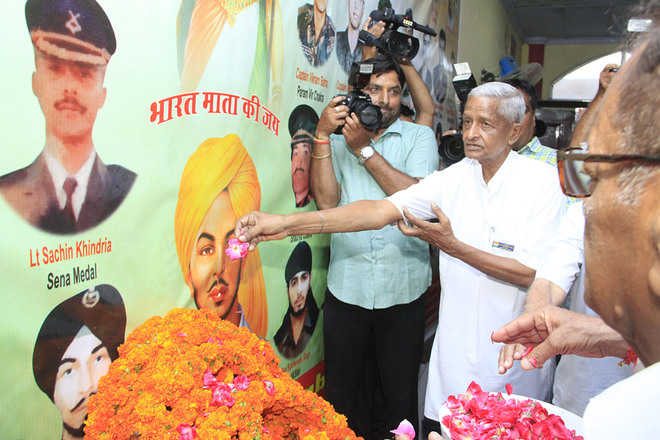
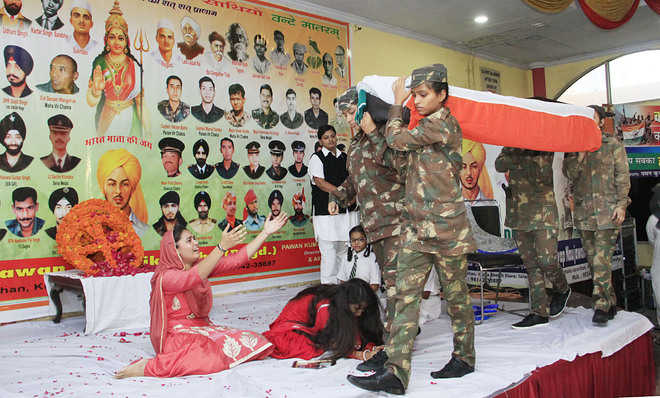
Their eyes were fixed on the projector showcasing a documentary made on the war heroes, who sacrificed their lives for the country. They did not want to blink their eyes as they did not want to miss even a single scene. The emotions could not be controlled and the pain of losing their young children got out through their eyes. They were the parents of the martyrs who sacrificed their lives for the nation.Families of the martyrs were present at a function, which was dedicated to war heroes. A special wall containing pictures of martyrs attracted the attention of the families.Jalandhar Tribune Talked to the families and found that they have been fighting their own battle for the past 18 years.Father of martyr waiting to dieMohan Lal, a lean looking elderly man, was sitting alone on a chair. He was looking sad. While talking to Jalandhar Tribune, he said, “I attend the function every year to remember my son who got martyred in 1999 in Bandipora district in Jammu and Kashmir.”“I feel this is the only day when my son gets importance otherwise who talks about me or my son’s sacrifice. Nobody knows what I have seen or faced through these 18 years,” the father said in a quivering voice.His son Mohinder Lal was posted as Deputy Commandant with the Border Security Force (BSF) and got martyred at the age of 30. “Not even a day passes when I don’t miss my son,” he said while getting emotional.“I don’t know why he joined the force. He was doing well here as a lecturer at a college but he had a wish to serve the nation. He told me after joining the force,” he said and wiped off his tears.“And see now, a father of a martyr himself wants to die. I have no source of income and my elder daughter who is married helps me in everything. Even my wife is not well and I am not able to provide her proper treatment due to lack of money,” Mohal added.“I have also sought help from the governments, pr koi kuch nahee krta, kaun parvaah krta hai ki kisne kis k lie jaan di. Ab main isi intzar mein hu ki mar jaau (Nobody does anything, who cares if someone sacrificed his life for the nation. Now, I am waiting for the day when I will die).”After sharing his grudge, Lal moved forward and again sat on the chair.He fights to get boards bearing his son’s name reinstalledKirpal Singh, 70, was listening to the announcers, who were praising the sacrifices of the martyrs. Kirpal, who is a granthi, said these words always make him proud.His son Daljit Singh got martyred in Dras, a town in Kargil district of Jammu and Kashmir, in 1999. His wife Kanwaljit Kaur, who had accompanied him, could not utter a word. Her eyes were filled with tears while remembering her son, who joined the Army.  She, along with her family, never wanted to see her son joining the Army. They are now fighting a battle to get boards bearing his son’s photos reinstalled at Rama Mandi Chowk and Johal Chowk.  He said the boards containing information of his son were installed at these chowks but these were removed due to some project. Thereafter, nobody bothered to reinstall the boards, he added.


In Iraq, VK Singh on rescue mission

In Iraq, VK Singh on rescue mission
VK Singh

Simran Sodhi

Tribune News Service

New Delhi, July 10

India today said it is making efforts to secure the release of 39 Indians, mostly from Punjab, who have been in IS captivity in Mosul since 2014. External Affairs Minister Sushma Swaraj spoke to Punjab Chief Minister Capt Amarinder Singh and assured him of making all efforts to secure their release.Punjab page: Iraq action rekindles their hopesWith Iraqi forces freeing Mosul from Islamic State control, India has stepped up efforts to locate and facilitate the return of its nationals. Minister of State for External Affairs General VK Singh (retd) is flying to Iraq’s Erbil to coordinate with the government there for the return of stranded Indians.The Ministry of External Affairs said Air India officials had been instructed to assist with their return, and that the government had activated all channels to locate the missing nationals. The MEA added that the Iraqi government has promised all help in locating the 39 Indians.(Follow The Tribune on Facebook; and Twitter @thetribunechd)The official spokesperson for the MEA said: “As soon as the announcement of liberation of Mosul was made by the Prime Minister of Iraq Haider al-Abadi, the government activated various channels to locate those Indians. Iraqi authorities have conveyed that all cooperation would be extended in this regard and instructions have been issued by them to all relevant Iraqi agencies for the same.”The 39 Indians were taken hostage by the IS on June 11, 2014, in Mosul. However, confusion prevails over the fate of the abducted Indians. Harjit Masih, a Punjab resident who escaped from IS captivity in June 2014, had claimed that the 39 had been killed. However, the MEA has maintained that it has no information confirming that the Indians are dead.


Yet another soldier killed in LoC firing

Yet another soldier killed in LoC firing
File photo

Jammu, July 21

A jawan was killed after the Pakistan army opened unprovoked firing on Indian Army posts in the Sunderbani sector around 6.05 pm today.Rifleman Jayadrath Singh, 28, was grievously injured in the firing and later succumbed to his injuries. The Army retaliated strongly and effectively to the Pakistan firing.(Follow The Tribune on Facebook; and Twitter @thetribunechd)The rifleman belonged to Bhagwanpur village in Saharanpur district of Uttar Pradesh. He is survived by his wife Mamta Devi.“Rifleman Jayadrath Singh was a brave and sincere soldier. The nation will always remain indebted to him for the supreme sacrifice and devotion to duty,” an Army spokesman said. Meanwhile, there were reports of ceasefire violations in the Naugam sector as well as Kupwara’s Keran sector. Eleven persons, including nine soldiers, have been killed in 18 ceasefire violations by Pakistan this month. — TNS


Separatism stays a step ahead on social media

ONLINE WAR Viral videos that capture militants at leisure, videos of alleged rights excesses by forces and frequent gags on internet are bringing a paradigm shift in the narrative of the Valley’s conflict

The PDP­BJP government is the most unpopular government Kashmir has seen in the last decade. So even if the government tries to reach out to people through social media, it won’t make much of a difference for its public relations …. IRFAN MEHRAJ, an activist with the Jammu Kashmir Coalition of Civil Society

A few days after the killing of Hizbul Mujahideen militant Burhan Wani on July 8 last year, a video surfaced on social media showing Wani and an accomplice tapping their rifles and humming a Kashmiri folk song playing in the background. The lyrics of the song in the video went: “You will miss me, o mother, when I will be buried under the earth…”

That video touched a chord with many in Kashmir where militants enjoy wide public support. “Any Kashmiri will cry, the video touches you,” a 40-year-old woman from old Srinagar said.

Viral videos that capture militants at play and leisure, shocking videos of alleged rights excesses committed by security forces on Kashmiri civilians, the alleged use of instant messaging platforms to mobilise stone pelters and recruit foot soldiers for militants and the frequent gags on internet are bringing a paradigm shift in the narrative of the Valley’s conflict. But the government seems to be losing the online war, with the militants and separatists seemingly always a step ahead. The week-long protest calendar by separatists to mark Wani’s first death anniversary calls for a “Kashmir Awareness” campaign on social media.

“The PDP-BJP government is the most unpopular government Kashmir has seen in the last decade. So even if the government tries to reach out to people through social media, it won’t make much of a difference for its public relations because I think it will face similar kind of criticism on social media to the one it faces on ground,” says Irfan Mehraj, an activist with the Jammu Kashmir Coalition of Civil Society (JKCCS) and editor of e-magazine Wande.

Militants are no longer faceless. They wear military fatigues, strap ammunition across their chests and smile at you from forests. Given how successfully Wani struck a chord with people through social media and attracted youngsters, newer militants are trying out the same.

Police sources say although they check and analyse all latest militant videos, they are not dependant on them for gathering information on insurgents who are already profiled by police intelligence. But Kashmir watchers, like senior journalist and former Kashmir bureau chief of Reuters Sheikh Mushtaq, point out that militant videos play a “huge role” in humanising the insurgents to the common population and putting forward their viewpoint. “You see them and get to know them through these videos. They penetrate your computers and mobile phones. This is quite different from the militancy of the 1990s, when there were no such technologies.”

Stone-pelting protesters now shoot videos of clashes and upload them onto social media almost in real time. Many such videos were shared widely after a clash near an encounter site in Kulgam in February. With commentary on how forces were allegedly shooting at protesters and “killing Kashmiris”, the videos captured disturbing visuals from the clashes.

Director general of state police, SP Vaid, says police is successfully putting a check on all sorts of militancy propaganda on social media, but videos capturing atrocities and human rights violations of Kashmiris have dominated the narrative this year and proved to be a major headache for the administration.

In April, a video emerged of a group of Kashmiri youth heckling CRPF jawans returning from duty on the day of Srinagar bypolls on April 9 and resulted in a national outrage. What followed, however, was a torrent of videos showing security forces committing atrocities and human rights excesses on civilians, including using a “human shield” by the army and the targeted shooting of a teenage stone pelter on the day of the bypoll.

Army Major Leetul Gogoi tied Kashmiri shawl weaver, Farooq Dar, to the bonnet of a jeep as a ‘human shield’ and drove him around for five hours across 17 villages over 28km on April 9. A video of the act, which surfaced a few days later and was shared by many. including former chief minister Omar Abdullah. had put the spotlight on the now infamous act. Soon after these videos went viral, the administration on April 17 snapped highspeed mobile internet services and on April 26, banned 22 social media sites, including Facebook, Twitter and WhatsApp, for a month.

INTERNET GAGS CHECK VIOLENCE OR CURB DISSENT?

The security establishment tries to keep pace through its cyber cells but the government’s main response is to snap mobile internet services, like it did after Wani was killed. Post-paid mobile internet services were restored in mid-November, while pre-paid services were restored on January 30 this year — making the blackout period the longest in Kashmir till now.

The blackout did not stop youth from mobilising in large number and organising stone pelting protests. The unrest that began after Wani’s death left over 90 people dead last year. The idea that without internet there would be no street protests was also debunked when both broadband and mobile internet services were snapped across Kashmir for the bypolls in Srinagar constituency — eight civilian protesters were gunned down by forces that day. Senior police officers, however, argue that with functioning internet, the scale of violence would have been higher.

The suspension of 3G and 4G services in April was to curb the uploading of multimedia content that could provoke violence, while letting users access the basic minimum internet on their phones.

Similarly, the April 26 order by state home secretary RK Goyal to ban 22 sites said the step was taken because the government felt that “continued misuse of social networking sites and instant messaging services is likely to be detrimental to the interests of peace and tranquility in the state”. The social media ban turned out to be a colossal failure. Most Kashmiri users switched on to Virtual Private Network (VPN) apps to overcome the ban and what came as a real surprise was that the Who’s Who of Kashmir were all leading a busy social media life throughout the ban.

This year, internet services were completely or partially snapped at least seven times in Kashmir. But activists say the administration is clueless about how to control the space, which is being increasingly used for dissent, and hence gags it.

“Kashmiris chose dissent online, because the offline real world democracy wasn’t working. Even then they were pushed to the wall. The ban on social media was the peaking of an authoritarian state that can’t tolerate dissent. The state has lost both the battles offline and online. Now it’s just brutalisation that works in reality and virtually,” says Srinagar-based blogger Muhammad Faysal, who has over 15,000 followers on Twitter.

According to data since 2012 provided by internet shutdowns.in, a project by the Software Freedom Law Centre (SFLC), Jammu and Kashmir has recorded 35 instances of complete or partial internet shutdowns, the highest among states.

‘GOVT TALKS ONLY OF DEVELOPMENTAL WORK’

CM Mehbooba Mufti has a verified Twitter account with around 21 thousand followers, but is yet to write her first tweet. On the other hand, the leader of opposition, former CM Omar Abdullah, is a Twitter star with 1.88 million followers and a tweet on almost every topic relevant to Kashmiris.

The PDP’s official Twitter handle is mostly focused on promoting the developmental work of the government. Mehbooba’s verified Facebook page is a collection of videos of her public appearances and short press statements.

“The ruling dispensation’s engagement on social media is mostly related to sharing news about development work and success stories. That’s their mandate. They do not go beyond that. If they express anguish over civilian killings or injuries, they will face tough questions by social media users,” said Moazum Mohammad, a journalist with English daily Kashmir Reader.