Sanjha Morcha

CHANDIGARH GETS NEW ARMY CANTEEN IN SEC 29

HANDIGARH: Havildar Sampuran Singh (retd), a Vir Chakra awardee of the Indo-Pak 1971 war in Poonch sector, inaugurated a new canteen outlet at Field Area Family Accommodation Complex in Sector 29, Chandigarh.

HT PHOTOHavildar Sampuran Singh inaugurating an army canteen in Sector 29, Chandigarh, on Friday.

This extension counter will fulfill long cherished demand of the field area families residing in Sector 29 complex and vicinity. This will also enable the provision of canteen services at the door steps of the families and dependents of the soldiers who are deployed in field areas.
The new facility is in sync with the four corner stones of welfare, namely ‘Sahuliyat, Sambandh, Sehat and Samman’, said Lt Gen KJ Singh, Army Commander, Western Command. Lt Gen Gurdeep Singh, Chief of Staff, senior army officers, veterans and residents of Field Area Family Accommodation Complex was also present on the occasion.


EX-SERVICEMEN RALLY AT HOSHIARPUR (PUNJAB) :16 JUN 2016

IMG-20160616-WA0024
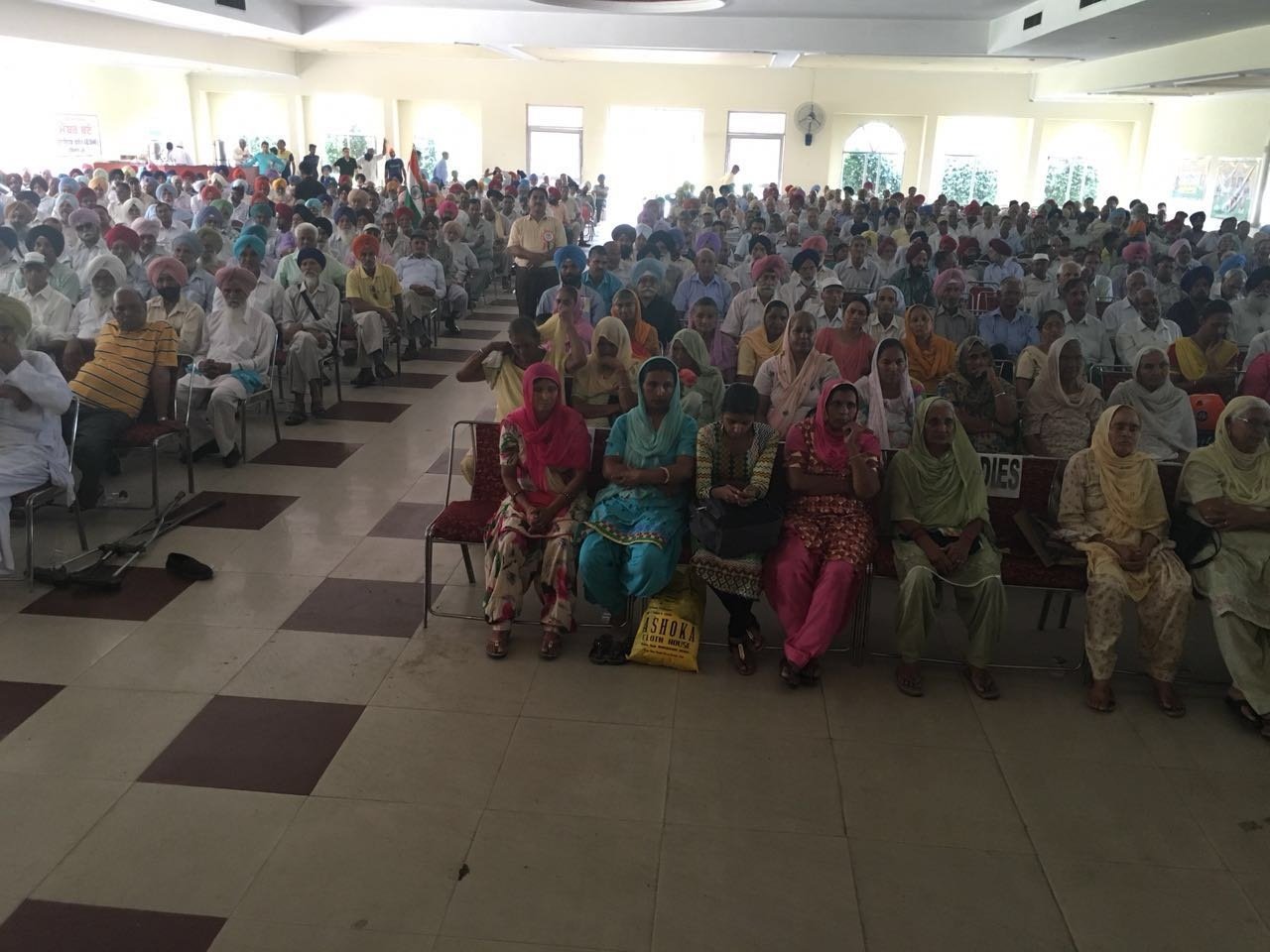
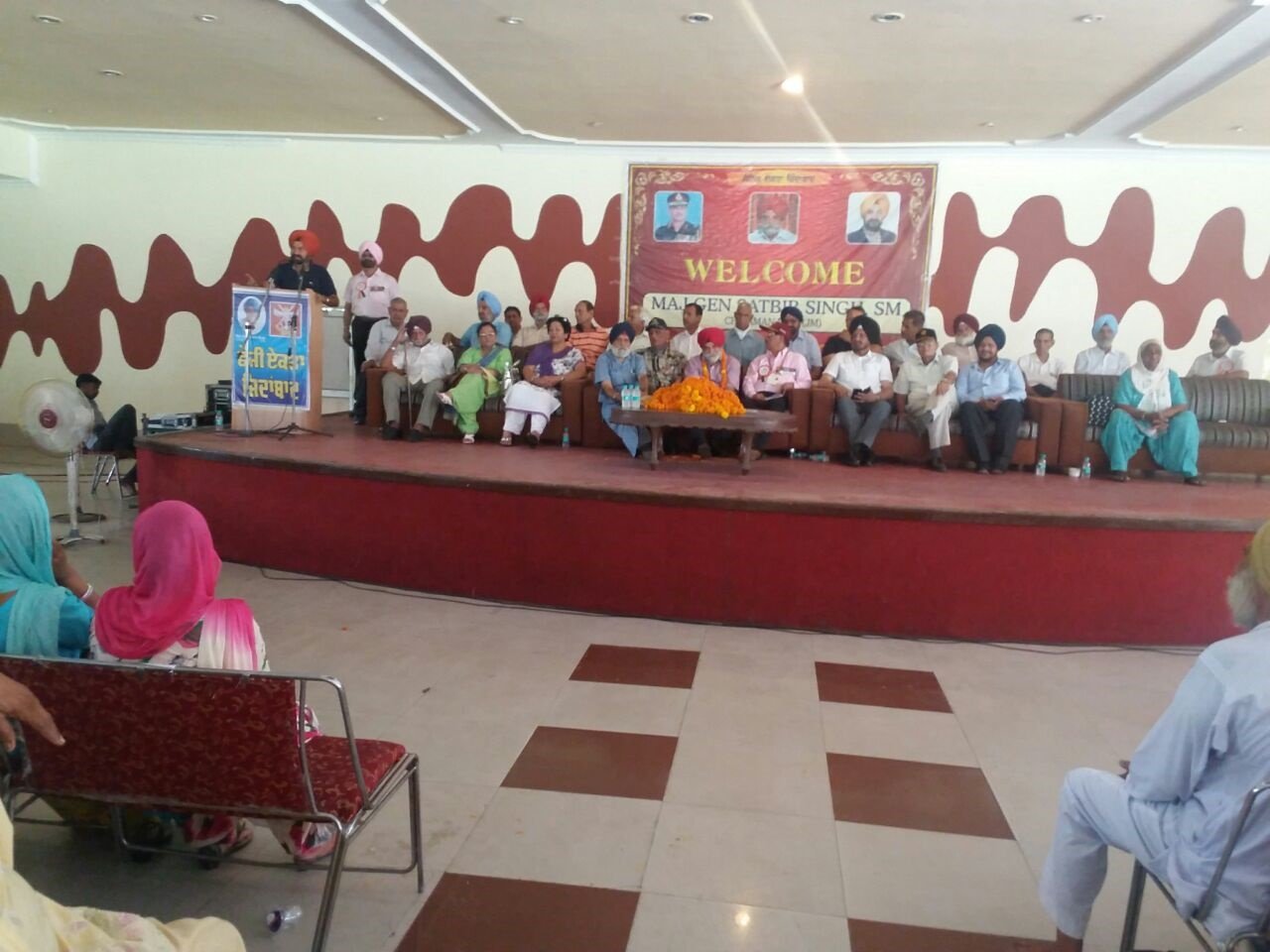
Ex-servicemen rally at Hoshiarpur was held on 16 Jun 2016

IMG-20160616-WA0020


Maj Gen Satbir Singh was the chief guest.

Large number of Ex-servicemen & Veer Naries attended the Rally.

Maj Gen Satbir sigh briefed the ESM at the Rally about the Outcome of detailed discussion held with RM on 15 Jun 2016 regarding OROP 

OPEN THE BLOG LINK   voice  of  esm  punjab   BELOW FOR DETAILS ABOUT RALLY


http://voiceofesmpunjab.blogspot.in/

assembly


Parrikar seeks help from ex-Air Marshal

NEW DELHI:Breaking traditions, defence minister Manohar Parrikar has hired a retired IAF officer to coordinate between his ministry and the Services, which has always been a ticklish issue. Air Marshal (retd.) P P Reddy, who was heading the office of the Chief of Integrated Defence Staff till March, has been appointed as a consultant in Parrikar’s office.

 Reddy, an ex- fighter pilot, was handling the tri-services’ planning and acquisitions as chief of Integrated Defence Staff to the Chairman Chiefs of Staff Committee. “The minister wanted to use Air Marshal Reddy’s expertise in resolving issues related to the tri-services. His duties include coordination between the ministry and the Services, and assisting the defence minister in having a better understanding of Services’ matters,” an official said.Usually, the defence minister has a private secretary, an IAS officer who looks after his engagements and meetings. Then there is an Officer on Special Duty, who explains files and communications to the minister. An official said bureaucrats don’t understand the requirements of the Services, which eventually reflect in the ministry’s decision-making “and creates resentment amongst the Services. An defence official will reduce friction between babus and defence personnel and will hasten decision-making”.http://www.newindianexpress.com/thesundaystandard/Parrikar-seeks-help-from-ex-Air-Marshal/2016/06/12/article3477829.ece


Two killed aboard INS Vikramaditya

Tribune News Service

New Delhi, June 10

Two persons, including a Navy man, have died following a gas leakage on board the seaborne aircraft carrier INS Vikramaditya, the country’s biggest warship.The 44,500-tonne warship was undergoing maintenance at the Karwar naval base, bordering Goa, when the incident occurred at 5 pm today. The accident took place when a team of workers was replacing a pipe in the sewage treatment plant located among the lowermost compartments of the 20-storey tall aircraft carrier. Due to inhalation of the toxic fumes, four personnel — two naval sailors and two civilian workers — were evacuated to the Karwar Naval Hospital.Two persons, Rakesh Kumar, shipwright artificer (Class 4), and Mohandas Kolambkar, an employee of Messers Royal Marine, died of toxic gas inhalation. The next of kin of the deceased have been informed. The condition of the other two personnel is stable. The Navy has ordered an inquiry into the incident. Action has been taken to render the compartment and area on the ship safe.This is the first major refit-and-repair of INS Vikramaditya, or the refurbished Admiral Gorshkov, which was inducted in November 2013 under a $2.33 billion deal with Russia.


Pak, US discuss bilateral ties strained after drone strike

Islamabad, June 10

Senior Pakistani and American officials on Friday held “candid discussions” on bilateral ties strained after Afghan Taliban chief was killed in a US drone strike in Balochistan and the F-16 fighter jet deal was scuttled due to a row over their financing.

A US delegation which included senior Director for Afghanistan and Pakistan at the US National Security Council Peter Lavoy and Special Representative for Afghanistan and Pakistan Richard Olson arrived here this morning to hold talks with Pakistan’s civilian and military leaders.

Lavoy called on Adviser to the Prime Minister’s on Foreign Affairs Sartaj Aziz and Foreign Secretary Aizaz Ahmed Chaudhry.

“They held candid discussions on bilateral relations, regional security situation and the Afghan peace process” in the wake of the 21 May drone strike in Balochistan that killed Afghan Taliban chief Mullah Akhtar Mansour.

The Adviser conveyed “a strong message” to the US that the drone strike was not only a violation of Pakistan’s sovereignty and breach of the principles of the UN’s Charter, but has also vitiated bilateral ties, Foreign Office said in a statement.

“It was emphasised that any future drone strike in Pakistan will be detrimental to our common desire to strengthen relations,” it said.

The family of the Pakistani driver killed along with Mansour in the US drone strike has also demanded justice.

Aziz said the drone strike had “seriously undermined” the ongoing efforts for Afghan peace and reconciliation process at a time when Pakistan along Quadrilateral Coordination Group (QCG) countries was engaged in serious efforts to revive peace talks between Afghan Government and the Taliban.

The Foreign Secretary recalled that in QCG’s fifth meeting on 18 May 2016, it was decided that peace negotiations remained the only option for a political settlement.

He emphasised that this would require collective efforts on the part of all QCG members to promote lasting peace in Afghanistan.

Besides Pakistan QCG includes Afghanistan, China and the US.

Pak-US ties are sliding down the hill due to difference over handling of peace process in Afghanistan and US’ growing defence ties with India, especially the support for India’s candidacy in the Nuclear Suppliers Group (NSG).

Pakistan is also unhappy over the scuttling of eight F-16 fighter jet deal by US Congress which blocked funding to it citing Pakistan’s unsatisfactory actions against Haqqani network. But Islamabad believes that the US Congress was prompted to act due to Indian lobbying and pressure.

In response to US queries on safe havens in Pakistan for Taliban, it was emphasised that Pakistan is already pursuing its objective of eliminating all militants and terrorists from its soil in accordance with the National Action Plan, the Foreign Office statement said.

At the same time, Pakistan would have to safeguard its own security through better border management and early repatriation of Afghan refugees.

Pakistan also expects action by Afghan forces against TTP operatives in Afghanistan.

These steps would also help to promote better relations between Afghanistan and Pakistan and reduce mistrust.

Lavoy, while conveying President Obama’s good wishes for the Prime Minister Nawaz Sharif’s speedy recovery, said that President Obama was committed to improving relations with Pakistan, the statement said. — PTI


Cultivate the US Congress KV Prasad Some tough posturing for Modi’s visit

Cultivate the US Congress
The jitters: How will Modi dodge this one?

ON Wednesday, Prime Minister Narendra Modi arrives at the US Congress to address a joint sitting.  Like his predecessors, he will also discover he is walking into a unique institution in one of the most powerful democracies in the world where the legislative branch insists on operating independent of the government.Unlike Parliament, a product of the Westminster model that India follows, the bicameral US Congress is one of the three branches that govern the United States and is fiercely protective of its role ordained by the Constitution.In the run-up to PM Modi’s sojourn on the Capitol Hill, New Delhi had a taste of how US lawmakers can curdle up the entree. Last week, a Ranking Member of the powerful Senate Foreign Relations Committee (SFRC), Senator Ben Cardin (Democrat representing Maryland State), was in India — and he minced no words in telling what he and his colleagues would ask the Prime Minister — India’s record on human rights violations, religious intolerance and extra-judicial killings.Now it should not have surprised the South Block mandarins coming as it did in the backdrop of a India-specific hearing in May on the bilateral relations, balancing progress and managing expectations, where SFRC Chairman Senator Bob Corker (Republican from Tennessee), while acknowledging the overall cooperation between the two countries remains at an all-time high, went on to say: “We’re not as brutally honest about our relationship with India as we should be, and it benefits neither them nor us.”Making a scathing observation that PM Modi’s promise on economic reforms was high on rhetoric outpacing reforms, Senator Corker expressed frustration over India’s failure to address its status as a country with the largest enslaved population. “How does a country like this have 12 to 14 million slaves. Do they have just zero prosecution abilities, zero law enforcement; I mean how could this happen? On that scale, it’s pretty incredible.”Adding to the rub is the decision of the Tom Lantos Congressional Commission on Human Rights that scheduled a hearing on the eve of the PM’s visit on the Hill. The topic is: “Challenges and Opportunities — The Advancement of Human Rights in India” and it will be based on a report of the US Commission on International Religious Freedom. This report makes a mention of how Dalits are victims of trafficking for commercial sexual exploitation or forced labour. It also talks of religious minorities facing challenges. “In 2015, religious tolerance deteriorated and religious freedom violations increased in India. Minority communities, especially Christians, Muslims, and Sikhs, experienced numerous incidents of intimidation, harassment, and violence, largely at the hands of Hindu nationalist groups,” the Lantos Commission hearing  the notice says, quoting the latest report.The hearing, it said, will examine these and other issues while seeking to provide concrete recommendations for how the US policy-makers can most effectively encourage the protection of human rights, given the strategic importance and continued growth of the US-India bilateral relationship.Many in India would find such notices rather disagreeable. Why does it happen? Is it meant to embarrass a preferred guest or intended to convey a strong message from members of the Congress — 100 Senators and 435 Representatives — to a country whose caucus enjoys the largest number of Congress members among any country-specific group?Perhaps the answer lies in the largely unnoticed tendency of the Indian diplomats working in Washington DC.  Barring a few exceptions, the India connect on the Capitol Hill is largely outsourced to the outreach by enthusiastic Indian-Americans who have come to organise themselves as a cogent group.It could be a smart and cost-effective way of doing things in a city where lobbyists work with a professional purpose, of course, for a fee. Yet, what is missing is the professional diplomatic outreach and level of intense engagement with the lawmakers on a scale that for a country of the size of India is less than adequate.Has New Delhi found another way of working its way through the doors of various offices that dot either side of the Capitol Hill, where staffers continue to play a significant role in assisting lawmakers in arriving at an opinion? The evidence is missing.Each lawmaker is acutely aware of the causes that are dear to him or her and their constituents. Irrespective of what the person inside the White House thinks and irrespective that many envy the President as holding one of the most powerful offices on the planet, yet each member of the Congress has his or her own world view. No wonder it is said the US has 535 Secretaries of State, with each Congressman wanting to leave an imprint on how the US shapes its foreign policy.Imagine this, during the run-up to the campaign for the Lok Sabha polls in 2014, two members of the US Congress, on a visit  to Delhi organised by an international think-tank, were sounded not to attend an interaction with the BJP leadership in Delhi. The ostensible reason was that two among the group of four had signed a petition in the wake of the 2002 Gujarat riots. Incidentally, the programme was coordinated by a person who is a close relative of a top-ranking Indian diplomat.  Among those asked to step aside was a founding member of India caucus, Jim McDermott, who sportingly signed up to join 36 Congress members and shook hands with Prime Minister Modi during the Madison Square event a few months later. Sometimes statements made at committees sound to the Indian ear like talking down but it is surely meant to resonate among policy-makers and intended to have an amplifier effect. Yes, India enjoys bipartisan support on the Hill, but it is time that the Indian engagement with the Congress  and Indian Parliament was restructured and the Ministry of External Affairs relied more on its traditional methods and professional officials  than on Indian-Americans, the White House and the US Administration to do heavy-lifting with lawmakers. The Capitol Hill is institutionally zealous of its voice and its say in the conduct of US foreign policy. It is about time that we learnt to operate the Congressional ropes.The writer spent a year pursuing American Political Science Association-Fulbright Congressional Fellowship on “Role of US Congress in shaping foreign policy”


Vajra Corps carries out tactical exercises

Ludhiana, June 6

Close on the heels of divisional-level manoeuvre exercise conducted in general area Nakodar-Nurmahal, in the vicinity of Ludhiana by Panther Division, two more tactical exercises were conducted by the Vajra Corps.These exercises were conducted at Khem Karan, historically known as ‘Patton Graveyard’ and Jalalabad, both in general area of Ferozepur by ‘Double Victory Brigade’ and ‘Golden Arrow Division’.The exercises involving large scale tank, infantry and aviation manoeuvres were supervised by Lt Gen JS Cheema, General Officer Commanding Vajra Corps. Despite intense heat, with extremely high temperature inside the tank or infantry combat vehicle, troops displayed remarkable skills and enthusiasm in undertaking various tactical manoeuvres.The exercise was witnessed by Lt Gen KJ Singh, General Officer Commanding -in-Chief, Western Command. The Army Commander complimented the troops for displaying a high standard of professionalism, even under harsh weather condition. —TNS


Keep cool on AQ Khan’s loose nuclear talk :::Lt Gen Raj Kadyan (retd)

There is absolutely no need for Indian officialdom to start reacting to statements made by a private individual. That should be left to the intelligentsia; editors and commentators. Mature countries should eschew making official statements on the use of nuclear weapons.

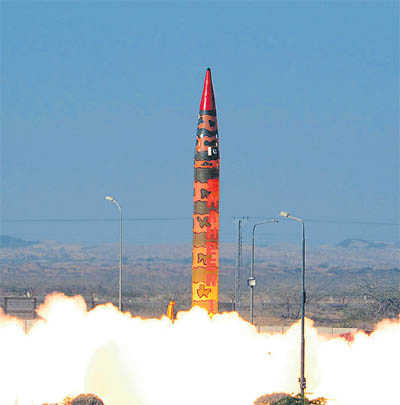
Every development brings its own problems. Modern communication technology is no different. It has made us keyboard happy. With the speed of communication reaching near instant level, and given the human desire to always “be the first”, we tend to act faster than we can think. Social media is a particularly dicey medium in this respect. Fingers begin to act even before the brain gets engaged. Often we land up sending messages without due deliberation.Take the case of recent remarks by Pakistani national Abdul Qadeer Khan about his country’s reported capability to hit Delhi in five minutes. Our anger went viral with almost a matching speed. Facebook, WhatsApp and Twitter were dense with reactions critical of Indian political and military hierarchy. “Why hasn’t the Army Chief spoken?”, “What is the Defence minister doing?” Some even castigated the Prime Minister for not making a statement. “After all,” the missives said, “it is the question of national morale.” And there were other reactions, even angrier and more bizarre. We need to give the issue a cool, deliberate thought. First, who is Abdul Qadeer Khan? He is a Pakistani nuclear physicist, who founded the uranium enrichment programme for Pakistan’s atomic bomb project. Khan founded and established the Kahuta Research Laboratories (KRL) in 1976, serving as both its senior scientist and Director-General until he retired in 2001. In January 2004, the Pakistani government detained him on US-provided evidence of his active role in nuclear weapons technology proliferation in other countries.   He was placed under “official” house arrest and remained so till 2009, when Islamabad High Court had him released and allowed him free movement inside the country. That makes him a person who certainly has nuclear knowledge, but also someone looking for publicity. His utterances need to be seen in that perspective.  Second, what has he said? He has merely stated an easily guessable fact. Nothing more.  Recall the background of Pakistan going nuclear. Pakistan began development of nuclear weapons in January 1972, after the humiliating military defeat by the Indian Army and its break-up. It was also a response to the development of India’s nuclear programme. Prime Minister Zulfikar Ali Bhutto was the prime mover and made a commitment  to have the bomb ready by the end of 1976. When the programme lagged behind schedule, Abdul Qadeer Khan was brought from Europe by Bhutto at the end of 1974. Reportedly, Pakistan was ready to detonate a bomb by 1984. However, as Abdul Qadeer Khan himself has disclosed, then President Zia showed reluctance for fear of adverse world reaction and apprehension of aid drying up.  Finally, on  May 28, 1998, a few weeks after India’s second nuclear test (Operation Shakti), Pakistan detonated five nuclear devices in the Ras Koh Hills in Balochistan. The background leaves no doubt that Pakistan’s nuclear programme was, and remains, India specific. That being so, they have to design weapons and missiles that can target India, their main perceived adversary. And what better nuclear target than its capital, Delhi? Kahuta, their nuclear nerve centre, is under 700 km air distance from Delhi. Most of their missiles would have much larger range than that and should be able to reach it. When AQ Khan says they can target Delhi in five minutes, he is perhaps talking of the flight time of a missile. That is a mere statement of fact. Khan’s undoubtedly irresponsible boast must not be misconstrued as Pakistan’s policy or plans of actually doing so. Launching of a nuclear attack on another nuclear power is totally a different matter and has never happened so far. Many more intricate factors would be involved in any such decision. There is absolutely no need for Indian officialdom to start reacting to statements made by a private individual. That should be left to the intelligentsia; editors, commentators and panelists. In any case, what Khan has stated should be too well known to Indian planners. And necessary counter-measures would undoubtedly be in place. Mature countries should eschew making official statements  on a subject as serious as use of nuclear weapons.  Our “no-first-use” policy is well known to the world. Despite the sabre-rattling, Pakistan is unlikely to resort to use of nuclear weapons, unless some erratic decision maker has suicidal tendencies.  Because in the unlikely event of a nuclear exchange, while India has the capacity to absorb a strike, Pakistan would disappear from the map.            

    AIbEiAIAAABDCPTLtYO_nOaJNyILdmNhcmRfcGhvdG8qKDgxY2NiNzYwYzcwZGUwMTY1YWQwNzZlODU5ODVhMDM0YTE3MjcwN2YwAcUV_kHCp8VJa-6VmfMQ1VqHUueY             Lt Gen Raj Kadyan (retd)

 The writer is former Deputy Chief of Army Staff.


Nearly one million AK bullets seized from militants in state in 13 years

Tribune News Service

Srinagar, June 28

In the last 13 years, the security forces have recovered nearly one million AK bullets and over 6,800 kg of the RDX explosive material from the possession of the militants and their hideouts during anti-insurgency operations.The government forces have also confiscated over 11,000 AK rifles and pistols from the militants operating in different parts of the state.Chief Minister Mehbooba Mufti, who holds charge of the Home also, gave these details in a written reply to a question raised by MLC Naresh Kumar Gupta in the Legislative Council.Gupta had sought details about the arms and ammunition recovered from the militants during operations and from the hideouts by the police and other security agencies from January 2002 to December 31, 2015. He had also sought the numbers of first information reports (FIRs) registered in these incidents and also the number of accused arrested and challenged in the court throughout the state.According to the details furnished by the Home Department, the police and security agencies had recovered 8,146 AK 47, AK 56 and AK 74 rifles during anti-militancy operations from different parts of the state.During this period, the security agencies had also seized 2,877 pistols and revolvers from the militants and during raids at their hideouts, the official data revealed.It also said that from January 1, 2002 to December 31, 2015, the security agencies also recovered 76 sniper rifles from the militants besides 20,158 hand grenades and 6,871.6 kg of highly explosive RDX material from them.The recoveries during this period also include 9.938 lakh AK 47/56/74 rounds besides 38,688 pistol/revolver bullets. In addition, the security agencies have also recovered 24,372 magazines of AK 47/56/74 rifles and 2,899 pistol/revolver magazines.“The arms and ammunition recovered by the police are kept in ‘Mal Khanas’ of the courts or district police lines and concerned police stations as case property,” the government stated in the written reply, adding that during this period 17,607 cases were also registered by the police, in which 6,330 persons were arrested.


Cabinet to take up pay panel proposals:23% hike likely in 7th pay panel; decision tomorrow

NEW DELHI: Central government employees can look forward to fatter salary cheques as the Union cabinet is likely to take up the 7th Pay Commission recommendations on Wednesday.

The commission has recommended an average 23.55% increase in their salary, allowances and pension, a move that will benefit 4.8 million staffers and 5.5 million pensioners.

The commission headed by justice (retired) AK Mathur had presented its 900-page report to finance minister Arun Jaitley in November 2015.

In January, the government had set up an empowered committee of secretaries headed by cabinet secretary PK Sinha to examine the panel’s suggestions. A secretariat has also been set up within the finance ministry to oversee the panel’s recommendations. The cabinet is expected to discuss on Wednesday the Sinha committee’s report on implementation of the pay panel’s recommendations.

The salary hikes will be effective from January 1, 2016.

More cash in hand is likely to result in higher consumption by the government’s massive employee base, which accounts for a large segment of the Indian middle-class. More demand could boost the economy through higher spending on assets such as cars and housing.

The government usually accepts the broad proposals for pay revision — due every 10 years and state governments usually respond with their own hikes.

The Centre’s total salary and allowances bill for 2016-17 has been pegged at `1.84 lakh crore, which is `65,687 crore or 55% higher than last year’s `1.18 lakh crore. The higher wage bill for this year partly factors in the anticipated increase in employee remuneration.

The pay commission’s recommendations say a fresh IAS recruit will get a basic salary of `56,000 a month against `23,000 currently. A sepoy in the Indian Army will earn `21,700 a month from `8,460 at present. In addition, employees are paid dearness allowance and house rent among many other allowances.

If accepted, the new proposals will set `18,000 as the minimum pay of an employee on the central government’s rolls. At present, the minimum salary is `7,000.

The total emoluments of a general helper — the lowestranked employee — amount to `22,579, more than double that of his counterpart in the private sector, a study commissioned by the panel found.

The commission has proposed a change in the salary structure by doing away with the system of pay bands and grade pay and recommended “pay matrix”. It has also called for scrapping overtime allowance and interest-free loans to buy motor vehicles.

23% hike likely in 7th pay panel; decision tomorrow

New Delhi, June 27

The government is likely to soon announce the implementation of 7th Pay Commission that would hike the salaries and allowances for over 1 crore government employees and pensioners by at least 23.5 per cent.A committee of secretaries headed by Cabinet Secretary PK Sinha has submitted its report on the recommendations of the 7th Pay Commission which may be accepted, a financial ministry official said.Based on the panel’s report, the Finance Ministry is preparing a Cabinet note and the issue may come up for approval by the Cabinet as early as June 29. “The Committee of Secretaries (CoS) has finalised its report on Pay Commission recommendations…We will soon (file) draft Cabinet note based on the report,” Finance Secretary Ashok Lavasa said today.The government had in January set up a high-powered panel headed by the Cabinet Secretary to process the recommendations of the 7th Pay Commission, which will have bearing on the remuneration of nearly 50 lakh central government employees and 58 lakh pensioners.The Pay Commission had recommended 23.55 per cent overall hike in salaries, allowances and pension involving an additional burden of Rs 1.02 lakh crore or nearly 0.7 per cent of the GDP.The panel recommended a 14.27 per cent increase in basic pay, the lowest in 70 years. The previous 6th Pay Commission had recommended a 20 per cent hike which the government doubled while implementing it in 2008.The 23.55 per cent increase includes hike in allowances. The entry level pay has been recommended to be raised to Rs 18,000 per month from current Rs 7,000 while the maximum pay, drawn by the Cabinet Secretary, has been fixed at Rs 2.5 lakh per month from current Rs 90,000.Sources said the secretaries’ panel may have recommended higher pay increase, with minimum entry level pay at Rs 23,500 a month and maximum salary of Rs 3.25 lakh.While the Budget for 2016-17 fiscal did not provide an explicit provision for implementation of the 7th Pay Commission, the government had said the once-in-a-decade pay hike for government employees has been built in as interim allocation for different ministries. Around Rs 70,000 crore has been provisioned for it, officials said. Lavasa said the 7th Pay Commission report would be effective from January 1. — PTI

Recommendations

  • 23.55% Overall hike in salaries, allowances and pension
  • 14.27% increase in basic pay, lowest in 70 years
  • Rs 18,000/month Entry-level pay (up from current Rs 7,000)

  • Rs 2.5 lakh/month Maximum pay, drawn by the Cabinet Secretary (up from current Rs 90,000)