Sanjha Morcha

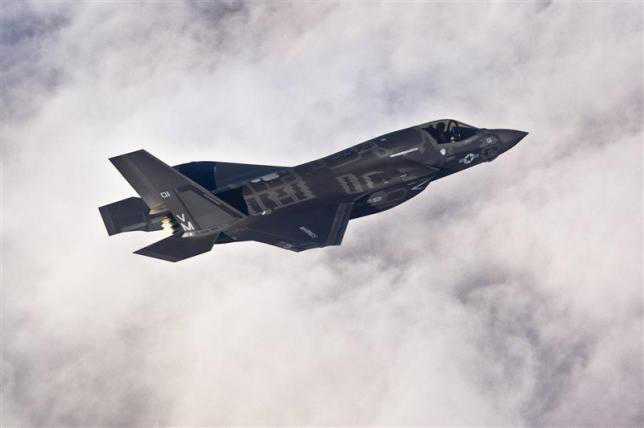
BY THE WAY… US Air Force to test F-35s’ combat use

Nevada: The US Air Force will deploy four Lockheed Martin Corp F-35 fighter jets to a different US air base this month as it assesses whether the new warplane can be declared combat-ready by August as planned. The deployment would include pilots, mechanics, spare parts, equipment and the plane’s computerised logistics system. The US Marine Corps declared an initial squadron of 10 of its F-35B model jets ready for combat last July. The F-35B can take off from shorter runways and land like a helicopter. reuters


Army promotions: SC approves command and exit model

New Delhi, February 15

Army promotions: SC approves command and exit model

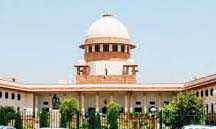
The Supreme Court approved Indian Army’s promotions under ‘command and exit’ model, subject to creation of additional posts for the affected divisions, on Monday.

Under the policy the Army’s infantry and artillery officers were given priority while giving promotions.

The Central Government had appealed an order by Armed Forces Tribunal order in which quashed the policy in May 2015.

In the previous hearing, the Central Government had proposed creating 141 additional vacancies for promotion of the officers of combat support units to also accommodate officers aggrieved by the Army’s 2009 promotion policy, which gave preference to those posted in Artillery and Infantry divisions

The command exit policy was framed in 2009 on the recommendations of AV Singh committee for reducing the age of colonels in combat units in line with the practice in Pakistan, China and Japan. — Agencies/ TNS


Homage paid to General Rao

Jammu, February 1

Officials and staff of the Shri Mata Vaishno Devi Shrine Board (SMVDSB) have condoled the demise of General (retd) KV Krishna Rao, former Governor of the state. He was also the former chairman of the shrine board.A condolence meeting was held at the Spiritual Growth Centre in Katra today. Officials and staff participated in the meeting.Ajeet Kumar Sahu, Chief Executive Officer of the shrine board, paid homage to General Rao and recalled his contribution, particularly as the chairman of the shrine board for the facilitation of the pilgrims.A two-minute silence was observed to pay homage to the departed soul. — TNS

412710aa-6c14-47d0-9361-4ad63544a146


Army dedicates bridge to PVC recipient

Chandigarh, February 25

To bestow due honour and accord to the sacrifice of gallantry award winners of the Army, the rail underbridge at the Chandimandir Military Station has been dedicated to Lt Col AB Tarapore, who was decorated posthumously with the Param Vir Chakra, the highest award for gallantry.The bridge has now been christened ‘Tarapore Setu’. Key milestones in the history of the Western Command have been pictorially depicted along the parapets of the bridge.Lt Col Tarapore, the Commanding Officer of 17 Horse, laid down his life while capturing Phillora on the western frontier on September 16 during the 1965 Indo-Pak War.Lt Gen KJ Singh, General Officer Commanding-in-Chief, Western Command, said the bridge, now named in the war hero’s memory, would continue to inspire future generations to dedicate their lives towards nation building. — TNS


Pathankot an opportunity to strike, prepare

The India-Pakistan seesaw on terror and dialogue continues. Euphoria over another round of bilateral dialogue comes crashing down following a Pakistan-sponsored terror attack. The attack on a major airbase at Pathankot, close to the international border in the midst of military strike formations, exceeds even the Mumbai attacks in strategic value. After three cross-border attacks the Punjab international border (IB) is now as threatened as the Line of Control in J&K.

Analysts say it is high time that the deep state in Pakistan realised that there was no long-term value in terror attacks to disrupt the possibility of the two countries sitting across a table. Actually, the value of these attacks has multiplied. It certainly achieves its purpose, considering that India shuns dialogue each time. It tests India’s readiness, capability and political will to retaliate — something that we mouth after each attack. Nothing could have pleased the sponsors more than the complete disarray in command, strategy and control in Pathankot while neutralising the perpetrators.

The Pathankot attack created an ideal situation for India to take immediate retaliatory action. Being an exclusively military target, India was well within its rights to act. It would have demonstrated the will of the government to act, and strengthened Narendra Modi domestically, and in dealing with Pakistan. It could have strengthened Nawaz Sharif in exposing the disastrous nature of Pakistan’s civilian-military divide.

Under these circumstances, would it be any surprise should Pakistan escalate matters further and launch a punishing foray across the international border, much as the Chinese did in Tawang in 1962? The ease with which the JeM terrorists entered the Pathankot airbase using the drug-smuggling cross-border networks demonstrates that terrorist groups have built up sufficient equities in India. We can expect them to use them with impunity all along the IB. India’s weak underbelly in Punjab, where many youth are captive to drugs and there’s rampant penetration by the BSF, is a recipe for disaster.

With sleeper cells of the Indian Mujahideen, and arrests of Islamic State adherents in cities and towns the hypothetical situation of the Pakistan Army crossing the IB to teach India a lesson has become real. In such an eventuality how can Indian forces stop such an advance?

In 1962 the Chinese taught us a lesson we cannot ignore. The Pakistan Army’s seizing of 108 bunkers at Kargil was not heeded as a wake-up call. Pathankot forces us to review our crisis management procedures with well-thought out scenario-building to delineate responsibilities for command, control and coordination between our forces covering the international border apart from the LoC.

Rajendra Abhyankar, a former diplomat, teaches at the School of Public and Environmental Affairs, Indiana University, Bloomington The views expressed are personal

‘Construction of bunkers along IB in full swing’

JAMMU: Union minister Jitendra Singh on Sunday said construction of bunkers for those living along the International Border (IB) with Pakistan in J&K’s Kathua district has already begun. “A major demand of residents of border areas was construction of bunkers near the IB… work on it has already begun,” Singh said. The Union minister of state in the PMO visited a few border hamlets and took stock of the “border area toilets” project, the work on which started two weeks ago in collaboration with Sulabh International.


Ex-serviceman assaulted, six booked

Tribune News Service,Amritsar, February 13

The Cantonment police station has booked six unidentified persons on the charge of attempt to murder. They allegedly attacked an ex-serviceman, deputed as a gunman with an owner of an eatery joint in the Gate Hakima area here.Sukhdev Singh, the complainant and a resident of the Kot Khalsa area, stated to the police that he was returning home late last night when the accused, armed with sharp-edged and blunt weapons, came on motorbikes and suddenly attacked him. He said he fell down from his motorcycle while the accused ran away after snatching his .12-bore rifle with two cartridges.Manjit Singh, investigating officer, said a case under Sections 307, 323, 379, 148 and 149, IPC, has been registered in this regard. He said efforts were being made to identify the culprits while no arrest has been made so far.


Col MPS Gill (retd) It’s time to reorient our counter-terrorism strategy

Questions must be asked, errors pin-pointed and those conducting counter-terrorist operations held responsible. Neutralising a handful of terrorists, with heavy casualties of the Security Forces is not professional. Why do we not draw lessons from the actions taken recently in France and earlier in US?

It’s time to reorient our counter-terrorism strategy
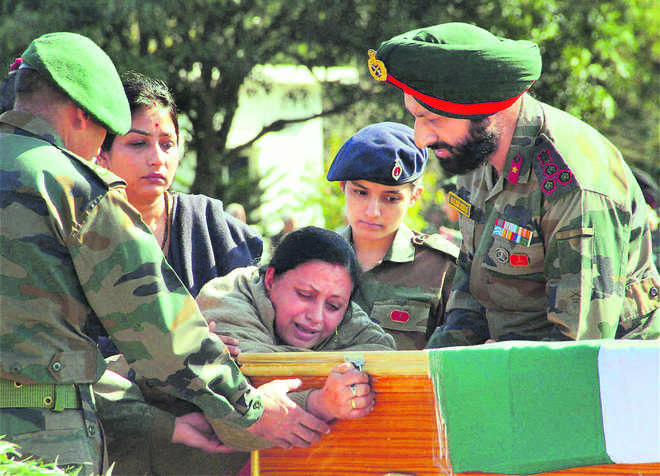
The mother of Captain Tushar Mahajan, killed in a gun battle with militants at Pampore, breaks down near her son’s coffin. PTI

Repeatedly, one witnesses counter-terrorist operations resulting in undue casualties to our troops, be it Pathankot and now at Pampore, Srinagar. The earlier instances of Samba and elsewhere notwithstanding. What is most striking is that the casualties suffered by our security forces in such operations are always a multiple of that suffered by the terrorists. Let us compare this to the operations of Americans and other armies in Afghanistan. They too were faced with such a situation to begin with, but very quickly they reoriented their method of engagement with better intelligence, inducted better technology such as the extensive use of drones and pin-point  targeting weapons, and above all providing high-end fatigue and personal gear to the soldiers. Through such efforts they have reduced their casualties to a very low percentage. On the other hand, even after more than 25 years of operations in Jammu and Kashmir, and an even larger background experience in India, we have still not refined our response mechanism, equipment or intelligence-gathering methods to an adequate degree. Ironically, we have the advantage of conducting an operation within our territory, thus have the opportunity of freedom and speed of movement and flexibility in such operations. We are also familiar with the terrain and language, help of the local administration is easily available and the Government and the command-and-control structure is our own. Add to this, decades of hands-on experience. A negative factor that is affecting our anti-terrorist operations is the easy and unaccounted availability of funds. Our intelligence-gathering has degenerated to purchasing intelligence through informers, thus the delay and inaccuracies. An additional factor is the lack of appropriate and adequate equipment with the troops engaged in actual anti-terrorist operations.  The close combat weapons used by our troops in such operations are more akin to military operations as against anti-terrorist operations. An example is how our troops still use a very old version of rocket launchers to engage militants in a building or a hideout. It not only hampers the quick movement of troops, but gives away their position easily and can at best only punch a hole in the structure. It cannot incapacitate or blind the occupants, to facilitate further operations. The methods of engagement are as they were years back. Better equipment and engagement methods thus require upgradation. In the absence of such upgradation, casualties will continue to be high and frequent surprises due to the lack of accurate and updated intelligence will result in improper as well as inadequate response. These inadequacies are covered by shouting nationalistic slogans and the glorification of frequent cremations. First and foremost, the tendency to resort to a graduated response in a given terrorist operation is the first pitfall.  We saw it recently at Pathankot. It was first left to the Garuds of the IAF to neutralise the militants who had achieved total surprise in the first place. Once they were overwhelmed and casualties resulted, cordoning off by the police was considered adequate with a special forces team flown in. In such a manner, ultimately a much larger force got engaged, there were higher casualties and the command and control went out of hand. There was a similar situation at Pampore recently. In the given operation at Pampore, a pertinent question is: How can a trained military mind think of a few special forces’ persons storming a five-storey building (like the one in question at Pampore) , without first pinning down or incapacitating the terrorists. As a result, there were high casualties and the subsequent very familiar glorification of cremation. It is only thereafter that higher commanders in charge of the operation come on camera to say that time will not be a constraint, but a very deliberate operation will be undertaken to minimise casualties.  There are already high casualties and a number of days have been exhausted with no definite information about the terrorists. Are young lives in India so cheap?It is time questions were asked, errors pin-pointed and those conducting these operations held responsible. Neutralising a handful of terrorists, with heavy casualties of the security forces is no professional work. Above all, why do we not draw lessons from the actions taken very recently in France and earlier in the US, by constantly tracking a militant outfit and pre-empting its actions, so that they cannot resort to the luxury of undetected movement and surprise the security forces by mounting an attack as audacious as the one at Pathankot. It is time to set our house in order. Public sentiment must be targeted towards high casualties and not limited to a glorified funeral of these brave young men, which begins and ends as quickly with nationalistic slogans. Accountability, both political and at the level of operation, will hopefully be the outcome.


Rohtak operation was difficult, says army in-charge

ROHTAK: As the city limbs back to normal after a tough, violent week during the Jat quota stir, the army on Saturday left with all its 10 columns, comprising 75-77 men each, giving charge to the city police once again.

HT FILEThe army left Rohtak with all its 10 columns on Saturday, giving the charge to the city police.The army had come in the city on February 20 when situation went out of control and city police failed to curb incidents of violence and robbery. Even when the administration declared curfew in Rohtak and army had ordered shoot and sight, cases of violence continued unabated, leaving the army clueless.

While talking to HT, army commander Brig Arun Yadav admitted that their operation in Rohtak had been tough. “The operation in Rohtak was a difficult as we reached the city on February 20 with minimum resources. We had no time to understand the situation. The moment we reached, we started the operation without any delay,” Yadav said.

On being asked whether the army had orders to shoot the agitators, he said: “The situation in Rohtak was not classical. It was not what you read in the books about protests. The moment the civil magistrate hands over the situation to the army, we get shooting orders. But we did not shoot anyone because when we reached, the shops were already burning and the crowd had already started dispersing. We did not witness anyone committing a crime or killing anyone as they were running away. If we had shot at that time, the chances of killing an innocent man would have increased.”

He said at times when they were patrolling, things got “dangerously closed” as they could not recognise who was doing what. “Shopkeepers had come to their shops and they were checking their things. At that time, it became difficult to analyse who was a perpetrator and who was genuine.”

On army drawing flak from the shopkeepers and residents, Yadav said: “If I were a shopkeeper whose shop was burned, I would have wanted to shoot everyone at that time. But as an army man, it was my duty to restore the much-needed peace rather than taking a chance and shooting at innocent public.”

About the reports of the differences between the police and the army, Yadav said their team received enough support from the police. However, he said he would not like to comment on why the situation turned ugly in the city.

Yadav said their mission was to stop the violence and not to shoot people, which he said was achieved. He said if they had used violence, more people would have had come out in different parts of the state, which could have created a bigger problem.


Induction of women in combat roles in phases: Parrikar

Induction of women in combat roles in phases: Parrikar
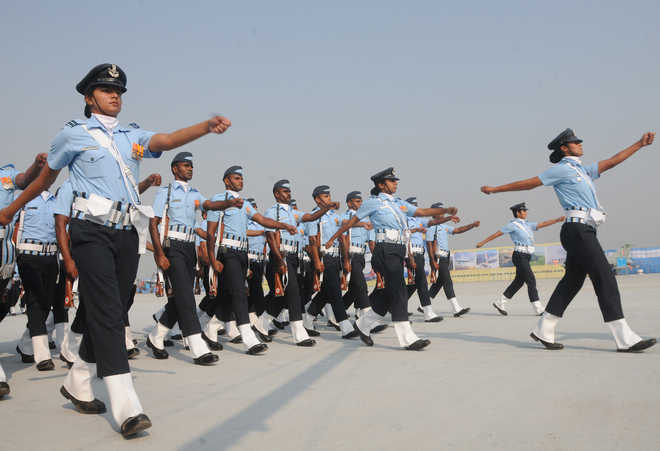
A woman officer leads the Air Force Day parade at Hindon in Ghaziabad. Tribune file photo

Ajay Banerjee
Tribune News Service
New Delhi, February 25Defence Minister Manohar Parrikar on Thursday said induction of women in the Armed Forces will be in a phased manner.Timelines will be decided for the three forces — the Army, IAF and Navy — after taking into account issues of facilities like training and accommodation, Parrikar said on the sidelines of a function organised by the Defence Innovators and Industry Associations.Parrikar’s remarks are largely meant to highlight lack of separate accommodation for women in field areas when posted in combat with the Army or on warships.On Wednesday, President Pranab Mukherjee, while addressing a joint session of Parliament, had spoken about having women in combat roles in the forces.


In Bhiwani, stir gets break to honour Capt

In Bhiwani, stir gets break to honour Capt
Villagers line up the route as the body of Capt Pawan Kumar is taken for the last rites at his native Bhadana village on Monday.

Sat Singh & N Kalia

Tribune News Service

Bhiwani/Jind February 22

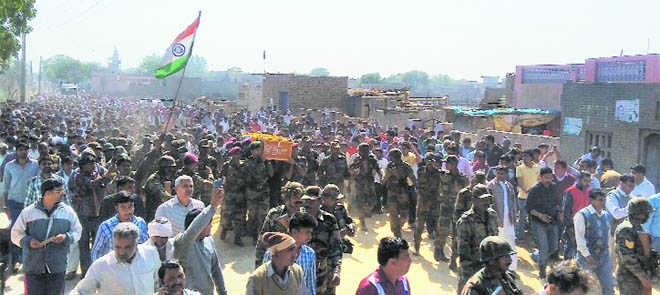
Captain Pawan Kumar Khatkar, who died in an encounter with terrorists in Kashmir on February 20, hailed from Jind district but it was in Bhiwani that he sharpened his skills to make it to the National Defence Academy while studying at BRCM Vidyagram School, Bahal. And despite the mayhem wrought by the Jat agitation, villagers were out in full force to give him a befitting farewell. The body was brought in an Army chopper to his residence in Urban Estate in Jind at 11 am because of the blocked roads, and was taken to Badhana, 20 km away.  Agitating Jats had cleared the way leading to Badhana to enable residents of Amarheri, Kandela, Shahpur and Nagura villages, who had lined up on roads, to pay tributes. The pyre was lit by his father and cousin. Capt Pawan, who was commissioned in 2013, had joined the elite 10 Para (Special Forces) last year. His mother Kamlesh Rani and father Rajbir are government teachers. He passed his Class XII (non-medical) exam in 2008. “My sole aim is to crack the NDA exam and become an officer. For this, I surrender myself to you,” Pawan Kumar would tell Sehdev Singh Shekawat, his favourite teacher. Sehdev Singh, a physical training instructor at the residential school, said Pawan had a passion for horse-riding and athletics.  Girish Kumar, the house master, remembered him as being “ever ready for sports”. “We are pained at the loss to the family but feel proud that our alumnus sacrificed his life fighting for the country,” said principal Parveen Masta.

Delhi link still snapped

3 die in Army bid to clear highway at Sonepat, Jats won’t relent
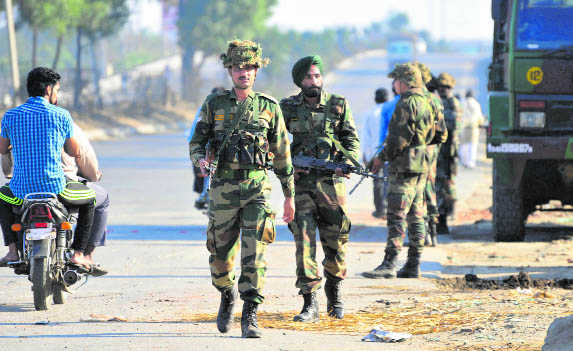
Delhi link still snapped
Army deployed outside Siwah village on national highway in Panipat district on Monday. Ravi Kumar

Tribune News Service

Chandigarh, February 22

Adamant Jat protesters lay siege to National Highway 1 (NH-1), snapping link to the national capital despite stern measures by the security forces to get the road cleared. The Army opened fire to disperse  protesters at Larsauli in Sonepat today. Though official sources said three persons were killed, other reliable sources put the toll at five.Meanwhile, curfew was imposed in Kaithal after a mob vandalised a mall and looted shops. More than 500 persons were booked. The authorities have sought more forces for the district. At least 1,300 persons have been booked in Faridabad and 1,000 in Palwal for rioting.Much to the relief of stranded commuters, protesters agreed to lift blockades on National Highway 10 after a series of negotiations with the authorities at Rohtak and Hisar. Ram Bhagat Malik, spokesperson for the Akhil Bharatiya Jat Arakshan Sangharsh Samiti, said blockades on NH-10, that links Sirsa, Hisar and Rohtak with Delhi, had been removed.Education Minister Ram Bilas Sharma said 16 persons had died in the ongoing agitation, including three at Larsauli village in Sonepat. The deceased are Sunny of Ganaur, Rakesh of Shamri village and Sandeep of Pamcha village. Haryana Janhit Congress chief Kuldeep Bishnoi demanded a criminal case against former Chief Minister Bhupinder Singh Hooda in view of a CD on the social media showing his former political adviser, Prof Virender, instigating the Jats. Minister Ram Bilas Sharma said the government would get the CD examined. Hooda and his son Deepender Singh, Rohtak MP, were stopped at the Tikri border near Bahadurgarh today as they tried to enter Rohtak from Delhi. Protesters squatting on the Rohtak-Delhi road refused to budge, insisting that they be provided a copy of the government notification on Jat reservation. Later in the evening, they lifted the blockade at Sampla village (NH-10) after a delegation of Jat leaders met Principal Secretary AK Singh and Additional DGP BS Sandhu at the Police Lines, Rohtak.An Arakshan Sangharsh Samiti leader announced that they had decided to clear the roads in Hisar, Fatehabad and Bhiwani. Meanwhile, water supply to Delhi has been restored. In violence-hit Rohtak, curfew was relaxed for an hour today.

Bhagwat for apolitical panel

  • Many people are demanding reservation. A committee should be formed to decide who are eligible for reservation. It should be apolitical so that there are no vested interests. —Mohan Bhagwat, RSS chief

REMAINS OF THE DAY

Not just Haryana, even Cabinet is divided

Naveen S Garewal,Tribune News Service,Chandigarh, February 22

These are no minor gashes. The ongoing Jat agitation in Haryana has caused deep wounds in the minds and psyche of its people and resulted in caste polarisation being firmly entrenched.What started as a “Jat versus non-Jat” conflict has ended up as a great divide.With no signs of the violence abating, statements of politicians have exacerbated the social divide that has manifested itself along caste lines. Initially, goons in the garb of Jat protesters attacked the affluent, looting and burning properties. In Rohtak, Jhajjar and Deswali, affluent Punjabis and other rich were targeted.The “Jat versus non-Jat” pattern soon turned into “have-nots versus haves” and “one caste versus the other”. That division has become apparent even in the state Cabinet, with Jat ministers trying to appease the protesters, forcing the government to announce compensation to those who have died along with government jobs to the next of kin, and a “veiled promise” to protect the arsonists from the rule of law. A move that was strongly opposed by the non-Jat ministers.The  Manohar Lal Khattar government’s image has taken a beating. The BJP came to power essentially at the  back of non-Jat voters on the promise of “good governance”. With the government failing to control the raging Jats for days, the non-Jat voter now feels betrayed and alienated.Questions are being raised over why the BJP first tried to appease the Jats by promising reservation and then allowed its MP Raj Kumar Saini to raise an anti-Jat reservation pitch.Health Minister Anil Vij and other non-Jat ministers  today asked for strict action against those  indulging in violence. Leaders of other parties have only added to the chaos with the INLD asking for a Vidhan Sabha session on the crisis and Congress’ former CM Bhupinder Singh Hooda choosing to sit on a “fast”. A non-Jat leader now plans a counter-agitation, while some others want judicial and other probes.The state stands divided, and for what in the end?


Geetanjali Gayatri

Tribune News Service

Chandigarh, February 22

The decision to pay a compensation of Rs 10 lakh to the next of kin of “innocent” persons killed in the Jat stir met with stiff resistance from non-Jat ministers at the Cabinet meeting here today. Led by Health Minister Anil Vij, the ministers expressed annoyance over “rewarding arsonists”.The plea that compensation could placate the Jats and help end the stir was outrightly rejected by the non-Jat ministers, who argued that those who had died were involved in looting and arson and that there was no justification in “awarding” their kin.Though the matter remained unresolved, the government chose to announce the compensation.It was Education Minister Ram Bilas Sharma who made the announcement and not Chief Minister Manohar Lal Khattar. Sharma initially announced that the Chief Secretary would appoint a nodal officer to assess damage and that the role of officials would also be ascertained. The form for filing claims would be made available online and at the office of DCs and money released within a month, he said. Oddly, it was after the conclusion of the press meet that Sharma returned to announce the ex gratia. The two Jat ministers, Capt Abhimanyu and OP Dhankar, were away for the cremation of Capt Pawan Kumar.